
Revision Notes
OxfordAQA International A-level Sociology (9690): People and animals – Revision Notes
Revision notes for OxfordAQA 9690 section 3.2.2.3: Bryant, the sociozoologic scale, welfare and rights, slaughter, pets, zoonoses, biodiversity and the 3Rs.
- Subject
- Sociology
- Level
- A LEVEL
- Topic
- Unit 4 – People and the Environment
- Author
- Marlbridge Academic Team
- Updated
- Reviewed by
- Naqiya Yousaf (what this means)
Aligned to OxfordAQA A Level Sociology (9690), Version 1.1. Official specification .
Syllabus page (what it covers and how it is assessed): OxfordAQA A Level Sociology.
Syllabus points this page covers
9690 (A Level)
- 3.2.2.3 People and animals
Found an error? Report a correction.
Need help with this topic? Request a free trial class for A Level Sociology (9690).
These notes condense content point 3.2.2.3 People and animals of OxfordAQA International A-level Sociology (9690), Version 1.1, assessed in the Unit 4 People and the environment exam. Full explanations are in the people and animals study guide; the rest of the unit is in the People and the environment revision notes.
What the specification lists
- The zoological connection (Bryant); views of the relationship between humans and animals.
- Animal welfare; animal cruelty and animal rights.
- Domestication: working animals; livestock, production and slaughter for food.
- Pets: companion animal-human relationships; therapeutic use of animals.
- Health: animals and diseases affecting people, including zoonotic diseases.
- The Columbian Exchange.
- Biodiversity: extinctions; megafauna; hunting and fishing; invasive species.
- Countering loss: conservation, zoos, rewilding, reintroduction, de-extinction.
- Biotechnology and genomics; animal experimentation.
Core recall
Frameworks
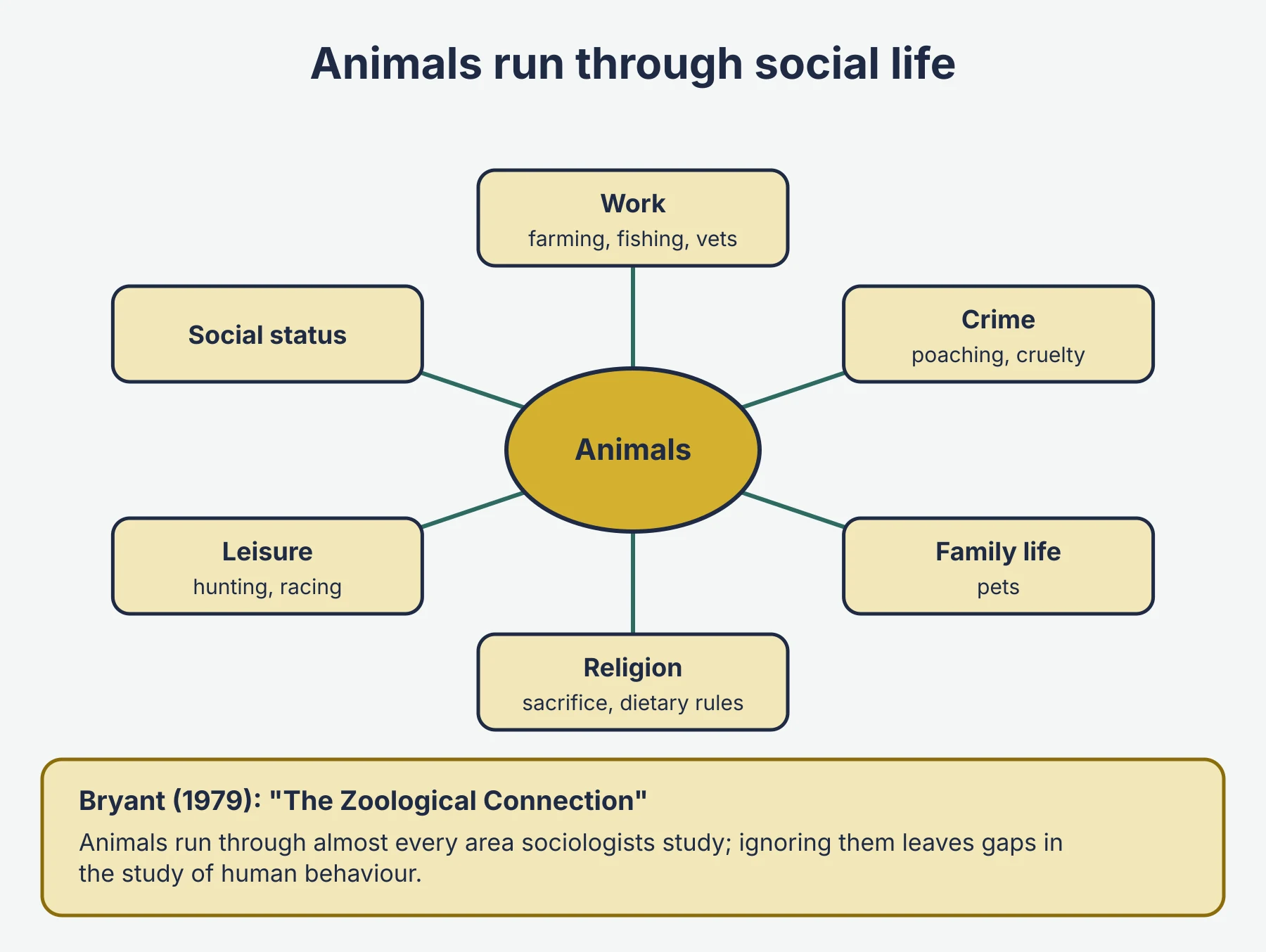
- Bryant (1979), Social Forces: animals run through work, crime, family, religion, leisure and status, so sociology must study them.
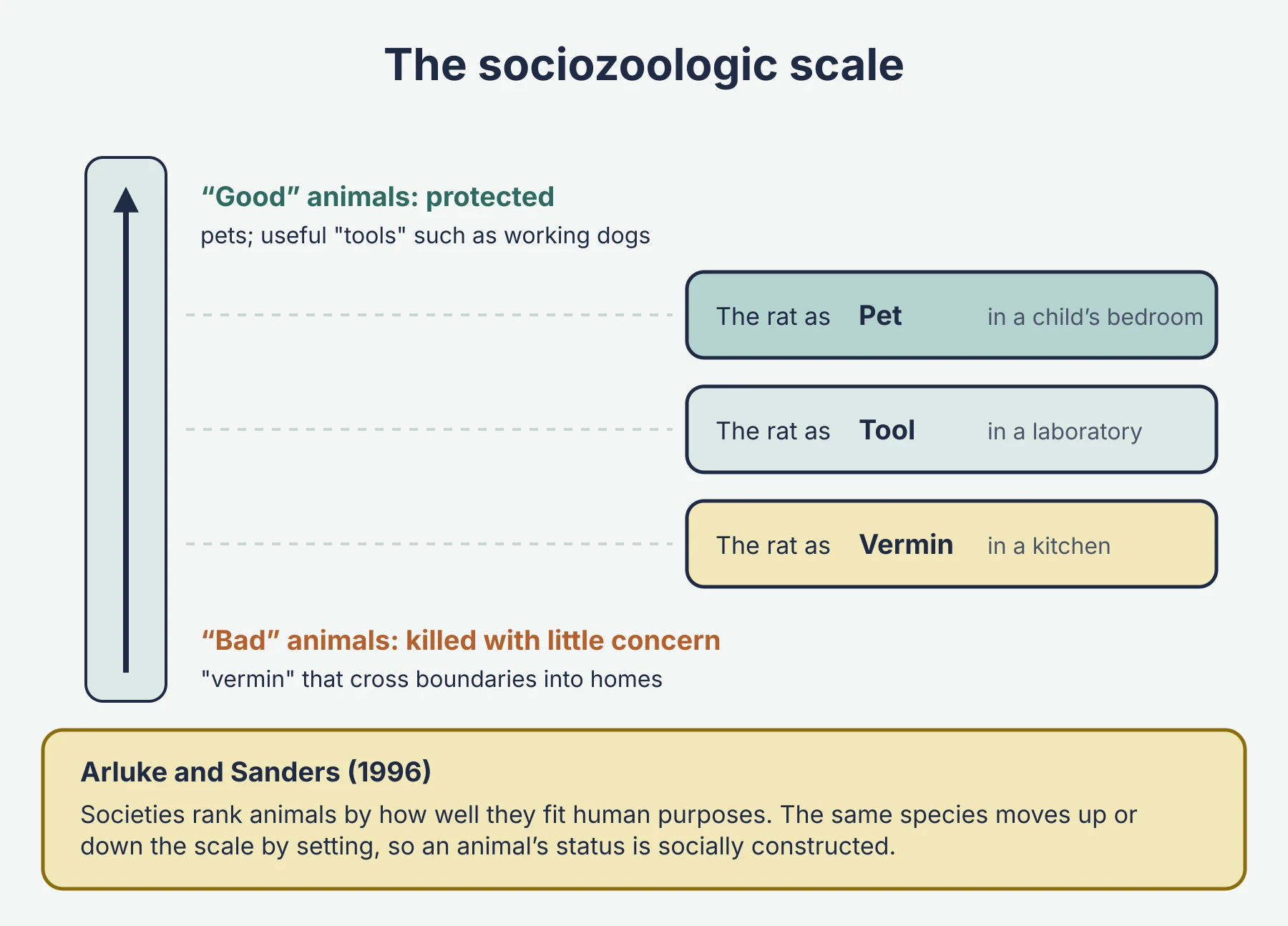
- Arluke and Sanders (1996): the sociozoologic scale ranks animals as “good” (pets, tools) or “bad” (vermin, demons); the same species shifts by setting.
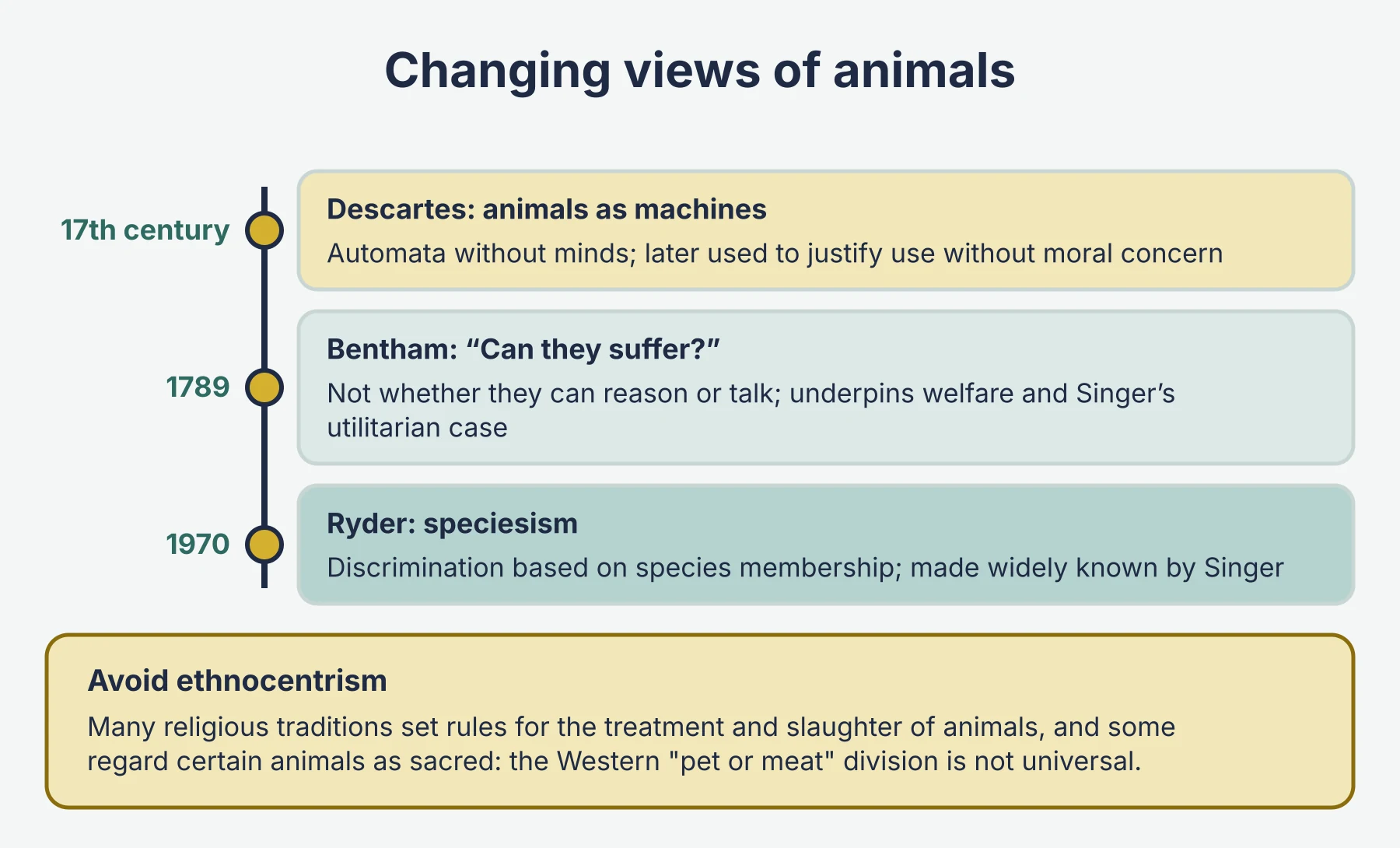
- Descartes: animals as machines. Bentham (1789): “Can they suffer?”. Ryder (1970) coined speciesism; Singer popularised it.
- Cultural and religious rules vary; the Western pet/meat divide is not universal.
Welfare, cruelty, rights
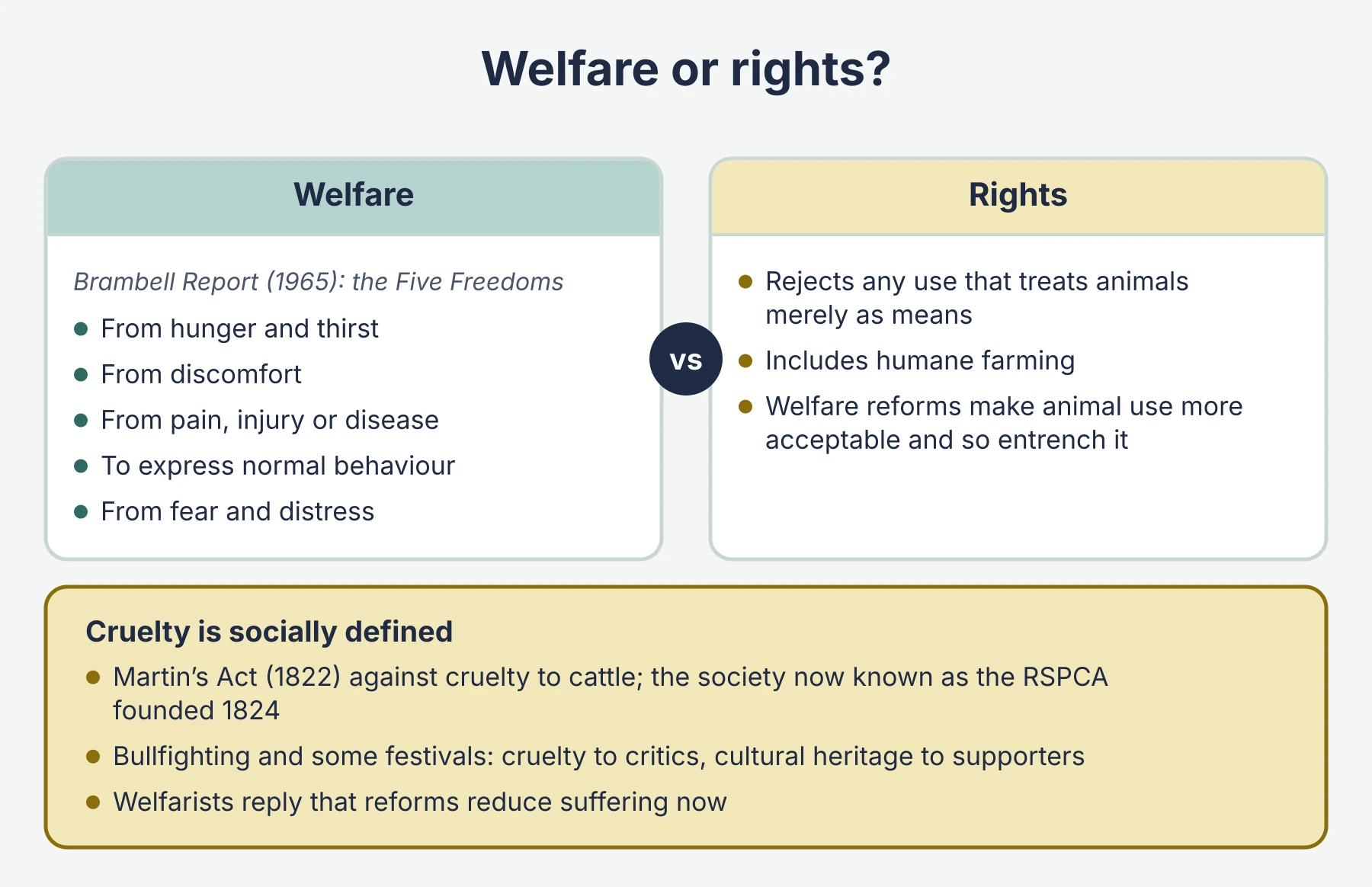
- Brambell Report (1965) led to the Five Freedoms: from hunger and thirst; discomfort; pain, injury or disease; to express normal behaviour; from fear and distress.
- Martin’s Act (1822) against cruelty to cattle; the society later named the RSPCA founded in 1824.
- Cruelty is socially defined, as debates over bullfighting and festivals show.
- Rights theorists: welfare reform can entrench use. Welfarists: reform cuts suffering now.
Domestication and slaughter
- Dogs were the first domesticated animals.
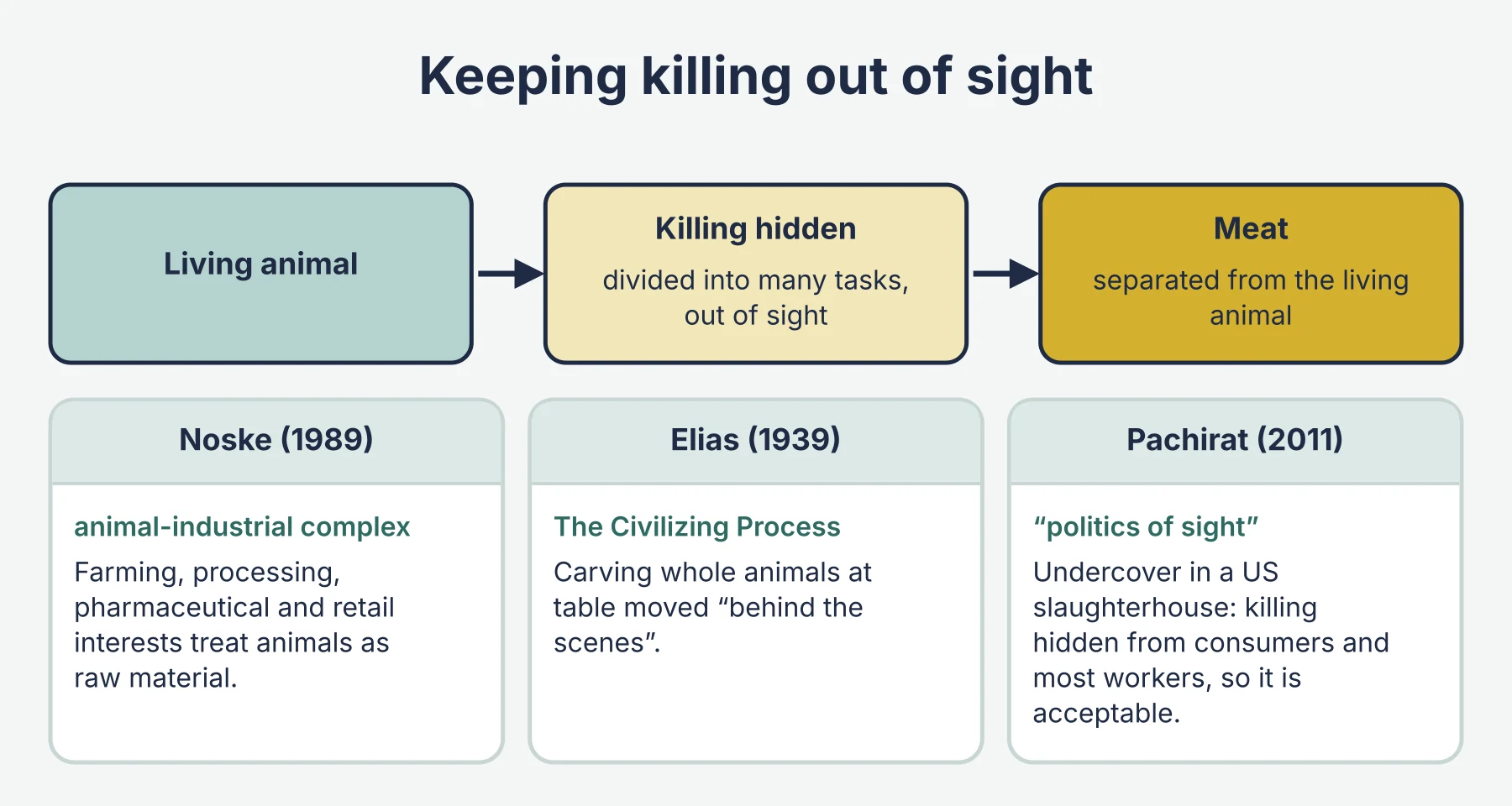
- Noske (1989): animal-industrial complex of farming, processing, pharmaceutical and retail interests.
- Elias (1939): carving moved “behind the scenes” in the civilising process.
- Pachirat (2011): the politics of sight; killing divided and hidden makes it acceptable.
Pets and therapy
- Serpell (1986): companionship explains pet keeping.
- Pets treated as family; assistance dogs, therapy animals; mixed evidence on health benefits; welfare of therapy animals questioned.
Health
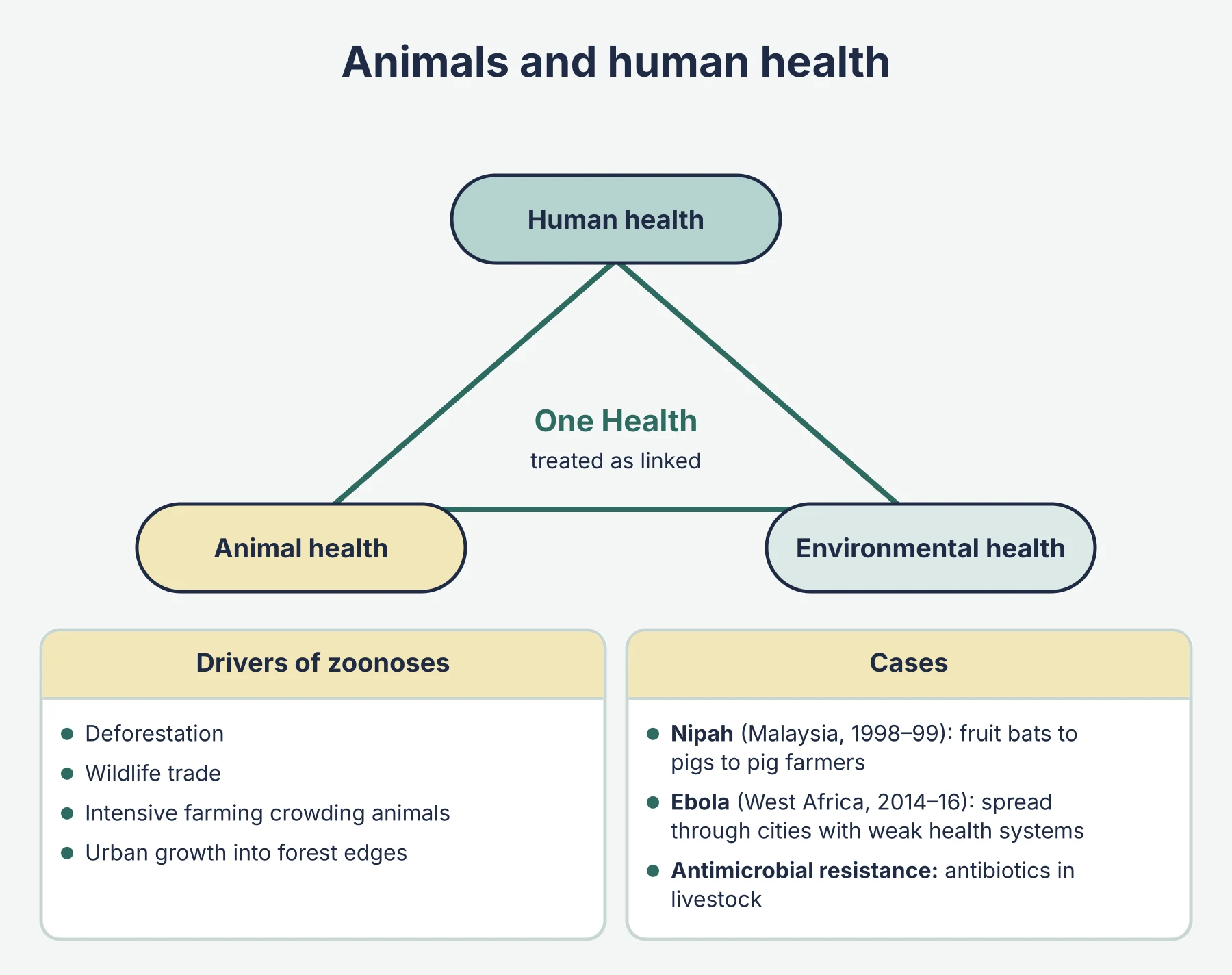
- Nipah (Malaysia, 1998 to 1999): bats to pigs to farmers.
- Ebola (West Africa, 2014 to 2016): spread through cities with weak health systems.
- Drivers: deforestation, wildlife trade, intensive farming, urban expansion.
- Antibiotic use in livestock contributes to antimicrobial resistance.
- One Health: human, animal and environmental health linked.
Columbian Exchange
- Crosby (1972, then Ecological Imperialism, 1986): “portmanteau biota” helped colonists.
- Horses transformed Plains peoples’ lives; smallpox devastated indigenous populations; potatoes and maize fed population growth elsewhere.
Biodiversity
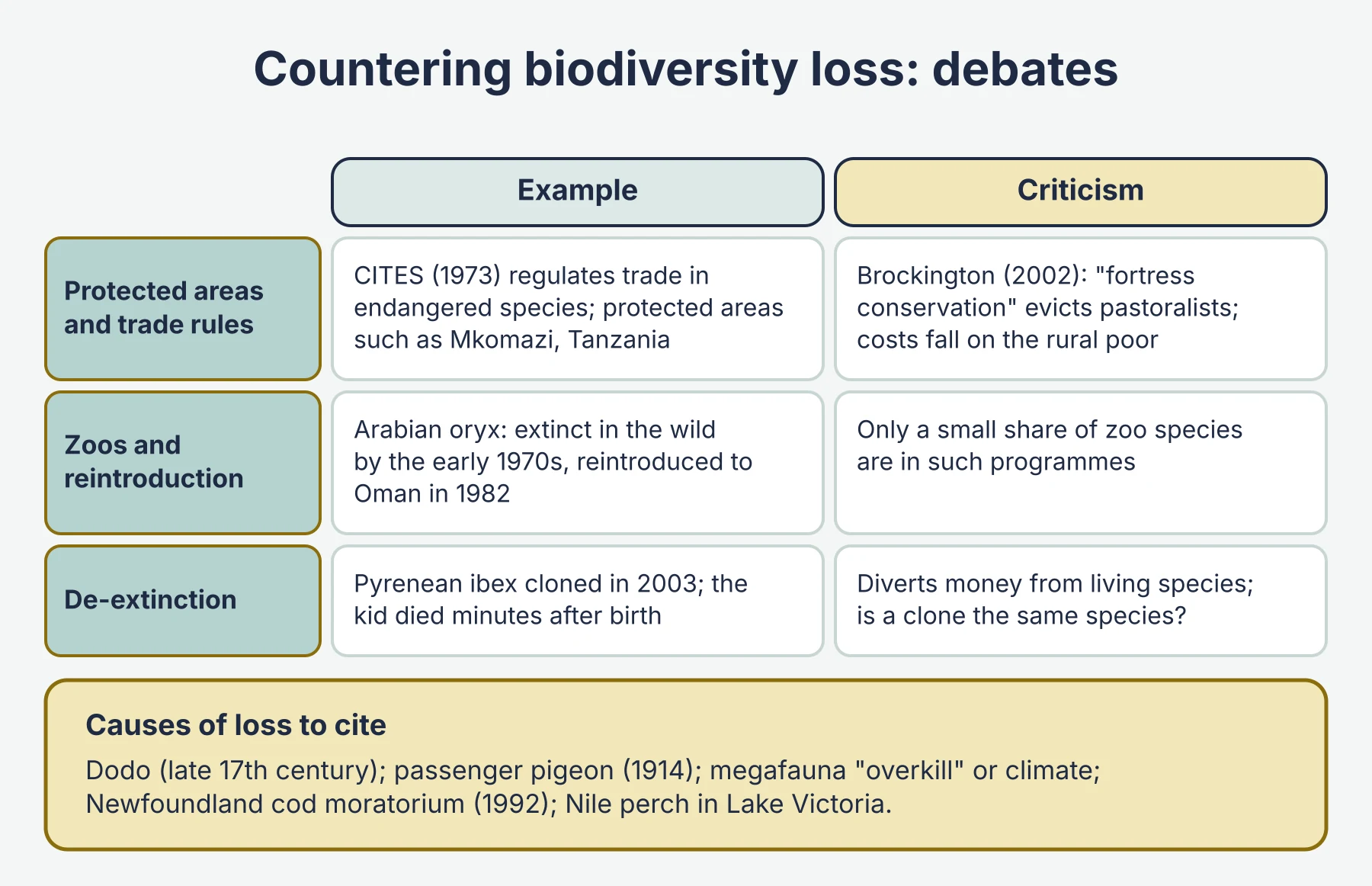
- Dodo extinct by the late seventeenth century; last passenger pigeon died 1914.
- Megafauna: Martin’s “overkill” hypothesis versus climate explanations.
- Atlantic cod collapse: Canadian moratorium in 1992.
- Nile perch in Lake Victoria: loss of many native cichlid species.
Countering loss
- CITES (1973) regulates trade in endangered species.
- Brockington (2002): fortress conservation at Mkomazi, Tanzania, evicted pastoralists.
- Arabian oryx: bred in captivity, reintroduced to Oman in 1982.
- Bucardo cloned in 2003; died minutes after birth. De-extinction criticised as a costly diversion.
Biotechnology and experimentation
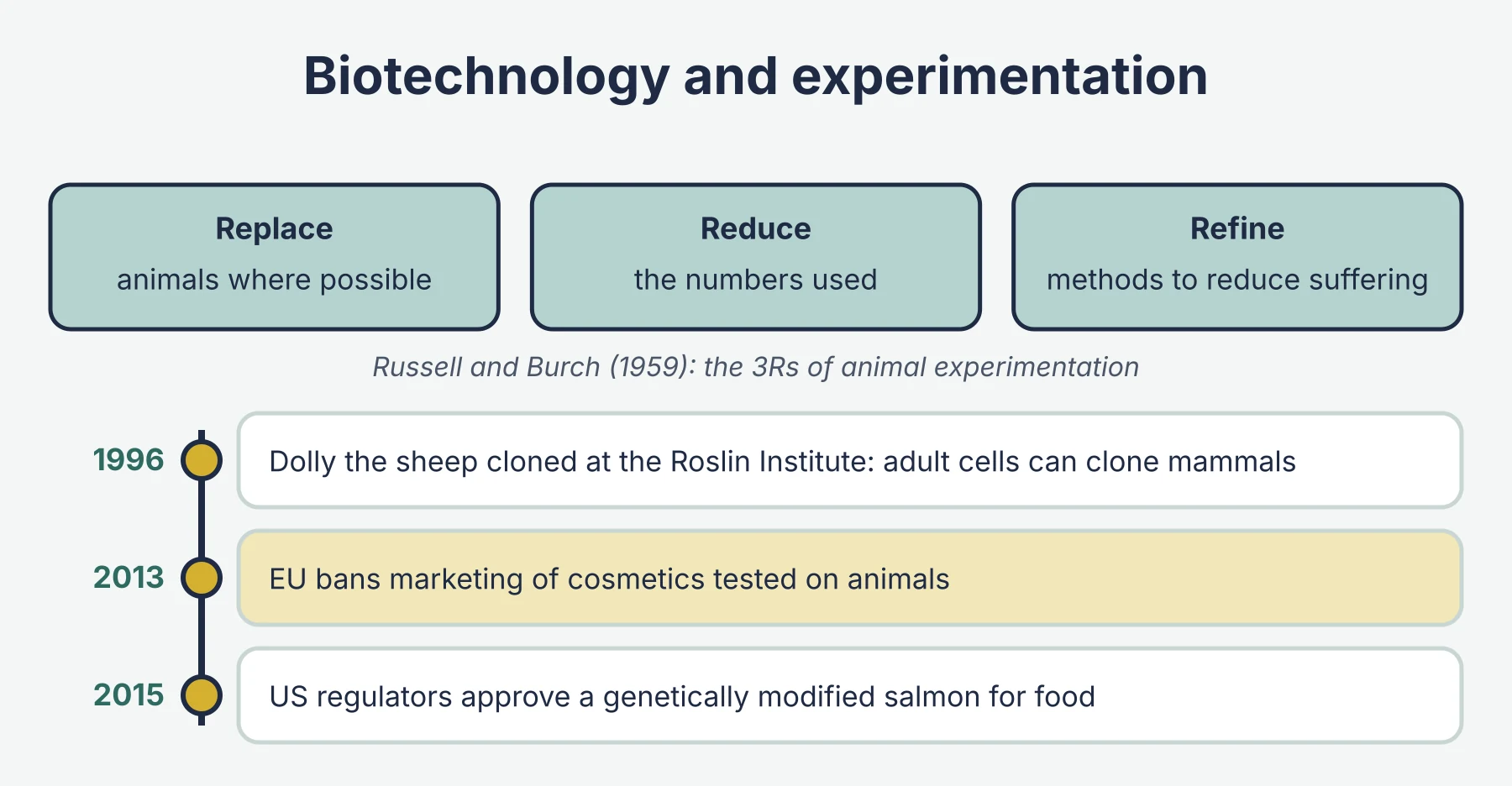
- Dolly the sheep, cloned 1996 (Roslin Institute).
- GM salmon approved for food in the US in 2015.
- Russell and Burch (1959): the 3Rs, replace, reduce, refine.
- EU marketing ban on animal-tested cosmetics from 2013.
Key terms
| Term | Definition |
|---|---|
| Zoological connection | Bryant’s term for the many ways human behaviour involves animals |
| Sociozoologic scale | Social ranking of animals as good or bad by how they fit human purposes |
| Speciesism | Discrimination based on species membership |
| Animal welfare | Accepting human use while reducing suffering |
| Animal rights | Rejecting the use of animals as mere means |
| Animal-industrial complex | Network of interests treating animals as raw material |
| Politics of sight | Hiding violence so that it becomes acceptable (Pachirat) |
| Companion animal | Animal kept mainly for social and emotional companionship |
| Zoonosis | Disease passed from animals to humans |
| One Health | Approach linking human, animal and environmental health |
| Megafauna | Large animal species |
| Invasive species | Species introduced to an area where it spreads and harms native species |
| Fortress conservation | Protecting nature by excluding local people |
| De-extinction | Attempts to recreate extinct species |
| The 3Rs | Replace, reduce, refine: principles for animal experimentation |
Exam traps
- Welfare and rights are different positions; state which you mean.
- Explain why zoonoses emerge (social drivers), not just name diseases.
- The Columbian Exchange ran both ways.
- Conservation can harm people: use Brockington.
- Do not assume all societies divide animals into pets and food the same way.
- De-extinction has been attempted but not achieved for a living population; say so.
Self-test
- What did Bryant mean by the zoological connection?
- Explain the sociozoologic scale with one example.
- Who coined “speciesism”?
- List three of the Five Freedoms.
- What is the animal-industrial complex?
- What did Pachirat mean by the politics of sight?
- How did Nipah virus first spread to people?
- What is One Health?
- What did Crosby mean by “portmanteau biota”?
- What did Brockington criticise about conservation?
- Give one success and one failure of attempts to restore lost species.
- What are the 3Rs?
Answers
- Animals are involved in almost every area of human social life, so sociologists must study human-animal relationships.
- Societies rank animals by how they fit human purposes; a rat is vermin in a kitchen but a pet in a bedroom.
- Richard Ryder, in 1970.
- Any three: freedom from hunger and thirst; from discomfort; from pain, injury or disease; to express normal behaviour; from fear and distress.
- The network of farming, processing, pharmaceutical and retail interests that treats animals as raw material (Noske).
- Slaughter is divided and hidden, which makes killing socially acceptable.
- From fruit bats to farmed pigs to pig farmers in Malaysia (1998 to 1999).
- An approach treating human, animal and environmental health as linked.
- The crops, animals, weeds and diseases that travelled with European colonists and helped them succeed.
- Fortress conservation evicts local people, so the poor bear the costs of protecting wildlife.
- Success: the Arabian oryx reintroduced to Oman in 1982. Failure: the cloned bucardo died minutes after birth in 2003.
- Replace animals where possible, reduce their numbers, refine methods to reduce suffering.
Apply these in the people and animals practice questions.
Related resources
-
Study guides
OxfordAQA International A-level Sociology (9690): The built human environment
Guide to OxfordAQA 9690 section 3.2.2.1: nomads, rural life, urbanisation, slums, suburbs, segregation, megacities, non-places and demographic transition.
Sociology · OxfordAQA · A Level
Read guide -
Practice questions
OxfordAQA International A-level Sociology (9690): The built human environment – Practice Questions
Original OxfordAQA 9690 practice questions on nomads, rural power, urban life, informal housing, segregation and demographic transition, with full answers.
Sociology · OxfordAQA · A Level
Try questions -
Revision notes
OxfordAQA International A-level Sociology (9690): The built human environment – Revision Notes
Revision notes for OxfordAQA 9690 section 3.2.2.1: nomadism, rural power and depopulation, urban theory, slums, segregation, gated communities and DTT.
Sociology · OxfordAQA · A Level
Revise topic
Related articles
Get free revision emails (optional)
Occasional emails with practice questions, worked explanations and links to free resources for the qualification and subjects you choose. No spam, and you can unsubscribe from any email. The free tools on this site never need an email.