
Revision Notes
OxfordAQA International A-level Sociology (9690): Pre-and non-digital technologies – Revision Notes
Revision notes for OxfordAQA 9690 section 3.2.3.1: Taylorism, Fordism, emotional labour, railways and cars, consumerism, and determinism versus construction.
- Subject
- Sociology
- Level
- A LEVEL
- Topic
- Unit 5 – People and Technology
- Author
- Marlbridge Academic Team
- Updated
- Reviewed by
- Naqiya Yousaf (what this means)
Aligned to OxfordAQA A Level Sociology (9690), Version 1.1. Official specification .
Syllabus page (what it covers and how it is assessed): OxfordAQA A Level Sociology.
Syllabus points this page covers
9690 (A Level)
- 3.2.3.1 Pre-and non-digital technologies
Found an error? Report a correction.
Need help with this topic? Request a free trial class for A Level Sociology (9690).
These notes condense content point 3.2.3.1 Pre-and non-digital technologies of OxfordAQA International A-level Sociology (9690), Version 1.1, assessed in the Unit 5 People and technology exam. Full explanations are in the pre- and non-digital technologies study guide; the rest of the unit is in the People and technology revision notes.
What the specification lists
- Machines: industrialisation and the changing nature of work, including extraction, manufacturing and service industries.
- Mobilities and mass transport: cars and roads; railways; air travel; effects on people and on the environment.
- Consumerism and conspicuous consumption of material goods.
- Technological determinism; social constructionist views of technology.
Core recall
Work
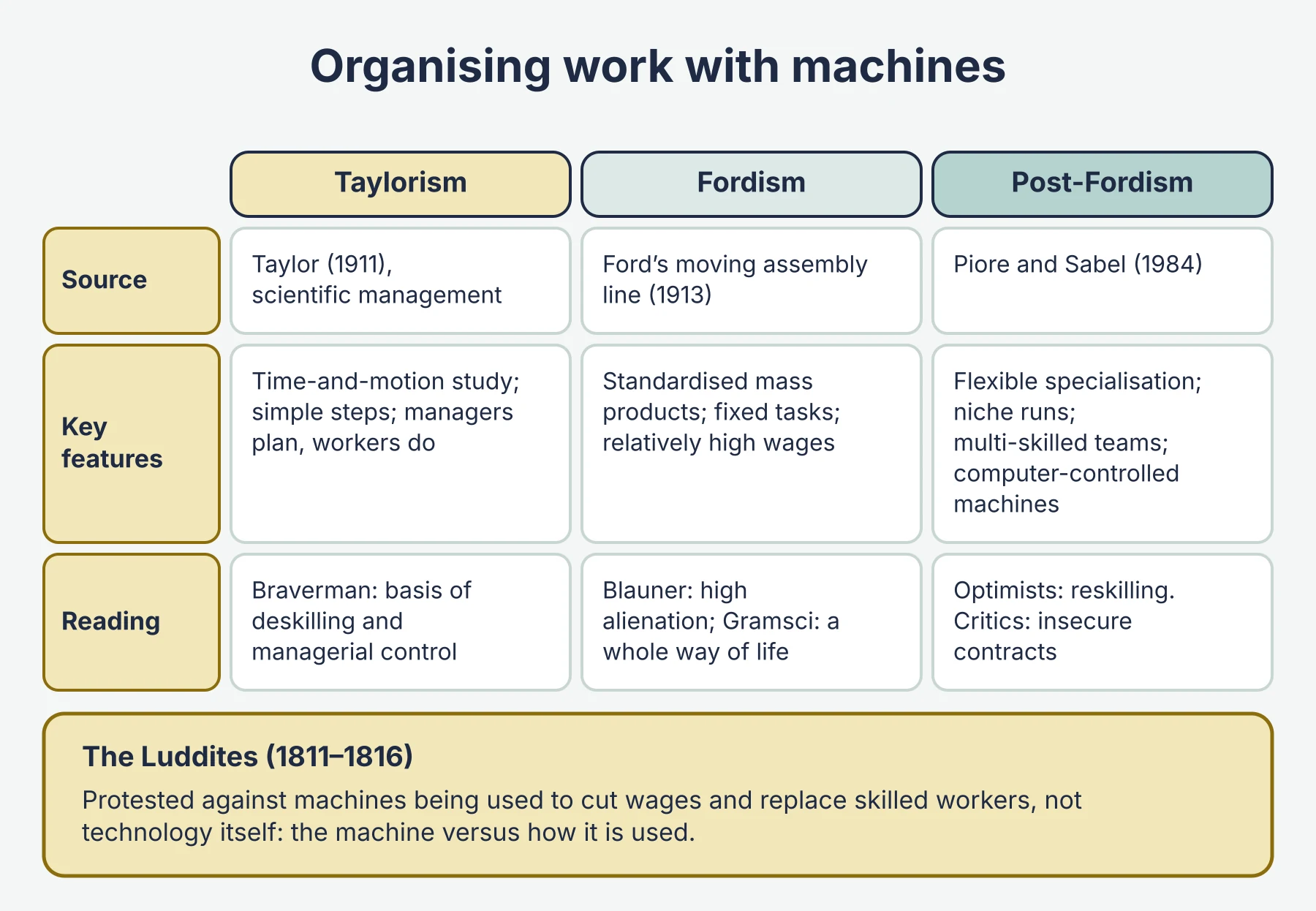
- Luddites (1811 to 1816): protested against machines used to cut wages and replace skilled workers, not technology as such.
- Taylorism (1911): time-and-motion study, simple tasks, planning separated from doing.
- Fordism (moving assembly line, 1913): standardised mass production and mass consumption.
- Post-Fordism (Piore and Sabel, 1984): flexible specialisation, niche markets, multi-skilled teams; critics stress insecure work.
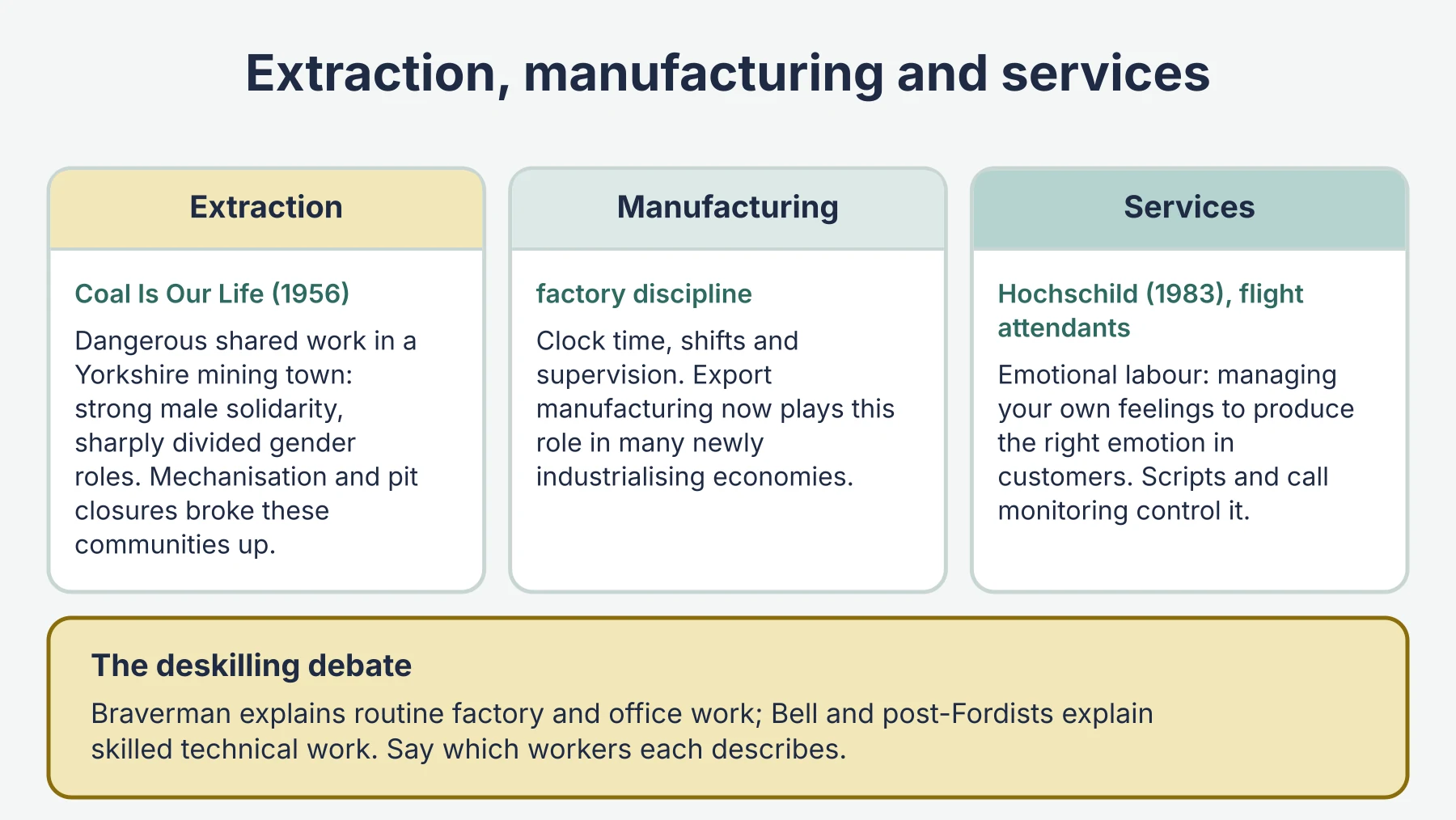
- Braverman: deskilling and control. Blauner: alienation varies with technology. Bell: post-industrial knowledge work.
- Extraction: Coal Is Our Life (Dennis, Henriques and Slaughter, 1956), solidarity and divided gender roles in a mining town.
- Services: Hochschild (1983), emotional labour among flight attendants; technology also monitors emotional work.
Mobilities
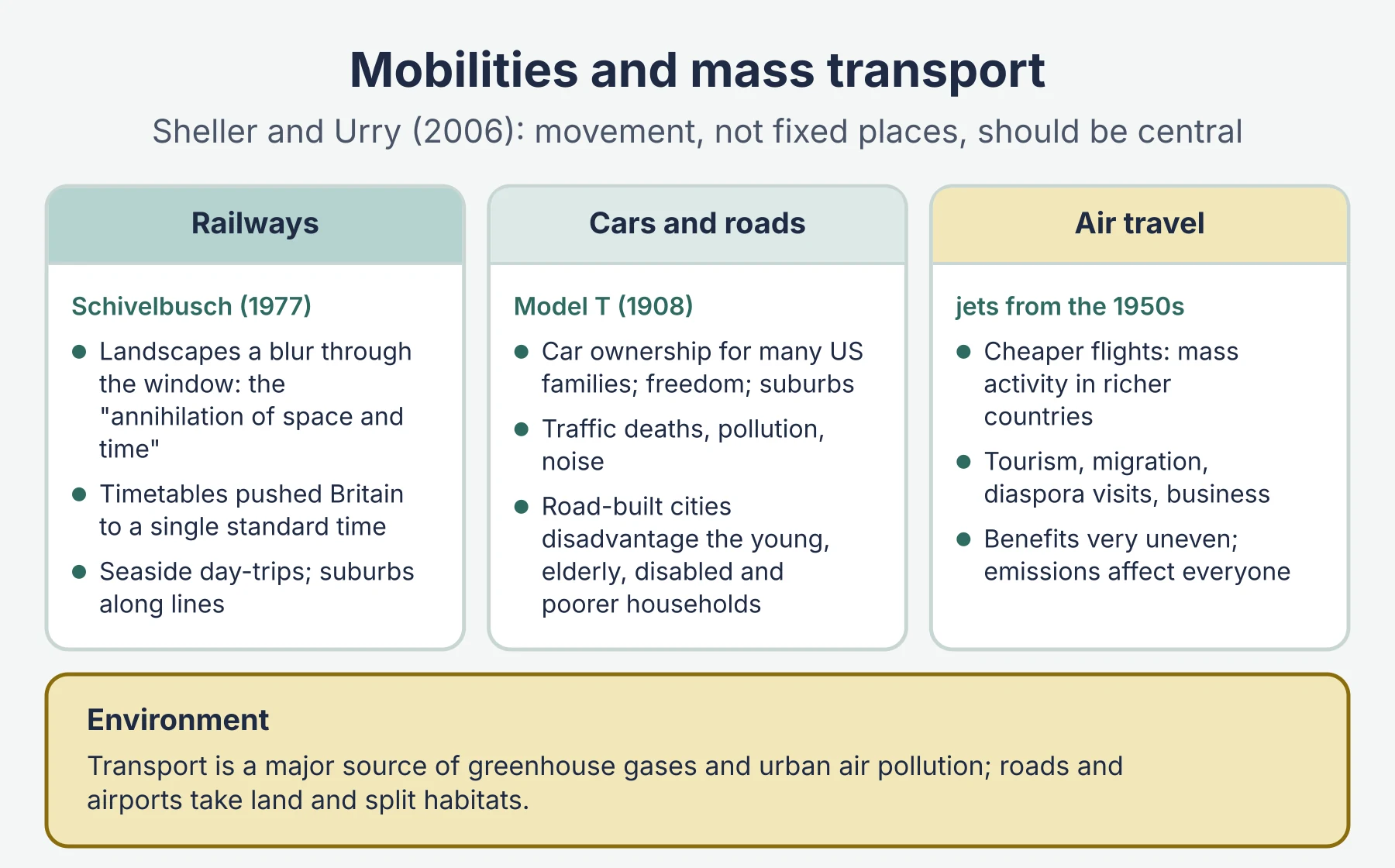
- Sheller and Urry (2006): the new mobilities paradigm puts movement at the centre of sociology.
- Railways: Schivelbusch (1977), changed perception of space and time; timetables pushed standard time; seaside trips and suburbs.
- Cars: Model T (1908); freedom and suburbs versus deaths, pollution and car-centred cities that disadvantage non-drivers. Urry’s automobility.
- Air travel: jets from the 1950s; benefits unevenly spread; emissions shared by all.
- Environment: transport emissions, air pollution, land take, habitat fragmentation.
Consumption
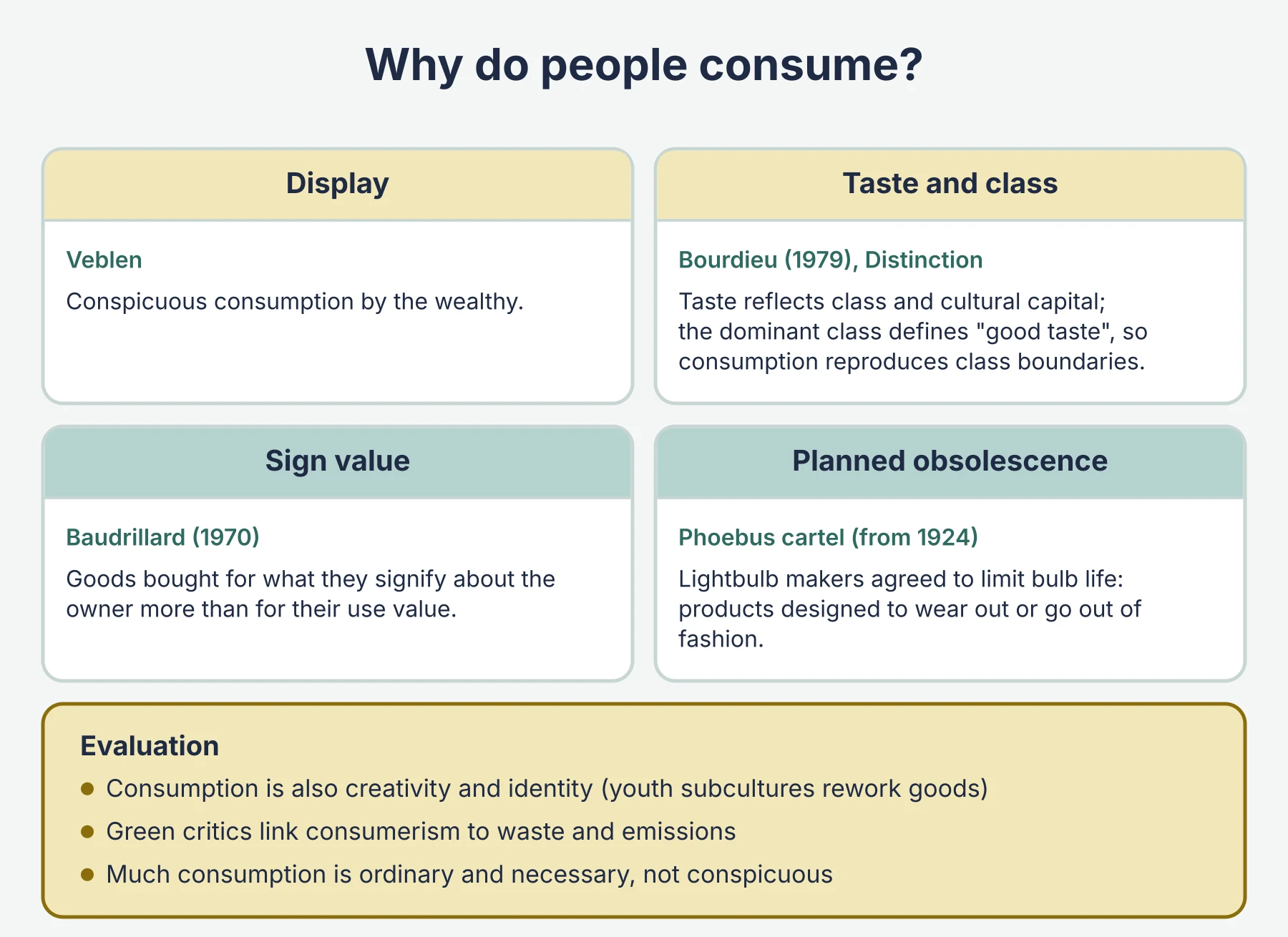
- Veblen (1899): conspicuous consumption, display of wealth.
- Bourdieu (1979): taste reflects class and cultural capital; consumption reproduces class boundaries.
- Baudrillard (1970): goods bought for sign value more than use value.
- Planned obsolescence: the Phoebus lightbulb cartel (from 1924) limited bulb life.
- Counter: consumption as creativity and identity; much consumption is ordinary, not conspicuous.
Determinism and construction
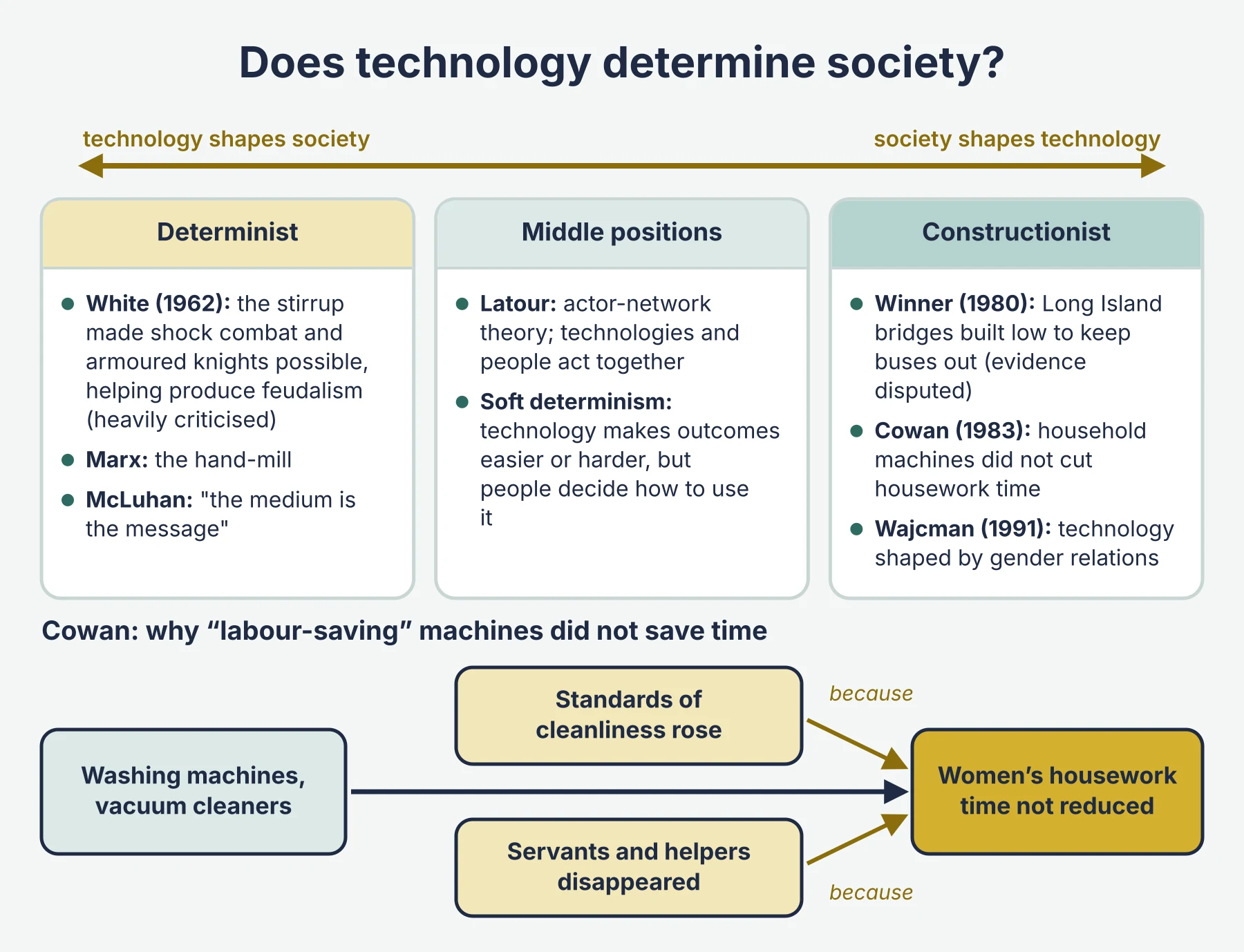
- Determinist: Marx’s hand-mill; McLuhan; Lynn White (1962), the stirrup and feudalism (heavily criticised).
- Constructionist: Pinch and Bijker’s bicycle; Winner (1980), Long Island bridges (evidence disputed); Cowan (1983), household technology did not cut women’s housework; Wajcman (1991), technology shaped by gender relations.
- Middle: Latour’s actor-network theory; soft determinism.
Key terms
| Term | Definition |
|---|---|
| Industrialisation | Shift to machine-based production in factories |
| Deskilling | Reduction of the skill needed for a job, often through machines and task division |
| Taylorism | Scientific management: timing and simplifying tasks, separating planning from doing |
| Fordism | Mass production of standard goods on assembly lines, with mass consumption |
| Post-Fordism | Flexible production for varied markets with multi-skilled workers |
| Emotional labour | Managing one’s own feelings to produce emotions in customers (Hochschild) |
| Mobilities | The movement of people, objects and information |
| Automobility | The self-expanding system of cars, roads, fuel and habits (Urry) |
| Conspicuous consumption | Buying goods to display wealth and status (Veblen) |
| Cultural capital | Tastes, knowledge and manners linked to class (Bourdieu) |
| Sign value | What a good signifies about its owner (Baudrillard) |
| Planned obsolescence | Designing products to wear out or go out of fashion |
| Technological determinism | View that technology drives social change |
| Social construction of technology | View that social groups shape how technologies are designed and used |
| Soft determinism | View that technology makes outcomes easier or harder without fixing them |
Linking points
- To Unit 4: transport emissions, commuting and over-tourism appear again under human impacts on environment, so mobilities evidence can be reused there.
- To AI and digital work: Taylorist timing and Braverman’s deskilling reappear when algorithms monitor warehouse and gig workers, so the same debate can be applied to new technology.
- To families: Cowan’s finding links household technology to the domestic division of labour studied at AS level.
Exam traps
- The Luddites protested against how machines were used.
- Fordism is a system, not just “a factory”.
- Deskilling is contested: say which workers Braverman’s view fits.
- Veblen and Baudrillard differ: display of wealth versus meaning of signs.
- Cases with disputed evidence (White, Winner) should be used with that caveat.
- Mobilities questions need effects on people and environment, as the specification says.
Self-test
- What were the Luddites protesting against?
- Give two features of Taylorism.
- How does post-Fordism differ from Fordism?
- What did Coal Is Our Life find?
- What is emotional labour and who identified it?
- What is the new mobilities paradigm?
- How did railways change perceptions, according to Schivelbusch?
- Which groups are disadvantaged by car-centred cities?
- What did Bourdieu argue about taste?
- What is sign value?
- What did Lynn White argue about the stirrup?
- What did Cowan find about household technology?
Answers
- The use of machines to cut wages and replace skilled workers.
- Any two: time-and-motion study; breaking tasks into simple steps; separating planning by managers from doing by workers.
- Fordism makes standard goods in huge numbers with fixed tasks; post-Fordism uses flexible production for varied markets with multi-skilled teams.
- In a Yorkshire mining town, dangerous shared work produced strong male solidarity and sharply divided gender roles.
- Managing one’s own feelings to produce the right emotion in customers; Arlie Hochschild.
- Sheller and Urry’s argument that the movement of people, objects and information should be central to sociology.
- Passengers saw landscapes as a blur through a window, and contemporaries felt space and time had been “annihilated”.
- Any of: young people, the elderly, disabled people, poorer households without cars.
- Taste reflects class and cultural capital, and the dominant class defines “good taste”, reproducing class boundaries.
- What a good signifies about its owner, as opposed to its use.
- It made mounted shock combat possible, which helped produce feudalism.
- Washing machines and vacuum cleaners did not reduce women’s housework time, because standards rose and help disappeared.
Apply these in the pre- and non-digital technologies practice questions.
Related resources
-
Study guides
OxfordAQA International A-level Sociology (9690): 'Traditional' media
Guide to OxfordAQA 9690 section 3.2.3.2: post, telegraph and broadcasting, mass culture, ownership, propaganda, representations and media-audience models.
Sociology · OxfordAQA · A Level
Read guide -
Practice questions
OxfordAQA International A-level Sociology (9690): 'Traditional' media – Practice Questions
Original OxfordAQA 9690 practice questions on early media, news selection, ownership, propaganda, representations and audience models, with full answers.
Sociology · OxfordAQA · A Level
Try questions -
Revision notes
OxfordAQA International A-level Sociology (9690): 'Traditional' media – Revision Notes
Revision notes for OxfordAQA 9690 section 3.2.3.2: early media, news selection, ownership, propaganda, representations and four media-audience models.
Sociology · OxfordAQA · A Level
Revise topic
Related articles
Get free revision emails (optional)
Occasional emails with practice questions, worked explanations and links to free resources for the qualification and subjects you choose. No spam, and you can unsubscribe from any email. The free tools on this site never need an email.