
Revision Notes
OxfordAQA International A-level Sociology (9690): 'Traditional' media – Revision Notes
Revision notes for OxfordAQA 9690 section 3.2.3.2: early media, news selection, ownership, propaganda, representations and four media-audience models.
- Subject
- Sociology
- Level
- A LEVEL
- Topic
- Unit 5 – People and Technology
- Author
- Marlbridge Academic Team
- Updated
- Reviewed by
- Naqiya Yousaf (what this means)
Aligned to OxfordAQA A Level Sociology (9690), Version 1.1. Official specification .
Syllabus page (what it covers and how it is assessed): OxfordAQA A Level Sociology.
Syllabus points this page covers
9690 (A Level)
- 3.2.3.2 'Traditional' media
Found an error? Report a correction.
Need help with this topic? Request a free trial class for A Level Sociology (9690).
These notes condense content point 3.2.3.2 ‘Traditional’ media of OxfordAQA International A-level Sociology (9690), Version 1.1, assessed in the Unit 5 People and technology exam. Full explanations are in the ‘traditional’ media study guide; the rest of the unit is in the People and technology revision notes.
What the specification lists
- Communication: post; telegraph; telephone.
- Information and entertainment: newspapers; broadcasting (radio and television); film/cinema.
- Growth of popular/mass culture.
- Marxist and pluralist views of “traditional” media.
- Ownership and control; media corporations and concentration of ownership.
- Misinformation, disinformation and propaganda.
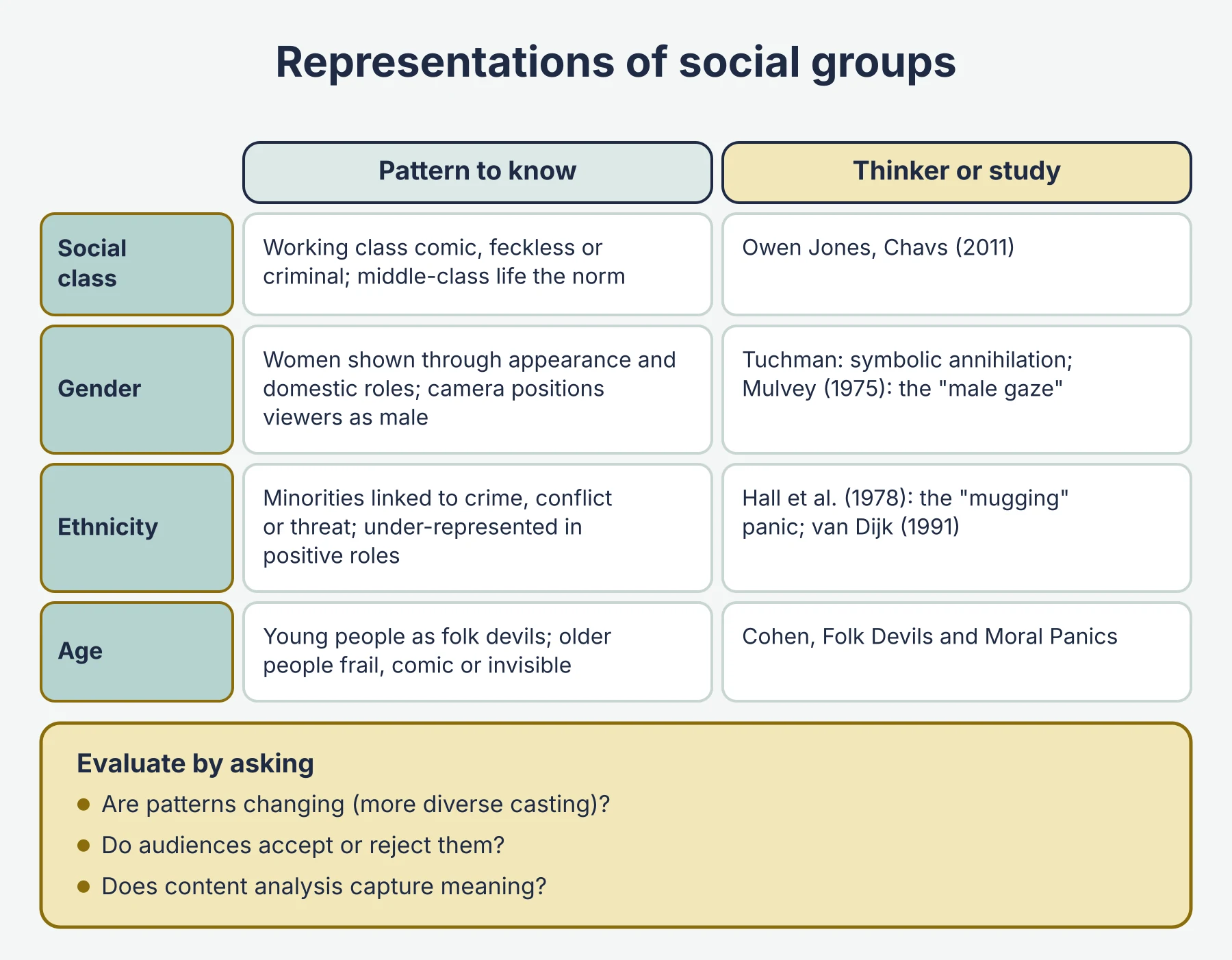
- Representations by social class, gender, ethnicity and age.
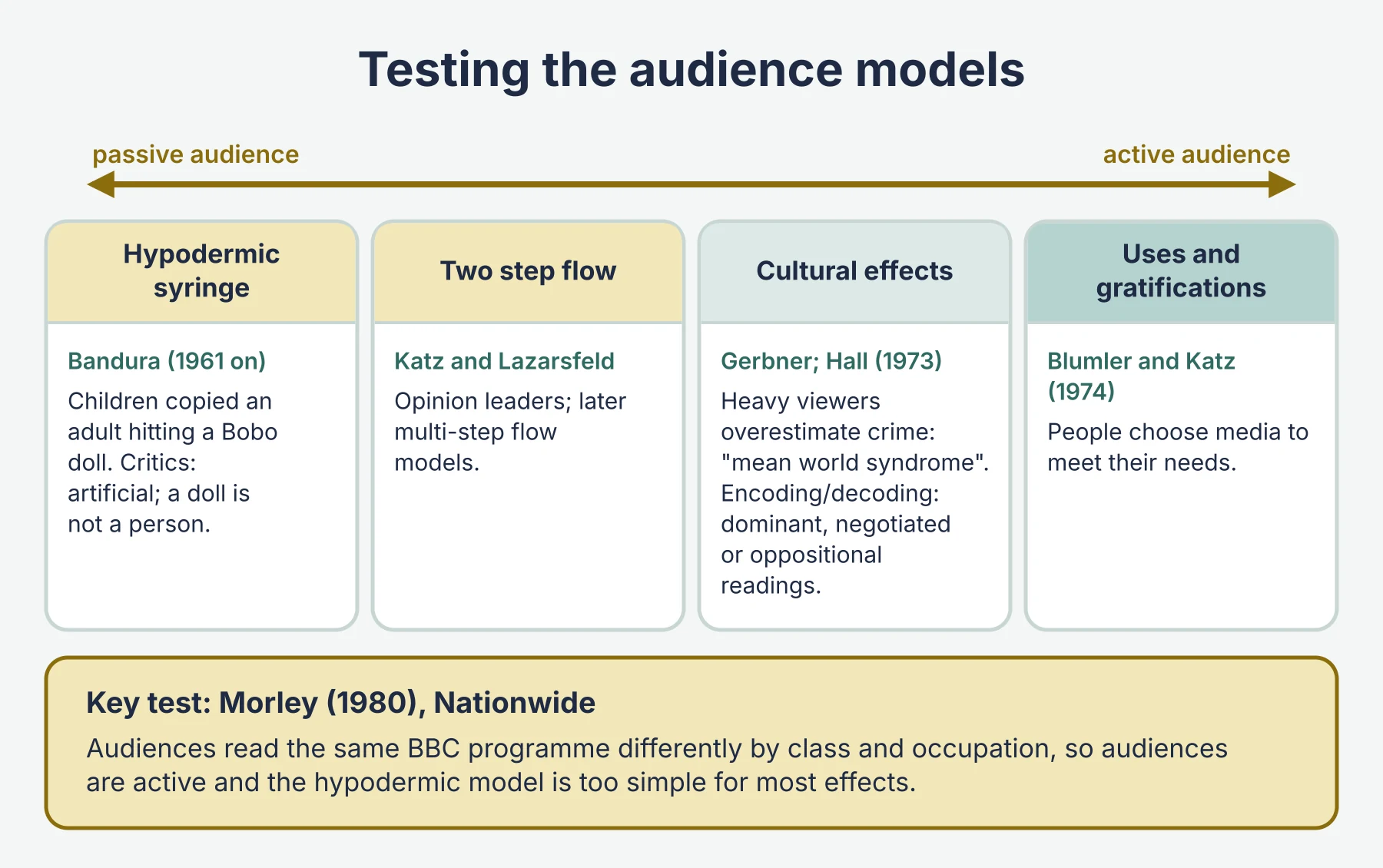
- Media and audiences: hypodermic syringe; two step flow; cultural effects; uses and gratifications.
Core recall
Early communication
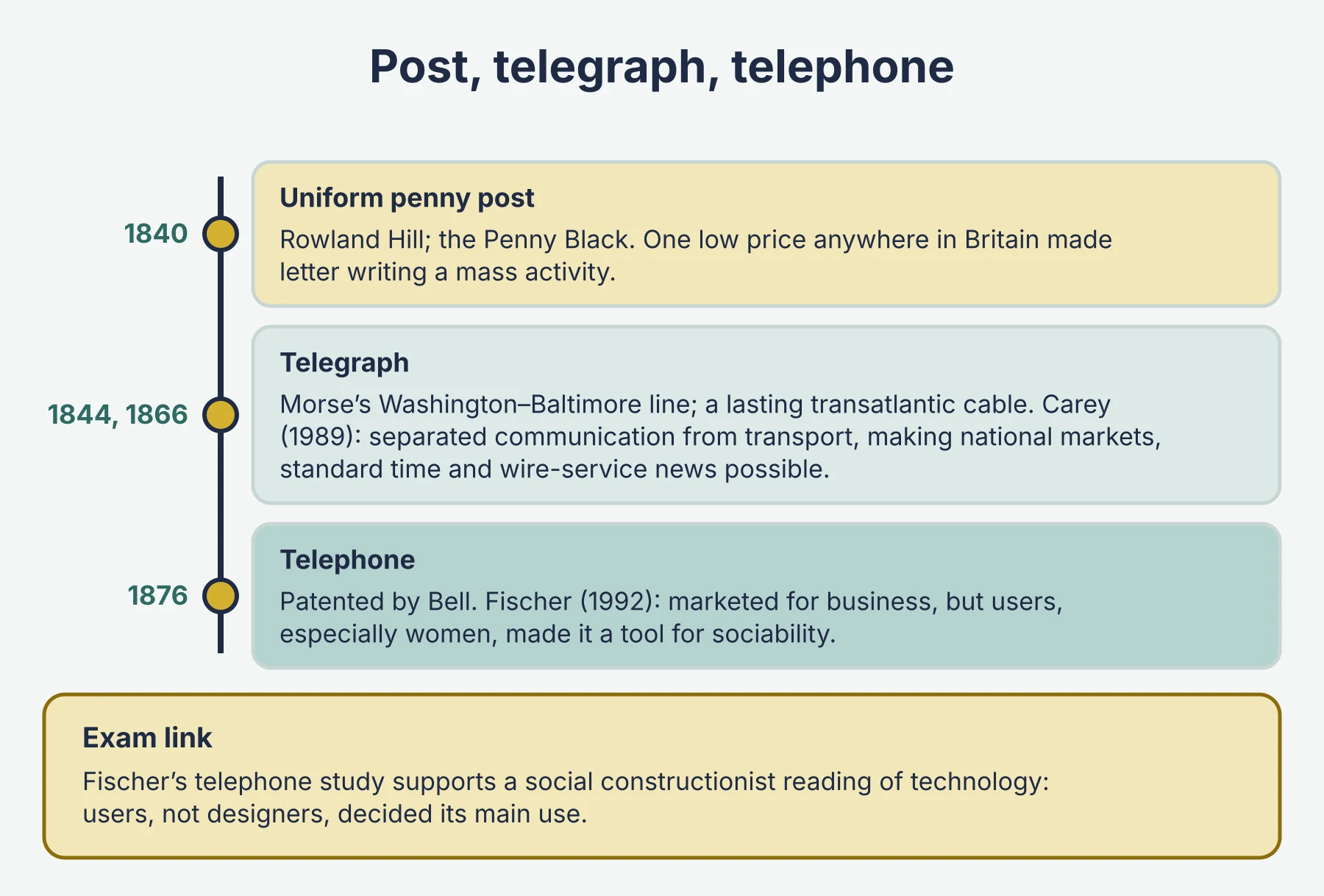
- Uniform penny post (1840, Rowland Hill, Penny Black): letters at one low price nationwide.
- Telegraph: Morse line (1844); lasting transatlantic cable (1866). Carey (1989): separated communication from transport.
- Telephone: Bell’s patent (1876). Fischer (1992): marketed for business, turned by users, especially women, into a tool for sociability.
Newspapers, broadcasting, film
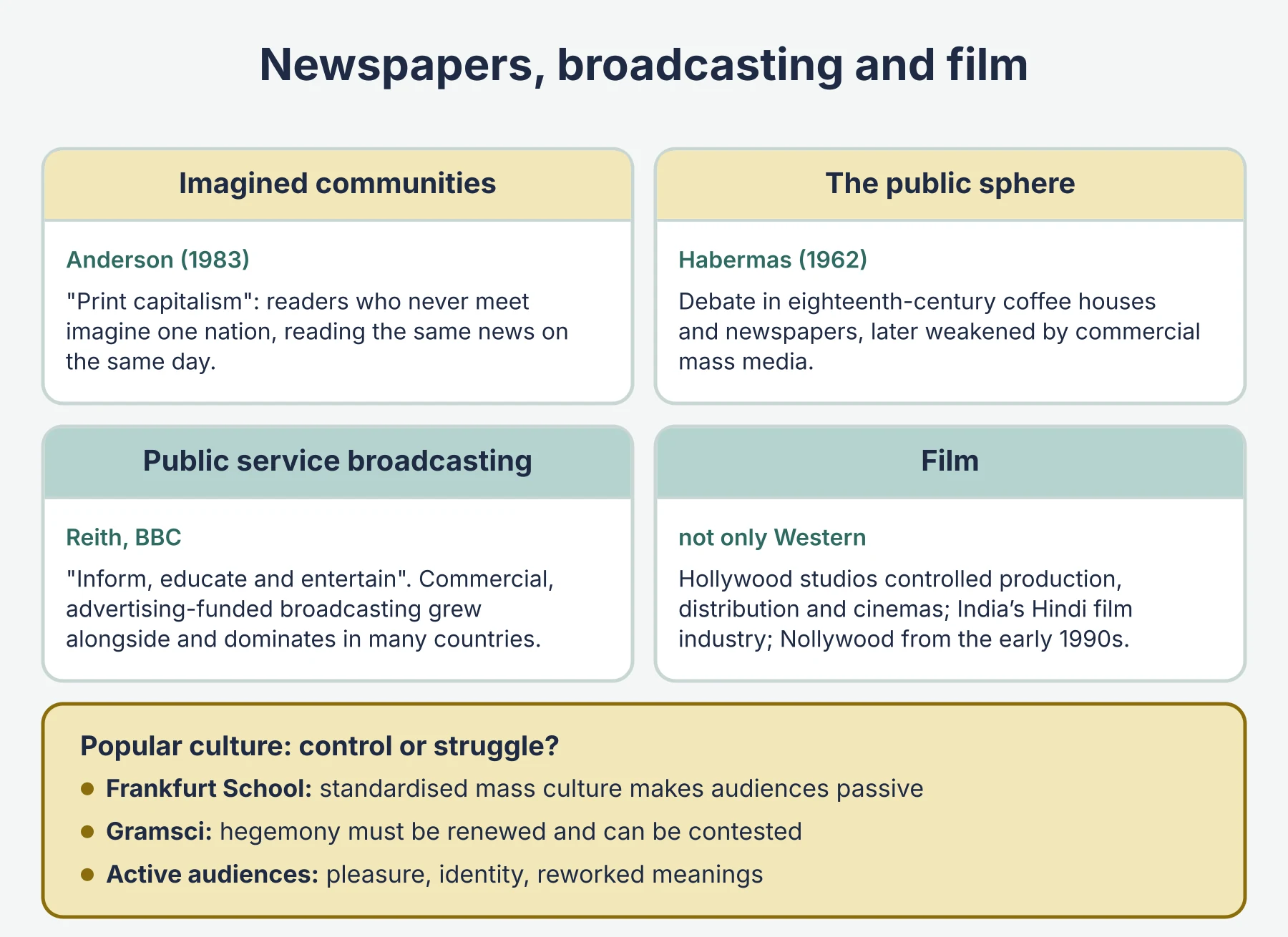
- Anderson (1983): print capitalism created “imagined communities” of nation.
- Habermas (1962): the public sphere of debate, later weakened by commercial media.
- Reith (BBC): “inform, educate and entertain”; public service versus commercial broadcasting.
- Hollywood studio system; Hindi cinema; Nollywood from the early 1990s.
Mass culture
- Frankfurt School: culture industry and passive audiences.
- Gramsci: hegemony, consent that must be renewed and can be contested.
- Active audience view: pleasure, identity, reworking meanings.
How news is made
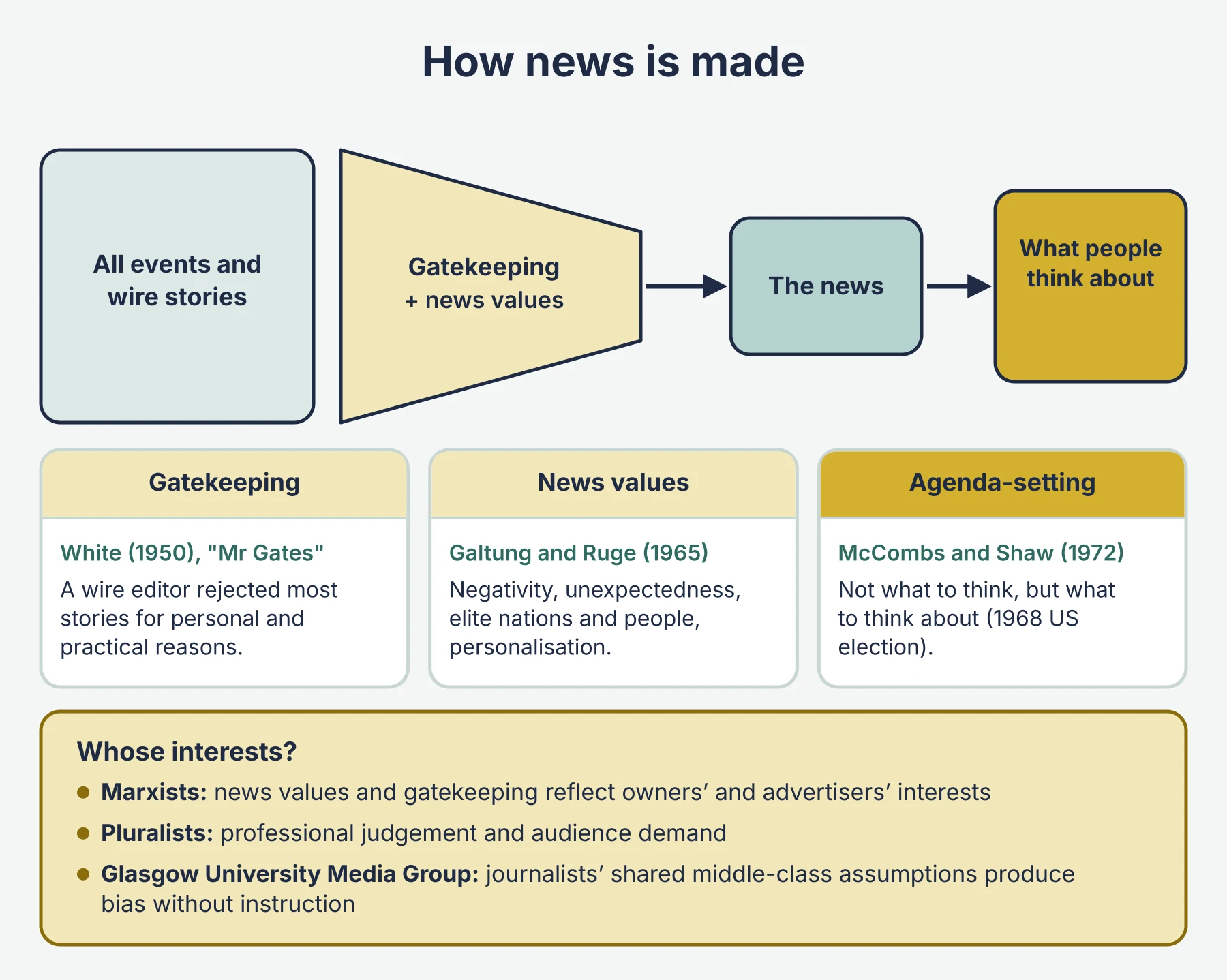
- Gatekeeping: White (1950), “Mr Gates” rejected most stories.
- News values: Galtung and Ruge (1965), such as negativity, unexpectedness, elite nations and people, personalisation.
- Agenda-setting: McCombs and Shaw (1972), media influence what people think about.
- Marxist reading: selection serves owners and advertisers. Pluralist: professional judgement and demand. Neo-Marxist (Glasgow University Media Group): journalists’ shared assumptions.
Ownership
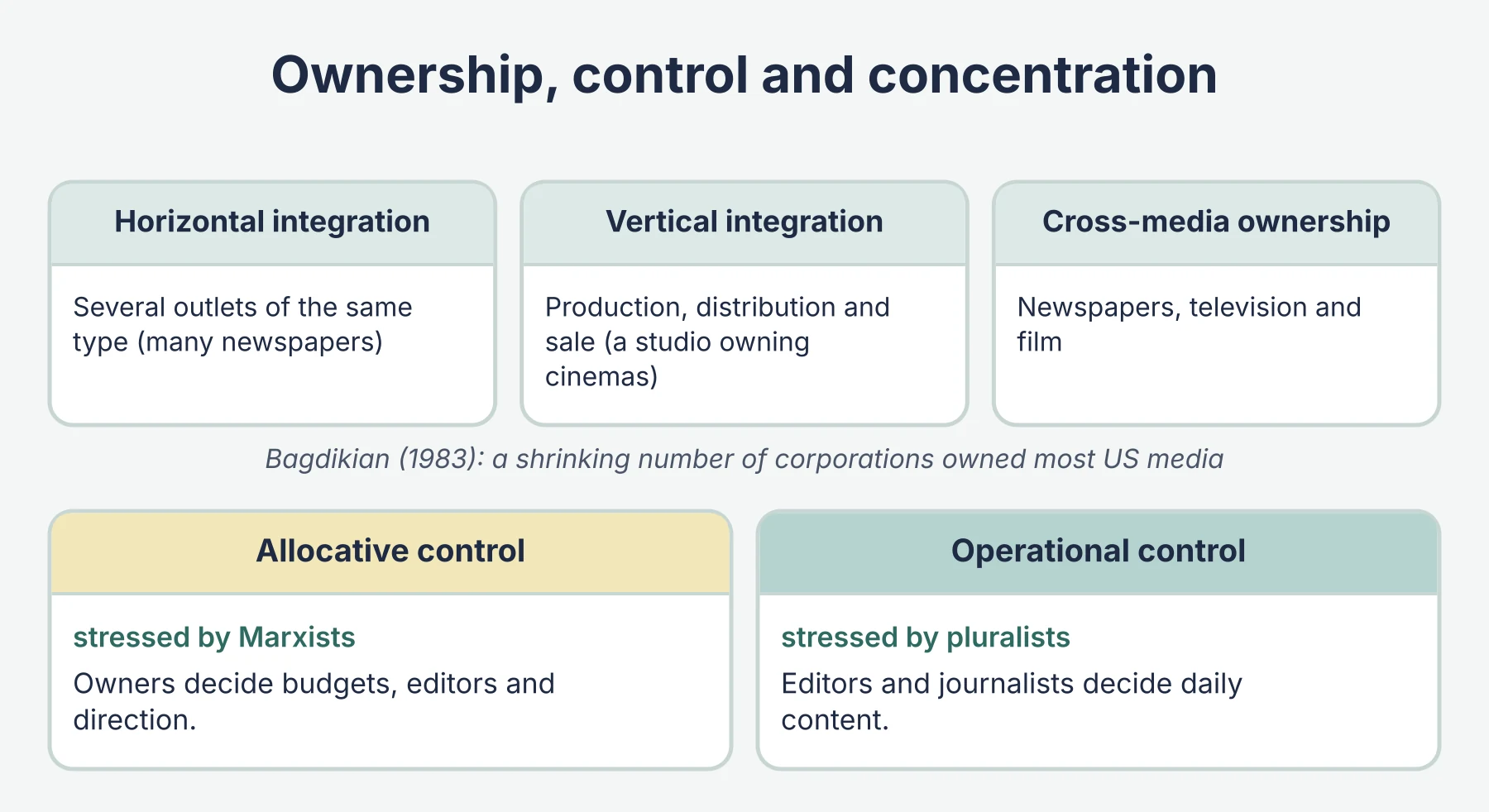
- Horizontal, vertical and cross-media integration.
- Bagdikian (1983): The Media Monopoly.
- Allocative control (owners: budgets, editors, direction) versus operational control (editors and journalists: daily content).
Propaganda cases
- Nazi Germany: Goebbels’s ministry and the cheap “people’s receiver” radio.
- Rwanda (1994): RTLM radio incitement; founders convicted by the International Criminal Tribunal for Rwanda.
- Wartime posters and newsreels.
Representations
- Class: Jones (2011), Chavs.
- Gender: Tuchman, symbolic annihilation; Mulvey (1975), the male gaze.
- Ethnicity: Hall and colleagues (1978), Policing the Crisis; van Dijk (1991), Racism and the Press.
- Age: Cohen’s folk devils; older people as frail or invisible.
Audience models: evidence
- Hypodermic: Bandura’s Bobo doll (from 1961); criticised as artificial.
- Two step flow: opinion leaders; later multi-step flow.
- Cultural effects: Gerbner’s cultivation theory, “mean world syndrome”; Hall’s encoding/decoding (dominant, negotiated, oppositional); Morley (1980), Nationwide, readings vary by class.
- Uses and gratifications: Blumler and Katz (1974).
Key terms
| Term | Definition |
|---|---|
| Print capitalism | Mass printing for profit that helped create national identities (Anderson) |
| Public sphere | Space of open public debate (Habermas) |
| Public service broadcasting | Broadcasting to inform, educate and entertain rather than for profit |
| Hegemony | Ruling-class ideas accepted as common sense through consent (Gramsci) |
| Gatekeeping | Selection of which stories become news |
| News values | Criteria that make events newsworthy |
| Agenda-setting | Media influence over which issues people think about |
| Horizontal integration | Ownership of several outlets of the same type |
| Vertical integration | Control of production, distribution and sale |
| Allocative control | Owners’ control over budgets, appointments and direction |
| Operational control | Editors’ and journalists’ control over daily content |
| Male gaze | Media positioning the viewer as a heterosexual man (Mulvey) |
| Cultivation | Long-term shaping of beliefs by repeated exposure (Gerbner) |
| Oppositional reading | Rejecting the preferred meaning of a message (Hall) |
Linking points
- To social media: gatekeeping and agenda-setting now operate through search rankings and feeds, so compare editors with algorithms.
- To globalisation: Schiller’s cultural imperialism and McLuhan’s global village in Unit 3 rely on the same evidence about broadcast and film ownership.
- To crime and deviance: Cohen’s moral panic model from AS level explains how press coverage shapes which groups are labelled deviant.
Exam traps
- Gatekeeping is selection; agenda-setting is influence.
- Distinguish allocative from operational control in ownership answers.
- Representation answers need change over time and audience response.
- Support or challenge each audience model with a study.
- Non-Western media industries count; use them in own-society examples.
- Propaganda is organised and deliberate; misinformation need not be.
Self-test
- What did the uniform penny post change?
- What did Carey argue about the telegraph?
- What did Fischer find about the telephone?
- What did Anderson mean by imagined communities?
- Name three news values identified by Galtung and Ruge.
- What did McCombs and Shaw find?
- Distinguish allocative and operational control.
- Give one example of radio used as propaganda.
- What is Mulvey’s male gaze?
- What is the mean world syndrome?
- Name Hall’s three types of reading.
- What did Morley’s Nationwide study show?
Answers
- It let letters be sent anywhere in Britain at one low price, making personal letter writing a mass activity.
- It separated communication from transport, enabling national markets, standard time and wire news.
- It was marketed for business, but users, especially women, made it a tool for sociability.
- Readers of the same printed news imagined themselves as one nation without meeting.
- Any three: negativity, unexpectedness, reference to elite nations, reference to elite people, personalisation.
- The issues voters thought important matched the issues the media covered most.
- Allocative: owners decide budgets, appointments and direction. Operational: editors and journalists decide daily content.
- RTLM in Rwanda (1994), or the Nazi “people’s receiver” broadcasts.
- Media position the viewer as a heterosexual man looking at women as objects.
- Gerbner’s finding that heavy TV viewers see the world as more dangerous than it is.
- Dominant, negotiated, oppositional.
- Audiences read the same programme differently according to class and occupation.
Apply these in the ‘traditional’ media practice questions.
Related resources
-
Study guides
OxfordAQA International A-level Sociology (9690): Artificial intelligence and cyborgs
Guide to OxfordAQA 9690 section 3.2.3.5: types of AI, algorithmic power and inequality, the extent and effects of AI use, human-machine merging and cyborgs.
Sociology · OxfordAQA · A Level
Read guide -
Practice questions
OxfordAQA International A-level Sociology (9690): Artificial intelligence and cyborgs – Practice Questions
Original OxfordAQA 9690 practice questions on types of AI, algorithmic bias, AI and work, human-machine technologies, robots and cyborgs, with full answers.
Sociology · OxfordAQA · A Level
Try questions -
Revision notes
OxfordAQA International A-level Sociology (9690): Artificial intelligence and cyborgs – Revision Notes
Revision notes for OxfordAQA 9690 section 3.2.3.5: how AI types differ, algorithmic bias cases, AI and work, hidden labour, human-machine merging and robots.
Sociology · OxfordAQA · A Level
Revise topic
Related articles
Get free revision emails (optional)
Occasional emails with practice questions, worked explanations and links to free resources for the qualification and subjects you choose. No spam, and you can unsubscribe from any email. The free tools on this site never need an email.