
Study Guides
OxfordAQA International A-level Sociology (9690): 'Traditional' media
Guide to OxfordAQA 9690 section 3.2.3.2: post, telegraph and broadcasting, mass culture, ownership, propaganda, representations and media-audience models.
- Subject
- Sociology
- Level
- A LEVEL
- Topic
- Unit 5 – People and Technology
- Author
- Marlbridge Academic Team
- Updated
- Reviewed by
- Naqiya Yousaf (what this means)
Aligned to OxfordAQA A Level Sociology (9690), Version 1.1. Official specification .
Syllabus page (what it covers and how it is assessed): OxfordAQA A Level Sociology.
Syllabus points this page covers
9690 (A Level)
- 3.2.3.2 'Traditional' media
Found an error? Report a correction.
Need help with this topic? Request a free trial class for A Level Sociology (9690).
This guide covers content point 3.2.3.2 ‘Traditional’ media of the OxfordAQA International A-level Sociology (9690) specification, Version 1.1, assessed in the Unit 5 People and technology exam. The specification lists: communication (post; telegraph; telephone); information and entertainment (newspapers; broadcasting, radio and television; film/cinema); the growth of popular/mass culture; Marxist and pluralist views; ownership and control, “media corporations and concentration of ownership”; misinformation, disinformation and propaganda; “Representations of social groups according to social class, gender, ethnicity and age”; and theories of media and audiences: hypodermic syringe, two step flow, cultural effects, and uses and gratifications.
The People and technology study guide introduces McLuhan, the Frankfurt School, Herman and Chomsky, the Glasgow University Media Group, Tuchman, Cohen and a table of the four audience models. This page adds the history of each medium, how news is selected, more on representation, and the research that tests each audience model. Use it with the ‘traditional’ media revision notes and the ‘traditional’ media practice questions.
Communication: post, telegraph, telephone
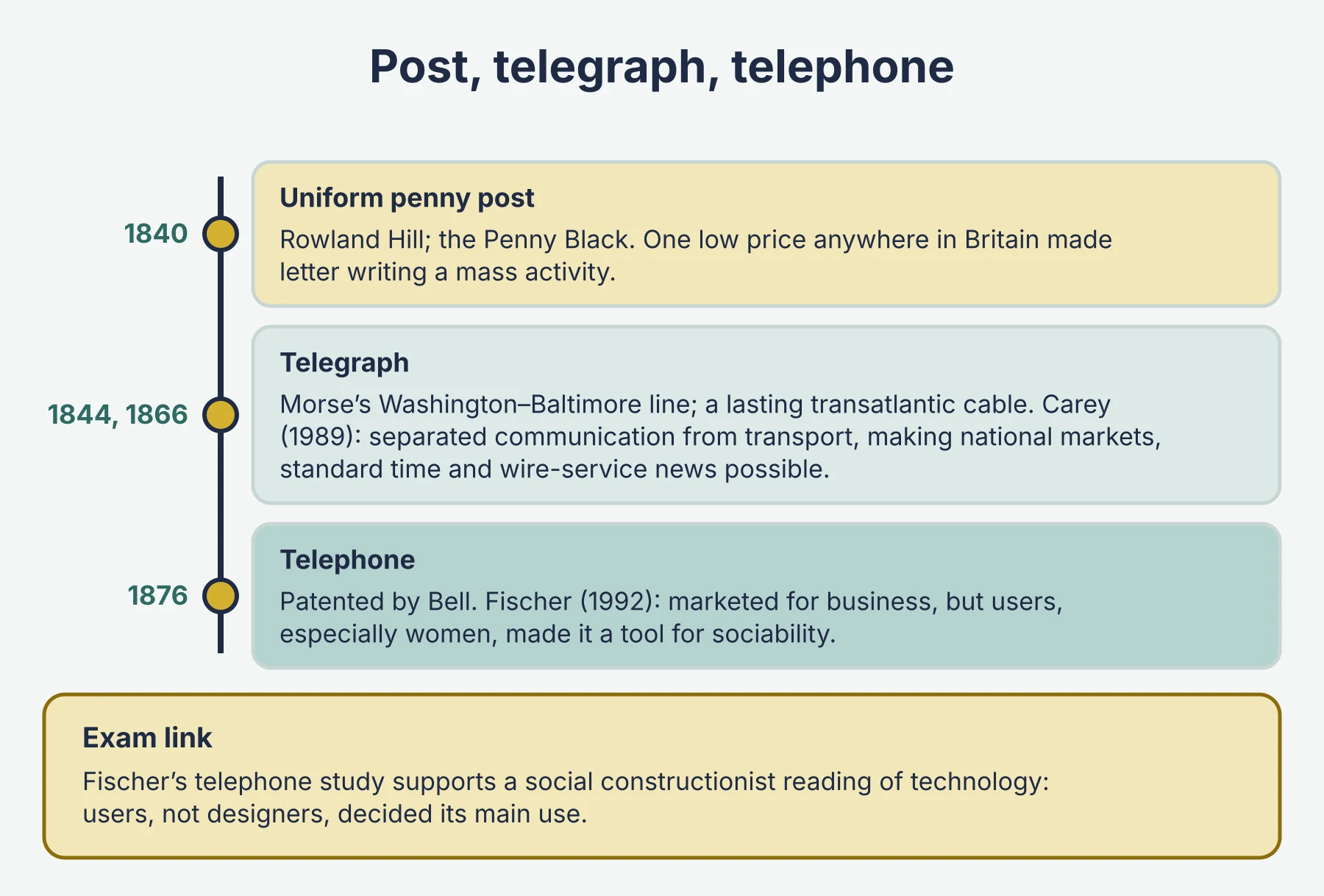
- Post: Britain’s uniform penny post (1840), promoted by Rowland Hill and marked by the Penny Black stamp, charged the same low price for a letter anywhere in the country, which made personal letter writing a mass activity.
- Telegraph: Samuel Morse’s line between Washington and Baltimore (1844) and a lasting transatlantic cable (1866) carried messages almost instantly. James Carey (“Technology and Ideology: The Case of the Telegraph”, 1989) argued it separated communication from transport, which made national markets, standard time and wire-service news possible.
- Telephone: patented by Alexander Graham Bell in 1876. Claude Fischer (America Calling, 1992) found that telephone companies first marketed it for business, but users, especially women, made it a tool for sociability; this supports a social constructionist reading of technology.
Newspapers, broadcasting and film
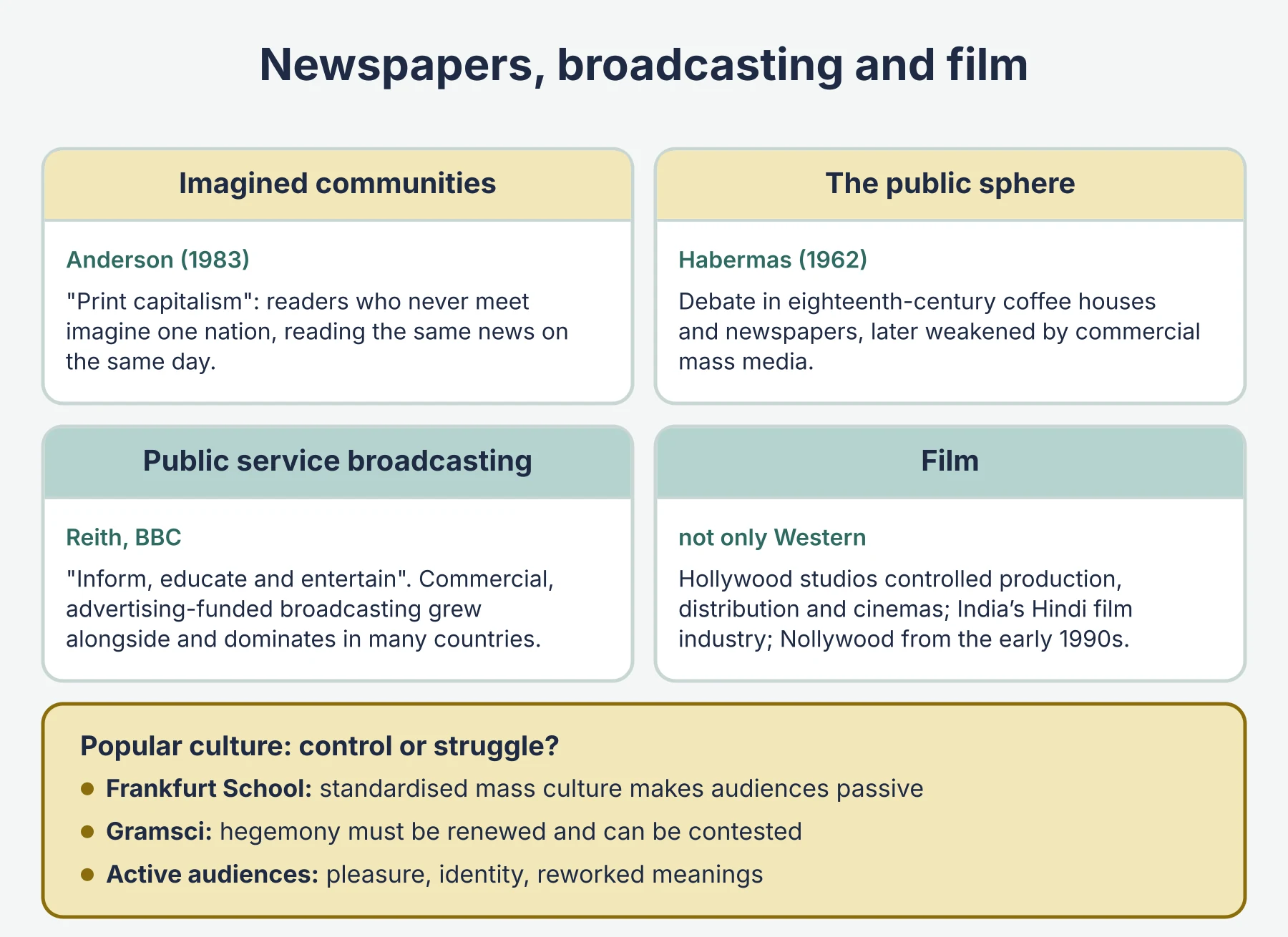
- Newspapers: Benedict Anderson (Imagined Communities, 1983) argued that “print capitalism” let readers who would never meet imagine themselves as one nation, reading the same news on the same day. Jürgen Habermas (The Structural Transformation of the Public Sphere, 1962) traced a public sphere of debate in eighteenth-century coffee houses and newspapers, which he argued was later weakened by commercial mass media.
- Broadcasting: radio and then television brought live events into homes. John Reith, first director-general of the BBC, defined its purpose as to “inform, educate and entertain”, the model of public service broadcasting. Commercial broadcasting, funded by advertising, grew alongside it and dominates in many countries.
- Film/cinema: the Hollywood studio system controlled production, distribution and cinemas; India’s Hindi film industry and Nigeria’s video-film industry (“Nollywood”, which grew from the early 1990s) show that mass cinema is not only Western.
Growth of popular and mass culture
The mass culture critique (the Frankfurt School, in the unit guide) sees standardised products making audiences passive. Two counter-positions:
- Hegemony (Antonio Gramsci): ruling-class ideas win consent through culture, but consent must be constantly renewed and can be contested, so popular culture is a site of struggle, not simple control.
- Active audiences: popular culture offers pleasure, identity and shared experience, and audiences rework its meanings.
Marxist and pluralist views: going deeper
How news is made. These concepts let you test both views.
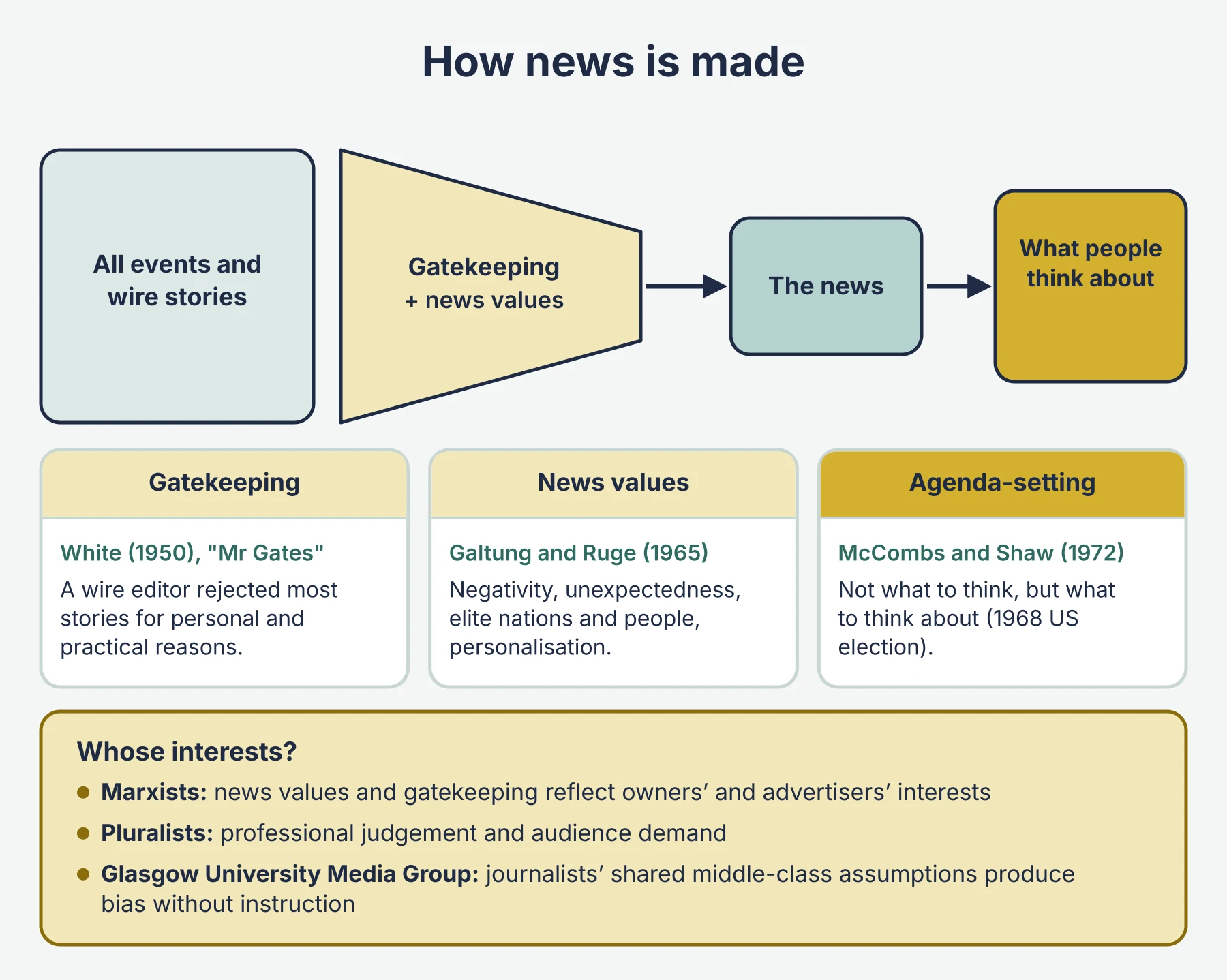
- Gatekeeping: David Manning White (1950) studied a wire editor (“Mr Gates”) who rejected most incoming stories for personal and practical reasons, showing news is selected, not simply reported.
- News values: Johan Galtung and Mari Ruge (1965) identified factors that make events newsworthy, including negativity, unexpectedness, reference to elite nations and elite people, and personalisation.
- Agenda-setting: Maxwell McCombs and Donald Shaw (1972), studying the 1968 US election, found that the issues voters thought important matched the issues the media covered most: the media may not tell people what to think, but they influence what people think about.
Evaluation. Marxists say news values and gatekeeping reflect owners’ and advertisers’ interests; pluralists say they reflect professional judgements and audience demand. Neo-Marxists, such as the Glasgow University Media Group, argue that journalists’ shared middle-class assumptions produce bias without any instruction from owners.
Ownership, control and concentration
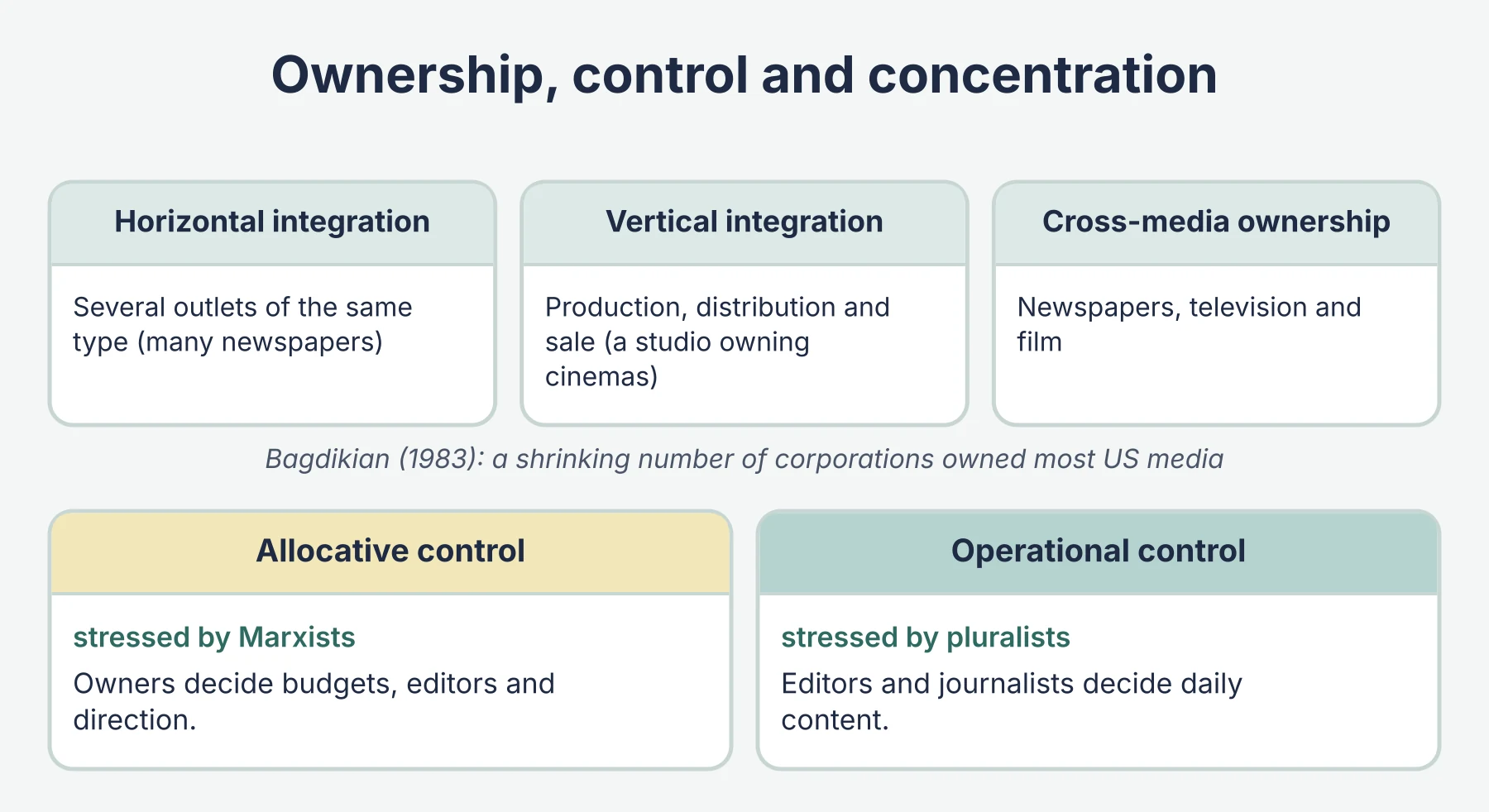
- Horizontal integration: one company owning several outlets of the same type (many newspapers).
- Vertical integration: one company controlling production, distribution and sale (a studio owning cinemas).
- Cross-media ownership: one company owning newspapers, television and film.
- Ben Bagdikian (The Media Monopoly, 1983) documented how a shrinking number of corporations came to own most US media.
The key distinction for evaluation is between allocative control (owners decide budgets, editors and direction) and operational control (editors and journalists decide daily content). Marxists stress allocative power; pluralists stress operational independence.
Misinformation, disinformation and propaganda
Historical cases show how traditional media served state propaganda. Nazi Germany’s propaganda ministry under Joseph Goebbels promoted a cheap radio set, the “people’s receiver”, so that the regime’s broadcasts reached most homes. In Rwanda in 1994, the radio station RTLM broadcast incitement against Tutsi during the genocide; its founders were later convicted by the International Criminal Tribunal for Rwanda. Wartime posters and newsreels in many countries used patriotic imagery to mobilise populations. Misinformation in traditional media also spreads through errors and unchecked rumours, which corrections rarely reach as widely.
Representations of social groups
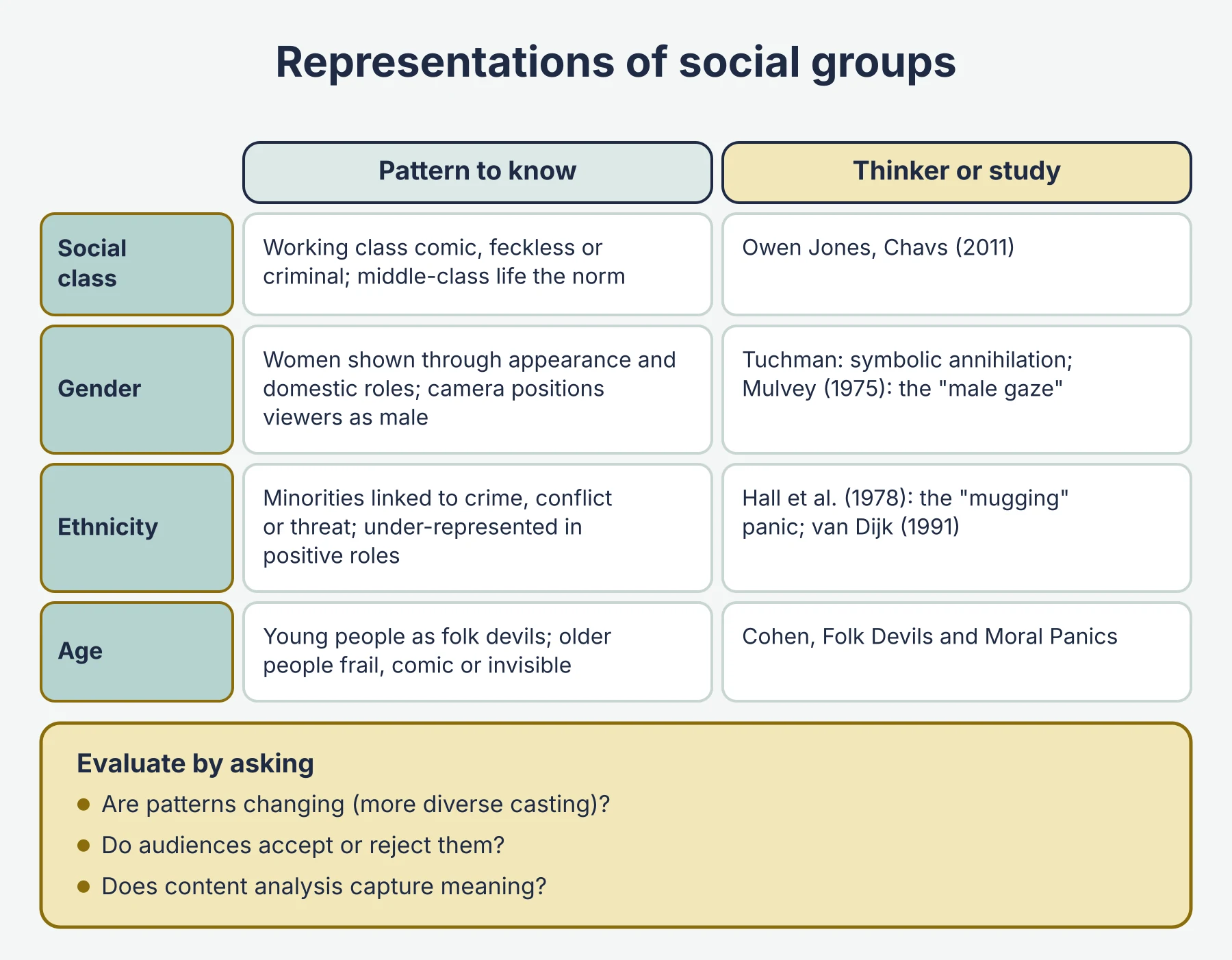
| Group | Pattern to know | Thinker or study |
|---|---|---|
| Social class | Working class shown as comic, feckless or criminal; middle-class life as the norm | Owen Jones, Chavs (2011), on demonisation of the British working class |
| Gender | Women shown through appearance and domestic roles; camera positions viewers as male | Tuchman’s symbolic annihilation; Laura Mulvey’s “male gaze” (1975) |
| Ethnicity | Minorities linked to crime, conflict or threat; under-represented in positive roles | Stuart Hall and colleagues, Policing the Crisis (1978), on the “mugging” panic; Teun van Dijk, Racism and the Press (1991) |
| Age | Young people as folk devils; older people as frail, comic or invisible | Cohen, Folk Devils and Moral Panics |
Evaluate representation claims by asking whether patterns are changing (more diverse casting), whether audiences accept or reject them (see audience models below), and whether content analysis captures meaning.
Media and audiences: testing the models
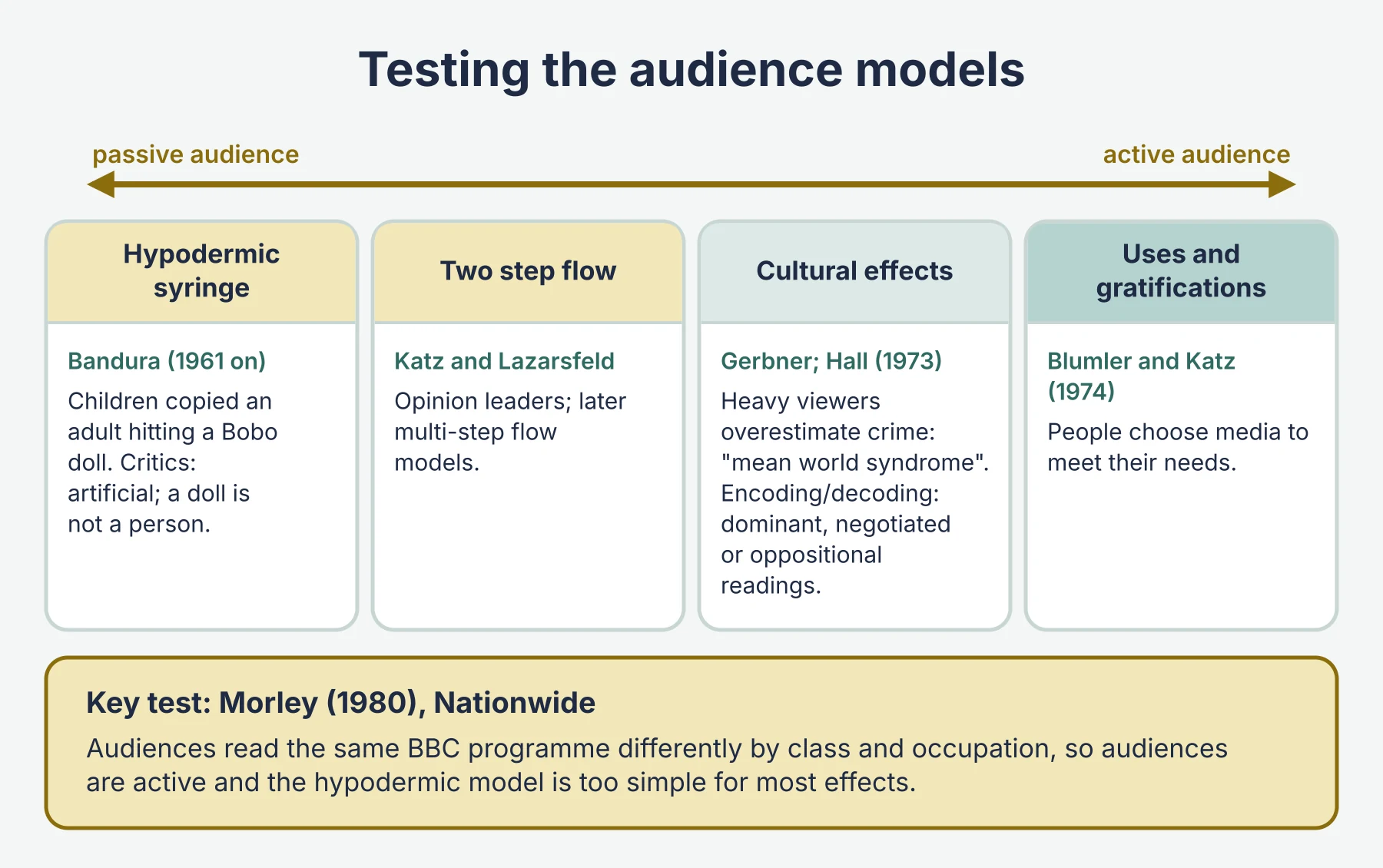
- Hypodermic syringe: Albert Bandura’s “Bobo doll” experiments (1961 onwards) found that children who watched an adult hitting an inflatable doll were more likely to copy the behaviour. Critics note the artificial laboratory setting and that a doll designed to be hit is not a person.
- Two step flow: Katz and Lazarsfeld’s opinion leaders (in the unit guide). Later “multi-step flow” models recognise many layers of influence.
- Cultural effects: George Gerbner’s cultivation theory found that heavy television viewers in the US were more likely to overestimate crime and see the world as dangerous, which he called the “mean world syndrome”. Hall’s encoding/decoding model (1973) argued that audiences can take a dominant, negotiated or oppositional reading of the same message; David Morley’s study of audiences for the BBC programme Nationwide (1980) found readings varied by class and occupation.
- Uses and gratifications: Jay Blumler and Elihu Katz (1974) developed the idea that people choose media to meet needs; the unit guide lists McQuail, Blumler and Brown’s four needs.
Annotated model answer
Extract from a 12-mark answer: Evaluate the hypodermic syringe model of media effects.
The hypodermic model claims media messages are injected into a passive audience [knowledge]. Bandura’s Bobo doll experiments appear to support it, as children copied the violence they saw [evidence]. But a laboratory doll is not a real victim, and effects were short-term [analysis of method]. Hall’s encoding/decoding model and Morley’s Nationwide study show audiences read the same message differently by class, so audiences are active, which suggests the model is too simple for most media effects [evaluation and judgement].
Common mistakes
- Confusing gatekeeping (selection) with agenda-setting (influence on what audiences think about).
- Treating every representation claim as current without considering change.
- Using the hypodermic model with no evidence for or against.
- Ignoring non-Western media industries.
- Describing ownership without distinguishing allocative and operational control.
Exam technique
For outline questions on representation, name the group, the pattern and an example. For explain questions on audiences, give the model and the mechanism. In evaluate answers, set Marxist against pluralist, or passive against active audience models, and use own-society examples of newspapers, channels or films where the question asks.
Where next
How these debates change online is covered in the internet and social and new media, and how older media adapt in digital technologies.
Related resources
-
Practice questions
OxfordAQA International A-level Sociology (9690): 'Traditional' media – Practice Questions
Original OxfordAQA 9690 practice questions on early media, news selection, ownership, propaganda, representations and audience models, with full answers.
Sociology · OxfordAQA · A Level
Try questions -
Revision notes
OxfordAQA International A-level Sociology (9690): 'Traditional' media – Revision Notes
Revision notes for OxfordAQA 9690 section 3.2.3.2: early media, news selection, ownership, propaganda, representations and four media-audience models.
Sociology · OxfordAQA · A Level
Revise topic -
Study guides
OxfordAQA International A-level Sociology (9690): Artificial intelligence and cyborgs
Guide to OxfordAQA 9690 section 3.2.3.5: types of AI, algorithmic power and inequality, the extent and effects of AI use, human-machine merging and cyborgs.
Sociology · OxfordAQA · A Level
Read guide
Related articles
Get free revision emails (optional)
Occasional emails with practice questions, worked explanations and links to free resources for the qualification and subjects you choose. No spam, and you can unsubscribe from any email. The free tools on this site never need an email.