
Study Guides
OxfordAQA International A-level Sociology (9690): Digital technologies
Guide to OxfordAQA 9690 section 3.2.3.4: online games, media adapting to digital, self-tracking and gamification, surveillance, cybercrime and digital divides.
- Subject
- Sociology
- Level
- A LEVEL
- Topic
- Unit 5 – People and Technology
- Author
- Marlbridge Academic Team
- Updated
- Reviewed by
- Naqiya Yousaf (what this means)
Aligned to OxfordAQA A Level Sociology (9690), Version 1.1. Official specification .
Syllabus page (what it covers and how it is assessed): OxfordAQA A Level Sociology.
Syllabus points this page covers
9690 (A Level)
- 3.2.3.4 Digital technologies
Found an error? Report a correction.
Need help with this topic? Request a free trial class for A Level Sociology (9690).
This guide covers content point 3.2.3.4 Digital technologies of the OxfordAQA International A-level Sociology (9690) specification, Version 1.1, assessed in the Unit 5 People and technology exam. The specification lists: “Digital/online games”; “Ways ‘traditional’ media are adapting to the digital age”; “Use of technologies for health and fitness, including quantification and gamification of social life”; “Use of technologies for surveillance”; “Illegal and anti-social uses: cybercrimes and cyber security; hacking”; and “Inequalities in access to digital technologies; digital divides”.
The People and technology study guide introduces Lupton, Foucault’s panopticon, Mathiesen’s synopticon, Wall’s types of cybercrime and Norris’s three divides. This page adds theory and cases for each content point so you can analyse and evaluate. Use it with the digital technologies revision notes and the digital technologies practice questions.
Digital and online games
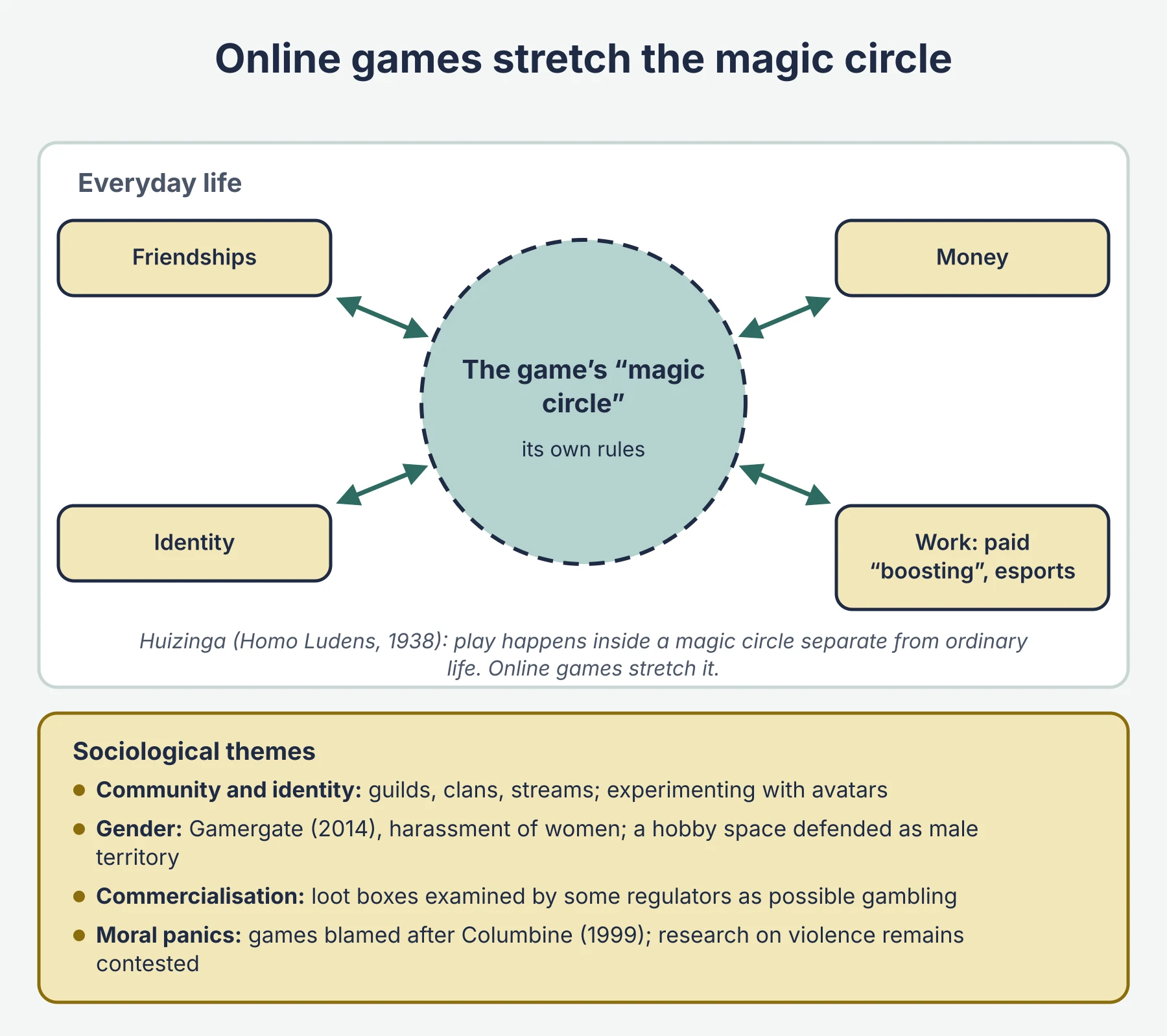
Play as social life. Johan Huizinga (Homo Ludens, 1938) argued that play is a basic element of culture, taking place inside a “magic circle” with its own rules, separate from ordinary life. Online games stretch that circle: friendships, money, identity and even work (paid “boosting”, professional esports) cross between game and everyday life.
Sociological themes.
- Community and identity: guilds, clans and streams create lasting groups; players experiment with avatars and identities.
- Gender: the “Gamergate” campaign of 2014 involved sustained online harassment of women in gaming and games journalism, and showed how a hobby space could be defended as male territory.
- Commercialisation: in-game purchases and “loot boxes” (paid random rewards) have led some regulators to examine whether they resemble gambling.
- Moral panics: violent games were blamed after school shootings, such as Columbine in 1999. Research on whether games cause real-world violence remains contested, and many researchers find no clear link to serious violence, so this is a good case for Cohen’s model.
How ‘traditional’ media adapt to the digital age
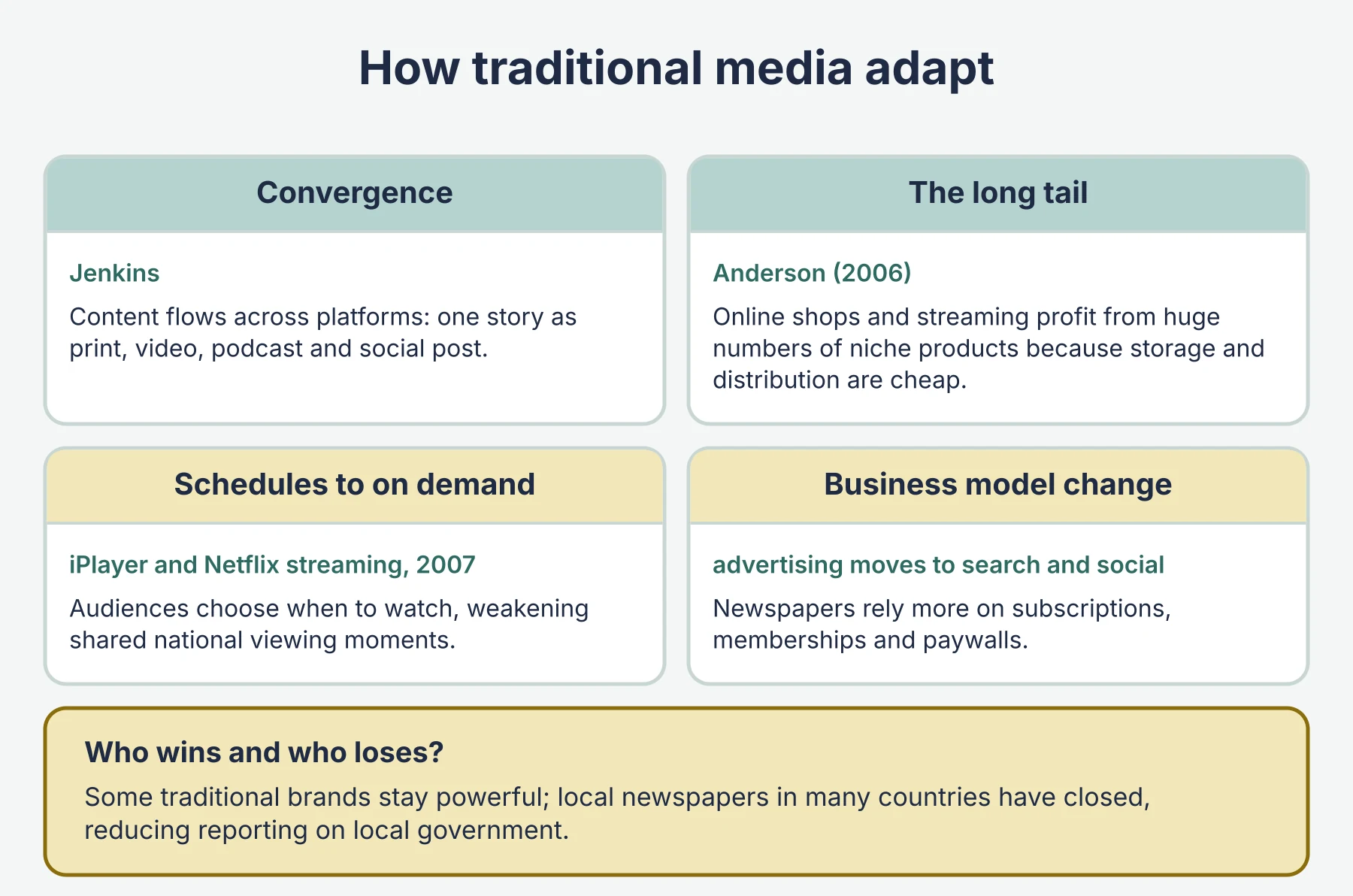
- Convergence: Jenkins’s idea that content flows across platforms; one story now appears as print, video, podcast and social post.
- The long tail: Chris Anderson (The Long Tail, 2006) argued that online shops and streaming can profit from huge numbers of niche products, not only hits, because storage and distribution costs are low.
- From schedules to on demand: the BBC launched iPlayer in 2007, and Netflix, which began by renting DVDs by post, started streaming in the same year. Audiences now choose when to watch, weakening shared national viewing moments.
- Business model change: advertising has moved to search and social platforms, so newspapers rely more on subscriptions, memberships and paywalls.
Evaluation: adaptation has kept some traditional brands powerful, while local newspapers in many countries have closed, which reduces reporting on local government.
Health, fitness, quantification and gamification
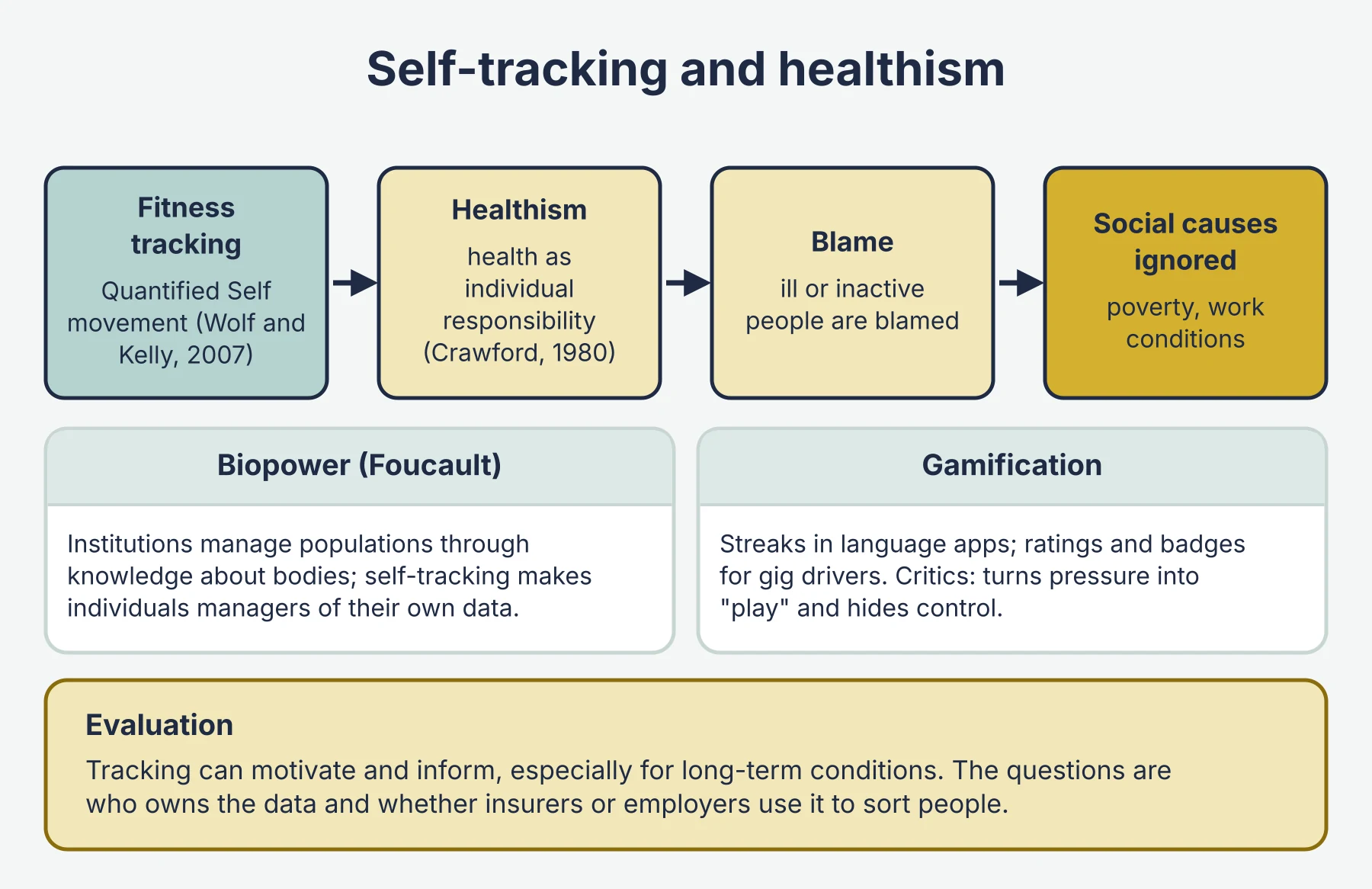
- The Quantified Self: Gary Wolf and Kevin Kelly founded the Quantified Self movement in 2007 for people who track their own data. Lupton’s work (in the unit guide) analyses this.
- Healthism: Robert Crawford (1980) used “healthism” for the idea that health is mainly an individual responsibility achieved through lifestyle. Fitness tracking can deepen this, so people who are ill or inactive may be blamed, while social causes of poor health (poverty, work conditions) are ignored.
- Foucault’s biopower: states and institutions manage populations through knowledge about bodies; self-tracking turns individuals into managers of their own data.
- Gamification beyond fitness: points and streaks in language-learning apps, ratings and badges for gig-economy drivers. Critics argue gamification at work turns pressure into “play” and hides control.
Evaluation: tracking can motivate and give useful information, especially for long-term conditions; the questions are who owns the data and whether insurers or employers use it to sort people.
Surveillance
Go beyond the panopticon and synopticon with these concepts.
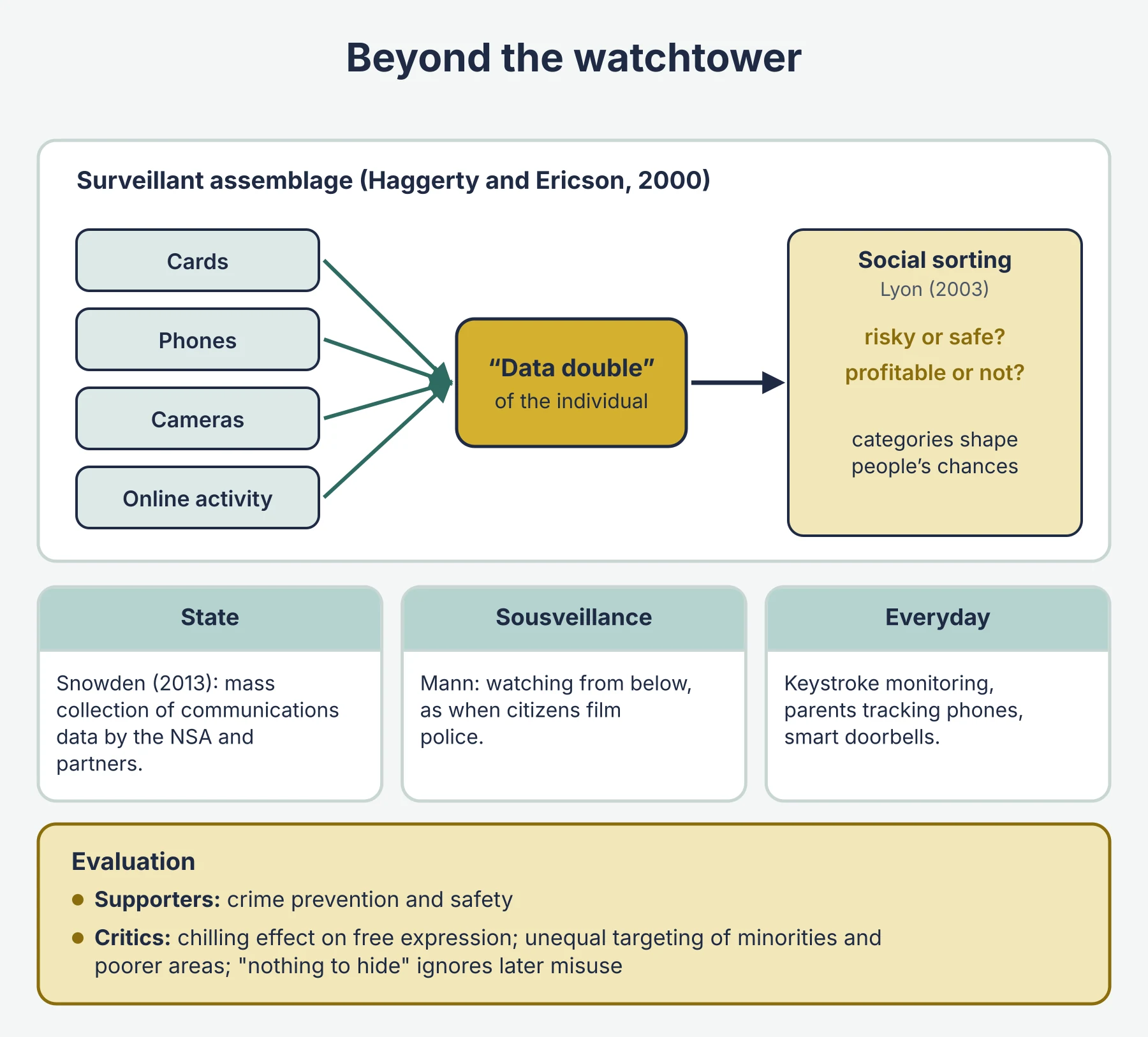
- Social sorting: David Lyon (Surveillance as Social Sorting, 2003) argued that the main effect of surveillance is to classify people into categories (risky or safe, profitable or not) that shape their chances.
- The surveillant assemblage: Kevin Haggerty and Richard Ericson (2000) argued that surveillance now works by combining scattered data flows (cards, phones, cameras, online activity) into “data doubles” of individuals, rather than through a single watchtower.
- State surveillance: in 2013 Edward Snowden leaked documents showing mass collection of communications data by the US National Security Agency and partner agencies.
- Sousveillance: Steve Mann’s term for watching from below, as when citizens film police.
- Everyday surveillance: employers monitoring keystrokes, parents tracking children’s phones, smart doorbells recording streets.
Evaluation: supporters cite crime prevention and safety; critics stress the chilling effect on free expression, unequal targeting of minorities and poorer areas, and that “nothing to hide” arguments ignore how data can be misused later.
Cybercrimes, cyber security and hacking
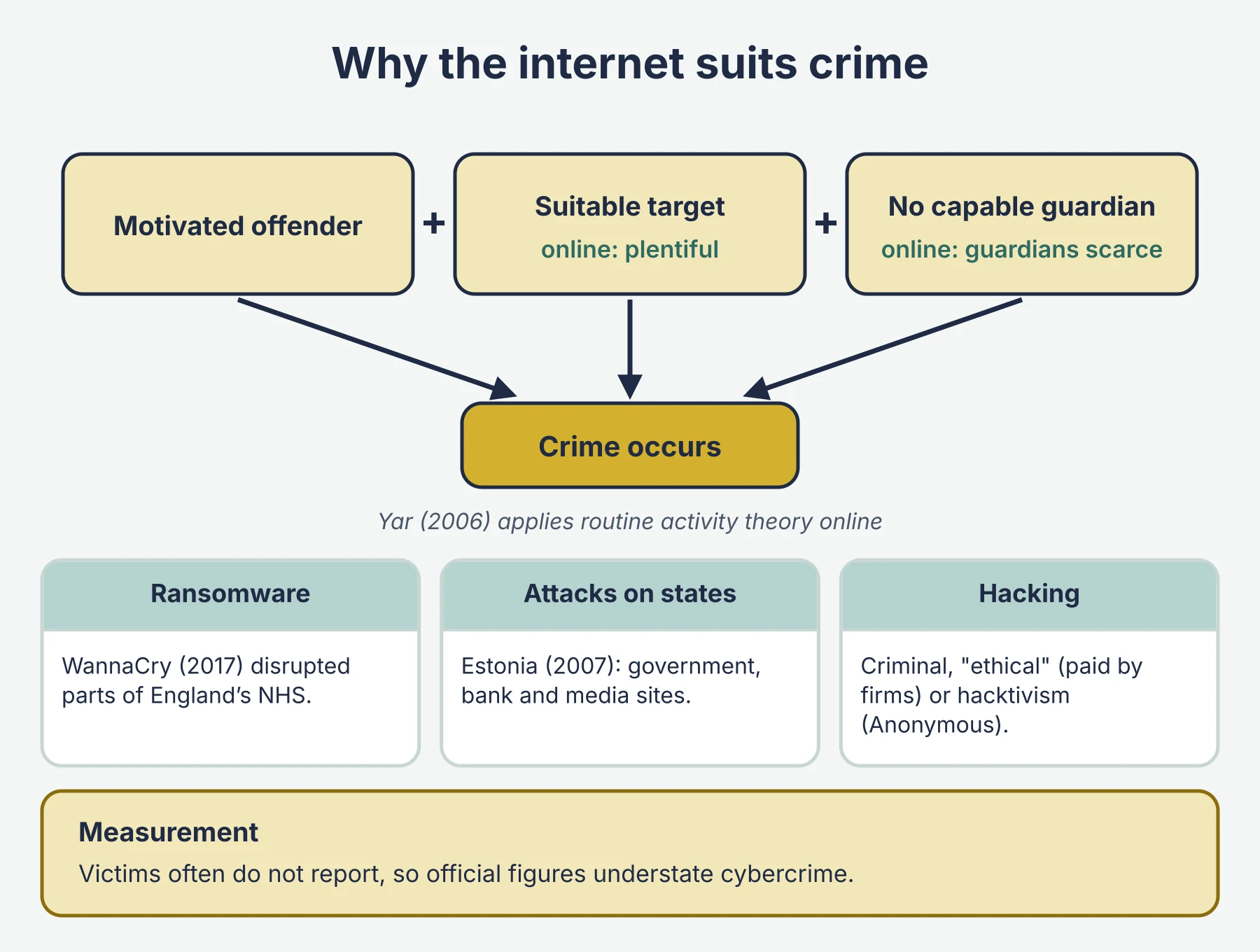
- Scale and anonymity: Majid Yar (Cybercrime and Society, 2006) applied routine activity theory online: crime occurs when a motivated offender meets a suitable target without capable guardianship, and the internet makes targets plentiful and guardians scarce.
- Ransomware: the WannaCry attack of 2017 encrypted computers worldwide and disrupted parts of England’s National Health Service, cancelling appointments.
- Attacks on states: Estonia suffered a wave of cyber attacks on government, bank and media websites in 2007, which led it to invest heavily in cyber defence.
- Hacking ranges from criminal intrusion to “ethical” hacking, paid by firms to find weaknesses, and hacktivism, hacking for political causes, associated with the loose collective Anonymous.
- Cyber security: passwords, encryption, two-factor authentication, laws and international cooperation. Victims often do not report, so official figures understate cybercrime.
Digital divides in depth
Norris’s three divides (in the unit guide) can be deepened:
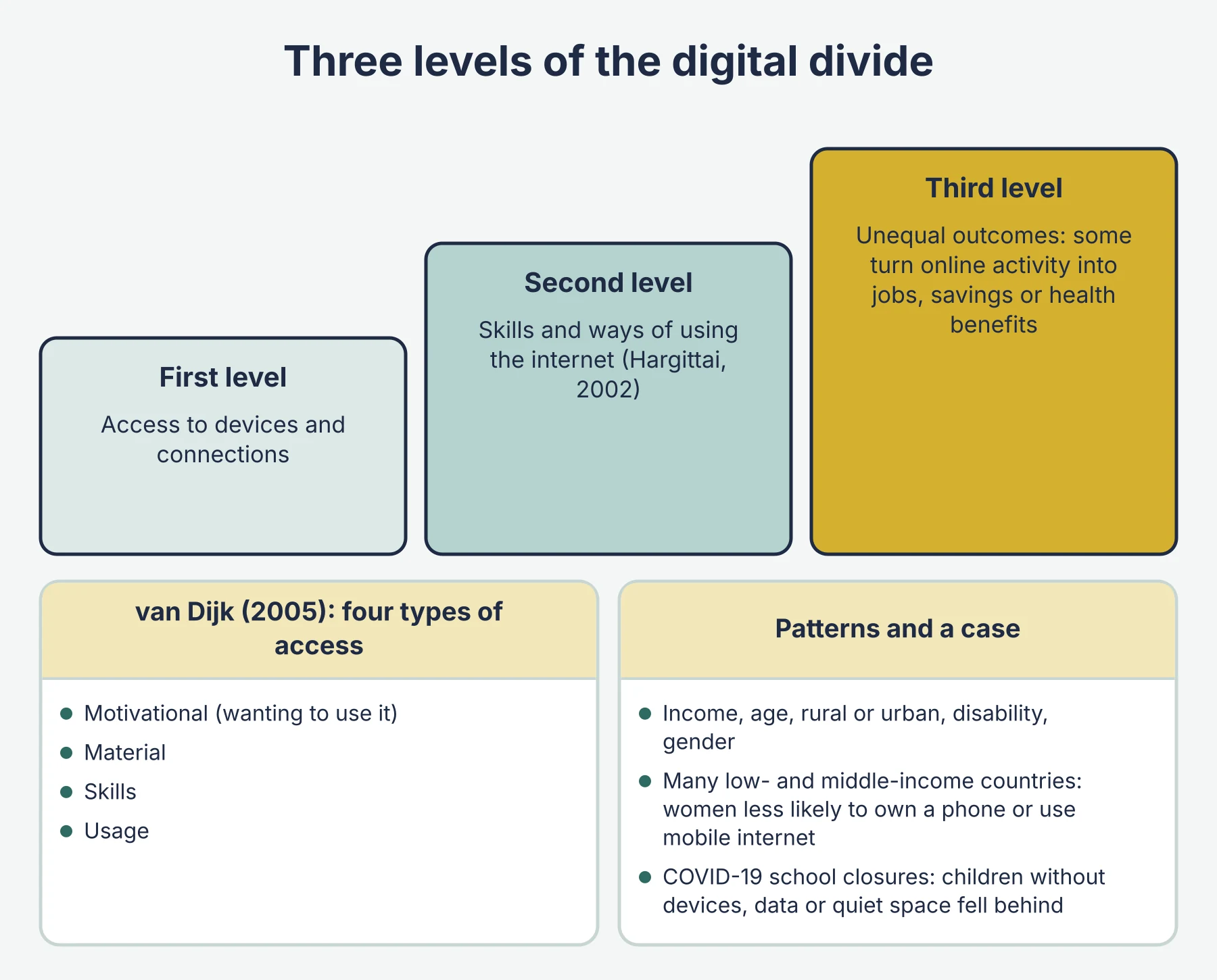
- Levels of the divide: the first level is access to devices and connections; the second level (Eszter Hargittai, 2002) is differences in skills and ways of using the internet; a third level concerns unequal outcomes, as some users turn online activity into jobs, savings or health benefits and others do not.
- Types of access: Jan van Dijk (The Deepening Divide, 2005) separated motivational access (wanting to use technology), material access, skills access and usage access.
- Patterns: divides by income, age, rural or urban location, disability and gender; in many low- and middle-income countries women are less likely than men to own a mobile phone or use mobile internet.
- A case: school closures during the COVID-19 pandemic showed the divide sharply, as children without devices, data or a quiet space fell behind.
Annotated model answer
Extract from a 12-mark answer: Evaluate the view that digital surveillance mainly protects people.
Supporters argue CCTV and data monitoring prevent crime and help find missing people [knowledge]. In my city, cameras at transport hubs are used to trace stolen phones [application]. However, Lyon argues surveillance sorts people into categories, so poorer and minority groups are watched and stopped more [analysis]. Haggerty and Ericson’s surveillant assemblage shows that data collected for one purpose can be combined for others, so protection for some is control for others [evaluation and judgement].
Common mistakes
- Treating moral panics about games as proof of harm.
- Writing about the digital divide as access only; add skills and outcomes.
- Confusing hacking with all cybercrime.
- Using the panopticon for every surveillance example; the assemblage and social sorting often fit better.
- Describing traditional media adapting without evaluating who wins and loses.
Exam technique
Outline questions want a use of technology plus an example; explain questions want its consequence for a social group. In evaluate answers, balance benefits (health, safety, entertainment, access) against control and inequality, and bring in own-society examples of apps, cameras, games or internet access where asked.
Where next
Platforms and social media are in the internet and social and new media; automated decisions and algorithms are in artificial intelligence and cyborgs.
Related resources
-
Practice questions
OxfordAQA International A-level Sociology (9690): Digital technologies – Practice Questions
Original OxfordAQA 9690 practice questions on online games, on-demand media, self-tracking, surveillance, cybercrime and digital divides, with full answers.
Sociology · OxfordAQA · A Level
Try questions -
Revision notes
OxfordAQA International A-level Sociology (9690): Digital technologies – Revision Notes
Revision notes for OxfordAQA 9690 section 3.2.3.4: games, media adapting, self-tracking, social sorting, the surveillant assemblage, cybercrime and divides.
Sociology · OxfordAQA · A Level
Revise topic -
Study guides
OxfordAQA International A-level Sociology (9690): The internet and social and new media
Guide to OxfordAQA 9690 section 3.2.3.3: the internet, changing communication, mental health, platform ownership, misinformation, creators and influencers.
Sociology · OxfordAQA · A Level
Read guide
Related articles
Get free revision emails (optional)
Occasional emails with practice questions, worked explanations and links to free resources for the qualification and subjects you choose. No spam, and you can unsubscribe from any email. The free tools on this site never need an email.