
Revision Notes
OxfordAQA International A-level Sociology (9690): The internet and social and new media – Revision Notes
Revision notes for OxfordAQA 9690 section 3.2.3.3: network society, networked publics, mental health, platform power, filter bubbles and online audiences.
- Subject
- Sociology
- Level
- A LEVEL
- Topic
- Unit 5 – People and Technology
- Author
- Marlbridge Academic Team
- Updated
- Reviewed by
- Naqiya Yousaf (what this means)
Aligned to OxfordAQA A Level Sociology (9690), Version 1.1. Official specification .
Syllabus page (what it covers and how it is assessed): OxfordAQA A Level Sociology.
Syllabus points this page covers
9690 (A Level)
- 3.2.3.3 The internet and social and new media
Found an error? Report a correction.
Need help with this topic? Request a free trial class for A Level Sociology (9690).
These notes condense content point 3.2.3.3 The internet and social and new media of OxfordAQA International A-level Sociology (9690), Version 1.1, assessed in the Unit 5 People and technology exam. Full explanations are in the internet and social media study guide; the rest of the unit is in the People and technology revision notes.
What the specification lists
- The internet: fast global access to information.
- Social and new media: changes in communication; social media and mental health.
- Ownership and control of new and social media.
- Social media and misinformation and disinformation; conspiracy theories.
- Social media and audiences: greater involvement as content creators and citizen journalists; social media influencers.
Core recall
Access to information
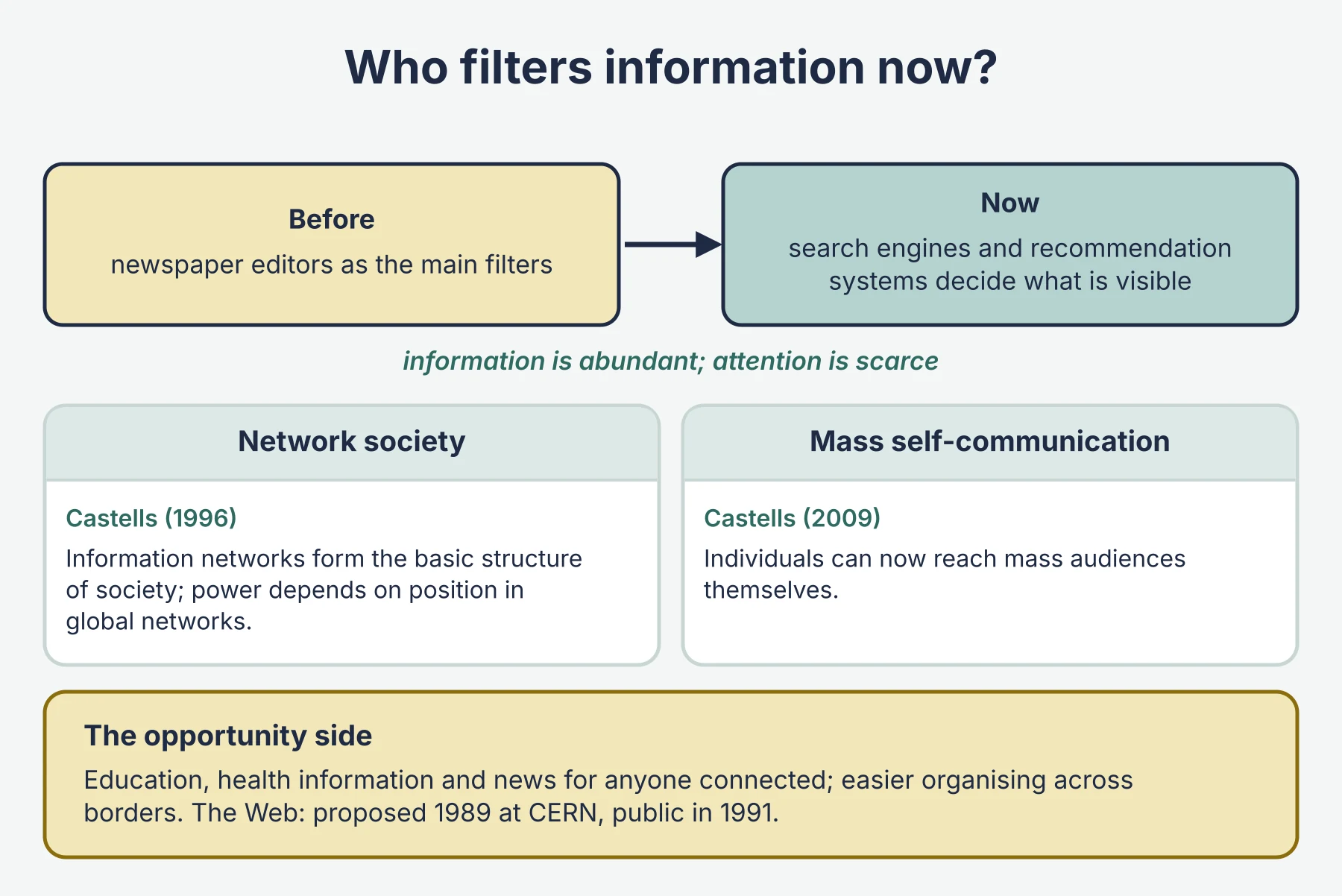
- Berners-Lee proposed the web (1989); public from 1991.
- Castells (1996): network society; (2009) mass self-communication.
- Search and recommendation systems are the new gatekeepers; attention is scarce.
Communication
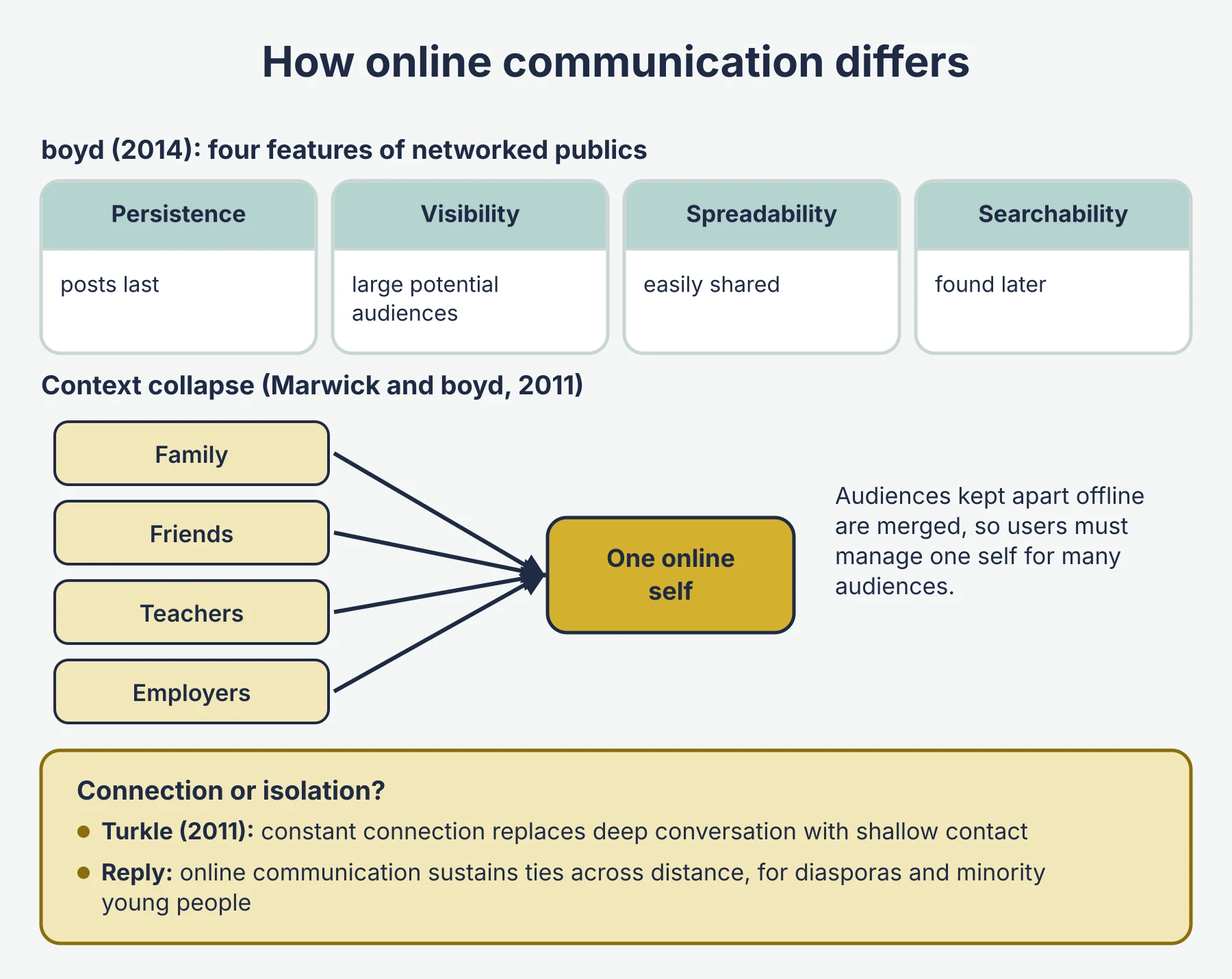
- boyd (2014): networked publics have persistence, visibility, spreadability, searchability.
- Marwick and boyd (2011): context collapse merges separate audiences.
- Turkle (2011): Alone Together, connection without depth.
- Counter: online ties sustain diasporas and support minority young people.
Mental health
- Haidt (2024): smartphones harmed adolescent mental health.
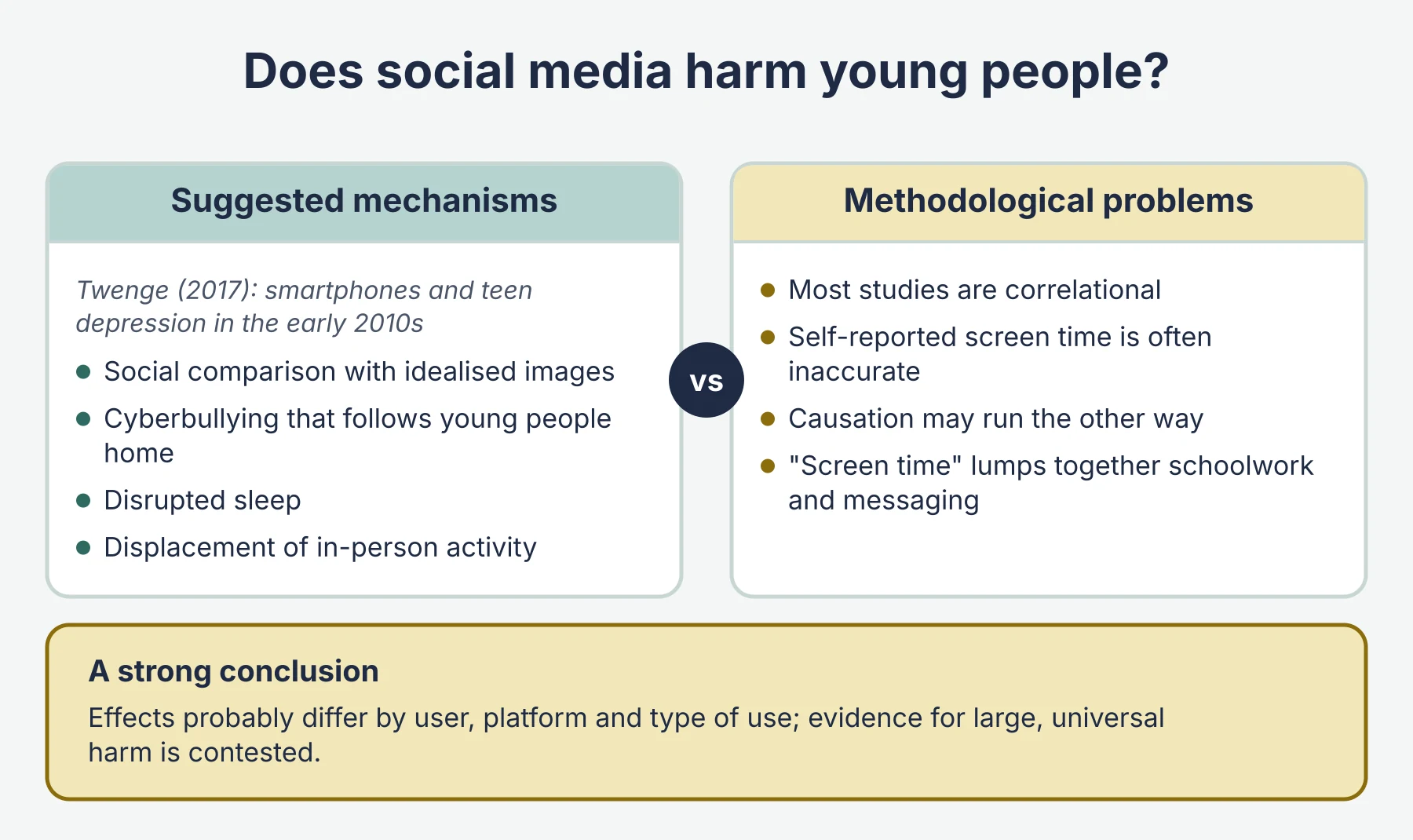
- Twenge (2017): rises in reported teen depression in the early 2010s linked to smartphones.
- Orben and Przybylski (2019): small association only.
- Mechanisms: social comparison, cyberbullying, lost sleep, displaced activity.
- Method problems: correlation, self-reported screen time, reverse causation, “screen time” too broad.
Ownership and control
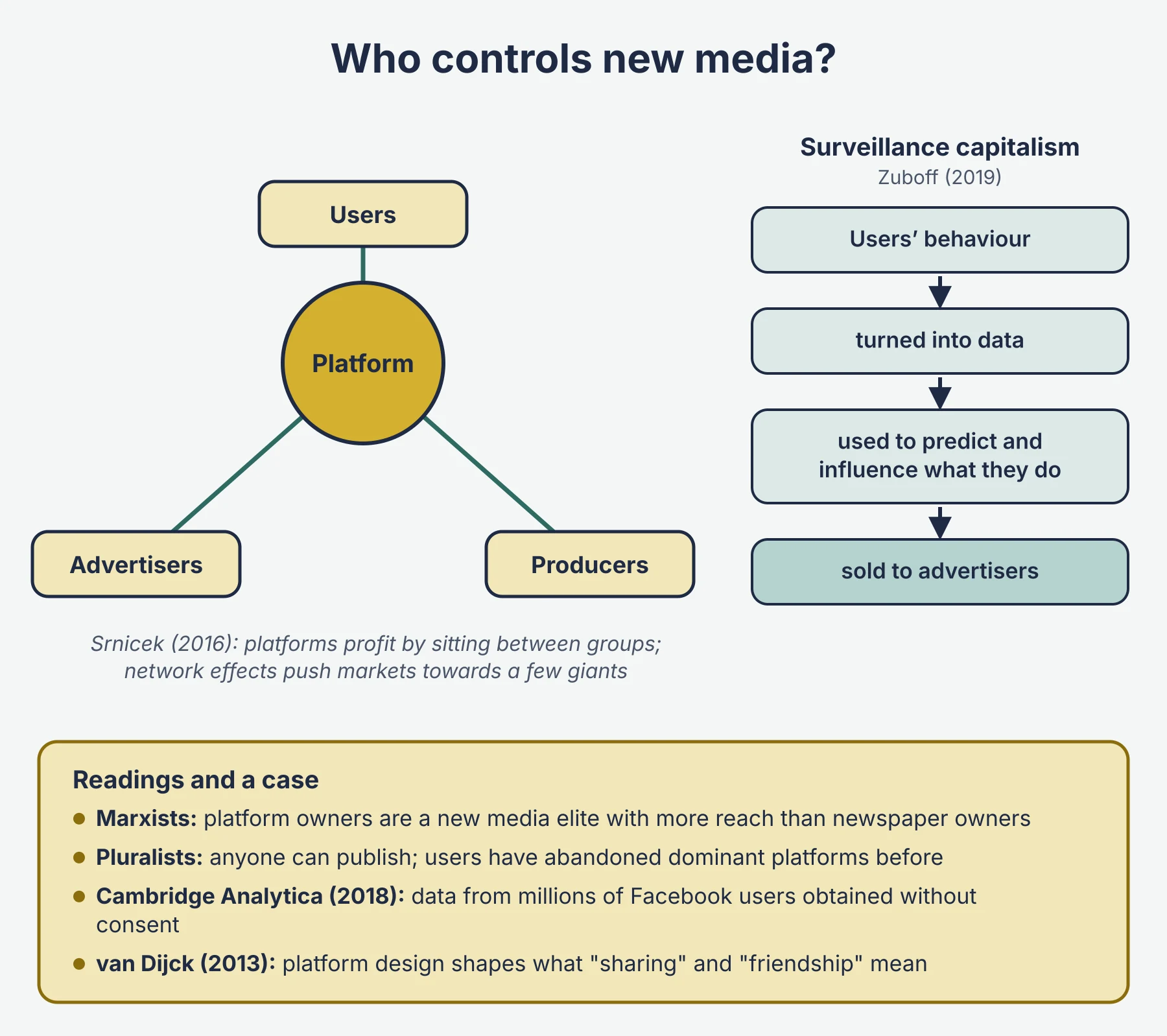
- Srnicek (2016): platform capitalism; network effects favour a few giants.
- Zuboff (2019): surveillance capitalism, behaviour turned into predictions sold to advertisers.
- Van Dijck (2013): platform design shapes the meaning of sharing and friendship.
- Cambridge Analytica (2018): personal data from millions of Facebook users taken without consent.
- Marxist: new media elite. Pluralist: anyone can publish; users leave platforms.
Misinformation and conspiracy
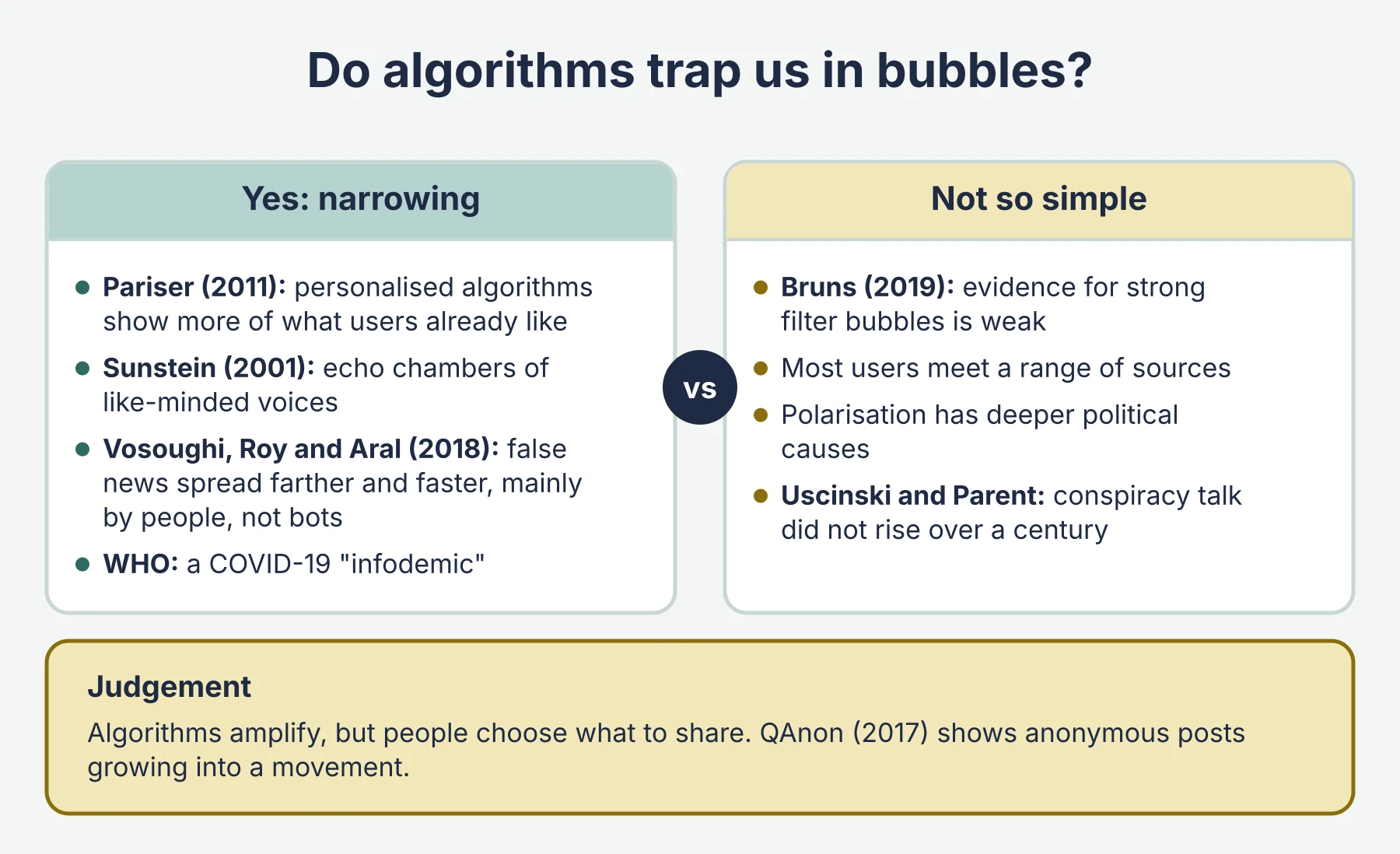
- Pariser (2011): filter bubbles. Sunstein (2001): echo chambers.
- Vosoughi, Roy and Aral (2018): false news spread farther and faster than true news on Twitter, mainly through people.
- WHO: “infodemic” during COVID-19.
- QAnon (2017): online conspiracy movement.
- Uscinski and Parent: no long-term rise in conspiracy talk.
- Bruns (2019): evidence for strong filter bubbles is weak.
Audiences
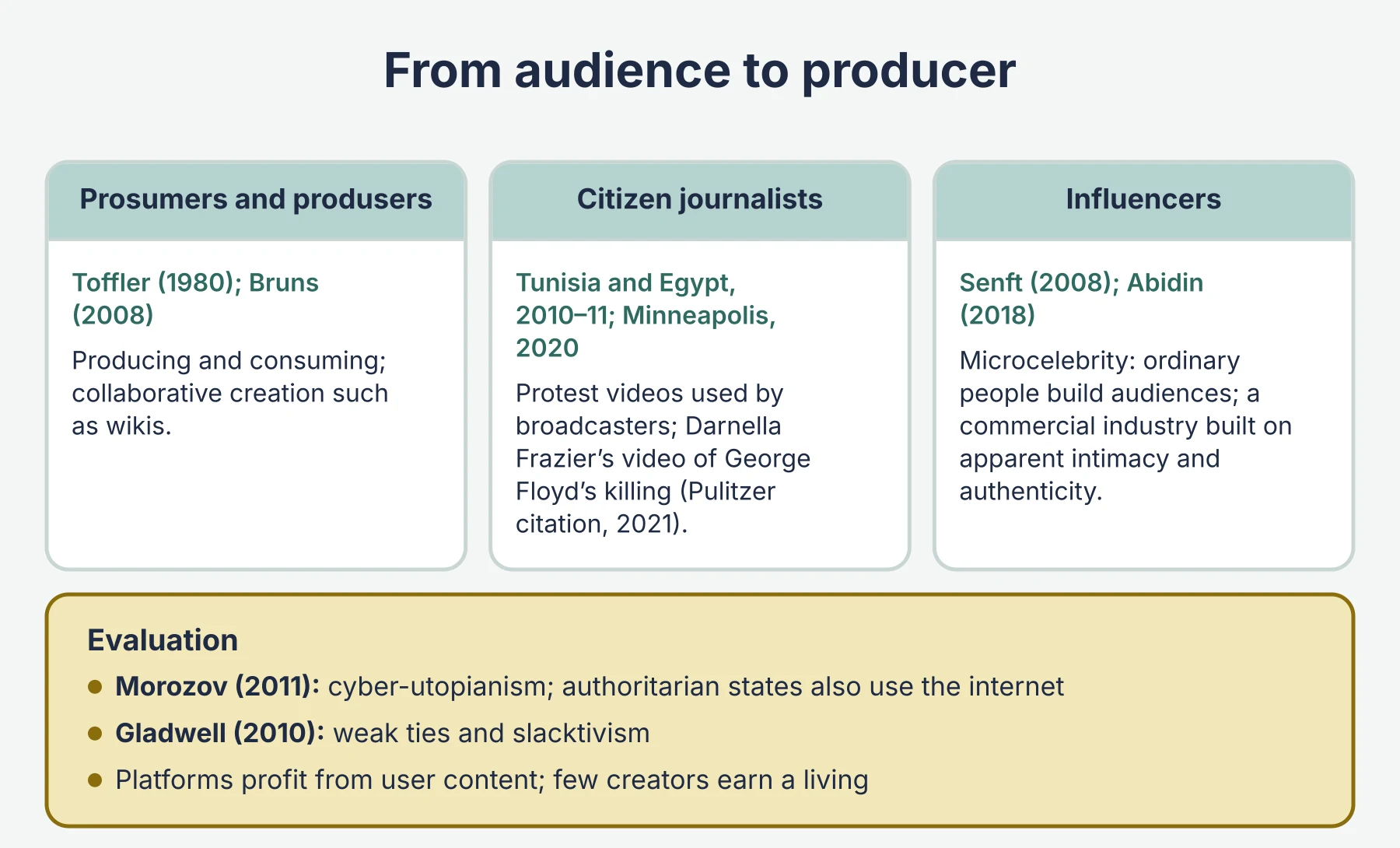
- Toffler (1980): the prosumer. Bruns (2008): produsage.
- Citizen journalism: Tunisia and Egypt (2010 to 2011); George Floyd video (2020), Darnella Frazier’s special Pulitzer citation (2021).
- Senft (2008): microcelebrity. Abidin (2018): influencers as an industry of performed intimacy.
- Morozov (2011): cyber-utopianism criticised. Gladwell (2010): weak ties and slacktivism.
- Platforms profit from user content; few creators earn a living.
Key terms
| Term | Definition |
|---|---|
| Network society | Society structured around information networks (Castells) |
| Mass self-communication | Individuals reaching mass audiences themselves (Castells) |
| Networked publics | Online spaces with persistence, visibility, spreadability, searchability (boyd) |
| Context collapse | Merging of separate audiences in one online space |
| Platform capitalism | Profit from controlling digital platforms between users, advertisers and producers |
| Network effects | A service becoming more valuable as more people use it |
| Surveillance capitalism | Profit from turning behaviour into predictive data (Zuboff) |
| Filter bubble | Personalised content narrowing what users see (Pariser) |
| Echo chamber | Group in which members mainly hear like-minded views |
| Infodemic | Overabundance of information, including false information |
| Prosumer | Person who both produces and consumes |
| Citizen journalist | Non-professional who reports news events |
| Microcelebrity | Ordinary person building an audience online (Senft) |
| Slacktivism | Low-cost online support with little real effect |
| Cyber-utopianism | Belief that the internet naturally empowers citizens |
Linking points
- To ‘traditional’ media: Marxist and pluralist debates about owners carry over to platform owners; compare allocative control with control of algorithms.
- To migration: messaging and video calls sustain diaspora networks and transnational families, which is evidence for Unit 3.
- To identity: context collapse and networked publics link to AS-level work on how identities are presented and managed.
Exam traps
- Mental health effects are contested: give both sides and the method problems.
- Filter bubbles are a claim, not a fact: use Bruns to evaluate.
- Not every creator is a citizen journalist; that term means reporting news events.
- Ownership questions need platform owners and algorithms, not only newspaper owners.
- Avoid technological determinism: people choose what to share.
- Distinguish misinformation (no intent) from disinformation (deliberate).
Self-test
- What did Castells mean by mass self-communication?
- Name boyd’s four features of networked publics.
- What is context collapse?
- Give two methodological problems with research on social media and mental health.
- What are network effects and why do they matter for ownership?
- What did Zuboff mean by surveillance capitalism?
- What happened in the Cambridge Analytica case?
- What did Vosoughi, Roy and Aral find?
- What did Bruns argue about filter bubbles?
- Give one example of citizen journalism.
- Who coined “microcelebrity”?
- What did Morozov criticise?
Answers
- Individuals can now reach mass audiences themselves through digital networks.
- Persistence, visibility, spreadability, searchability.
- Separate audiences (family, friends, employers) merge in one online space.
- Any two: correlation not causation; inaccurate self-reported screen time; reverse causation; “screen time” covers very different activities.
- A platform becomes more valuable as more people use it, so markets tend towards a few giants.
- Platforms turn users’ behaviour into data used to predict and influence what they do, sold to advertisers.
- A political consultancy obtained personal data from millions of Facebook users without their consent (revealed 2018).
- False news spread farther and faster than true news on Twitter, mainly through people rather than bots.
- Evidence for strong filter bubbles is weak; most users see a range of sources.
- Protesters’ videos in Tunisia and Egypt (2010 to 2011), or the George Floyd video (2020).
- Theresa Senft (2008).
- Cyber-utopianism, the belief that the internet naturally empowers citizens.
Apply these with the internet and social media practice questions.
Related resources
-
Study guides
OxfordAQA International A-level Sociology (9690): Pre-and non-digital technologies
Guide to OxfordAQA 9690 section 3.2.3.1: machines and work, mobilities and mass transport, consumerism, and technological determinism versus constructionism.
Sociology · OxfordAQA · A Level
Read guide -
Practice questions
OxfordAQA International A-level Sociology (9690): Pre-and non-digital technologies – Practice Questions
Original OxfordAQA 9690 practice questions on machines and work, Fordism, emotional labour, mobilities, consumption and theories of technology, with answers.
Sociology · OxfordAQA · A Level
Try questions -
Revision notes
OxfordAQA International A-level Sociology (9690): Pre-and non-digital technologies – Revision Notes
Revision notes for OxfordAQA 9690 section 3.2.3.1: Taylorism, Fordism, emotional labour, railways and cars, consumerism, and determinism versus construction.
Sociology · OxfordAQA · A Level
Revise topic
Related articles
Get free revision emails (optional)
Occasional emails with practice questions, worked explanations and links to free resources for the qualification and subjects you choose. No spam, and you can unsubscribe from any email. The free tools on this site never need an email.