
Revision Notes
OxfordAQA International GCSE Business (9225): Globalisation – Revision Notes
Revision notes for OxfordAQA IGCSE Business 9225 section 3.2.4: forms of globalisation, four-viewpoint benefits and drawbacks, exchange rates and a self-test.
- Subject
- Business
- Level
- IGCSE
- Topic
- Influences on business
- Author
- Marlbridge Academic Team
- Updated
- Reviewed by
- Salman Ahmad (what this means)
Aligned to OxfordAQA IGCSE Business (9225), First teaching September 2020, first examined May/June 2022. Official specification .
Syllabus page (what it covers and how it is assessed): OxfordAQA IGCSE Business.
Syllabus points this page covers
9225
- 3.2.4 Globalisation
Found an error? Report a correction.
Need help with this topic? Request a free trial class for IGCSE Business (9225).
Condensed recall for section 3.2.4. For full explanations and the worked example, use the Globalisation study guide. Figures are invented.
What the specification asks
- Forms of globalisation: specialisation by country, relative cost advantage, movement of labour, larger markets, international competition.
- Benefits and drawbacks for businesses and economies in developed and developing countries.
- Impact of exchange rates on the profit and sales of importers and exporters.
- Effects of severe fluctuations in exchange rates.
- No exchange-rate conversion calculations.
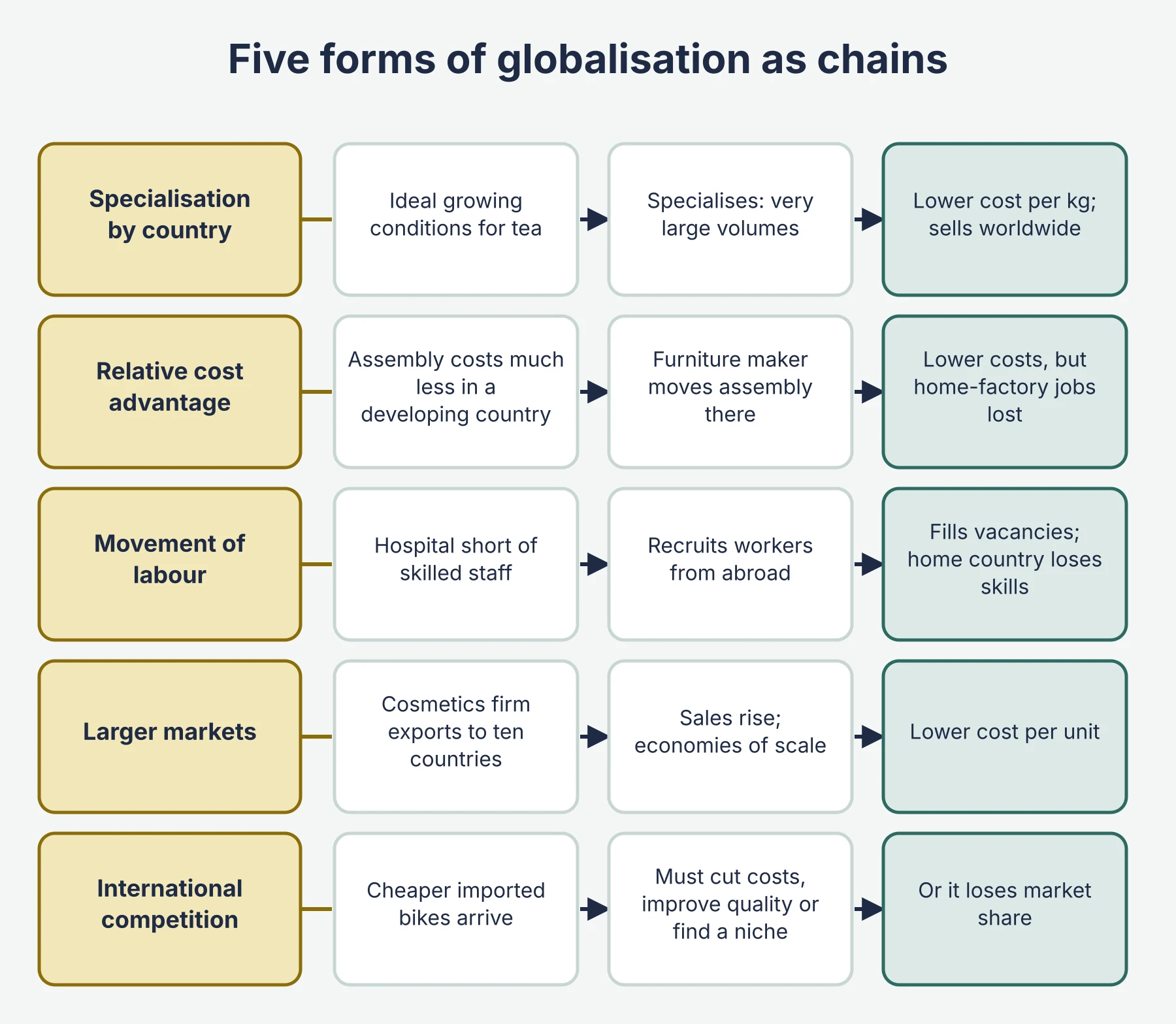
Five forms in one line each
| Form | One-line meaning | Typical business effect |
|---|---|---|
| Specialisation by country | Countries focus on what they produce best and trade for the rest | Large volumes, low unit costs for specialists |
| Relative cost advantage | Some countries can produce more cheaply | Production moves to lower-cost countries |
| Movement of labour | Workers move abroad for work | Wider pool of skills for employers |
| Larger markets | Businesses can sell worldwide | More sales; economies of scale |
| International competition | Foreign firms sell in the home market | Pressure on price, quality and survival |
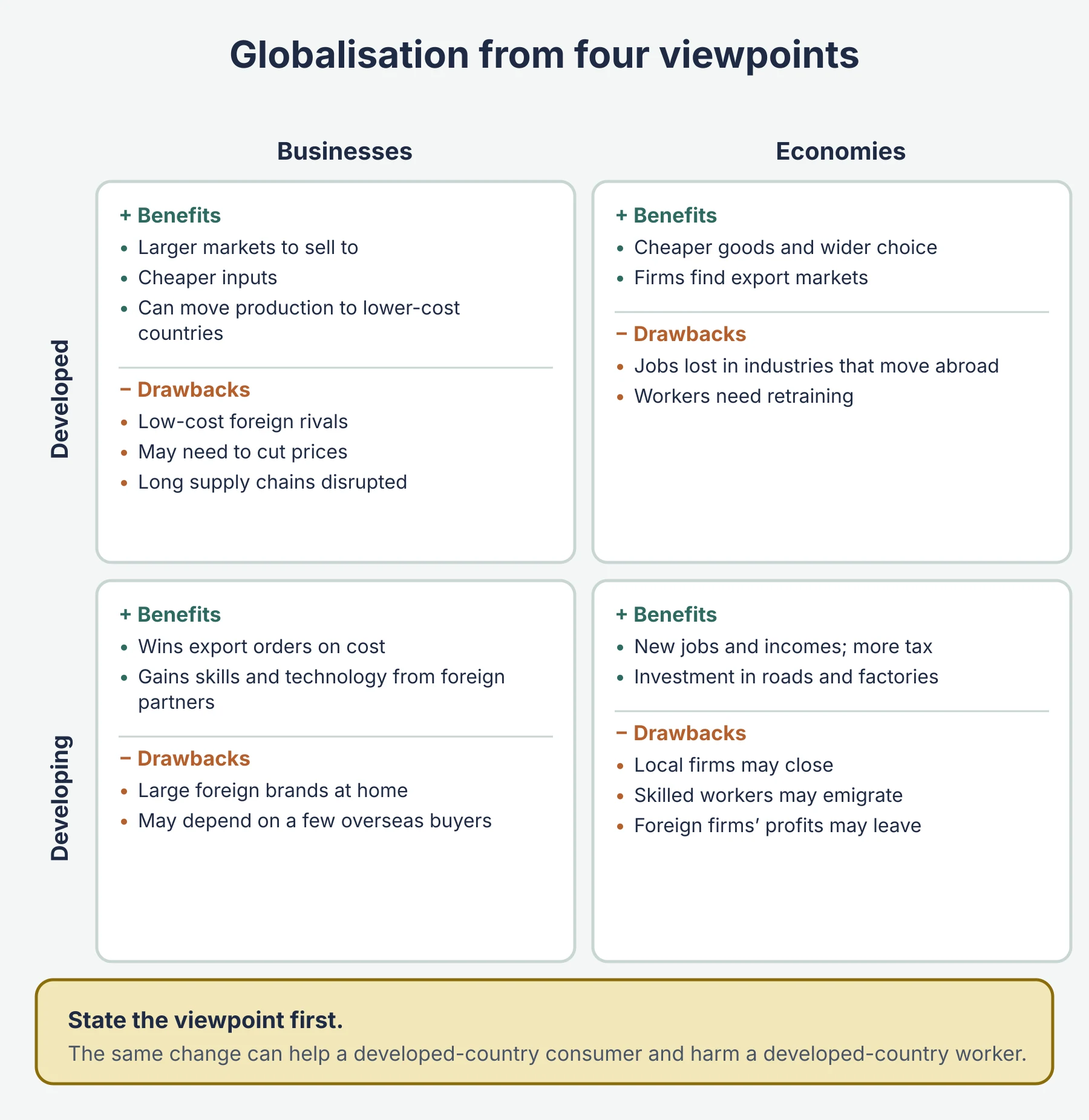
Four viewpoints
| Main benefit | Main drawback | |
|---|---|---|
| Developed-country business | Bigger markets; cheaper inputs | Low-cost foreign rivals |
| Developing-country business | Export orders from cost advantage | Competition from big foreign brands |
| Developed economy | Cheaper goods, wider choice | Jobs lost as production moves abroad |
| Developing economy | Jobs, incomes, tax, investment | Local firms close; skilled workers leave; profits flow abroad |
Answer frame: viewpoint → form of globalisation → effect on costs, sales or jobs → consequence.
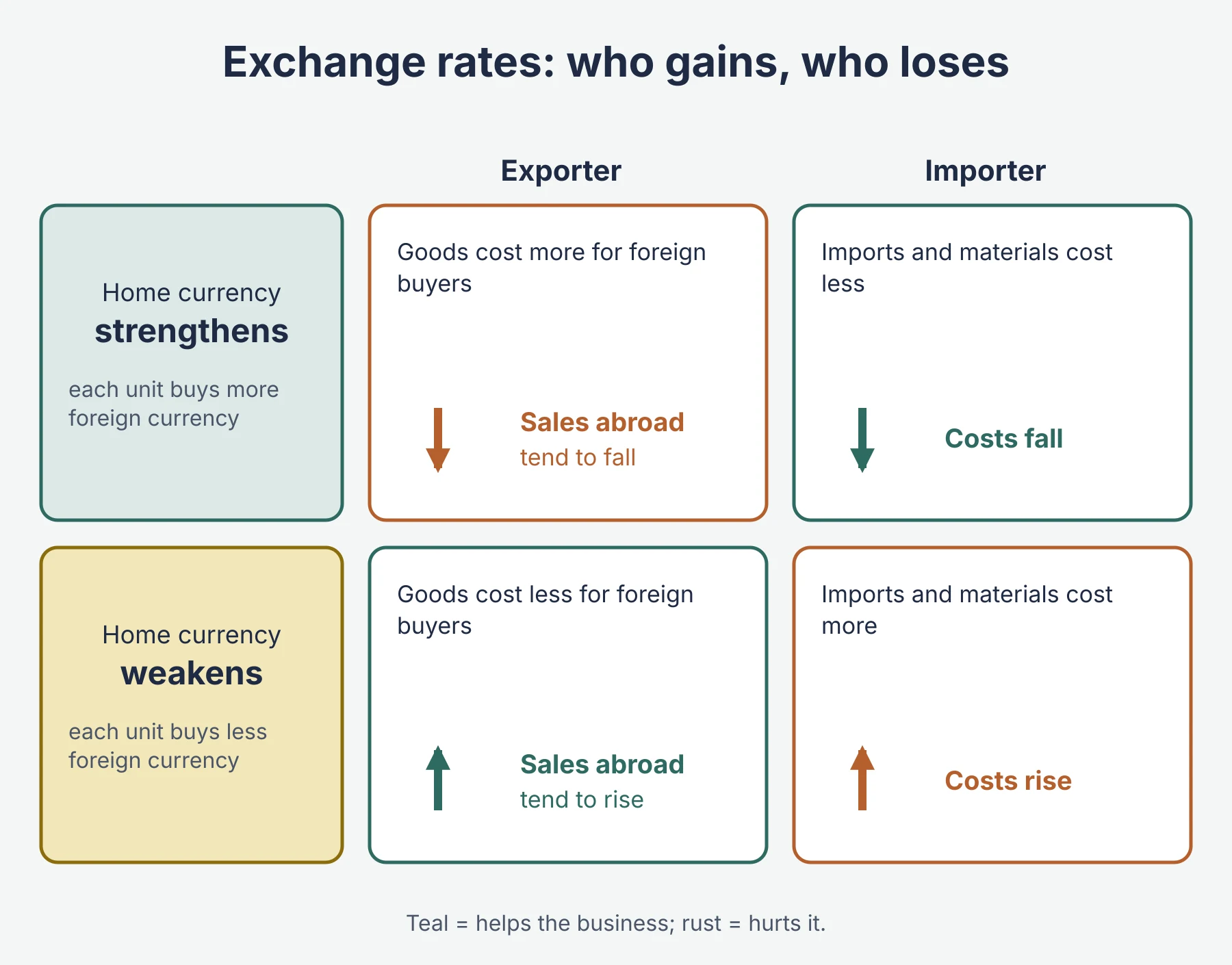
Exchange rates
| Home currency | Exporter | Importer |
|---|---|---|
| Strengthens | Dearer abroad → sales fall (or price cut → profit per unit falls) | Imports cheaper → costs fall → profit rises |
| Weakens | Cheaper abroad → sales rise | Imports dearer → costs rise → profit falls unless price rises |
Businesses that both import and export feel two effects that pull in opposite directions; judge which is larger from the case.
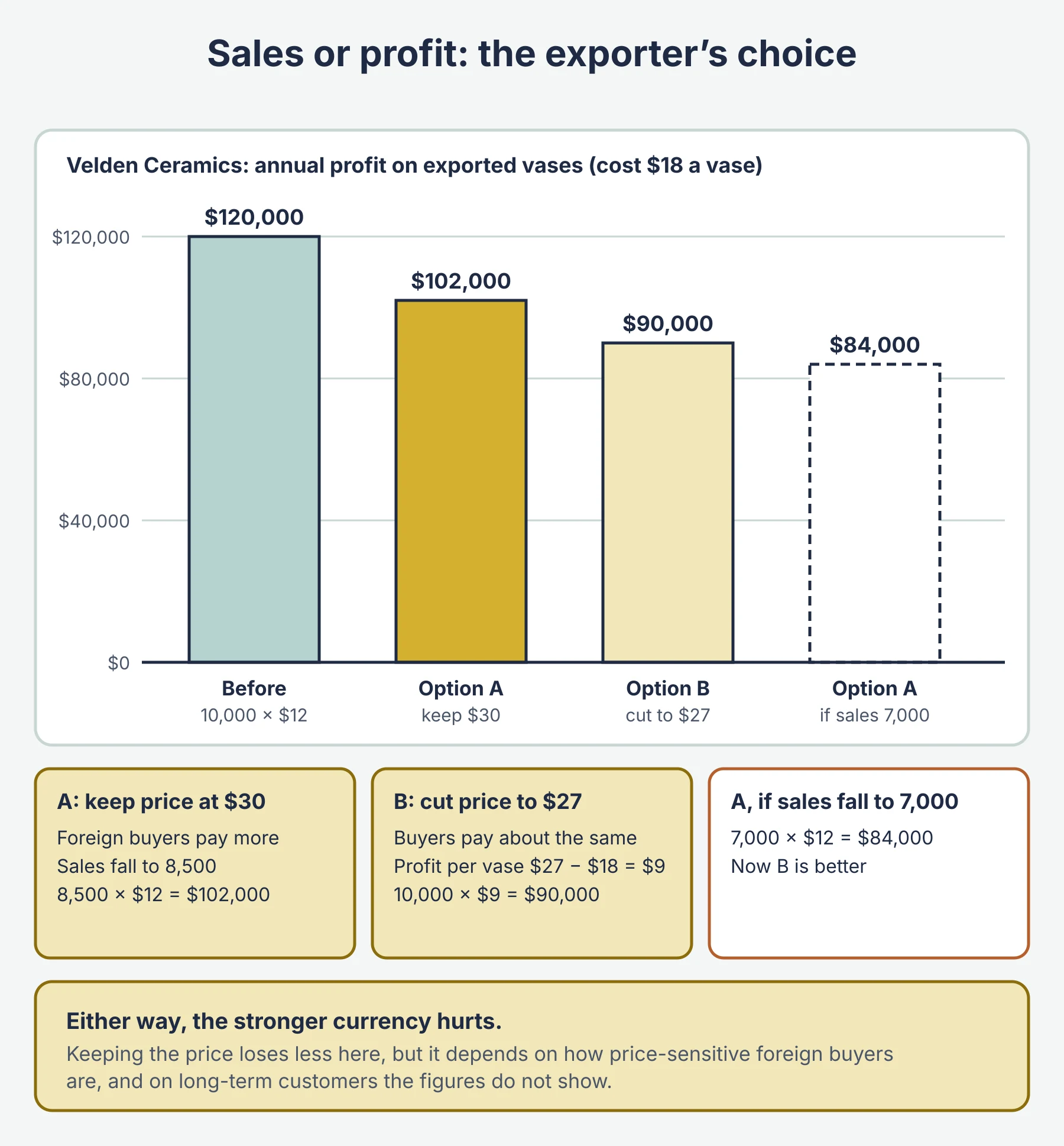
The exporter’s choice when its currency strengthens: keep the home price and lose sales, or cut the home price and lose profit per unit.
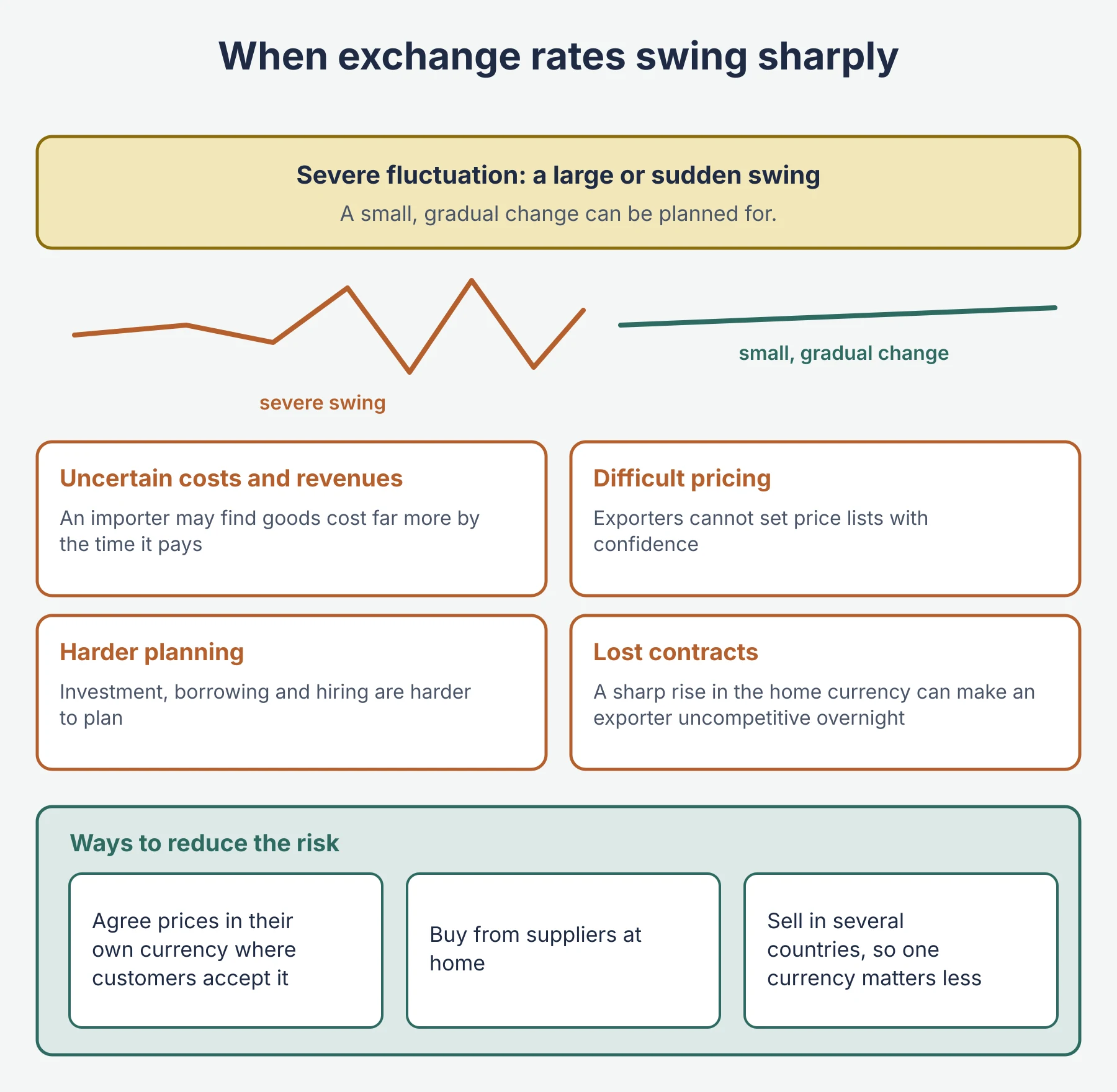
Severe fluctuations
- Costs can change between ordering and paying.
- Price lists are hard to set.
- Profit becomes uncertain, so planning, borrowing and hiring are harder.
- Contracts can be lost suddenly.
- Responses: agree prices in home currency; buy from home suppliers; sell in several countries.
Judging how much a currency change matters
Ask three questions about the business in the case: what share of its sales are exports; what share of its costs are imports; and how sensitive its foreign customers are to price. A firm that exports most of its output but buys few imports is hit hard by a stronger home currency; one that both imports and exports may find the effects partly cancel out.
Key terms
| Term | Meaning |
|---|---|
| Globalisation | Countries becoming more closely linked through trade, investment and movement of people |
| Specialisation by country | A country concentrating on producing particular goods |
| Relative cost advantage | Being able to produce at lower cost than other countries |
| Movement of labour | Workers moving between countries for jobs |
| Developed country | A country with high average incomes and established industries |
| Developing country | A country with lower average incomes that is building its industries |
| Exchange rate | The price of one currency in terms of another |
| Exporter | A business that sells goods or services to other countries |
| Importer | A business that buys goods or services from other countries |
| Severe fluctuation | A large or sudden change in an exchange rate |
Exam traps
- Direction: strong home currency hurts exporters and helps importers; weak home currency does the opposite.
- Say whether you mean sales or profit: a currency change can hit one, the other or both.
- Keep business and economy points apart.
- Name the form of globalisation exactly as the specification does.
- Do not convert currencies; explain direction and effect.
- Globalisation brings both opportunity and threat to the same business.
Self-test
- State the five forms of globalisation named in the specification.
- Give one benefit of globalisation for a business in a developing country.
- Give one drawback of globalisation for a developed economy.
- What is meant by relative cost advantage?
- The home currency weakens. Is this good or bad for an exporter’s sales? Why?
- The home currency weakens. What happens to an importer’s costs?
- An exporter’s currency strengthens. State its two pricing options.
- An exporter sells 6,000 units at a profit of $5 each. After its currency strengthens, sales fall to 5,000. Calculate the fall in profit.
- Give two effects of severe exchange-rate fluctuations on a business.
- Give one way a business can reduce exchange-rate risk.
- How can movement of labour help a business?
- Why might international competition benefit consumers?
Answers
- Specialisation by country, relative cost advantage, movement of labour, larger markets, international competition.
- It can win export orders because its costs are lower (or gain skills and investment from foreign partners).
- Jobs may be lost as production moves to lower-cost countries.
- Being able to produce a good more cheaply than businesses in other countries, for example because of lower wages.
- Good: its goods become cheaper for foreign buyers, so sales abroad tend to rise.
- They rise, because imported goods cost more in home currency.
- Keep its home-currency price and accept lower sales, or cut its home-currency price and accept lower profit per unit.
- 6,000 × $5 = $30,000; 5,000 × $5 = $25,000; fall = $5,000.
- Any two: uncertain costs, difficult pricing, harder planning, sudden loss of contracts.
- Agree prices in its own currency (or buy from home suppliers, or sell in several countries).
- It gives access to a wider pool of skilled workers to fill vacancies.
- Rivals from abroad push prices down and quality up, and give wider choice.
Related resources
-
Study guides
OxfordAQA International GCSE Business (9225): Legislation
Study guide to OxfordAQA IGCSE Business 9225 section 3.2.5 Legislation: employment, health and safety and consumer law, minimum wage and compliance costs.
Business · OxfordAQA · IGCSE
Read guide -
Practice questions
OxfordAQA International GCSE Business (9225): Legislation – Practice Questions
Twelve original questions with answers on employment, health and safety and consumer law and the national minimum wage for OxfordAQA IGCSE Business 9225 3.2.5.
Business · OxfordAQA · IGCSE
Try questions -
Revision notes
OxfordAQA International GCSE Business (9225): Legislation – Revision Notes
Revision notes for OxfordAQA IGCSE Business 9225 section 3.2.5: employment, health and safety and consumer law, minimum wage and a self-test.
Business · OxfordAQA · IGCSE
Revise topic
Get free revision emails (optional)
Occasional emails with practice questions, worked explanations and links to free resources for the qualification and subjects you choose. No spam, and you can unsubscribe from any email. The free tools on this site never need an email.