
Revision Notes
OxfordAQA International GCSE Business (9225): Legislation – Revision Notes
Revision notes for OxfordAQA IGCSE Business 9225 section 3.2.5: employment, health and safety and consumer law, minimum wage and a self-test.
- Subject
- Business
- Level
- IGCSE
- Topic
- Influences on business
- Author
- Marlbridge Academic Team
- Updated
- Reviewed by
- Salman Ahmad (what this means)
Aligned to OxfordAQA IGCSE Business (9225), First teaching September 2020, first examined May/June 2022. Official specification .
Syllabus page (what it covers and how it is assessed): OxfordAQA IGCSE Business.
Syllabus points this page covers
9225
- 3.2.5 Legislation
Found an error? Report a correction.
Need help with this topic? Request a free trial class for IGCSE Business (9225).
Condensed recall for section 3.2.5. For full explanations and worked examples, use the Legislation study guide. Figures are invented.
What the specification asks
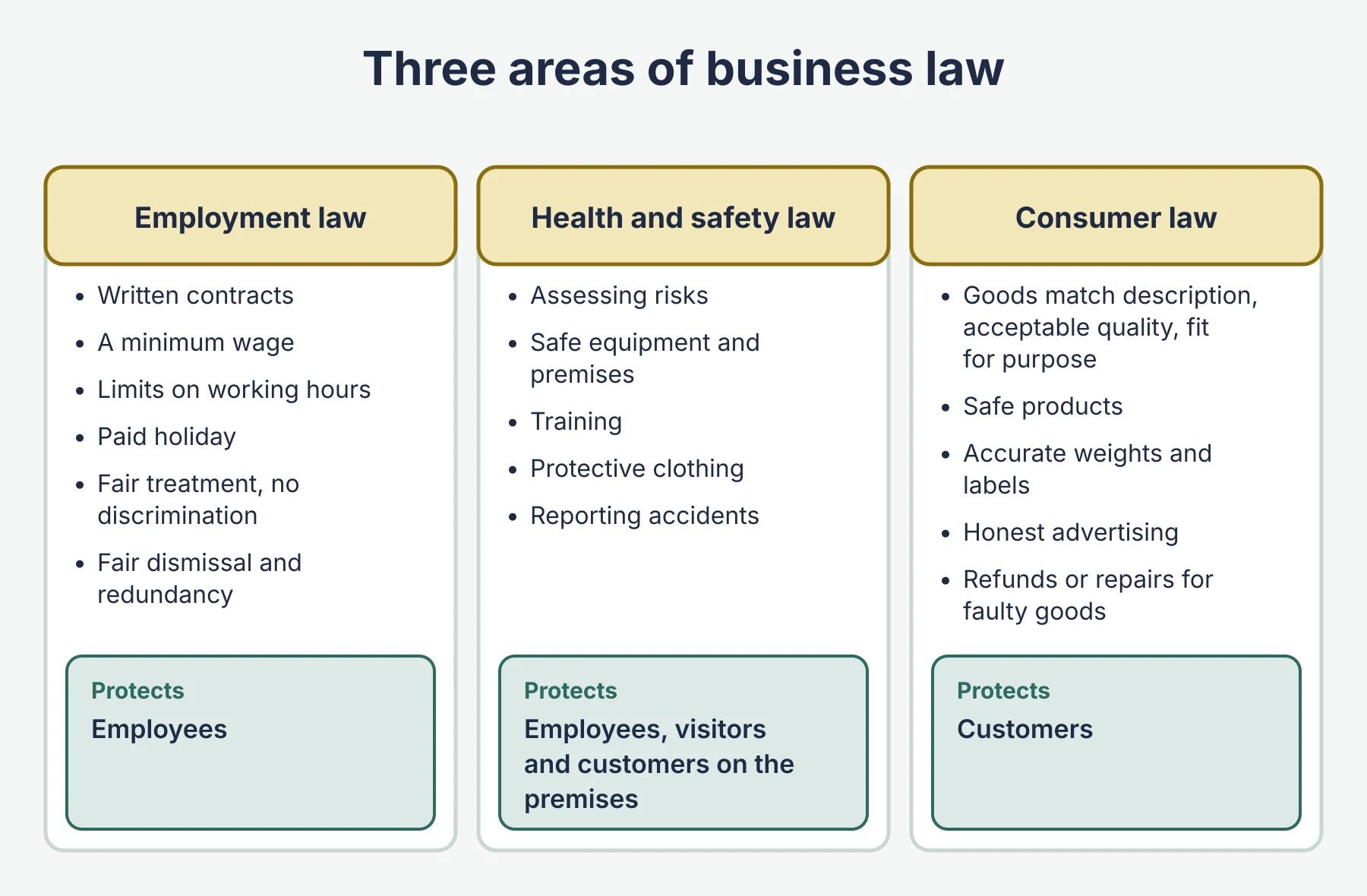
- Three areas: employment law, health and safety law, consumer law.
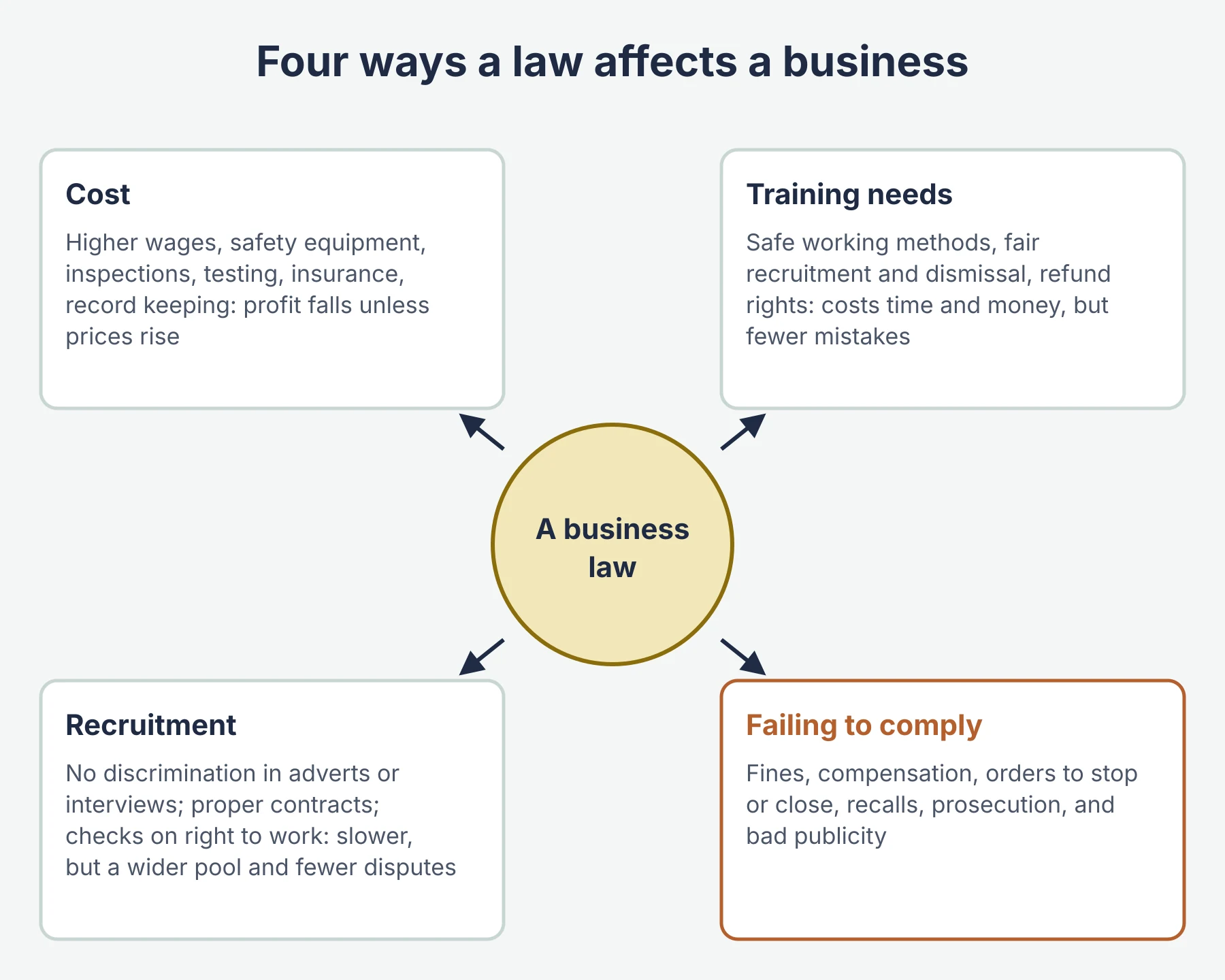
- Assess the impact on businesses: cost, training needs, recruitment, consequences of failure to follow legislation.
- Benefits and drawbacks of laws requiring a safe working environment and a national minimum wage.
- How consumer protection laws affect businesses.
Laws differ between countries; apply general ideas to the business described.
The three areas
| Area | Typical requirements | Example of business action |
|---|---|---|
| Employment | Contracts, minimum wage, hours limits, paid holiday, no discrimination, fair dismissal | Issue written contracts; check pay rates; train managers in fair recruitment |
| Health and safety | Risk assessments, safe equipment, training, protective clothing, accident reports | Fit machine guards; run safety training; keep an accident log |
| Consumer | Goods as described, acceptable quality, fit for purpose, safe; accurate labels; honest adverts; refunds or repairs | Test products; check labels; set up a returns desk |
Four headings for any “assess the impact” question
- Cost: wages, equipment, testing, inspections, records.
- Training needs: safe methods, fair recruitment, refund rules.
- Recruitment: non-discriminatory adverts and interviews, contracts, right-to-work checks.
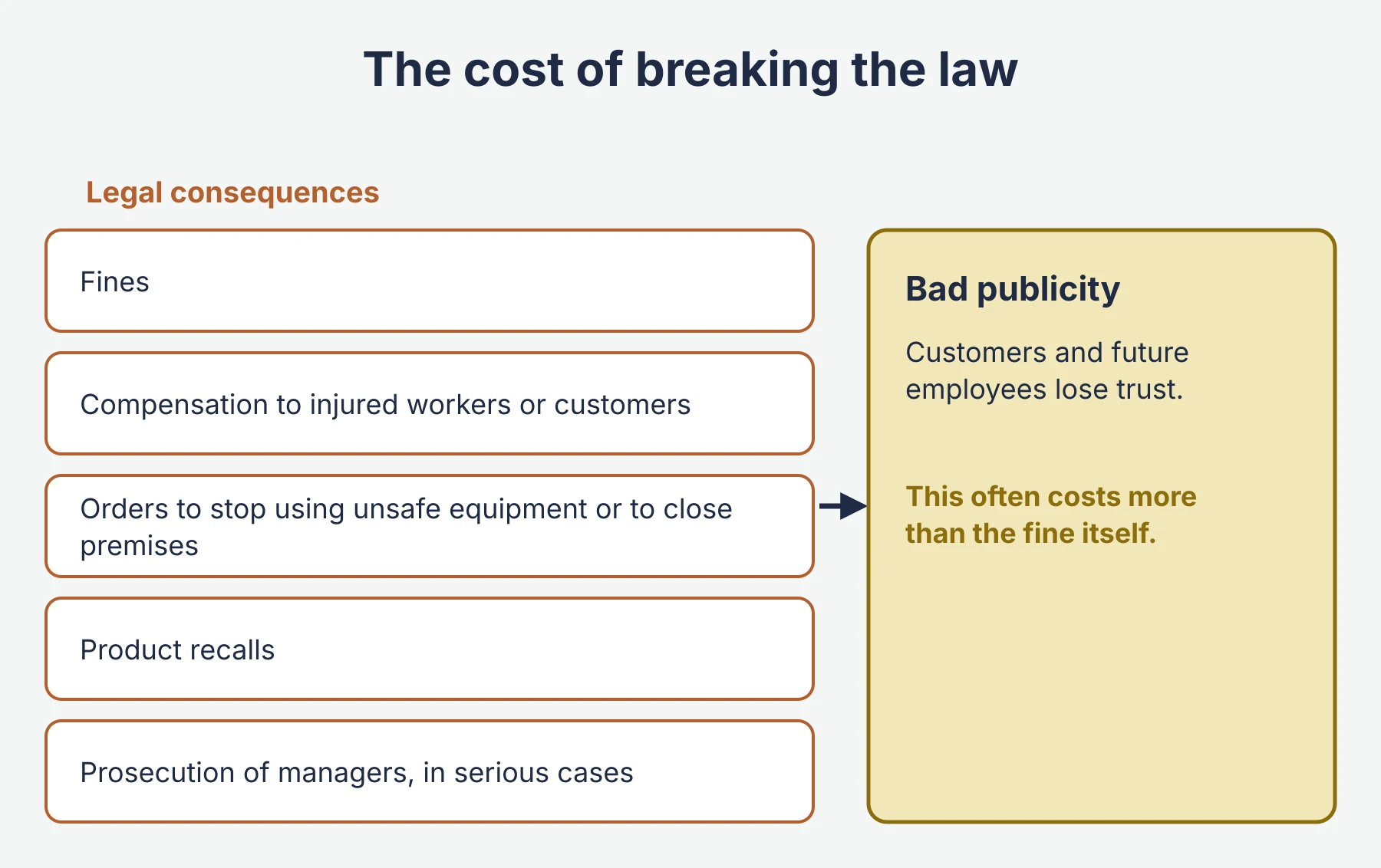
- Consequences of failure: fines, compensation, closure orders, recalls, prosecution, reputation damage.
Safe working environment
| Benefits | Drawbacks |
|---|---|
| Fewer accidents and absences | Equipment and inspection costs |
| Fewer fines and claims | Training time and paperwork |
| Better morale and retention | Some rules slow production |
| Easier recruitment | Harder for small firms to afford |
National minimum wage
| Benefits | Drawbacks |
|---|---|
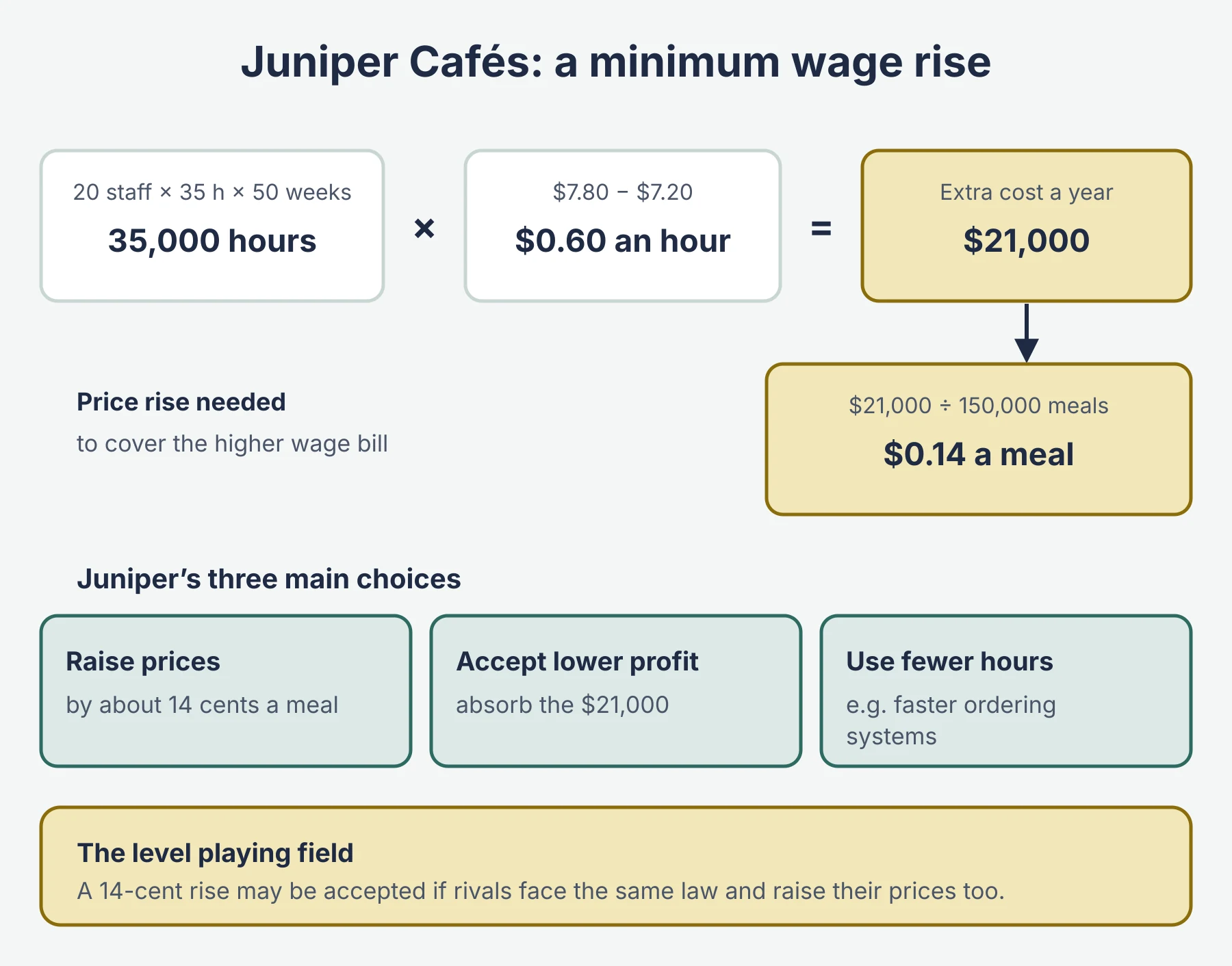
| More motivated staff, lower turnover | Higher wage bill |
| Lower recruitment and training costs | Price rises may lose customers |
| Level playing field: rivals cannot pay less | Pressure to raise pay for higher grades too |
| Low-paid customers have more to spend | Hours or jobs may be cut |
Calculation method: extra cost = number of staff × hours each × weeks × increase per hour.
Consumer protection
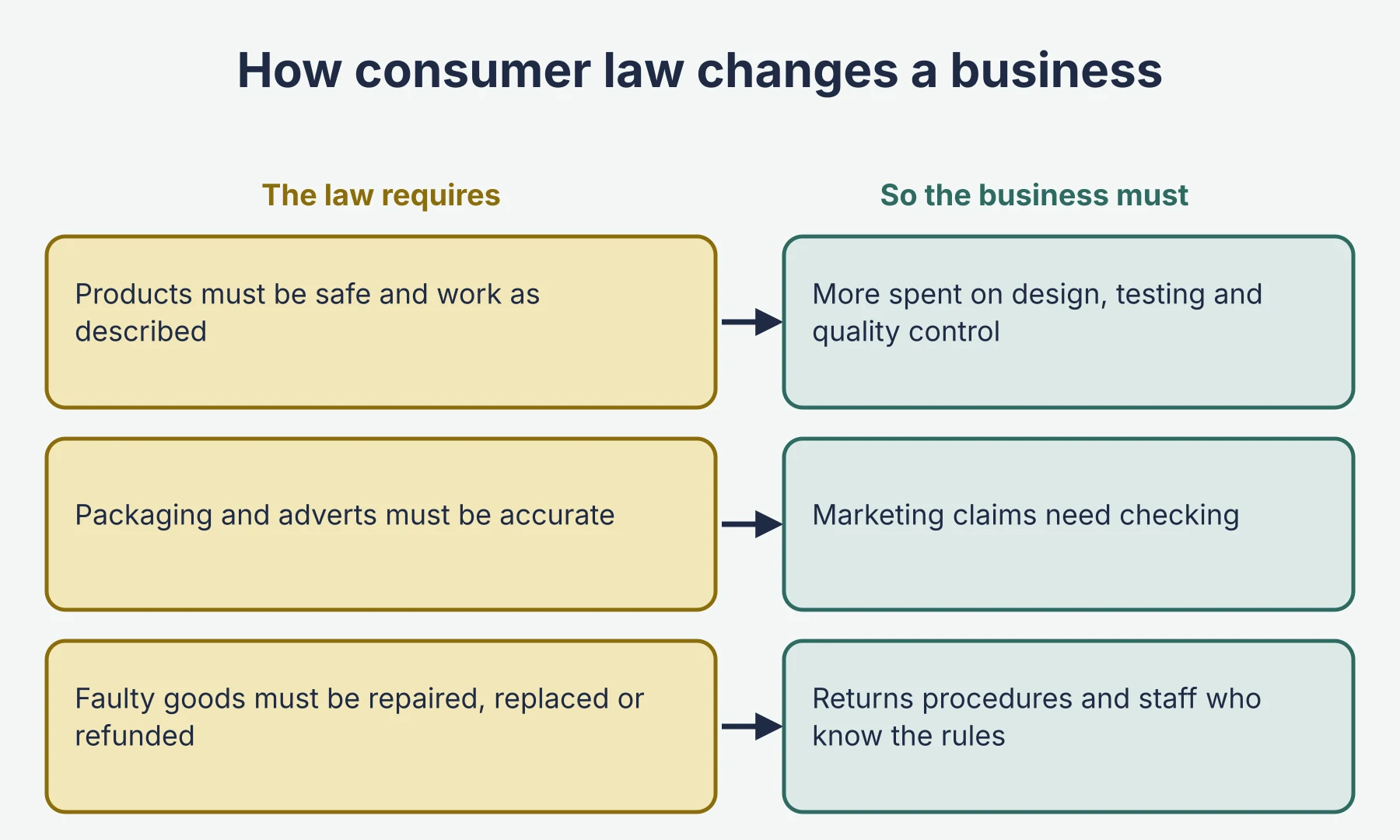
- Product design and testing cost more, but returns fall.
- Marketing claims and labels must be checked.
- Faulty goods: repair, replace or refund, so a returns system is needed.
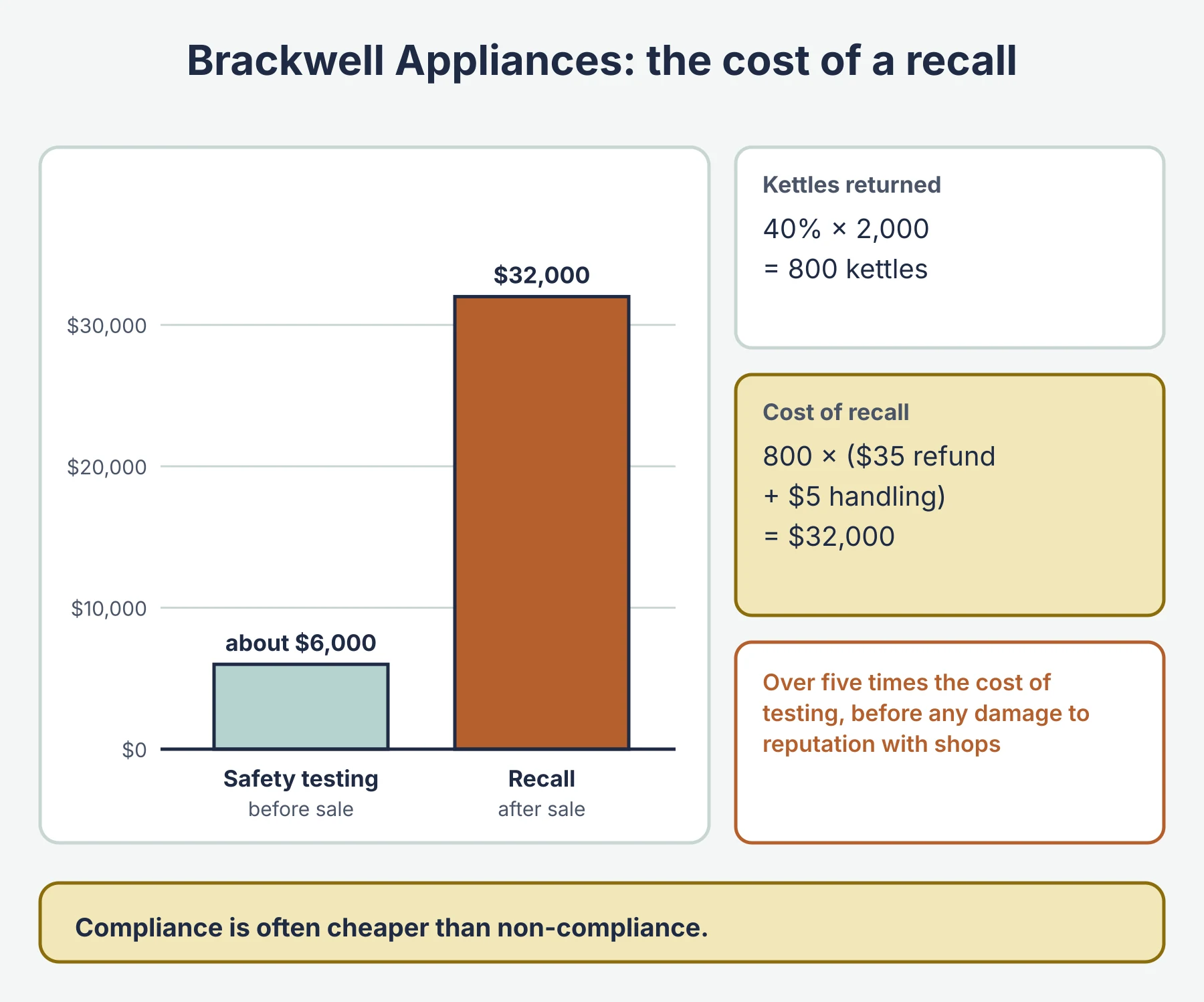
- Breaking the law: recalls, fines, compensation, lost trust.
Which businesses feel a law most?
- Minimum wage rise: labour-intensive businesses with many low-paid staff, such as cafés, cleaning firms and care homes.
- Safety law: businesses using machinery, chemicals or vehicles, such as factories, building firms and haulage companies.
- Consumer law: businesses selling complex or potentially dangerous products, such as electrical goods, food and toys.
Use this to judge the size of the impact in an evaluation answer.
Key terms
| Term | Meaning |
|---|---|
| Legislation | Laws passed by government that businesses must follow |
| Employment law | Laws protecting employees’ rights at work |
| Health and safety law | Laws requiring safe workplaces and working methods |
| Consumer law | Laws protecting customers when they buy goods and services |
| National minimum wage | The lowest hourly rate an employer may legally pay |
| Risk assessment | Checking a workplace for hazards and deciding how to reduce them |
| Discrimination | Treating someone unfairly because of a characteristic such as gender, religion or race |
| Product recall | Asking customers to return a product found to be faulty or unsafe |
| Compliance | Following the law |
| Level playing field | A situation where all competitors face the same rules |
Exam traps
- Law is compulsory; ethics is voluntary. Do not mix them up.
- Always give a benefit as well as a cost.
- “It costs money” is not enough: say what the money is spent on and the effect on profit or prices.
- Consequences of failure include reputation, not just fines.
- A minimum wage rise affects some businesses far more than others: look at how many staff are on it and how labour-intensive the business is.
- Do not quote a specific country’s laws unless the question does.
Self-test
- Name the three areas of legislation in the specification.
- Give two requirements of employment law.
- Give two things a business might do to meet health and safety law.
- State two consequences for a business of breaking consumer law.
- How can employment law affect recruitment?
- Give one benefit to a business of a safe working environment.
- Give one drawback to a business of a national minimum wage.
- 12 staff each work 30 hours a week for 52 weeks. The minimum wage rises by $0.50 an hour. Calculate the extra yearly cost.
- Explain the “level playing field” argument for minimum wage laws.
- A business must recall 500 faulty heaters, refunding $60 each. Calculate the refund cost.
- Why might a business need to train staff because of consumer law?
- Distinguish legislation from ethics.
Answers
- Employment law, health and safety law, consumer law.
- Any two: written contracts, minimum wage, limits on hours, paid holiday, no discrimination, fair dismissal procedures.
- Any two: carry out risk assessments; fit guards; provide protective clothing; train staff; report accidents.
- Any two: fines, compensation, product recalls, damage to reputation.
- Adverts and interviews must not discriminate, and contracts and right-to-work checks take time and money.
- Fewer accidents, so less lost output (or fewer claims, better morale, easier recruitment).
- Higher wage costs (or pressure to raise prices, or cuts to hours).
- 12 × 30 × 52 = 18,720 hours; 18,720 × $0.50 = $9,360.
- All businesses must pay at least the same minimum, so a rival cannot win on price simply by paying very low wages.
- 500 × $60 = $30,000.
- Staff must know customers’ rights to refunds, repairs or replacements so they handle complaints correctly.
- Legislation is compulsory with penalties for breaking it; ethics is a voluntary choice to behave fairly beyond what the law requires.
Related resources
-
Study guides
OxfordAQA International GCSE Business (9225): Technology
Study guide to OxfordAQA IGCSE Business 9225 section 3.2.1 Technology: ICT and business activity, e-commerce and wider markets, digital communication.
Business · OxfordAQA · IGCSE
Read guide -
Practice questions
OxfordAQA International GCSE Business (9225): Technology – Practice Questions
Twelve original questions with mark-scheme answers on ICT, e-commerce, wider markets and digital communication for OxfordAQA IGCSE Business 9225 section 3.2.1.
Business · OxfordAQA · IGCSE
Try questions -
Revision notes
OxfordAQA International GCSE Business (9225): Technology – Revision Notes
Revision notes for OxfordAQA IGCSE Business 9225 section 3.2.1 Technology: ICT and business activity, e-commerce, digital communication, traps and a self-test.
Business · OxfordAQA · IGCSE
Revise topic
Get free revision emails (optional)
Occasional emails with practice questions, worked explanations and links to free resources for the qualification and subjects you choose. No spam, and you can unsubscribe from any email. The free tools on this site never need an email.