
Revision Notes
OxfordAQA International GCSE Business (9225): Technology – Revision Notes
Revision notes for OxfordAQA IGCSE Business 9225 section 3.2.1 Technology: ICT and business activity, e-commerce, digital communication, traps and a self-test.
- Subject
- Business
- Level
- IGCSE
- Topic
- Influences on business
- Author
- Marlbridge Academic Team
- Updated
- Reviewed by
- Salman Ahmad (what this means)
Aligned to OxfordAQA IGCSE Business (9225), First teaching September 2020, first examined May/June 2022. Official specification .
Syllabus page (what it covers and how it is assessed): OxfordAQA IGCSE Business.
Syllabus points this page covers
9225
- 3.2.1 Technology
Found an error? Report a correction.
Need help with this topic? Request a free trial class for IGCSE Business (9225).
Condensed recall for section 3.2.1 Technology. For full explanations and worked examples, use the Technology study guide. Figures are invented.
What the specification asks
- Understand the impact of the changing use of ICT and how it influences business activity.
- Understand how businesses use e-commerce to access wider markets.
- Understand the use of digital communication with stakeholders, with examples such as email and video conferencing.
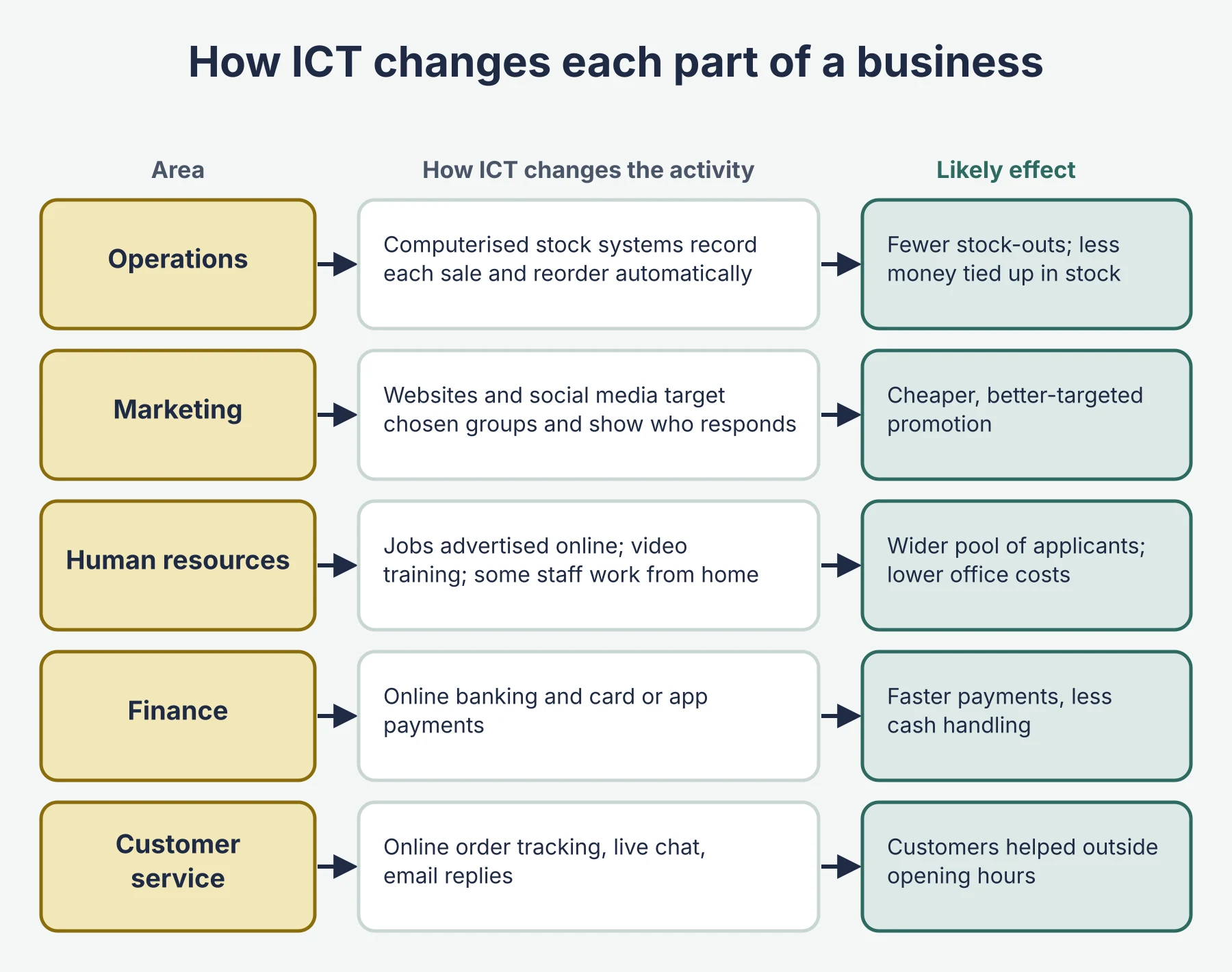
ICT across the business
| Area | Example of ICT | Benefit | Cost or risk |
|---|---|---|---|
| Operations | Computerised stock control that reorders automatically | Fewer stock-outs; less stock held | System cost; errors if data is wrong |
| Marketing | Website, social media, online adverts aimed at chosen groups | Wider reach; results can be measured | Must be updated; negative comments are public |
| Human resources | Online job adverts; video training; home working | More applicants; lower office costs | Harder to supervise; equipment needed at home |
| Finance | Online banking, card and app payments | Faster payments; less cash to handle | Fraud and security risks |
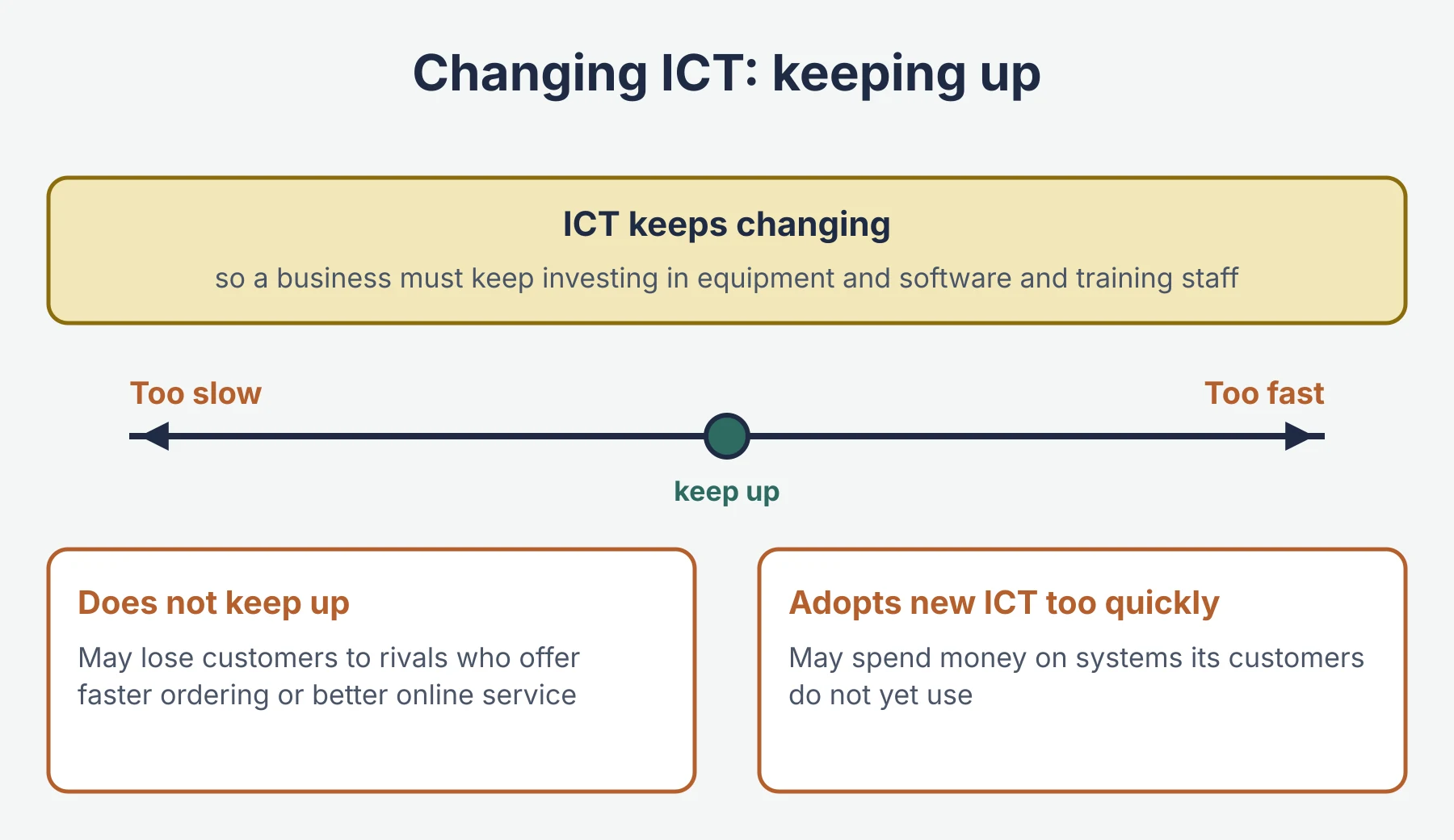
“Changing” use: ICT keeps developing, so businesses face repeated spending on equipment, software and staff training. Falling behind rivals can lose customers.
E-commerce
Definition: buying and selling goods and services online.
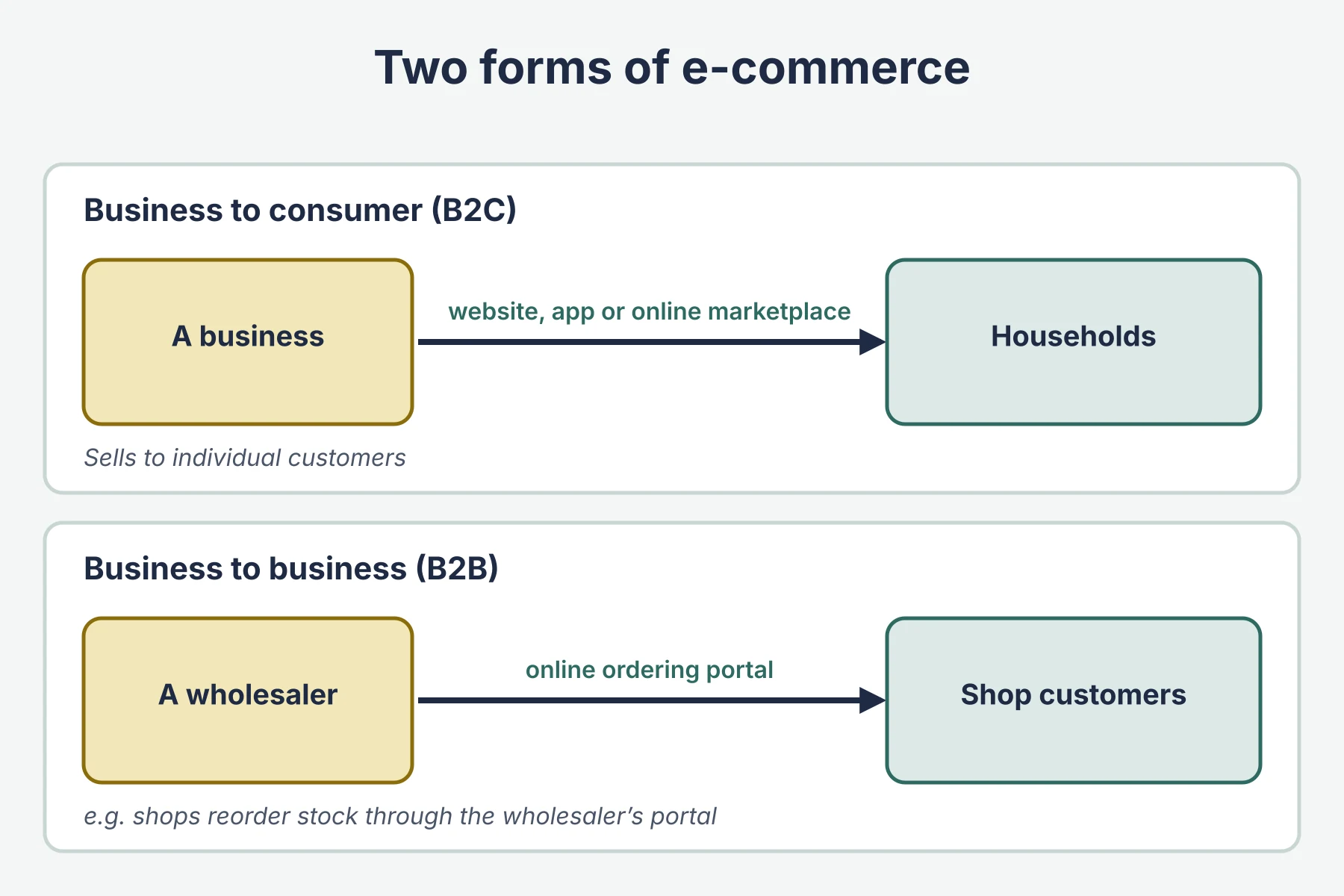
Forms: business to consumer (B2C), such as an online shop selling to households; business to business (B2B), such as a supplier’s online ordering portal.
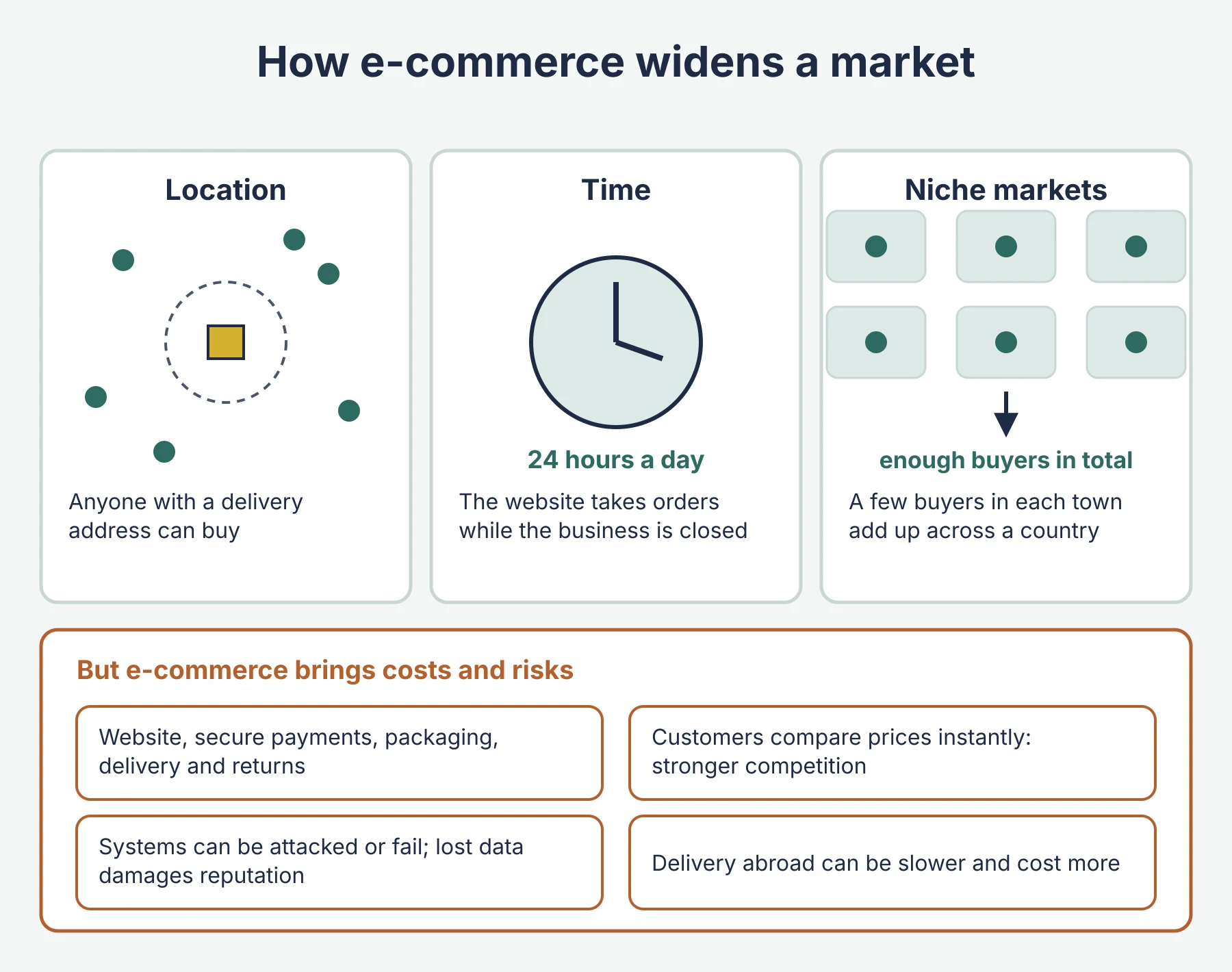
How it widens markets:
- Place: anyone with a delivery address can buy, at home or abroad.
- Time: orders arrive 24 hours a day.
- Niche products: a few buyers in many places add up to a viable market.
Drawbacks: website and payment system costs; packaging, delivery and returns; customers compare prices instantly; cyber attacks and data loss; some customers want to see or touch the product; longer delivery times abroad.
Digital communication
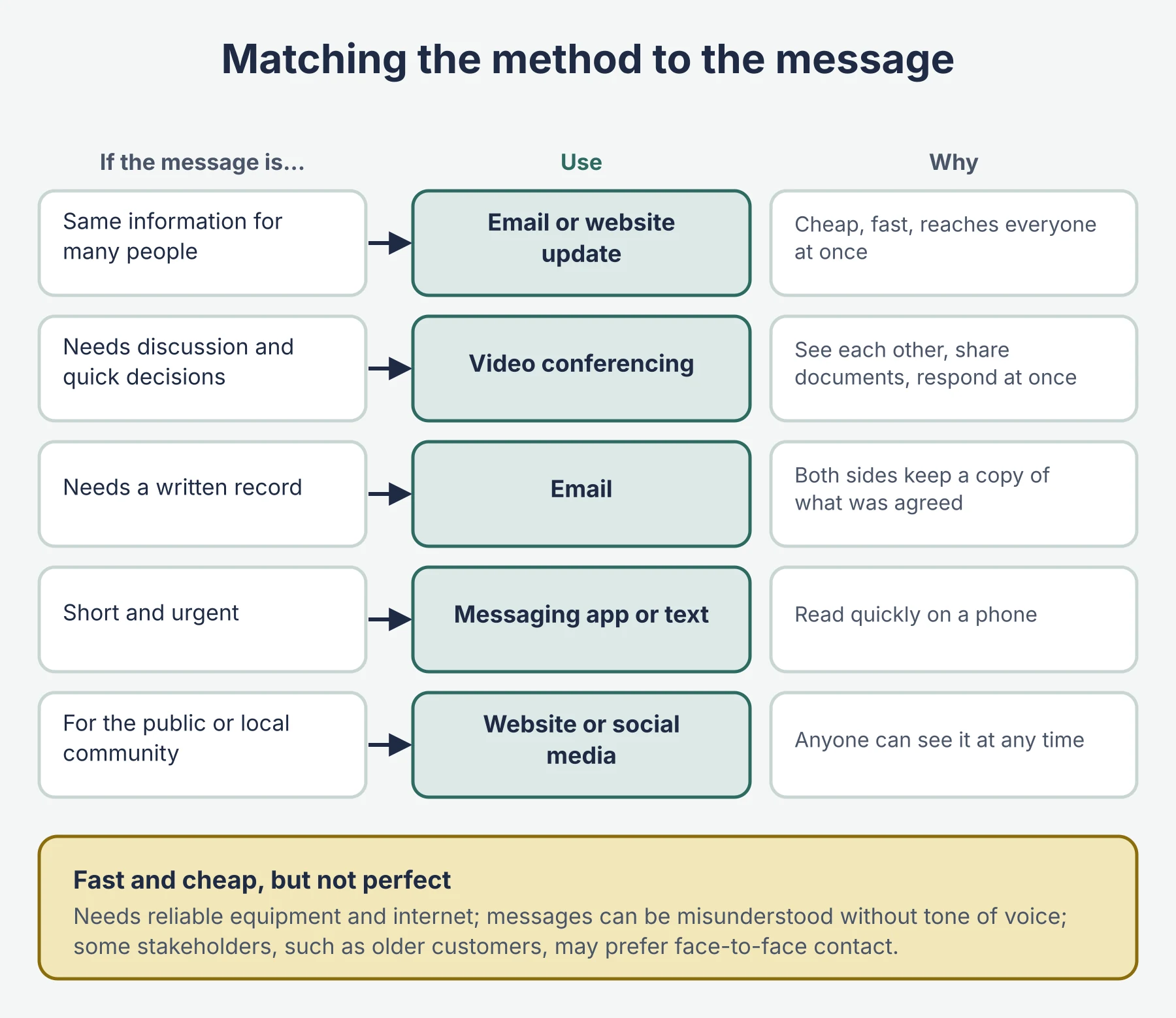
| Method | Best for | Watch out for |
|---|---|---|
| Written records; messages to many people; orders to suppliers | Can be ignored; tone misread | |
| Video conferencing | Meetings between sites; talks with overseas suppliers; remote training | Needs good internet; faults interrupt; less personal |
| Messaging and text | Short, urgent messages to staff | Easy to miss detail |
| Website and social media | Information for customers and the community | Needs updating; public criticism |
Internal stakeholders: employees, managers, owners. External stakeholders: customers, suppliers, lenders, local community, government.
Judging whether new technology is worth it
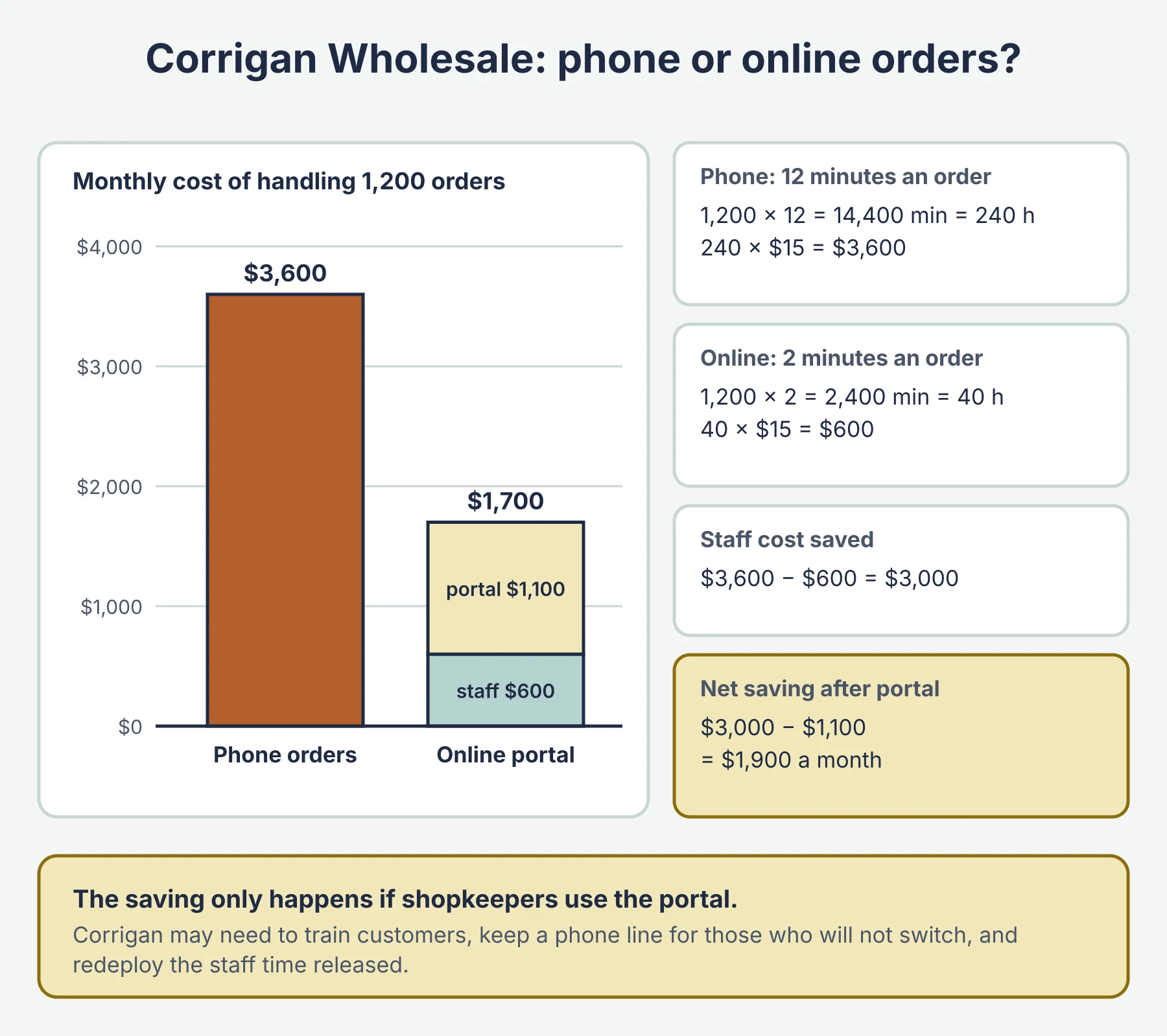
Weigh four things from the case: the cost of the equipment, software and training; the saving or extra revenue it brings; how quickly that benefit arrives; and whether the business’s customers and staff will actually use it. A system that saves staff time is only valuable if that time is used productively, and an online shop only adds sales if customers want to buy that way.
Key terms
| Term | Meaning |
|---|---|
| ICT | Information and Communication Technology: computers, networks, software and devices used to handle and share information |
| E-commerce | Buying and selling goods and services online |
| B2C | A business selling to consumers |
| B2B | A business selling to other businesses |
| Wider market | Customers beyond the area or hours a business could reach before |
| Digital communication | Sharing information with stakeholders by electronic means |
| Video conferencing | A meeting held through live video and sound over the internet |
| Stakeholder | Any person or group with an interest in a business |
| Cyber attack | An attempt to damage, disrupt or steal from a computer system |
Exam traps
- Saying “the business will use ICT” without naming the activity that changes.
- Assuming online sales are all extra: some customers simply stop buying in the shop and buy online instead.
- Forgetting delivery and returns when judging whether e-commerce is profitable.
- Giving a digital method without saying which stakeholder it is used with.
- Describing video conferencing as free: equipment, software and reliable internet cost money.
- Treating “wider market” as only overseas: it also means more customers in the home country and more hours of selling.
Self-test
- What does ICT stand for?
- Define e-commerce.
- Give one example of B2B e-commerce.
- State two ways e-commerce lets a business access a wider market.
- Give two drawbacks of e-commerce for a small business.
- Name two examples of digital communication given in the specification.
- Which digital method is best for agreeing an order change with an overseas supplier quickly, and why?
- A business takes 600 phone orders a month, each taking 10 minutes, at a staff cost of $12 an hour. Calculate the monthly staff cost.
- Online orders take 2 minutes each. Calculate the monthly saving in staff cost for the same 600 orders.
- Give one reason why a business may lose sales if it does not keep up with changing ICT.
- State one internal and one external stakeholder.
- Give one risk to a business of storing customer data online.
Answers
- Information and Communication Technology.
- Buying and selling goods and services online.
- A supplier’s online portal where shops place their orders (any valid example).
- Customers can buy from any location with a delivery address; orders can be taken 24 hours a day (also: niche products can reach enough buyers).
- Any two: website and security costs; delivery and returns costs; price comparison increases competition; risk of cyber attack.
- Email and video conferencing.
- Video conferencing, because both sides can discuss and agree at once and see documents together, without travelling.
- 600 × 10 = 6,000 minutes = 100 hours; 100 × $12 = $1,200.
- Online: 600 × 2 = 1,200 minutes = 20 hours = $240. Saving = $1,200 − $240 = $960 a month.
- Customers may switch to rivals who offer faster online ordering, tracking or payment.
- Internal: employees (or managers, owners). External: customers (or suppliers, lenders, local community).
- A cyber attack could steal the data, damaging the business’s reputation and customers’ trust.
Related resources
-
Study guides
OxfordAQA International GCSE Business (9225): The Economic Climate on Business
Study guide to OxfordAQA IGCSE Business 9225 section 3.2.3: interest rates and borrowing, Sharia compliant finance, employment levels and consumer spending.
Business · OxfordAQA · IGCSE
Read guide -
Practice questions
OxfordAQA International GCSE Business (9225): The Economic Climate on Business – Practice Questions
Twelve original questions with answers on interest rates, borrowing costs, Sharia compliant finance, employment and consumer spending for OxfordAQA IGCSE 9225.
Business · OxfordAQA · IGCSE
Try questions -
Revision notes
OxfordAQA International GCSE Business (9225): The Economic Climate on Business – Revision Notes
Revision notes for OxfordAQA IGCSE Business 9225 section 3.2.3: interest rates, Sharia compliant finance, employment and consumer spending, with a self-test.
Business · OxfordAQA · IGCSE
Revise topic
Get free revision emails (optional)
Occasional emails with practice questions, worked explanations and links to free resources for the qualification and subjects you choose. No spam, and you can unsubscribe from any email. The free tools on this site never need an email.