
Study Guides
OxfordAQA International GCSE Business (9225): Ethical and Environmental Considerations
Study guide to OxfordAQA IGCSE Business 9225 section 3.2.2: ethics and profit, fairness to stakeholders, environmental impacts and sustainability trade-offs.
- Subject
- Business
- Level
- IGCSE
- Topic
- Influences on business
- Author
- Marlbridge Academic Team
- Updated
- Reviewed by
- Salman Ahmad (what this means)
Aligned to OxfordAQA IGCSE Business (9225), First teaching September 2020, first examined May/June 2022. Official specification .
Syllabus page (what it covers and how it is assessed): OxfordAQA IGCSE Business.
Syllabus points this page covers
9225
- 3.2.2 Ethical and environmental considerations
Found an error? Report a correction.
Need help with this topic? Request a free trial class for IGCSE Business (9225).
This guide covers section 3.2.2 Ethical and environmental considerations of OxfordAQA International GCSE Business (9225), part of Topic 2, Influences on business. The specification asks you to identify and analyse possible trade-offs between ethics and profit; to understand that ethical behaviour means acting in ways stakeholders consider fair and honest, including religious observance and charitable giving; to know examples of ethical behaviour and its benefits and drawbacks; to understand society’s expectation of greater environmental responsibility (traffic congestion, recycling, disposing of waste, noise and air pollution) and its costs and benefits; and to analyse trade-offs between sustainability (global warming, using scarce resources) and profit. All businesses and figures are invented.
For the whole topic, see the Influences on Business study guide. Condensed notes are in the Ethical and Environmental Considerations revision notes and questions in the Ethical and Environmental Considerations practice questions.
Ethics: fair and honest to whom?
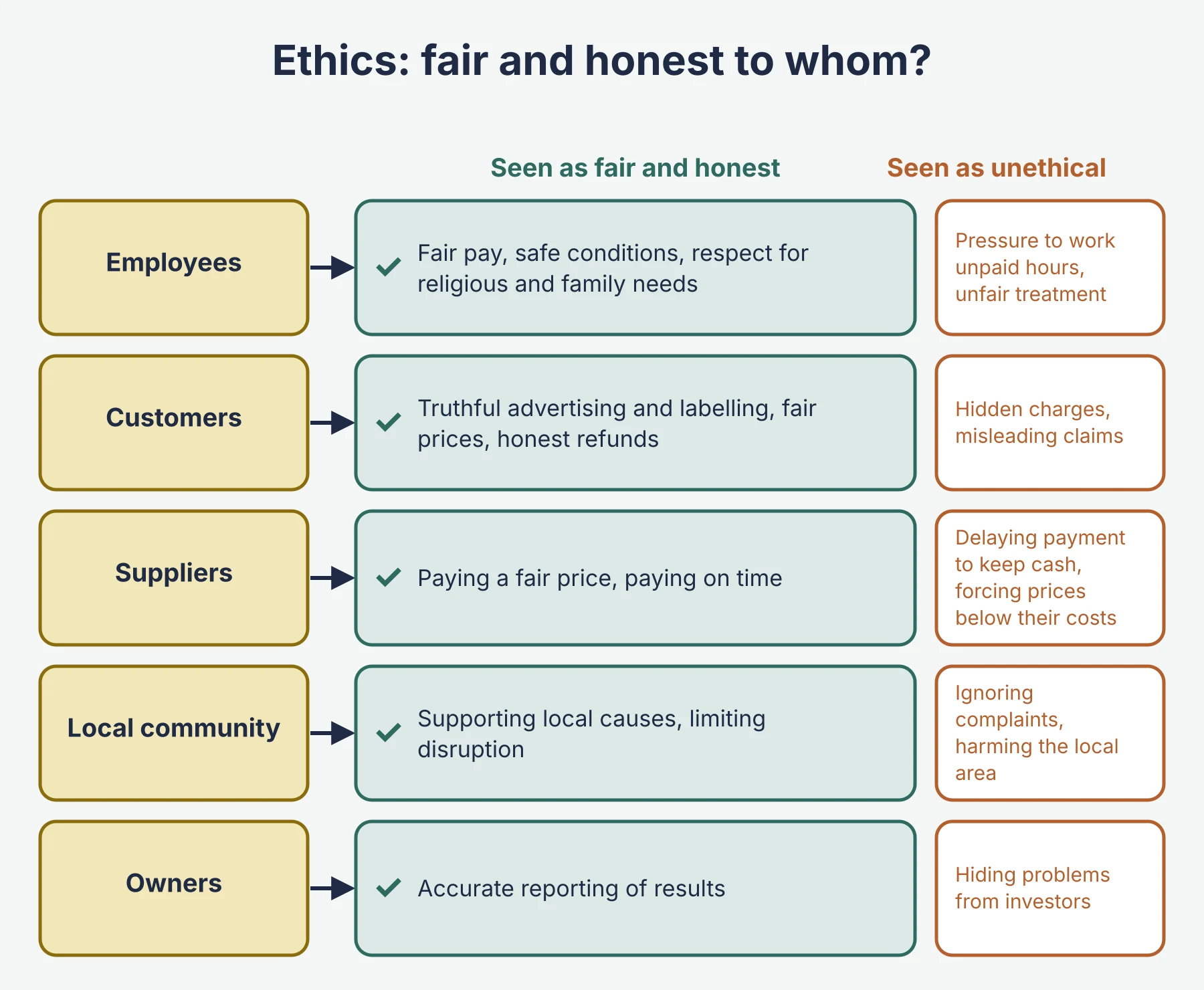
Ethics is about doing what is morally right, beyond what the law requires. The specification defines it through stakeholders: a business behaves ethically when stakeholders see its actions as fair and honest. So the best way to analyse an ethical issue is to ask which stakeholder is affected.
| Stakeholder | Fair and honest behaviour looks like… | Unethical behaviour looks like… |
|---|---|---|
| Employees | Fair pay, safe conditions, respect for religious and family needs | Pressure to work unpaid hours, unfair treatment |
| Customers | Truthful advertising and labelling, fair prices, honest refunds | Hidden charges, misleading claims |
| Suppliers | Paying a fair price, paying on time | Delaying payment to keep cash, forcing prices below the supplier’s costs |
| Local community | Supporting local causes, limiting disruption | Ignoring complaints, harming the local area |
| Owners | Accurate reporting of results | Hiding problems from investors |
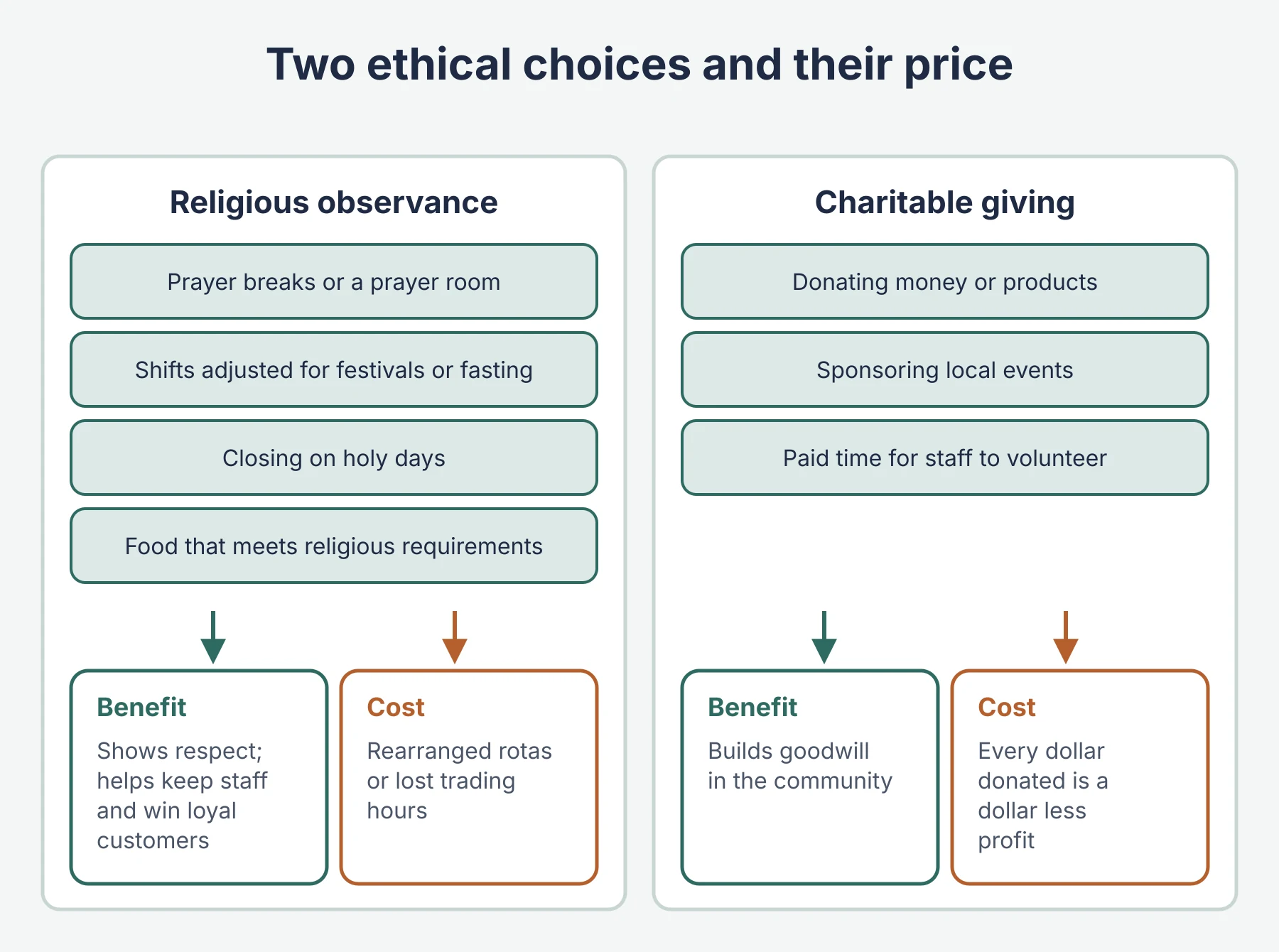
Religious observance means making it possible for employees and customers to follow their faith: allowing prayer breaks or providing a prayer room, adjusting shifts during religious festivals or fasting periods, closing on holy days, and sourcing food that meets religious requirements. These actions show respect and help a business keep staff and win loyal customers, but they can cost money, for example in rearranged rotas or lost trading hours.
Charitable giving includes donating money or products, sponsoring local events and giving staff paid time to volunteer. It builds goodwill in the community, but every dollar donated is a dollar less profit for the owners.
The trade-off between ethics and profit
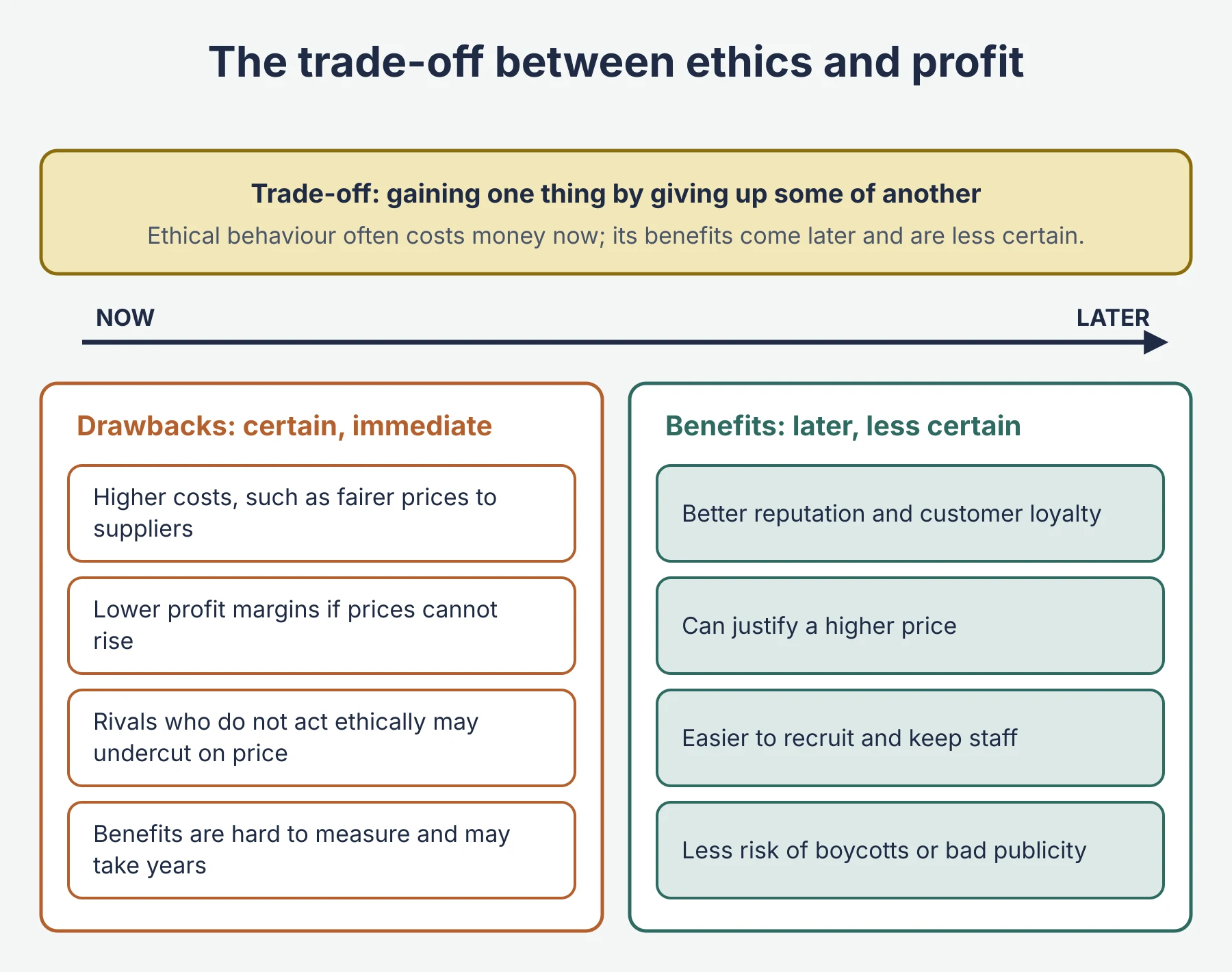
A trade-off means gaining one thing by giving up some of another. Ethical behaviour often costs money now, while its benefits come later and are less certain.
| Benefits of ethical behaviour | Drawbacks of ethical behaviour |
|---|---|
| Better reputation and customer loyalty | Higher costs, such as fairer prices to suppliers |
| Can justify a higher price | Lower profit margins if prices cannot rise |
| Easier to recruit and keep staff | Rivals who do not act ethically may undercut on price |
| Less risk of boycotts or bad publicity | Benefits are hard to measure and may take years |
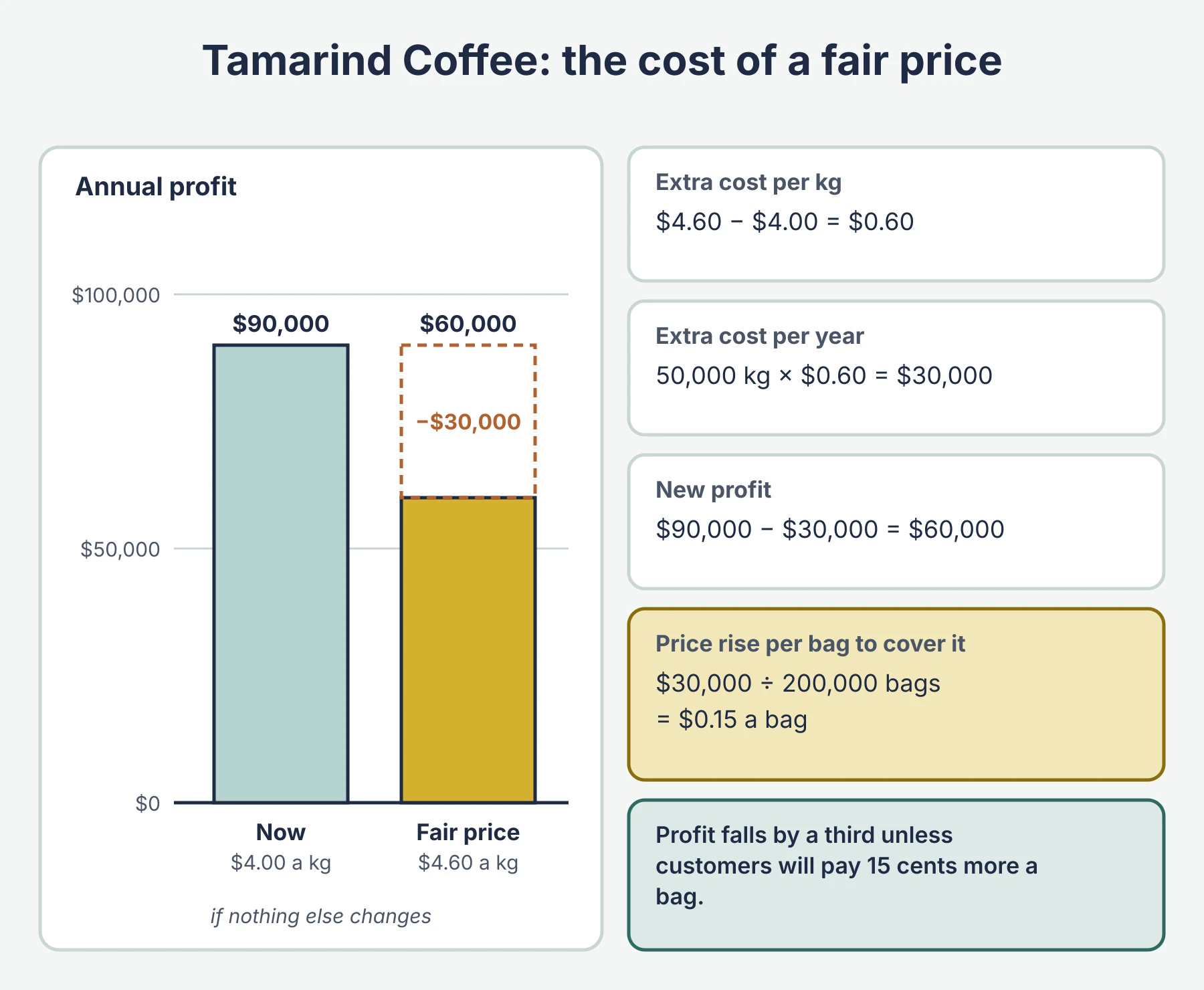
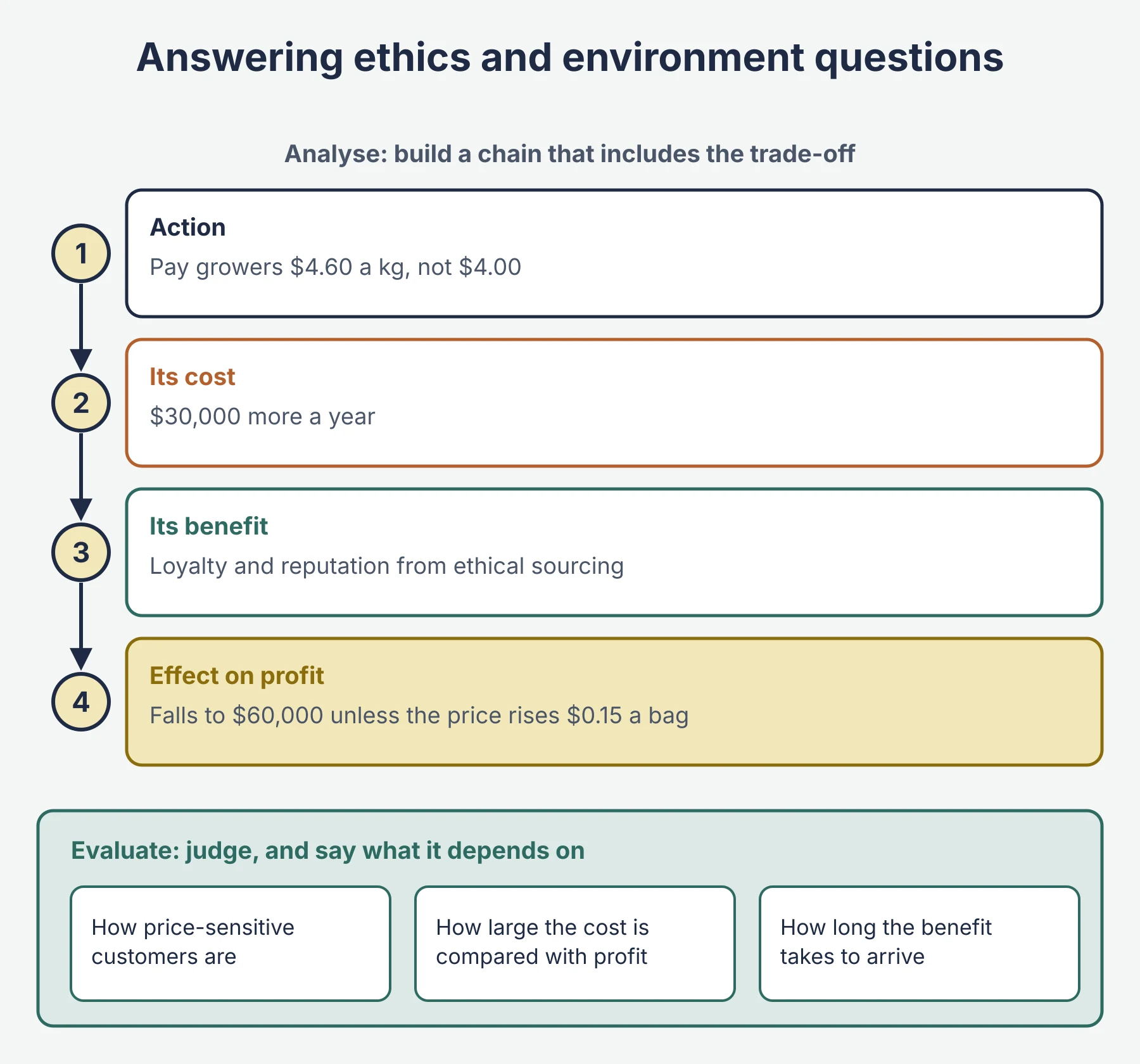
Worked example 1. Tamarind Coffee Roasters buys 50,000 kg of coffee beans a year at $4.00 a kg. It is considering paying growers $4.60 a kg so they earn a fair living. It sells 200,000 bags a year and makes a profit of $90,000.
Extra cost per kg   = $4.60 - $4.00 = $0.60
Extra cost per year = 50,000 x $0.60 = $30,000
New profit (if nothing else changes) = $90,000 - $30,000 = $60,000
Price rise per bag to cover the cost = $30,000 / 200,000 = $0.15
Profit falls by a third unless Tamarind can raise its price. Whether customers will pay 15 cents more per bag depends on how much they value ethical sourcing and how close rival prices are. A strong answer weighs the certain cost against the uncertain gain in loyalty and reputation.
Environmental considerations
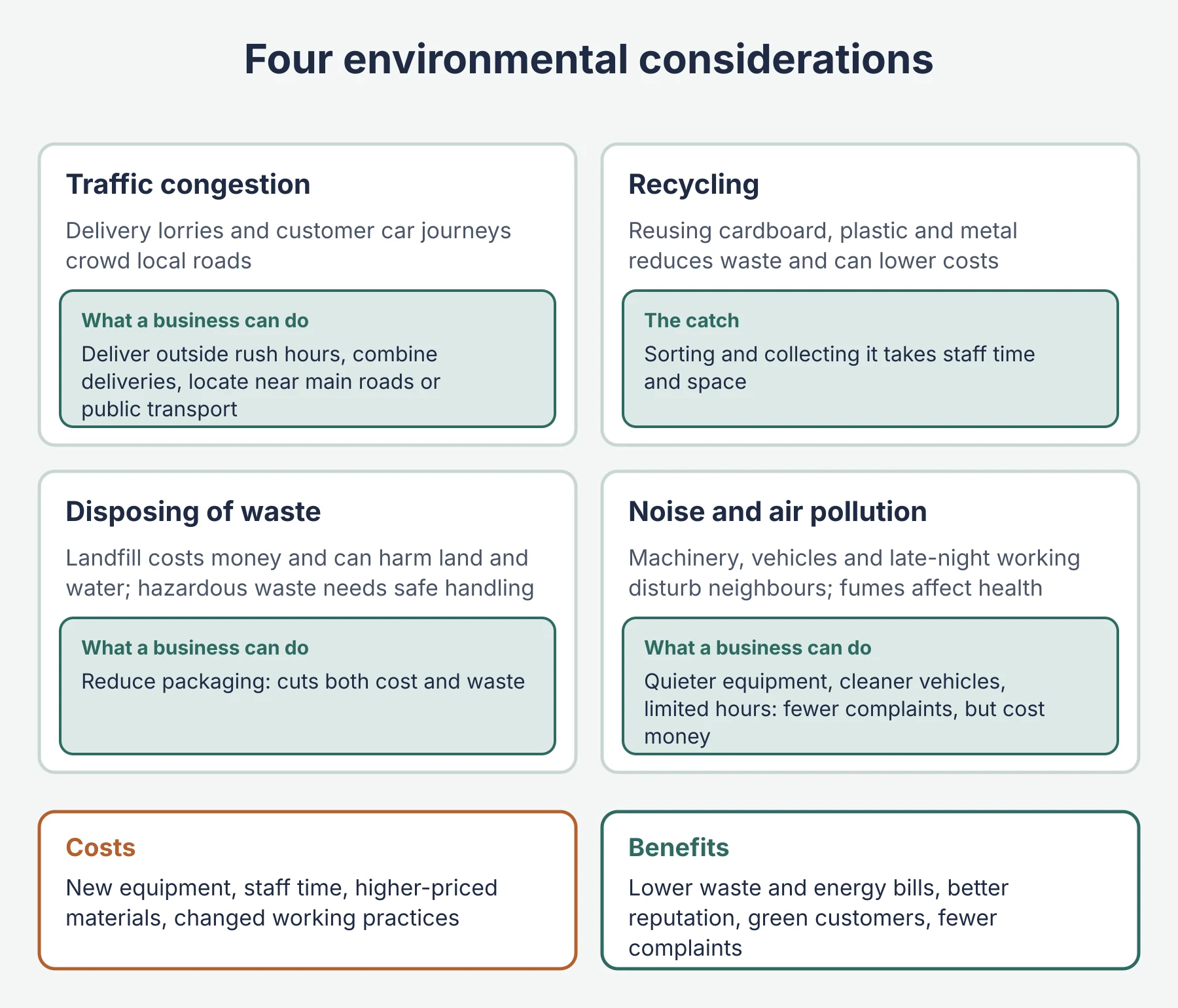
Customers, local communities and governments increasingly expect businesses to take responsibility for their effect on the environment. The specification names four areas.
- Traffic congestion: delivery lorries and customer car journeys crowd local roads. A business can schedule deliveries outside rush hours, combine deliveries into fewer journeys, or choose a location near main roads or public transport.
- Recycling: reusing materials such as cardboard, plastic and metal reduces waste and can lower costs, but sorting and collecting it takes staff time and space.
- Disposing of waste: waste sent to landfill costs money and can harm land and water; hazardous waste needs safe handling. Reducing packaging cuts both cost and waste.
- Noise and air pollution: machinery, vehicles and late-night working disturb neighbours; fumes affect health. Quieter equipment, cleaner vehicles and limited working hours reduce complaints but cost money.
Costs and benefits of environmental responsibility. Costs include new equipment, staff time, higher-priced materials and changed working practices. Benefits include lower waste and energy bills, an improved reputation, customers who choose green businesses, and fewer complaints from the community.
Sustainability
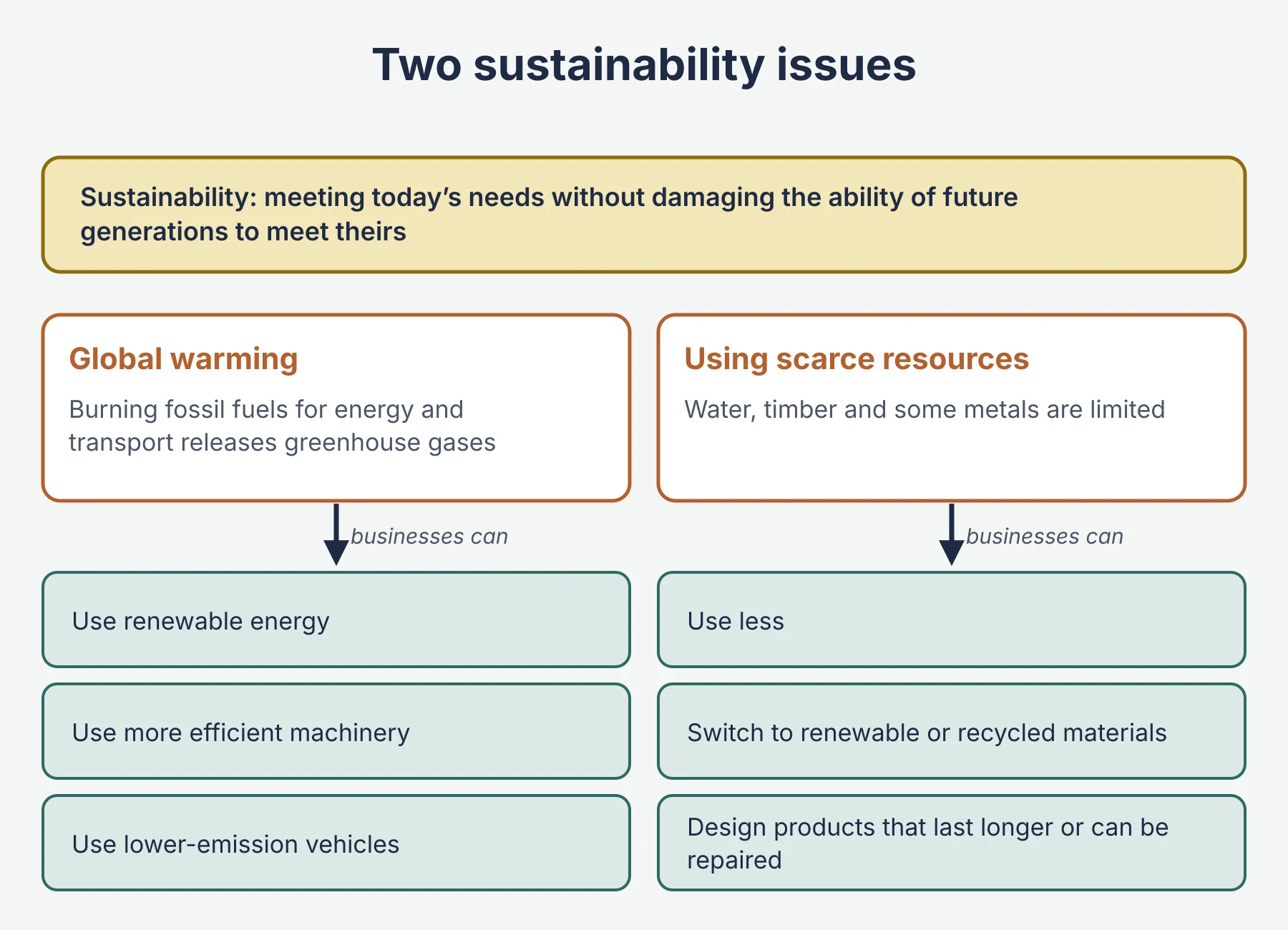
Sustainability means meeting today’s needs without damaging the ability of future generations to meet theirs. The specification focuses on two issues.
- Global warming: burning fossil fuels for energy and transport releases greenhouse gases. Businesses can reduce this by using renewable energy, more efficient machinery and lower-emission vehicles.
- Using scarce resources: materials such as water, timber and some metals are limited. Businesses can use less, switch to renewable or recycled materials, and design products that last longer or can be repaired.
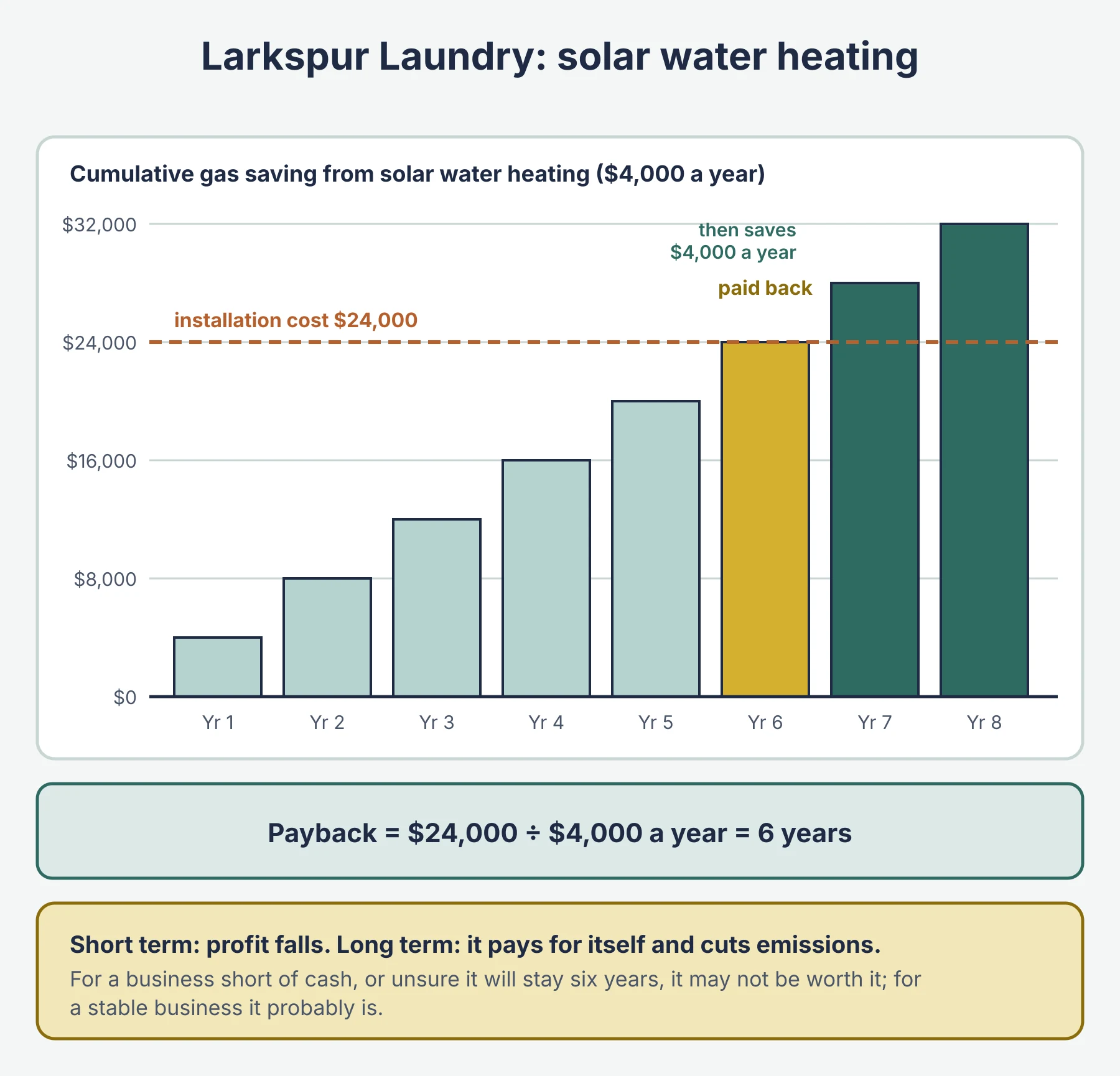
Worked example 2: a sustainability trade-off. Larkspur Laundry spends $11,000 a year on gas to heat water. Solar water heating would cost $24,000 to install and cut the gas bill by $4,000 a year.
Payback period = cost of investment / annual saving
               = $24,000 / $4,000 = 6 years
In the short term, profit falls, because $24,000 is spent before any saving arrives. Over the long term, the system pays for itself after 6 years and then saves $4,000 a year, as well as cutting emissions. For a business that is short of cash, or unsure it will still occupy the building in six years, the trade-off may not be worth it; for a stable business, it probably is.
Common mistakes
- Treating ethical behaviour as free: the specification asks you to identify a trade-off with profit.
- Confusing ethics with the law: ethics is about choices beyond what the law requires.
- Listing environmental issues without saying how they affect the business’s costs, revenue or reputation.
- Assuming customers will always pay more for ethical or green products.
- Forgetting short term versus long term when judging a sustainability decision.
Exam technique for this section
Explain questions want a point and its effect on the named business: “Recycling cardboard reduces waste collection charges, which lowers costs.” Analyse questions want a chain that includes the trade-off: the action, its cost, its benefit, and what happens to profit. Evaluate questions want both sides and a judgement that depends on something in the case, such as how price-sensitive customers are, how large the cost is compared with profit, or how long the benefit takes to arrive.
More resources on this topic
Related resources
-
Practice questions
OxfordAQA International GCSE Business (9225): Ethical and Environmental Considerations – Practice Questions
Eleven original questions with mark-scheme answers on ethics and profit, religious observance, waste and sustainability for OxfordAQA IGCSE 9225 3.2.2.
Business · OxfordAQA · IGCSE
Try questions -
Revision notes
OxfordAQA International GCSE Business (9225): Ethical and Environmental Considerations – Revision Notes
Revision notes for OxfordAQA IGCSE Business 9225 section 3.2.2: ethics, religious observance, environmental impacts, sustainability, key terms and a self-test.
Business · OxfordAQA · IGCSE
Revise topic -
Study guides
OxfordAQA International GCSE Business (9225): Globalisation
Study guide to OxfordAQA IGCSE Business 9225 section 3.2.4 Globalisation: its five forms, benefits and drawbacks, and exchange rates for traders.
Business · OxfordAQA · IGCSE
Read guide
Get free revision emails (optional)
Occasional emails with practice questions, worked explanations and links to free resources for the qualification and subjects you choose. No spam, and you can unsubscribe from any email. The free tools on this site never need an email.