
Study Guides
OxfordAQA International GCSE Business (9225): Technology
Study guide to OxfordAQA IGCSE Business 9225 section 3.2.1 Technology: ICT and business activity, e-commerce and wider markets, digital communication.
- Subject
- Business
- Level
- IGCSE
- Topic
- Influences on business
- Author
- Marlbridge Academic Team
- Updated
- Reviewed by
- Salman Ahmad (what this means)
Aligned to OxfordAQA IGCSE Business (9225), First teaching September 2020, first examined May/June 2022. Official specification .
Syllabus page (what it covers and how it is assessed): OxfordAQA IGCSE Business.
Syllabus points this page covers
9225
- 3.2.1 Technology
Found an error? Report a correction.
Need help with this topic? Request a free trial class for IGCSE Business (9225).
This guide covers section 3.2.1 Technology of OxfordAQA International GCSE Business (9225), part of Topic 2, Influences on business. The specification lists two content points, e-commerce and digital communication, and asks you to understand the impact of the changing use of Information and Communication Technology (ICT) on business activity, how businesses use e-commerce to access wider markets, and how they use digital communication with stakeholders, with examples such as email and video conferencing. All businesses and figures below are invented.
For the whole topic, see the Influences on Business study guide. Condensed notes are in the Technology revision notes and questions in the Technology practice questions.
How changing ICT changes what a business does
ICT is not one decision; it reaches every part of a business. A good answer names the business activity that changes and then the effect on costs, revenue, customers or staff.
| Business area | How ICT changes the activity | Likely effect |
|---|---|---|
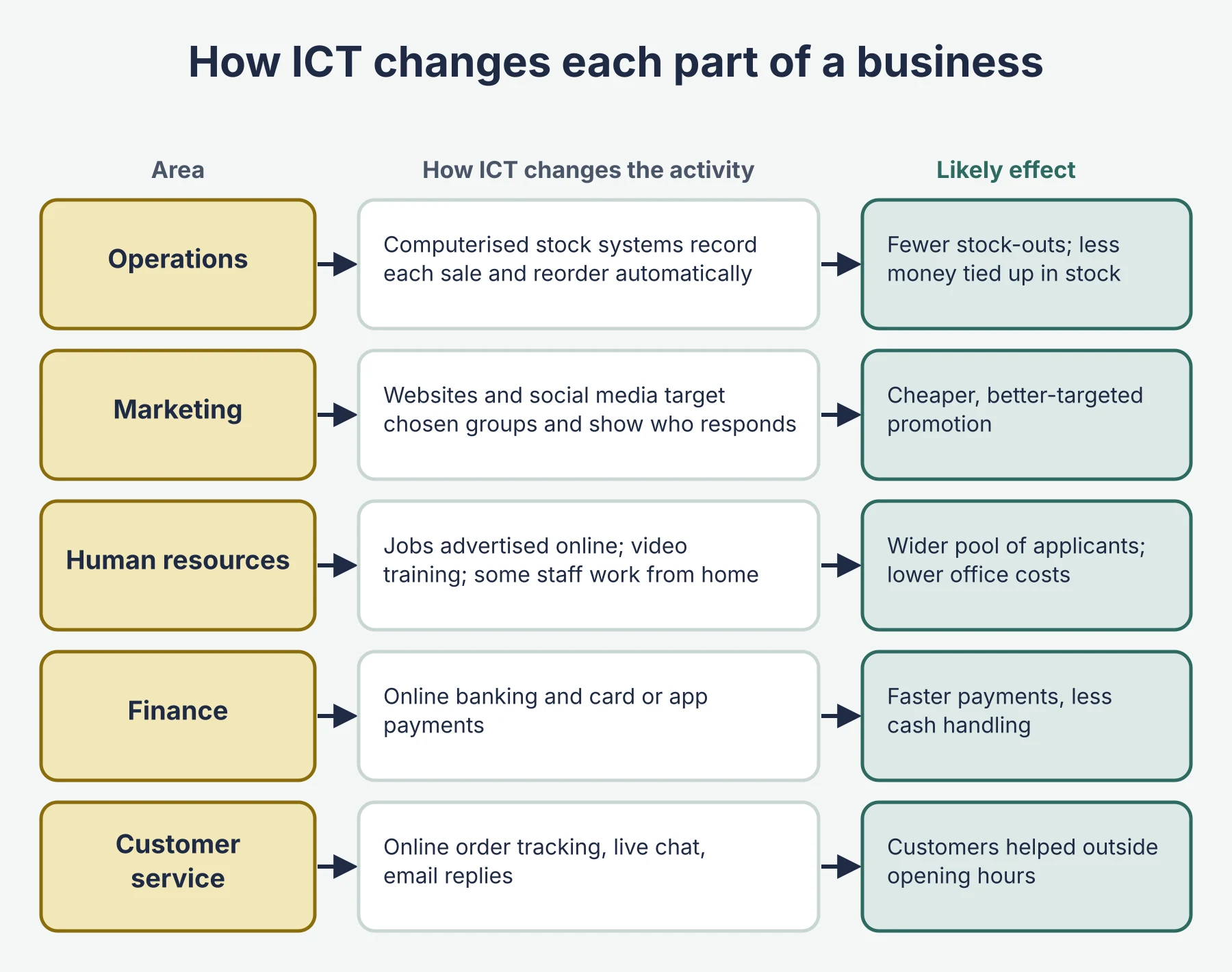
| Operations | Computerised stock systems record each sale and reorder automatically | Fewer stock-outs, less money tied up in stock |
| Marketing | Websites and social media let a business advertise to chosen groups and see who responds | Cheaper, better-targeted promotion |
| Human resources | Jobs advertised online; training delivered by video; some staff work from home | Wider pool of applicants; lower office costs |
| Finance | Online banking and card or app payments | Faster payments, less cash handling |
| Customer service | Online order tracking, live chat, email replies | Customers helped outside opening hours |
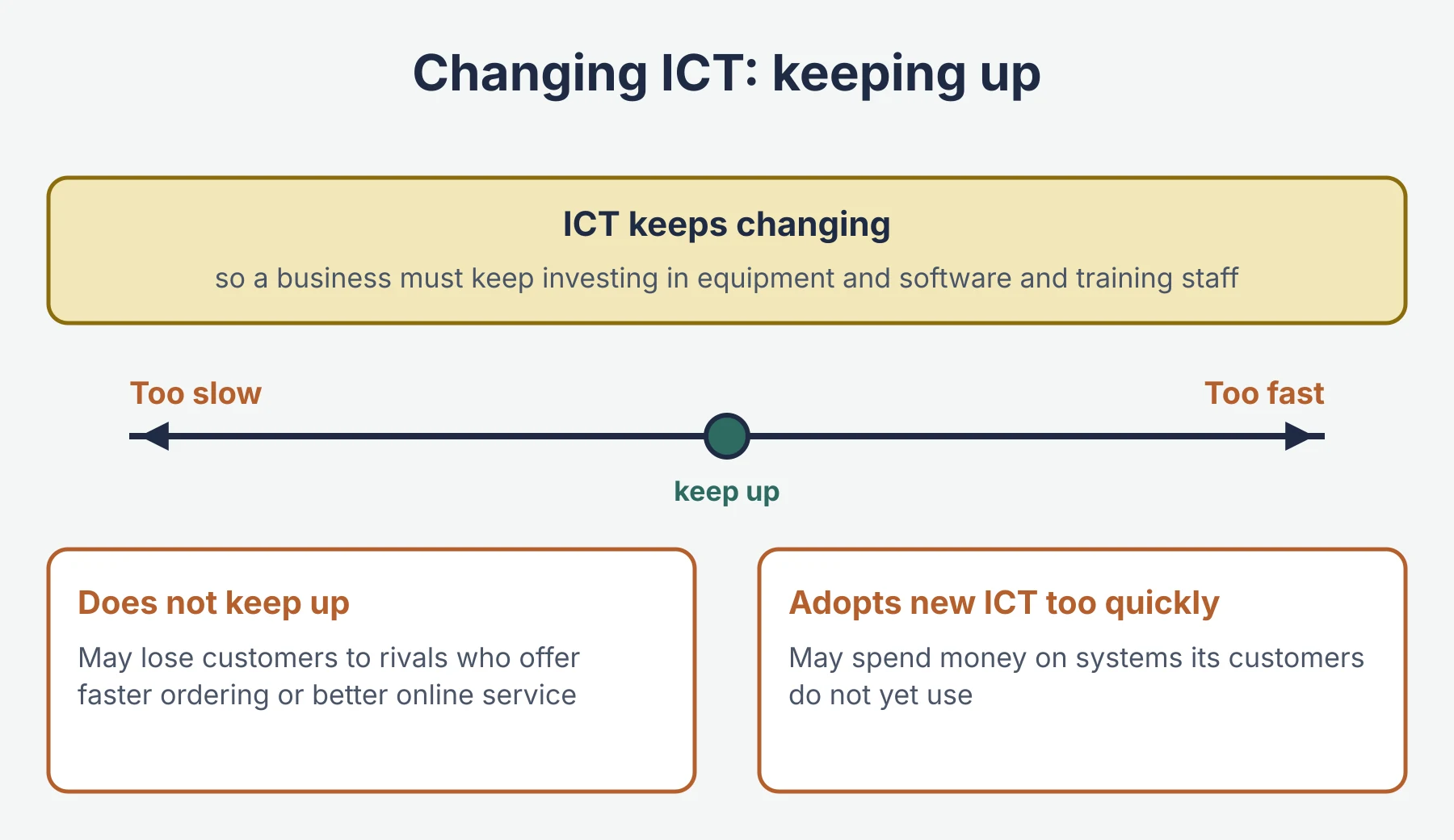
The key word in the specification is changing. ICT keeps developing, so a business must keep investing in equipment and software and training staff to use it. A business that does not keep up may lose customers to rivals who offer faster ordering or better online service. A business that adopts new ICT too quickly may spend money on systems its customers do not yet use.
E-commerce and wider markets
E-commerce is buying and selling goods and services online. It takes two main forms:
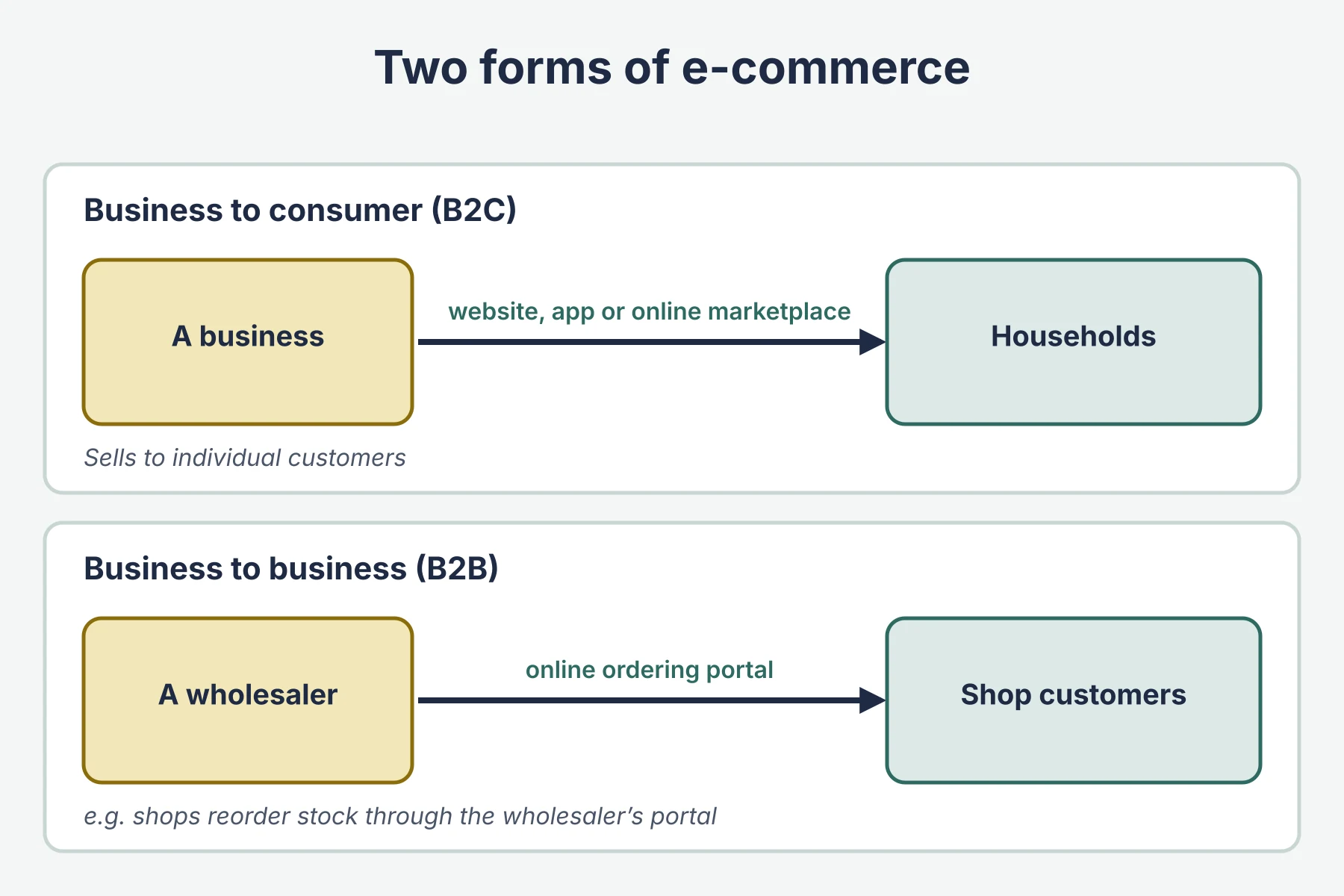
- Business to consumer (B2C): a business sells to households through its website, an app or an online marketplace.
- Business to business (B2B): a business sells to other businesses online, for example a wholesaler whose shop customers reorder through an online portal.
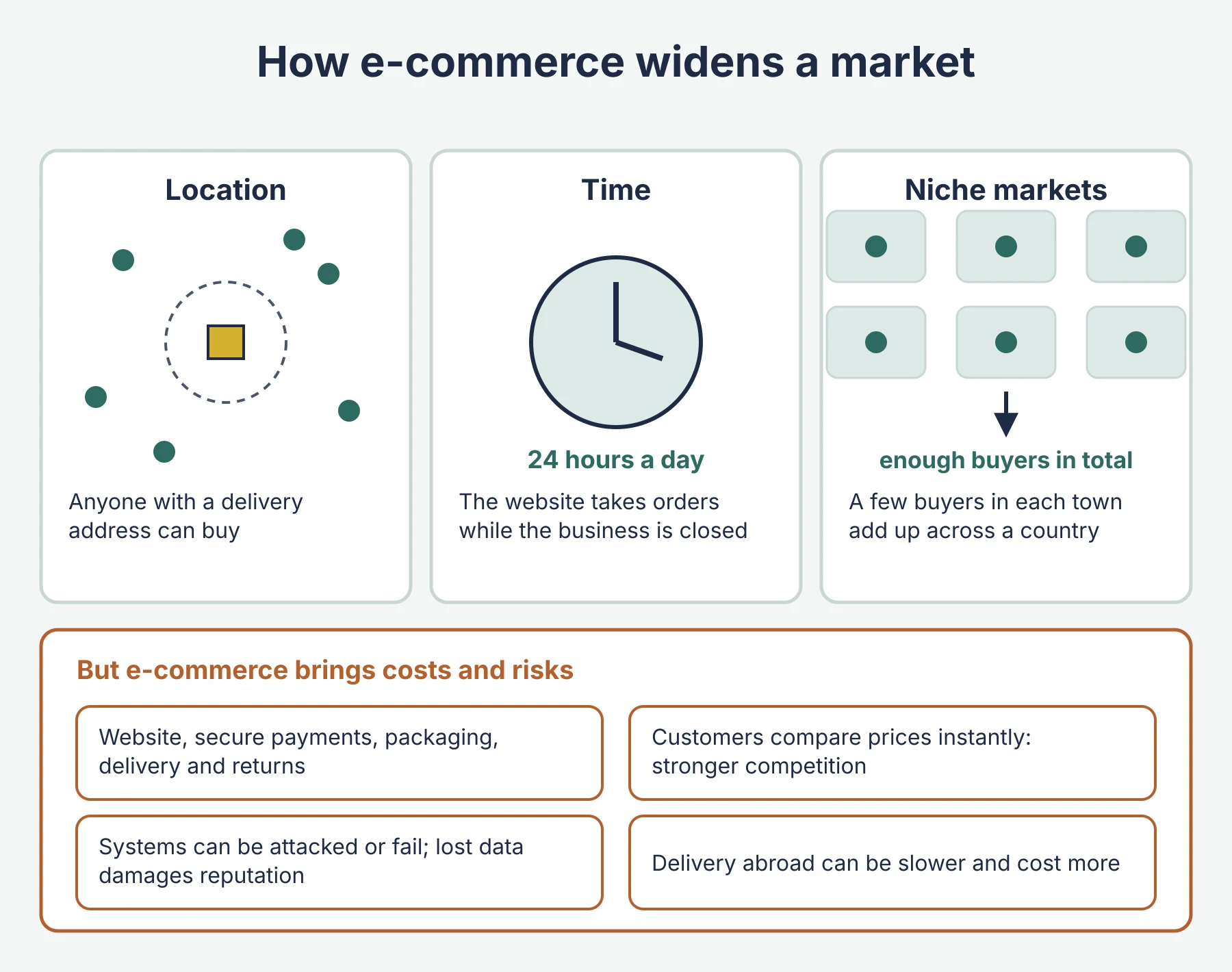
E-commerce lets a business access wider markets in three ways. It removes the limit of location, because customers anywhere with a delivery address can buy. It removes the limit of time, because the website takes orders 24 hours a day. And it makes niche markets worth serving: a product that only a few people in each town want may have enough buyers across a whole country or several countries.
E-commerce also brings costs and risks. The business must pay for a website, secure payment systems, packaging and delivery, and must handle returns. Customers can compare prices instantly, so competition is stronger. Online systems can be attacked or can fail, and a business that loses customer data damages its reputation. Delivery abroad can take longer and cost more, which may make the product less competitive against local sellers.
Digital communication with stakeholders
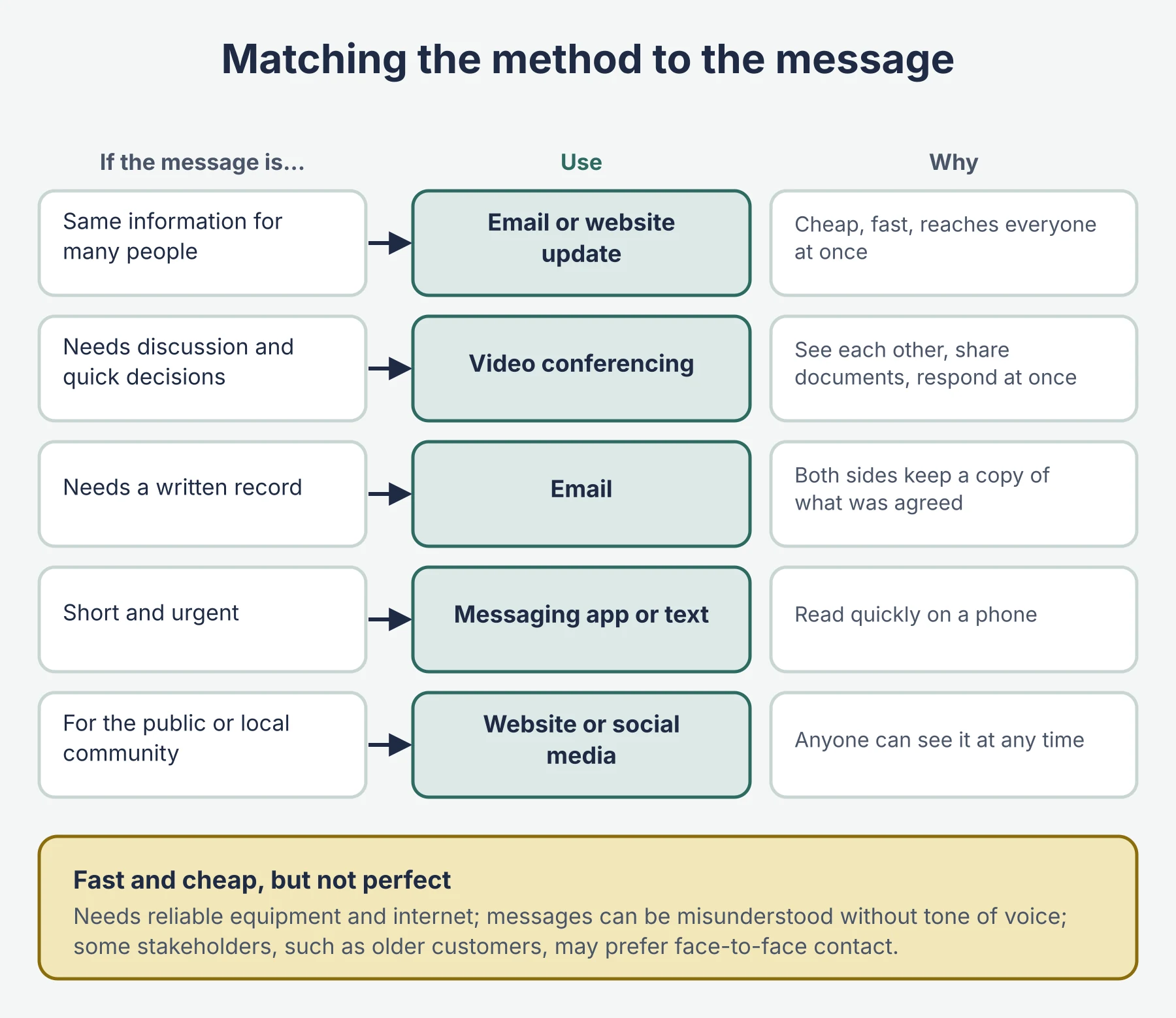
Stakeholders include employees, customers, suppliers, owners, lenders and the local community. Choosing a digital method depends on the message.
| If the message is… | A suitable method | Why |
|---|---|---|
| The same information for many people | Email or a website update | Cheap, fast and reaches everyone at once |
| Needing a discussion and quick decisions | Video conferencing | People can see each other, share documents and respond at once |
| Needing a written record | Both sides keep a copy of what was agreed | |
| Short and urgent | Messaging app or text message | Read quickly on a phone |
| For the public or local community | Website or social media | Anyone can see it at any time |
Internal stakeholders, such as staff in different branches, can hold meetings and training by video conferencing instead of travelling. External stakeholders, such as suppliers, can receive orders by email and join video meetings to agree changes to deliveries. Digital communication is fast and cheap, but it depends on reliable equipment and internet connections, messages can be misunderstood without tone of voice, and some stakeholders, such as older customers, may prefer face-to-face contact.
Worked example 1: ICT changes how orders are handled
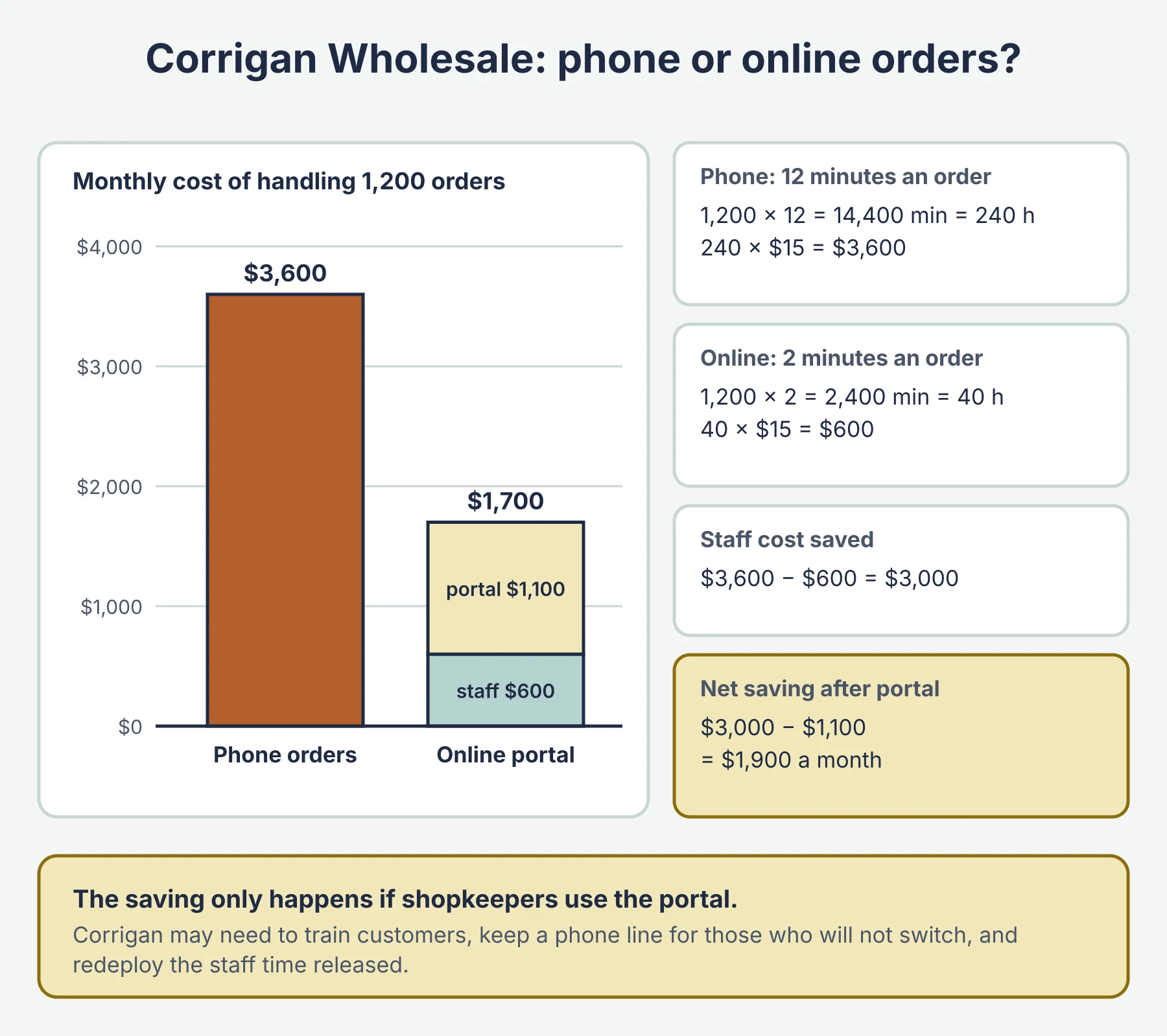
Corrigan Wholesale supplies 300 small shops. Each month it takes 1,200 orders by telephone. Each order takes a member of staff 12 minutes, and staff cost $15 an hour. Corrigan introduces an online ordering portal costing $1,100 a month; online orders need only 2 minutes of staff time each.
Phone orders:  1,200 x 12 minutes = 14,400 minutes = 240 hours
               240 x $15 = $3,600 a month

Online orders: 1,200 x 2 minutes = 2,400 minutes = 40 hours
               40 x $15 = $600 a month

Staff cost saved = $3,600 - $600 = $3,000 a month
Net saving after portal cost = $3,000 - $1,100 = $1,900 a month
The portal saves money, but the saving only happens if shopkeepers actually use it. Corrigan may need to train customers, keep a phone line for those who will not switch, and decide what to do with the staff time released, such as moving staff to sales or delivery work.
Worked example 2: an annotated analysis answer
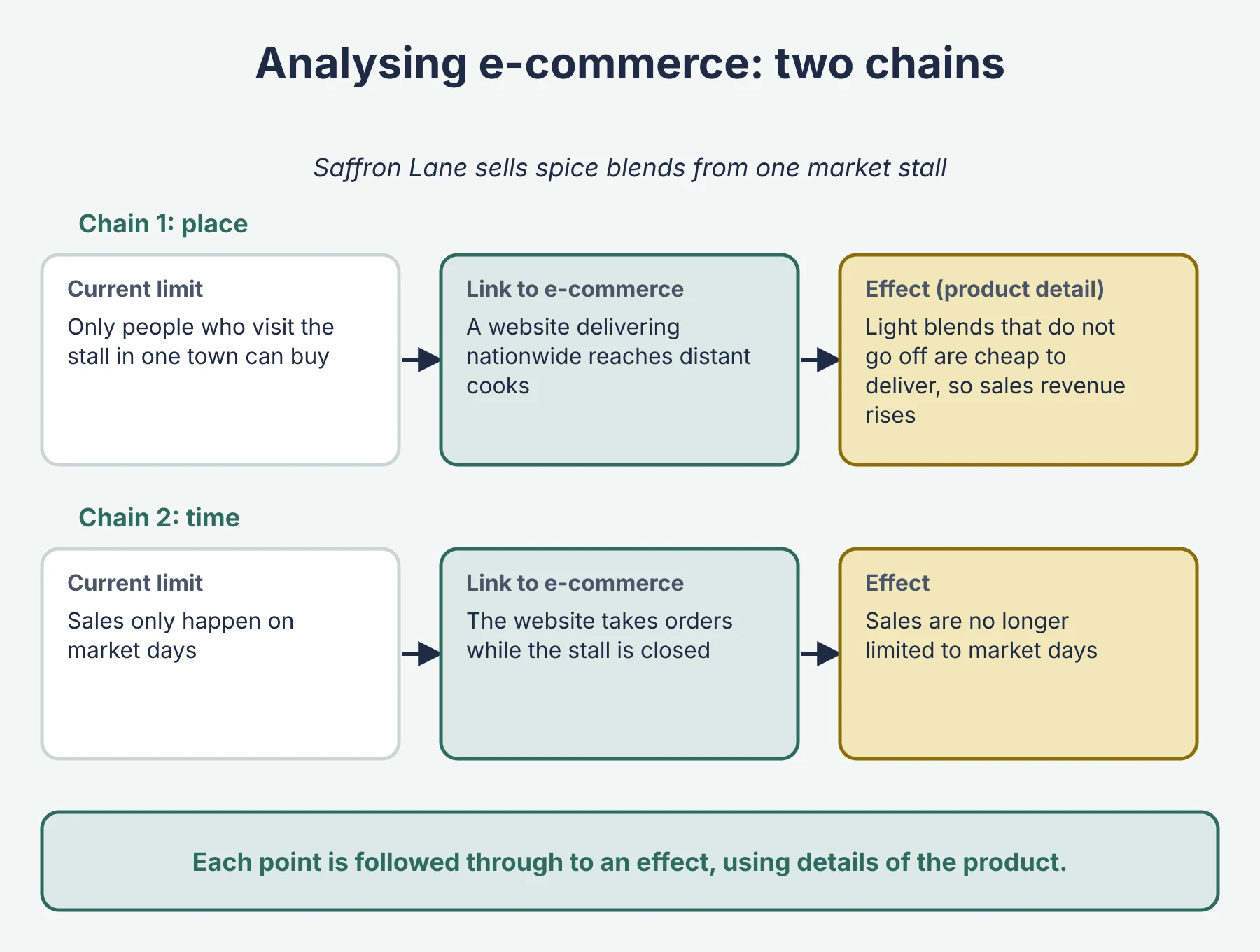
Question: Analyse how e-commerce could help Saffron Lane, a small business selling spice blends from one market stall, to access wider markets.
At present Saffron Lane can only sell to people who visit its market stall, so its customers are limited to one town [identifies the current limit]. With a website that delivers anywhere in the country, people who cook these dishes but live far away could buy its blends [links e-commerce to wider market]. Because spice blends are light and do not go off quickly, delivery costs would be low, so the business could sell profitably to these distant customers and increase its sales revenue [develops the chain using a product detail]. The website also takes orders while the stall is closed, so sales are no longer limited to market days [second chain: time].
The answer earns analysis marks because each point is followed through to an effect on the business, and it uses details about the product rather than general statements.
Common mistakes
- Writing that a business “uses ICT” without saying which activity changes and how.
- Assuming e-commerce always raises profit; delivery, returns and website costs can outweigh the extra sales.
- Forgetting that customers online can compare prices with rivals easily.
- Giving examples of digital communication without linking them to a stakeholder.
- Describing video conferencing only as “cheaper” without saying what cost is saved, such as travel.
Exam technique for this section
- State or identify: give a short, accurate answer, such as naming one example of digital communication.
- Define: give the meaning in one sentence, for example of e-commerce.
- Calculate: show each step and the units, as in worked example 1.
- Explain: make a point, then give its effect on the business using a detail from the case.
- Analyse: build a chain of reasons, as in worked example 2.
- Evaluate: weigh benefits against costs and reach a judgement that depends on something in the case, such as the type of customer or the size of the cost.
More resources on this topic
Related resources
-
Practice questions
OxfordAQA International GCSE Business (9225): Technology – Practice Questions
Twelve original questions with mark-scheme answers on ICT, e-commerce, wider markets and digital communication for OxfordAQA IGCSE Business 9225 section 3.2.1.
Business · OxfordAQA · IGCSE
Try questions -
Revision notes
OxfordAQA International GCSE Business (9225): Technology – Revision Notes
Revision notes for OxfordAQA IGCSE Business 9225 section 3.2.1 Technology: ICT and business activity, e-commerce, digital communication, traps and a self-test.
Business · OxfordAQA · IGCSE
Revise topic -
Study guides
OxfordAQA International GCSE Business (9225): The Economic Climate on Business
Study guide to OxfordAQA IGCSE Business 9225 section 3.2.3: interest rates and borrowing, Sharia compliant finance, employment levels and consumer spending.
Business · OxfordAQA · IGCSE
Read guide
Get free revision emails (optional)
Occasional emails with practice questions, worked explanations and links to free resources for the qualification and subjects you choose. No spam, and you can unsubscribe from any email. The free tools on this site never need an email.