
Study Guides
OxfordAQA International GCSE Business (9225): The Economic Climate on Business
Study guide to OxfordAQA IGCSE Business 9225 section 3.2.3: interest rates and borrowing, Sharia compliant finance, employment levels and consumer spending.
- Subject
- Business
- Level
- IGCSE
- Topic
- Influences on business
- Author
- Marlbridge Academic Team
- Updated
- Reviewed by
- Salman Ahmad (what this means)
Aligned to OxfordAQA IGCSE Business (9225), First teaching September 2020, first examined May/June 2022. Official specification .
Syllabus page (what it covers and how it is assessed): OxfordAQA IGCSE Business.
Syllabus points this page covers
9225
- 3.2.3 The economic climate on business
Found an error? Report a correction.
Need help with this topic? Request a free trial class for IGCSE Business (9225).
This guide covers section 3.2.3 The economic climate on business of OxfordAQA International GCSE Business (9225), part of Topic 2, Influences on business. The specification lists three content points: interest rates (how fluctuating rates affect businesses that rely on overdrafts and loans, and how they affect consumer and business spending), the level of employment and consumer spending. You must understand how businesses are affected by changes in interest rates, including Sharia compliant alternatives, how and why they are affected by changes in employment, and how demand may change as incomes fluctuate. You are not expected to know the economic theory of how or why interest rates change. All businesses and figures are invented.
For the whole topic, see the Influences on Business study guide. Condensed notes are in the Economic Climate revision notes and questions in the Economic Climate practice questions.
Interest rates: who feels a change most?
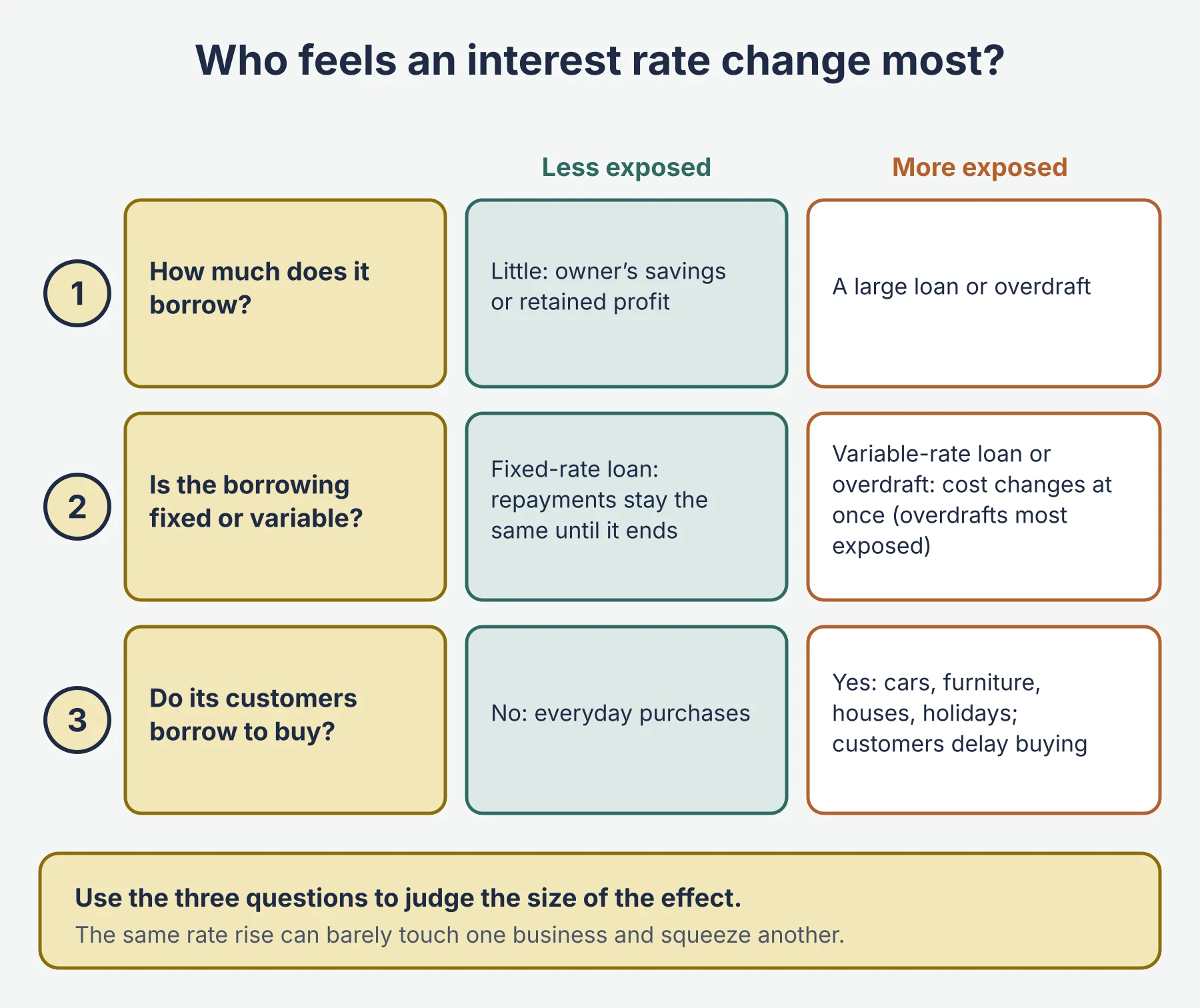
The interest rate is the cost of borrowing money. Not every business is affected equally when it changes. Three questions help you judge the size of the effect in a case study.
- How much does the business borrow? A business with a large loan or overdraft feels a rise more than one financed by the owner’s savings or retained profit.
- Is the borrowing fixed or variable? With a fixed-rate loan, repayments stay the same until the agreement ends. With a variable-rate loan or an overdraft, the cost changes as soon as rates change. Overdrafts are usually the most exposed, because they are short-term and repriced quickly.
- Do its customers borrow to buy? Businesses selling cars, furniture, houses or holidays often rely on customers using loans or credit cards. When borrowing becomes dearer, these customers delay purchases.
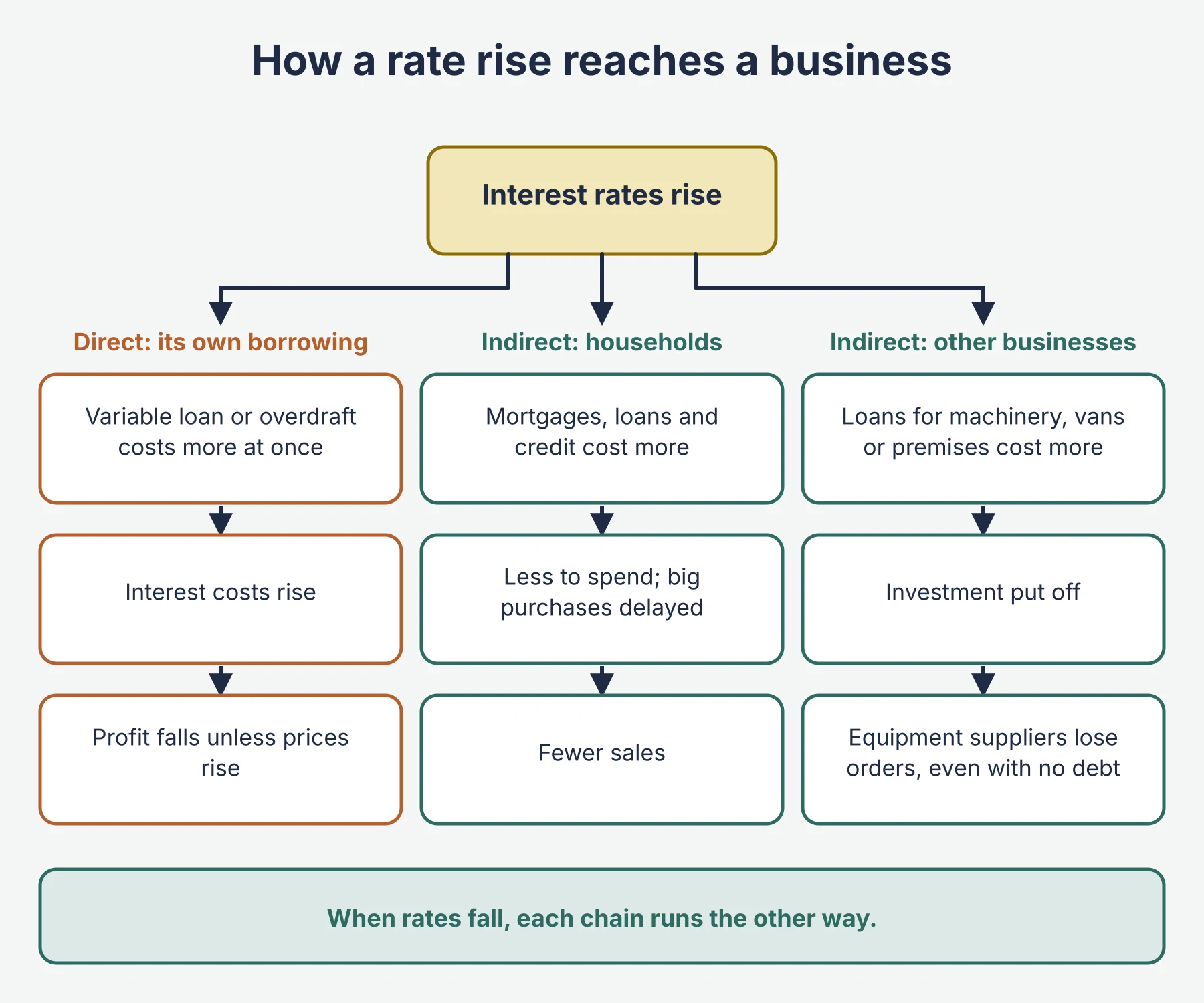
Business spending is affected too. When rates rise, other businesses put off buying new machinery, vans or premises, because the loans to pay for them cost more. So a supplier of equipment to other businesses can lose orders even if it has no debt itself. When rates fall, the reverse happens: borrowing is cheaper, households have more to spend after loan repayments, and businesses are more willing to invest.
Worked example 1: same rise, different effects
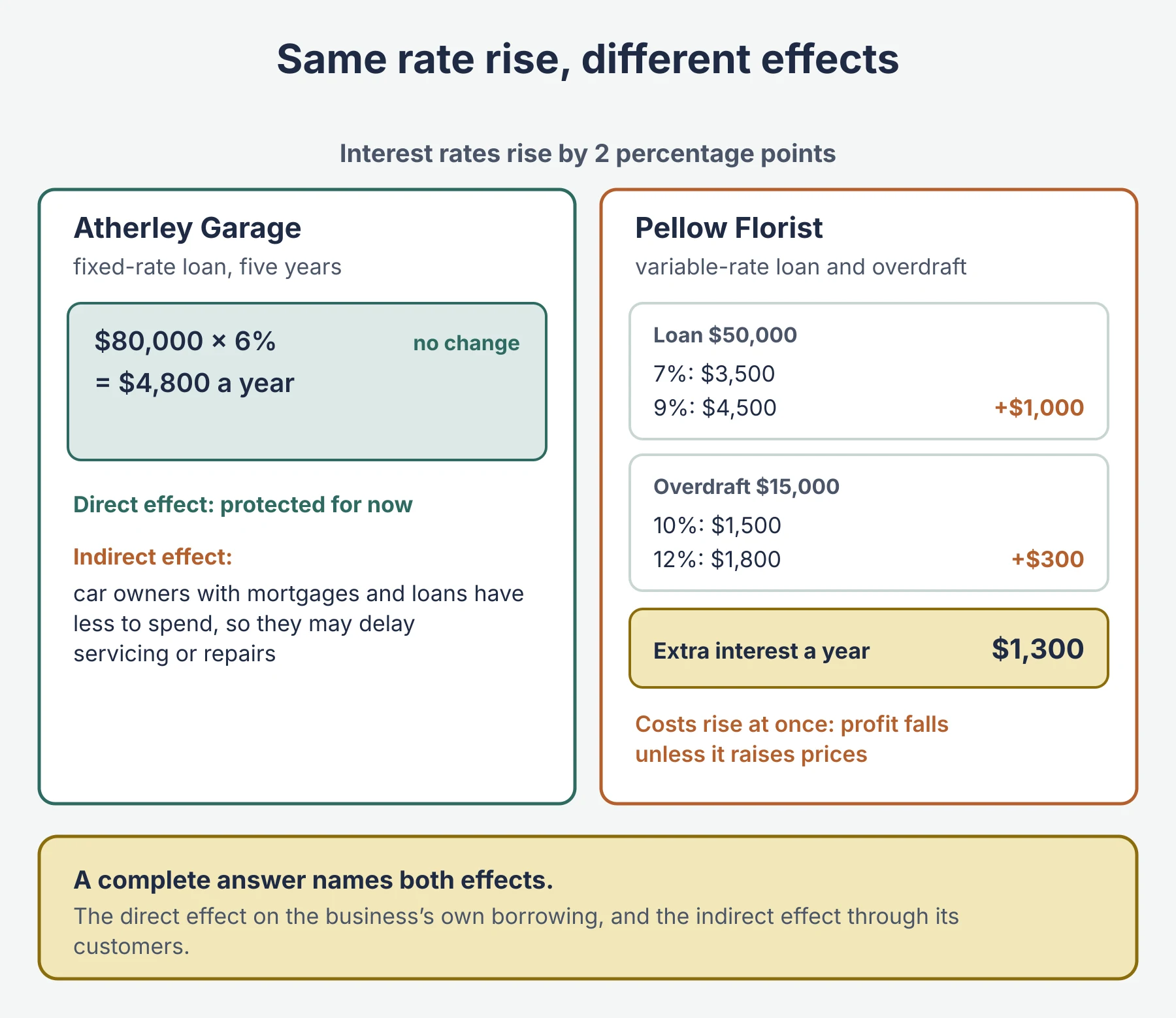
Interest rates rise by 2 percentage points. Two local businesses are affected differently.
Atherley Garage: fixed-rate loan of $80,000 at 6% for five years
   Interest stays at 80,000 x 6% = $4,800 a year (no change until the loan ends)

Pellow Florist: variable-rate loan of $50,000 and average overdraft of $15,000
   Loan:      50,000 x 7%  = $3,500  ->  50,000 x 9%  = $4,500   (+$1,000)
   Overdraft: 15,000 x 10% = $1,500  ->  15,000 x 12% = $1,800   (+$300)
   Extra interest each year = $1,300
The florist’s costs rise at once, so its profit falls unless it raises prices. The garage’s own costs are protected for now, but it is not unaffected: car owners with mortgages and loans have less to spend, so they may delay servicing or repairs. A complete answer names both the direct effect on the business’s borrowing and the indirect effect through customers.
Sharia compliant alternatives
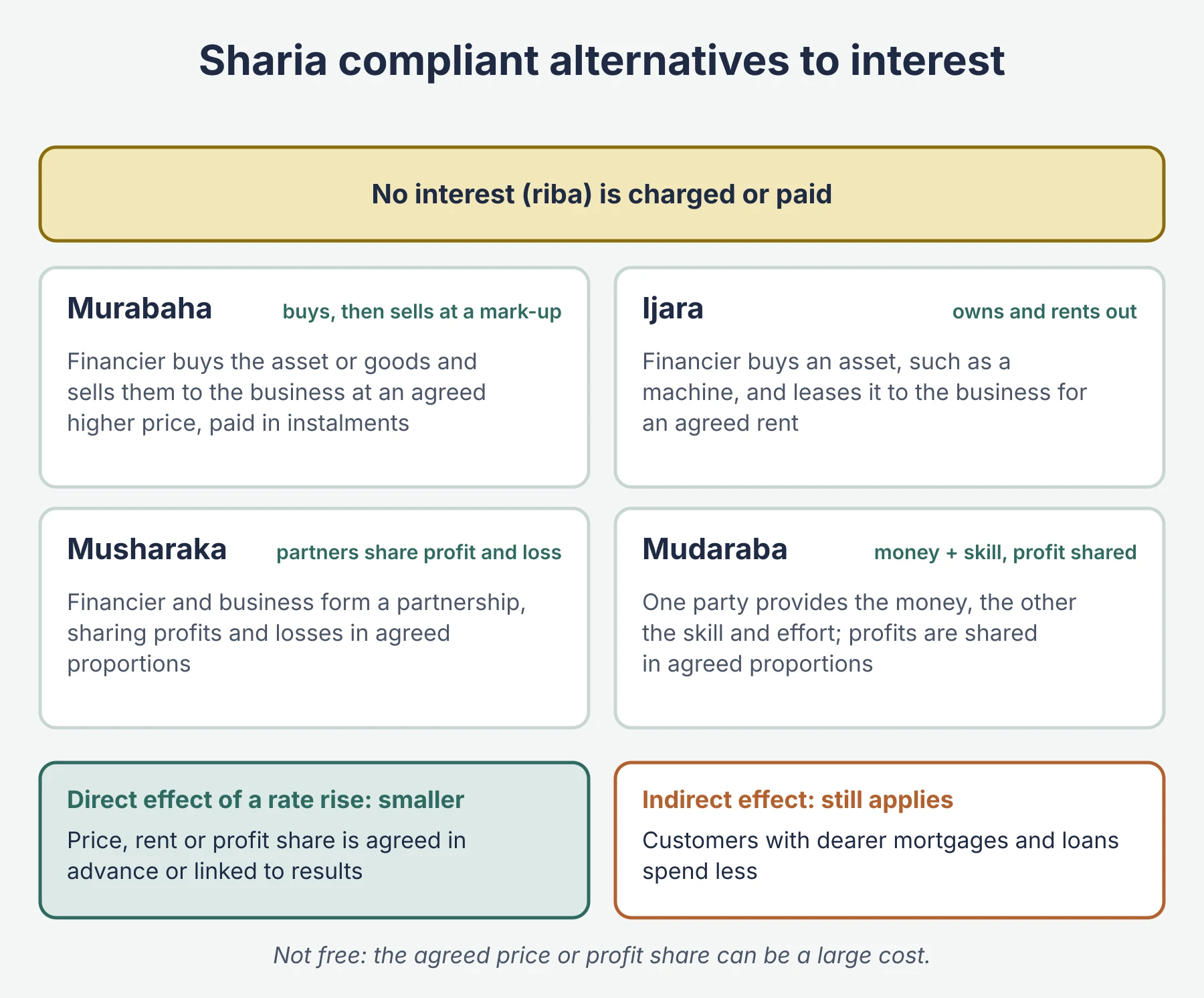
Islamic law does not allow interest (riba) to be charged or paid. Business owners and customers who follow this principle use finance structured in other ways. The specification names “Sharia compliant alternatives” without listing them; the common forms are:
| Form | How it works in simple terms |
|---|---|
| Murabaha | The financier buys an asset or goods and sells them to the business at an agreed higher price, paid in instalments |
| Ijara | The financier buys an asset, such as a machine, and leases it to the business for an agreed rent |
| Musharaka | The financier and the business form a partnership, sharing profits and losses in agreed proportions |
| Mudaraba | One party provides the money and the other the skill and effort; profits are shared in agreed proportions |
How a change in interest rates affects a business using them. Because the price, rent or profit share is agreed in advance or linked to the business’s results, a rise in conventional interest rates does not automatically increase the cost of finance already arranged, so the direct effect is smaller. The indirect effect still applies: if customers face higher mortgage and loan costs, they spend less, whatever finance the business itself uses. Sharia compliant finance is not free: the agreed price or profit share can be a large cost, and new agreements may reflect market conditions at the time they are made.
The level of employment
The level of employment means how many people who want to work have jobs. Changes affect a business in several ways.
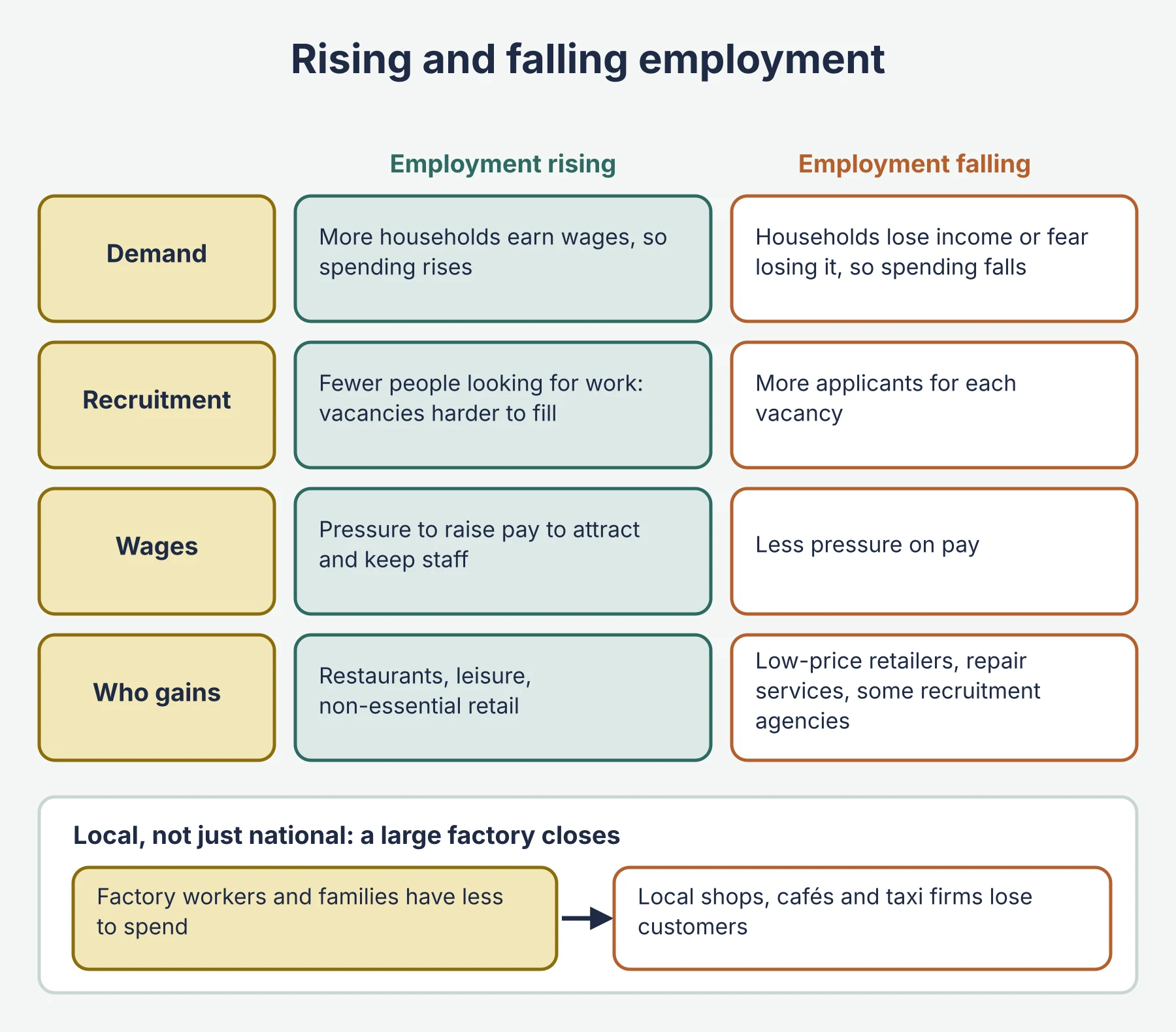
| Employment rising | Employment falling | |
|---|---|---|
| Demand | More households earn wages, so spending rises | Households lose income or fear losing it, so spending falls |
| Recruitment | Fewer people looking for work, so vacancies are harder to fill | More applicants for each vacancy |
| Wages | Pressure to raise pay to attract and keep staff | Less pressure on pay |
| Which businesses gain | Restaurants, leisure, non-essential retail | Low-price retailers, repair services, some recruitment agencies |
Employment can change in one town while the national picture stays the same. If a large factory closes, local shops, cafés and taxi firms lose customers, because the factory’s workers and their families have less to spend.
Consumer spending as incomes fluctuate
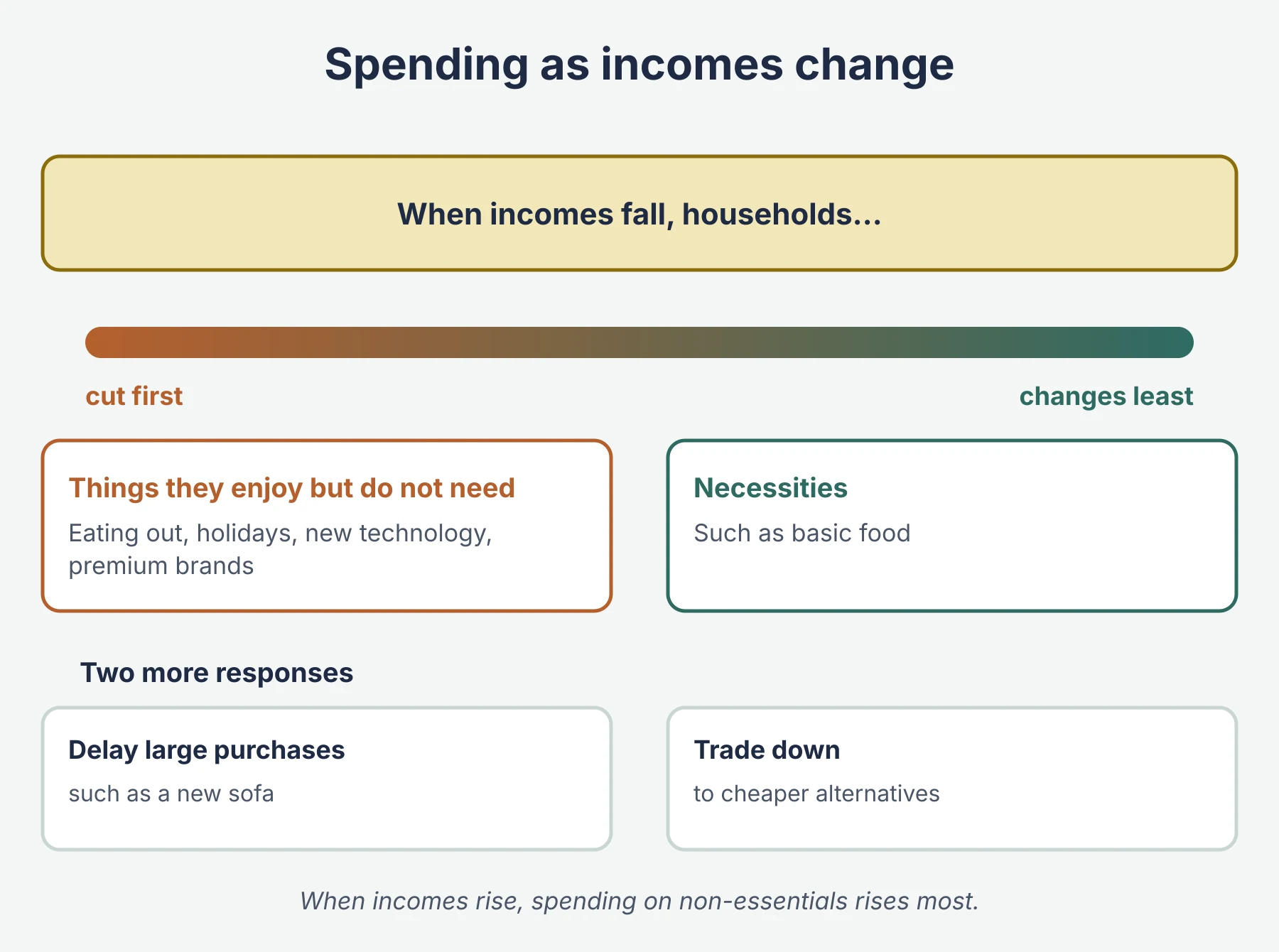
When incomes rise, households spend more, especially on things they enjoy but do not need: eating out, holidays, new technology, premium brands. When incomes fall, they cut those first, delay large purchases and trade down to cheaper alternatives. Spending on necessities, such as basic food, changes least.
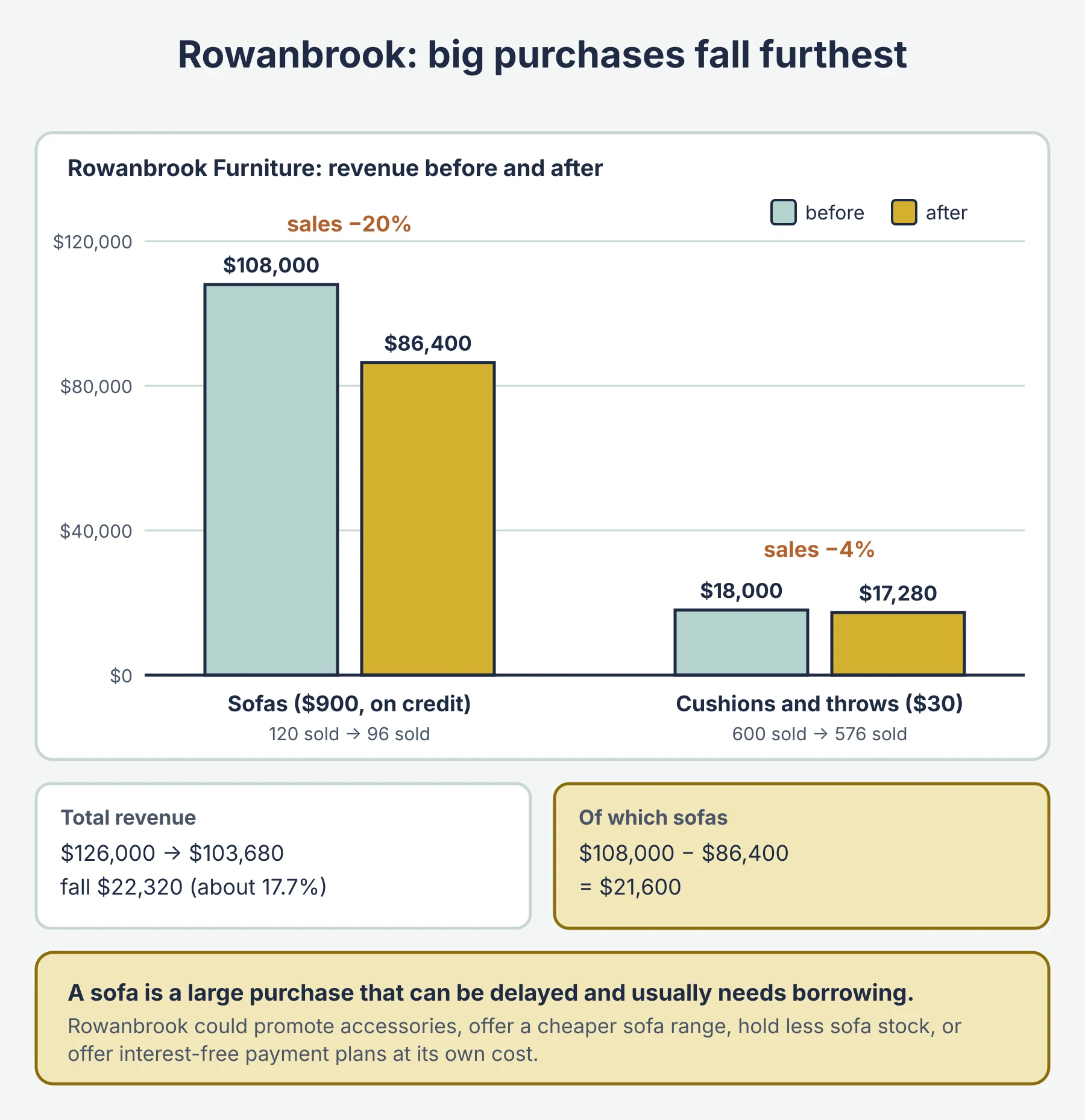
Worked example 2. Rowanbrook Furniture sells sofas at $900, which most customers buy on credit, and cushions and throws at $30. Interest rates rise and local incomes are squeezed.
Before: 120 sofas x $900 = $108,000;  600 accessories x $30 = $18,000;  total $126,000
After:   96 sofas x $900 =  $86,400;  576 accessories x $30 = $17,280;  total $103,680

Fall in revenue = $126,000 - $103,680 = $22,320  (about 17.7%)
Of which sofas  = $108,000 - $86,400  = $21,600
Sofa sales fall by 20% while accessories fall by only 4%, because a sofa is a large purchase that can be delayed and usually needs borrowing. Rowanbrook could respond by promoting accessories, offering sofas through a cheaper range, holding less sofa stock to protect its cash, or offering payment plans without interest charges, although that last option costs the business money.
Common mistakes
- Explaining only the effect on the business’s own loans and missing the effect on customers’ spending.
- Treating all borrowing the same: fixed-rate loans are not affected straight away.
- Trying to explain why the interest rate changed, which the specification does not require.
- Saying falling employment is bad for every business: recruitment becomes easier, and low-price sellers may gain.
- Describing Sharia compliant finance as “interest-free loans”, which misses how the cost is structured.
Exam technique for this section
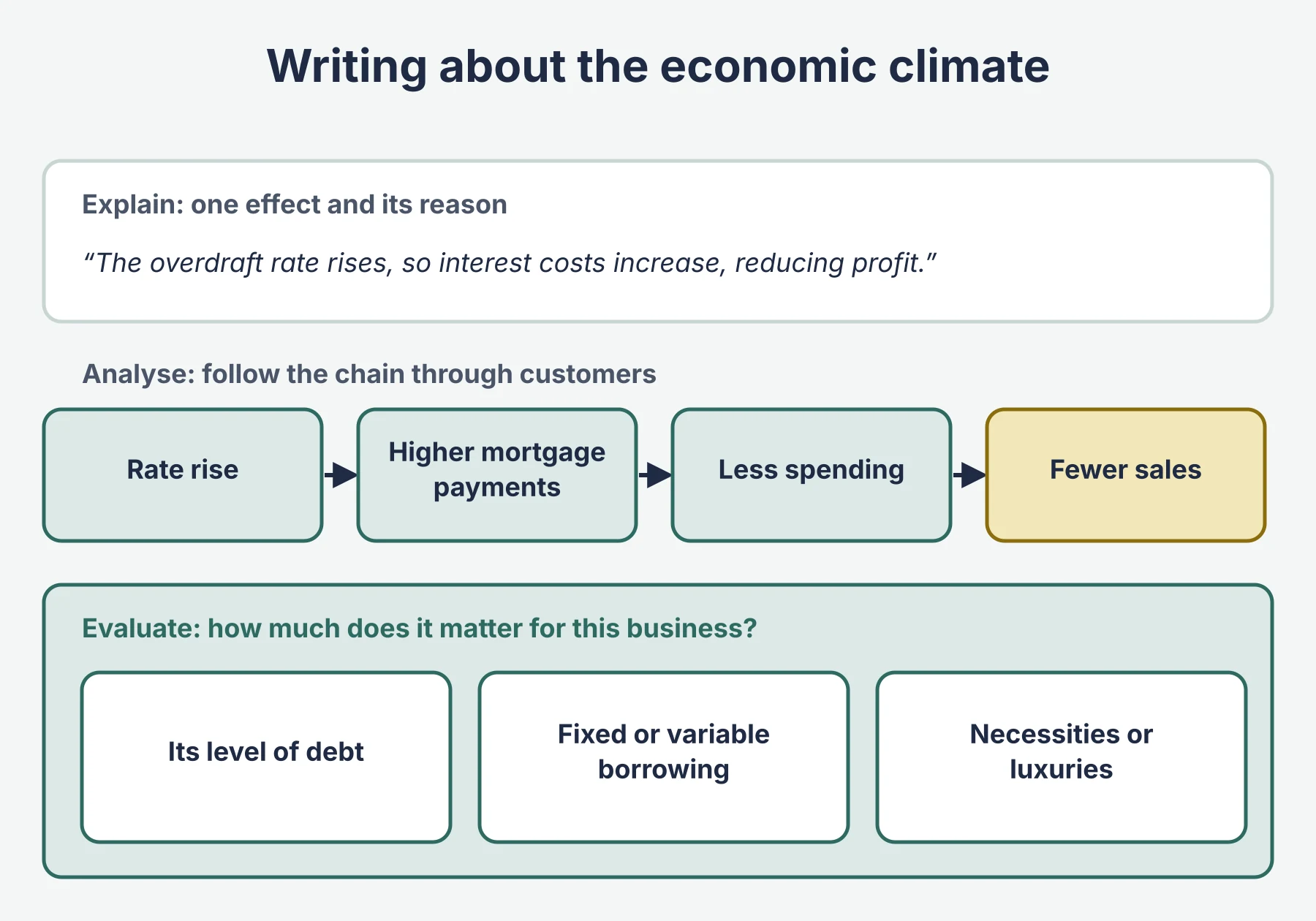
For explain answers, give one effect and the reason for it, linked to the business in the question: “The overdraft rate rises, so interest costs increase, reducing profit.” For analyse answers, follow the chain through customers too: rate rise, higher mortgage payments, less spending, fewer sales. For evaluate answers, judge how much the change matters for this business, using its level of debt, whether its borrowing is fixed or variable, and whether its products are necessities or luxuries.
More resources on this topic
Related resources
-
Practice questions
OxfordAQA International GCSE Business (9225): The Economic Climate on Business – Practice Questions
Twelve original questions with answers on interest rates, borrowing costs, Sharia compliant finance, employment and consumer spending for OxfordAQA IGCSE 9225.
Business · OxfordAQA · IGCSE
Try questions -
Revision notes
OxfordAQA International GCSE Business (9225): The Economic Climate on Business – Revision Notes
Revision notes for OxfordAQA IGCSE Business 9225 section 3.2.3: interest rates, Sharia compliant finance, employment and consumer spending, with a self-test.
Business · OxfordAQA · IGCSE
Revise topic -
Practice questions
OxfordAQA IGCSE Business: Influences on Business — Practice Questions (9225)
Original OxfordAQA International GCSE Business 9225 practice questions with worked answers on technology, ethics, the economy, globalisation, law and rivals.
Business · OxfordAQA · IGCSE
Try questions
Get free revision emails (optional)
Occasional emails with practice questions, worked explanations and links to free resources for the qualification and subjects you choose. No spam, and you can unsubscribe from any email. The free tools on this site never need an email.