
Revision Notes
OxfordAQA International GCSE Business (9225): The Economic Climate on Business – Revision Notes
Revision notes for OxfordAQA IGCSE Business 9225 section 3.2.3: interest rates, Sharia compliant finance, employment and consumer spending, with a self-test.
- Subject
- Business
- Level
- IGCSE
- Topic
- Influences on business
- Author
- Marlbridge Academic Team
- Updated
- Reviewed by
- Salman Ahmad (what this means)
Aligned to OxfordAQA IGCSE Business (9225), First teaching September 2020, first examined May/June 2022. Official specification .
Syllabus page (what it covers and how it is assessed): OxfordAQA IGCSE Business.
Syllabus points this page covers
9225
- 3.2.3 The economic climate on business
Found an error? Report a correction.
Need help with this topic? Request a free trial class for IGCSE Business (9225).
Condensed recall for section 3.2.3. For full explanations and worked examples, use the Economic Climate study guide. Figures are invented.
What the specification asks
- How fluctuating interest rates affect businesses that rely on overdrafts and loans.
- How fluctuating interest rates affect consumer and business spending.
- Sharia compliant alternatives to interest-based finance.
- How and why businesses are affected by changes in the level of employment.
- How demand changes as incomes fluctuate.
- Not required: economic theory of how or why interest rates change.
Interest rates: two channels
| Channel | Rate rise | Rate fall |
|---|---|---|
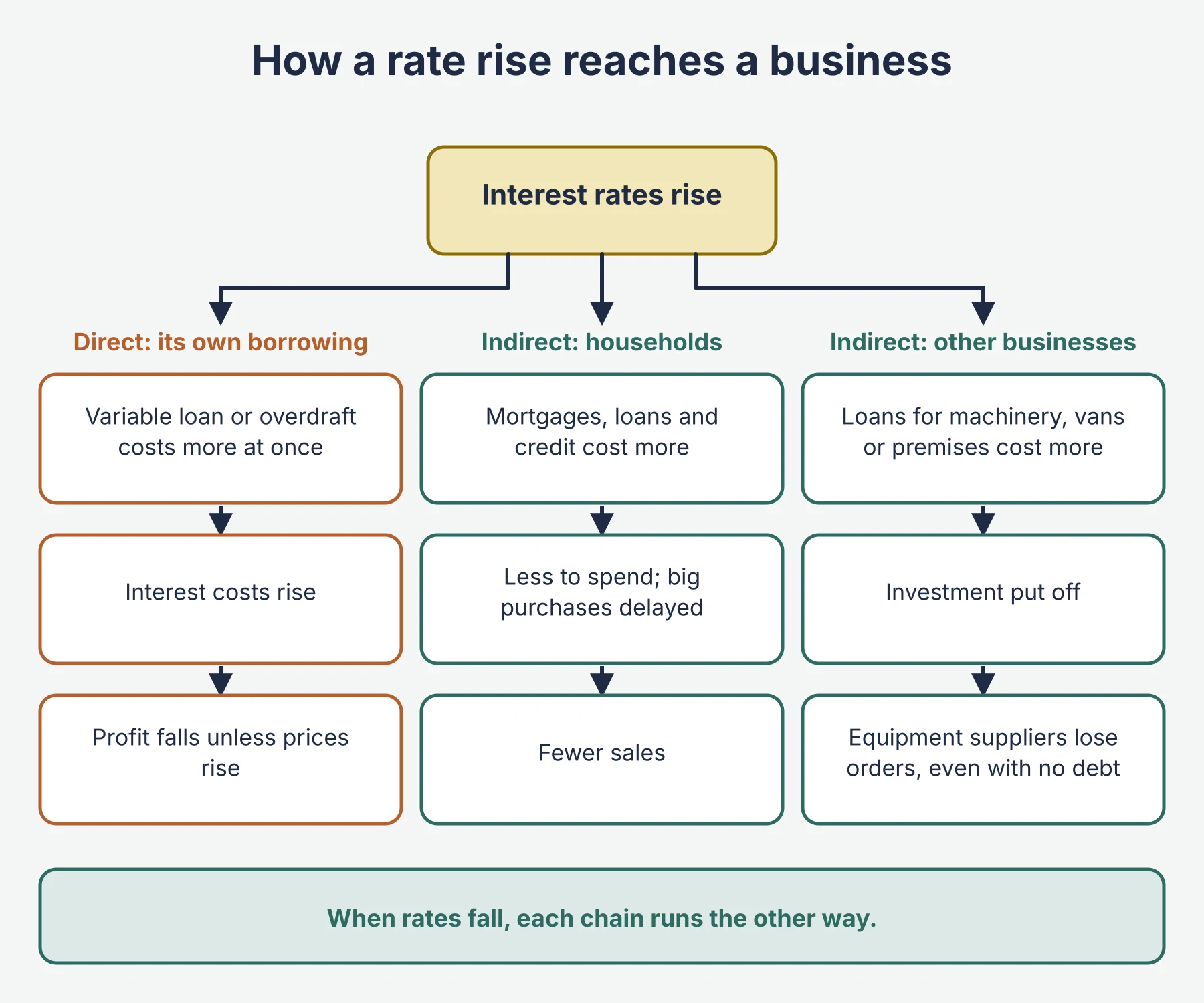
| Direct: the business’s own borrowing | Variable loans and overdrafts cost more; profit falls | Borrowing cheaper; profit rises; investment easier |
| Indirect: customers’ spending | Households pay more on mortgages and credit, so spend less; firms delay buying equipment | Households and firms have more to spend |
Most exposed businesses: high debt; variable-rate loans or overdrafts; products bought on credit (cars, furniture, houses); suppliers of equipment to other businesses; luxury products.
Least exposed: little or no debt; fixed-rate loans (until they end); necessities paid for in cash.
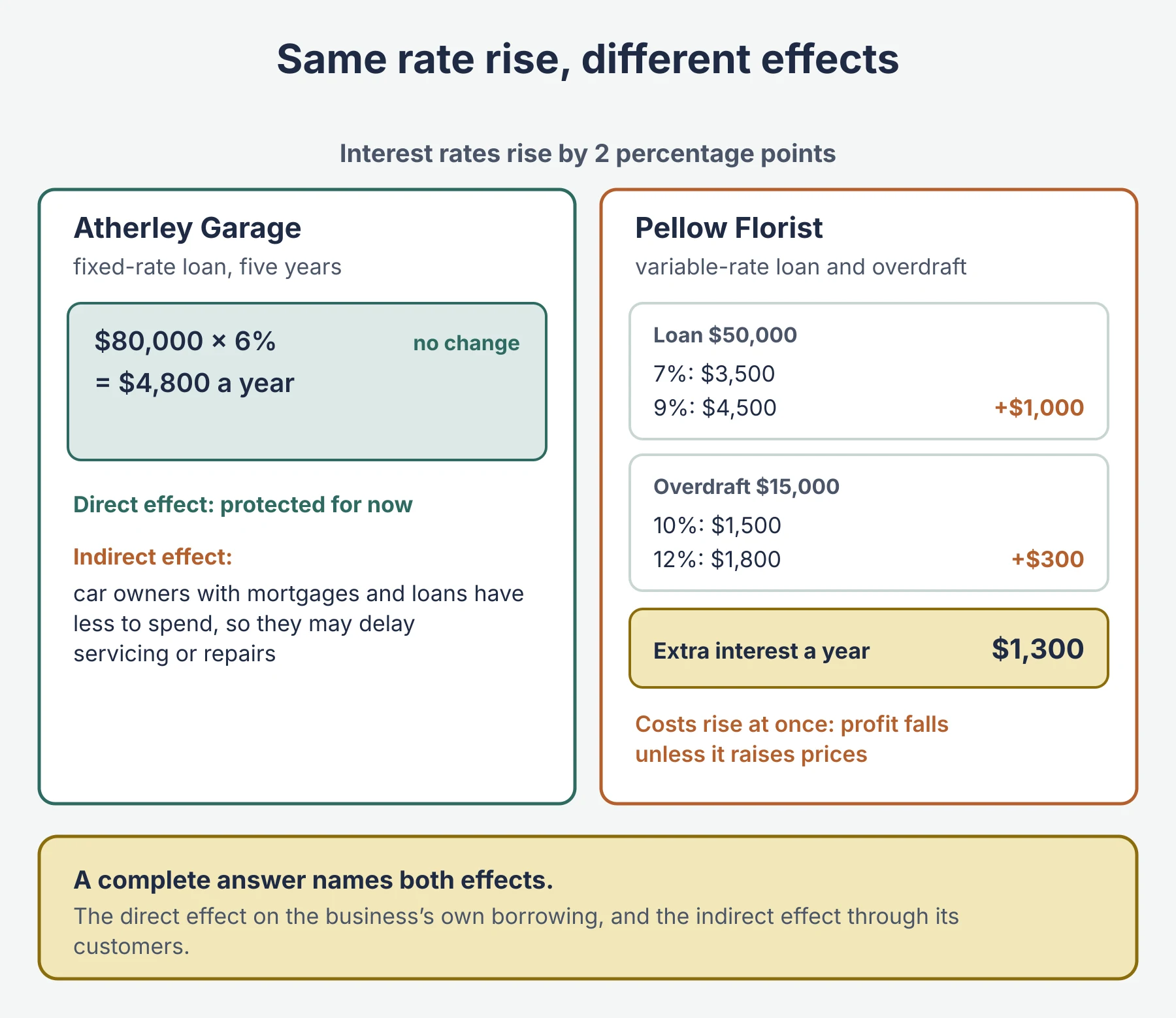
Calculation reminder: interest = amount borrowed × rate. A $40,000 overdraft rising from 8% to 11% costs 40,000 × 3% = $1,200 more a year.
Sharia compliant alternatives
Interest (riba) is not permitted under Islamic law, so finance is structured differently:
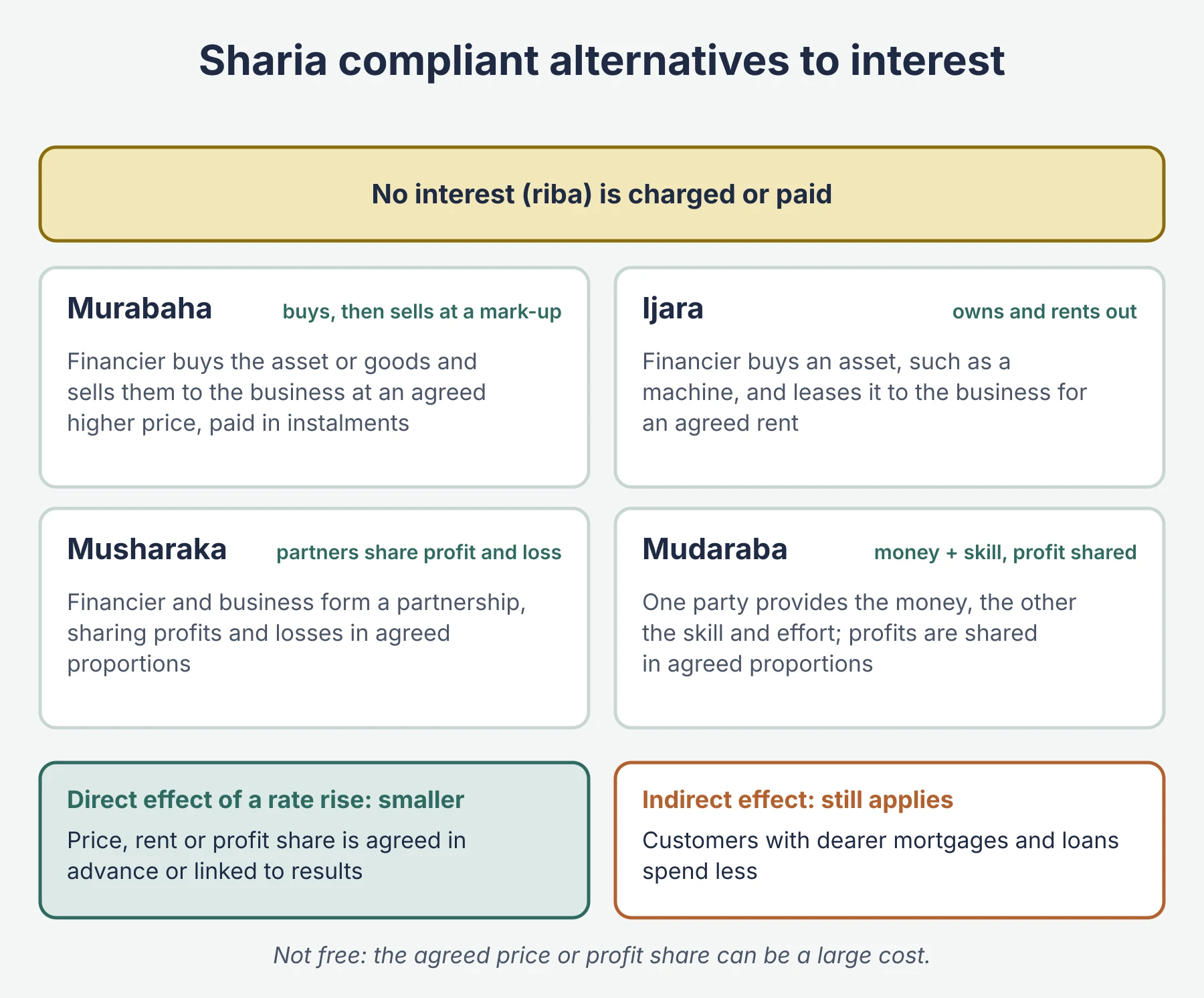
- Murabaha: financier buys goods and sells them to the business at an agreed higher price, paid in instalments.
- Ijara: financier buys an asset and leases it to the business for agreed rent.
- Musharaka: partnership sharing profits and losses in agreed proportions.
- Mudaraba: one side provides money, the other effort and skill; profits shared as agreed.
Effect of a rate change: finance already agreed does not automatically cost more, so the direct effect is smaller; the indirect effect on customers’ spending still applies. New agreements may reflect conditions at the time.
Level of employment
| Rising employment | Falling employment | |
|---|---|---|
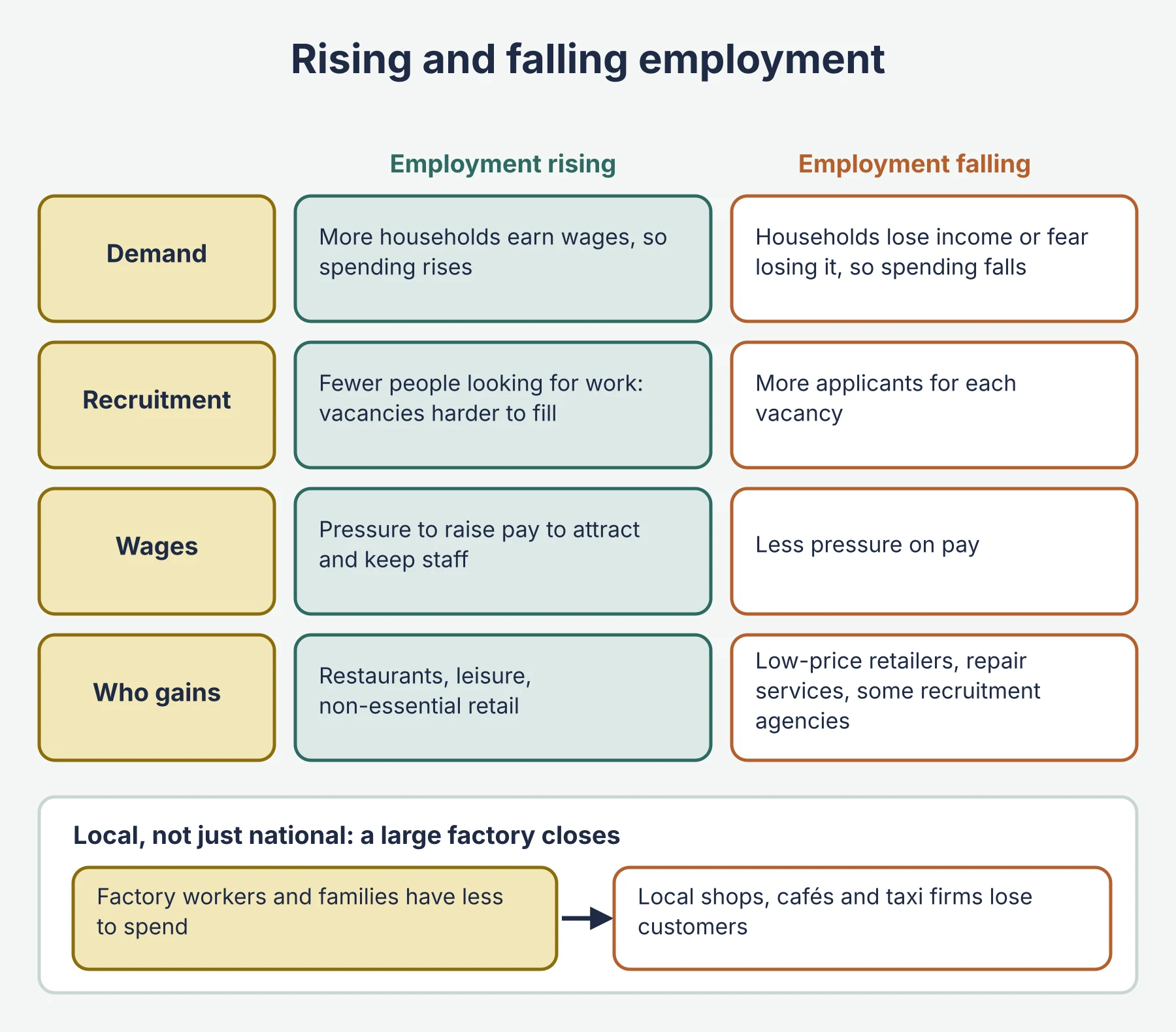
| Demand | Up, especially for non-essentials | Down; households cautious |
| Recruitment | Harder; skills shortages | Easier; more applicants |
| Wage costs | Pressure to rise | Less pressure |
| Winners | Restaurants, leisure, premium retail | Discount retailers, repair services |
A local closure (such as a large factory) hits local businesses even if national employment is steady.
Consumer spending
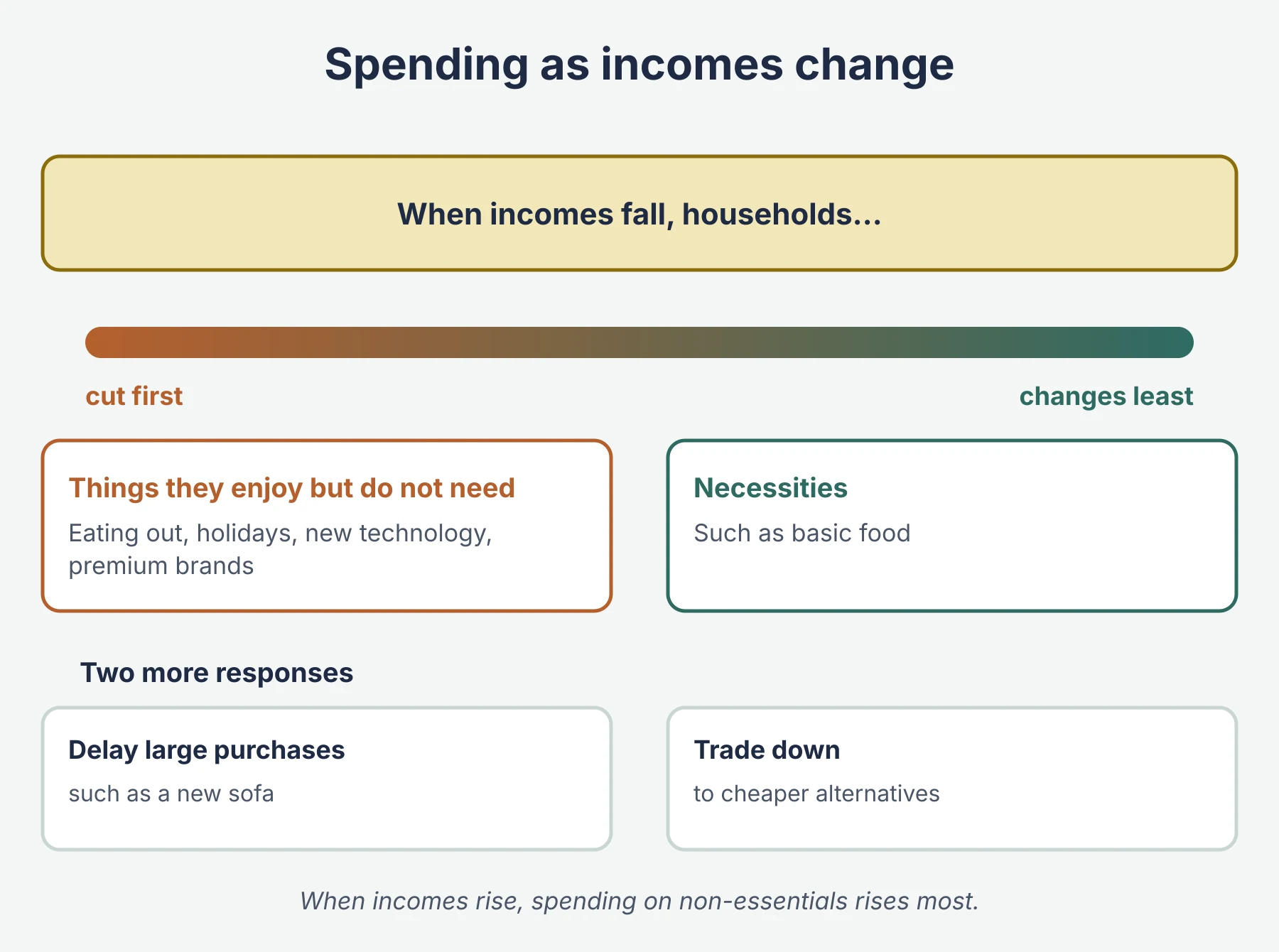
- Incomes up: more spending on luxuries, eating out, holidays, premium brands.
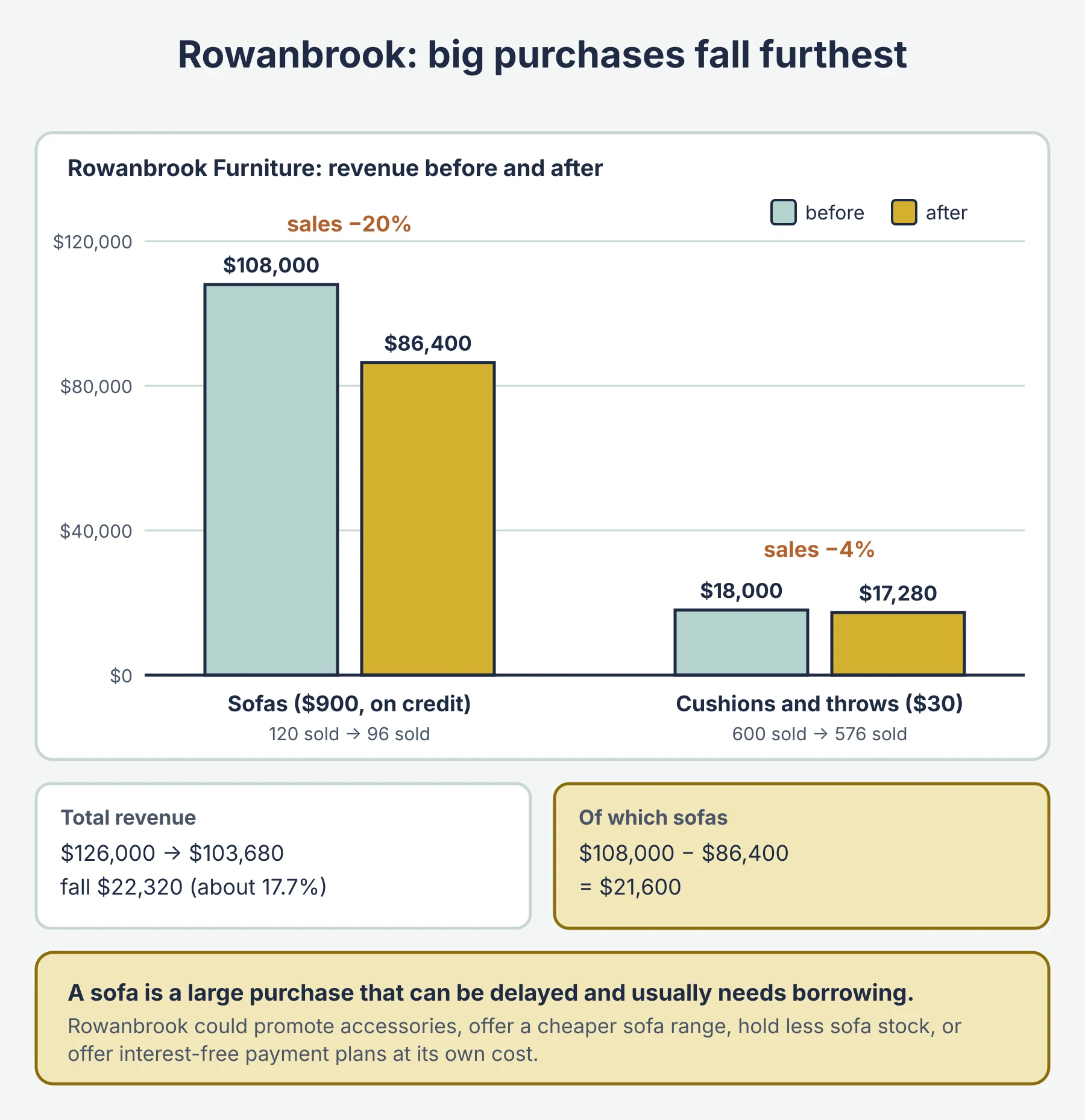
- Incomes down: cuts to luxuries first; big purchases delayed; customers trade down to cheaper alternatives.
- Necessities change least.
- A business with a mixed product range is cushioned; one selling only luxuries is exposed.
Key terms
| Term | Meaning |
|---|---|
| Interest rate | The cost of borrowing money, as a percentage per year |
| Overdraft | Permission to take more money out of a bank account than it holds, up to a limit |
| Loan | A fixed sum borrowed and repaid over an agreed period |
| Fixed rate | An interest rate that does not change during the agreement |
| Variable rate | An interest rate that changes when market rates change |
| Riba | Interest, which Islamic law does not permit |
| Level of employment | How many people who want to work have jobs |
| Consumer spending | Money households spend on goods and services |
| Trading down | Switching to cheaper versions of products |
Exam traps
- Always give both channels for interest rates: the business’s own borrowing and its customers’ spending.
- Fixed-rate loans do not change straight away; overdrafts usually do.
- Do not try to explain why rates changed.
- A fall in employment can help recruitment and help low-price businesses.
- Sharia compliant finance still has a cost; it is structured as a price, rent or profit share.
- Percentage-point change is not percentage change: 8% to 11% is 3 percentage points.
Self-test
- State two ways a rise in interest rates can affect a business.
- Why is a business with an overdraft affected more quickly than one with a fixed-rate loan?
- A business has a variable-rate loan of $60,000. The rate rises from 5% to 7%. Calculate the extra yearly interest.
- Give one type of business whose sales are likely to fall most when rates rise, and explain why.
- How can a rise in interest rates reduce business spending?
- Why do some businesses use Sharia compliant finance?
- Describe ijara in one sentence.
- Give one benefit and one problem for a restaurant when employment in its town rises.
- Give one way a business could be affected by a large local factory closing.
- When incomes fall, which products usually see the biggest fall in sales?
- Define trading down.
- Sales of a luxury product fall from 500 to 425 a month. Calculate the percentage fall.
Answers
- Higher repayments on variable loans and overdrafts; lower sales as customers have less to spend.
- Overdraft rates change as soon as market rates change, while a fixed-rate loan’s repayments stay the same until the agreement ends.
- 60,000 × 2% = $1,200 (from $3,000 to $4,200).
- A car dealer or furniture shop, because customers often buy these on credit, which becomes more expensive.
- Businesses delay buying machinery, vehicles or premises because the loans to pay for them cost more.
- Their owners follow Islamic law, which does not permit paying or receiving interest.
- The financier buys an asset and leases it to the business for an agreed rent.
- Benefit: more customers can afford to eat out. Problem: harder to recruit staff, and wages may need to rise.
- Local households lose income, so they spend less in local shops and cafés.
- Luxuries and large purchases that can be delayed.
- Switching to cheaper versions of products, for example own-brand instead of premium brands.
- (500 − 425) ÷ 500 × 100 = 15%.
Related resources
-
Practice questions
OxfordAQA IGCSE Business: Influences on Business — Practice Questions (9225)
Original OxfordAQA International GCSE Business 9225 practice questions with worked answers on technology, ethics, the economy, globalisation, law and rivals.
Business · OxfordAQA · IGCSE
Try questions -
Study guides
OxfordAQA IGCSE Business: Legislation and Competitive environment (9225)
Study guide to legislation, competition, risk and uncertainty for OxfordAQA International GCSE Business (9225), with worked cost examples.
Business · OxfordAQA · IGCSE
Read guide -
Practice questions
OxfordAQA IGCSE Business: Legislation and Competitive environment (9225) – Practice Questions
Eleven original questions with worked answers on legislation, competition, risk and cost advantage for OxfordAQA International GCSE Business (9225).
Business · OxfordAQA · IGCSE
Try questions
Get free revision emails (optional)
Occasional emails with practice questions, worked explanations and links to free resources for the qualification and subjects you choose. No spam, and you can unsubscribe from any email. The free tools on this site never need an email.