
Study Guides
OxfordAQA IGCSE Business: Legislation and Competitive environment (9225)
Study guide to legislation, competition, risk and uncertainty for OxfordAQA International GCSE Business (9225), with worked cost examples.
- Subject
- Business
- Level
- IGCSE
- Topic
- Influences on business
- Author
- Marlbridge Academic Team
- Updated
- Reviewed by
- Salman Ahmad (what this means)
Aligned to OxfordAQA IGCSE Business (9225), First teaching September 2020, first examined May/June 2022. Official specification .
Syllabus page (what it covers and how it is assessed): OxfordAQA IGCSE Business.
Syllabus points this page covers
9225
- 3.2.5 Legislation
- 3.2.6 Competitive environment
Found an error? Report a correction.
Need help with this topic? Request a free trial class for IGCSE Business (9225).
This guide is aligned to the OxfordAQA International GCSE Business (9225) specification, version 3.1, for International GCSE exams from May/June 2022 onwards. It covers section 3.2.5 Legislation and section 3.2.6 Competitive environment, both part of Influences on business. The specification names Influences on business as assessed on both written papers. For the full course, use the OxfordAQA IGCSE Business hub and the printable checklist.
For a wider tour of all six influences, read the Influences on business study guide and the Influences revision notes. This page goes deeper on two sections only. Test yourself afterwards with the revision notes and the practice set. If you are unsure where to start, try a free 10-minute diagnostic.
What the specification asks you to do
| Section | Content | What you must be able to do |
|---|---|---|
| 3.2.5 | Employment law, health and safety law, consumer law | Judge how legislation affects a business through cost, training needs, recruitment and the results of breaking the rules |
| 3.2.5 | Safe working environment and a national minimum wage | Know the benefits and drawbacks to businesses in countries that have such laws |
| 3.2.5 | Consumer protection laws | Know how they can impact on businesses |
| 3.2.6 | Impact of operating in competitive markets | Understand what a market and competition are; analyse impacts of competition; identify situations of minimal or no competition |
| 3.2.6 | Uncertainty and risks | Understand the risks businesses face and why all businesses face uncertainty; why entrepreneurs run businesses; activities that minimise risk |
| 3.2.6 | Developing and developed countries | Understand ways developing countries compete with developed countries, such as lower cost advantage |
The specification does not name particular Acts or regulators. Keep your answers general (“employment law requires…”) rather than quoting laws from one country. Students are expected to be “aware of” some points and to “assess” or “analyse” others, so prepare to write chains of reasoning, not just lists.
3.2.5 Legislation
Three areas of law
- Employment law covers how a business treats the people who work for it. Examples of the topics it deals with include pay, hours, contracts and fair treatment.
- Health and safety law requires a business to protect employees, and often customers and visitors, from harm.
- Consumer law protects buyers. It covers goods and services that must be as described, safe and of acceptable quality.
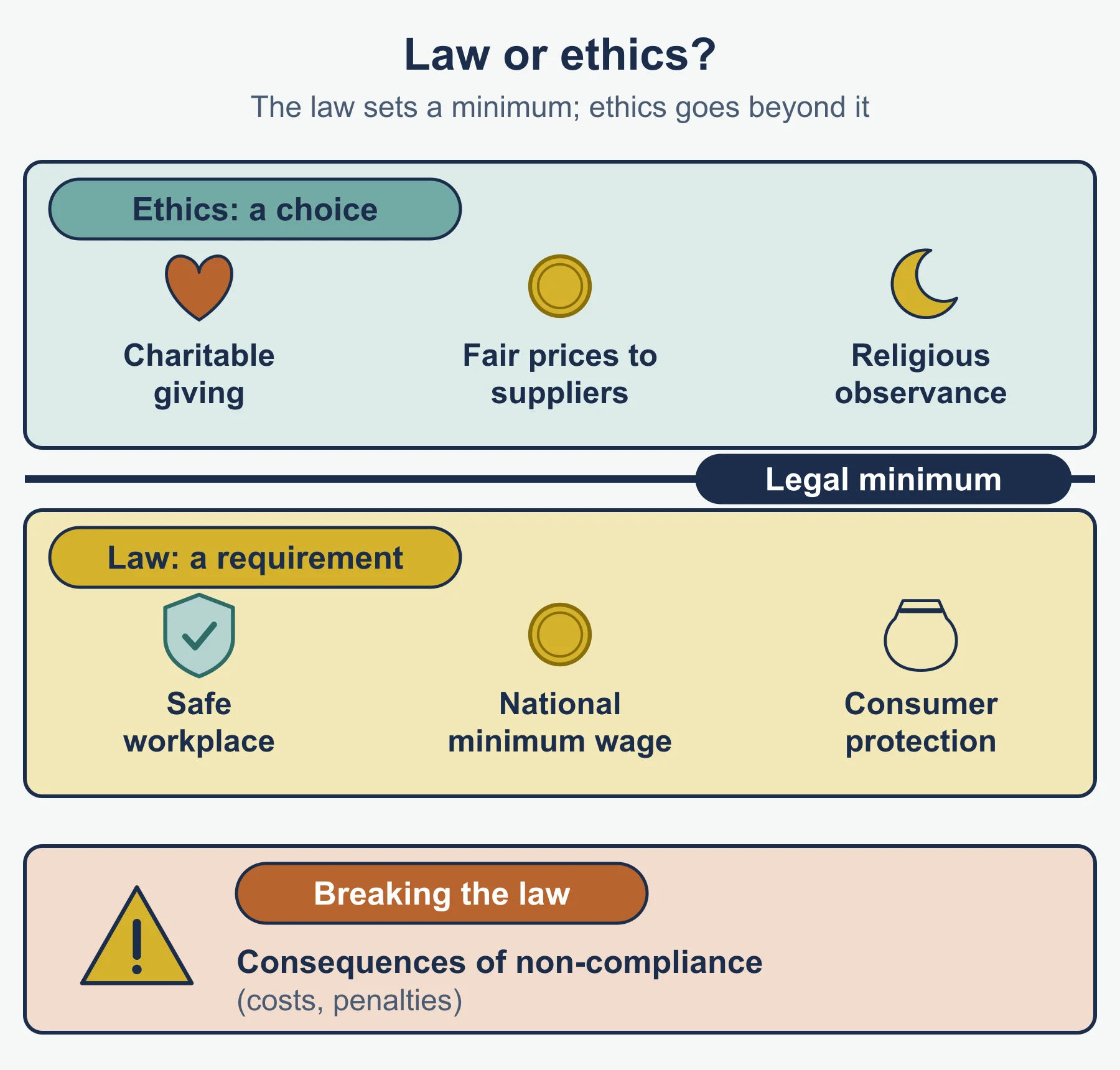
Legislation is a legal requirement. That separates it from ethics (section 3.2.2), which covers choices a business makes that go further than the law demands.
Assessing the impact: a four-part checklist
The specification lists four effects to assess. Use them as a checklist, then add the context of the business in the question.
- Cost. Wages, equipment, record-keeping, insurance, refunds.
- Training needs. Managers and staff must learn what the law requires and how to apply it.
- Recruitment. Rules on pay, contracts and safety shape what a business can offer applicants and how it hires.
- Consequences of failure. Fines, legal costs, compensation, forced changes, lost reputation and lost sales.
Worked example: a national minimum wage rise
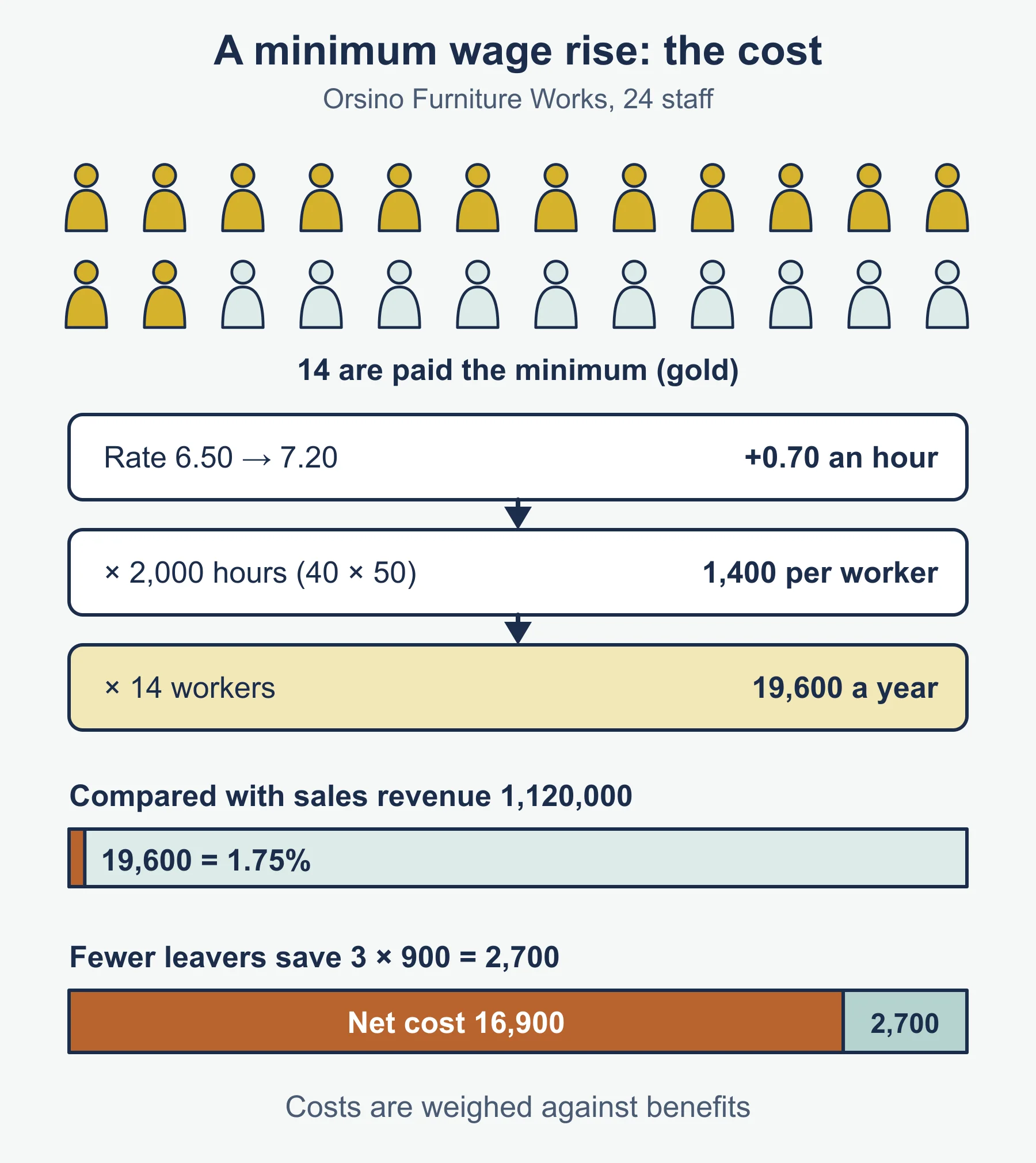
Orsino Furniture Works employs 24 people. 14 of them are paid the national minimum wage. The minimum rises from 6.50 to 7.20 per hour. Each of the 14 works 40 hours a week for 50 weeks. Annual sales revenue is 1,120,000.
Hours per worker per year      = 40 x 50                = 2,000
Rise per hour                  = 7.20 - 6.50            = 0.70
Extra cost per worker          = 2,000 x 0.70           = 1,400
Extra cost for 14 workers      = 14 x 1,400             = 19,600
As % of sales revenue          = 19,600 / 1,120,000     = 1.75%
The analysis does not stop at the number. Orsino could raise prices by about 1.75% to cover the cost, but that risks losing sales to rivals. Or it could accept lower profit.
Now consider the benefit side. If the higher pay cut the number of leavers from 6 to 3 a year, and each replacement costs 900 to recruit and train, the saving is 3 x 900 = 2,700. The net cost falls to 16,900. This is the logic behind the benefits and drawbacks of a national minimum wage:
| Benefits to a business | Drawbacks to a business |
|---|---|
| Staff may feel more motivated and remain longer, so fewer replacements need hiring and training | Higher wage bill, especially for labour-intensive businesses |
| Workers have more spending power, which can raise demand for products | Pressure to raise pay for staff just above the minimum, to keep differences |
| All rivals in the country face the same floor, so none can win customers simply by underpaying | Higher prices or lower profit; small firms with thin margins may struggle |
| Clear rule that helps recruitment planning | Businesses may cut hours or hire fewer people |
Worked example: a safe working environment
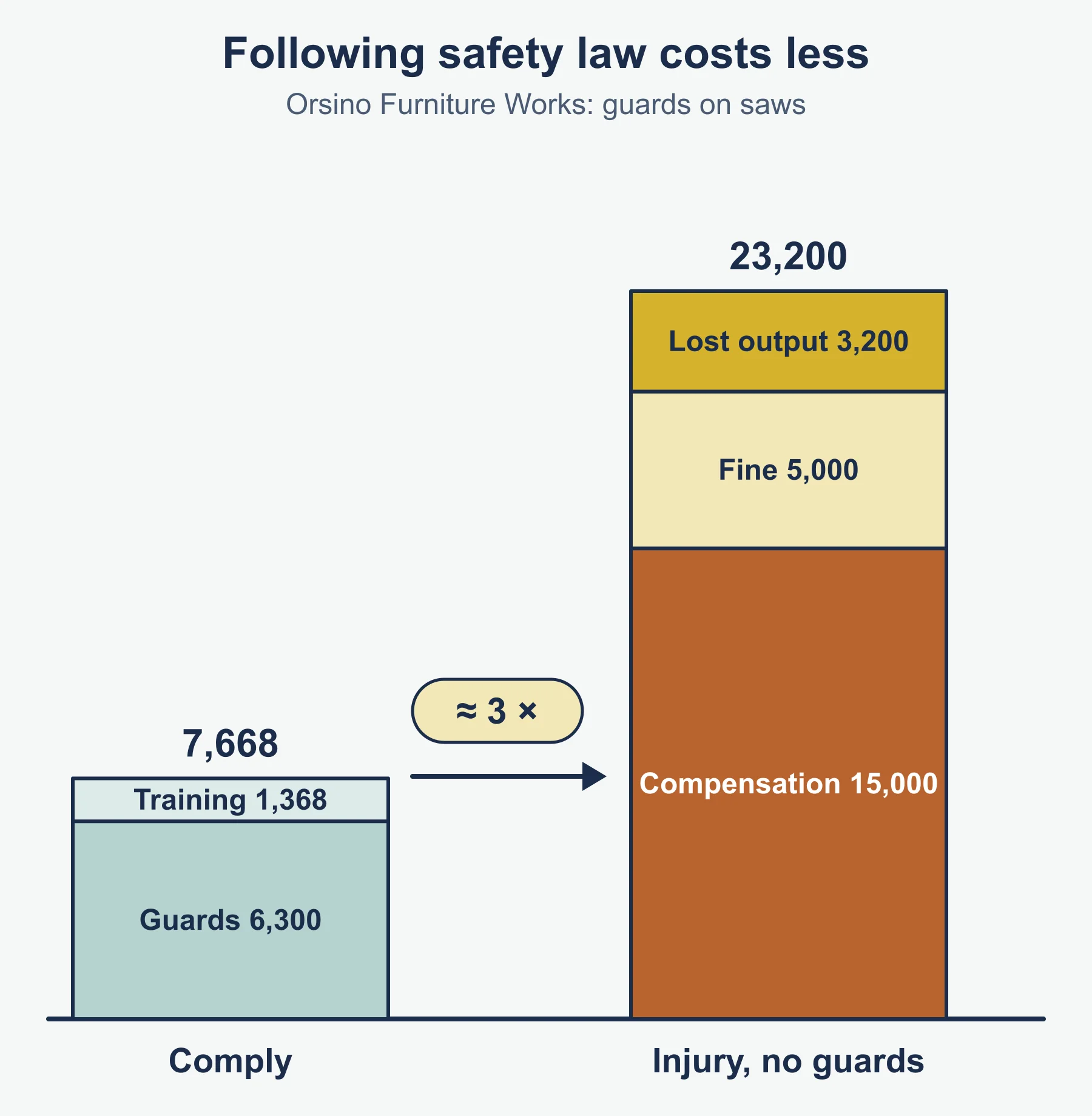
Orsino must fit guards to its saws. The guards cost 6,300 once. Training 24 staff for 4 hours each, valuing time at 8.00 an hour, costs 24 x 4 x 8.00 = 768. A course fee adds 600, so training is 1,368 and compliance is 7,668 in total.
Suppose one injury happened because the guards were missing. The business faces a compensation claim of 15,000, a fine of 5,000 and 3,200 of lost output. That is 23,200, roughly three times the compliance cost.
Compliance      6,300 + 1,368          =  7,668
Non-compliance  15,000 + 5,000 + 3,200 = 23,200
Benefits of safe-workplace laws to a business: fewer accidents and less absence, better morale, a good reputation with recruits and customers, and no price advantage for rivals who cut corners. Drawbacks: equipment and training costs, time spent on risk checks and records, and disruption while changes are made. Smaller businesses feel the fixed cost more heavily because they spread it over fewer sales.
Note the recruitment link: a business with a poor safety record finds it harder to attract applicants, and managers need training to run inspections.
Worked example: consumer protection
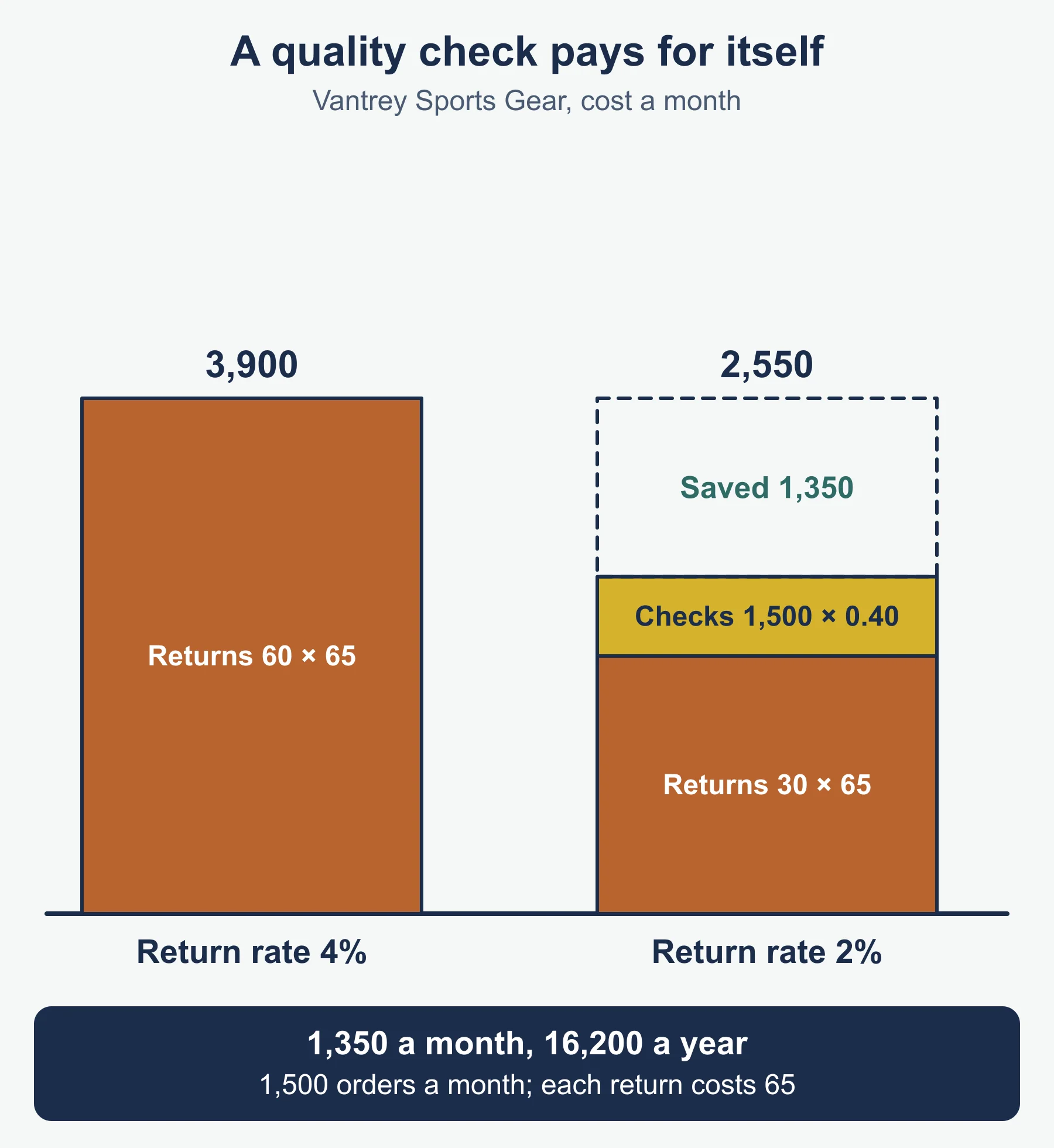
Vantrey Sports Gear sells online and ships 1,500 orders a month at an average of 60 per order. About 4% come back because the item was faulty or not as described. A refund plus return postage costs 65 per return.
Returns per month      = 1,500 x 0.04            = 60
Cost per month         = 60 x 65                 = 3,900
Cost per year          = 3,900 x 12              = 46,800
Vantrey adds a quality check costing 0.40 per order and cuts returns to 2%.
Returns after check    = 1,500 x 0.02            = 30
Return cost            = 30 x 65                 = 1,950
Check cost             = 1,500 x 0.40            = 600
New monthly total      = 2,550   (saving 1,350 a month, 16,200 a year)
Consumer protection laws therefore impact on businesses in two ways. They add cost (checks, refunds, clear product descriptions, staff training on complaints). They also build trust, which can raise repeat purchases, and they stop rivals from winning sales with misleading claims. Failure to follow them can mean compensation, fines, legal fees, damaged reputation and lost customers.
Common errors on legislation
- Saying a law “affects” a business without naming the route: which cost, which training need, which hiring change.
- Treating all legislation as pure cost. Always weigh the benefits.
- Mixing up ethics and legislation.
- Writing about one country’s named Acts. The specification does not ask for them.
3.2.6 Competitive environment
Markets and competition
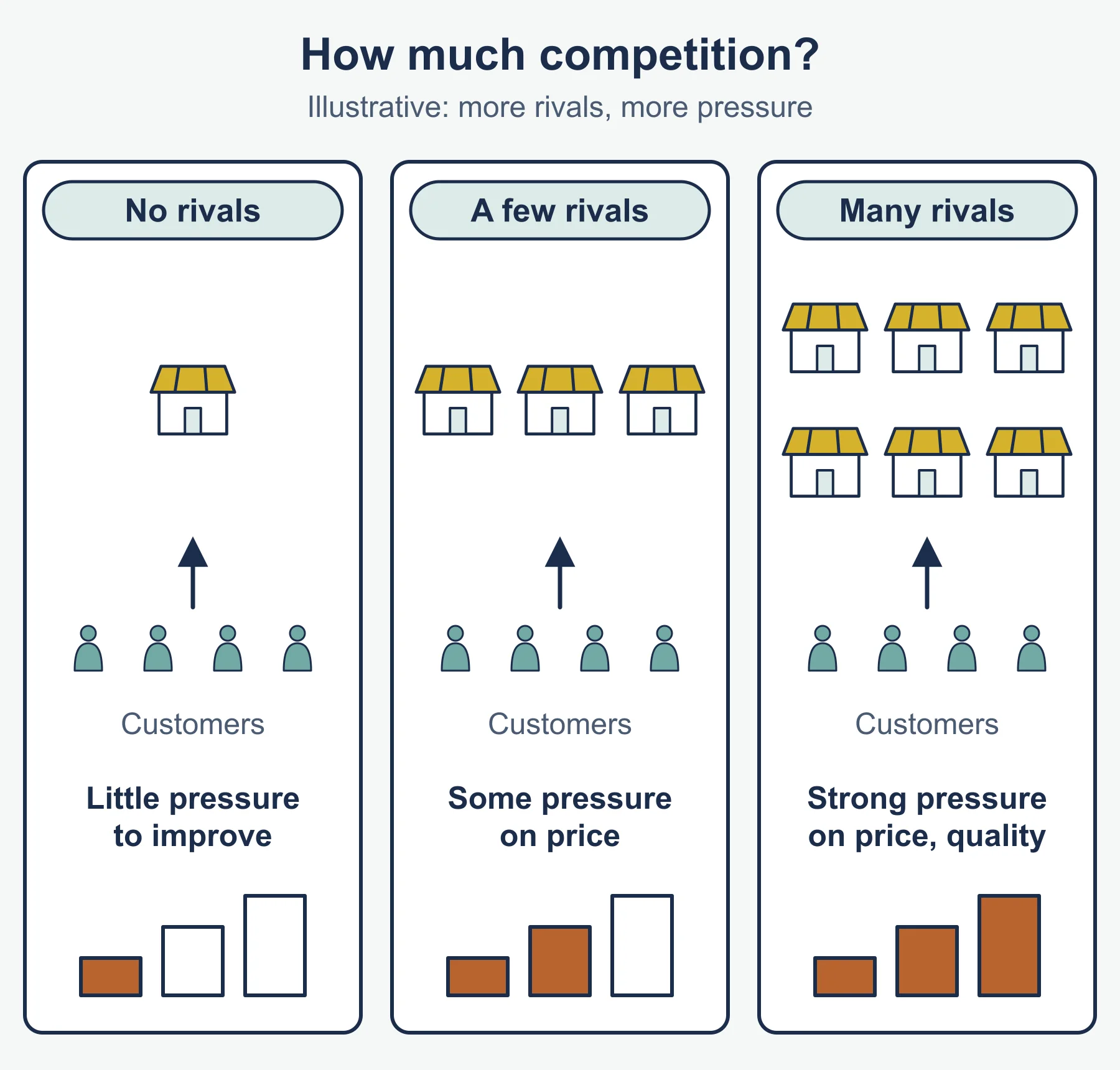
A market is where buyers and sellers come together to trade a good or service. It can be a physical place, a website or a whole country’s trade in one product. Competition exists when two or more businesses try to win the same customers. (These are the standard forms; the specification asks you to understand the terms.)
Worked example: analysing the impact of competition
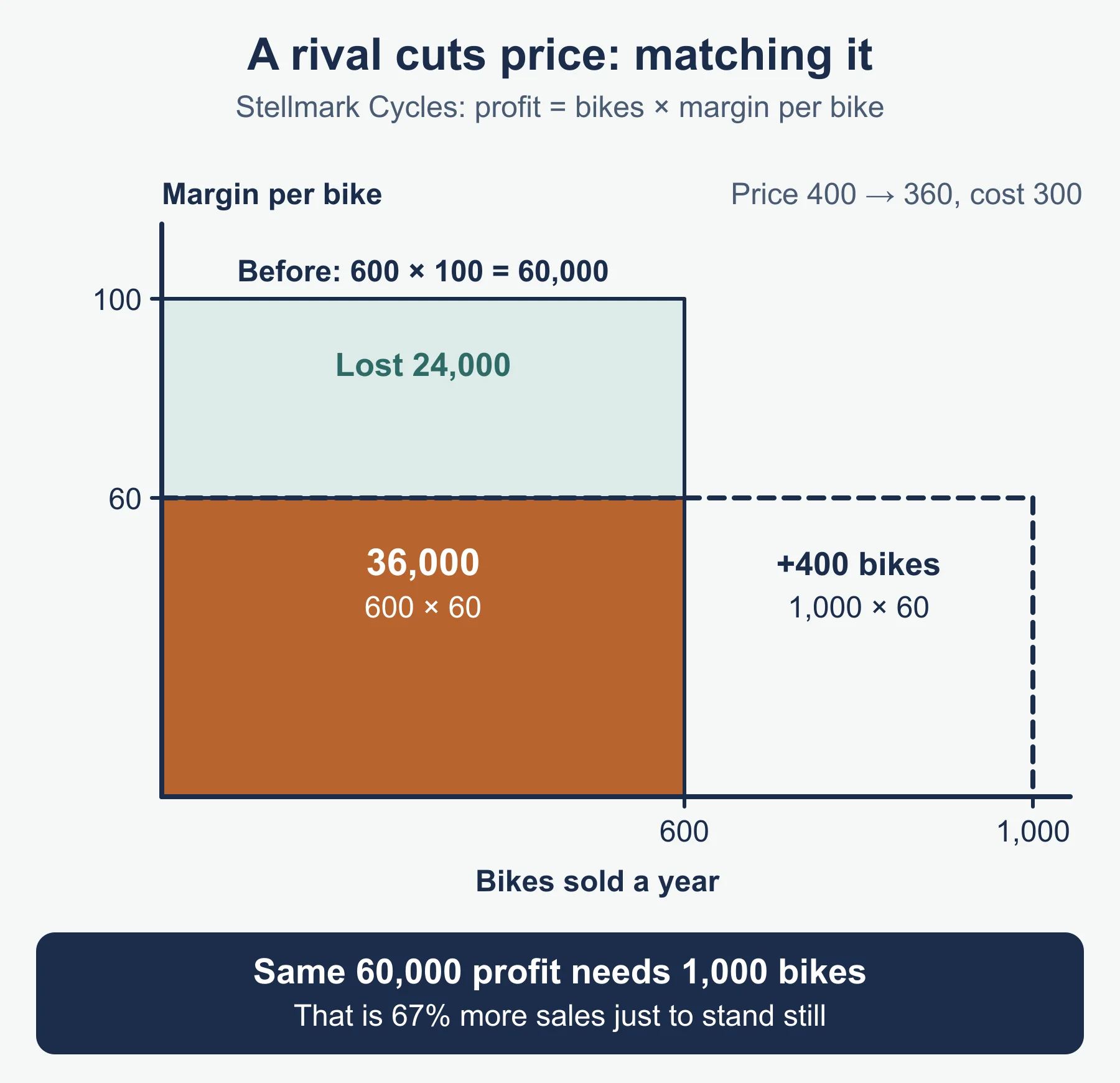
Stellmark Cycles sells 600 bikes a year at 400 each. Each bike costs 300, so profit is 100 a bike, or 60,000. A rival opens and cuts its price by 10% to 360.
If Stellmark matches the price, its margin falls to 60. To earn the same 60,000 it would need 60,000 / 60 = 1,000 bikes, an increase of about 67%.
Rival price cut           = (400 - 360) / 400      = 10%
Margin if matched         = 360 - 300              = 60
Bikes for same profit     = 60,000 / 60            = 1,000
Extra bikes needed        = 1,000 - 600            = 400  (66.7% more)
Potential impacts of competition on a business:
- Lower prices or margins, as in the example.
- Lost sales and market share if customers switch.
- Higher marketing and service costs to keep customers.
- Pressure to improve quality, design or customer service.
- Benefits for customers, such as choice, which can raise the market’s size.
Which effect matters most depends on the business: how loyal its customers are, how different its product is, and how big its cost cushion is.
Minimal or no competition
You should be able to identify when a business faces little or none:
- It is the only seller in an area, for example the only shop in a remote village.
- It holds a patent, licence or exclusive right.
- Start-up costs are very high, so few can enter.
- Its product is highly specialised.
- A government controls the supply.
The business can then charge higher prices and keep more profit. But it may have less pressure to improve service, risks attracting new entrants, and can face public criticism or regulation if it charges too much.
Risk and uncertainty
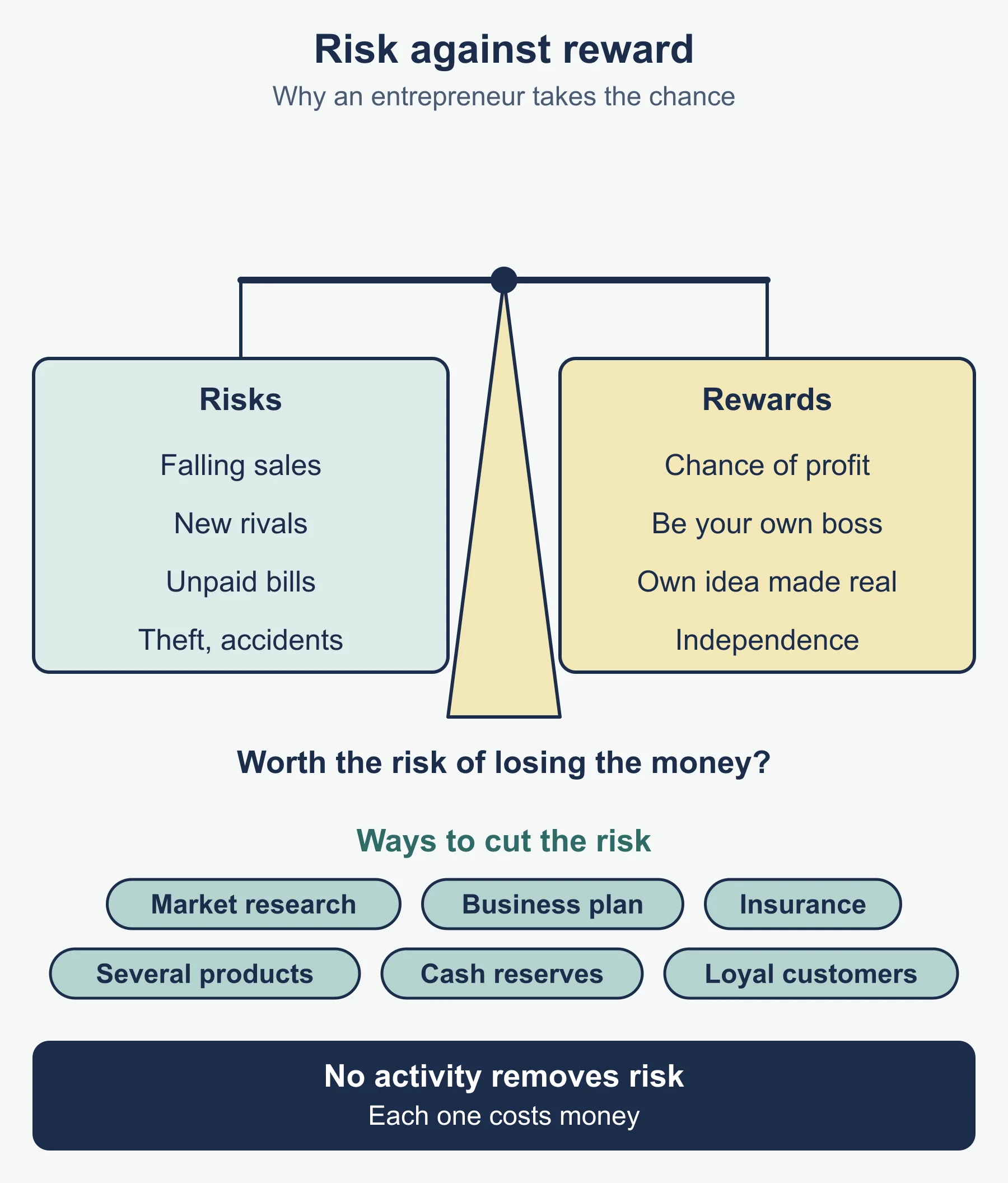
Risk is the chance that something harms the business. Uncertainty exists because nobody can know the future. All businesses face uncertainty because customers’ tastes change, rivals act, costs and exchange rates move, the economy shifts and technology develops. Examples of risks include falling sales, new competitors, unpaid bills, theft, accidents, poor cash flow and shortages of supplies. A new business has the added risk that it has no track record.
Why do entrepreneurs take these risks? Common reasons are the chance of profit and financial independence, being their own boss, turning an idea or skill into a business, meeting a need they have spotted, and the satisfaction of building something. The reward must look worth the risk of losing the money invested.
Activities that minimise risk include:
- Market research before launch, to test demand.
- A business plan with cash-flow forecasts.
- Insurance against fire, theft or injury.
- Offering several products or serving several markets (spreading risk).
- Keeping cash reserves and controlling costs.
- Building customer loyalty and supplier relationships.
- Training staff and following the law, so that fines and accidents are avoided.
No activity removes risk. Each has a cost: market research and insurance cost money.
Developing countries competing with developed countries
Businesses in developing countries can compete through lower cost advantage, because labour and some other costs are often lower. They may also offer local knowledge, local materials or a niche product.
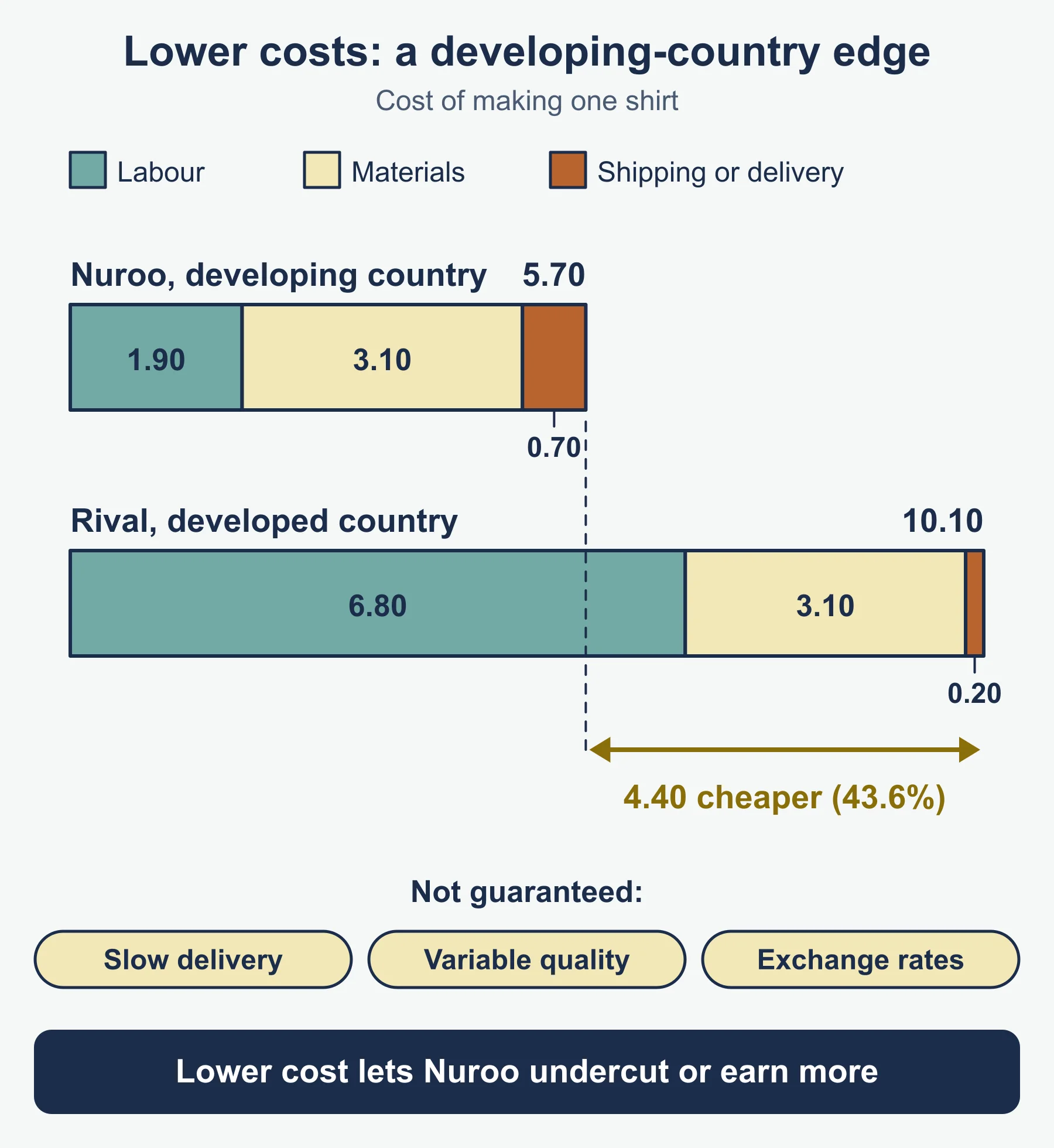
Nuroo Textiles makes shirts in a developing country and sells to a developed one. Its unit costs are labour 1.90, materials 3.10, shipping 0.70. A developed-country rival has labour 6.80, materials 3.10 and delivery 0.20.
Nuroo cost per shirt      = 1.90 + 3.10 + 0.70     = 5.70
Rival cost per shirt      = 6.80 + 3.10 + 0.20     = 10.10
Cost advantage            = 10.10 - 5.70           = 4.40  (43.6% of rival cost)
That 4.40 lets Nuroo undercut on price or earn a higher profit. But the advantage is not guaranteed. Longer delivery times, weaker transport links, variable quality, exchange-rate movements and customers’ trust in the rival can all cut into it. Developed-country rivals compete with branding, quality and service.
Common errors on competition
- Defining competition as only price. Quality, service and branding matter too.
- Assuming a business with no competition faces no risk.
- Giving a list of risks without linking one to the business in the question.
- Saying developing-country firms always win on price.
Frequently asked questions
What does employment law cover in OxfordAQA IGCSE Business? Employment law covers how a business treats the people who work for it, such as pay, hours, contracts and fair treatment. Legislation is a legal requirement, which separates it from ethics, the choices a business makes beyond the legal minimum.
How do consumer protection laws affect a business? They add costs, such as quality checks, refunds, clear product descriptions and staff training on complaints. They also build trust, which can raise repeat purchases, and stop rivals winning sales with misleading claims.
What are the benefits of health and safety laws to a business? Benefits include fewer accidents and less absence, better morale, a good reputation with recruits and customers, and no price advantage for rivals who cut corners. Drawbacks are equipment and training costs, time spent on checks and records, and disruption while changes are made.
Why do entrepreneurs take risks? Common reasons are the chance of profit and financial independence, being their own boss, turning an idea or skill into a business, meeting a need they have spotted and the satisfaction of building something. The reward must look worth the risk of losing the money invested.
Is competition only about price? No. Businesses also compete on quality, service and branding, so defining competition as price alone is a common error.
Official syllabus
OxfordAQA International GCSE Business (9225) specification, version 3.1, OxfordAQA, for International GCSE exams May/June 2022 onwards. Sections 3.2.5 Legislation and 3.2.6 Competitive environment.
Get free revision emails (optional)
Occasional emails with practice questions, worked explanations and links to free resources for the qualification and subjects you choose. No spam, and you can unsubscribe from any email. The free tools on this site never need an email.
Related resources
-
Practice questions
OxfordAQA IGCSE Business: Legislation and Competitive environment (9225) – Practice Questions
Eleven original questions with worked answers on legislation, competition, risk and cost advantage for OxfordAQA International GCSE Business (9225).
Business · OxfordAQA · IGCSE
Try questions -
Revision notes
OxfordAQA IGCSE Business: Legislation and Competitive environment (9225) – Revision Notes
Condensed notes on employment, health and safety and consumer law, competition, risk and developing-country advantage for OxfordAQA IGCSE Business.
Business · OxfordAQA · IGCSE
Revise topic -
Study guides
OxfordAQA IGCSE Business: Technology and Ethical and environmental considerations (9225)
A full teaching guide to e-commerce, digital communication, ethics, the environment and sustainability for OxfordAQA International GCSE Business.
Business · OxfordAQA · IGCSE
Read guide
Related articles
-
teaching
A Level tuition in Dubai: Cambridge or Pearson Edexcel International A Level?
Schools in Dubai and Abu Dhabi teach either Cambridge International AS & A Level or Pearson Edexcel International A Level. How the two are structured, why it matters for tuition, and how online classes from Lahore work.
9 October 2026
-
curriculum guides
Choosing subjects at IGCSE and A Level
How subject choices at 14 and 16 affect university options later, and how to keep pathways open without overloading a timetable.
28 July 2026
Studying this with a teacher
Working through Business IGCSE?
This page is free and stays free. If you would rather be taught it, Marlbridge runs Business classes one-to-one and in small groups of up to 15, online in your own time zone. The first trial class is free. WhatsApp replies within an hour (8am–11pm Pakistan time, every day); email the same day.
OxfordAQA Business teachers at Marlbridge
