
Revision Notes
OxfordAQA IGCSE Business: Legislation and Competitive environment (9225) – Revision Notes
Condensed notes on employment, health and safety and consumer law, competition, risk and developing-country advantage for OxfordAQA IGCSE Business.
- Subject
- Business
- Level
- IGCSE
- Topic
- Influences on business
- Author
- Marlbridge Academic Team
- Updated
- Reviewed by
- Salman Ahmad (what this means)
Aligned to OxfordAQA IGCSE Business (9225), First teaching September 2020, first examined May/June 2022. Official specification .
Syllabus page (what it covers and how it is assessed): OxfordAQA IGCSE Business.
Syllabus points this page covers
9225
- 3.2.5 Legislation
- 3.2.6 Competitive environment
Found an error? Report a correction.
Need help with this topic? Request a free trial class for IGCSE Business (9225).
These notes condense sections 3.2.5 Legislation and 3.2.6 Competitive environment of the OxfordAQA International GCSE Business (9225) specification, version 3.1, for exams from May/June 2022 onwards. For full explanations and worked cost examples, read the study guide. Then try the practice questions.
Related pages: the Influences on business revision notes, the course hub, the printable checklist and the free diagnostics.
3.2.5 Legislation at a glance
| Area of law | What it protects | Typical effect on a business |
|---|---|---|
| Employment law | Workers (pay, contracts, fair treatment) | Wage costs, record-keeping, hiring rules, training for managers |
| Health and safety law | Workers and others on the premises | Equipment, risk checks, safety training; fewer accidents |
| Consumer law | Buyers of goods and services | Quality control, clear descriptions, refunds, complaint handling; more trust |
Legislation is a legal requirement. Ethics is a choice beyond the legal minimum.
The four effects to assess
Cost, training needs, recruitment and consequences of failure to follow the law. Pick the ones that fit the business in the question and explain the route from law to effect.
Chain to use in answers: law changes, so business must do X, which costs or changes Y, so profit, prices, staff or customers change.
Consequences of failing to comply
- Fines and legal costs.
- Compensation to staff or customers.
- Forced changes to how the business operates.
- Reputation damage and lost sales.
- Trouble recruiting and keeping staff.
National minimum wage
| Benefits for a business | Drawbacks for a business |
|---|---|
| Better motivation and lower staff turnover | Higher wage bill |
| Workers have more to spend | Pay pressure on staff just above the minimum |
| Rivals face the same floor | Higher prices or lower profit |
| Easier planning of pay | May cut hours or recruit fewer staff |
Labour-intensive businesses feel the rise most.
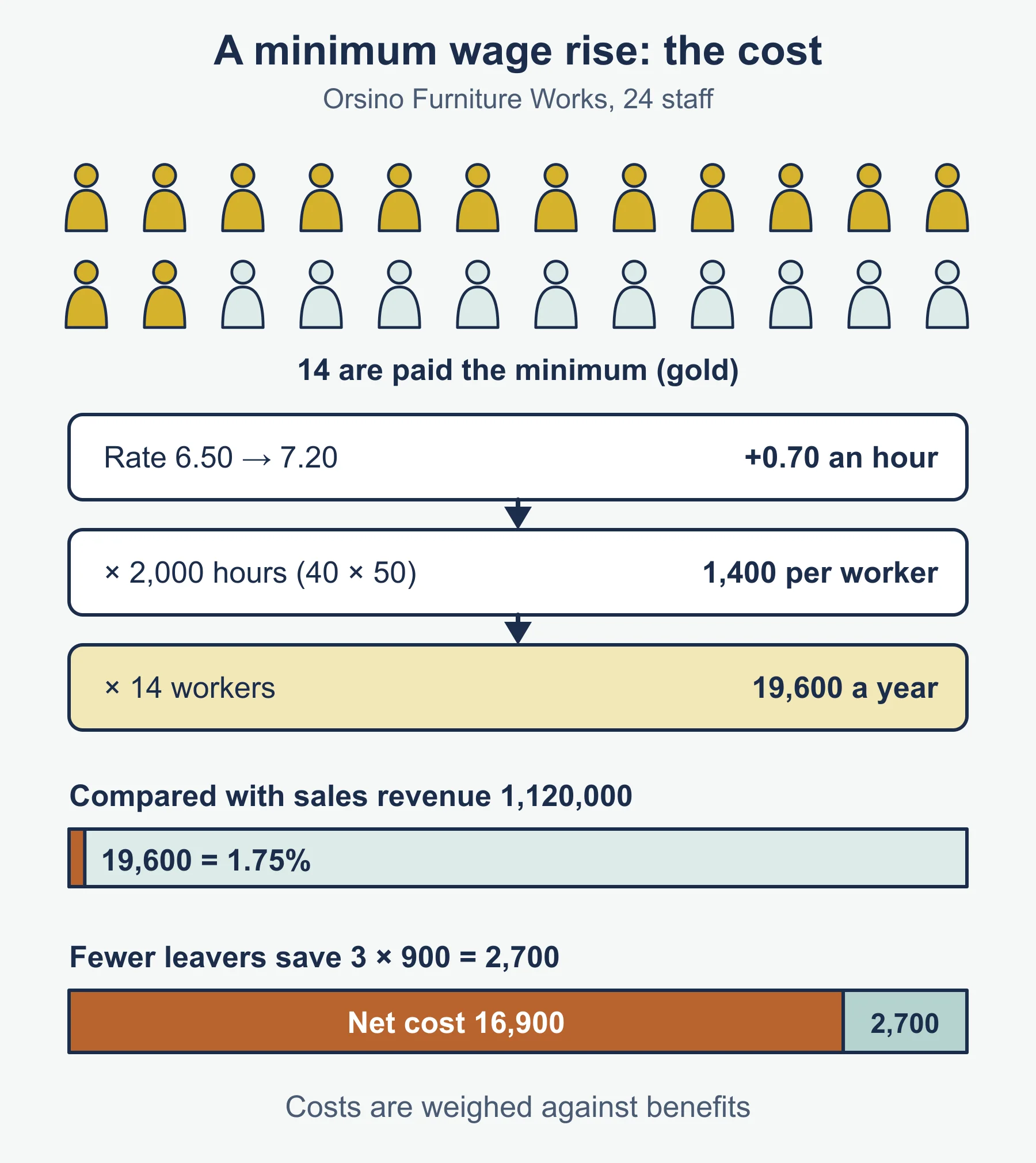
Laws requiring a safe working environment
- Benefits: fewer accidents, less absence, better morale, good reputation, a level playing field.
- Drawbacks: equipment and training cost, time on checks and records, disruption.
- Small firms spread fixed compliance costs over fewer sales.
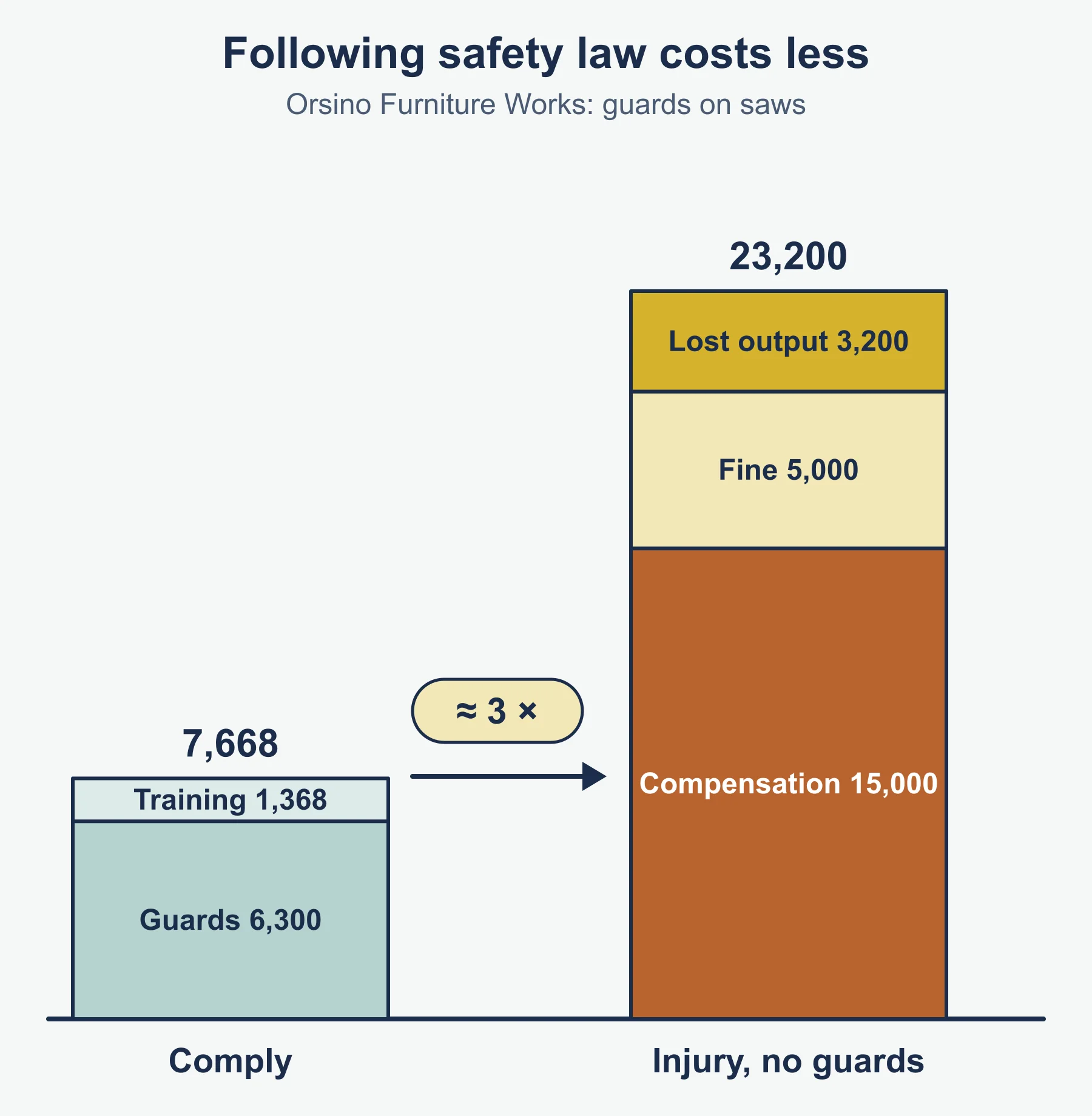
Consumer protection laws
- Impacts: checks on quality, clear product information, refunds and repairs, staff trained in complaints.
- Benefits: customer trust, repeat sales, protection from rivals who mislead.
- Failure: refunds, compensation, fines, bad publicity.
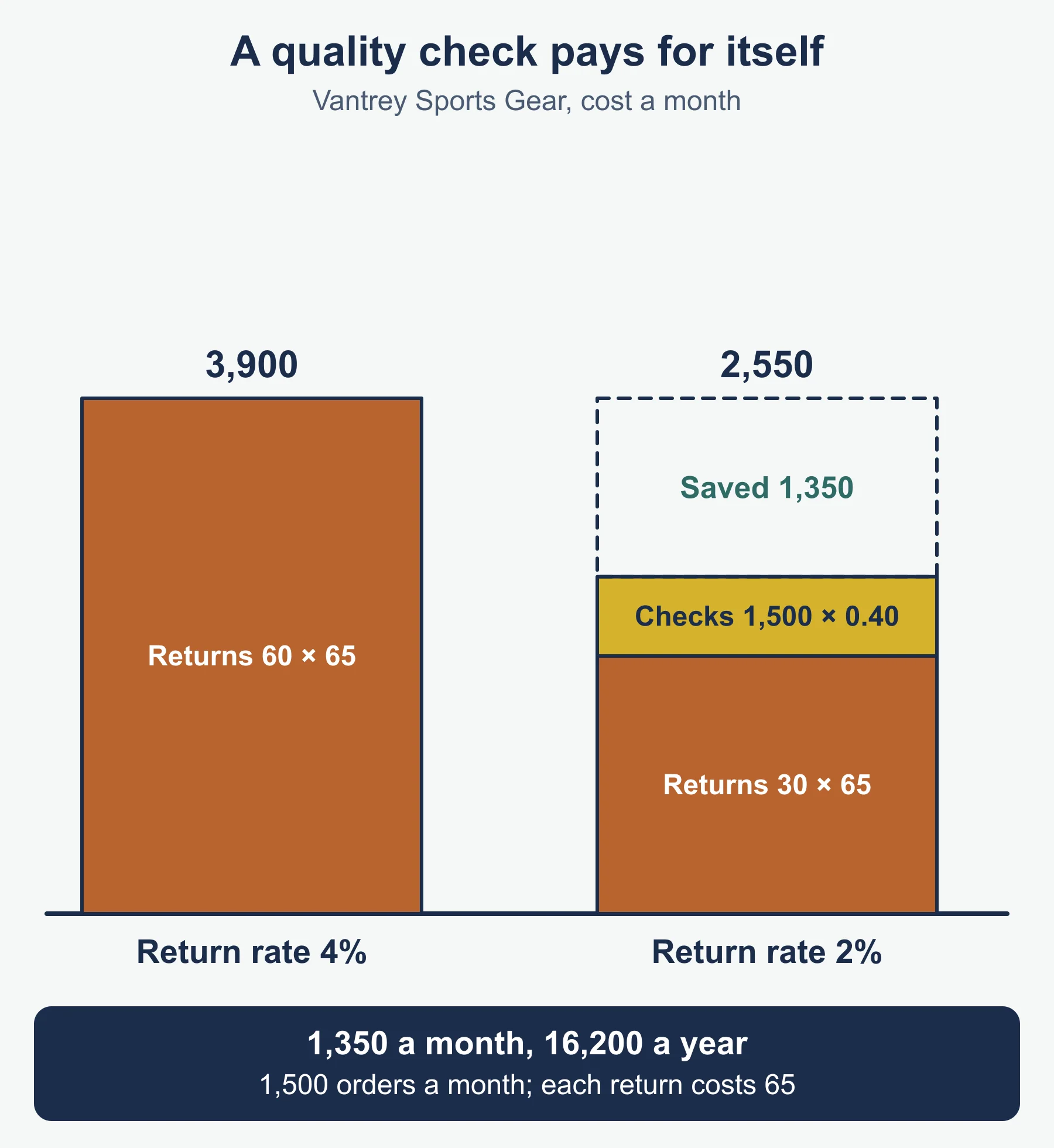
Method in steps: assess the impact of a law
- Name the law area (employment, health and safety, consumer).
- State what the business must now do.
- Choose the effects (cost, training, recruitment, consequences).
- Use any figures in the stem.
- Weigh benefits against drawbacks for this business.
- Make a judgement if the command word asks for it.
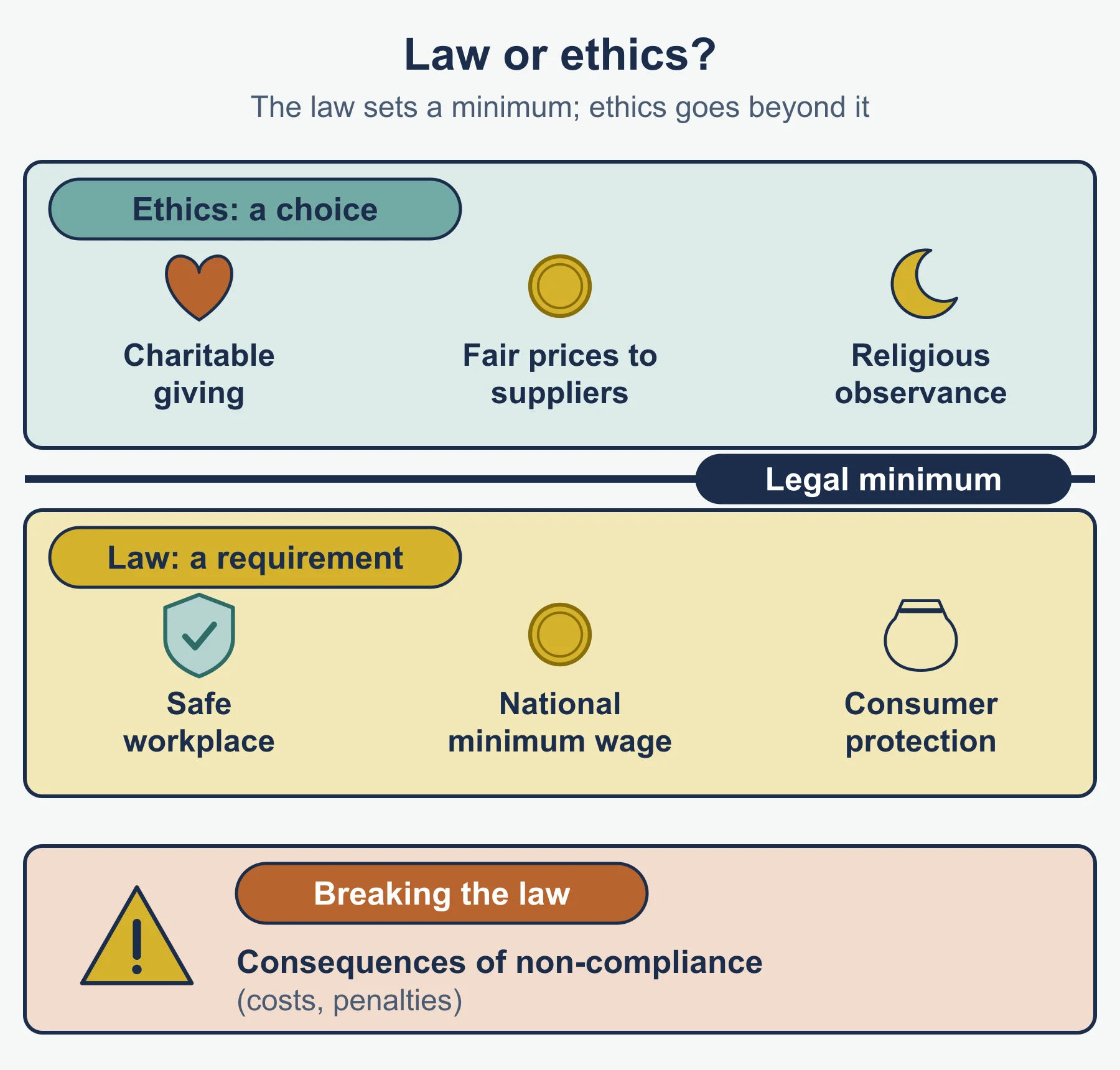
3.2.6 Competitive environment at a glance
| Term | Meaning (standard form) |
|---|---|
| Market | Where buyers and sellers trade a good or service |
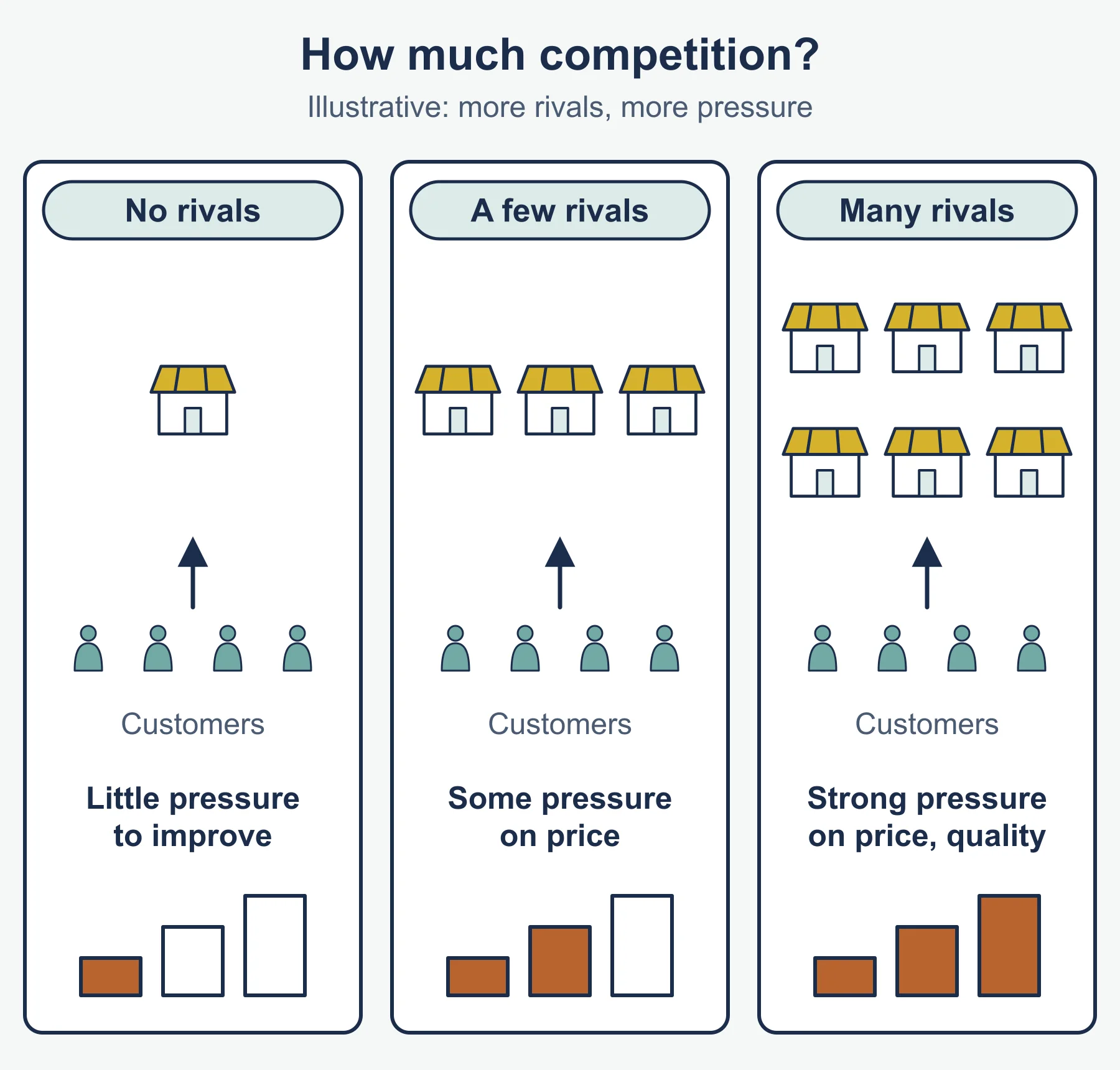
| Competition | Two or more businesses trying to win the same customers |
| Risk | A chance of something harming the business |
| Uncertainty | The future cannot be known, so outcomes are unpredictable |
| Cost advantage | Producing or delivering at lower cost than rivals |
Impacts of competition
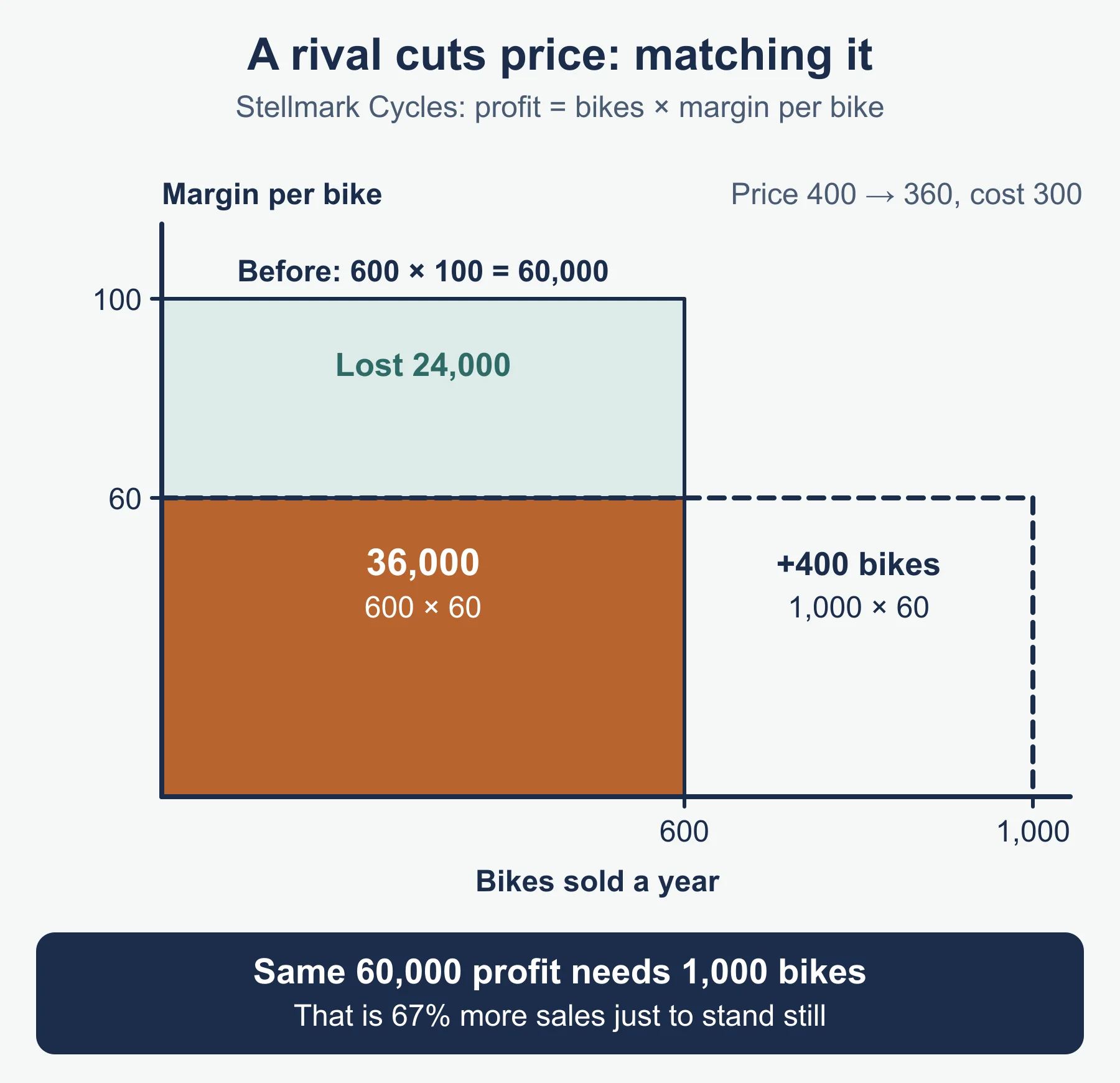
- Prices or margins pushed down.
- Lost sales or market share.
- Higher spending on marketing and service.
- Pressure to improve quality and range.
- Wider choice for customers, which can grow the market.
How big the impact is depends on loyalty, how different the product is, and how much cost cushion there is.
Minimal or no competition: spot the situation
- Only seller in an area.
- Patent, licence or exclusive right.
- Very high start-up costs.
- Highly specialised product.
- Government-controlled supply.
Results: more pricing freedom and profit, but less pressure to improve and a risk that new entrants arrive.
Why all businesses face uncertainty
Tastes change; rivals act; costs, interest rates and exchange rates move; technology develops; the economy shifts.
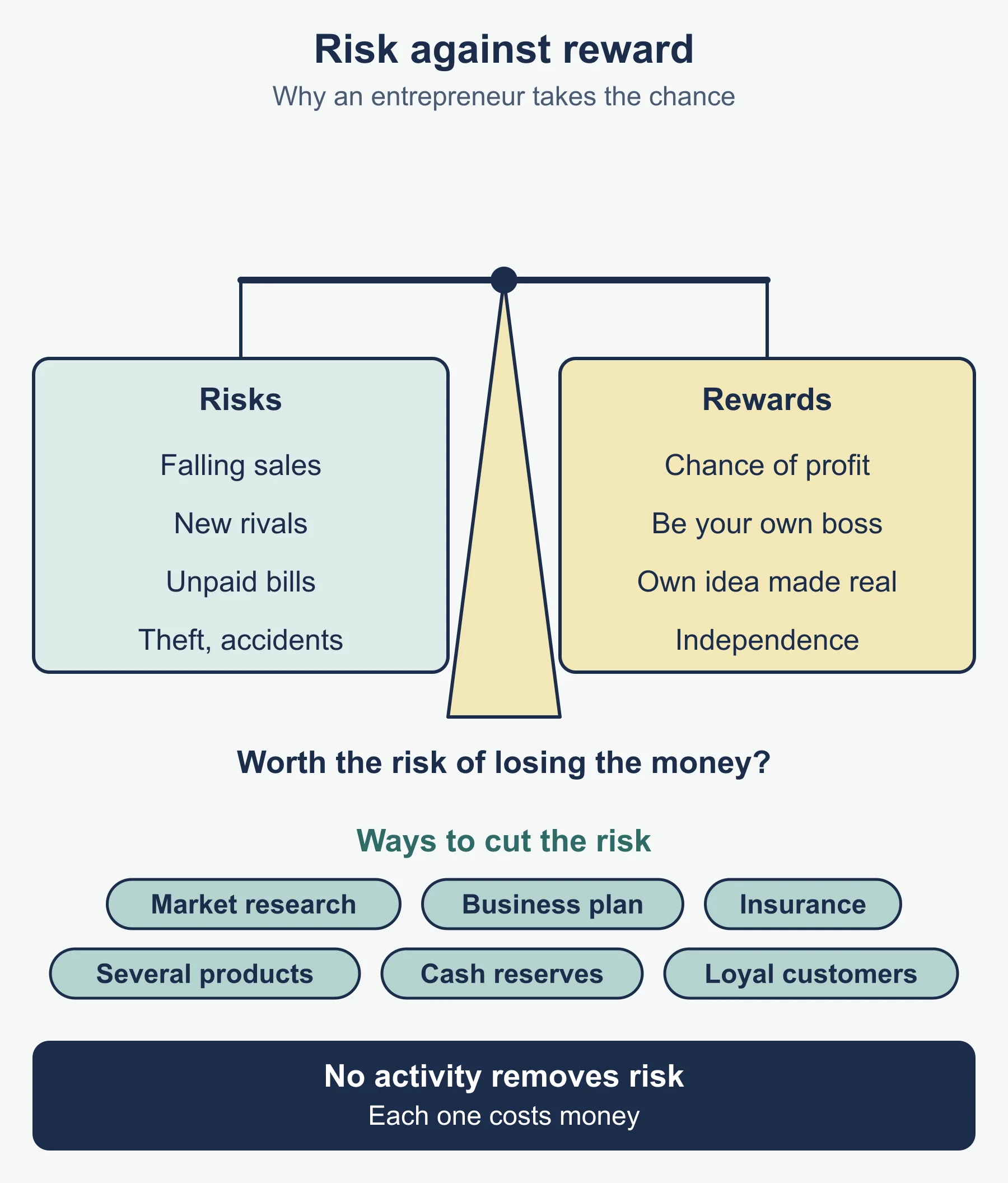
Why entrepreneurs take risks
Profit, independence, turning an idea into a business, meeting a need, personal satisfaction.
Ways to minimise risk
| Activity | How it reduces risk | Its limit |
|---|---|---|
| Market research | Tests demand before money is committed | Costs money; can be wrong |
| Business plan and forecasts | Shows cash needs early | Based on estimates |
| Insurance | Covers loss from fire, theft, injury | Premiums; excludes some events |
| Wider product or market range | Spreads the risk | Costs of developing new lines |
| Cash reserves | Absorbs shocks | Money tied up |
| Good supplier and customer relations | Stable supply and demand | Takes time |
Developing countries competing
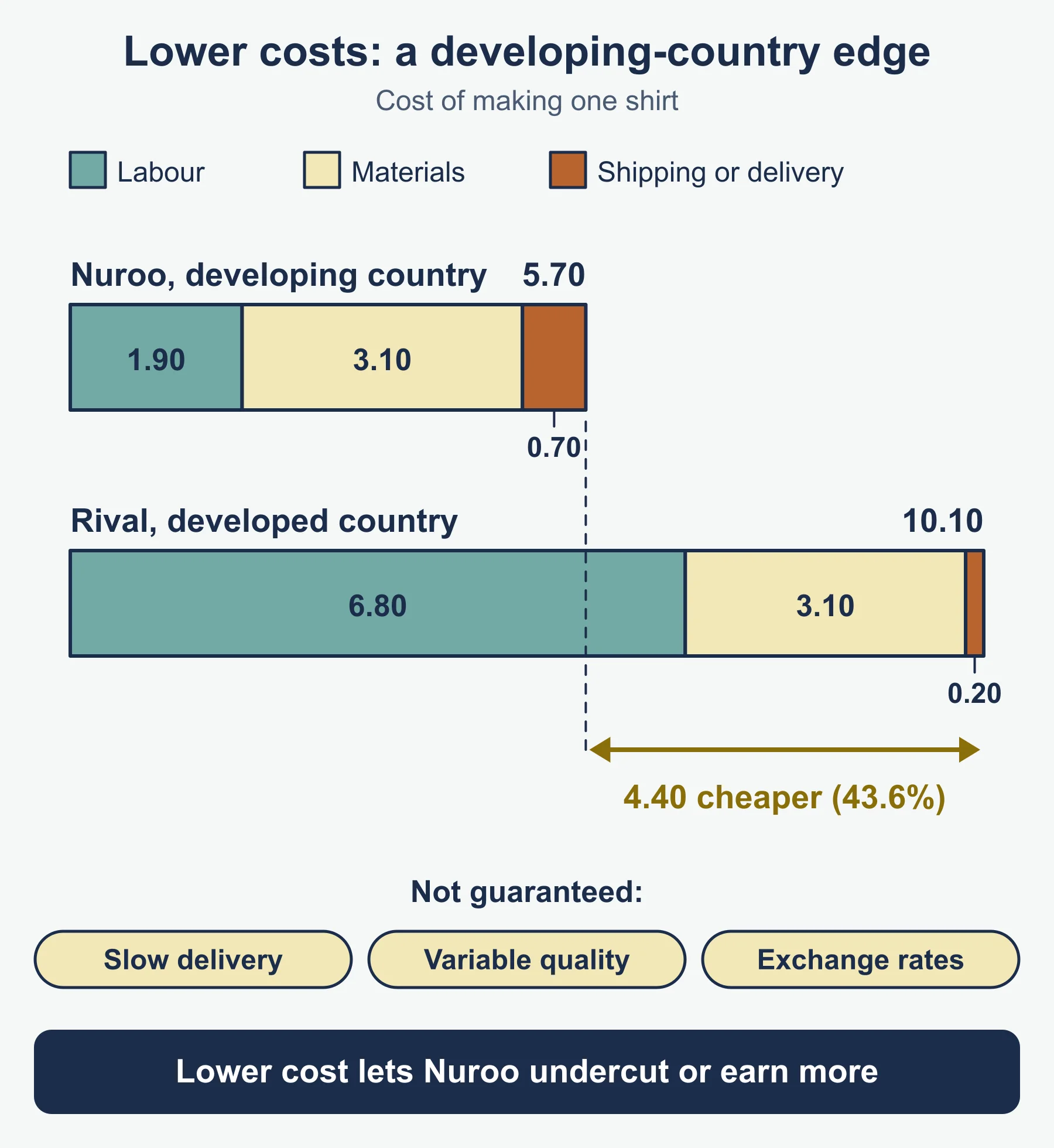
- Lower cost advantage (often lower labour costs).
- Local materials, skills or niche products.
- Limits: transport and delivery times, quality consistency, exchange rates, rivals’ brands and service.
Must-know distinctions
| Pair | Difference |
|---|---|
| Legislation vs ethics | Required by law vs chosen beyond the law |
| Compliance cost vs non-compliance cost | Cost of following the law vs fines, claims, lost sales if you do not |
| Risk vs uncertainty | A possible harm vs not knowing what will happen |
| Minimal competition vs no risk | Little competition does not remove other risks |
| Low cost vs success | A cost advantage helps, but quality, delivery and brand also count |
Small worked reminders
Wage rise. 10 workers, 35 hours a week, 52 weeks, rise of 0.50 an hour. Extra cost = 10 x 35 x 52 x 0.50 = 9,100. If sales revenue is 650,000, that is 1.4%.
Price match. Unit cost 12, price 20, 5,000 sold: profit 40,000. Matching a rival at 18 gives margin 6. Same profit needs 40,000 / 6 = 6,667 units (rounded up from 6,666.7).
Cost advantage. Developing-country unit cost 8.40, rival 13.00. Advantage 4.60, or 35.4% of the rival’s cost.
Quick self-test
- Name the three areas of law in section 3.2.5.
- State two items that may increase a firm’s costs after a rise in the national minimum wage.
- Give one benefit to a business of laws requiring a safe working environment.
- Explain one way a consumer protection law could benefit a business.
- Define a market.
- Identify two situations in which a business faces minimal or no competition.
- Give two reasons why every business faces uncertainty.
- State two reasons why an entrepreneur might start a business.
- Name two activities that reduce a business’s risks.
- Explain one reason a developing-country firm might undercut a developed-country rival.
Answers
- Employment law, health and safety law, consumer law.
- Any two: higher wages for staff on the minimum, pay increases for staff just above it to keep differences, higher prices to customers if costs are passed on, more spent on recruitment if staff leave.
- Any one: fewer accidents, less absence, better morale, good reputation, rivals cannot gain by cutting safety.
- For example: clear and fair rules build customer trust, which can lead to repeat purchases; or rivals cannot win sales through misleading claims.
- A place or system where buyers and sellers trade a good or service.
- Any two: only seller in the area, patent or licence, very high start-up costs, specialised product, government-controlled supply.
- Any two: customer tastes change, rivals act, costs or exchange rates move, the economy changes, technology develops.
- Any two: profit, independence (being their own boss), turning an idea into a business, meeting a need they have spotted.
- Any two: market research, business plan, insurance, wider product range, cash reserves.
- Lower labour costs lower its cost per unit, so it can charge a lower price or keep a higher margin.
Command words for this topic
| Command word | Your task here |
|---|---|
| State, identify | Give the point in a few words, such as one area of law or one risk |
| Define | Give a short, accurate meaning, such as of a market or of competition |
| Calculate | Show the working and the unit; check that the figure answers the question asked |
| Explain | Make a point, then say how or why it happens |
| Analyse | Build a chain of cause and effect using details from the stem |
| Evaluate, justify, recommend | Weigh both sides, compare their size for this business, then reach a reasoned judgement |
Judgement frames that work
- Size. Is the cost large or small compared with sales revenue or profit? A 1% rise in wage costs is easier to absorb than a 10% fall in sales.
- Time. Training costs are often one-off, while a wage rise recurs every year. Lost trust can last for years.
- Flexibility. Can the business pass the cost on, find savings or change supplier? A firm with loyal customers can usually raise prices more easily.
- Alternatives. Compare the cost of following a law with the cost of failing to follow it, including fines, claims and lost reputation.
- Context. Say whether the business is small or large, local or exporting, in a crowded market or a protected one.
Where marks are usually lost
- Writing that a law “affects” a business without saying how.
- Counting only costs and ignoring benefits such as lower staff turnover or customer trust.
- Mixing up ethics and legislation.
- Listing risks without tying any of them to the kind of firm described.
- Treating a business with no competitors as risk-free.
- Writing that developing-country firms always win on price, with no mention of limits such as delivery or quality.
- Not using the figures in a case study.
- Ending an evaluation with no judgement that refers to the firm in the case.
Frequently asked questions
What are the three areas of law in OxfordAQA IGCSE Business section 3.2.5? The three areas are employment law, health and safety law and consumer law. The specification does not name particular Acts, so answers should describe the effect of the law in general terms.
What is the difference between legislation and ethics? Legislation is a legal requirement that a business must follow. Ethics covers choices a business makes beyond the legal minimum.
What is the difference between compliance and non-compliance costs? Compliance costs are the costs of following the law, such as equipment and training. Non-compliance costs are the fines, claims and lost sales a business faces if it does not follow the law, and they can be much larger.
How do you judge how serious an external change is for a business? Consider the size of the cost compared with revenue or profit, whether it is one-off or recurring, how flexible the business is in passing it on, the alternatives, and the context of the business, such as its size and market.
Official syllabus
OxfordAQA International GCSE Business (9225) specification, version 3.1, OxfordAQA, for International GCSE exams May/June 2022 onwards. Sections 3.2.5 Legislation and 3.2.6 Competitive environment.
Get free revision emails (optional)
Occasional emails with practice questions, worked explanations and links to free resources for the qualification and subjects you choose. No spam, and you can unsubscribe from any email. The free tools on this site never need an email.
Related resources
-
Study guides
OxfordAQA IGCSE Business: Technology and Ethical and environmental considerations (9225)
A full teaching guide to e-commerce, digital communication, ethics, the environment and sustainability for OxfordAQA International GCSE Business.
Business · OxfordAQA · IGCSE
Read guide -
Practice questions
OxfordAQA IGCSE Business: Technology and Ethical and environmental considerations (9225) – Practice Questions
Twelve original questions with worked answers on ICT, e-commerce, ethics, the environment and sustainability for OxfordAQA International GCSE Business.
Business · OxfordAQA · IGCSE
Try questions -
Revision notes
OxfordAQA IGCSE Business: Technology and Ethical and environmental considerations (9225) – Revision Notes
Condensed recall notes, tables and a self-test on ICT, e-commerce, ethics, the environment and sustainability for OxfordAQA International GCSE Business.
Business · OxfordAQA · IGCSE
Revise topic
Related articles
-
teaching
A Level tuition in Dubai: Cambridge or Pearson Edexcel International A Level?
Schools in Dubai and Abu Dhabi teach either Cambridge International AS & A Level or Pearson Edexcel International A Level. How the two are structured, why it matters for tuition, and how online classes from Lahore work.
9 October 2026
-
curriculum guides
Choosing subjects at IGCSE and A Level
How subject choices at 14 and 16 affect university options later, and how to keep pathways open without overloading a timetable.
28 July 2026
Studying this with a teacher
Working through Business IGCSE?
This page is free and stays free. If you would rather be taught it, Marlbridge runs Business classes one-to-one and in small groups of up to 15, online in your own time zone. The first trial class is free. WhatsApp replies within an hour (8am–11pm Pakistan time, every day); email the same day.
OxfordAQA Business teachers at Marlbridge
