
Study Guides
OxfordAQA International GCSE Business (9225): Globalisation
Study guide to OxfordAQA IGCSE Business 9225 section 3.2.4 Globalisation: its five forms, benefits and drawbacks, and exchange rates for traders.
- Subject
- Business
- Level
- IGCSE
- Topic
- Influences on business
- Author
- Marlbridge Academic Team
- Updated
- Reviewed by
- Salman Ahmad (what this means)
Aligned to OxfordAQA IGCSE Business (9225), First teaching September 2020, first examined May/June 2022. Official specification .
Syllabus page (what it covers and how it is assessed): OxfordAQA IGCSE Business.
Syllabus points this page covers
9225
- 3.2.4 Globalisation
Found an error? Report a correction.
Need help with this topic? Request a free trial class for IGCSE Business (9225).
This guide covers section 3.2.4 Globalisation of OxfordAQA International GCSE Business (9225), part of Topic 2, Influences on business. The specification lists the forms of globalisation (specialisation by country, relative cost advantage, movement of labour, larger markets and international competition), the benefits and drawbacks of globalisation for businesses in developed and developing countries and for those countries’ economies, and exchange rates: their impact on the profit and sales of businesses that import or export, and the effects of severe fluctuations. You will not be asked to calculate exchange-rate conversions. All businesses and figures are invented.
For the whole topic, see the Influences on Business study guide. Condensed notes are in the Globalisation revision notes and questions in the Globalisation practice questions.
What globalisation means for a business
Globalisation is the process by which countries become more closely linked through trade, investment and the movement of people and ideas. For a business, it means that customers, suppliers, workers and competitors can all come from anywhere in the world.
The five forms, each as a chain
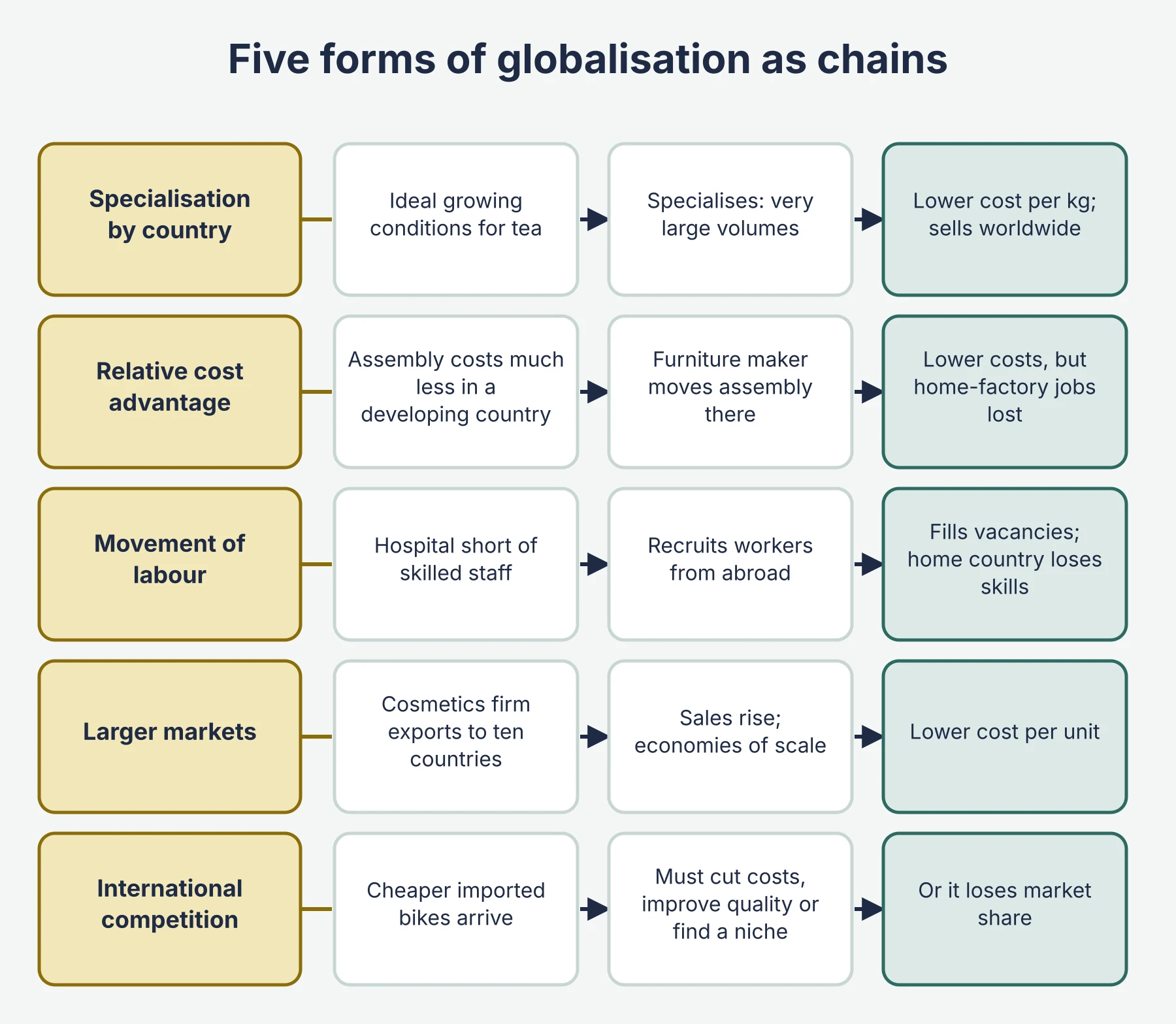
The specification names five forms. Learning each as a short cause-and-effect chain is more useful in an exam than learning a definition alone.
Specialisation by country. Countries concentrate on producing what they are best placed to make, perhaps because of climate, natural resources or workers’ skills, and trade for the rest. Chain: a country with ideal growing conditions specialises in tea, so its tea businesses produce very large volumes, which lowers their cost per kilogram and lets them sell to buyers worldwide.
Relative cost advantage. One country can produce a good at lower cost than another, often because wages, land or energy are cheaper. Chain: a furniture maker in a developed country finds that assembly costs much less in a developing country, so it moves assembly there, which lowers its costs, but jobs are lost in its home factory.
Movement of labour. Workers move between countries to find jobs or better pay. Chain: a hospital or engineering firm short of skilled staff recruits from abroad, so it can fill vacancies and keep running, while the workers’ home country loses some of its skilled people, although families there may receive money sent home.
Larger markets. As trade links grow and online selling spreads, a business can sell to customers in many countries. Chain: a cosmetics firm that once sold only at home now exports to ten countries, so sales rise and it gains economies of scale, lowering its cost per unit.
International competition. Foreign businesses can sell in the home market too. Chain: a home-country bicycle maker faces cheaper imported bikes, so it must cut costs, improve quality or find a niche, or it will lose market share.
Benefits and drawbacks: four different viewpoints
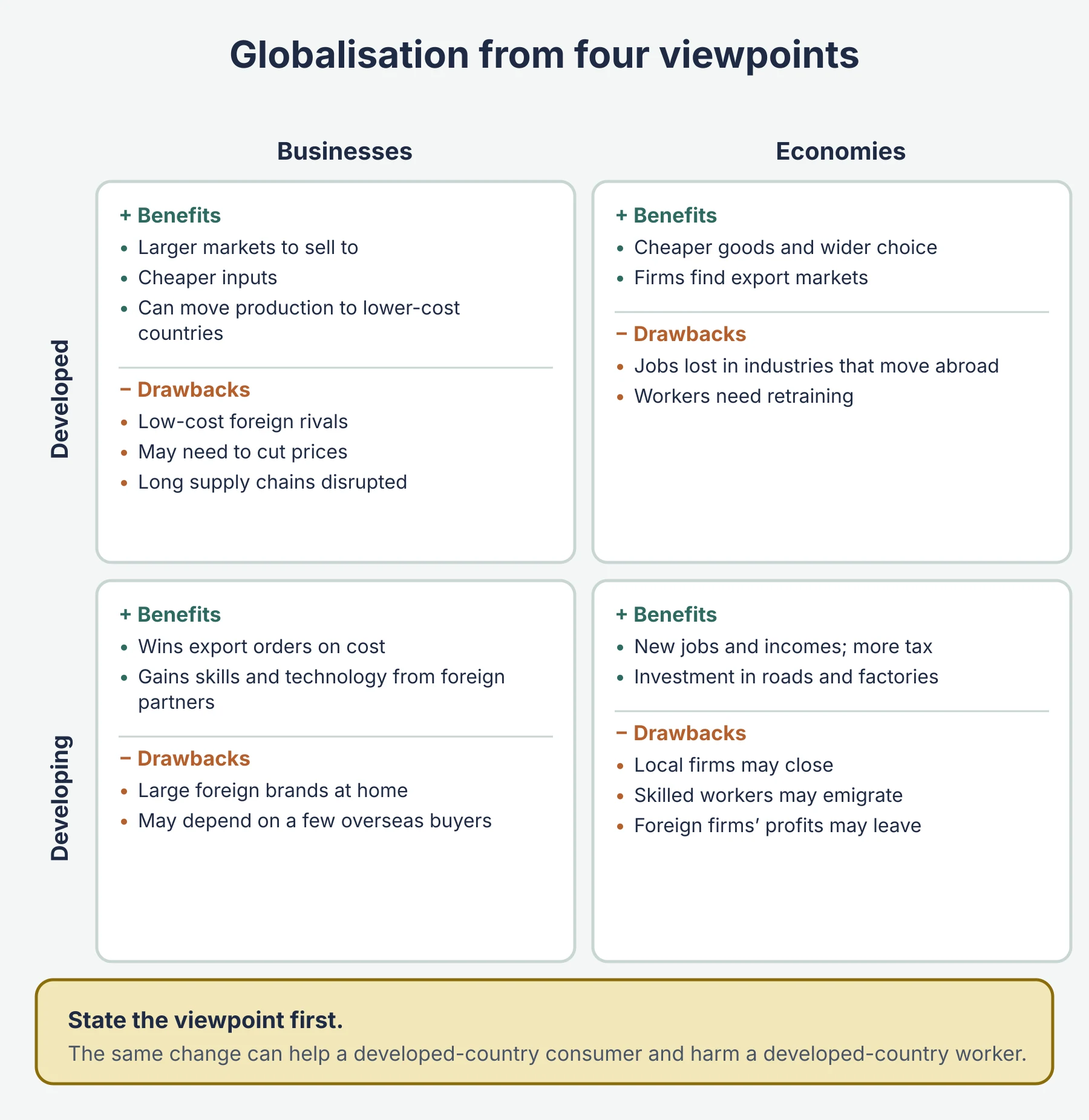
The specification asks about businesses and economies, in developed and developing countries. The same change can help one and harm another.
| Viewpoint | Benefits | Drawbacks |
|---|---|---|
| A business in a developed country | Sells to larger markets; buys cheaper inputs; can move production to lower-cost countries | Faces low-cost foreign rivals; may need to cut prices; long supply chains can be disrupted |
| A business in a developing country | Wins export orders using its cost advantage; gains skills and technology from foreign partners | Faces large, well-known foreign brands at home; may depend on a few overseas buyers |
| A developed economy | Consumers get cheaper goods and wider choice; firms find export markets | Jobs lost in industries that move abroad; workers need retraining |
| A developing economy | New jobs and incomes; government receives more tax; investment in roads and factories | Local firms may close; skilled workers may emigrate; profits of foreign-owned firms may leave the country |
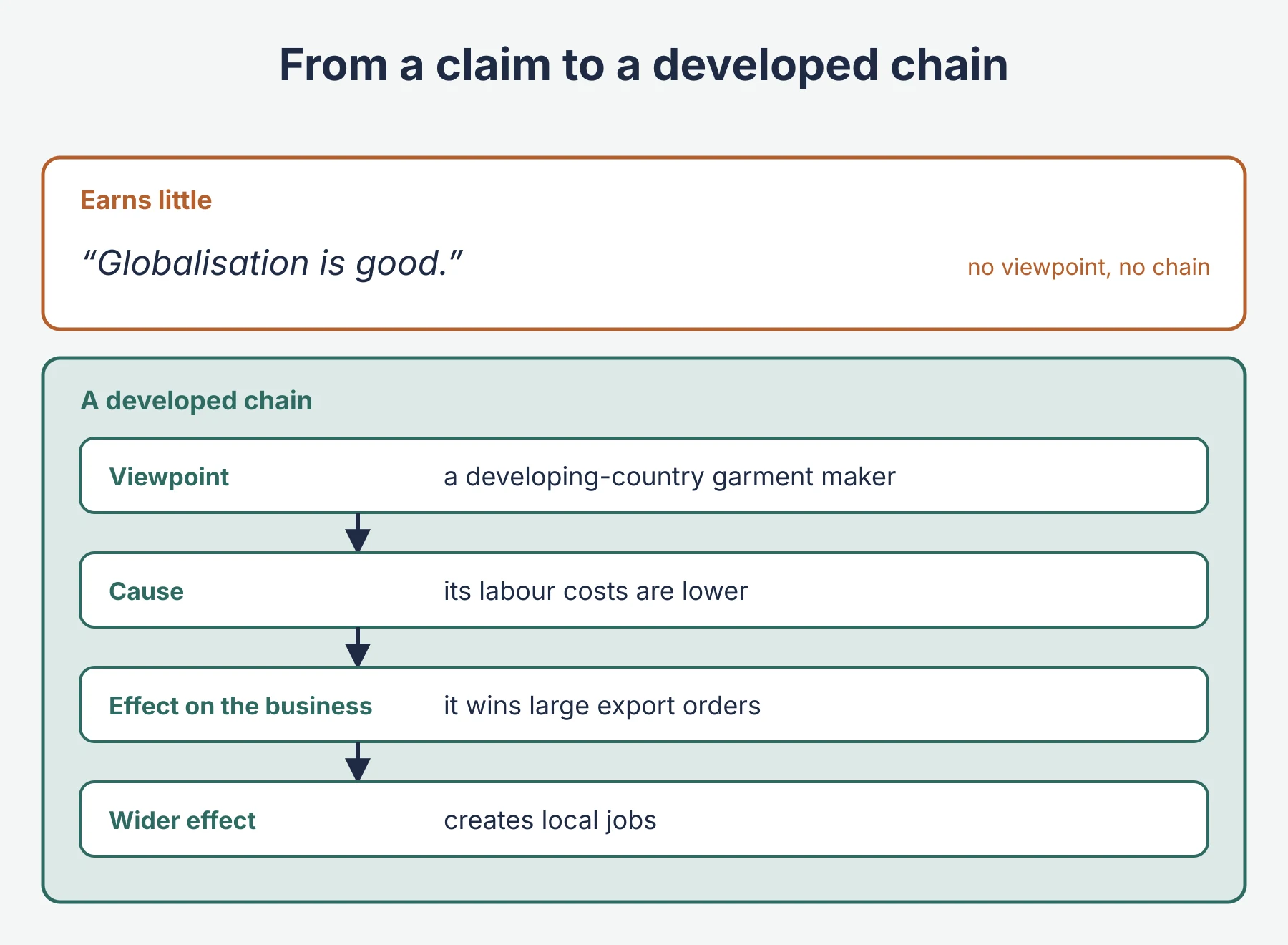
In an answer, state the viewpoint first. “Globalisation is good” earns little; “globalisation lets a developing-country garment maker win large export orders because its labour costs are lower, which creates local jobs” is a developed chain.
Exchange rates: sales and profit
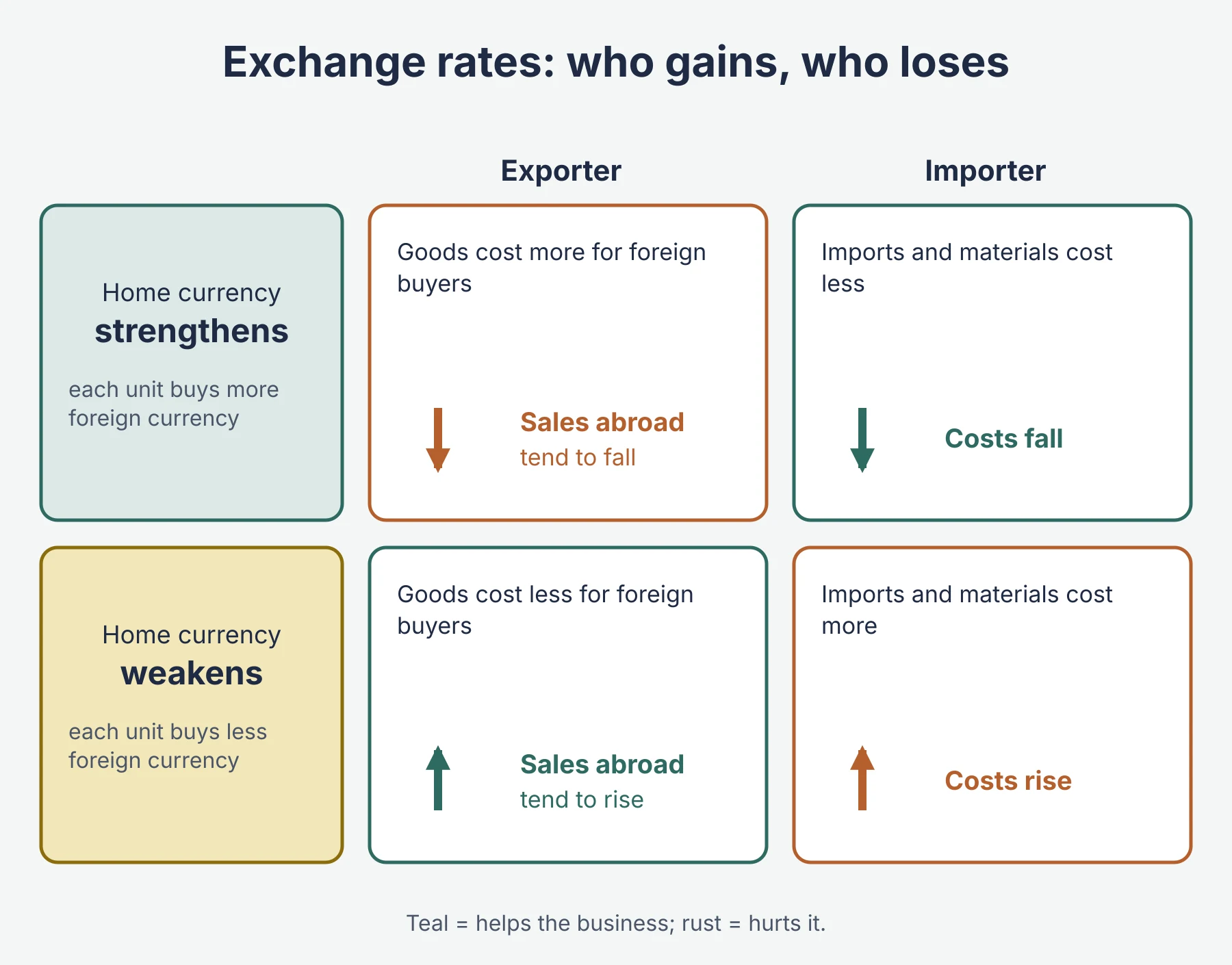
An exchange rate is the price of one currency in terms of another. When the home currency strengthens (rises in value), each unit buys more foreign currency; when it weakens, each unit buys less.
| Change in home currency | Exporter | Importer |
|---|---|---|
| Strengthens | Goods cost more for foreign buyers, so sales abroad tend to fall | Imported goods and materials cost less, so costs fall |
| Weakens | Goods cost less for foreign buyers, so sales abroad tend to rise | Imported goods and materials cost more, so costs rise |
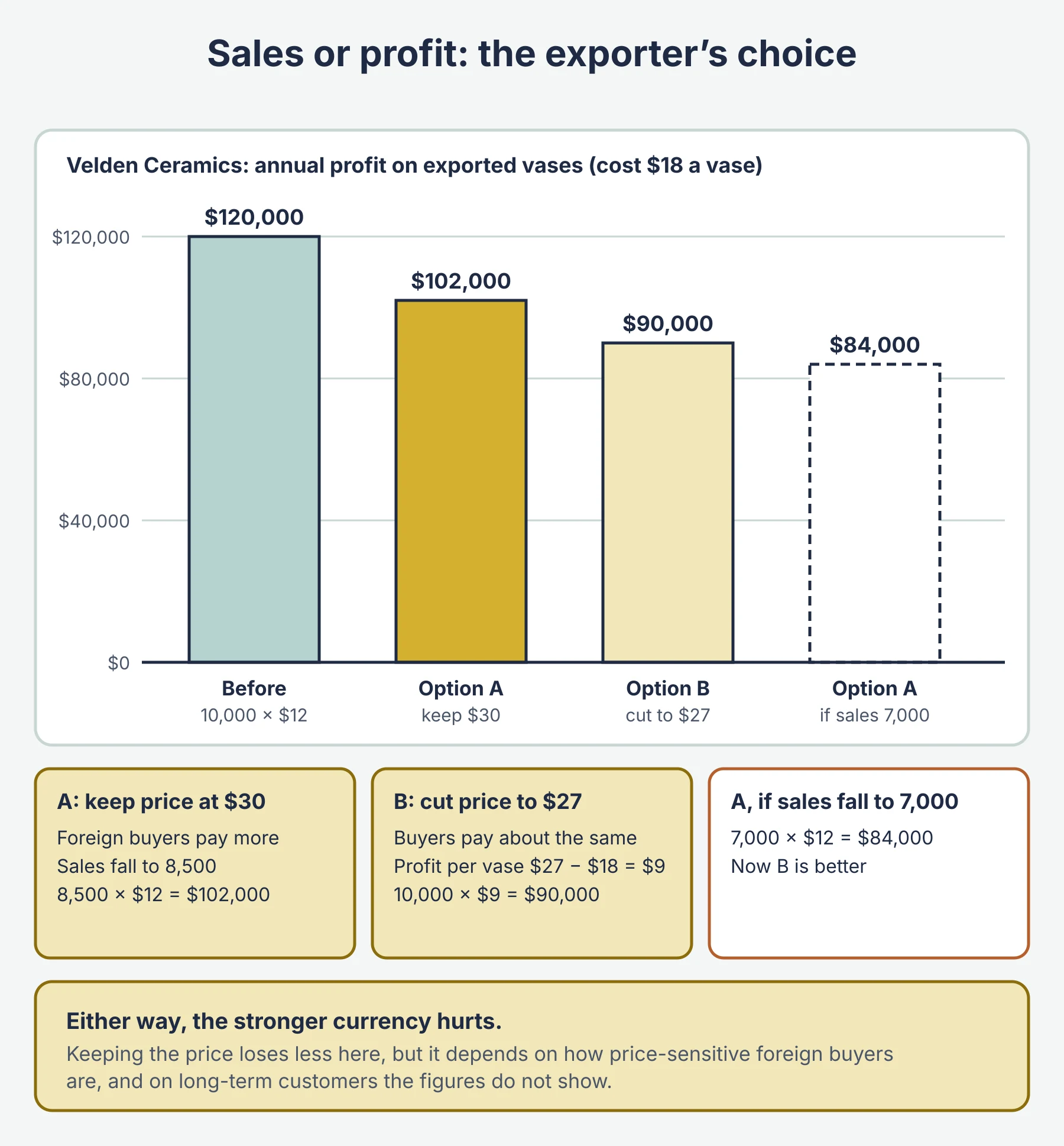
Sales or profit: the exporter’s choice. When its home currency strengthens, an exporter usually has to choose. It can keep its price in home currency, so foreign buyers pay more and some stop buying: sales fall. Or it can cut its home-currency price so foreign buyers pay about the same: sales hold, but profit per unit falls. Either way, the stronger currency hurts.
Worked example. Velden Ceramics exports 10,000 vases a year. Each sells for $30 in home currency and costs $18 to make, so profit per vase is $12 and total profit is $120,000. The home currency strengthens.
Option A: keep the price at $30
   Foreign buyers pay more; sales fall to 8,500 vases
   Profit = 8,500 x $12 = $102,000

Option B: cut the price to $27 so foreign buyers pay about the same
   Sales stay at 10,000 vases; profit per vase = $27 - $18 = $9
   Profit = 10,000 x $9 = $90,000
Here keeping the price loses less profit, but the decision depends on how sensitive foreign buyers are to price. If sales fell to 7,000 under option A, profit would be $84,000 and option B would be better. Velden might also lose long-term customers under option A, which the figures do not show.
Severe fluctuations
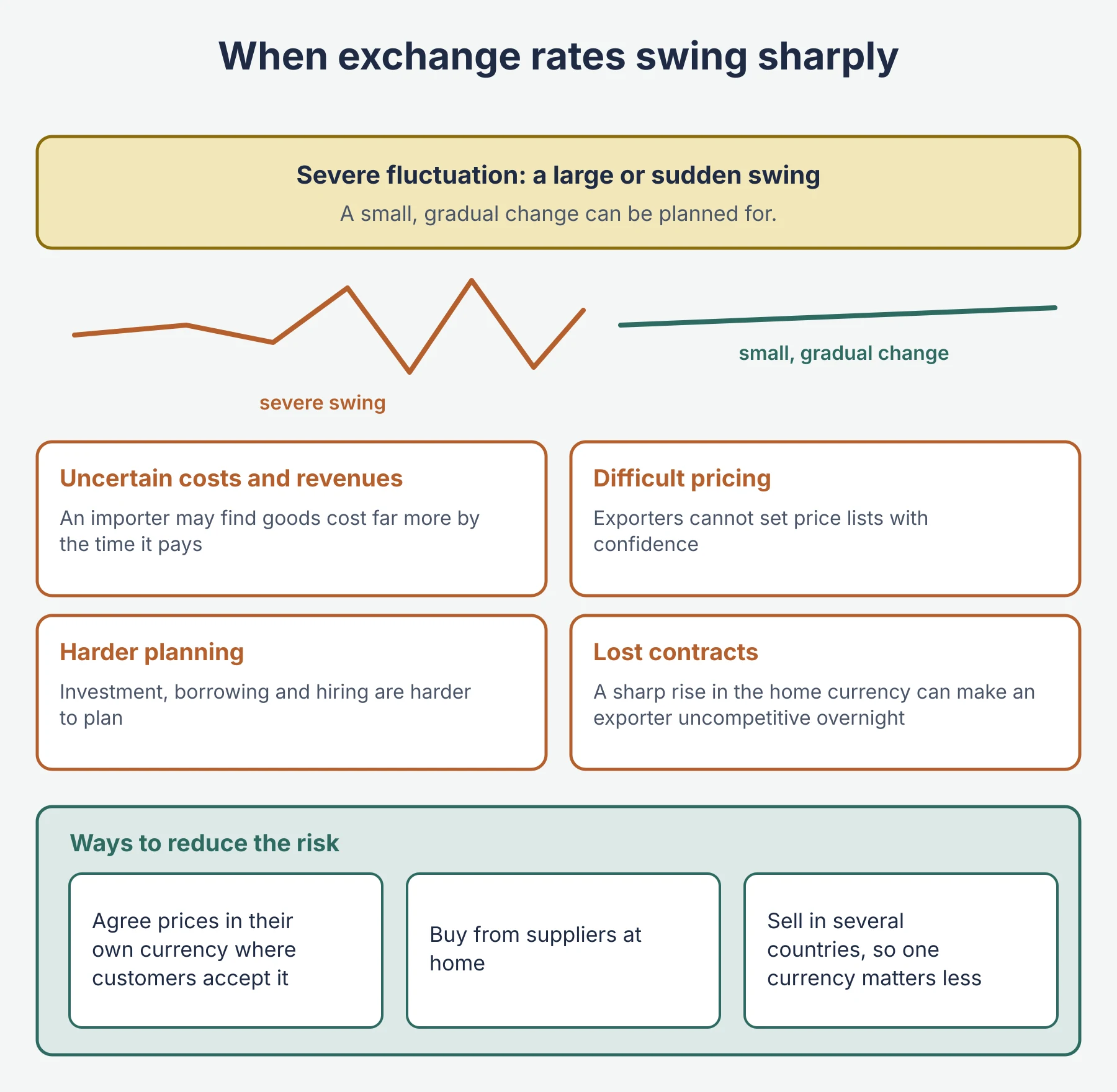
A small, gradual change in the exchange rate can be planned for. A severe fluctuation, a large or sudden swing, causes wider problems:
- Uncertain costs and revenues: an importer may agree to buy goods and find they cost far more by the time it pays.
- Difficult pricing: exporters cannot set price lists with confidence, and may lose orders if they keep changing prices.
- Harder planning: uncertain profits make it harder to plan investment, borrowing and hiring.
- Lost contracts: a sharp rise in the home currency can make an exporter uncompetitive almost overnight.
Businesses reduce the risk by agreeing prices in their own currency where customers accept it, buying from suppliers at home, or selling in several countries so that one currency’s movement matters less.
Common mistakes
- Getting the direction of exchange-rate effects the wrong way round. Write the chain out: “stronger home currency → foreign buyers pay more → exports fall”.
- Explaining only sales and forgetting profit, or the reverse.
- Treating developed and developing countries as the same, or mixing up businesses and economies.
- Listing the five forms without an effect on a business.
- Attempting currency conversions, which the specification says are not required.
Exam technique for this section
State and identify questions often ask for a form of globalisation: give the exact names from the specification. Explain questions on exchange rates need the direction and the effect on the named business’s sales or costs. Analyse answers should follow a chain from the form of globalisation to the business’s costs, sales or competition. Evaluate answers should weigh a benefit against a drawback for the specific business, and judge what matters most, for example how much of its sales are exports or how much of its costs are imported.
More resources on this topic
Related resources
-
Practice questions
OxfordAQA International GCSE Business (9225): Globalisation – Practice Questions
Eleven original questions with answers on the forms of globalisation, its benefits and drawbacks, and exchange rates for exporters in OxfordAQA 9225.
Business · OxfordAQA · IGCSE
Try questions -
Revision notes
OxfordAQA International GCSE Business (9225): Globalisation – Revision Notes
Revision notes for OxfordAQA IGCSE Business 9225 section 3.2.4: forms of globalisation, four-viewpoint benefits and drawbacks, exchange rates and a self-test.
Business · OxfordAQA · IGCSE
Revise topic -
Study guides
OxfordAQA International GCSE Business (9225): Legislation
Study guide to OxfordAQA IGCSE Business 9225 section 3.2.5 Legislation: employment, health and safety and consumer law, minimum wage and compliance costs.
Business · OxfordAQA · IGCSE
Read guide
Get free revision emails (optional)
Occasional emails with practice questions, worked explanations and links to free resources for the qualification and subjects you choose. No spam, and you can unsubscribe from any email. The free tools on this site never need an email.