
Study Guides
OxfordAQA International GCSE Business (9225): Legislation
Study guide to OxfordAQA IGCSE Business 9225 section 3.2.5 Legislation: employment, health and safety and consumer law, minimum wage and compliance costs.
- Subject
- Business
- Level
- IGCSE
- Topic
- Influences on business
- Author
- Marlbridge Academic Team
- Updated
- Reviewed by
- Salman Ahmad (what this means)
Aligned to OxfordAQA IGCSE Business (9225), First teaching September 2020, first examined May/June 2022. Official specification .
Syllabus page (what it covers and how it is assessed): OxfordAQA IGCSE Business.
Syllabus points this page covers
9225
- 3.2.5 Legislation
Found an error? Report a correction.
Need help with this topic? Request a free trial class for IGCSE Business (9225).
This guide covers section 3.2.5 Legislation of OxfordAQA International GCSE Business (9225), part of Topic 2, Influences on business. The specification lists three areas, employment law, health and safety law and consumer law, and asks you to assess the impact of legislation on businesses, for example on cost, training needs, recruitment and the consequences of failing to follow the law; to be aware of the benefits and drawbacks to businesses of laws requiring a safe working environment and a national minimum wage; and to be aware of how consumer protection laws affect businesses. All businesses and figures are invented.
Laws differ from country to country, and the specification does not name any particular country’s laws. This guide therefore describes what these areas of law commonly require, and you should apply the ideas to whatever business and country a question describes.
For the whole topic, see the Influences on Business study guide. Condensed notes are in the Legislation revision notes and questions in the Legislation practice questions.
Why governments pass business laws
Businesses usually have more power than an individual worker or customer. Laws set minimum standards so that employees are paid and treated fairly, workplaces are safe, and customers get what they pay for. They also stop responsible businesses being undercut by rivals that cut corners.
What each area of law typically covers
| Area | Common requirements | Who it protects |
|---|---|---|
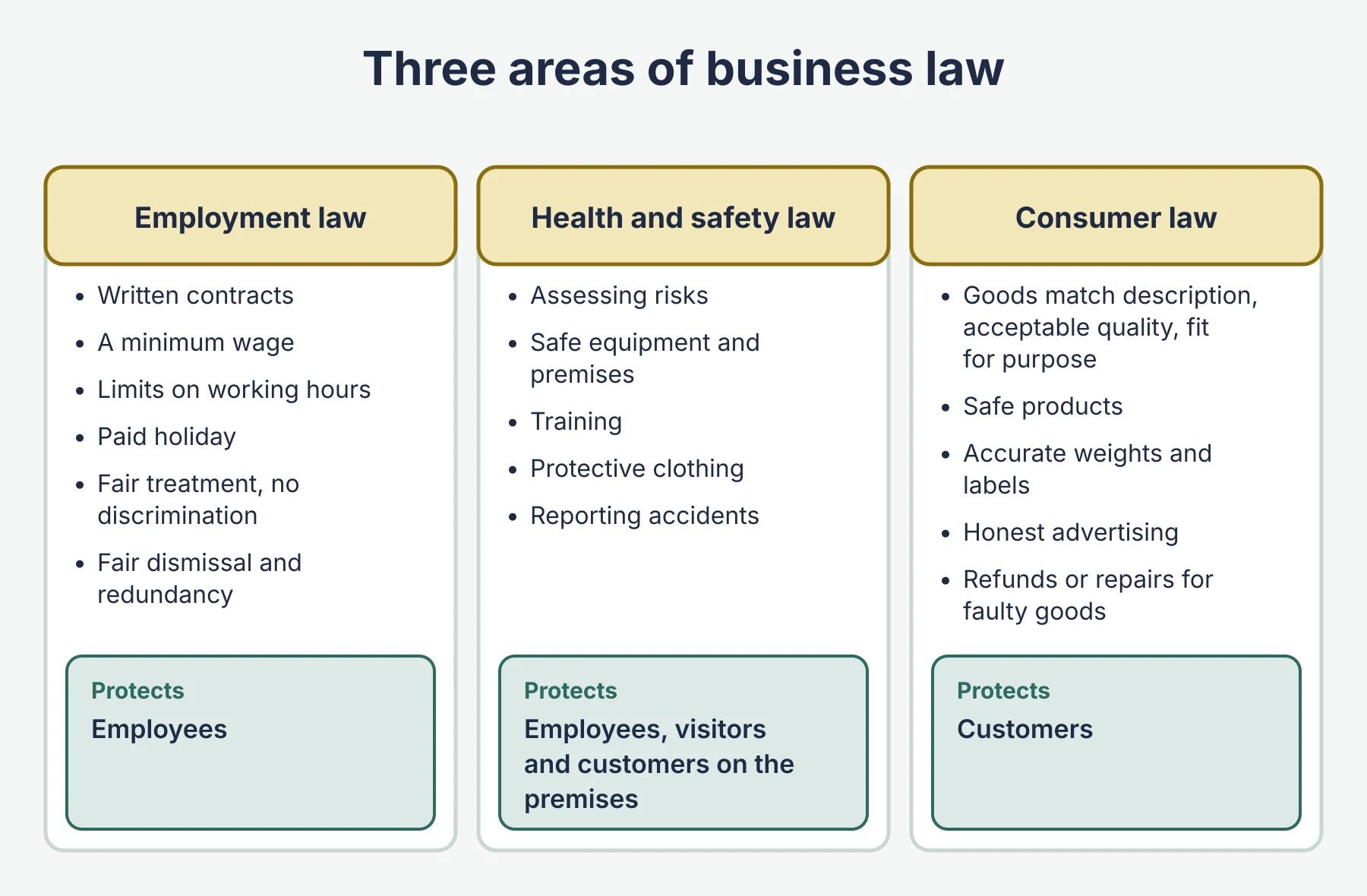
| Employment law | Written contracts; a minimum wage; limits on working hours; paid holiday; fair treatment without discrimination; fair procedures for dismissal and redundancy | Employees |
| Health and safety law | Assessing risks; safe equipment and premises; training; protective clothing; reporting accidents | Employees, and visitors or customers on the premises |
| Consumer law | Goods match their description, are of acceptable quality and fit for purpose; products are safe; accurate weights and labels; honest advertising; refunds or repairs for faulty goods | Customers |
Assessing the impact: the four headings in the specification
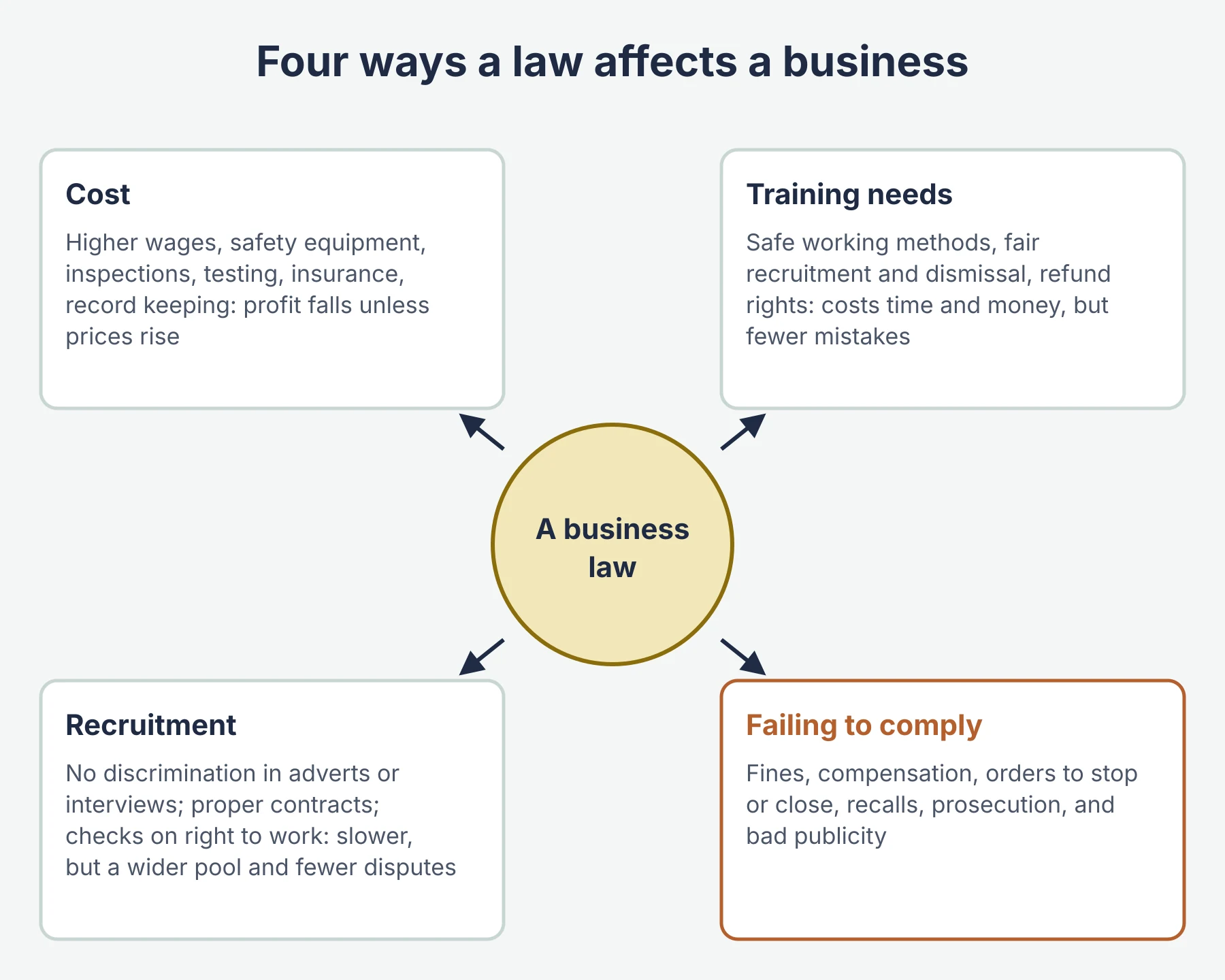
Cost. Laws add costs: higher wages, safety equipment, inspections, product testing, insurance and the time spent keeping records. These costs raise the cost of each product or service and reduce profit unless prices rise.
Training needs. Staff must be trained to follow the law: machine operators in safe working methods, managers in fair recruitment and dismissal, shop staff in customers’ refund rights. Training costs money and takes staff away from work, but it also reduces mistakes.
Recruitment. Employment law shapes how a business recruits. Job adverts and interviews must not discriminate, offers must be followed by proper contracts, and the business may need to check that applicants are allowed to work. This takes time, but it can widen the pool of applicants and reduce the risk of costly disputes later.
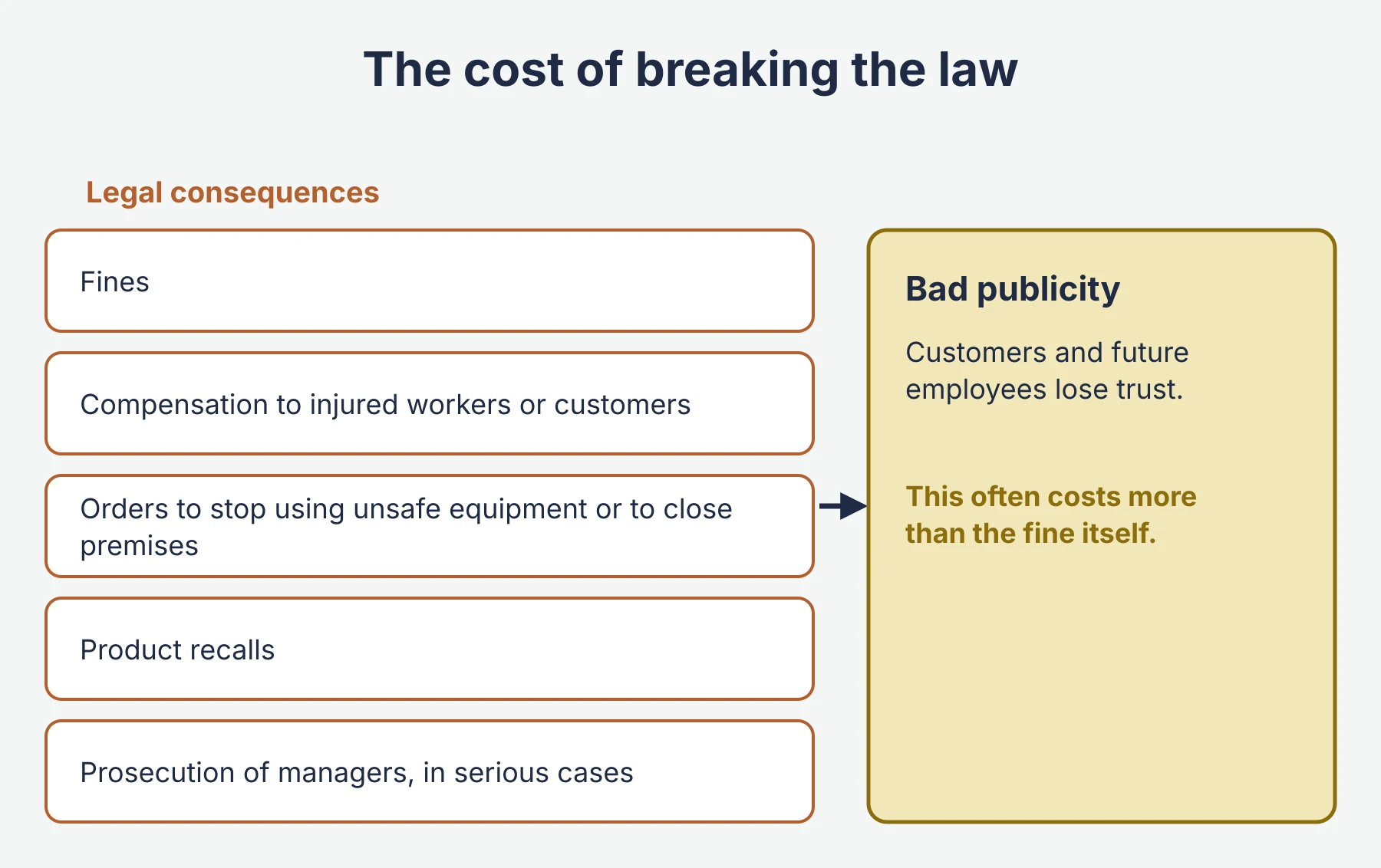
Consequences of failing to follow legislation. These can include fines, compensation payments to injured workers or customers, orders to stop using unsafe equipment or to close premises, product recalls and, in serious cases, prosecution of managers. Bad publicity often costs more than the fine, because customers and future employees lose trust.
Safe working environment: benefits and drawbacks
| Benefits to the business | Drawbacks to the business |
|---|---|
| Fewer accidents, so less lost output and staff absence | Cost of equipment, guards, protective clothing and inspections |
| Lower risk of fines and compensation claims | Training time and record keeping |
| Staff feel valued, so motivation and retention improve | Some safety rules slow down work |
| Easier to recruit when the business has a good safety record | Small firms may find the cost harder to absorb |
National minimum wage: benefits and drawbacks
A national minimum wage is the lowest hourly rate an employer is legally allowed to pay.
| Benefits to the business | Drawbacks to the business |
|---|---|
| Staff may be more motivated and less likely to leave | Higher wage costs, especially in labour-intensive businesses |
| Lower recruitment and training costs if turnover falls | Pressure to raise prices, which may lose customers |
| Rivals cannot undercut by paying very low wages | Pay differences may need restoring for more senior staff |
| Customers spend more if many workers’ pay rises | Some businesses respond by cutting hours or jobs |
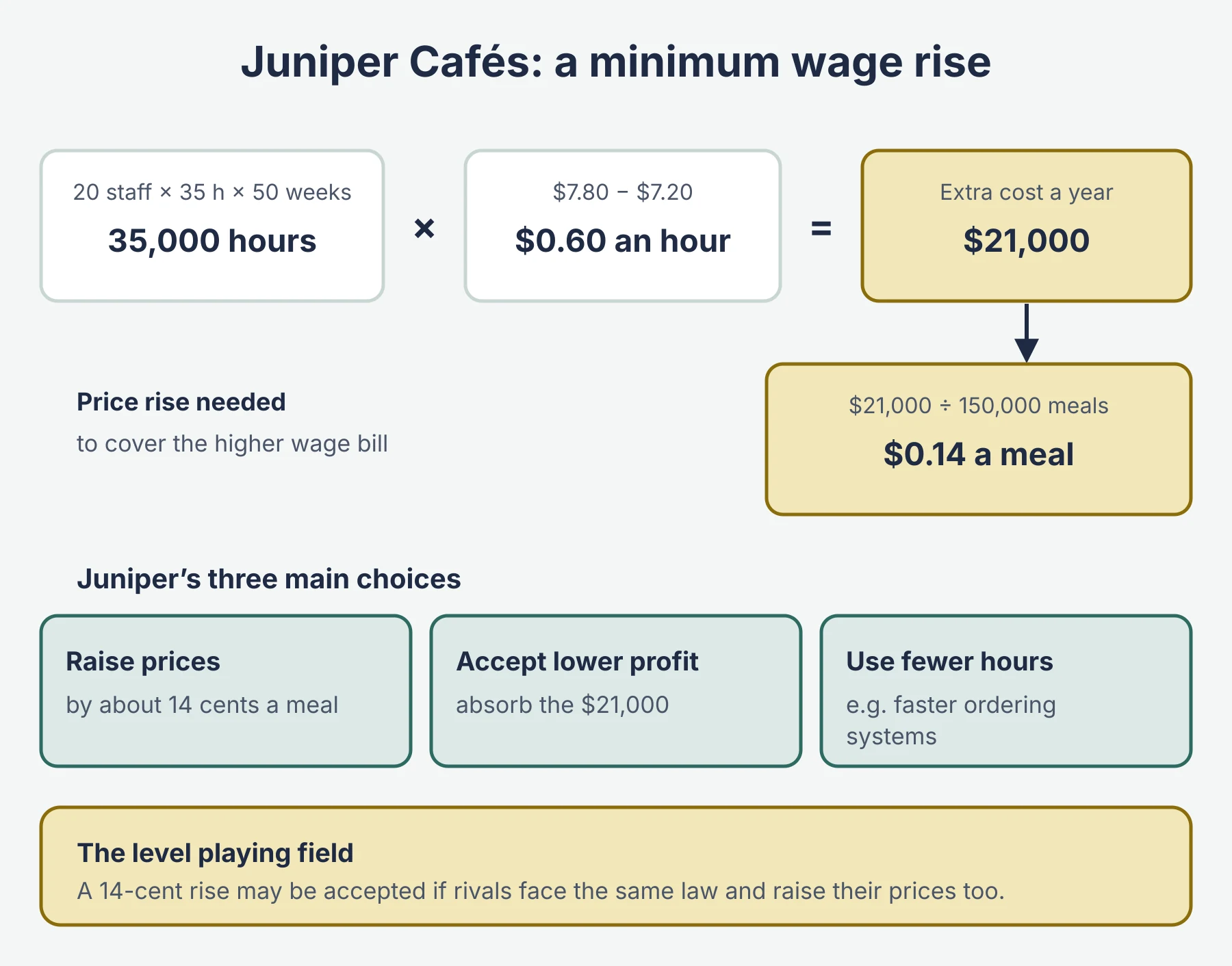
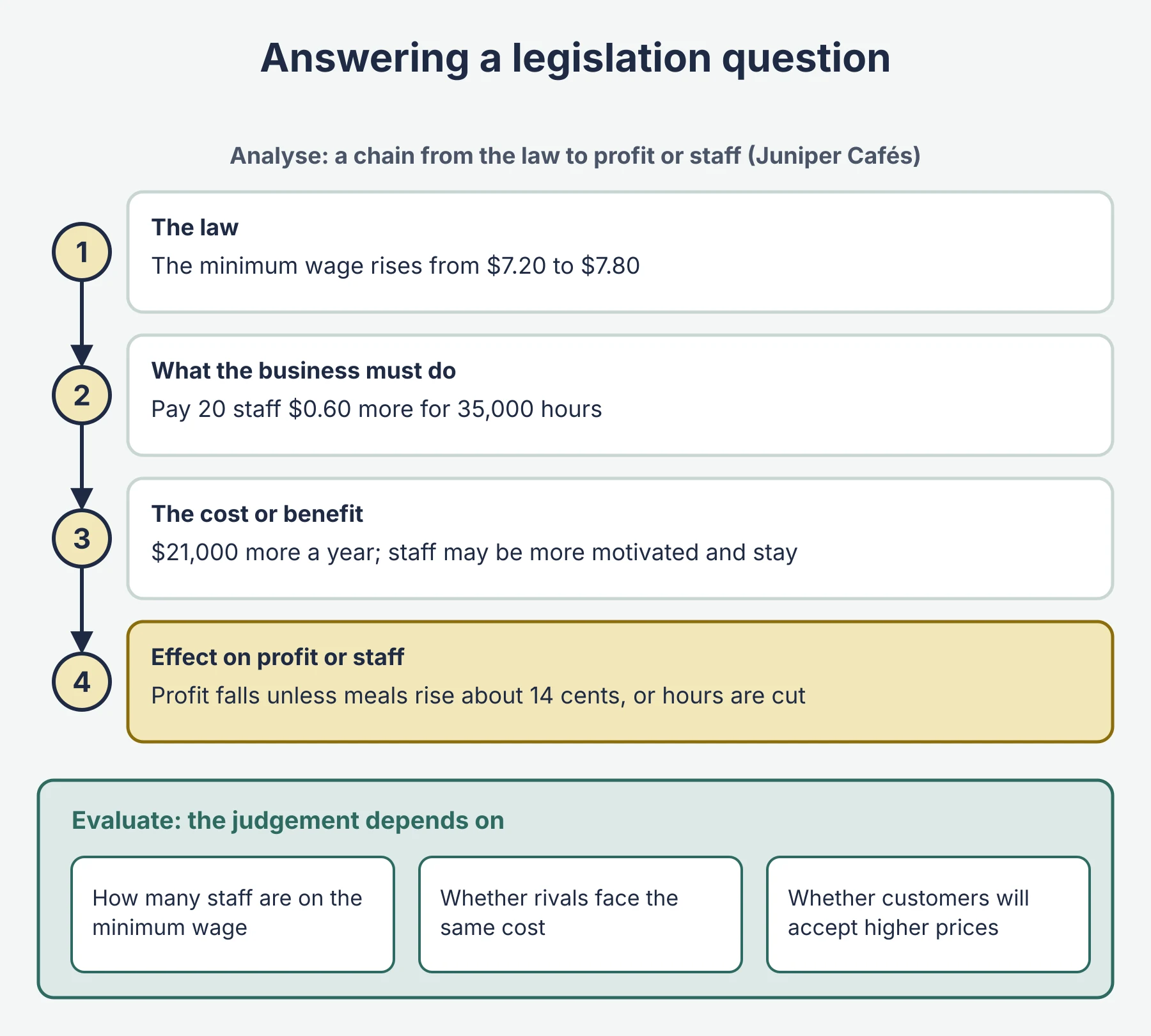
Worked example 1: a minimum wage rise. Juniper Cafés employs 20 staff on the minimum wage, each working 35 hours a week for 50 weeks a year. The minimum wage rises from $7.20 to $7.80 an hour. The cafés sell 150,000 meals a year.
Hours worked a year = 20 x 35 x 50 = 35,000 hours
Extra cost per hour = $7.80 - $7.20 = $0.60
Extra yearly cost   = 35,000 x $0.60 = $21,000
Price rise per meal to cover it = $21,000 / 150,000 = $0.14
Juniper has three main choices: raise prices by about 14 cents a meal, accept lower profit, or find ways to use fewer hours, such as faster ordering systems. A 14-cent rise may be accepted if rivals face the same law and raise their prices too, which is the “level playing field” point.
Consumer protection laws
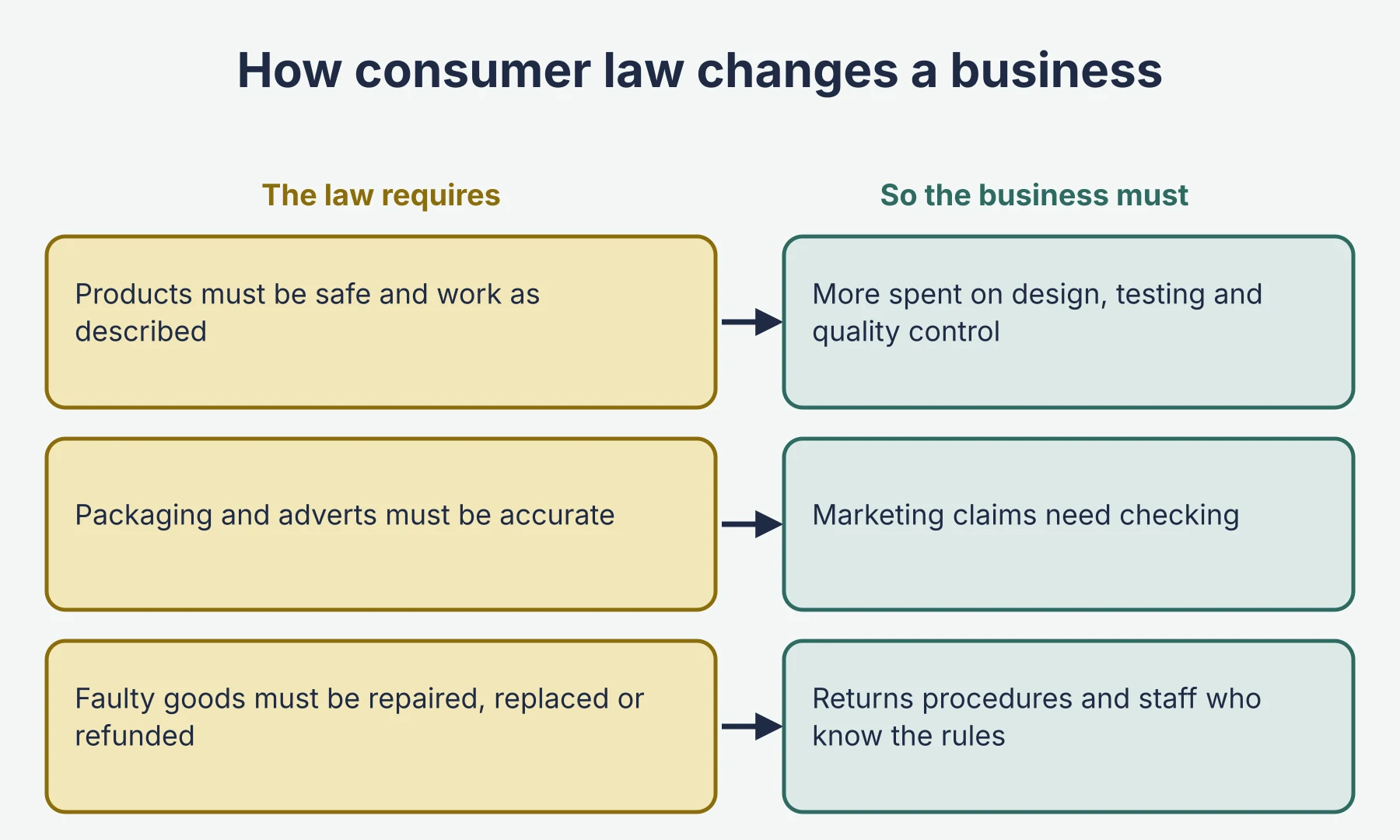
Consumer laws affect what a business sells and how it sells it. Products must be safe and work as described, so businesses spend more on design, testing and quality control. Packaging and adverts must be accurate, so marketing claims need checking. Faulty goods must be repaired, replaced or refunded, so businesses need returns procedures and staff who know the rules.
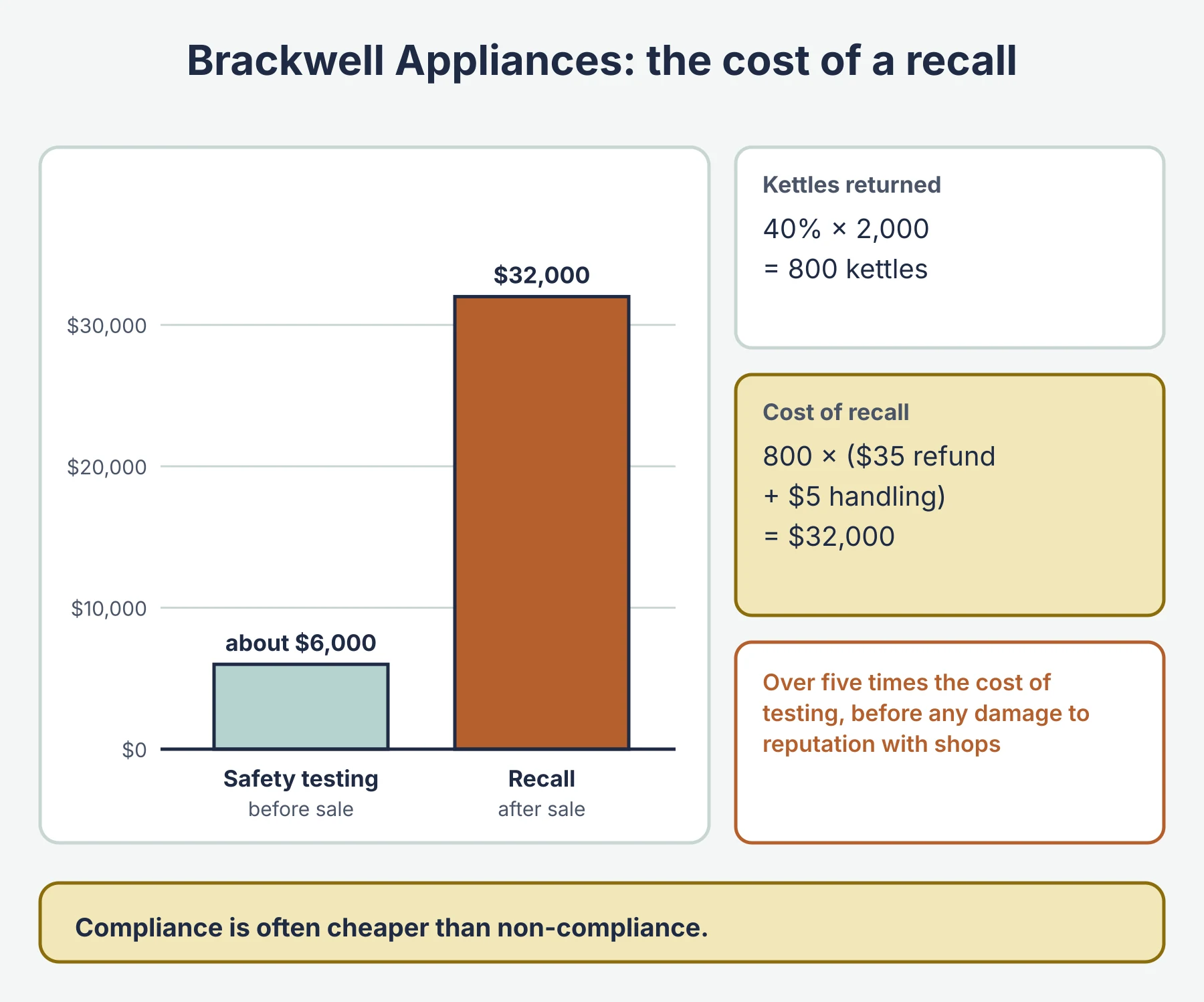
Worked example 2: the cost of getting it wrong. Brackwell Appliances sold 2,000 kettles with a faulty switch and must recall them. It expects 40% to be returned, each costing a $35 refund plus $5 handling.
Kettles returned = 40% x 2,000 = 800
Cost of recall   = 800 x ($35 + $5) = $32,000
Extra safety testing before sale would have cost about $6,000. The recall costs over five times as much, before counting the damage to Brackwell’s reputation with the shops that stock its products. Compliance is often cheaper than non-compliance.
Common mistakes
- Saying a law “affects the business” without saying how: through cost, training, recruitment or the risk of penalties.
- Assuming legislation is only a cost; the specification asks for benefits as well as drawbacks.
- Confusing legislation with ethics: the law is compulsory, ethics is a choice to go further.
- Naming a specific law from one country; questions describe laws in general terms.
- Forgetting that the consequences of breaking the law include damage to reputation, not only fines.
Exam technique for this section
Explain questions want one impact developed into an effect on the named business. Analyse questions want chains: the law, what the business must do, the cost or benefit, the effect on profit or staff. Evaluate questions, such as whether a minimum wage rise will harm a business, want both sides and a judgement that depends on the case: how many staff are on the minimum wage, whether rivals face the same cost, and whether customers will accept higher prices.
More resources on this topic
Related resources
-
Practice questions
OxfordAQA International GCSE Business (9225): Legislation – Practice Questions
Twelve original questions with answers on employment, health and safety and consumer law and the national minimum wage for OxfordAQA IGCSE Business 9225 3.2.5.
Business · OxfordAQA · IGCSE
Try questions -
Revision notes
OxfordAQA International GCSE Business (9225): Legislation – Revision Notes
Revision notes for OxfordAQA IGCSE Business 9225 section 3.2.5: employment, health and safety and consumer law, minimum wage and a self-test.
Business · OxfordAQA · IGCSE
Revise topic -
Study guides
OxfordAQA International GCSE Business (9225): Technology
Study guide to OxfordAQA IGCSE Business 9225 section 3.2.1 Technology: ICT and business activity, e-commerce and wider markets, digital communication.
Business · OxfordAQA · IGCSE
Read guide
Get free revision emails (optional)
Occasional emails with practice questions, worked explanations and links to free resources for the qualification and subjects you choose. No spam, and you can unsubscribe from any email. The free tools on this site never need an email.