
Study Guides
OxfordAQA International GCSE Business (9225): Competitive Environment
Study guide to OxfordAQA IGCSE Business 9225 section 3.2.6: markets and competition, minimal competition, risk, uncertainty and lower cost advantage.
- Subject
- Business
- Level
- IGCSE
- Topic
- Influences on business
- Author
- Marlbridge Academic Team
- Updated
- Reviewed by
- Salman Ahmad (what this means)
Aligned to OxfordAQA IGCSE Business (9225), First teaching September 2020, first examined May/June 2022. Official specification .
Syllabus page (what it covers and how it is assessed): OxfordAQA IGCSE Business.
Syllabus points this page covers
9225
- 3.2.6 Competitive environment
Found an error? Report a correction.
Need help with this topic? Request a free trial class for IGCSE Business (9225).
This guide covers section 3.2.6 Competitive environment of OxfordAQA International GCSE Business (9225), part of Topic 2, Influences on business. The specification lists two content points: the impact on businesses of operating in competitive markets, and the uncertainty and risks businesses face. You need to understand what is meant by a market and competition; analyse the potential impacts of competition and identify situations of minimal or no competition; understand the risks businesses face and why all businesses face uncertainty; understand why entrepreneurs embark on running businesses and the activities that can minimise risks; and understand how developing countries compete with developed countries, such as through lower cost advantage. All businesses and figures are invented.
For the whole topic, see the Influences on Business study guide. Condensed notes are in the Competitive Environment revision notes and questions in the Competitive Environment practice questions.
Markets and competition
A market is wherever buyers and sellers come together to exchange goods or services. It can be a physical place, such as a street market, or online. Competition is the rivalry between businesses trying to sell to the same customers.
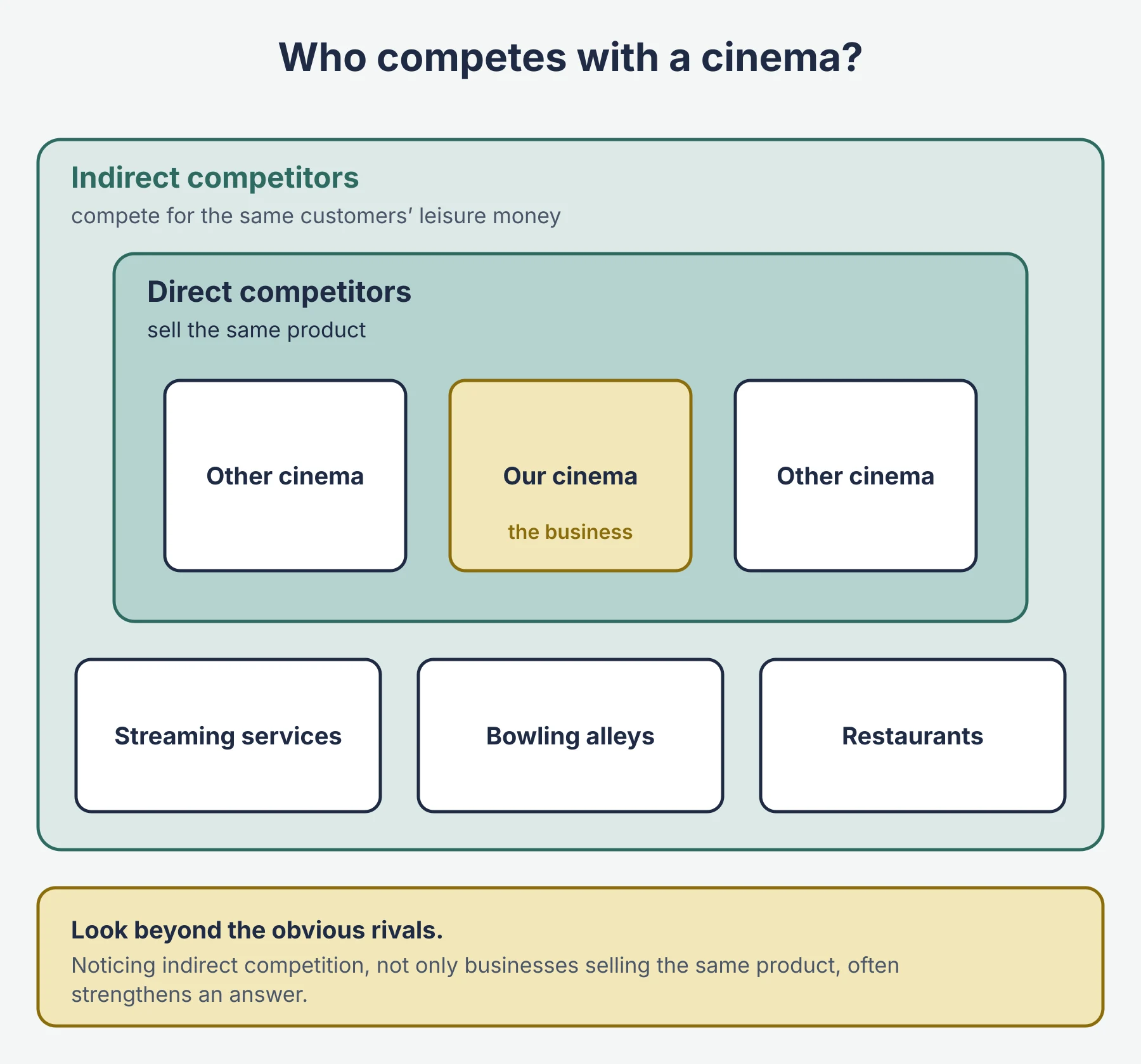
Competitors are not only businesses selling the same product. A cinema’s direct competitors are other cinemas; its indirect competitors include streaming services, bowling alleys and restaurants, because they compete for the same customers’ leisure money. Noticing indirect competition often strengthens an answer.
The impact of competition on a business
| Area | Effect of strong competition |
|---|---|
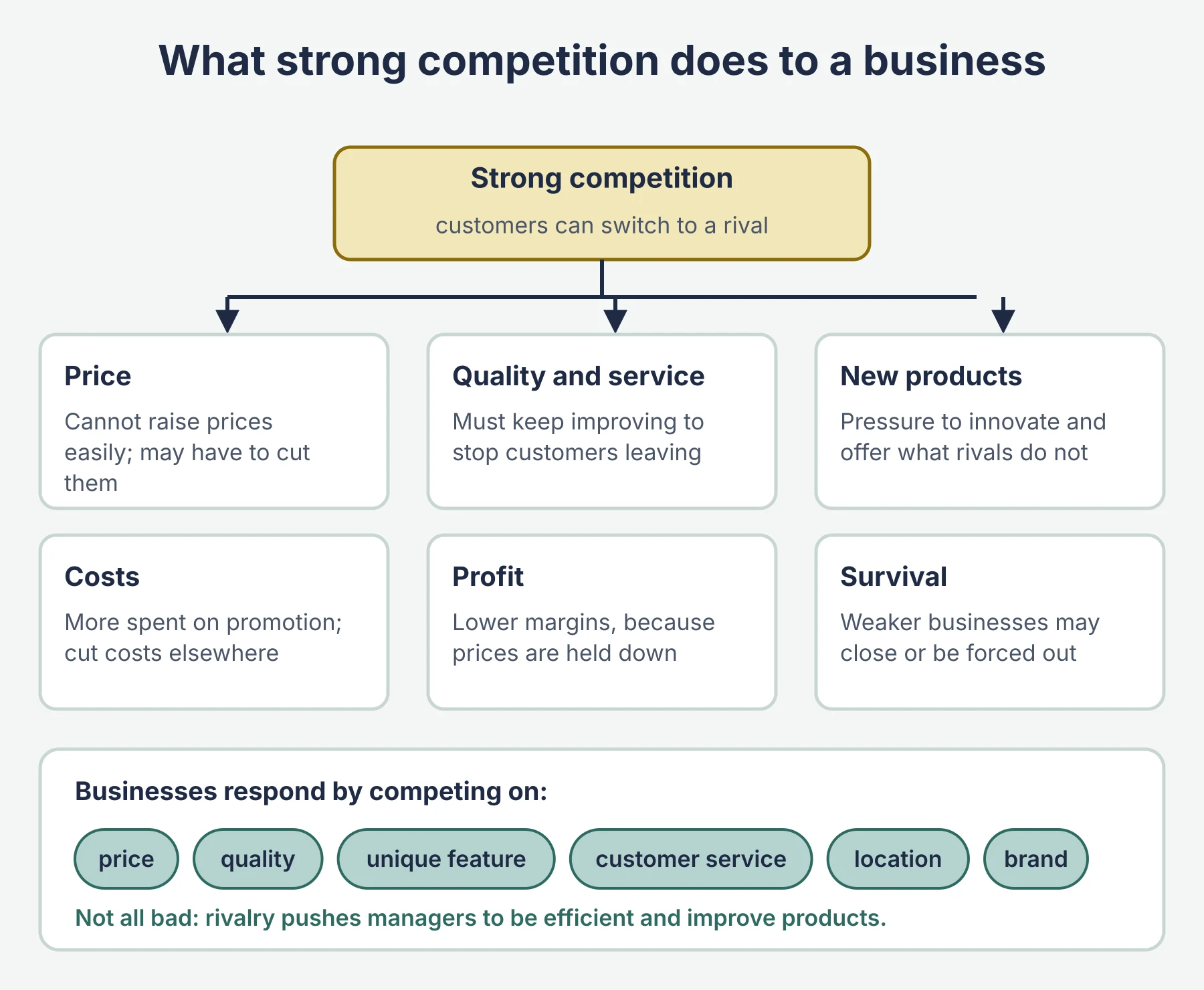
| Price | Customers can switch, so the business cannot raise prices easily and may have to cut them |
| Quality and service | The business must keep improving to stop customers leaving |
| New products | Pressure to innovate and offer something rivals do not |
| Costs | More spending on promotion; pressure to cut costs elsewhere |
| Profit | Lower margins, because prices are held down |
| Survival | Weaker businesses may close or be forced out |
Competition is not all bad for a business. It pushes managers to become more efficient, to understand customers better and to improve products, which can make the business stronger. Businesses respond by competing on price, quality, a unique feature, customer service, location or brand.
Worked example 1: competition arrives
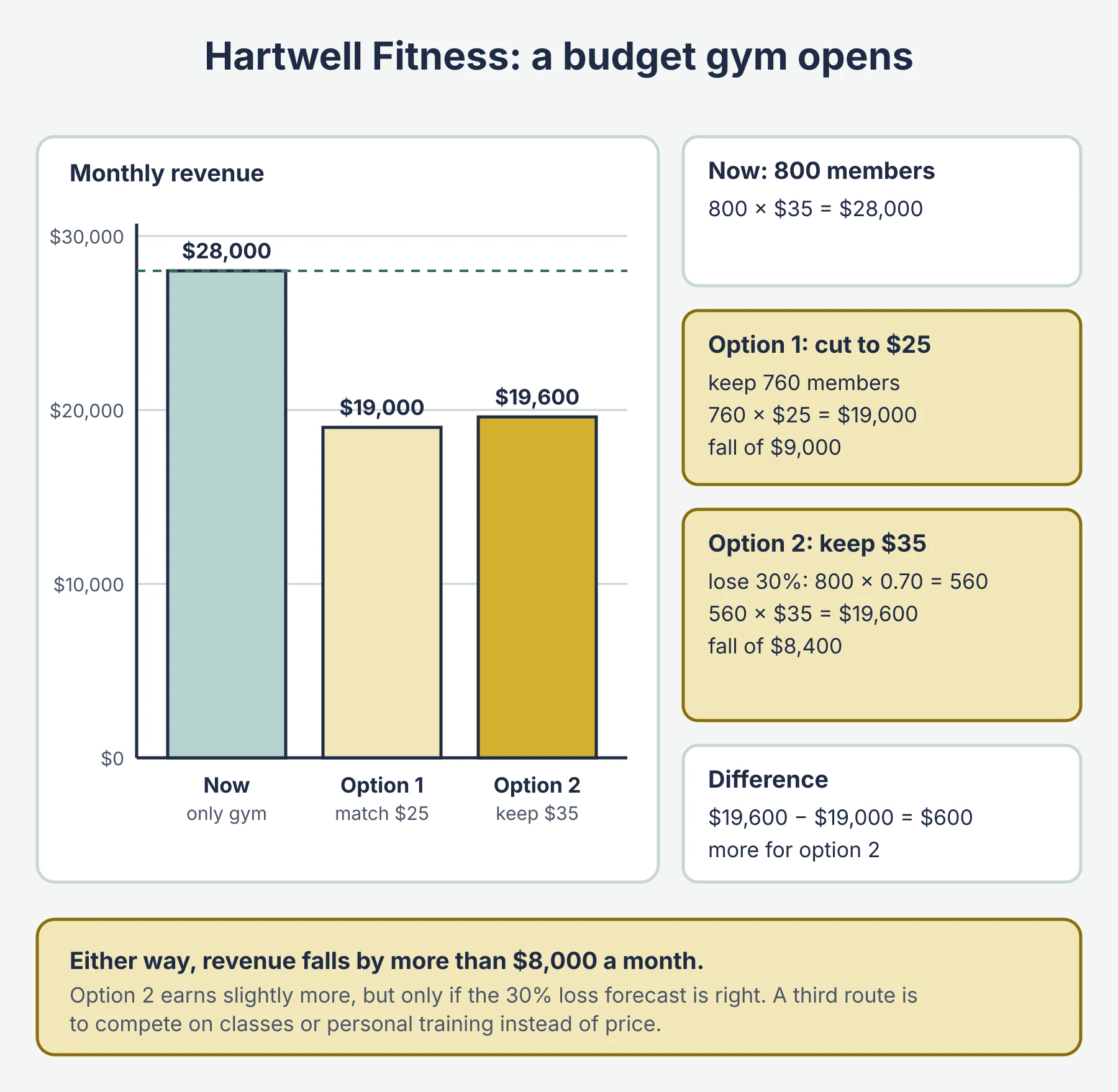
Hartwell Fitness is the only gym in a small town. It has 800 members paying $35 a month, so monthly revenue is $28,000. A budget gym opens nearby charging $25.
Option 1: match the $25 price; expected to keep 760 members
   Revenue = 760 x $25 = $19,000

Option 2: keep the $35 price; expected to lose 30% of members
   Members = 800 x 0.70 = 560
   Revenue = 560 x $35 = $19,600
Either way, revenue falls by more than $8,000 a month: the arrival of competition is costly. Keeping the higher price earns slightly more revenue and, with fewer members, may lower running costs. It also keeps Hartwell’s image as the better-equipped gym. But it depends on the 30% forecast being right. A third route is to compete on something other than price, such as classes or personal training, which the budget gym may not offer.
Minimal or no competition
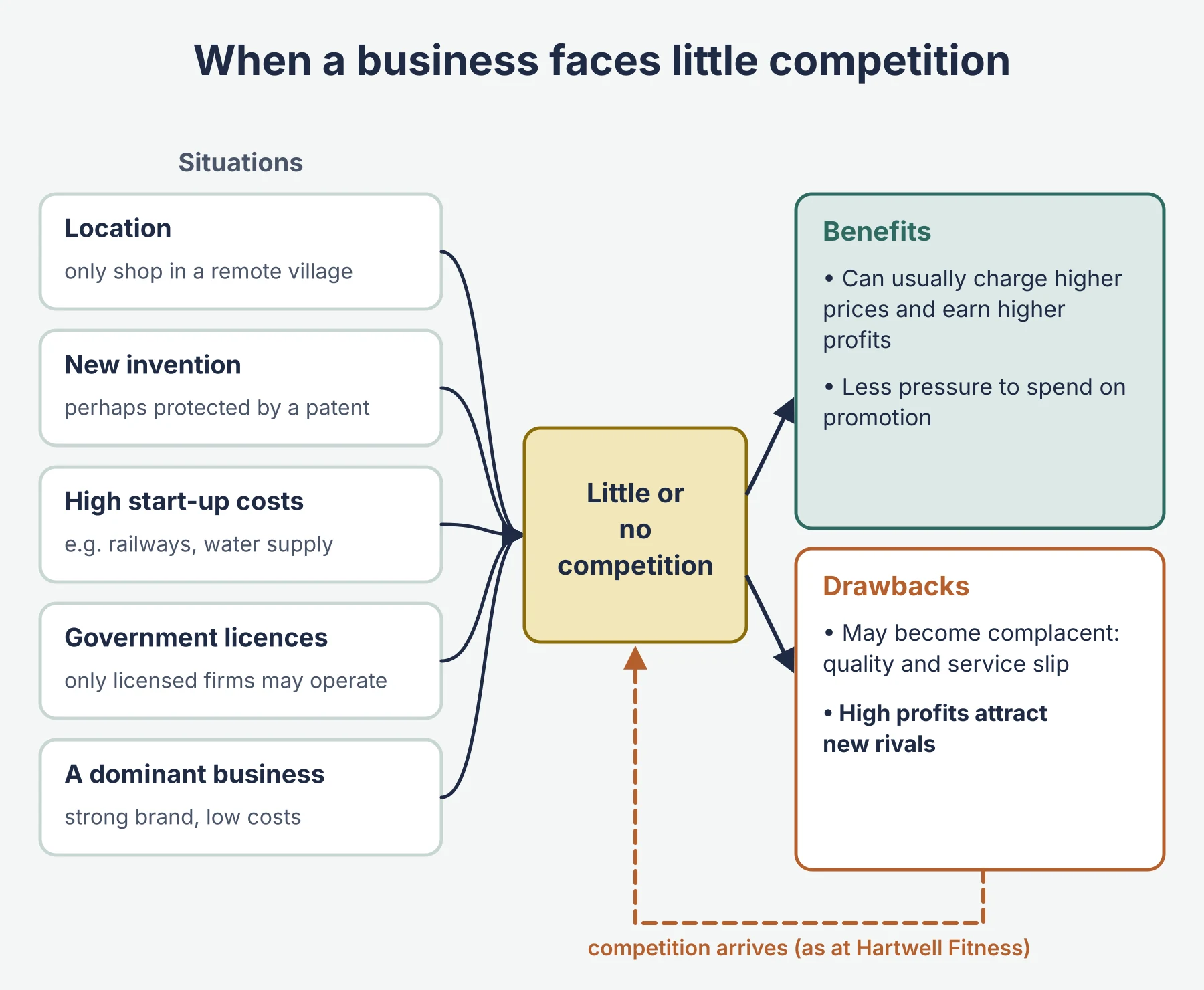
Some businesses face little or no competition. Situations to recognise include:
- Location: the only shop, pharmacy or petrol station in a remote village.
- A new invention or product that no one else yet makes, perhaps protected by a patent.
- High start-up costs: markets such as railways or water supply need huge investment, so few businesses enter.
- Government licences: only licensed businesses may operate, for example some transport or broadcasting services.
- A dominant business: one very large firm with a strong brand and low costs that others cannot match.
With little competition, a business can usually charge higher prices and earn higher profits, and it faces less pressure to spend on promotion. The drawbacks are that it may become complacent, letting quality and service slip, and that high profits attract new rivals, as Hartwell Fitness found.
Risk and uncertainty
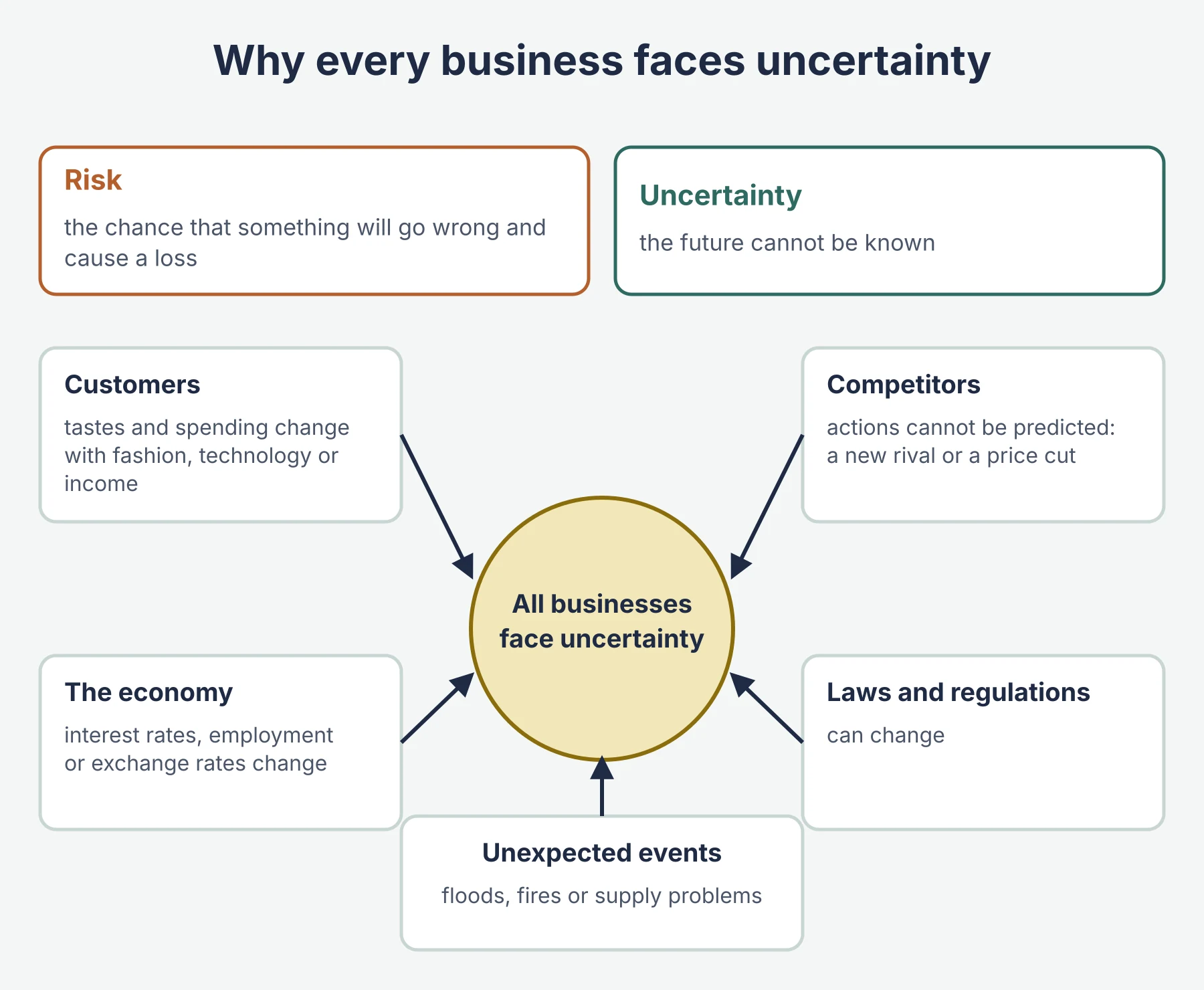
A risk is the chance that something will go wrong and cause a loss. Uncertainty means the future cannot be known. All businesses face uncertainty because:
- customers’ tastes and spending can change with fashion, technology or income;
- competitors’ actions cannot be predicted, such as a new rival or a price cut;
- the economy changes, for example interest rates, employment or exchange rates;
- laws and regulations change;
- unexpected events happen, such as floods, fires or supply problems.
Worked example 2: an annotated answer.
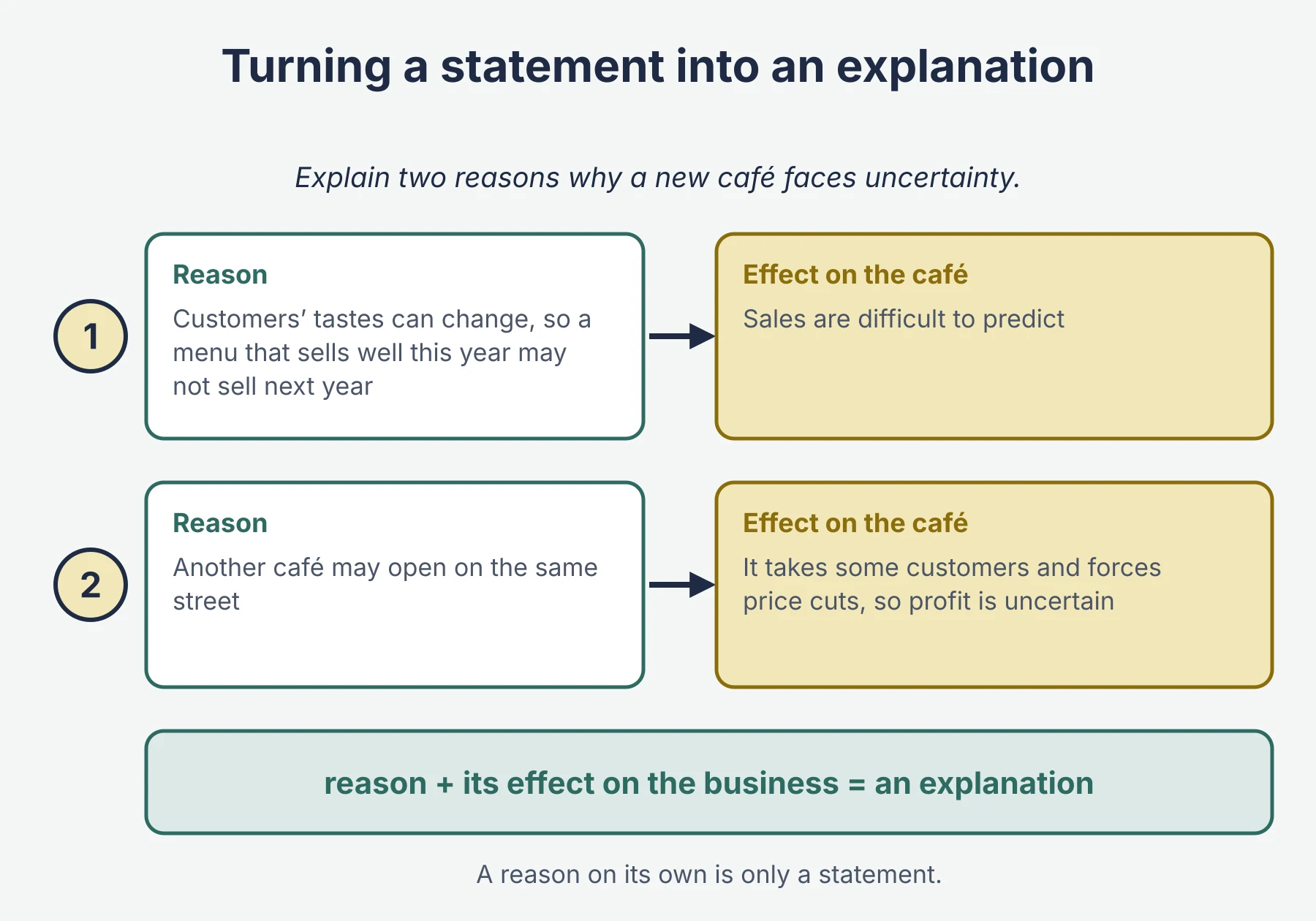
Question: Explain two reasons why a new café faces uncertainty.
Customers’ tastes can change, so a menu that sells well this year may not sell next year [reason], which makes the café’s sales difficult to predict [effect]. Another café may open on the same street [second reason], taking some of its customers and forcing it to cut prices, so its profit is uncertain [effect].
Each reason is followed by its effect on the business, which is what turns a statement into an explanation.
Why entrepreneurs take the risk
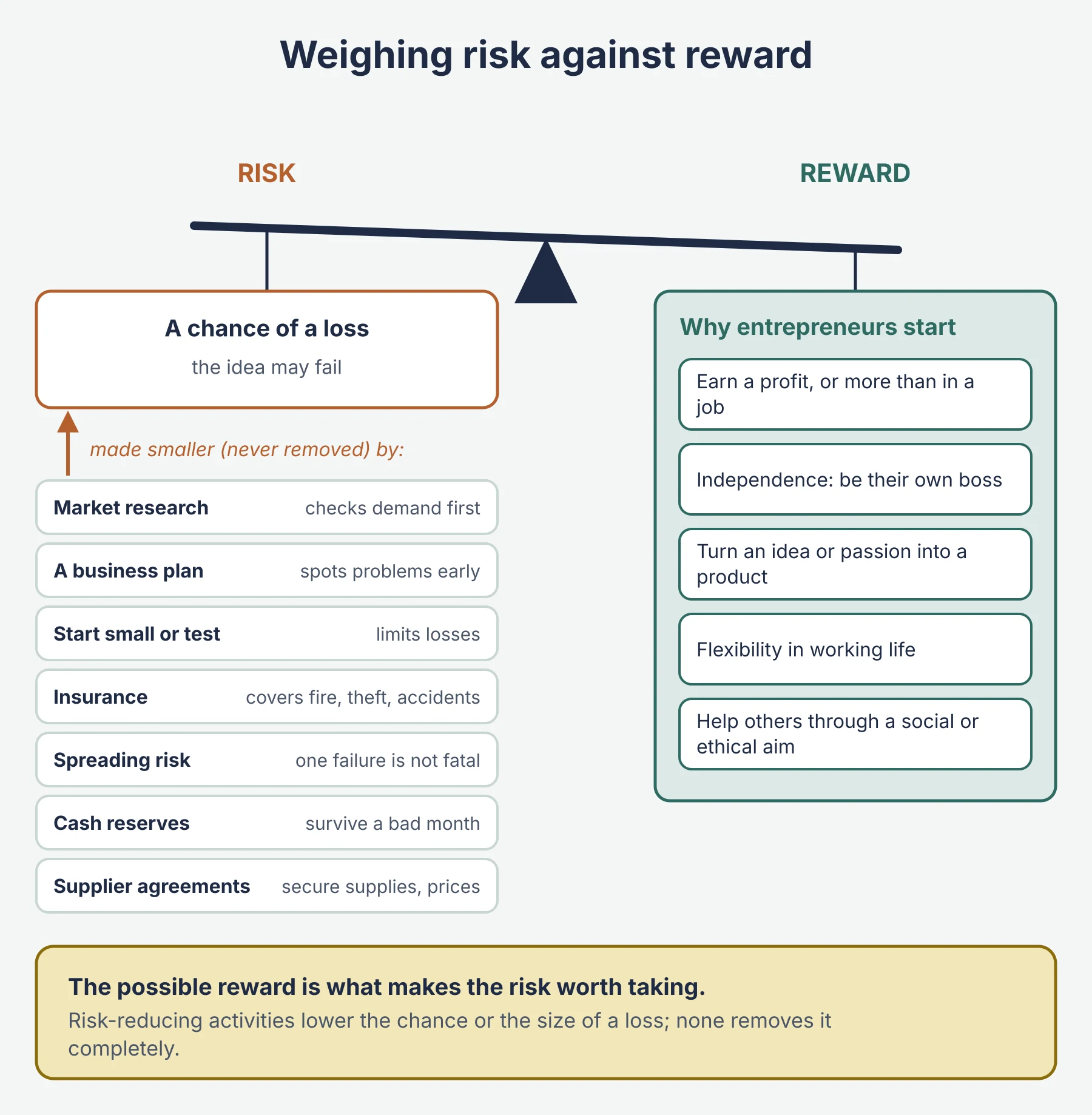
Entrepreneurs start businesses despite the risks because they hope to earn a profit or more income than in a job; want independence and to be their own boss; have an idea or passion they want to turn into a product; want flexibility in their working life; or want to help others through a social or ethical aim. The possible reward, financial or personal, is what makes the risk worth taking.
Activities that minimise risk
| Activity | How it reduces risk |
|---|---|
| Market research | Checks there is demand before money is committed |
| A business plan | Sets out finance, costs and forecasts so problems are spotted early |
| Starting small or testing first | Limits losses if the idea fails |
| Insurance | Covers losses from fire, theft or accidents |
| Spreading risk | Selling several products or in several markets, so one failure is not fatal |
| Keeping cash reserves | Allows the business to survive a bad month |
| Agreements with suppliers | Secures supplies and prices in advance |
None of these removes risk completely; they reduce the chance or the size of a loss.
How developing countries compete with developed countries
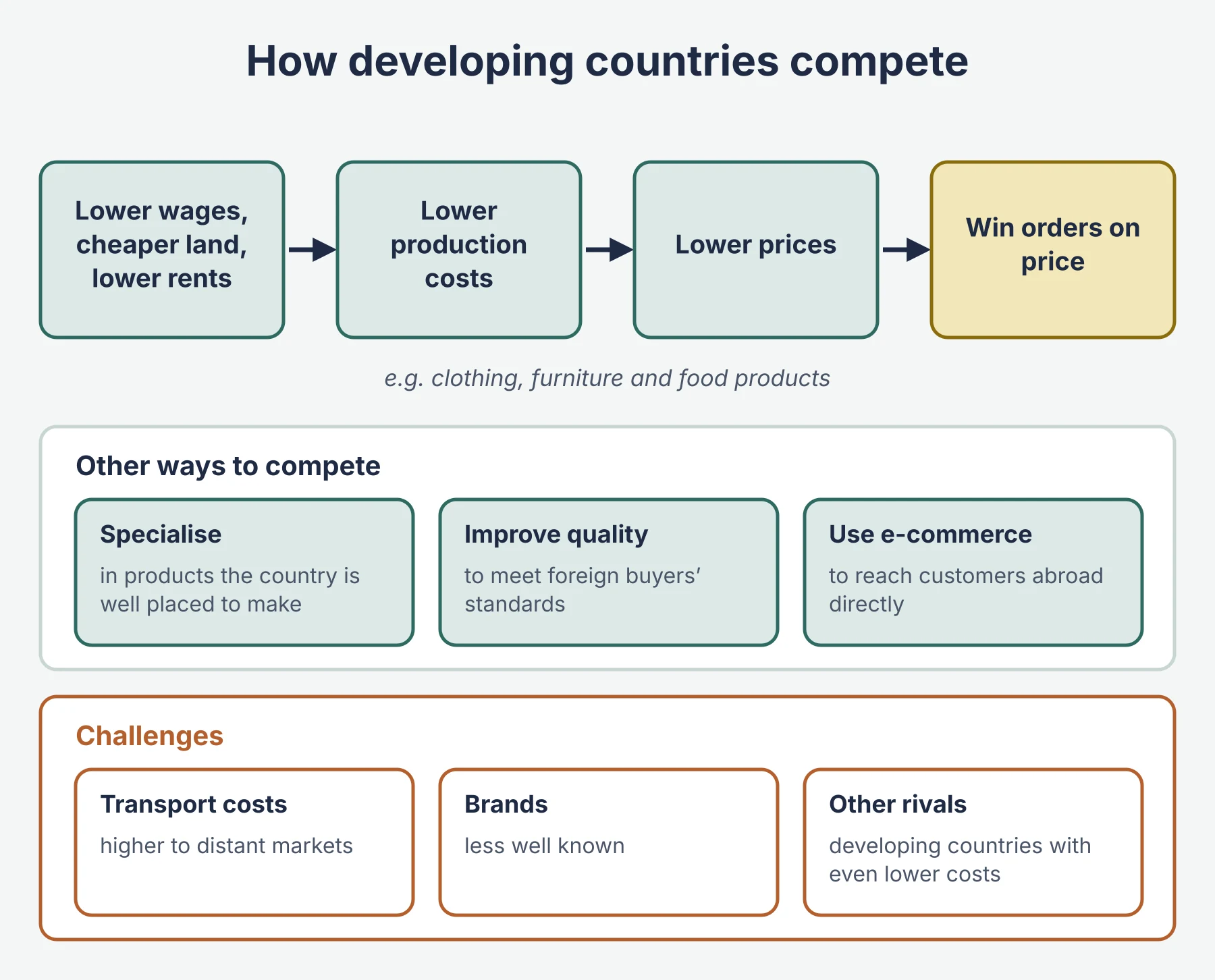
The specification gives lower cost advantage as the main example. Businesses in developing countries often have lower wages, cheaper land and lower rents, so they can produce goods such as clothing, furniture or food products more cheaply and win orders on price. Some also compete by specialising in products their country is well placed to make, by improving quality to meet foreign buyers’ standards, and by using e-commerce to reach customers abroad directly. Their challenges include higher transport costs to distant markets, less well-known brands and competition from businesses in other developing countries with even lower costs.
Common mistakes
- Defining a market as only a physical place.
- Assuming competition is always bad for a business.
- Saying a business with no competition has no risks.
- Confusing risk with uncertainty, or listing risks without explaining their effect.
- Writing that developing countries compete only through cheap labour, without explaining how lower costs win orders.
Exam technique for this section
Identify questions may ask you to spot a situation of minimal competition in a case: look for clues such as a remote location or a new invention. Explain questions need a reason plus its effect. Analyse answers on competition should follow the chain from a new rival to price, sales and profit. Evaluate answers should weigh responses, such as cutting price against improving quality, and judge what depends on the case: how loyal customers are and how much lower the rival’s price is.
More resources on this topic
Related resources
-
Practice questions
OxfordAQA International GCSE Business (9225): Competitive Environment – Practice Questions
Eleven original questions with answers on competition, minimal competition, risk, uncertainty and lower cost advantage for OxfordAQA IGCSE 9225 3.2.6.
Business · OxfordAQA · IGCSE
Try questions -
Revision notes
OxfordAQA International GCSE Business (9225): Competitive Environment – Revision Notes
Revision notes for OxfordAQA IGCSE Business 9225 section 3.2.6: competition, risk, uncertainty, entrepreneurs and cost advantage, with a self-test.
Business · OxfordAQA · IGCSE
Revise topic -
Study guides
OxfordAQA International GCSE Business (9225): Ethical and Environmental Considerations
Study guide to OxfordAQA IGCSE Business 9225 section 3.2.2: ethics and profit, fairness to stakeholders, environmental impacts and sustainability trade-offs.
Business · OxfordAQA · IGCSE
Read guide
Get free revision emails (optional)
Occasional emails with practice questions, worked explanations and links to free resources for the qualification and subjects you choose. No spam, and you can unsubscribe from any email. The free tools on this site never need an email.