
Revision Notes
OxfordAQA International GCSE Business (9225): Competitive Environment – Revision Notes
Revision notes for OxfordAQA IGCSE Business 9225 section 3.2.6: competition, risk, uncertainty, entrepreneurs and cost advantage, with a self-test.
- Subject
- Business
- Level
- IGCSE
- Topic
- Influences on business
- Author
- Marlbridge Academic Team
- Updated
- Reviewed by
- Salman Ahmad (what this means)
Aligned to OxfordAQA IGCSE Business (9225), First teaching September 2020, first examined May/June 2022. Official specification .
Syllabus page (what it covers and how it is assessed): OxfordAQA IGCSE Business.
Syllabus points this page covers
9225
- 3.2.6 Competitive environment
Found an error? Report a correction.
Need help with this topic? Request a free trial class for IGCSE Business (9225).
Condensed recall for section 3.2.6. For full explanations and worked examples, use the Competitive Environment study guide. Figures are invented.
What the specification asks
- What is meant by a market and competition.
- Analyse the impacts of competition; identify situations of minimal or no competition.
- The risks businesses face and why all businesses face uncertainty.
- Why entrepreneurs run businesses, and activities to minimise risks.
- How developing countries compete with developed countries, such as through lower cost advantage.
Markets and competitors
- Market: where buyers and sellers meet to exchange goods or services, physically or online.
- Competition: rivalry between businesses for the same customers.
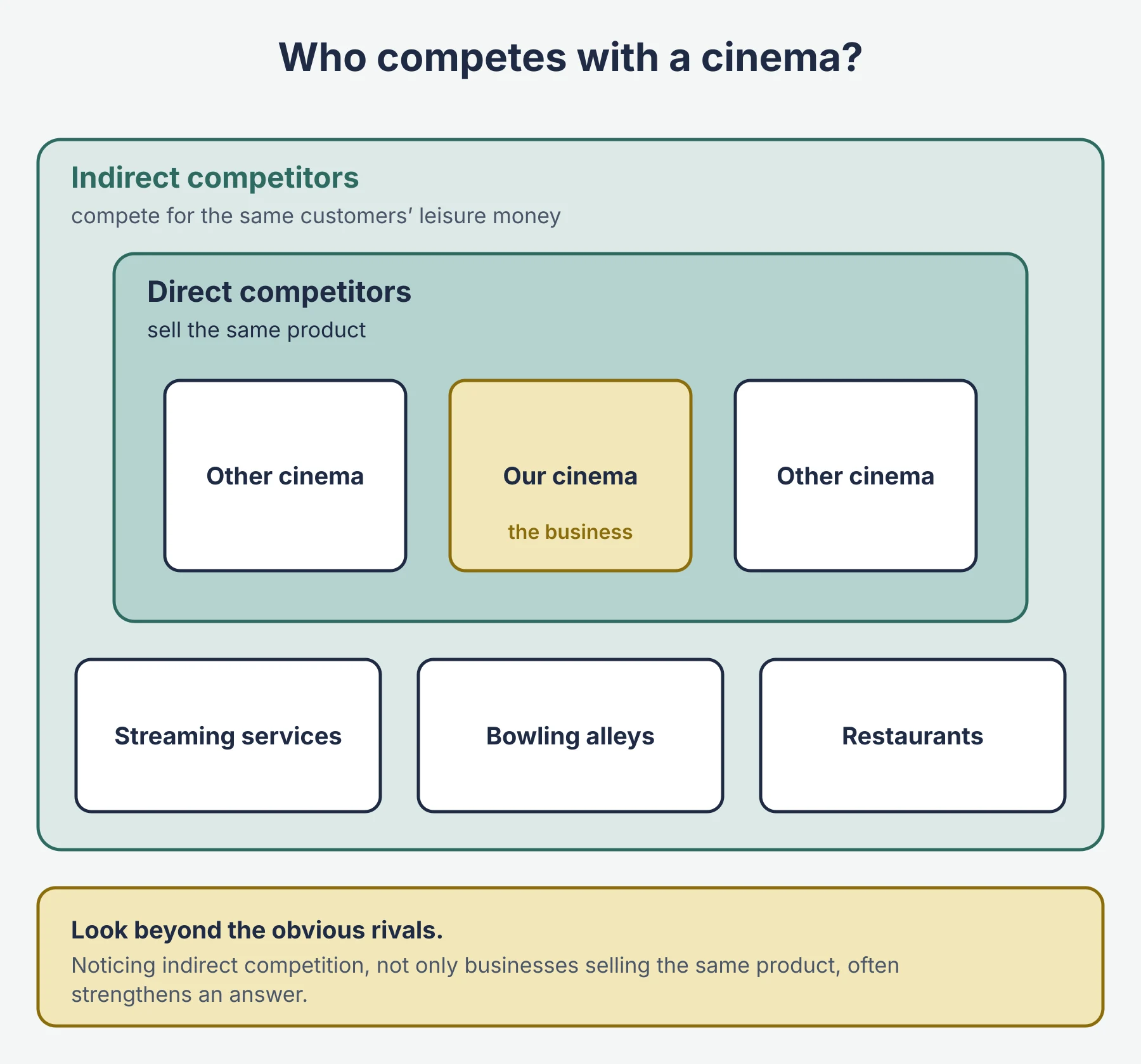
- Direct competitors: sell the same type of product. Indirect competitors: sell something different that meets the same need or takes the same spending.
Impacts of competition
| More competition means… | So the business… |
|---|---|
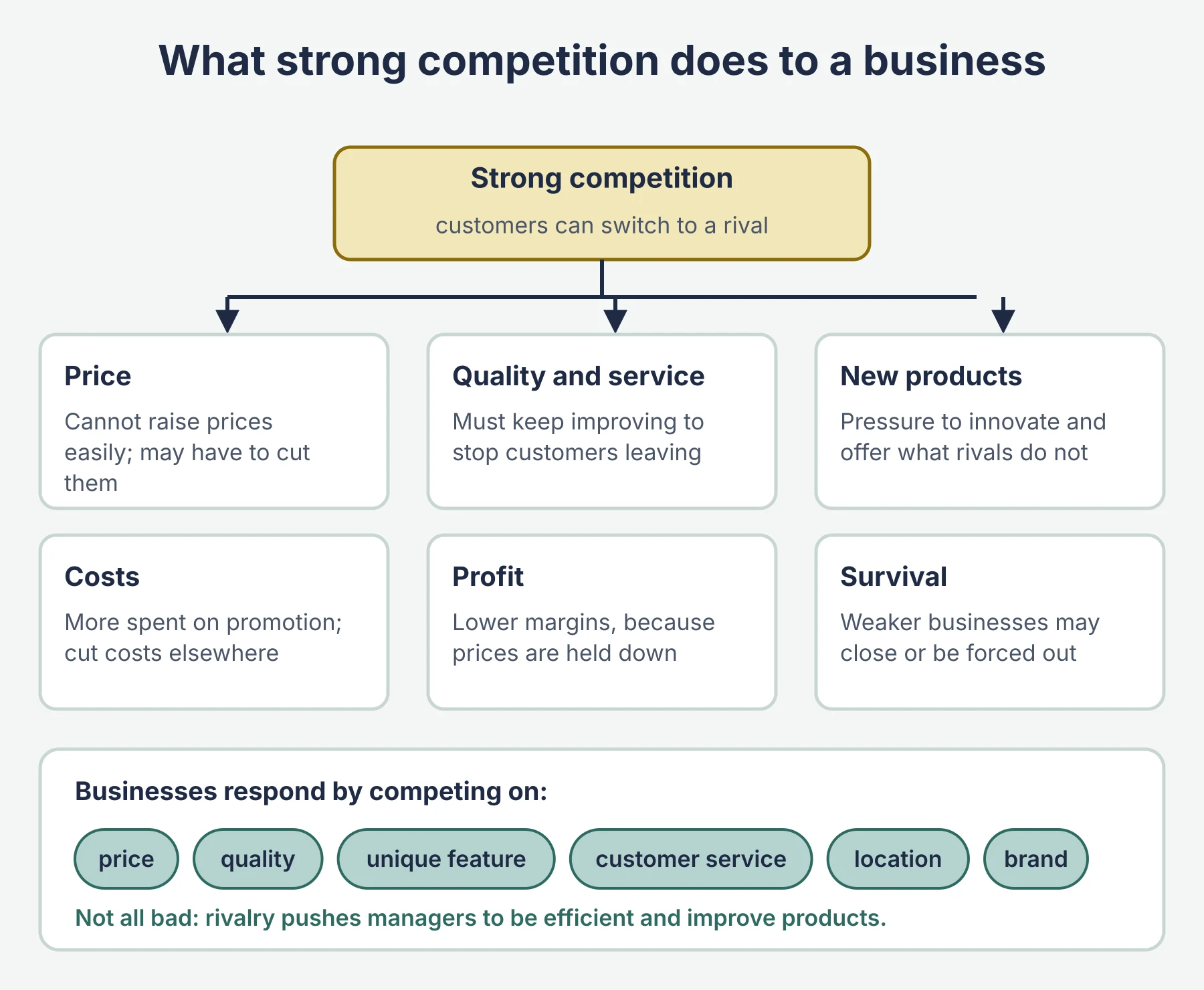
| Customers can switch easily | Keeps prices down, may cut them |
| Rivals improve their offer | Improves quality, service and range |
| Rivals advertise | Spends more on promotion |
| Margins are squeezed | Earns lower profit per unit |
| Weak firms struggle | Must become more efficient or risk closure |
Ways to compete: price, quality, unique feature, customer service, location, brand.
Good for the business too: pressure to become efficient, understand customers and innovate.
Minimal or no competition: spot the situation
| Clue in the case | Why competition is weak |
|---|---|
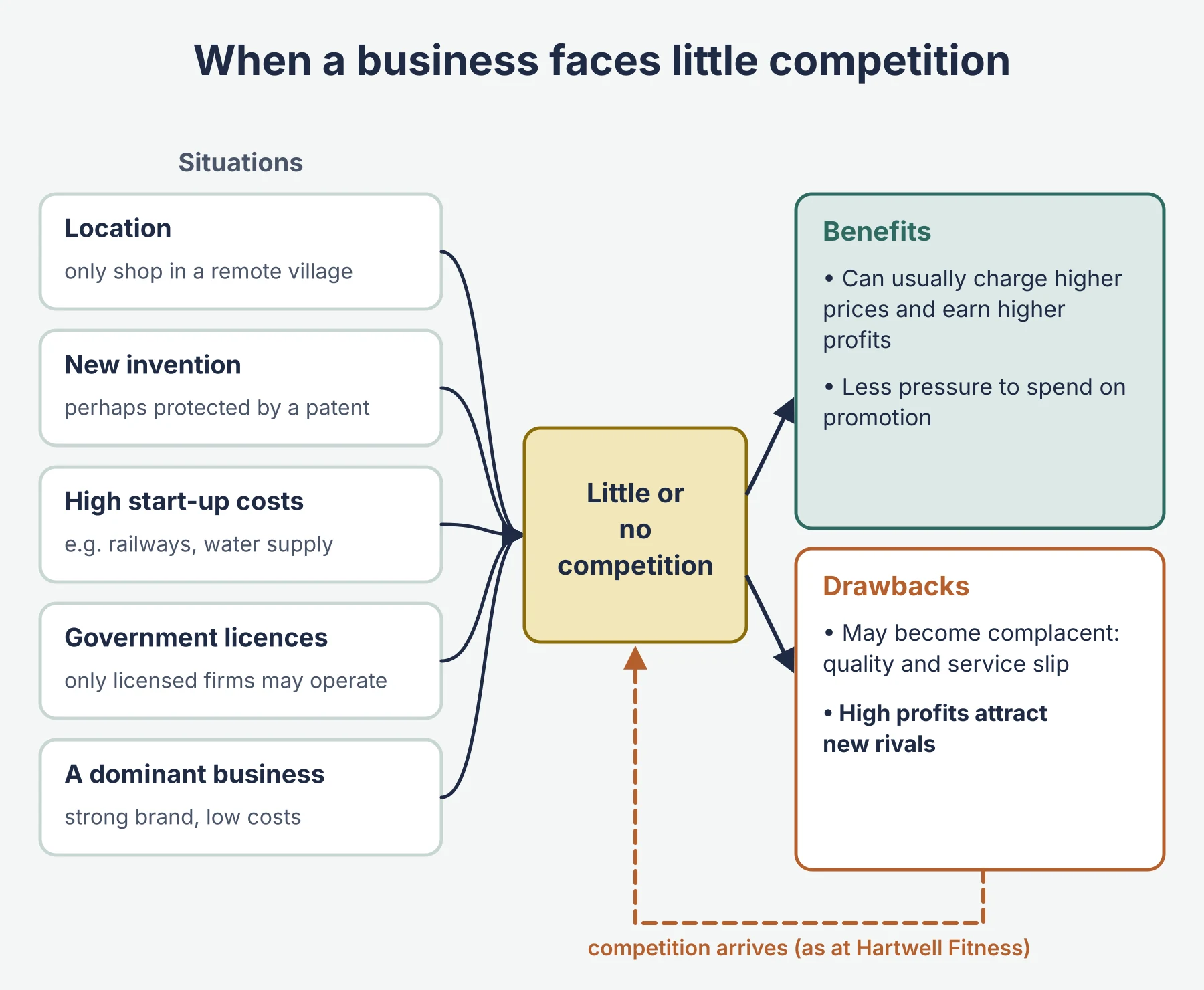
| Only business in a remote place | Customers cannot easily travel elsewhere |
| New invention or patent | No one else can yet make it |
| Huge start-up costs | Few businesses can afford to enter |
| Government licence needed | Only licensed firms may operate |
| One dominant firm | Others cannot match its brand or costs |
Effects: higher prices and profits, less promotion; but risk of complacency and of attracting new entrants.
Risk and uncertainty
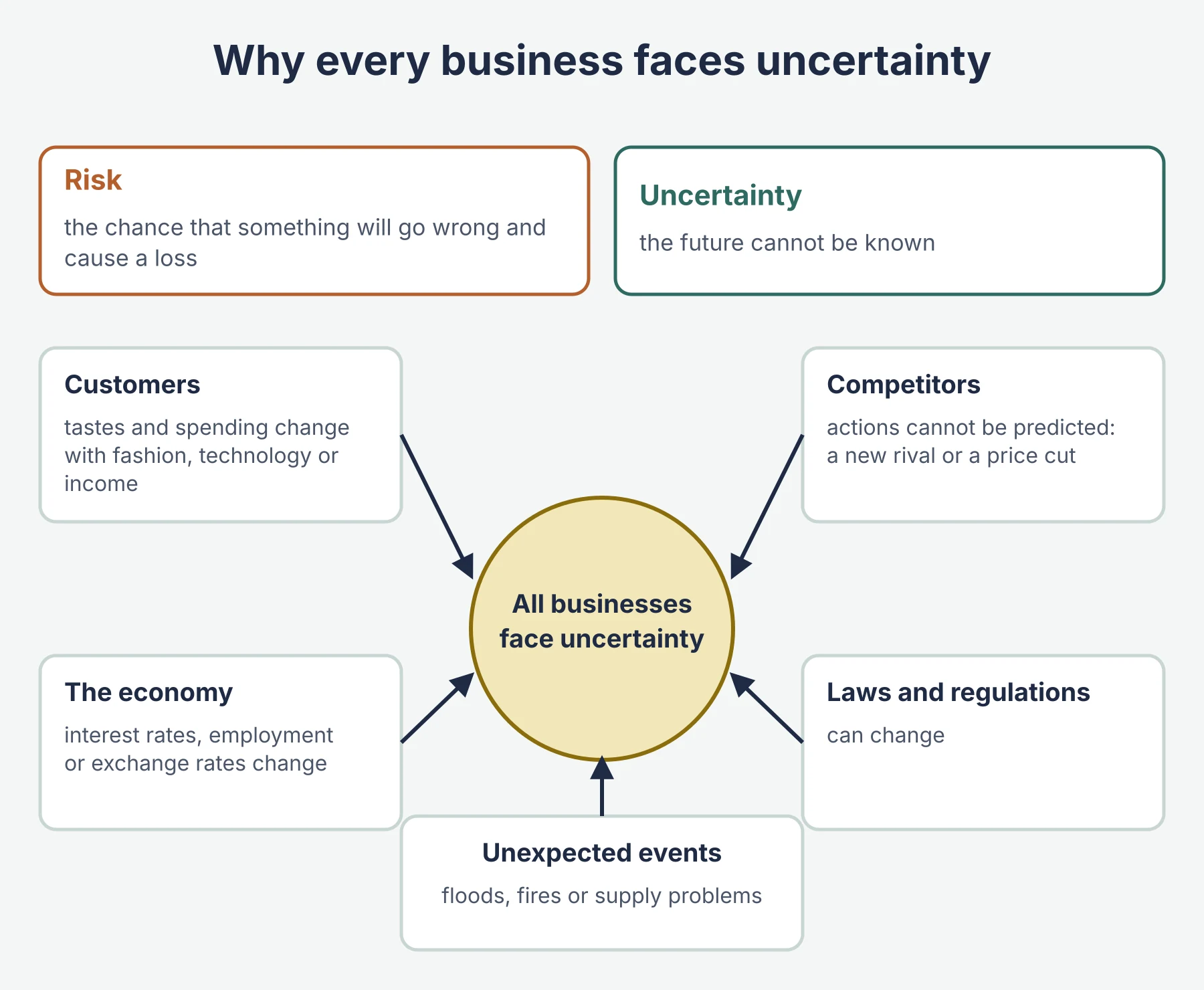
- Risk: the chance of a loss.
- Uncertainty: the future cannot be known.
- Why all businesses face uncertainty: changing tastes; rivals’ actions; economic changes; new laws; unexpected events such as floods or supply problems.
Entrepreneurs and risk
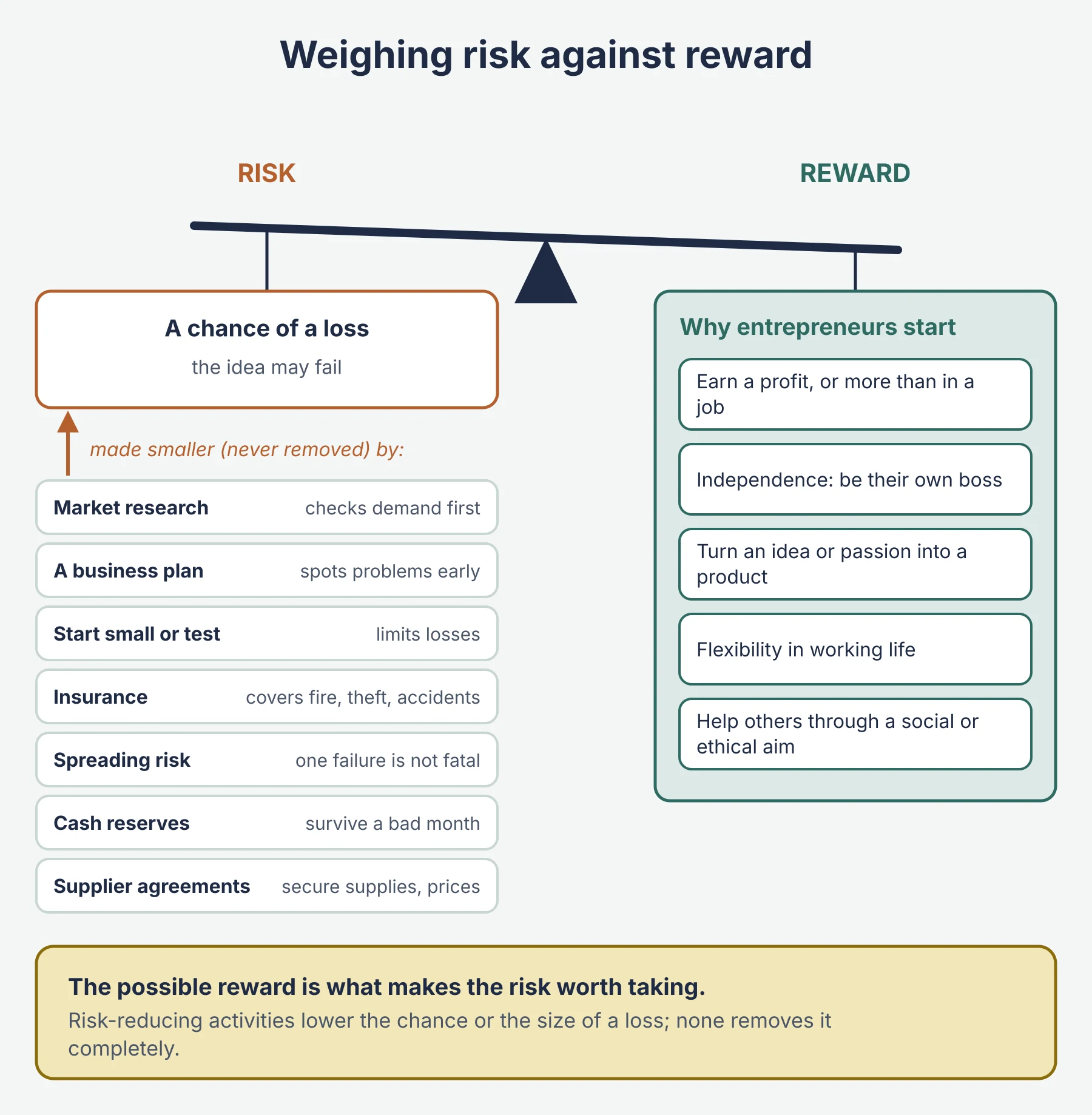
Why they take the risk: profit or higher income; independence; turning an idea or passion into a product; flexibility; helping others.
Activities to minimise risk:
- Market research before launch.
- A business plan with forecasts.
- Start small or test the idea first.
- Insurance against fire, theft and accidents.
- Spread risk across products or markets.
- Keep cash reserves.
- Agree supply and prices in advance with suppliers.
Developing countries competing with developed countries
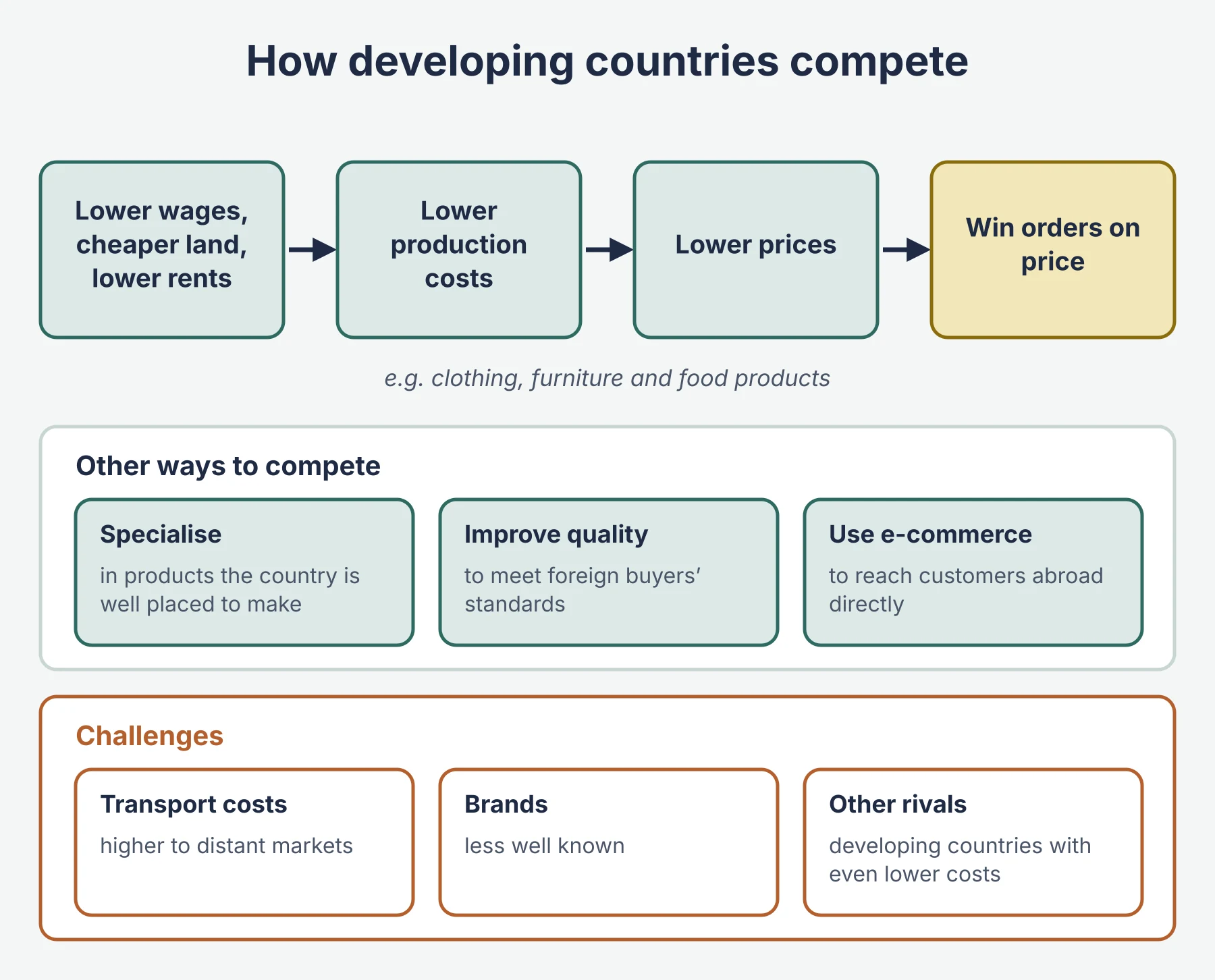
- Lower cost advantage: lower wages, cheaper land and rent → lower prices → export orders.
- Also: specialising in products the country is well placed to make; improving quality to meet buyers’ standards; selling online.
- Challenges: transport costs, less-known brands, rivals with even lower costs.
Key terms
| Term | Meaning |
|---|---|
| Market | Where buyers and sellers come together to trade |
| Competition | Rivalry between businesses for the same customers |
| Direct competitor | A business selling the same type of product |
| Indirect competitor | A business selling a different product that meets the same need |
| Risk | The chance of a loss |
| Uncertainty | Not knowing what will happen in the future |
| Entrepreneur | A person who sets up and runs a business, taking the risk |
| Patent | Legal protection that stops others copying an invention for a time |
| Cost advantage | Being able to produce at a lower cost than rivals |
| Insurance | Paying a regular amount so that certain losses are covered |
Exam traps
- Competition is not only bad: it can make a business more efficient.
- A business with no competition still faces risk, from new entrants and changes in demand.
- Every business faces uncertainty, however well run.
- Risk-reducing activities cut the chance or size of a loss; they never remove it.
- Lower cost advantage must be linked to lower prices and winning orders.
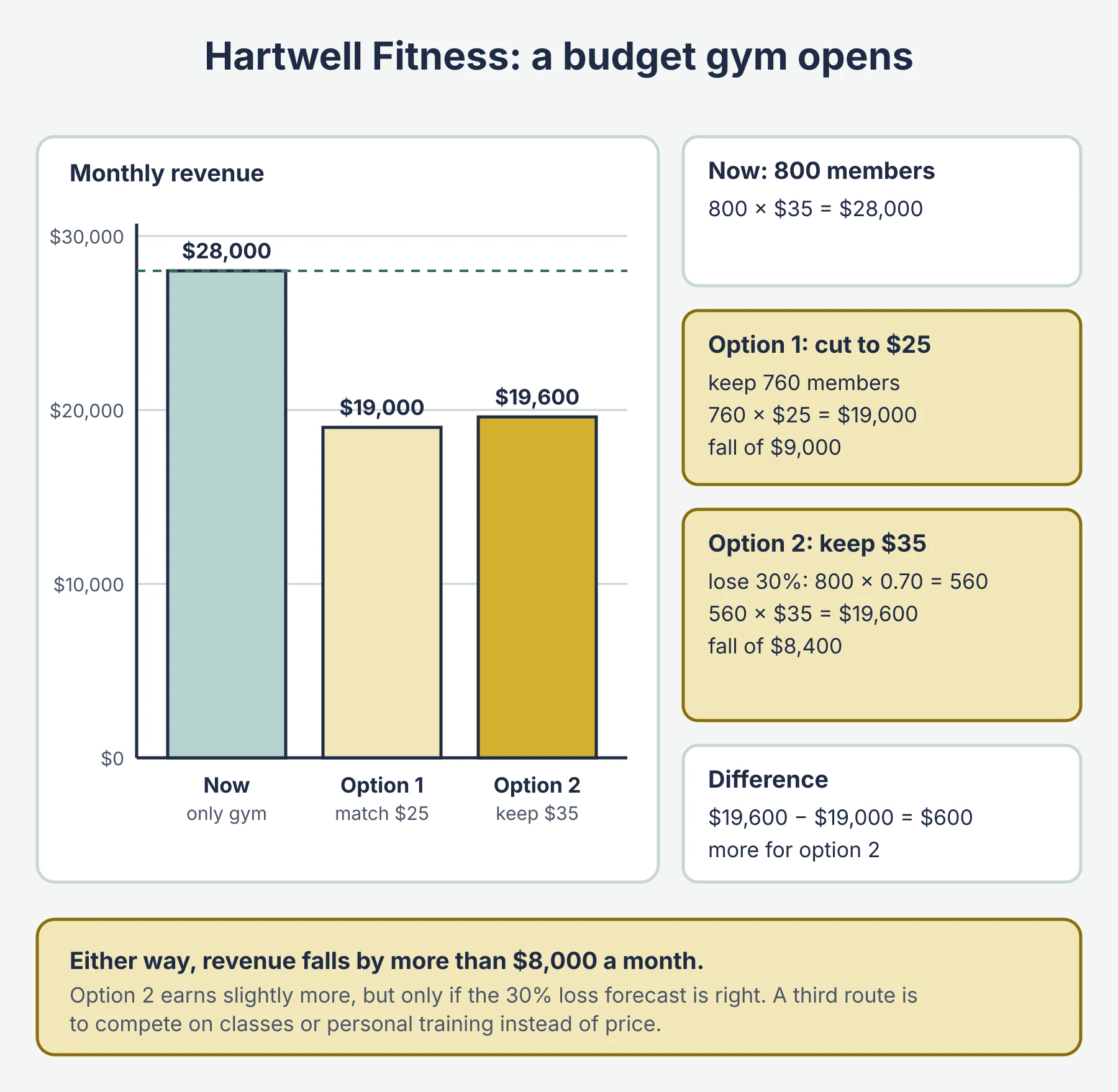
- In a calculation, compare revenue (or profit) under each option, not just customer numbers.
Self-test
- Define the term “market”.
- Give one example of an indirect competitor for a cinema.
- State two effects of strong competition on a business.
- Give one benefit to a business of facing competition.
- Identify two situations in which a business may face little or no competition.
- Why might a business with no competition be at risk in the long term?
- Give three reasons why all businesses face uncertainty.
- State two reasons why entrepreneurs start businesses despite the risks.
- Give three activities a business can use to minimise risk.
- How can a business in a developing country compete with one in a developed country?
- A café has 400 customers a week spending $6 each. A rival opens and customers fall by 15%. Calculate the fall in weekly revenue.
- Distinguish risk from uncertainty.
Answers
- Where buyers and sellers come together to exchange goods or services, physically or online.
- A streaming service (or a bowling alley, restaurant or other leisure activity).
- Any two: pressure to cut prices; need to improve quality and service; more spending on promotion; lower profit margins.
- It pushes the business to become more efficient and to improve its products.
- Any two: being the only business in a remote place; owning a new invention or patent; very high start-up costs for rivals; needing a government licence; being a dominant firm.
- High profits attract new rivals, and it may have become complacent about quality and service.
- Any three: changing tastes; competitors’ actions; economic changes; new laws; unexpected events.
- Any two: profit, independence, an idea or passion, flexibility, helping others.
- Any three: market research, business plan, starting small, insurance, spreading risk, cash reserves, supplier agreements.
- Through lower cost advantage: lower wages and land costs let it charge lower prices and win orders.
- 400 × 15% = 60 fewer customers; 60 × $6 = $360 fall in weekly revenue.
- Risk is the chance of a loss; uncertainty means the future, including what risks will arise, cannot be known.
Related resources
-
Study guides
OxfordAQA International GCSE Business (9225): Ethical and Environmental Considerations
Study guide to OxfordAQA IGCSE Business 9225 section 3.2.2: ethics and profit, fairness to stakeholders, environmental impacts and sustainability trade-offs.
Business · OxfordAQA · IGCSE
Read guide -
Practice questions
OxfordAQA International GCSE Business (9225): Ethical and Environmental Considerations – Practice Questions
Eleven original questions with mark-scheme answers on ethics and profit, religious observance, waste and sustainability for OxfordAQA IGCSE 9225 3.2.2.
Business · OxfordAQA · IGCSE
Try questions -
Revision notes
OxfordAQA International GCSE Business (9225): Ethical and Environmental Considerations – Revision Notes
Revision notes for OxfordAQA IGCSE Business 9225 section 3.2.2: ethics, religious observance, environmental impacts, sustainability, key terms and a self-test.
Business · OxfordAQA · IGCSE
Revise topic
Get free revision emails (optional)
Occasional emails with practice questions, worked explanations and links to free resources for the qualification and subjects you choose. No spam, and you can unsubscribe from any email. The free tools on this site never need an email.