
Revision Notes
OxfordAQA International GCSE Business (9225): Ethical and Environmental Considerations – Revision Notes
Revision notes for OxfordAQA IGCSE Business 9225 section 3.2.2: ethics, religious observance, environmental impacts, sustainability, key terms and a self-test.
- Subject
- Business
- Level
- IGCSE
- Topic
- Influences on business
- Author
- Marlbridge Academic Team
- Updated
- Reviewed by
- Salman Ahmad (what this means)
Aligned to OxfordAQA IGCSE Business (9225), First teaching September 2020, first examined May/June 2022. Official specification .
Syllabus page (what it covers and how it is assessed): OxfordAQA IGCSE Business.
Syllabus points this page covers
9225
- 3.2.2 Ethical and environmental considerations
Found an error? Report a correction.
Need help with this topic? Request a free trial class for IGCSE Business (9225).
Condensed recall for section 3.2.2. For full explanations and worked examples, use the Ethical and Environmental Considerations study guide. Figures are invented.
What the specification asks
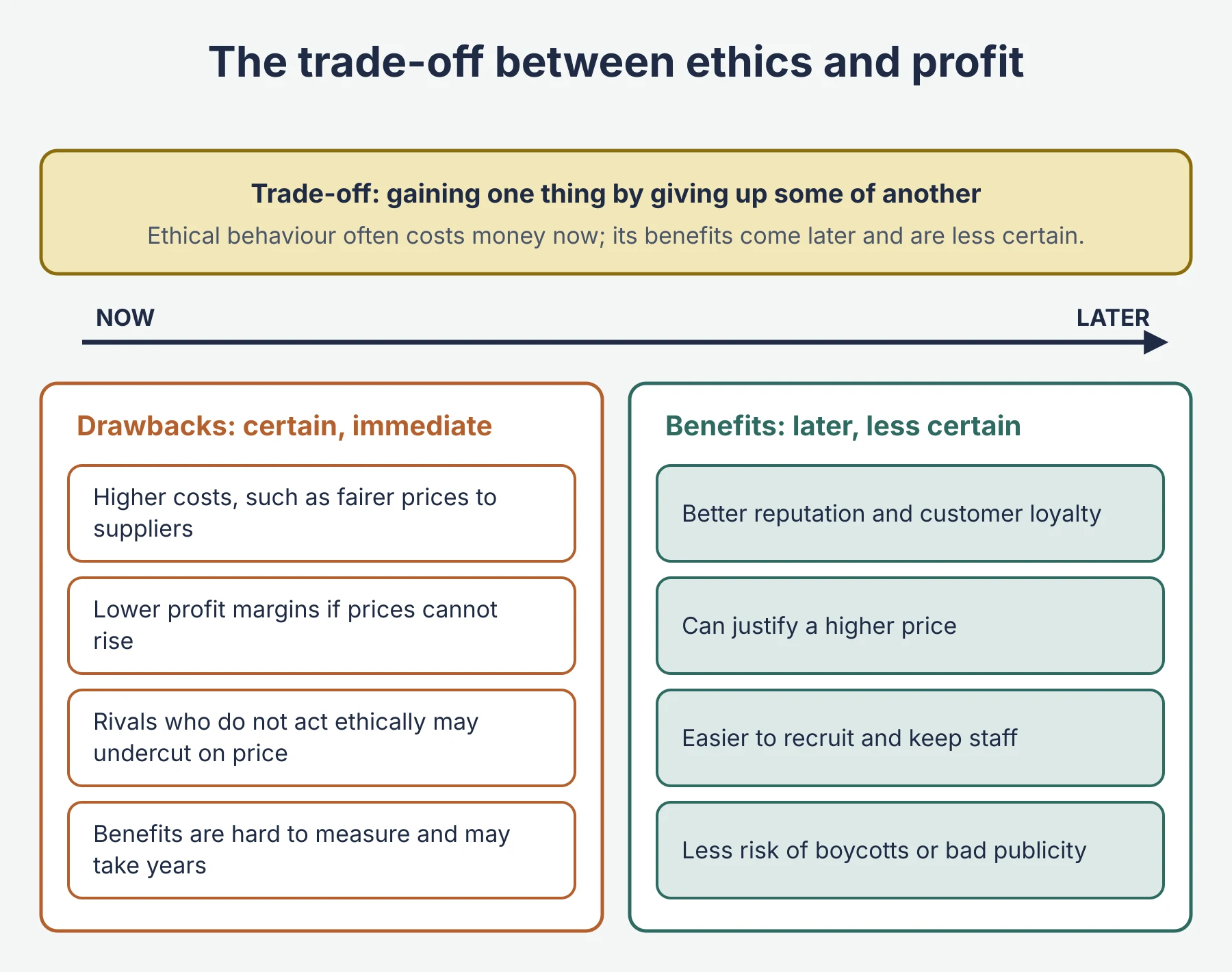
- Identify and analyse possible trade-offs between ethics and profit.
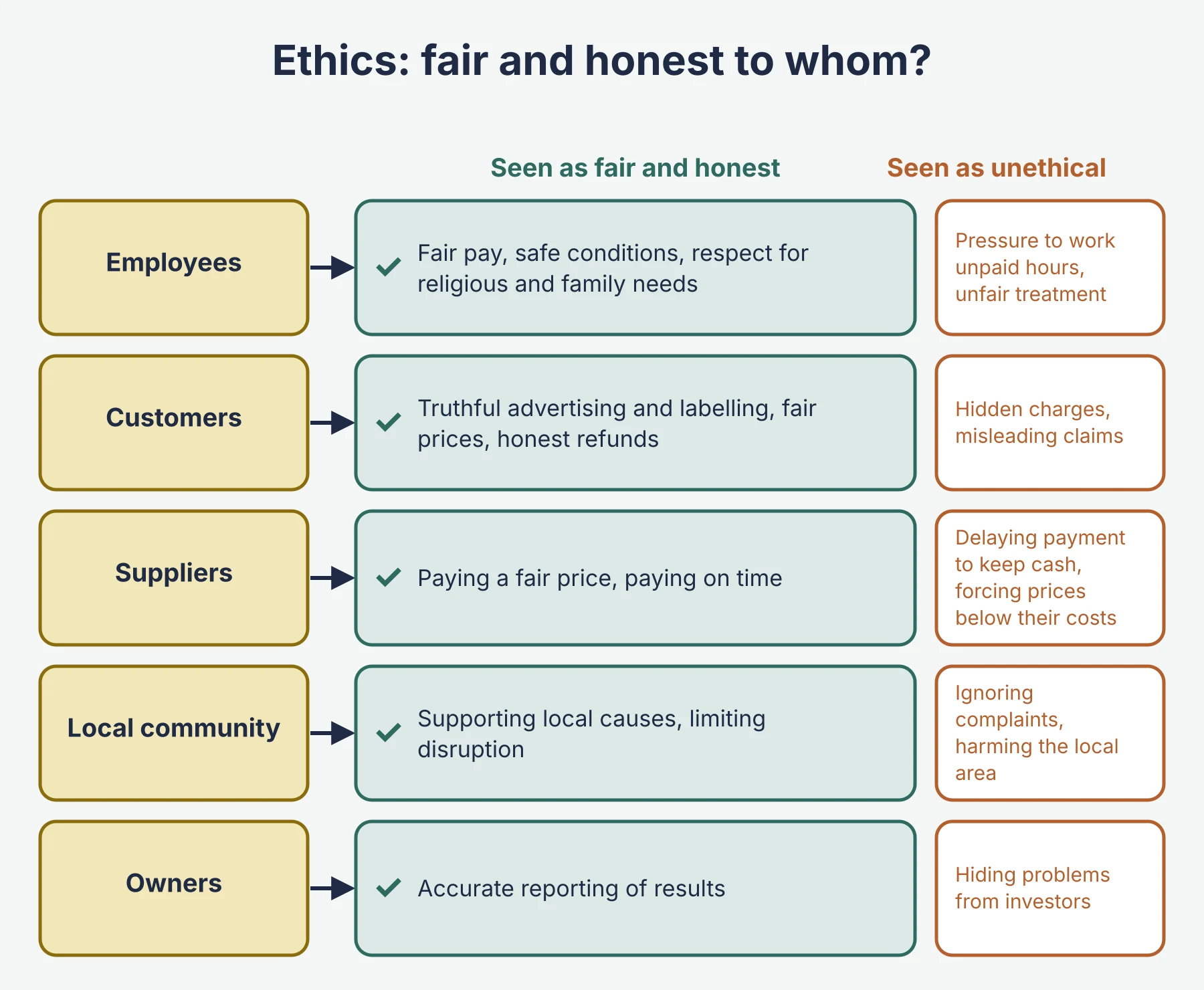
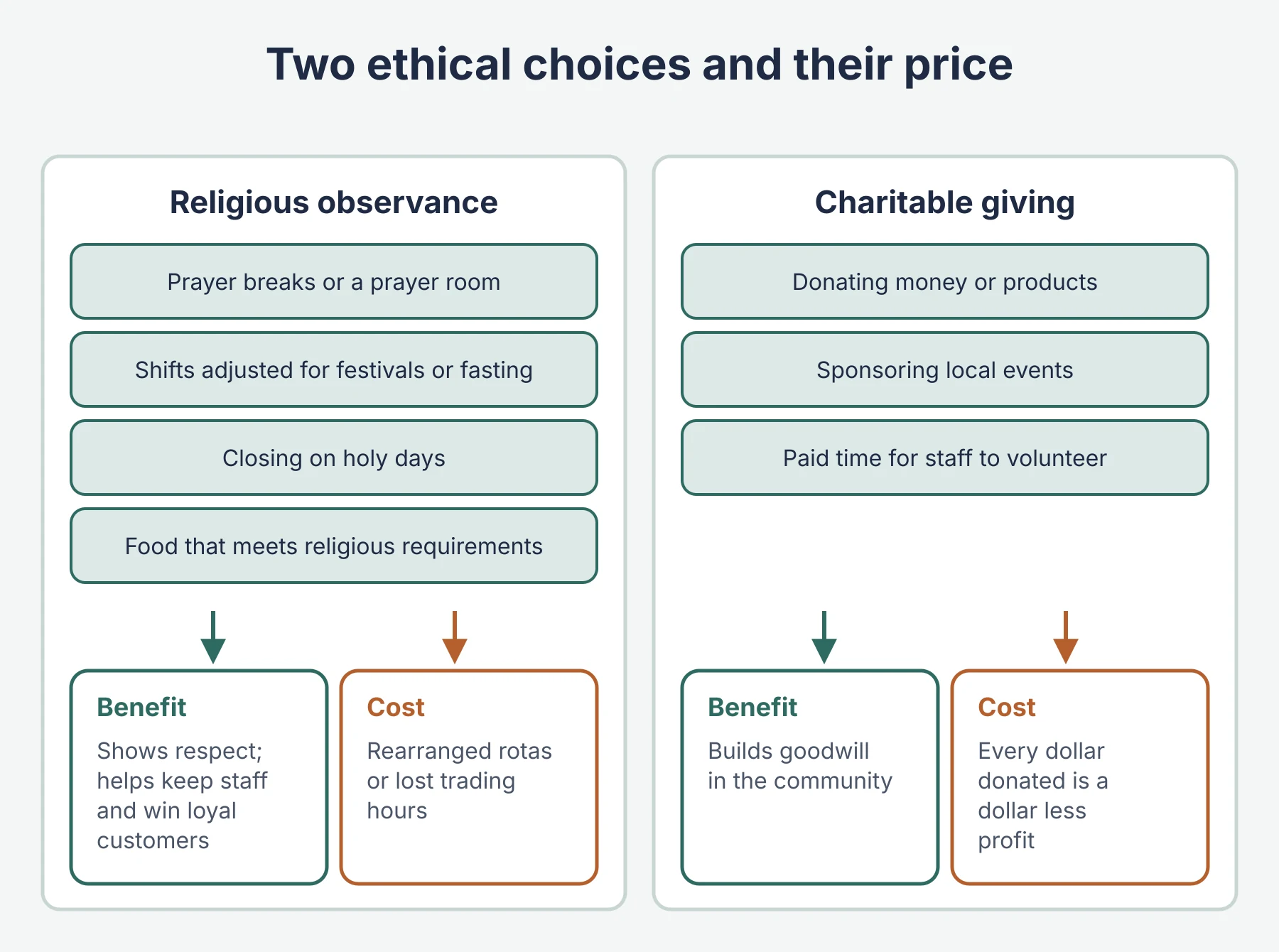
- Ethical behaviour = acting in ways stakeholders consider fair and honest, including religious observance and charitable giving.
- Know examples of ethical behaviour and its benefits and drawbacks.
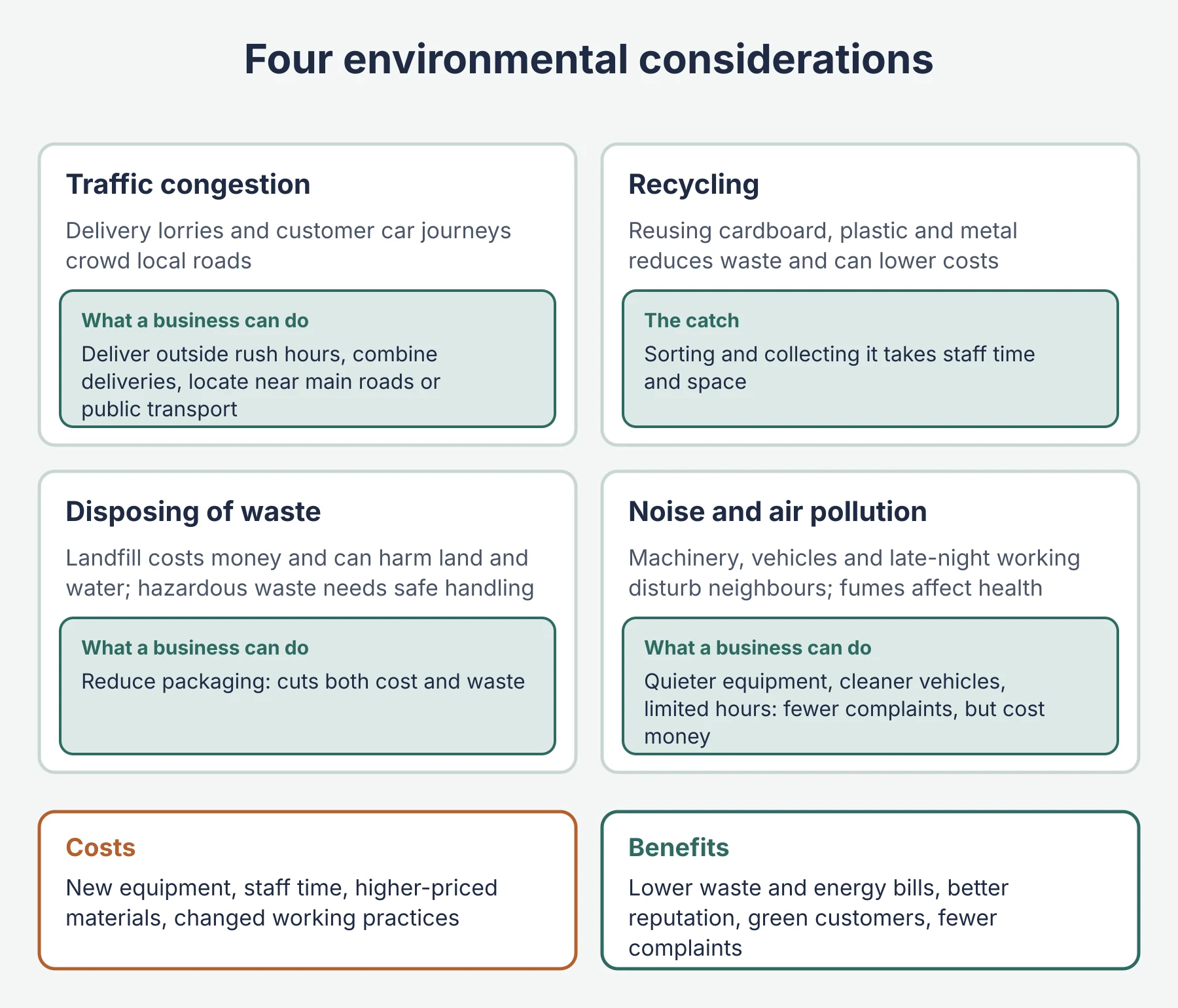
- Society expects more environmental responsibility: traffic congestion, recycling, disposing of waste, noise and air pollution; know the costs and benefits.
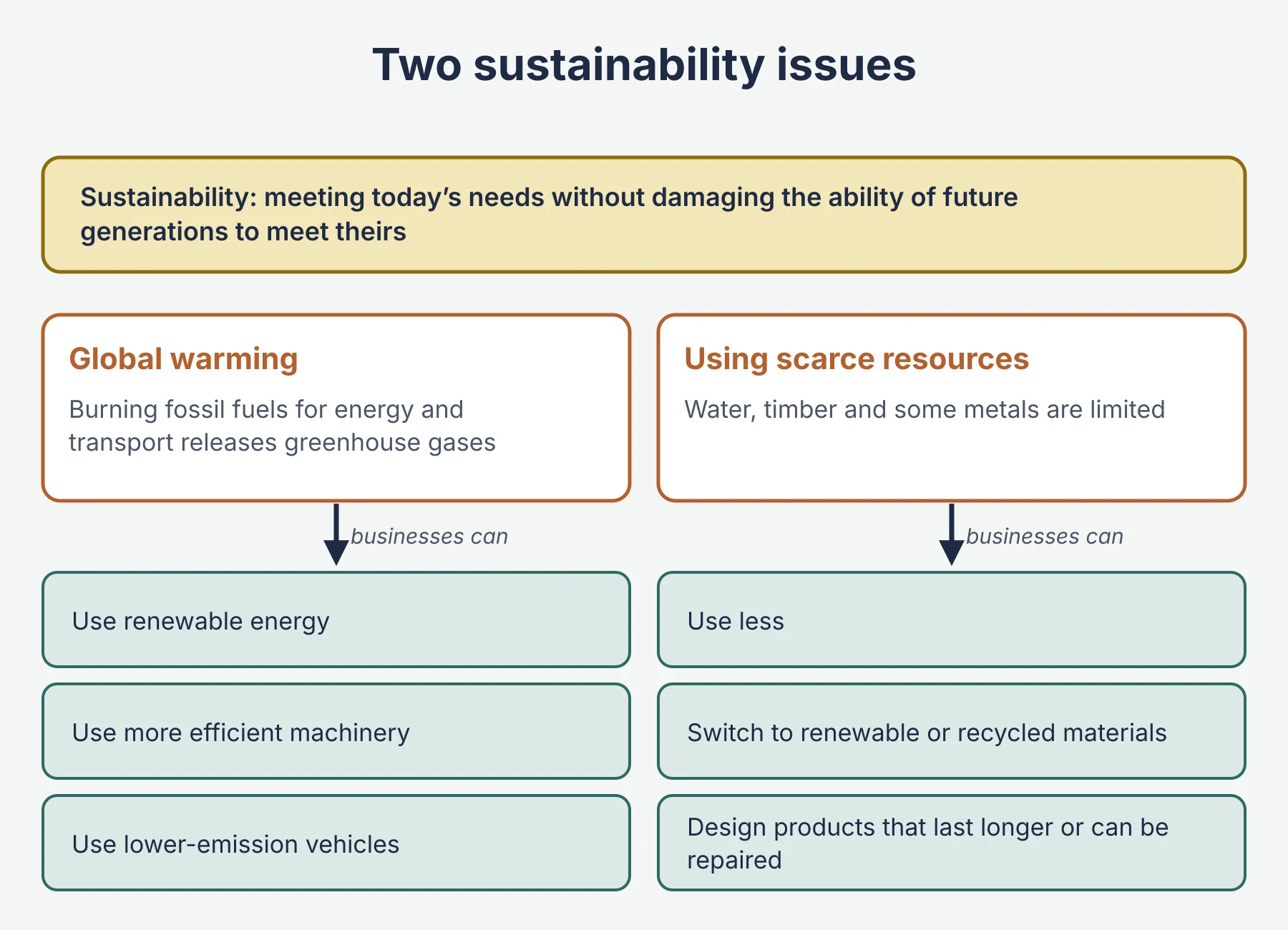
- Sustainability: global warming and using scarce resources; analyse the trade-off between sustainability and profit.
Ethical behaviour by stakeholder
| Stakeholder | Ethical example |
|---|---|
| Employees | Fair pay; safe conditions; prayer breaks; flexible shifts for religious festivals |
| Customers | Honest labelling and advertising; fair refunds; food meeting religious requirements |
| Suppliers | Fair prices; paying on time |
| Community | Charitable giving; sponsoring local events; staff volunteering |
Benefits and drawbacks of ethics
| Benefits | Drawbacks |
|---|---|
| Reputation and loyalty | Higher costs |
| May support a higher price | Lower margins if price cannot rise |
| Attracts and keeps staff | Rivals may undercut |
| Avoids boycotts and bad publicity | Benefits uncertain and slow to appear |
Method for an ethics versus profit question: (1) state the ethical action; (2) calculate or describe its cost; (3) state the possible benefit; (4) judge, saying what the decision depends on (customers’ willingness to pay, size of cost against profit, rivals’ behaviour).
Environmental considerations
| Issue | Example of the problem | Possible business response | Cost of the response |
|---|---|---|---|
| Traffic congestion | Lorries arriving at rush hour | Deliver off-peak; fewer, fuller deliveries | Night-time wages; less flexibility |
| Recycling | Packaging thrown away | Separate and recycle materials | Staff time, bins, space |
| Disposing of waste | Landfill charges, contamination | Reduce packaging; safe handling of hazardous waste | Redesign; specialist contractors |
| Noise pollution | Night-time machinery near homes | Quieter machines; limited hours | Equipment cost; lost output |
| Air pollution | Fumes from vehicles or chimneys | Cleaner vehicles; filters | High purchase cost |
Benefits of environmental responsibility: lower waste and energy bills, better reputation, appeal to green customers, fewer complaints.
Sustainability
- Sustainability: meeting present needs without harming future generations’ ability to meet theirs.
- Global warming: cut fossil-fuel energy and transport; use renewables and efficient equipment.
- Scarce resources: use less water, timber and metals; use recycled or renewable materials; design for repair and long life.
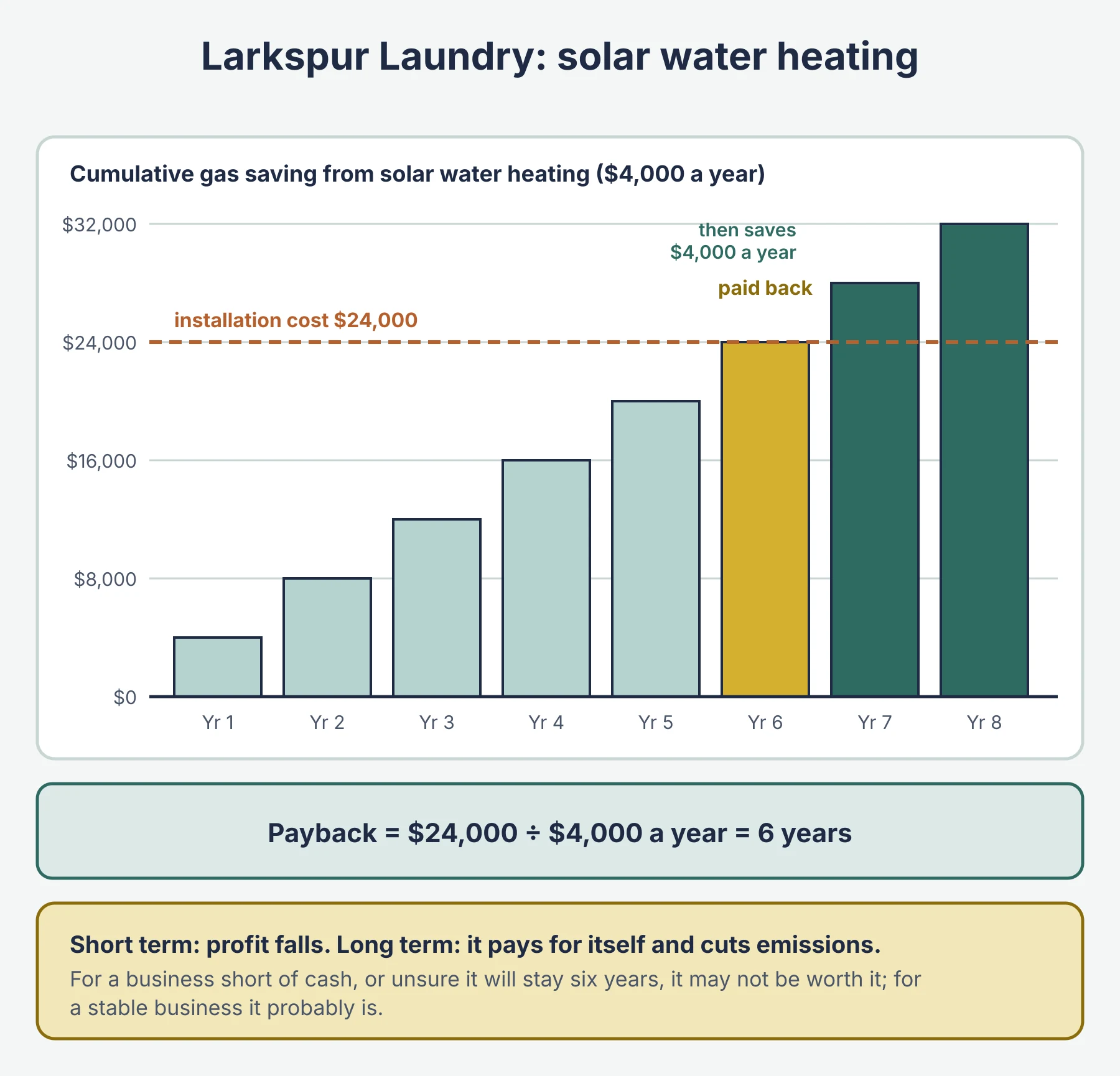
- Trade-off: cost now, saving or benefit later. Use payback period (cost ÷ annual saving) to compare.
Short term versus long term
Most decisions in this section cost money now and bring benefits later: recycling equipment, fairer supplier prices, cleaner vehicles, renewable energy. In an evaluation, say how soon the benefit arrives and whether the business can afford to wait. A business struggling to survive may delay; a stable, profitable one can usually justify the investment.
Key terms
| Term | Meaning |
|---|---|
| Ethics | Moral principles about what is right and wrong |
| Ethical behaviour | Acting in ways stakeholders consider fair and honest |
| Trade-off | Gaining more of one thing by giving up some of another |
| Religious observance | Following the practices of a faith, such as prayer or fasting |
| Charitable giving | Donating money, goods or time to good causes |
| Recycling | Processing used materials so they can be used again |
| Sustainability | Meeting today’s needs without damaging the future |
| Global warming | Rising world temperatures linked to greenhouse gas emissions |
| Scarce resource | A natural resource in limited supply |
| Payback period | Time taken for an investment to repay its cost |
Exam traps
- Ethics goes beyond the law; obeying the law is not, by itself, ethical behaviour in the specification’s sense.
- Always state the trade-off with profit; “it is the right thing to do” earns little.
- Separate the short-term cost from the long-term benefit.
- Name the stakeholder who sees the action as fair.
- Do not assume customers always pay more for ethical products.
- Environmental actions can save money (lower waste bills), so they are not always a cost.
Self-test
- What does the specification say ethical behaviour requires?
- Give two examples of religious observance a business might support.
- Give one benefit and one drawback of charitable giving for a business.
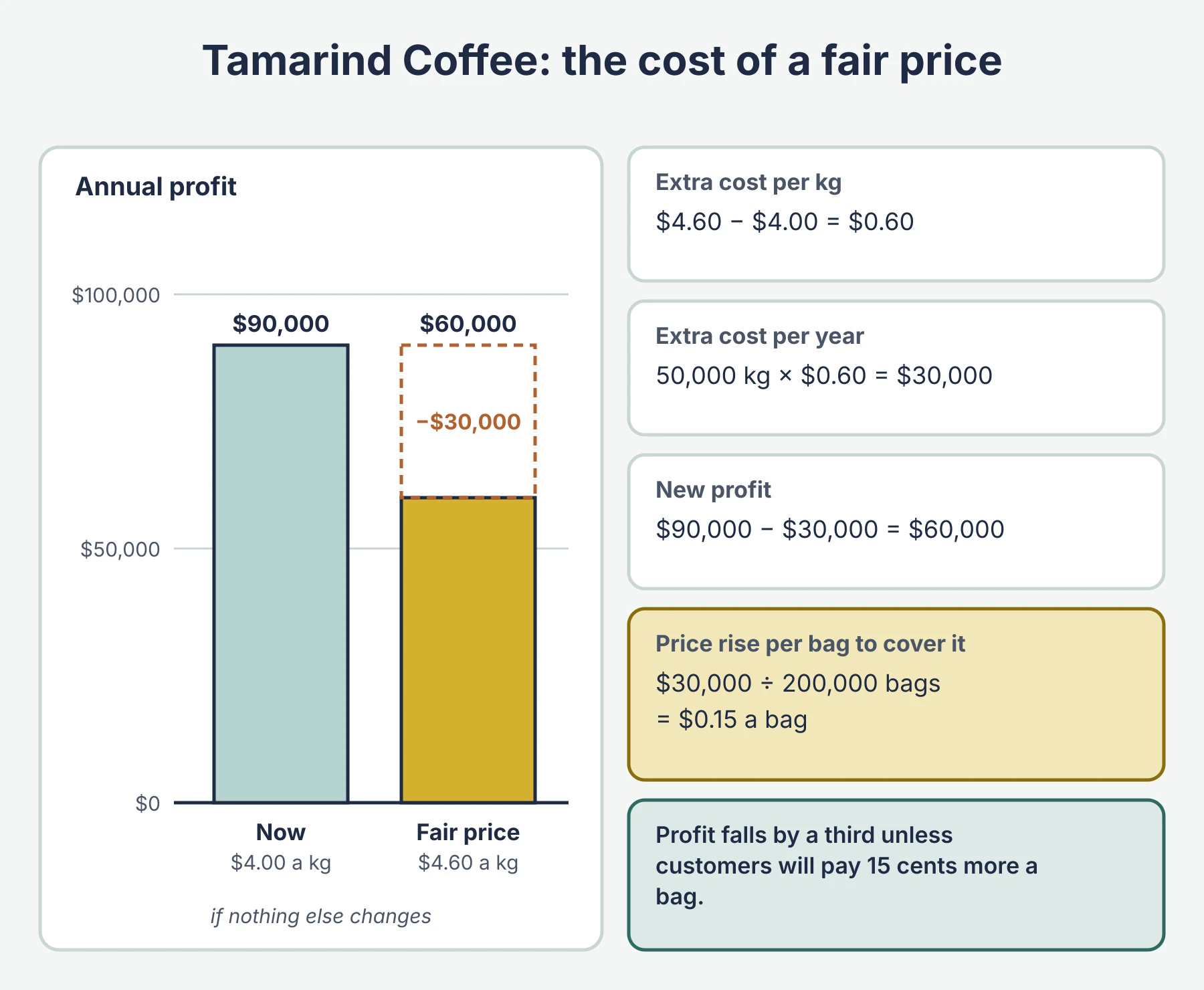
- A firm buys 20,000 units a year and pays suppliers $0.25 more per unit. Calculate the extra yearly cost.
- If the firm in question 4 made a profit of $40,000, what is its profit after the change, other things equal?
- Name the four environmental considerations listed in the specification.
- Give one way a business can reduce the traffic congestion it causes.
- Give one cost of recycling for a business.
- Define sustainability.
- State the two sustainability issues named in the specification.
- An energy-saving machine costs $15,000 and saves $2,500 a year. Calculate the payback period.
- Why might a business in financial difficulty reject an ethical or sustainable option?
Answers
- Acting in ways stakeholders consider both fair and honest.
- Any two: prayer breaks or a prayer room; flexible shifts during festivals or fasting; closing on holy days; food meeting religious requirements.
- Benefit: goodwill and a better reputation. Drawback: it reduces profit.
- 20,000 × $0.25 = $5,000.
- $40,000 − $5,000 = $35,000.
- Traffic congestion, recycling, disposing of waste, noise and air pollution.
- Schedule deliveries outside rush hours (or combine deliveries; locate near main roads).
- Staff time to sort materials (or bins, storage space).
- Meeting the needs of the present without damaging the ability of future generations to meet their own needs.
- Global warming and using scarce resources.
- $15,000 ÷ $2,500 = 6 years.
- It needs to survive in the short term, and the extra cost now could leave it unable to pay its bills.
Related resources
-
Study guides
OxfordAQA International GCSE Business (9225): Globalisation
Study guide to OxfordAQA IGCSE Business 9225 section 3.2.4 Globalisation: its five forms, benefits and drawbacks, and exchange rates for traders.
Business · OxfordAQA · IGCSE
Read guide -
Practice questions
OxfordAQA International GCSE Business (9225): Globalisation – Practice Questions
Eleven original questions with answers on the forms of globalisation, its benefits and drawbacks, and exchange rates for exporters in OxfordAQA 9225.
Business · OxfordAQA · IGCSE
Try questions -
Revision notes
OxfordAQA International GCSE Business (9225): Globalisation – Revision Notes
Revision notes for OxfordAQA IGCSE Business 9225 section 3.2.4: forms of globalisation, four-viewpoint benefits and drawbacks, exchange rates and a self-test.
Business · OxfordAQA · IGCSE
Revise topic
Get free revision emails (optional)
Occasional emails with practice questions, worked explanations and links to free resources for the qualification and subjects you choose. No spam, and you can unsubscribe from any email. The free tools on this site never need an email.