
Study Guides
OxfordAQA International GCSE English Language (9270): Paper 1 Section A — Literary Non-fiction
How to read and analyse the single unseen literary non-fiction text in OxfordAQA International GCSE English Language 9270 Paper 1, with a model answer.
- Subject
- English
- Level
- IGCSE
- Topic
- Paper 1 – Literary Non-fiction and Composition
- Author
- Marlbridge Academic Team
- Updated
- Reviewed by
- Ammar Bilal (what this means)
Aligned to OxfordAQA IGCSE English (9270), Version 5.1, for exams May/June 2018 onwards. Official specification .
Syllabus page (what it covers and how it is assessed): OxfordAQA IGCSE English Language.
Found an error? Report a correction.
Need help with this topic? Request a free trial class for IGCSE English Language (9270).
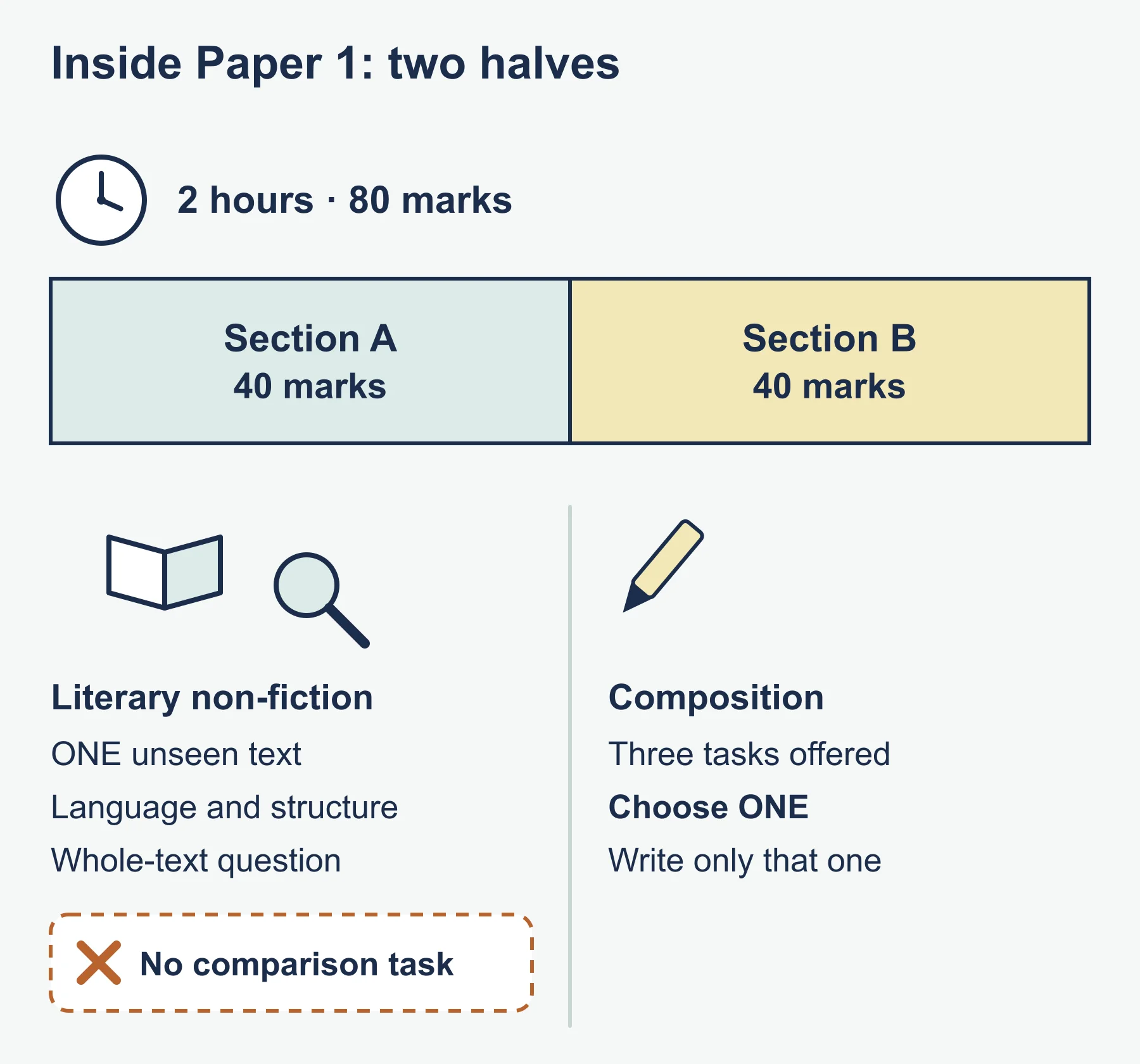
Section A of Paper 1 in OxfordAQA International GCSE English Language (9270) tests how well you read one unseen piece of literary non-fiction. It is worth 40 of the paper’s 80 marks. You are given a single text for close study, divided into sections with questions, and at least one question relates to the whole text. There is no second text and no comparison. This guide explains what kind of writing to expect, which reading skills are assessed, and how to turn close reading into precise written answers.
What the specification says
- The passages are literary non-fiction, for example autobiography, biography, letters, memoir and travel or adventure writing.
- Students answer all the questions in Section A.
- The text is divided into sections, each with its own question or questions.
- At least one question relates to the whole text.
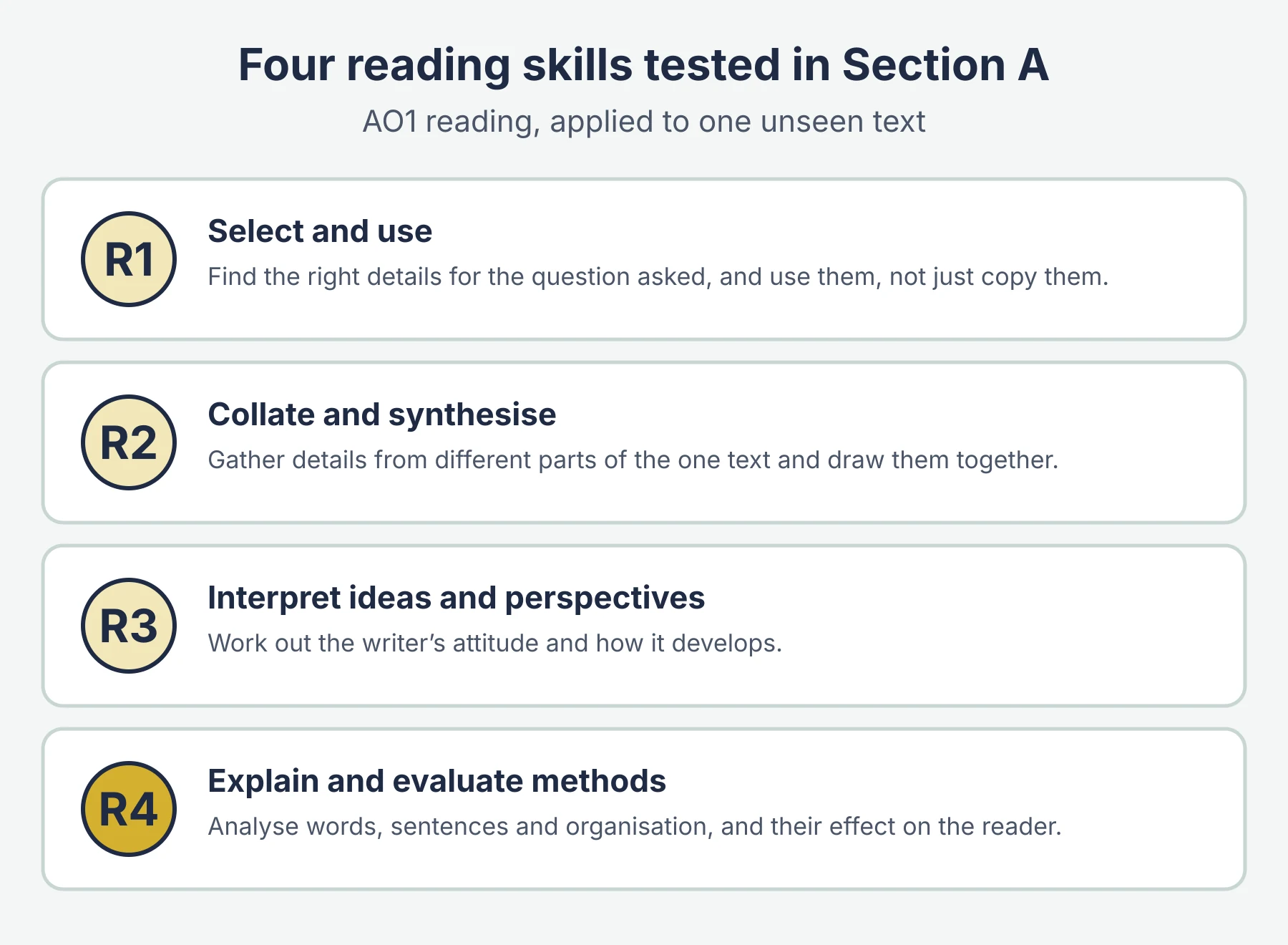
The reading skills assessed come from AO1:
| Skill | Specification wording | What it means in Section A |
|---|---|---|
| R1 | Read and understand texts, selecting and utilising material appropriate to purpose | Find the right details for the question asked, and use them, not just copy them |
| R2 | Collate and synthesise detail from one or more sources, making cross-references and comparisons as appropriate | Gather details from different parts of the one text and draw them together |
| R3 | Develop and sustain interpretations of writers’ ideas and perspectives | Work out the writer’s attitude and how it develops |
| R4 | Explain and evaluate how writers use linguistic, grammatical, structural and presentational features to achieve effects and engage and influence the reader | Analyse methods: words, sentences, organisation, and their effect |
What makes literary non-fiction different
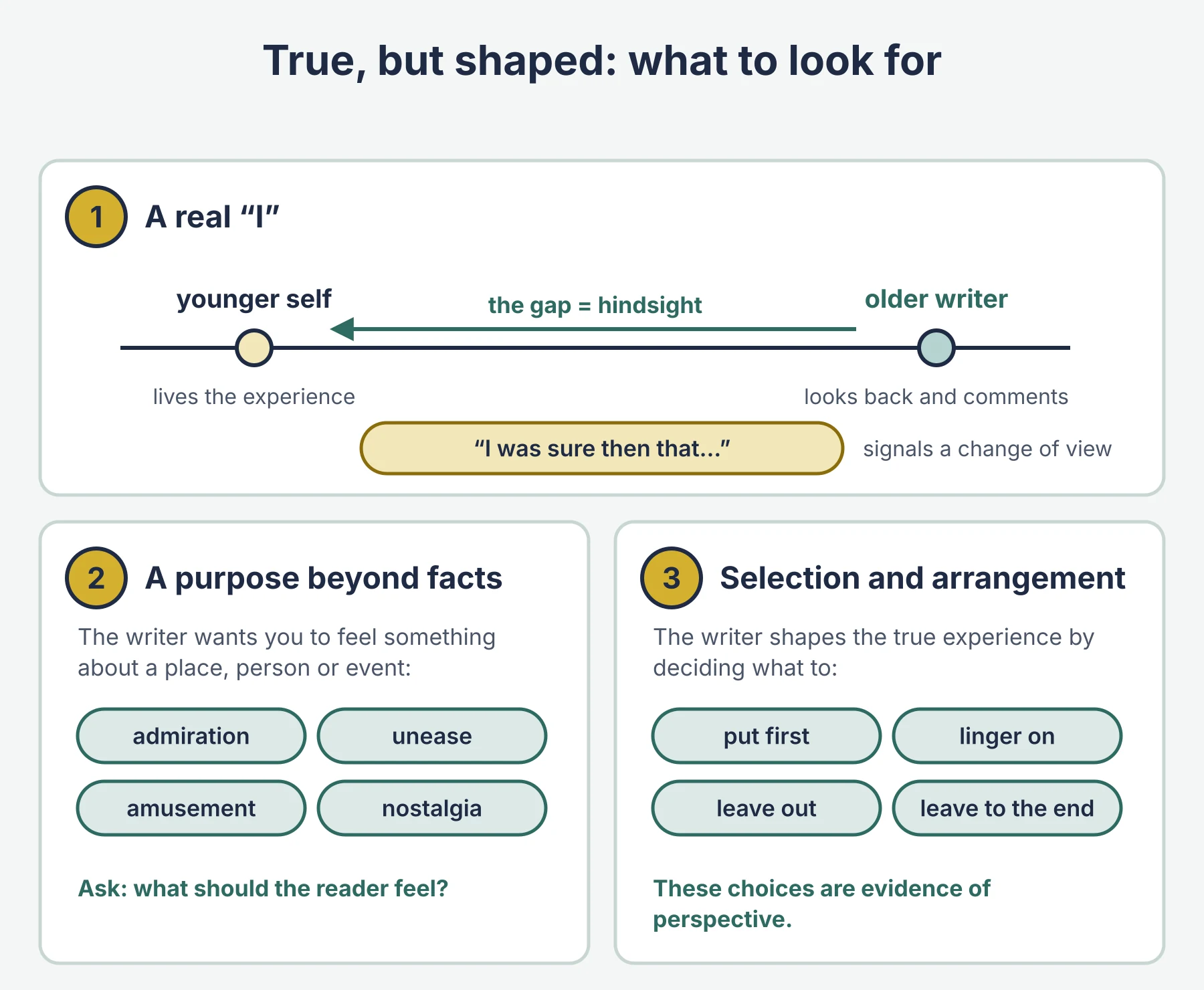
Literary non-fiction tells something true, but the writer shapes the experience. A memoir chooses which moments to include; a travel writer decides what to describe first and what to leave until the end; a letter writer adapts tone to the person addressed. Three features follow:
- A real “I”. Most of these texts have a first-person voice. The narrator is also the writer, but often an older writer looking back at a younger self. Notice the gap: “I was sure then that…” signals a change of view.
- A purpose beyond the facts. The writer wants you to feel something about a place, person or event: admiration, unease, amusement, nostalgia.
- Selection and arrangement. What the writer chose to put first, linger on or leave out is evidence of perspective.
Reading the text in sections
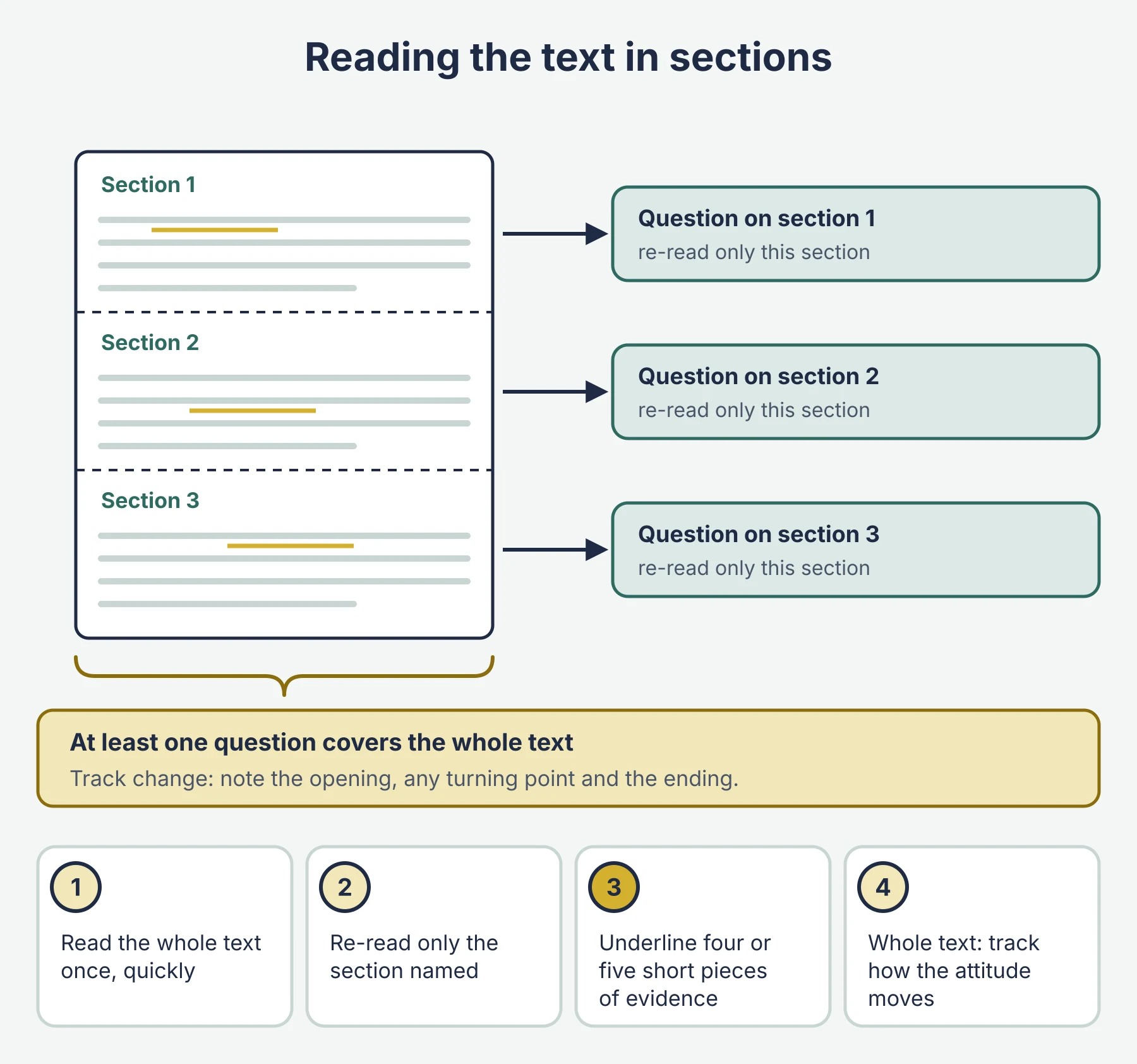
Because the questions are attached to sections, read with the question in mind:
- Read the whole text once quickly for the overall situation, voice and mood. Questions on one section are easier when you know where the text is going.
- For each question, re-read only the section named. Answers that drift into other sections waste time and may not be credited for that question.
- Underline before you write. Mark four or five short pieces of evidence that answer the question directly.
- For the whole-text question, track change. Note the opening, any turning point and the ending, and ask how the writer’s attitude or the reader’s understanding moves.
Analysing language: from feature to effect
The core move is the same as in any analytical answer: identify the method, quote briefly, and explain the effect on the reader. Literary non-fiction rewards attention to:
- Precise verbs and adjectives that reveal attitude (“the bus lurched”, “a grudging welcome”).
- Imagery that makes an unfamiliar place vivid through a familiar comparison.
- Contrast, especially between expectation and reality in travel writing.
- Humour and irony, often aimed at the writer’s younger self.
- Direct speech, which brings other people into the account and lets readers judge them.
- Tone shifts, signalled by a change of sentence length or vocabulary.
Analysing structure
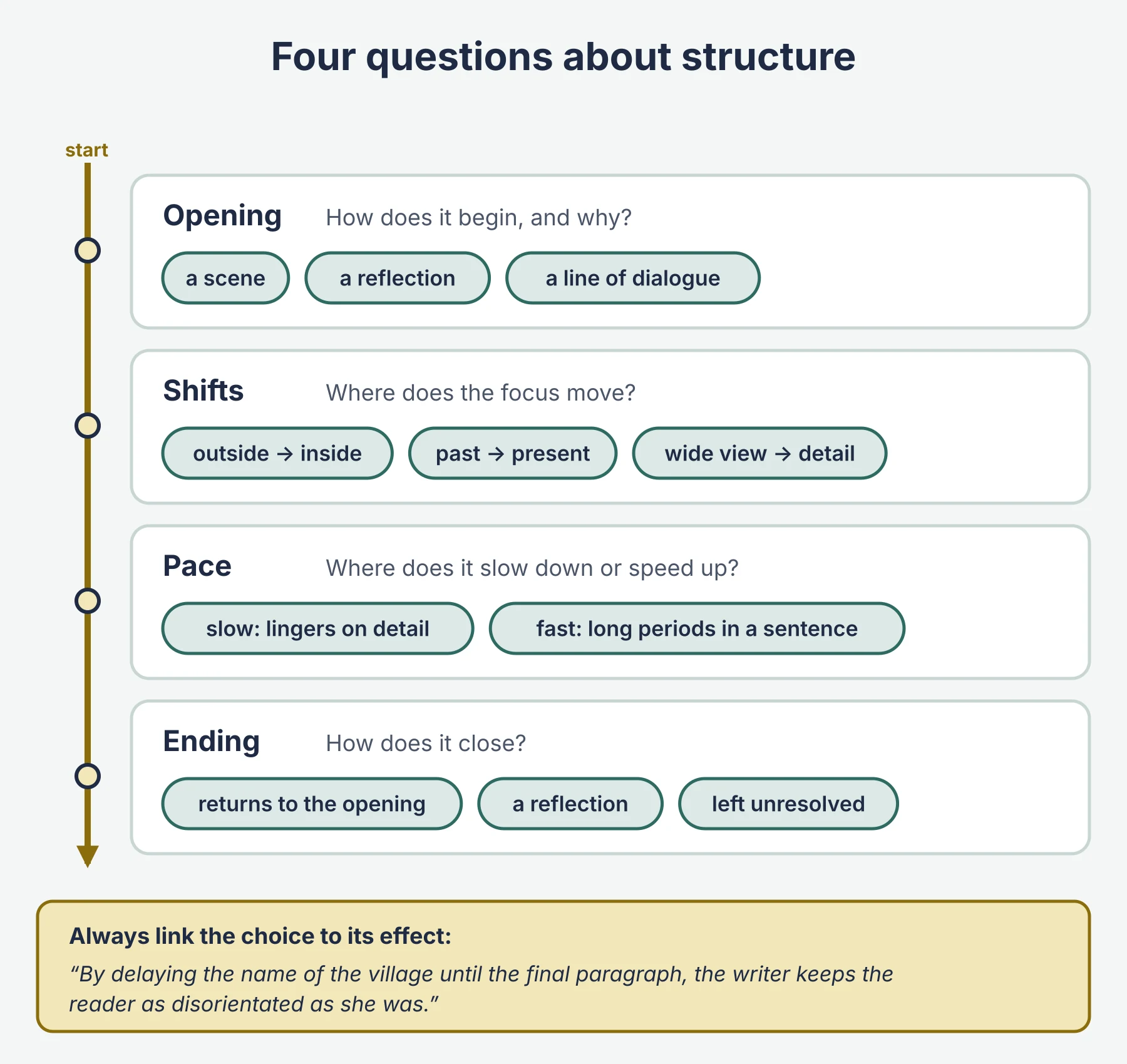
Structure means the order and shape of the text: how it opens, how it moves, where it changes focus, and how it ends. Useful questions to ask:
- Opening: does the writer begin with a scene, a reflection, a line of dialogue? Why?
- Shifts: where does the focus move from outside to inside, from past to present, from wide view to detail?
- Pace: where does the writer slow down with detail, and where are long periods summarised in a sentence?
- Ending: does it return to the opening, offer a reflection, or leave something unresolved?
Always link a structural choice to its effect: “By delaying the name of the village until the final paragraph, the writer keeps the reader as disorientated as she was.”
Interpreting perspective (R3)
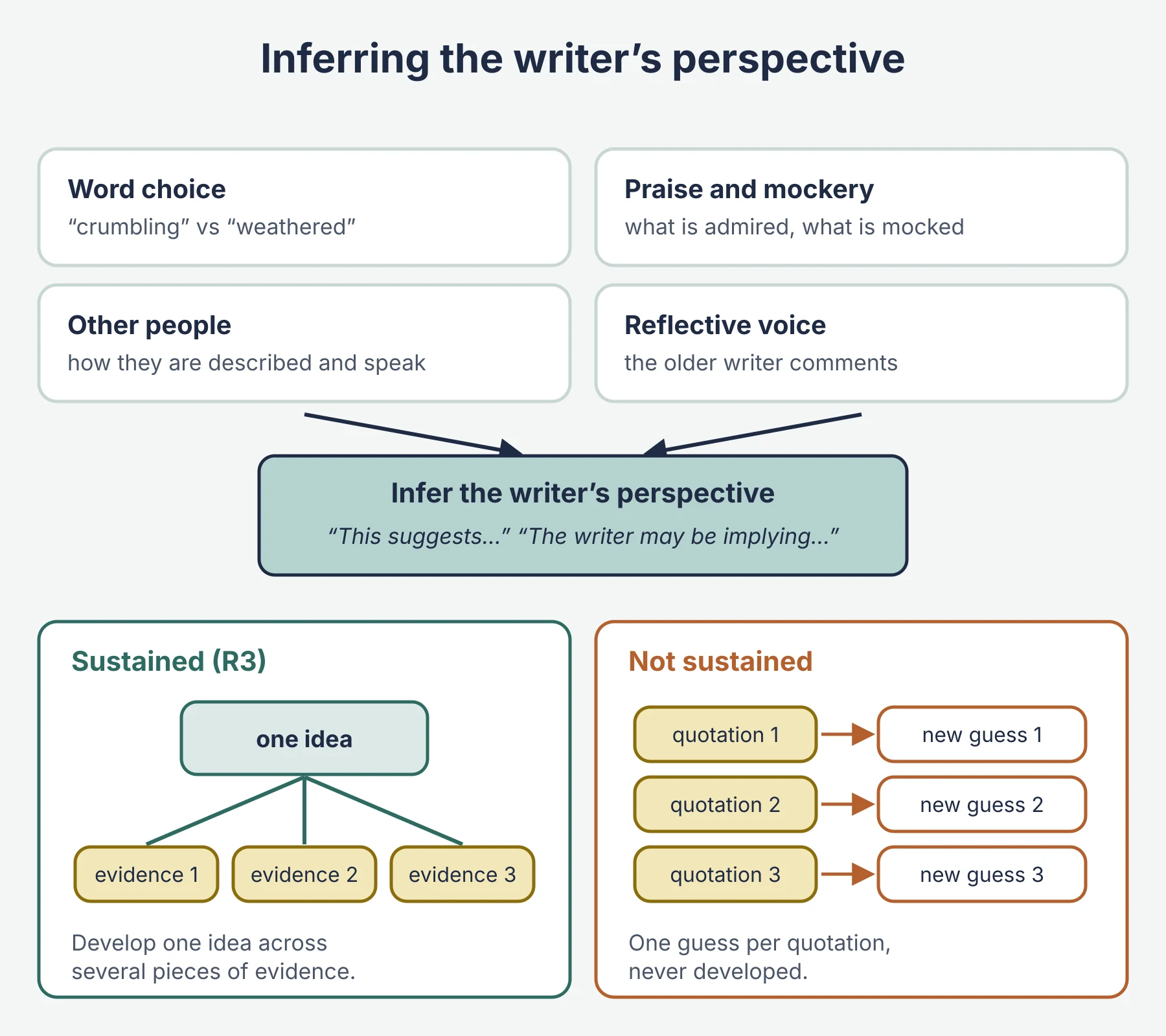
A writer’s perspective is rarely stated. You infer it from evidence:
- Word choice with connotations (“crumbling” vs “weathered”).
- What is praised and what is mocked.
- How other people are presented, through description and their own speech.
- The reflective voice, where the older writer comments on the experience.
Use tentative language when a text supports more than one reading: “This suggests…”, “The writer may be implying…”. Sustained interpretation (R3) means developing one idea across several pieces of evidence, not making one guess per quotation.
Worked example
The following is an original passage written for this guide, in the style of a memoir.
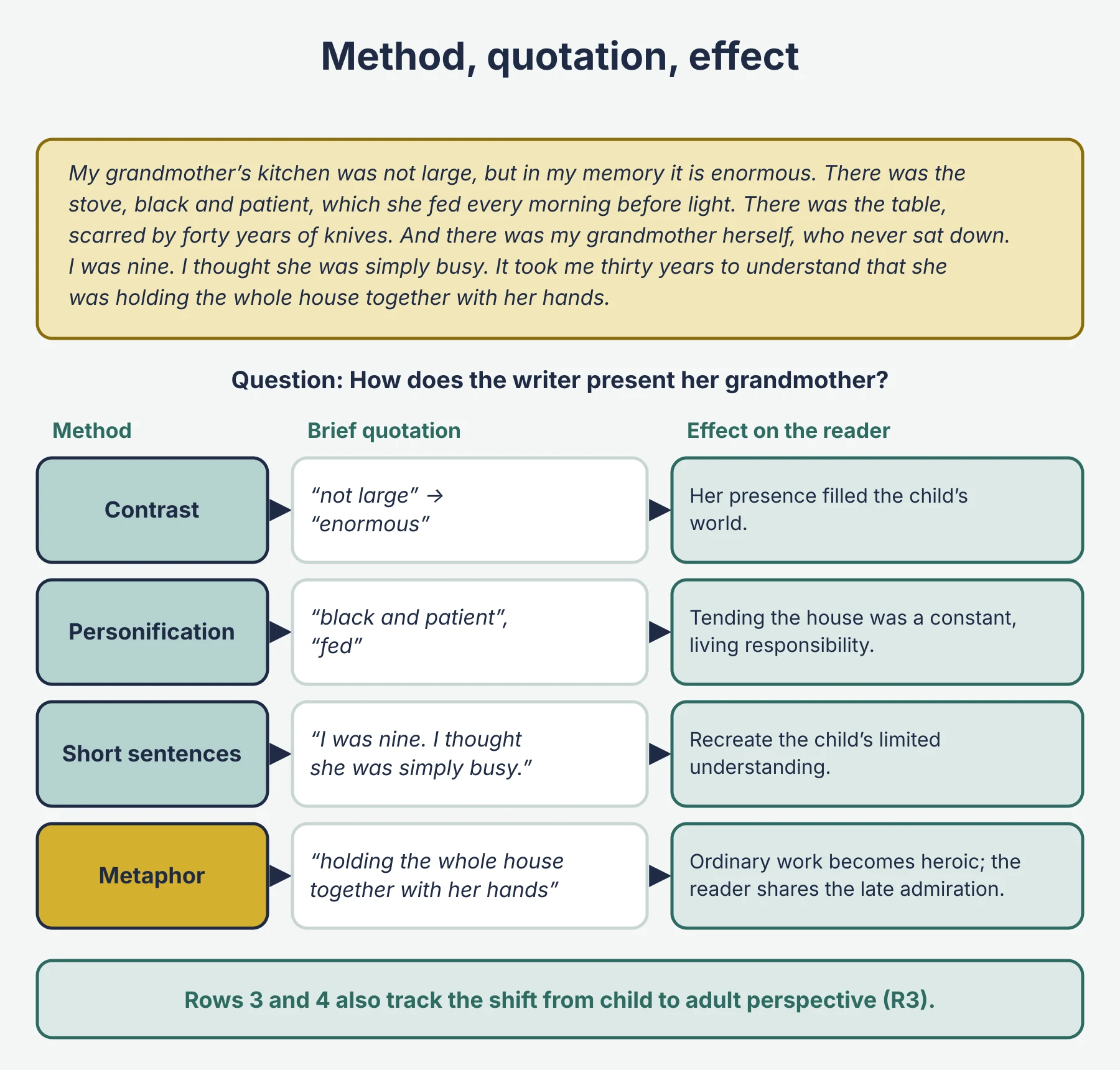
My grandmother’s kitchen was not large, but in my memory it is enormous. There was the stove, black and patient, which she fed every morning before light. There was the table, scarred by forty years of knives. And there was my grandmother herself, who never sat down. I was nine. I thought she was simply busy. It took me thirty years to understand that she was holding the whole house together with her hands.
Question: How does the writer present her grandmother in this section?
Model answer (extract): The writer presents her grandmother as tireless and quietly powerful. The contrast between a kitchen that was “not large” and one that is “enormous” in memory shows how much the grandmother’s presence filled the child’s world. Personifying the stove as “black and patient”, and saying she “fed” it, makes the stove seem like a creature in her care, suggesting that tending the house was a constant, living responsibility. The short sentences “I was nine. I thought she was simply busy.” recreate the child’s limited understanding, and the final sentence reveals the adult’s insight: the metaphor “holding the whole house together with her hands” turns ordinary work into something heroic and physical, so the reader shares the writer’s late-arriving admiration.
Why it works: each point names a method, quotes briefly, and explains the effect; the answer tracks the shift from child to adult perspective (R3) as well as language (R4).
Common mistakes
- Retelling the section instead of answering how or why.
- Feature-spotting: “There is a simile” with no effect.
- Quoting long sentences: short, embedded quotations are easier to analyse.
- Ignoring the section boundaries set for a question.
- Treating the narrator as a character in a novel: in non-fiction it is the writer’s real view, often shaped by hindsight.
- Commenting only on language when the question asks about structure or the whole text.
Exam technique: typical question stems
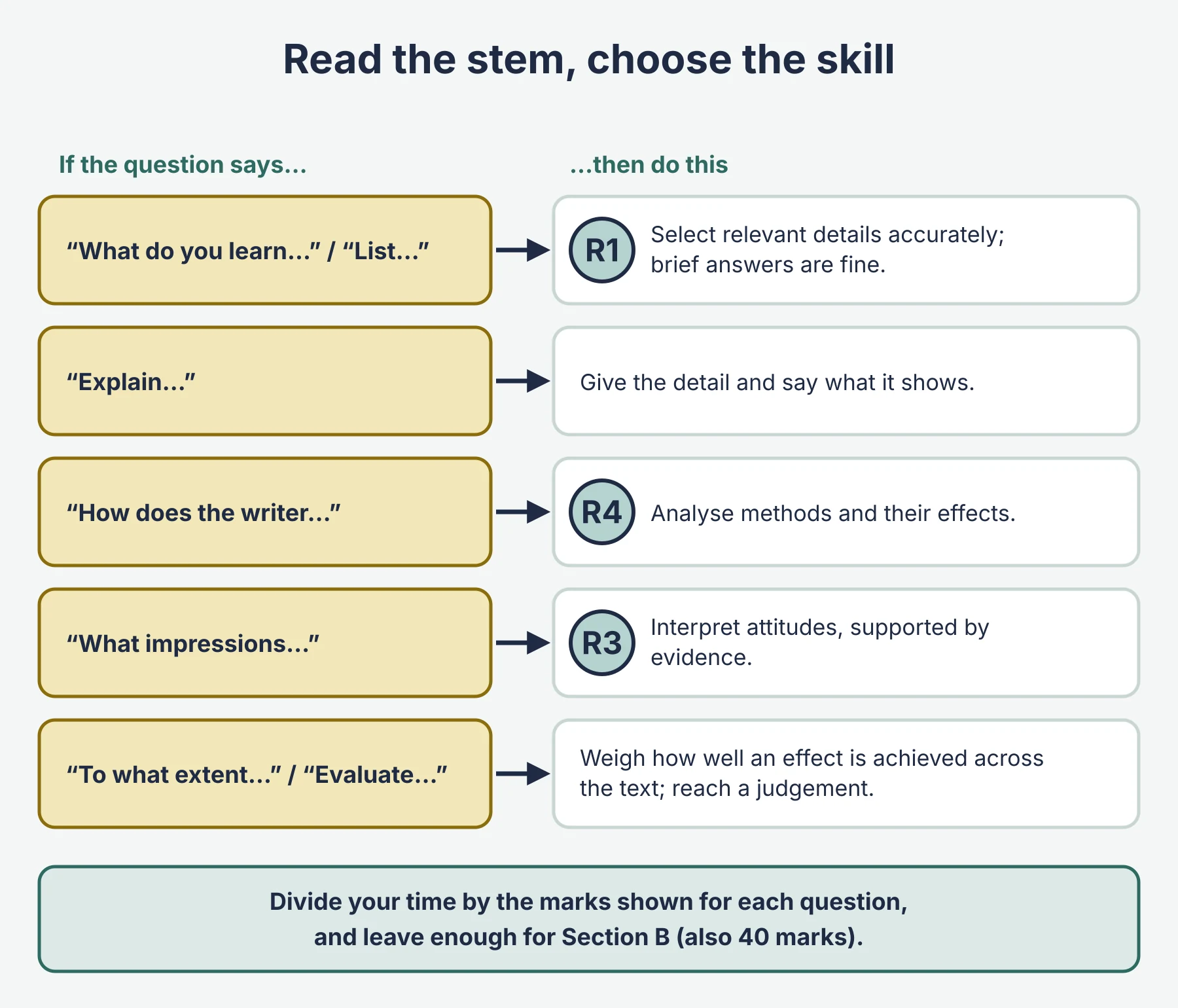
Question wording varies from paper to paper, but stems like these are common in reading papers, and each points to a different skill:
- “What do you learn…” / “List…”: select relevant details accurately (R1); brief answers are fine.
- “Explain…”: give the detail and say what it shows.
- “How does the writer…”: analyse methods and effects (R4).
- “What impressions…” / “What do you think and feel about…”: interpret attitudes (R3), supported by evidence.
- “To what extent…” / “Evaluate…”: weigh how successfully the writer achieves an effect across the text, and reach a judgement.
Divide your time by the marks shown for each question, and leave enough for Section B, which carries the same 40 marks.
More resources on this topic
- Section A literary non-fiction revision notes
- Section A literary non-fiction practice questions
- Paper 1 study guide
- Paper 1 Section B composition study guide
Source: OxfordAQA International GCSE English Language (9270) specification, Version 5.1, sections 2.2, 3.1.1 and 4.2.
Related resources
-
Practice questions
OxfordAQA International GCSE English Language (9270): Paper 1 Section A — Literary Non-fiction — Practice Questions
Original travel-writing text with 11 questions on selection, language, structure and perspective for OxfordAQA International GCSE English Language 9270 Paper 1.
English · OxfordAQA · IGCSE
Try questions -
Revision notes
OxfordAQA International GCSE English Language (9270): Paper 1 Section A — Literary Non-fiction — Revision Notes
Recall notes on reading a single literary non-fiction text, R1 to R4, voice, perspective and structure, for OxfordAQA International GCSE English Language 9270.
English · OxfordAQA · IGCSE
Revise topic -
Study guides
OxfordAQA International GCSE English Language (9270): Paper 1 Section B — Composition
How to choose, plan and write descriptive, imaginative, argumentative or discursive compositions for OxfordAQA International GCSE English Language 9270 Paper 1.
English · OxfordAQA · IGCSE
Read guide
Get free revision emails (optional)
Occasional emails with practice questions, worked explanations and links to free resources for the qualification and subjects you choose. No spam, and you can unsubscribe from any email. The free tools on this site never need an email.