
Revision Notes
OxfordAQA International GCSE English Language (9270): Paper 1 Section A — Literary Non-fiction — Revision Notes
Recall notes on reading a single literary non-fiction text, R1 to R4, voice, perspective and structure, for OxfordAQA International GCSE English Language 9270.
- Subject
- English
- Level
- IGCSE
- Topic
- Paper 1 – Literary Non-fiction and Composition
- Author
- Marlbridge Academic Team
- Updated
- Reviewed by
- Ammar Bilal (what this means)
Aligned to OxfordAQA IGCSE English (9270), Version 5.1, for exams May/June 2018 onwards. Official specification .
Syllabus page (what it covers and how it is assessed): OxfordAQA IGCSE English Language.
Found an error? Report a correction.
Need help with this topic? Request a free trial class for IGCSE English Language (9270).
These notes condense Paper 1 Section A of OxfordAQA International GCSE English Language (9270): reading one unseen literary non-fiction text. For the full explanation and a model answer, use the Section A literary non-fiction study guide.
The facts to know
| Feature | What the specification says |
|---|---|
| Marks | Section A: 40 of Paper 1’s 80 |
| Text | A single text for close study |
| Type | Literary non-fiction: autobiography, biography, letters, memoir, travel/adventure writing |
| Layout | Divided into sections, each with questions |
| Whole text | At least one question relates to the whole text |
| Choice | None: answer all Section A questions |
| Comparison | None on this paper |
Paper 1 as a whole lasts 2 hours and carries 60% of the qualification.
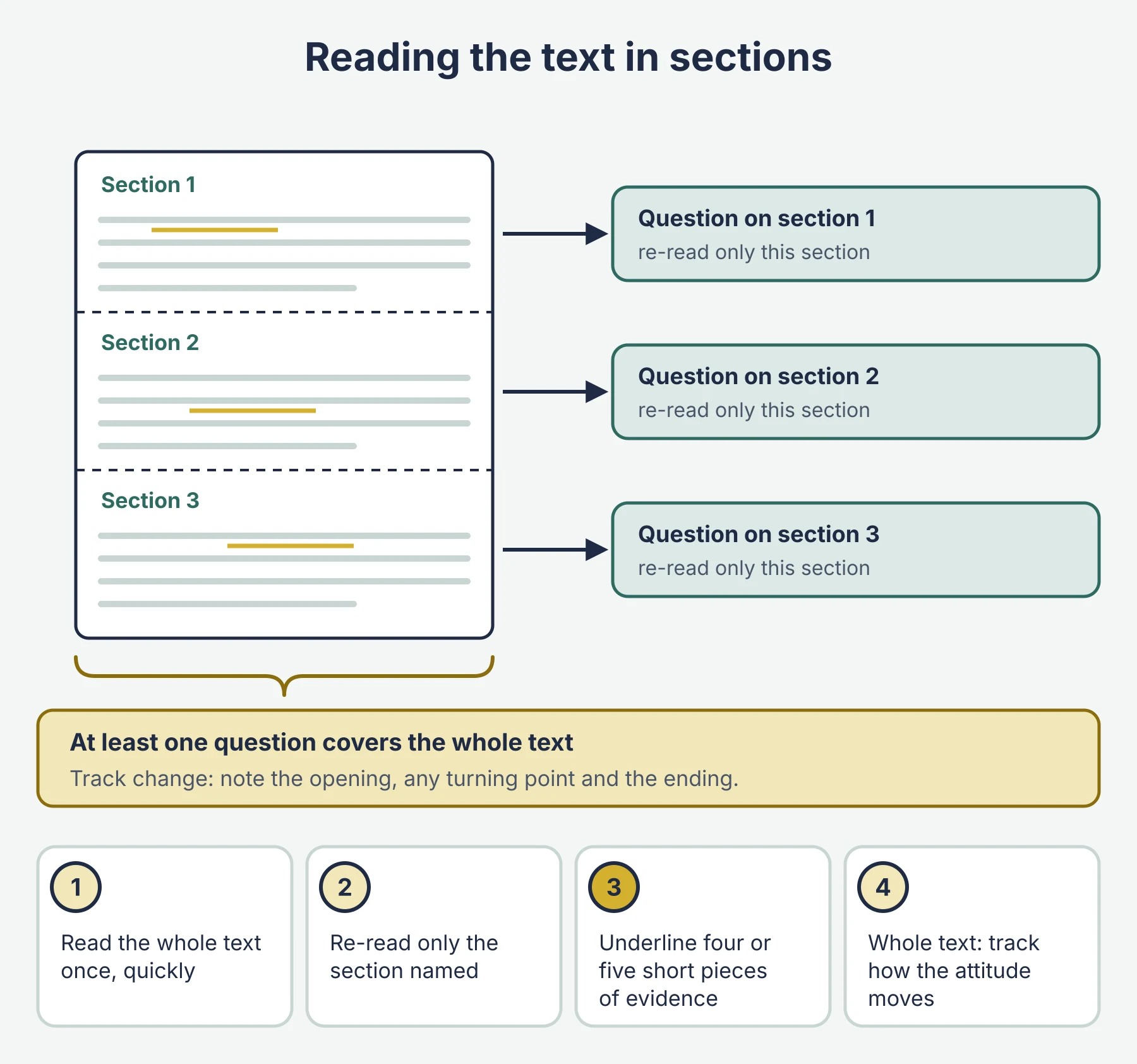
The four reading skills in one line each
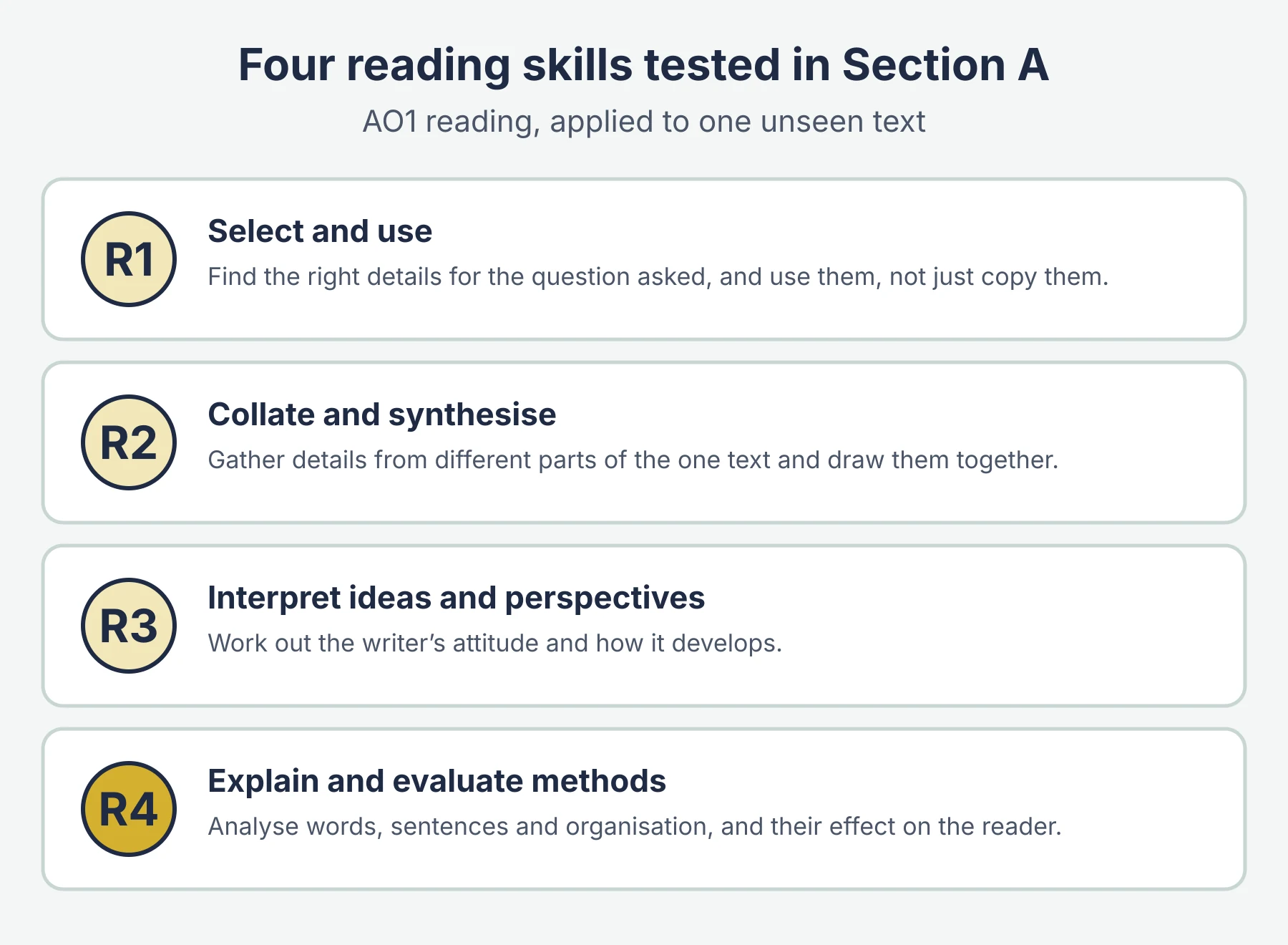
- R1 — select: pick details that fit the question and use them for its purpose.
- R2 — synthesise: gather details from different parts of the text into one point.
- R3 — interpret: work out the writer’s ideas and perspective, and sustain the reading.
- R4 — analyse and evaluate methods: language, grammar, structure, presentation, and their effect on the reader.
Recognising the forms
| Form | What to look for |
|---|---|
| Autobiography / memoir | Older narrator looking back; hindsight; selected key moments |
| Biography | Writer’s judgement of another person; chosen anecdotes; evaluative adjectives |
| Letters | Direct address; tone adapted to the recipient; private feelings |
| Travel / adventure | Contrast of expectation and reality; sensory detail; outsider’s view; danger and suspense |
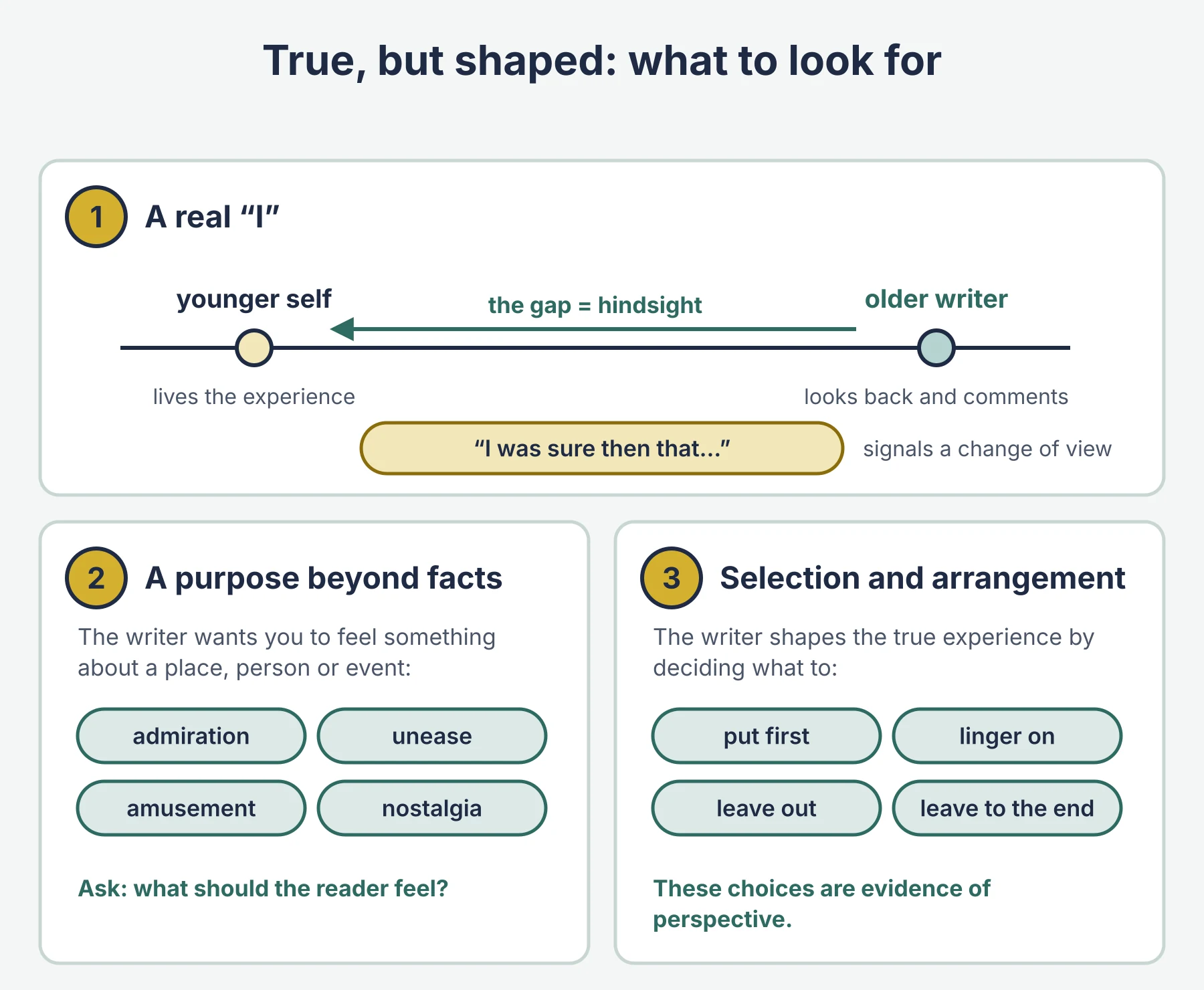
The voice: two “I”s
In memoir the experiencing self (the child or traveller at the time) and the narrating self (the writer now) can differ. Signals of the gap:
- time markers: “then”, “at the time”, “years later”;
- hindsight phrases: “I did not know”, “I see now”;
- a change of tense from past narrative to present reflection.
Comment on the gap: it often carries the writer’s real perspective.
Language checklist
- Verbs — show movement and attitude (“trudged”, “darted”).
- Adjectives and adverbs — reveal judgement.
- Imagery — simile, metaphor, personification: what does the comparison add?
- Semantic field — a group of related words (illness, battle, celebration) building one mood.
- Contrast and juxtaposition — two ideas placed side by side for effect.
- Irony and humour — often aimed at the younger self.
- Direct speech — lets other people’s voices characterise them.
- Sentence forms — short for impact, long for accumulation, questions for reflection.
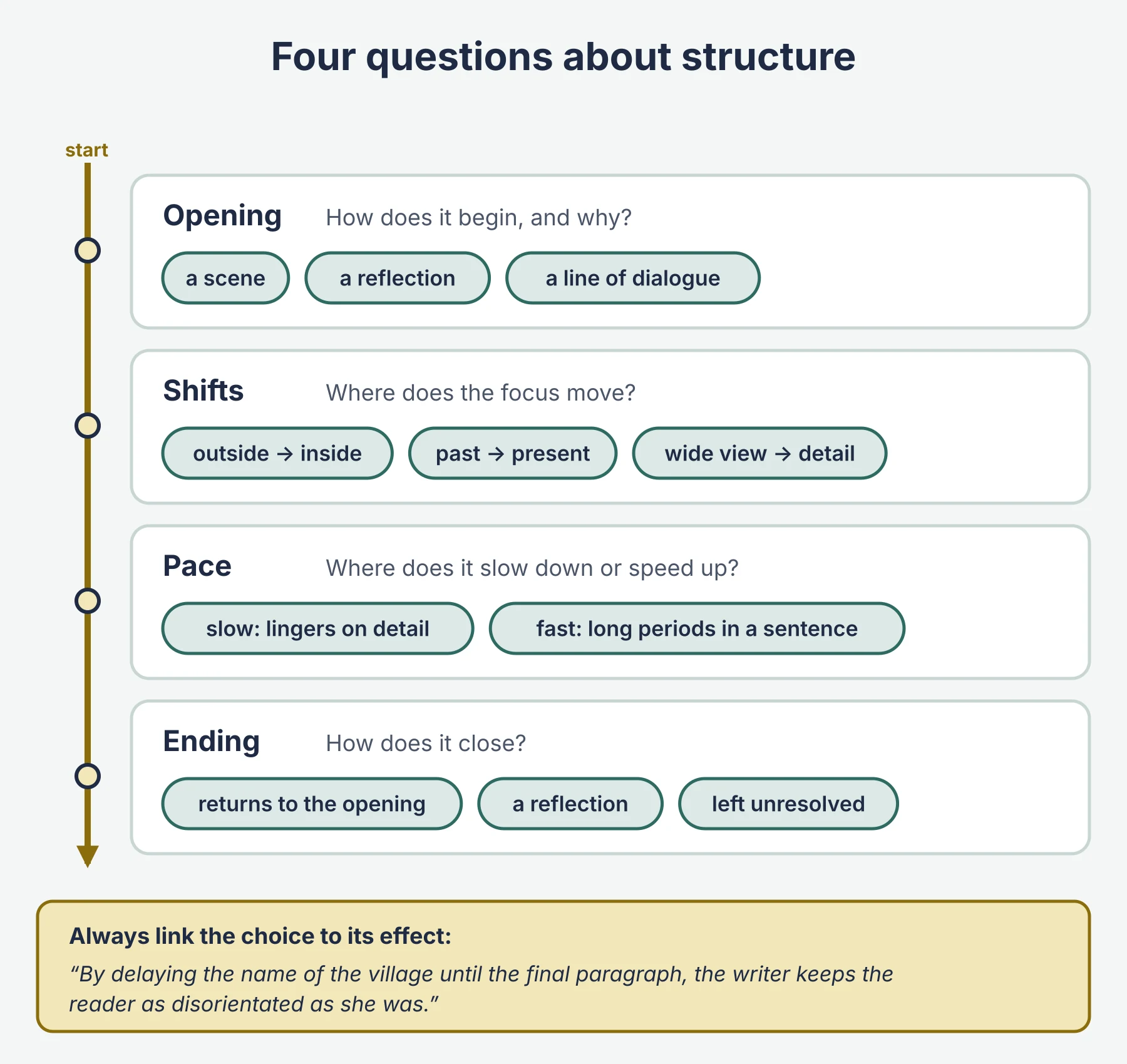
Structure checklist
OPENING   scene / reflection / dialogue / statement -> what does it set up?
SHIFTS    outside -> inside; past -> present; wide view -> detail
PACE      slowed by detail or sped up by summary
TURN      the moment the attitude or situation changes
ENDING    return to opening? reflection? unresolved?
Always finish the point with the effect: why here, and what does the reader feel or understand?
The analytical sentence
Method   +  short quotation  +  effect on reader  +  link to writer's perspective
"The personification of the stove as 'black and patient' makes it seem
 alive in her care, suggesting how constant her work was."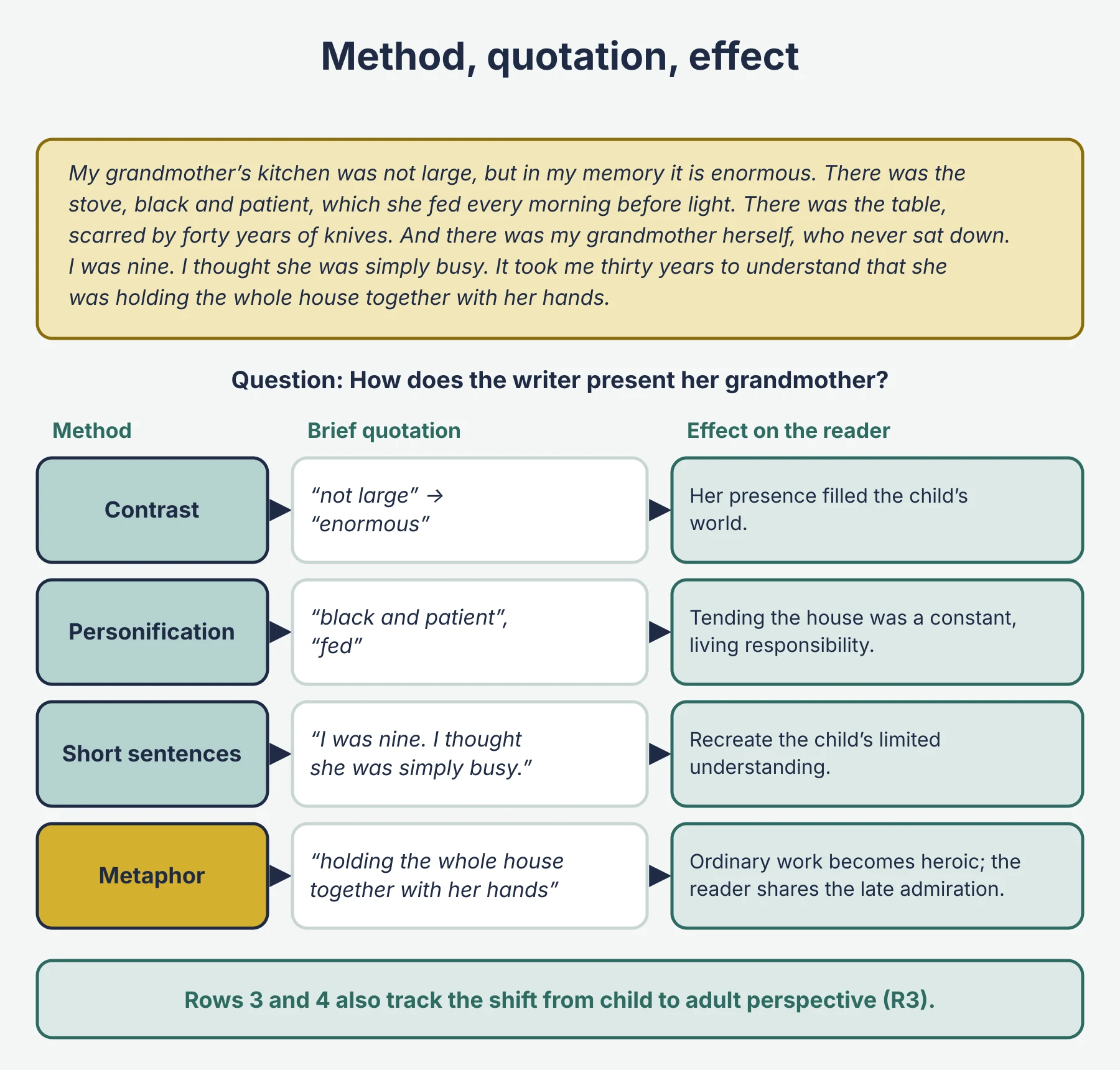
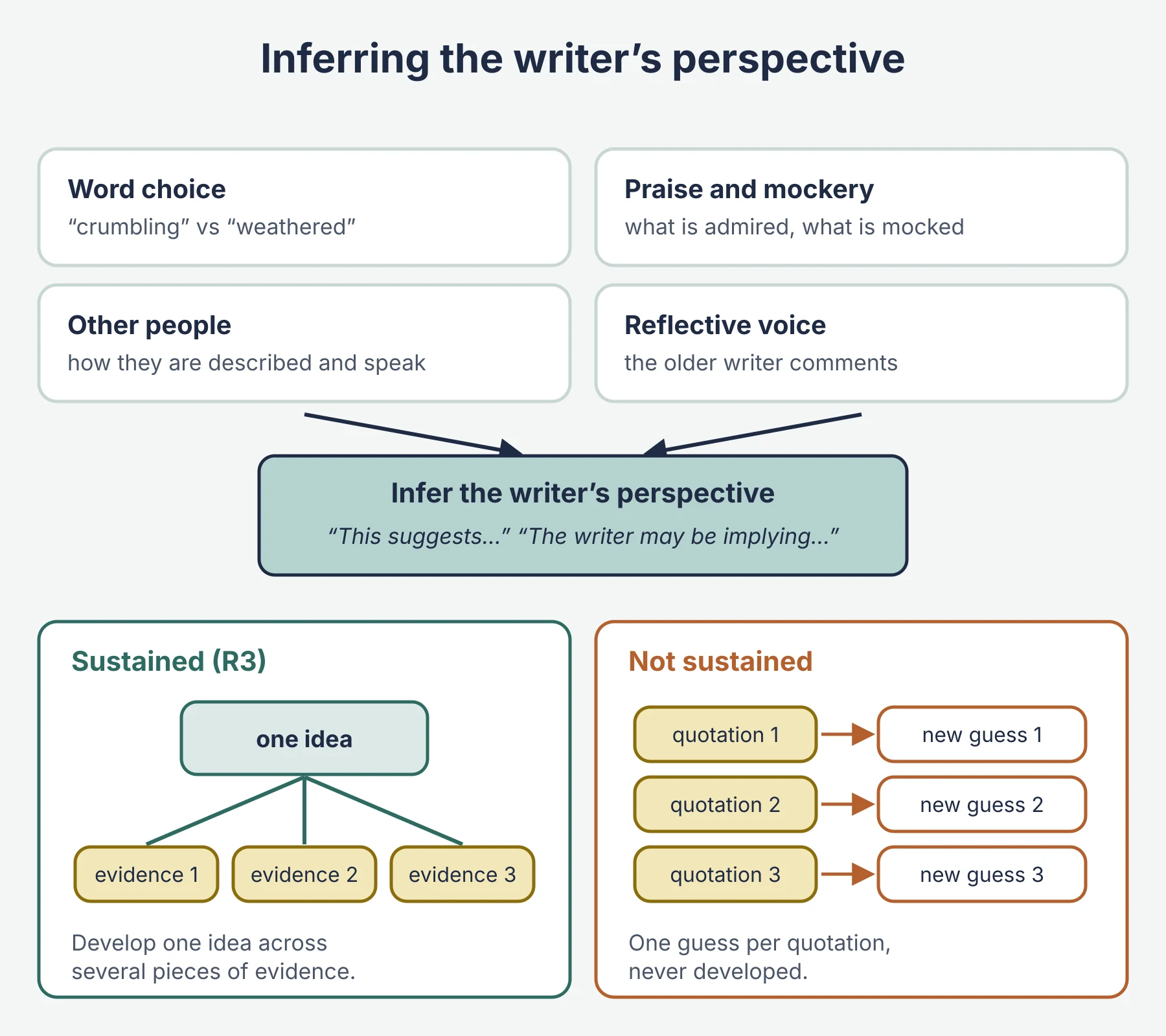
Perspective: where to find it
- connotations of word choice;
- what is praised and what is mocked;
- how other people are presented;
- what is included, and what is left out;
- the closing reflection.
Use tentative verbs for interpretation: suggests, implies, may reveal, perhaps.
Key terms
| Term | Meaning |
|---|---|
| Literary non-fiction | True writing shaped with literary techniques |
| Perspective | The writer’s point of view and attitude |
| Hindsight | Understanding gained later, used by the narrating self |
| Anecdote | A short personal story used to make a point |
| Juxtaposition | Placing two contrasting things side by side |
| Semantic field | A group of words linked by meaning |
| Cyclical structure | Ending that returns to the opening |
| Embedded quotation | A short quotation built into your own sentence |
Exam traps
- Answering from the wrong section of the text for a section-specific question.
- Narrating instead of analysing: if the question says “how”, explain methods.
- Quoting too much: long quotations hide the words that matter.
- Ignoring structure on the whole-text question.
- Reading the narrator as fictional: this is a real person’s view.
- Assuming comparison is needed: Paper 1 Section A is one text only.
- Spending too long: Section B carries the same 40 marks.
Self-test
- How many texts are set in Paper 1 Section A?
- Name four forms of literary non-fiction listed in the specification.
- What must at least one Section A question relate to?
- In your own words, what does R2 ask you to do within a single text?
- What is the difference between the experiencing self and the narrating self?
- Give two signals that a memoir writer is using hindsight.
- What is a semantic field? Give an example.
- Name three places to look for structural choices.
- Why are short, embedded quotations better than long ones?
- Give three sources of evidence for a writer’s perspective.
- Why use tentative verbs such as “suggests” in an interpretation?
- How many marks is Section A worth, and what does that mean for timing?
Answers: 1. One. 2. Any four of autobiography, biography, letters, memoir, travel/adventure writing. 3. The whole text. 4. Collect details from different parts of the text and combine them into a single, developed point. 5. The experiencing self lived the events at the time; the narrating self is the writer looking back, often with different understanding. 6. Any two: time markers such as “years later”; phrases like “I did not know”; a shift from past narrative to present reflection. 7. A group of words linked by meaning, for example “wound”, “fever”, “recovery” forming a field of illness. 8. Any three: the opening, shifts in focus or time, pace, the turning point, the ending. 9. They focus attention on the exact words being analysed and leave room for explanation. 10. Any three: connotations of word choice; what is praised or mocked; how other people are presented; what is included or left out; the closing reflection. 11. Because texts can support more than one reading, and tentative language shows you are interpreting from evidence. 12. 40 of the paper’s 80 marks, half the paper, so it needs about half the time.
More resources on this topic
- Section A literary non-fiction practice questions
- Paper 1 revision notes
- Section B composition revision notes
Source: OxfordAQA International GCSE English Language (9270) specification, Version 5.1.
Related resources
-
Study guides
OxfordAQA International GCSE English Language (9270): Paper 1 Section B — Composition
How to choose, plan and write descriptive, imaginative, argumentative or discursive compositions for OxfordAQA International GCSE English Language 9270 Paper 1.
English · OxfordAQA · IGCSE
Read guide -
Practice questions
OxfordAQA International GCSE English Language (9270): Paper 1 Section B — Composition — Practice Questions
Eleven original composition tasks with model plans, openings and endings for OxfordAQA International GCSE English Language 9270 Paper 1 Section B, with answers.
English · OxfordAQA · IGCSE
Try questions -
Revision notes
OxfordAQA International GCSE English Language (9270): Paper 1 Section B — Composition — Revision Notes
Recall notes on the four composition types, W1 to W4, planning and accuracy checks for OxfordAQA International GCSE English Language 9270 Paper 1 Section B.
English · OxfordAQA · IGCSE
Revise topic
Get free revision emails (optional)
Occasional emails with practice questions, worked explanations and links to free resources for the qualification and subjects you choose. No spam, and you can unsubscribe from any email. The free tools on this site never need an email.