
Revision Notes
OxfordAQA International GCSE English Language (9270): Paper 1 Section B — Composition — Revision Notes
Recall notes on the four composition types, W1 to W4, planning and accuracy checks for OxfordAQA International GCSE English Language 9270 Paper 1 Section B.
- Subject
- English
- Level
- IGCSE
- Topic
- Paper 1 – Literary Non-fiction and Composition
- Author
- Marlbridge Academic Team
- Updated
- Reviewed by
- Ammar Bilal (what this means)
Aligned to OxfordAQA IGCSE English (9270), Version 5.1, for exams May/June 2018 onwards. Official specification .
Syllabus page (what it covers and how it is assessed): OxfordAQA IGCSE English Language.
Found an error? Report a correction.
Need help with this topic? Request a free trial class for IGCSE English Language (9270).
These notes condense Paper 1 Section B of OxfordAQA International GCSE English Language (9270): composition. For full explanations and annotated examples, use the Section B composition study guide.
The facts to know
| Feature | What the specification says |
|---|---|
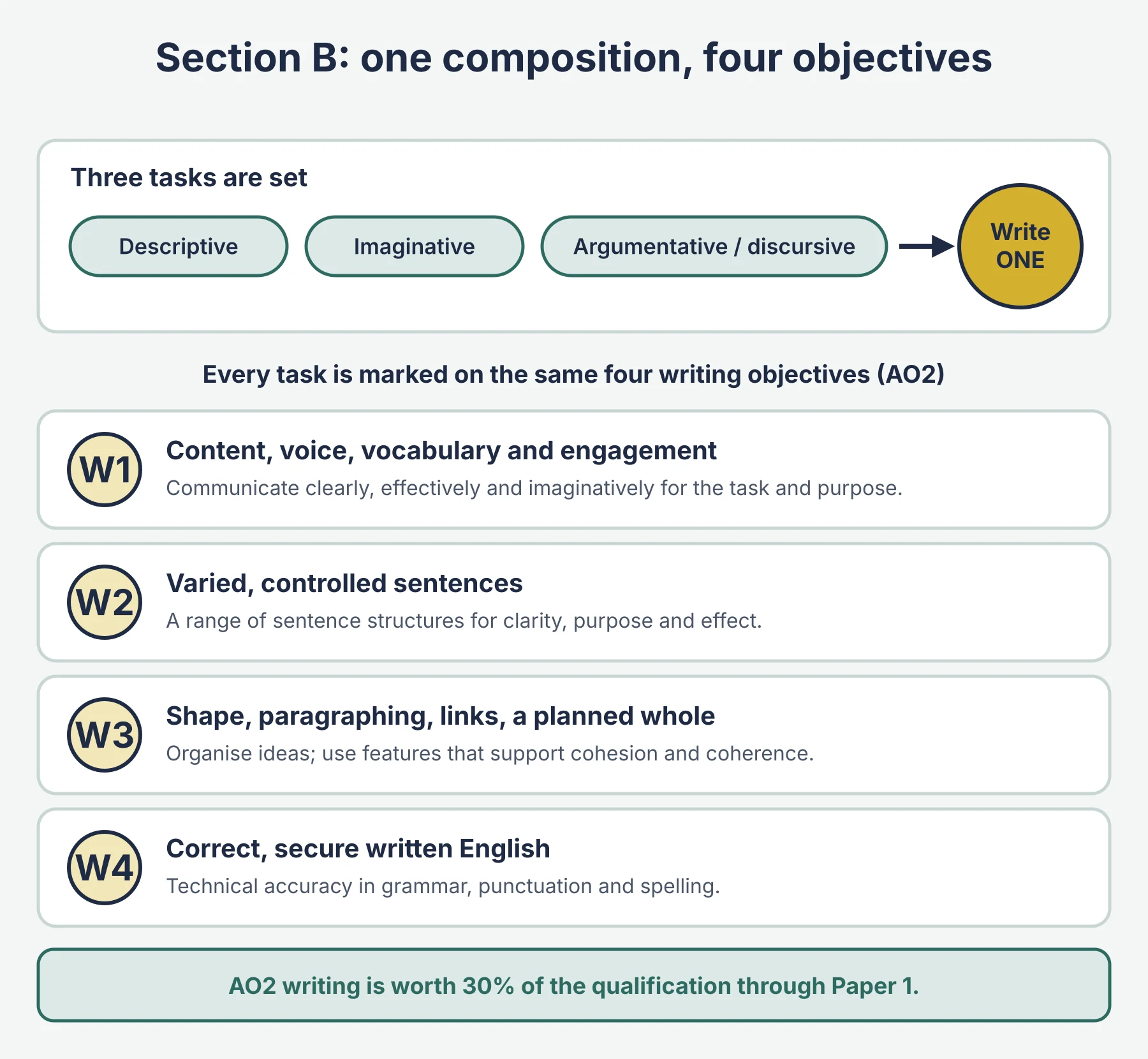
| Marks | Section B: 40 of Paper 1’s 80 |
| Tasks | Three; choose one |
| Types | Descriptive, imaginative, argumentative and/or discursive |
| Assessed by | AO2 writing objectives W1–W4 |
| Weighting | AO2 is 30% of the qualification through Paper 1 |
W1–W4 in one line each
- W1 — communicate: clear, effective, imaginative; form and vocabulary fit the task; reader engaged.
- W2 — sentences: a range of structures, chosen for clarity, purpose and effect.
- W3 — organise: sentences, paragraphs and the whole text hold together (cohesion and coherence).
- W4 — accuracy: grammar, punctuation and spelling.
Choosing the task: three checks
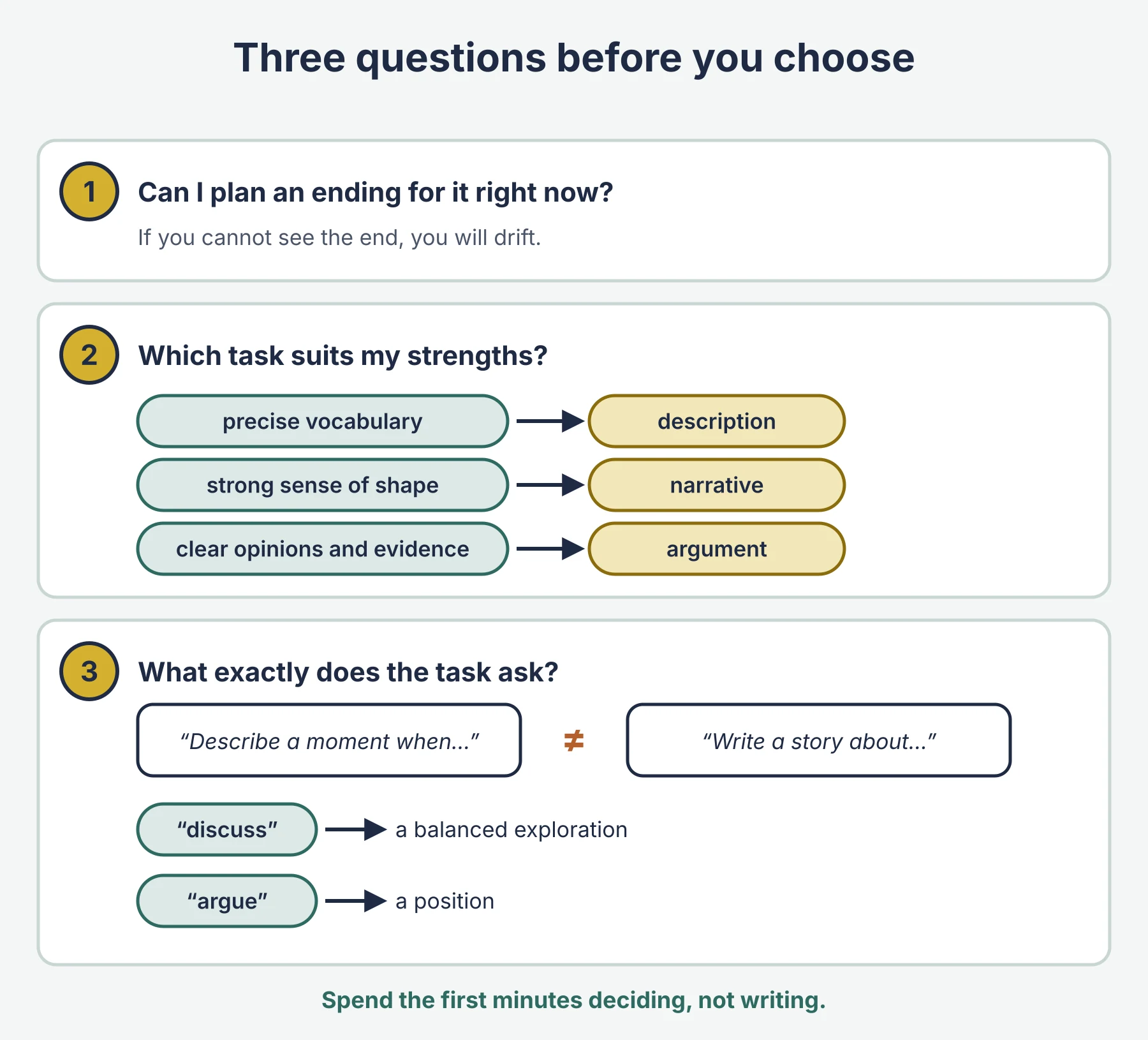
- Can I see the ending already?
- Does it suit my strengths?
- Have I read the instruction word: describe, write a story, argue, discuss?
The four types at a glance
| Type | Core move | Structure that works | Trap |
|---|---|---|---|
| Descriptive | Render one moment precisely | Camera movement; time shift; mood change | A list of sights across a whole day |
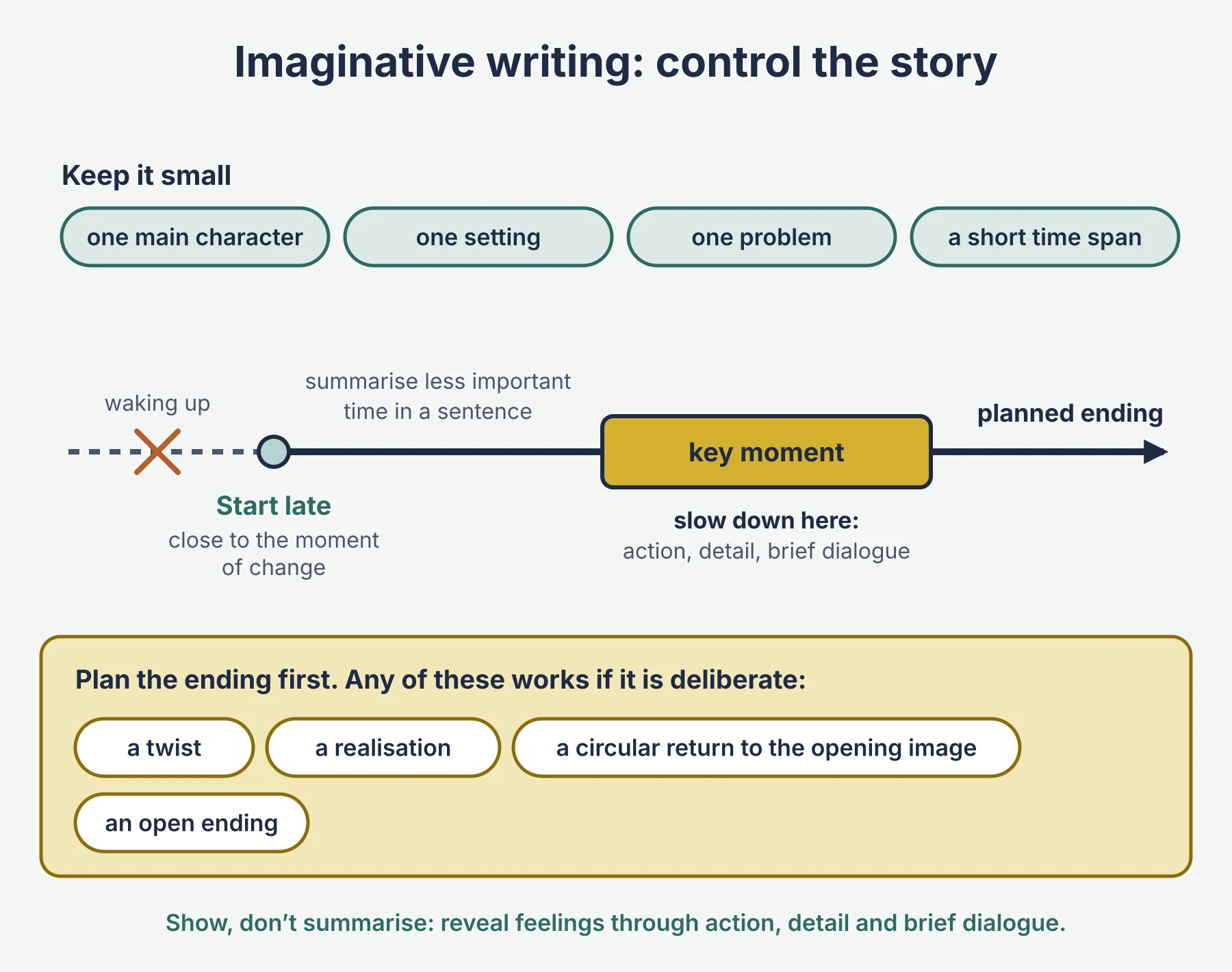
| Imaginative | Small story with a planned ending | Start late; slow down at the key moment; deliberate ending | Too many characters and events |
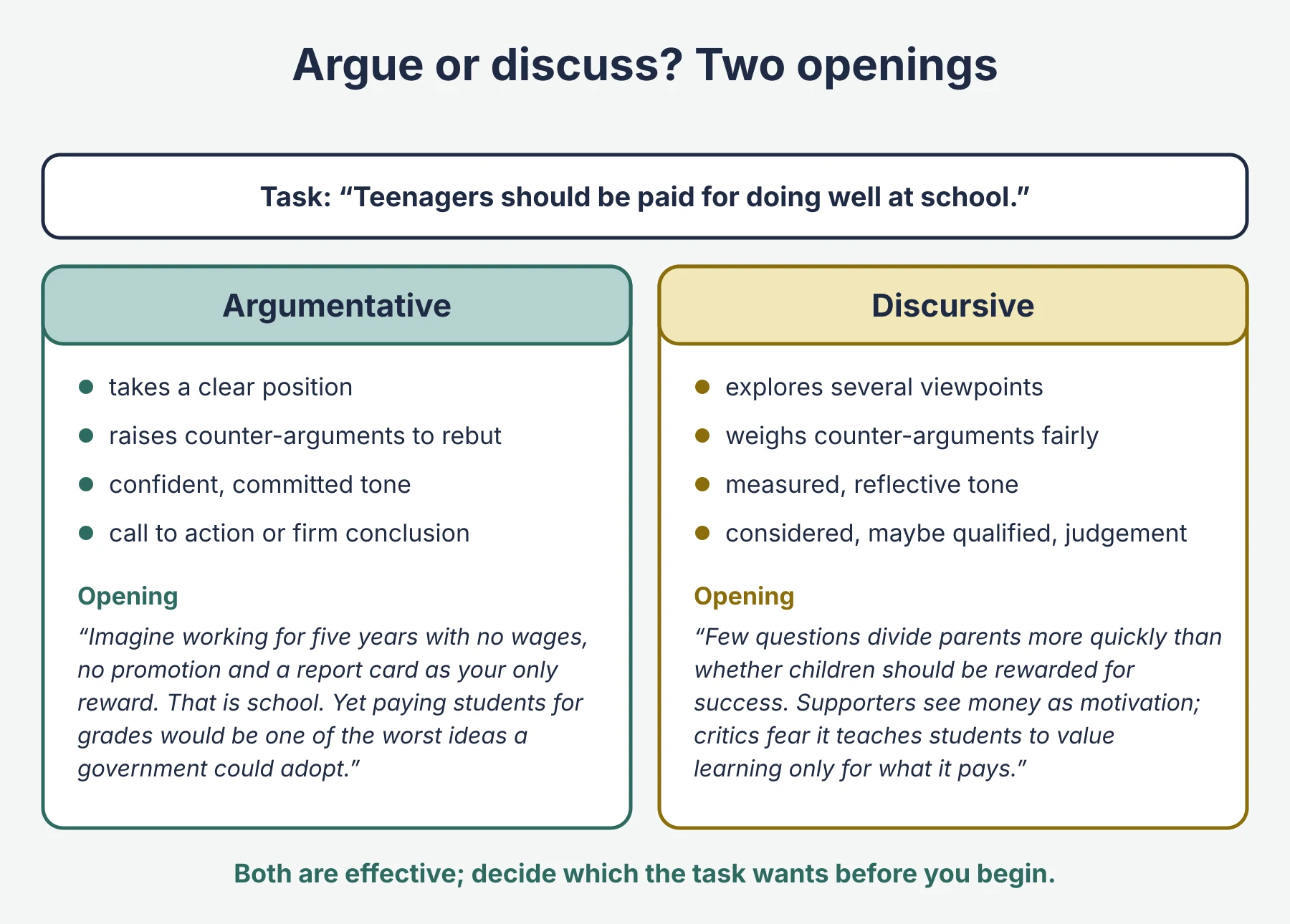
| Argumentative | Persuade from a clear position | Hook → 3–4 points → rebut → call to action | Ranting without evidence |
| Discursive | Explore views with balance | Introduce issue → views for → views against → judgement | Pretending to be balanced but taking one side throughout |
Descriptive toolkit
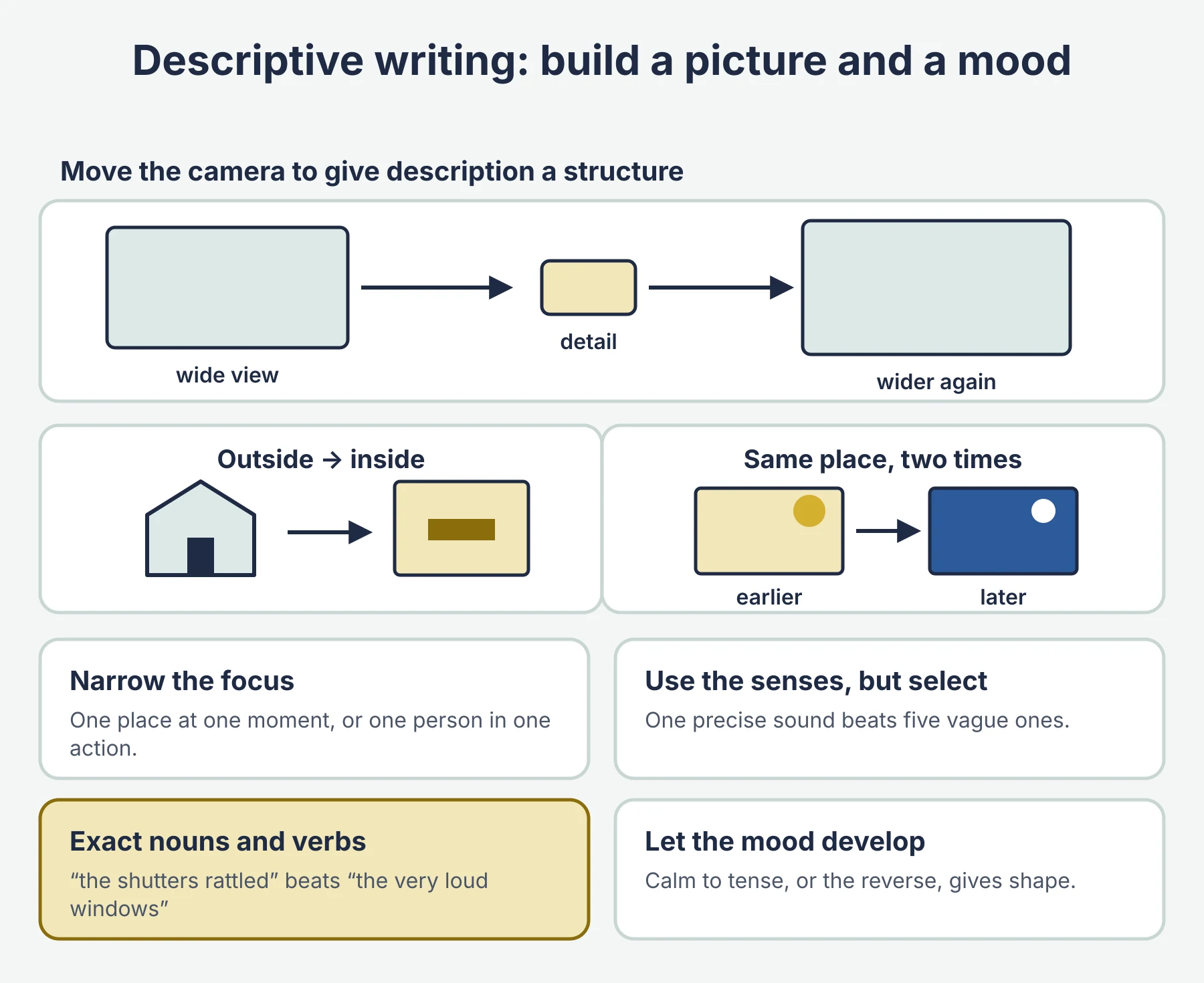
- Focus: one place, one moment.
- Nouns and verbs first, adjectives sparingly.
- Senses: select one or two precise details per sense.
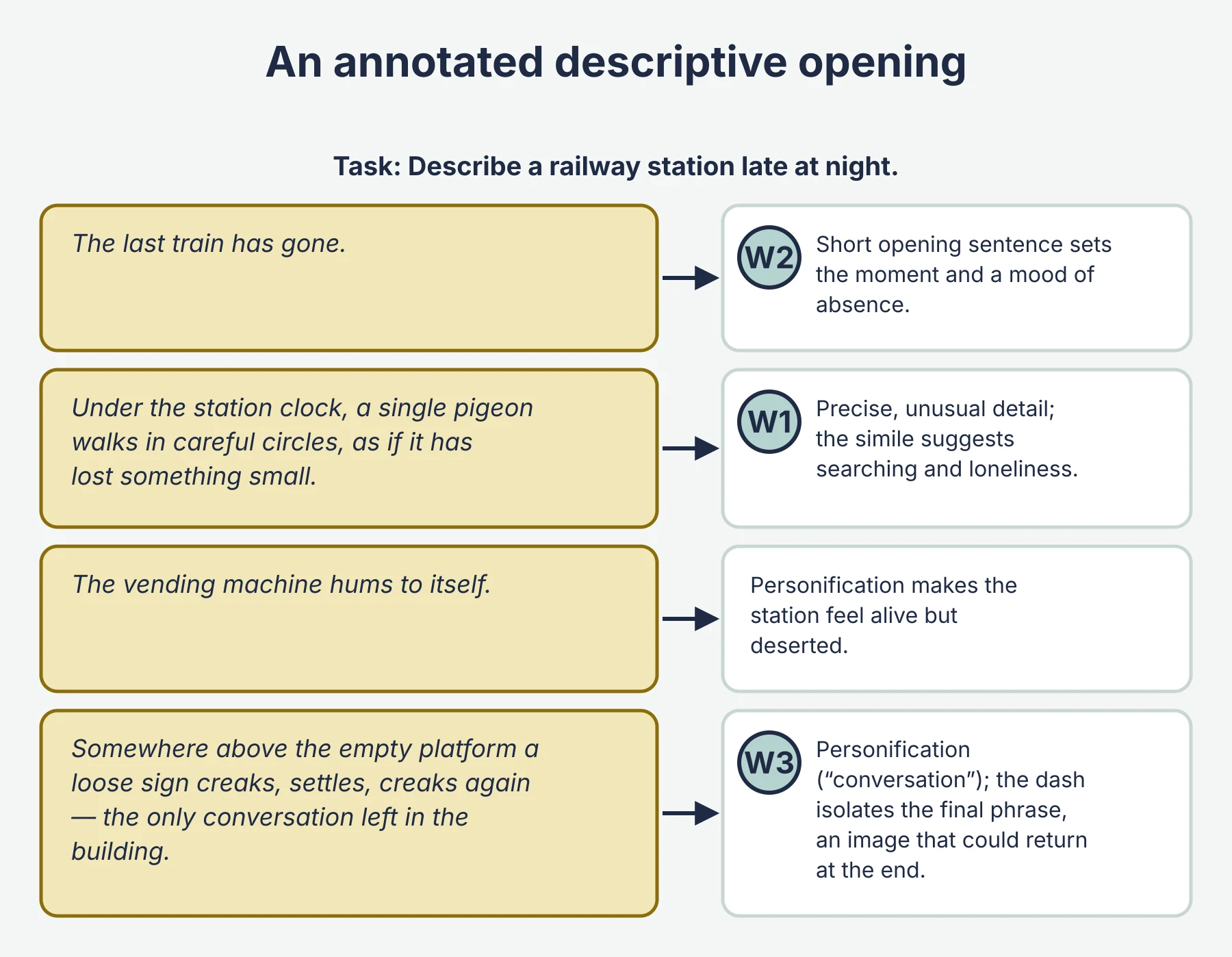
- Figurative language: one fresh image beats three clichés.
- Structure: wide → close → wide; outside → inside; dawn → dusk; calm → storm.
- Motif: an object or sound that returns.
Imaginative toolkit
- One character, setting, problem and short time span.
- Opening: dialogue, action or a striking detail, close to the moment of change.
- Middle: build tension; slow time at the climax.
- Ending: realisation, twist, cyclical return or deliberate open ending.
- Show feelings through action and detail.
- Dialogue: short, purposeful, correctly punctuated.
Argument and discussion toolkit
HOOK        anecdote / bold claim / question / scenario
POINT       one idea per paragraph
EVIDENCE    realistic example, observation, expert view you know to be accurate
EXPLAIN     why it matters to the reader
LINK        however / consequently / admittedly / above all
COUNTER     argue: raise and rebut; discuss: weigh fairly
CLOSE       argue: call to action; discuss: considered judgement
Rhetorical devices: direct address, rhetorical question, rule of three, emotive language, contrast, repetition. Use each where it adds force.
Sentence menu (W2)
| Form | Example | Effect |
|---|---|---|
| Short simple | It stopped. | Emphasis, shock |
| Multi-clause | As the rain thickened, the street emptied, and the lights came on one by one. | Build-up, flow |
| Fronted adverbial | Without warning, the door opened. | Varied opening, suspense |
| Subordinate clause first | Although she smiled, her hands shook. | Contrast, tension |
| Minor sentence | Silence. | Isolation (use sparingly) |
| Question | Who decides what is fair? | Engages the reader |
Cohesion (W3)
- Paragraph for each change of time, place, speaker, focus or argument.
- Link with pronouns, synonyms, discourse markers and repeated motifs.
- The ending answers the opening.
Accuracy checklist (W4)
- Full stops, not commas, between sentences (no comma splices).
- Apostrophes for possession and contraction only.
- Homophones: there/their/they’re, your/you’re, its/it’s, where/were.
- One tense, unless you deliberately shift.
- Speech punctuation: new speaker, new line.
- Capital letters for names and sentence starts.
Key terms
| Term | Meaning |
|---|---|
| Cohesion | Links that hold sentences and paragraphs together |
| Coherence | The whole text making sense as a planned piece |
| Discourse marker | A word or phrase that signals the logic of the next point |
| Motif | A repeated image or idea |
| Cyclical structure | Ending that returns to the opening |
| Rebuttal | Answering and overturning an opposing point |
| Register | The level of formality |
Exam traps
- Changing task after starting.
- Describing with a plot, or narrating when asked to describe.
- Treating “discuss” as “argue” or the reverse.
- Endings that stop rather than finish (“then I woke up”).
- Invented statistics in arguments.
- Over-decorated prose with every noun given an adjective.
- No time left to proofread.
Self-test
- How many composition tasks are offered, and how many do you answer?
- Name the task types listed in the specification.
- Which objective covers sentence structures?
- What does W3 mean by cohesion and coherence?
- Give one reason to narrow a descriptive piece to a single moment.
- Suggest two ways to structure a descriptive piece.
- Why should you plan the ending of an imaginative piece first?
- State two differences between argumentative and discursive writing.
- Give three discourse markers and the logic each signals.
- Why are invented statistics a weakness?
- Name four accuracy errors to check for.
- What is a cyclical structure, and why is it effective?
Answers: 1. Three; one. 2. Descriptive, imaginative, argumentative and/or discursive. 3. W2. 4. Cohesion is the linking of sentences and paragraphs; coherence is the whole text making sense as a planned piece. 5. It allows precise detail instead of a thin list. 6. Any two: wide view to close detail; outside to inside; the same place at two times; a change of mood. 7. So that the story has a shape and every paragraph moves towards a deliberate conclusion. 8. Argumentative takes a position and rebuts counter-arguments; discursive explores views fairly and ends with a considered judgement. 9. For example: however (contrast), consequently (result), admittedly (concession). 10. They are not credible, and a realistic example is more persuasive. 11. Any four: comma splices, apostrophes, homophones, tense shifts, speech punctuation, capital letters. 12. An ending that returns to the opening image or idea; it gives a sense of completion and shows how things have changed.
More resources on this topic
- Section B composition practice questions
- Paper 1 revision notes
- Section A literary non-fiction revision notes
Source: OxfordAQA International GCSE English Language (9270) specification, Version 5.1.
Related resources
-
Study guides
OxfordAQA International GCSE English Language (9270): The Whole-Text Question
How to answer the whole-text question in OxfordAQA International GCSE English Language 9270 Paper 1 Section A: tracking, structure, judgement and a model.
English · OxfordAQA · IGCSE
Read guide -
Practice questions
OxfordAQA International GCSE English Language (9270): The Whole-Text Question – Practice Questions
An original biographical text in four sections with 11 questions building to whole-text answers, for OxfordAQA International GCSE English Language 9270 Paper 1.
English · OxfordAQA · IGCSE
Try questions -
Revision notes
OxfordAQA International GCSE English Language (9270): The Whole-Text Question – Revision Notes
Revision notes on the whole-text question in OxfordAQA International GCSE English Language 9270 Paper 1: question shapes, tracking, key terms and a self-test.
English · OxfordAQA · IGCSE
Revise topic
Get free revision emails (optional)
Occasional emails with practice questions, worked explanations and links to free resources for the qualification and subjects you choose. No spam, and you can unsubscribe from any email. The free tools on this site never need an email.