
Study Guides
OxfordAQA International GCSE English Language (9270): Paper 1 Section B — Composition
How to choose, plan and write descriptive, imaginative, argumentative or discursive compositions for OxfordAQA International GCSE English Language 9270 Paper 1.
- Subject
- English
- Level
- IGCSE
- Topic
- Paper 1 – Literary Non-fiction and Composition
- Author
- Marlbridge Academic Team
- Updated
- Reviewed by
- Ammar Bilal (what this means)
Aligned to OxfordAQA IGCSE English (9270), Version 5.1, for exams May/June 2018 onwards. Official specification .
Syllabus page (what it covers and how it is assessed): OxfordAQA IGCSE English Language.
Found an error? Report a correction.
Need help with this topic? Request a free trial class for IGCSE English Language (9270).
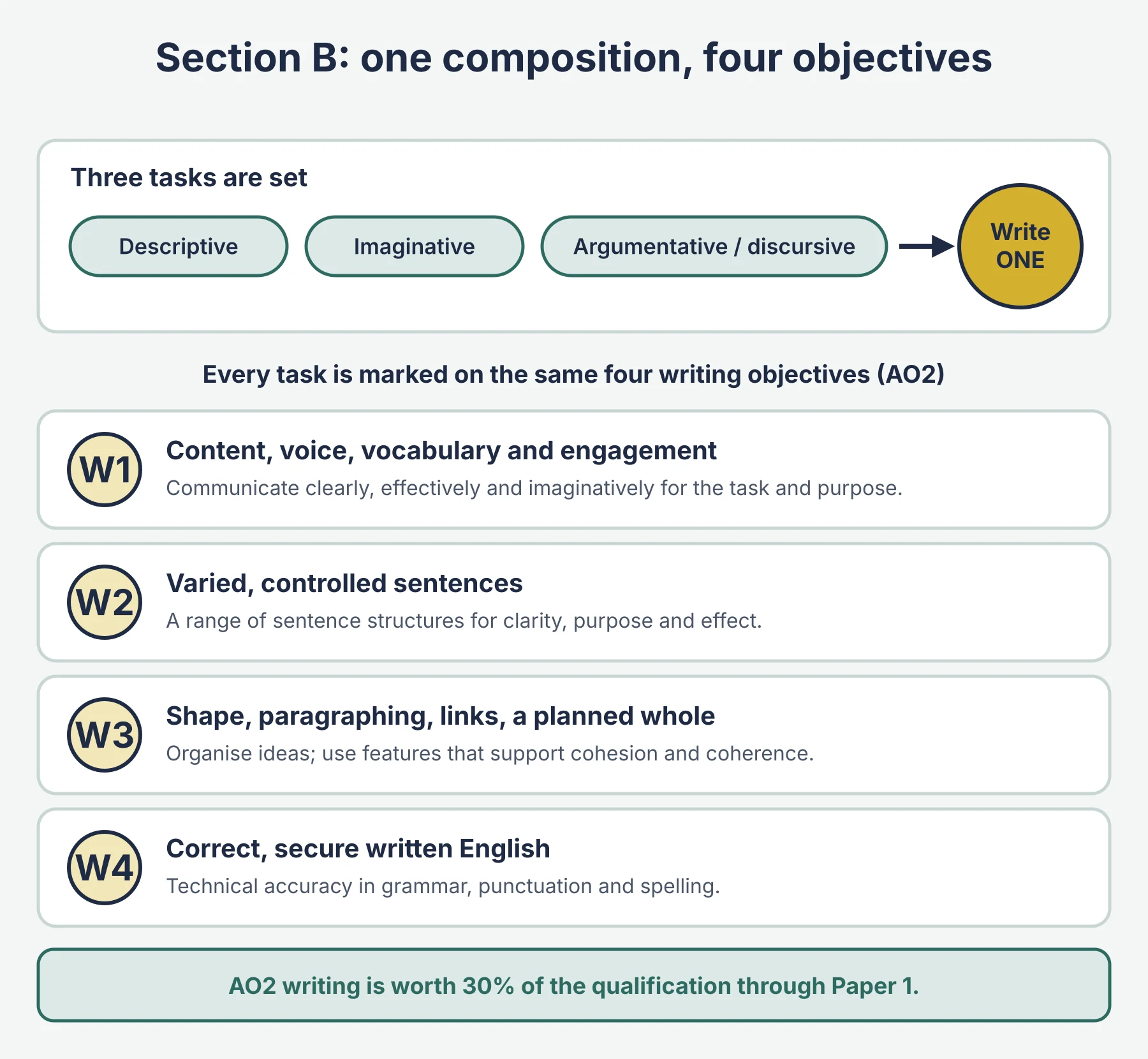
Section B of Paper 1 in OxfordAQA International GCSE English Language (9270) is the composition task. It carries 40 of the paper’s 80 marks. There are three tasks, and you choose one: the specification lists the types as descriptive, imaginative, and argumentative or discursive. This guide explains what each type demands, how the writing objectives are applied, and how to plan and control a piece under exam conditions.
What the specification says
- The writing section consists of three tasks from which students choose one.
- The task types are descriptive, imaginative, argumentative and/or discursive.
- Writing is assessed against AO2, worth 30% of the qualification through Paper 1:
| Objective | Specification wording | In practice |
|---|---|---|
| W1 | Communicate clearly, effectively and imaginatively; use and adapt forms and select vocabulary appropriate to task and purpose in ways that engage the reader | Content, voice, vocabulary and engagement |
| W2 | Use a range of sentence structures for clarity, purpose and effect | Varied, controlled sentences chosen for effect |
| W3 | Organise information and ideas into sentences, paragraphs and whole texts; use a variety of linguistic and structural features to support cohesion and overall coherence | Shape, paragraphing, links, a planned whole |
| W4 | Demonstrate technical accuracy in grammar, punctuation and spelling | Correct, secure written English |
Choosing your task
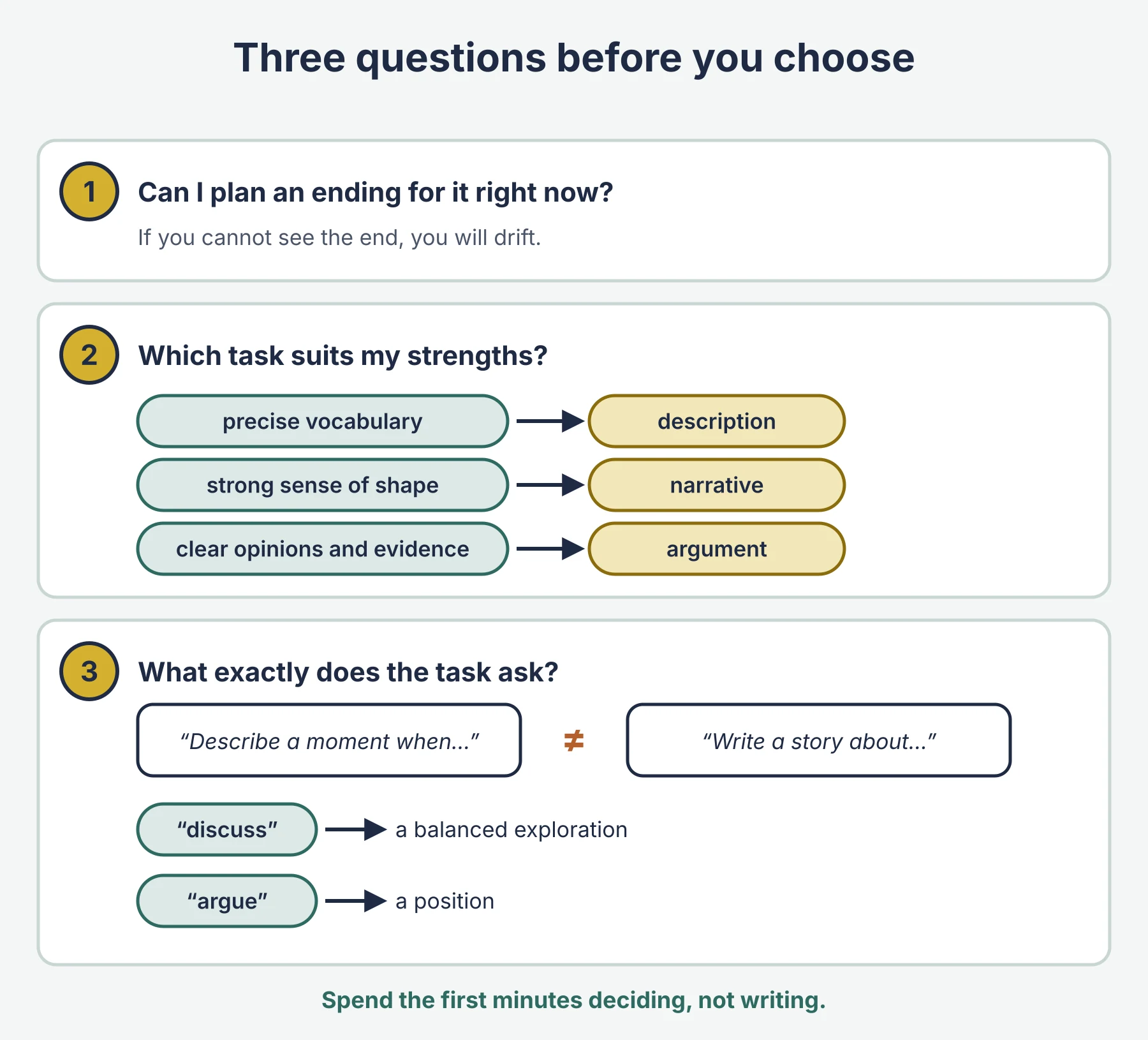
Spend the first minutes deciding, not writing. Ask:
- Which task can I plan an ending for right now? If you cannot see the end, you will drift.
- Which suits my strengths? Precise vocabulary favours description; a strong sense of shape favours narrative; clear opinions and evidence favour argument.
- What exactly does the task ask? “Describe a moment when…” is not “Write a story about…”. A task asking you to “discuss” wants a balanced exploration; one asking you to “argue” wants a position.
Descriptive writing
Description builds a picture and a mood without needing a plot.
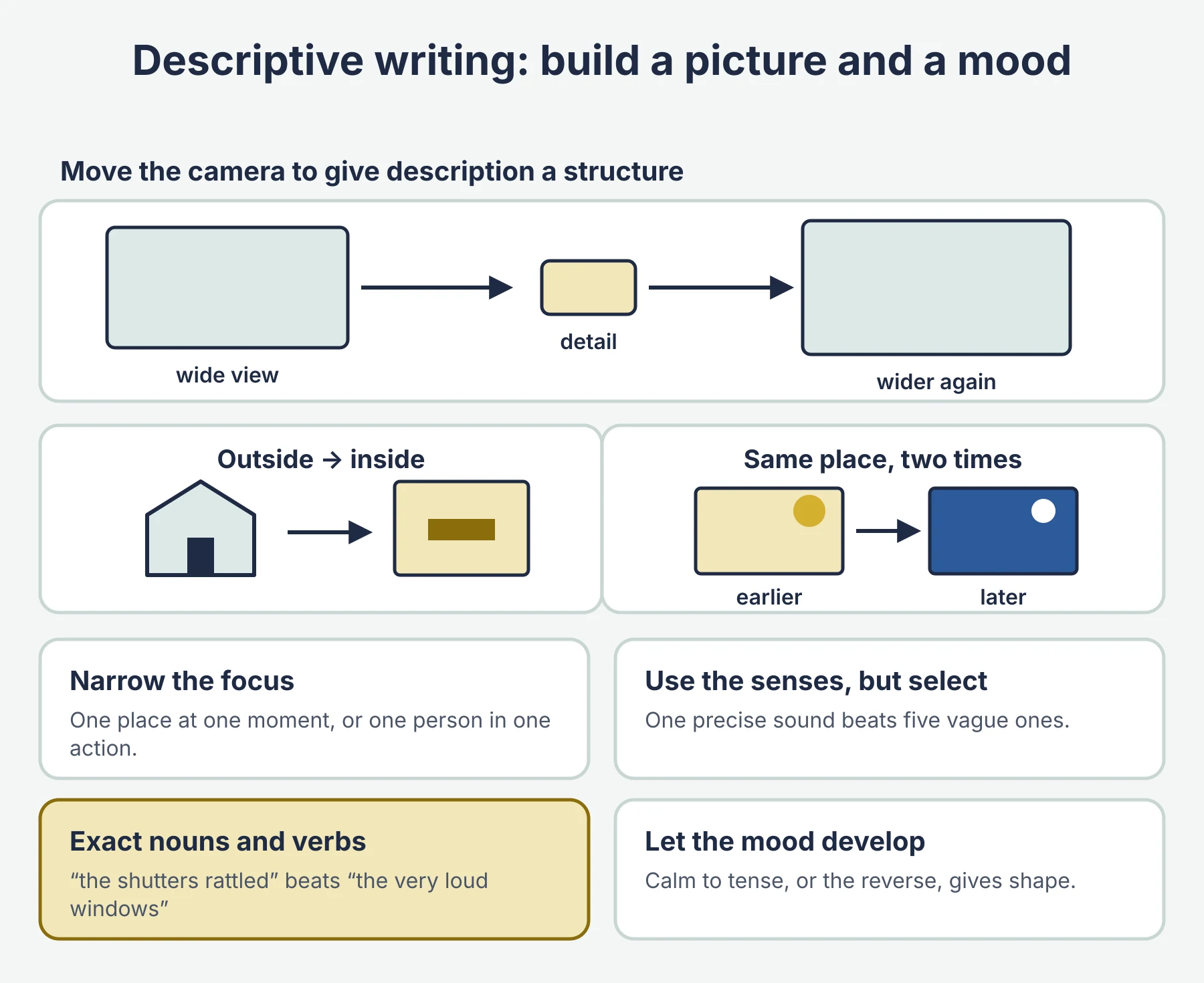
- Narrow the focus. One place at one moment, or one person in one action. A whole day becomes a list.
- Move the camera. Structure description by changing viewpoint: wide view → detail → wider again, or outside → inside, or the same place at two times.
- Use all the senses, but select: one precise sound beats five vague ones.
- Choose exact nouns and verbs before adjectives: “the shutters rattled” is stronger than “the very loud windows”.
- Let the mood develop. A piece that begins calm and ends tense, or the reverse, has shape.
Imaginative writing
Imaginative writing usually means a narrative, but the same control applies.
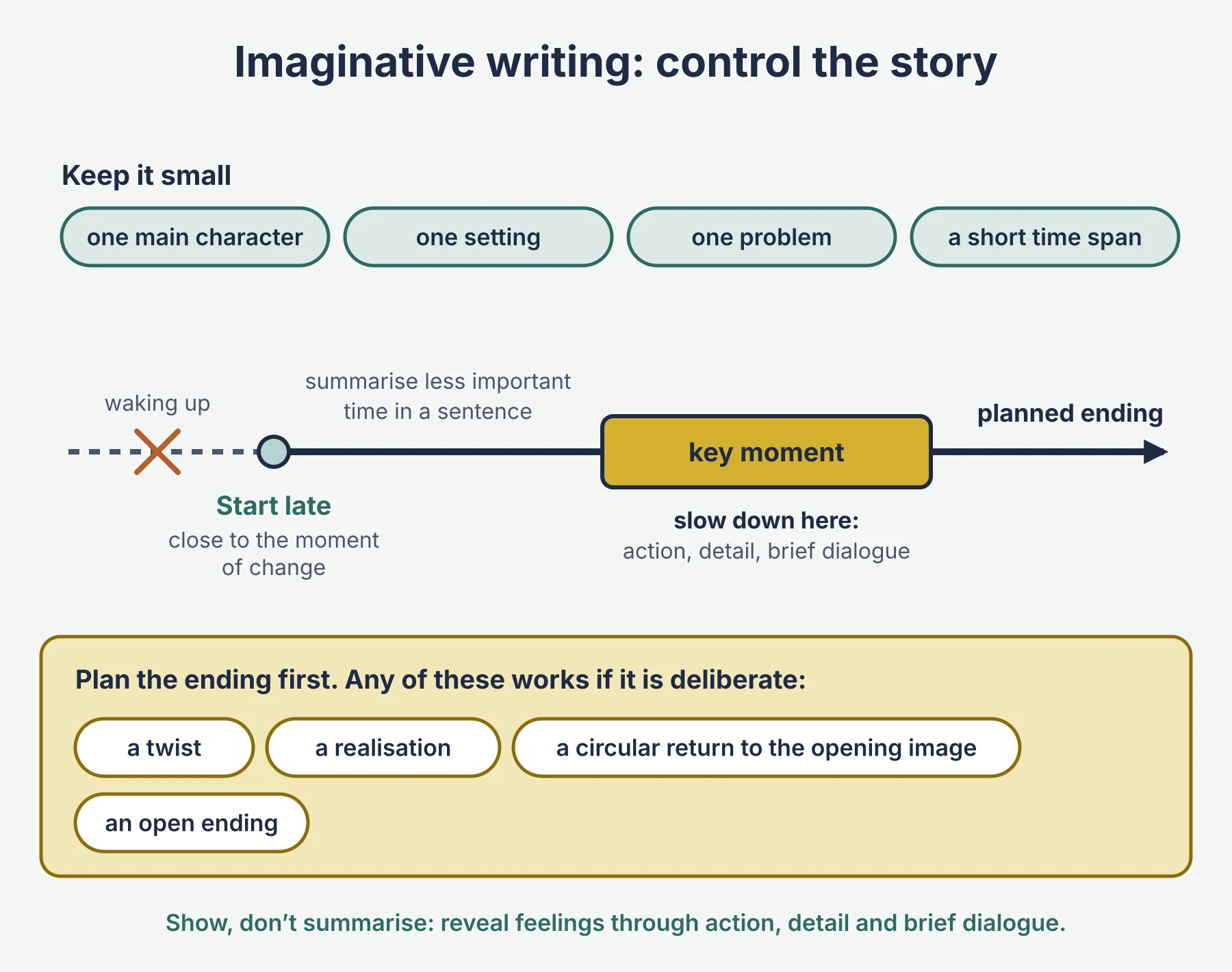
- Keep it small. One main character, one setting, one problem, a short time span.
- Start late. Begin close to the moment of change rather than with waking up.
- Plan the ending first. A twist, a realisation, a circular return to the opening image or an open ending all work if they are deliberate.
- Show, don’t summarise. Reveal feelings through action, detail and brief dialogue.
- Control time. Slow down at the key moment; summarise less important time in a sentence.
Argumentative and discursive writing
These are different tasks, and the difference matters:
| Argumentative | Discursive |
|---|---|
| Takes a clear position and persuades the reader | Explores several viewpoints in a balanced way |
| Counter-arguments raised in order to rebut them | Counter-arguments weighed fairly |
| Confident, committed tone | Measured, reflective tone |
| Ends with a call to action or firm conclusion | Ends with a considered judgement, which may be qualified |
For both:
- Plan three or four developed points, each with evidence or an example and an explanation.
- Open with a hook: an anecdote, a striking fact you know to be true, a question or a bold claim.
- Link paragraphs with discourse markers that show logic: however, consequently, admittedly, in contrast, above all.
- Use rhetoric purposefully: rhetorical questions, direct address, the rule of three, emotive language, but never in every sentence.
- Avoid invented statistics. A vivid, realistic example is more convincing than a made-up number.
Sentence control (W2)
- A short sentence after longer ones creates emphasis.
- A long, multi-clause sentence can build a list of details or show rising tension.
- Fronted adverbials (“Without warning, …”) and subordinate clauses first (“Although the door was open, …”) vary openings.
- Minor sentences (“Silence.”) are effective once or twice, not throughout.
- Vary for a reason: every choice should do a job.
Organisation and cohesion (W3)
- Use paragraphs to mark a change of time, place, speaker, focus or argument.
- Build cohesion with repeated motifs or images, pronouns, synonyms and linking words.
- Aim for coherence across the whole piece: the ending should answer the opening.
Accuracy (W4)
Check in the final minutes for: sentence boundaries (no comma splices), apostrophes, homophones (there/their/they’re, your/you’re), consistent tense, capital letters and the punctuation of speech.
Worked example: a descriptive opening with annotation
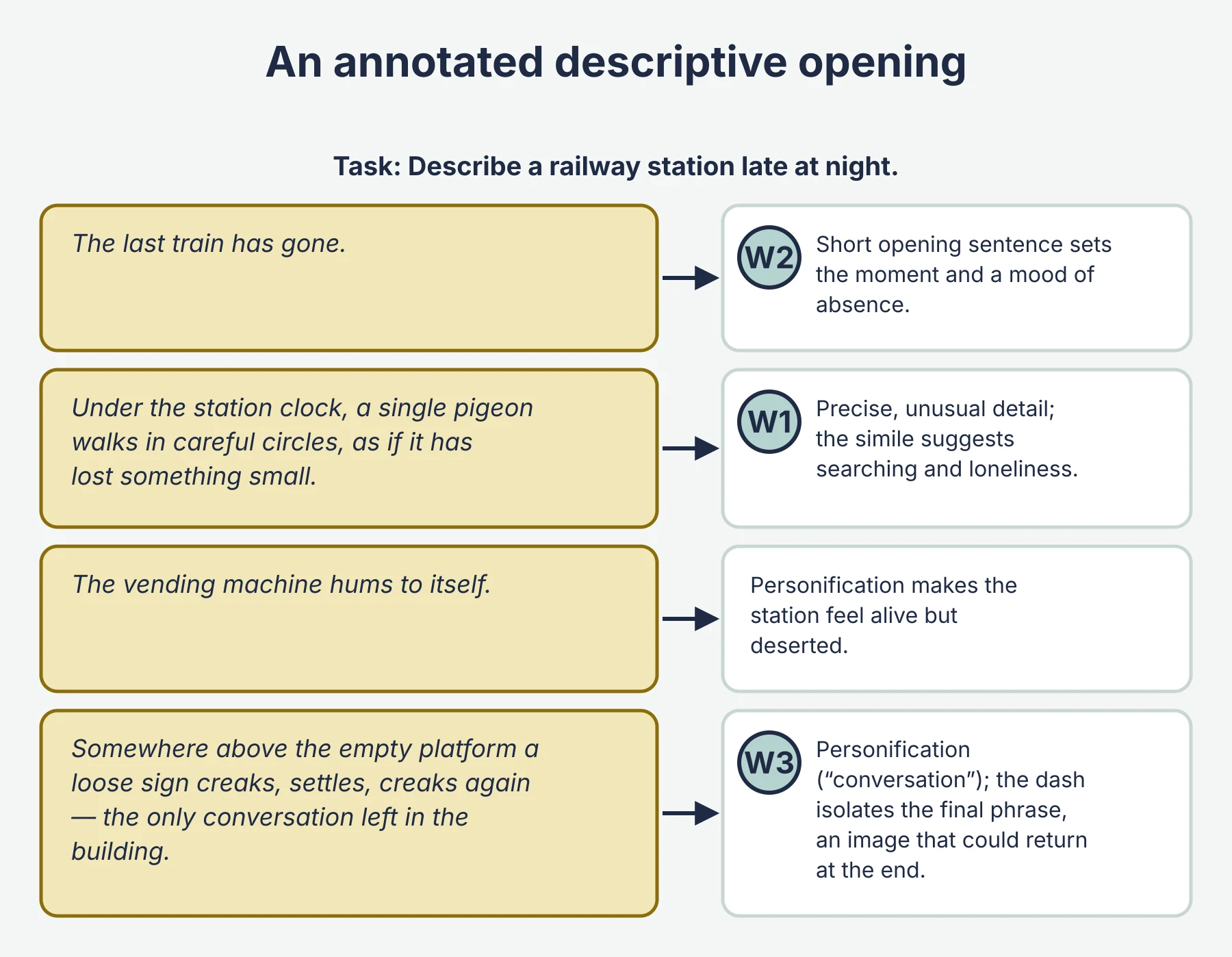
Task (original): Describe a railway station late at night.
The last train has gone. Under the station clock, a single pigeon walks in careful circles, as if it has lost something small. The vending machine hums to itself. Somewhere above the empty platform a loose sign creaks, settles, creaks again — the only conversation left in the building.
- Short opening sentence establishes the moment and the mood of absence (W2).
- Precise, unusual detail: the pigeon “walks in careful circles”, a simile suggesting searching and loneliness (W1).
- Personification of the machine (“hums to itself”) and the sign (“conversation”) makes the station feel alive but deserted.
- Dash isolates the final phrase for emphasis, and the image could return at the end of the piece for a cyclical structure (W3).
Worked example: argument vs discussion
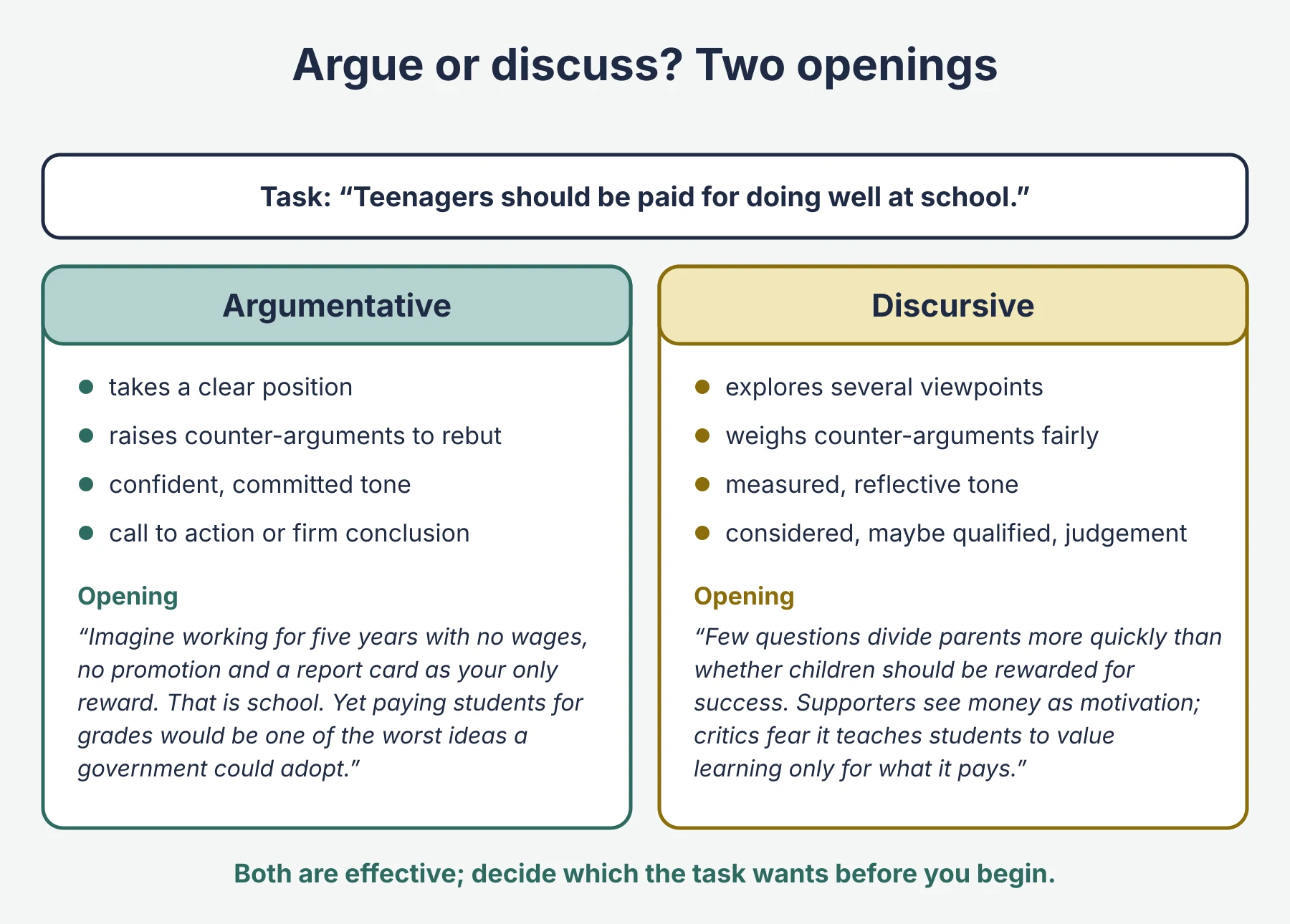
Task (original): “Teenagers should be paid for doing well at school.”
- Argumentative opening: “Imagine working for five years with no wages, no promotion and a report card as your only reward. That is school. Yet paying students for grades would be one of the worst ideas a government could adopt.”
- Discursive opening: “Few questions divide parents more quickly than whether children should be rewarded for success. Supporters see money as motivation; critics fear it teaches students to value learning only for what it pays.”
Both are effective; they simply do different jobs. Decide which the task wants before you begin.
Planning in five minutes
1. Task type and form, in one line
2. Ending: what is the final image, realisation or conclusion?
3. Four or five paragraph headings in order
4. Three ambitious but accurate words or images to use
5. One structural device: cyclical ending, time shift, change of focus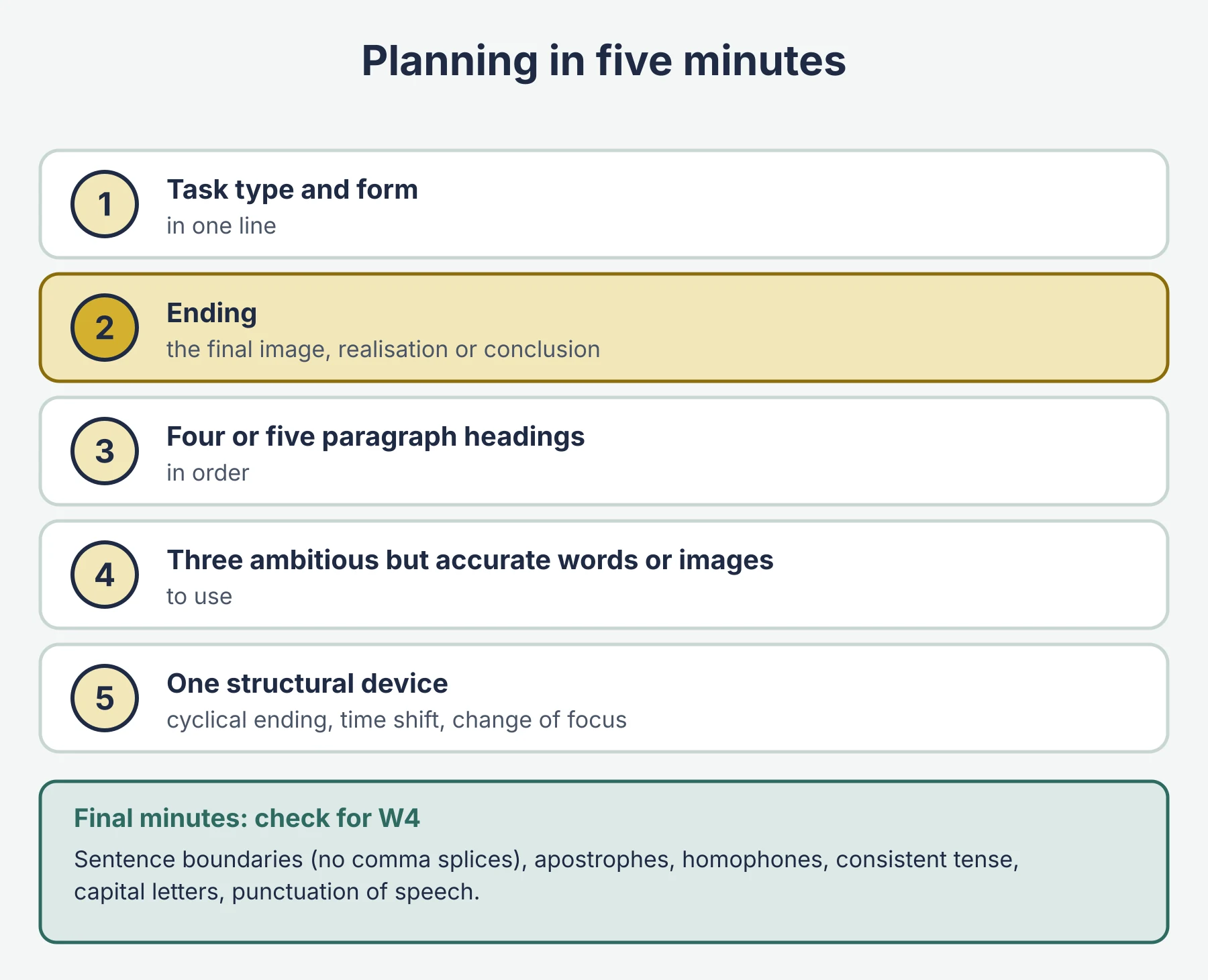
Common mistakes
- Choosing quickly and changing mind half way through.
- Writing a story when asked to describe, or a list of opinions when asked to discuss.
- Over-writing: piling up adjectives and similes until meaning is lost.
- Weak endings: “and then I woke up”, or an argument that simply stops.
- Uncontrolled ambition: a misused word costs more than a simple word used well.
- No time to check, so avoidable errors remain.
More resources on this topic
- Section B composition revision notes
- Section B composition practice questions
- Paper 1 study guide
- Paper 1 Section A literary non-fiction study guide
Source: OxfordAQA International GCSE English Language (9270) specification, Version 5.1, sections 2.2, 3.1.2 and 4.2.
Related resources
-
Practice questions
OxfordAQA International GCSE English Language (9270): Paper 1 Section B — Composition — Practice Questions
Eleven original composition tasks with model plans, openings and endings for OxfordAQA International GCSE English Language 9270 Paper 1 Section B, with answers.
English · OxfordAQA · IGCSE
Try questions -
Revision notes
OxfordAQA International GCSE English Language (9270): Paper 1 Section B — Composition — Revision Notes
Recall notes on the four composition types, W1 to W4, planning and accuracy checks for OxfordAQA International GCSE English Language 9270 Paper 1 Section B.
English · OxfordAQA · IGCSE
Revise topic -
Study guides
OxfordAQA International GCSE English Language (9270): The Whole-Text Question
How to answer the whole-text question in OxfordAQA International GCSE English Language 9270 Paper 1 Section A: tracking, structure, judgement and a model.
English · OxfordAQA · IGCSE
Read guide
Get free revision emails (optional)
Occasional emails with practice questions, worked explanations and links to free resources for the qualification and subjects you choose. No spam, and you can unsubscribe from any email. The free tools on this site never need an email.