
Revision Notes
OxfordAQA International GCSE English Language (9270): Paper 2 Section B — Writing — Revision Notes
Recall notes on audience, purpose, form, register and using sources for OxfordAQA International GCSE English Language 9270 Paper 2 Section B writing.
- Subject
- English
- Level
- IGCSE
- Topic
- Paper 2 – Source-based Reading and Directed Writing
- Author
- Marlbridge Academic Team
- Updated
- Reviewed by
- Ammar Bilal (what this means)
Aligned to OxfordAQA IGCSE English (9270), Version 5.1, for exams May/June 2018 onwards. Official specification .
Syllabus page (what it covers and how it is assessed): OxfordAQA IGCSE English Language.
Found an error? Report a correction.
Need help with this topic? Request a free trial class for IGCSE English Language (9270).
These notes condense Paper 2 Section B of OxfordAQA International GCSE English Language (9270): writing for audience and purpose. For full explanations and worked plans, use the Paper 2 Section B writing study guide.
The facts to know
| Feature | What the specification says |
|---|---|
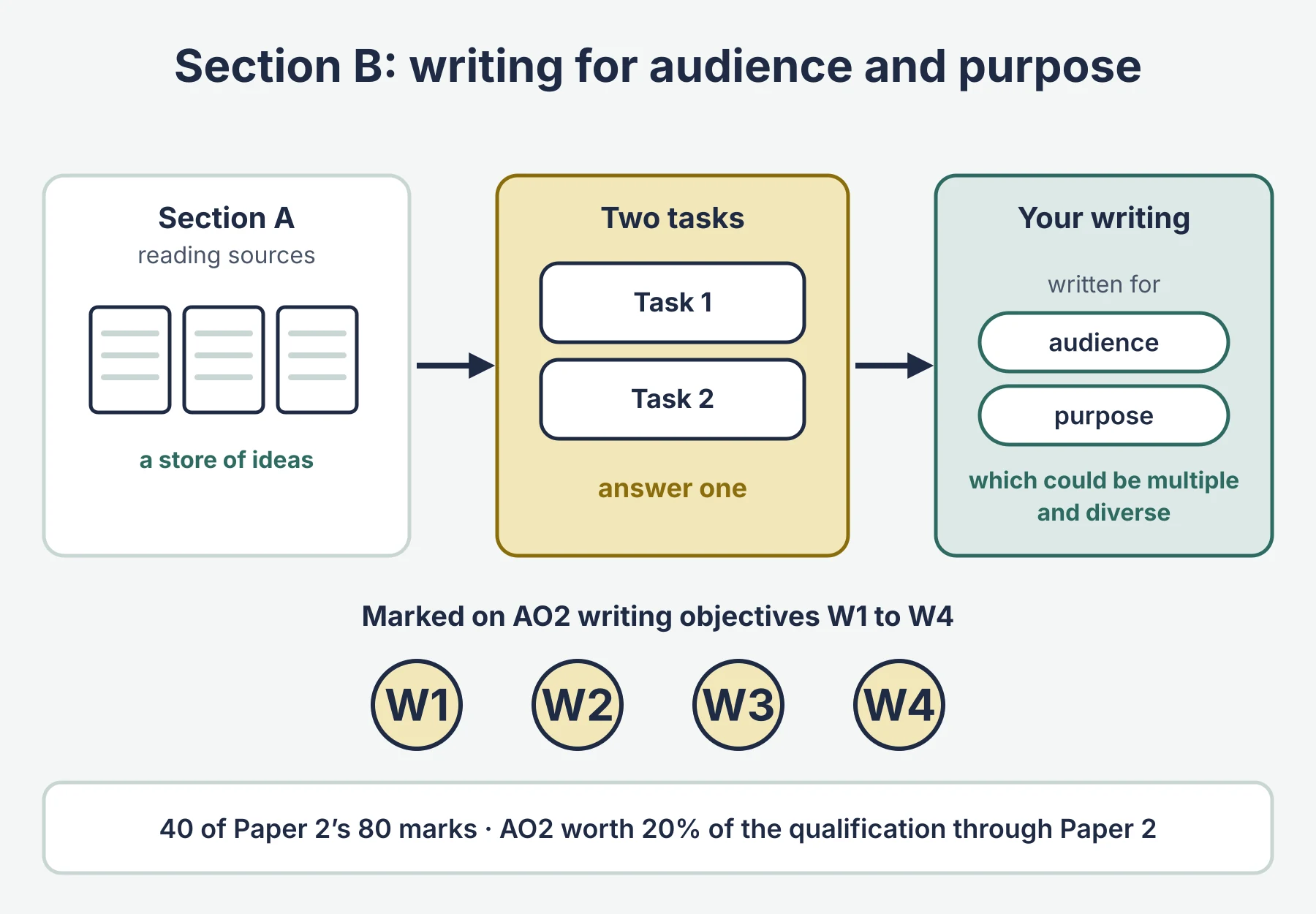
| Marks | Section B: 40 of Paper 2’s 80 |
| Focus | Writing for audience and purpose |
| Audience and purpose | Could be multiple and diverse |
| Link | Writing is linked with the Section A reading sources |
| Choice | Two tasks; answer one |
| Assessed by | AO2: W1–W4 |
| Weighting | AO2 is 20% of the qualification through Paper 2 |
Read every task with AFP + C
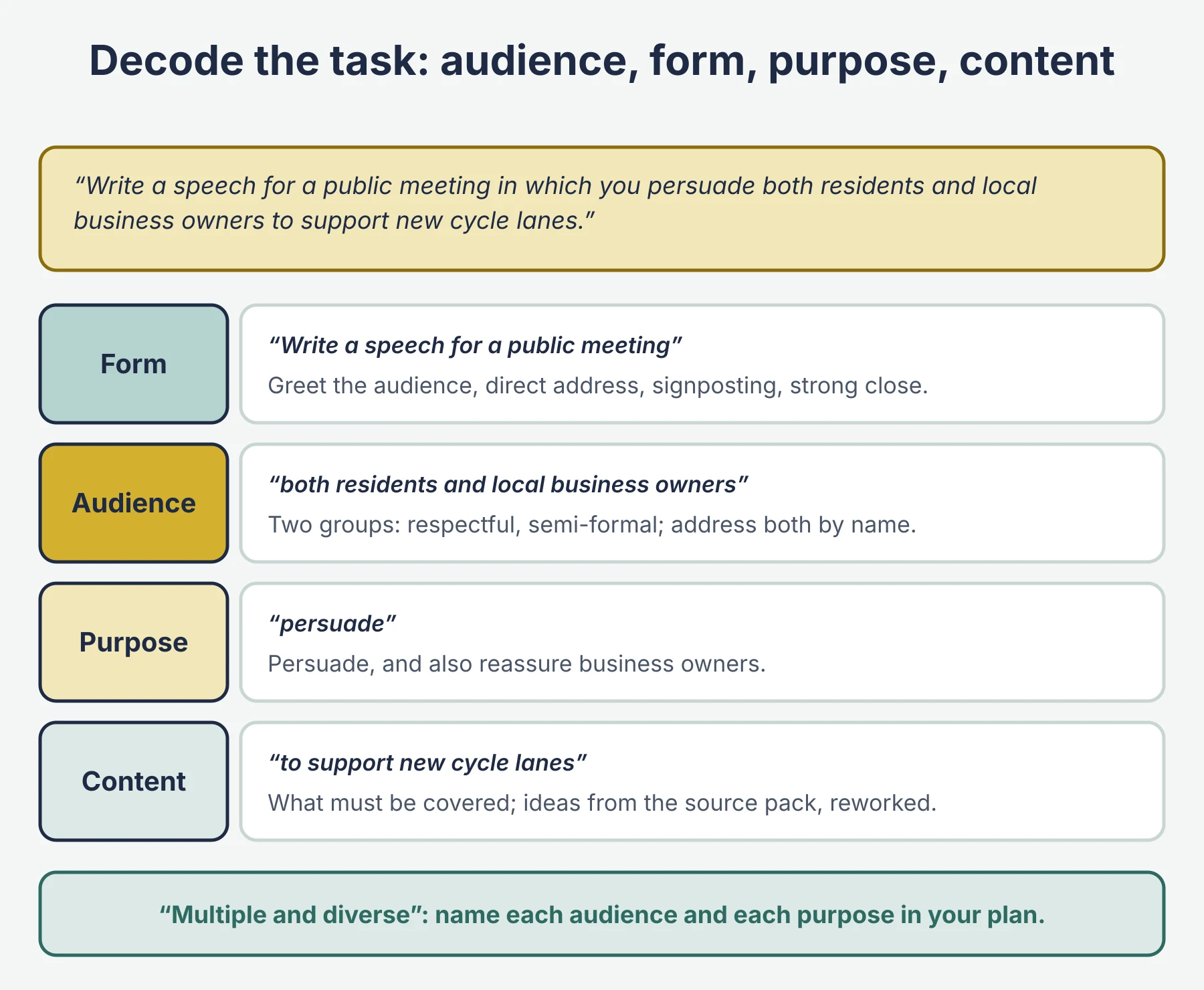
A  Audience   who? one group or several?
F  Form       letter / article / speech / leaflet / report / review / blog
P  Purpose    persuade / argue / inform / explain / advise / review? more than one?
C  Content    what must be covered? what can the sources give me?
Multiple and diverse = more than one audience or purpose in the same task. Name each in your plan and address each in the writing.
Sources: the four rules
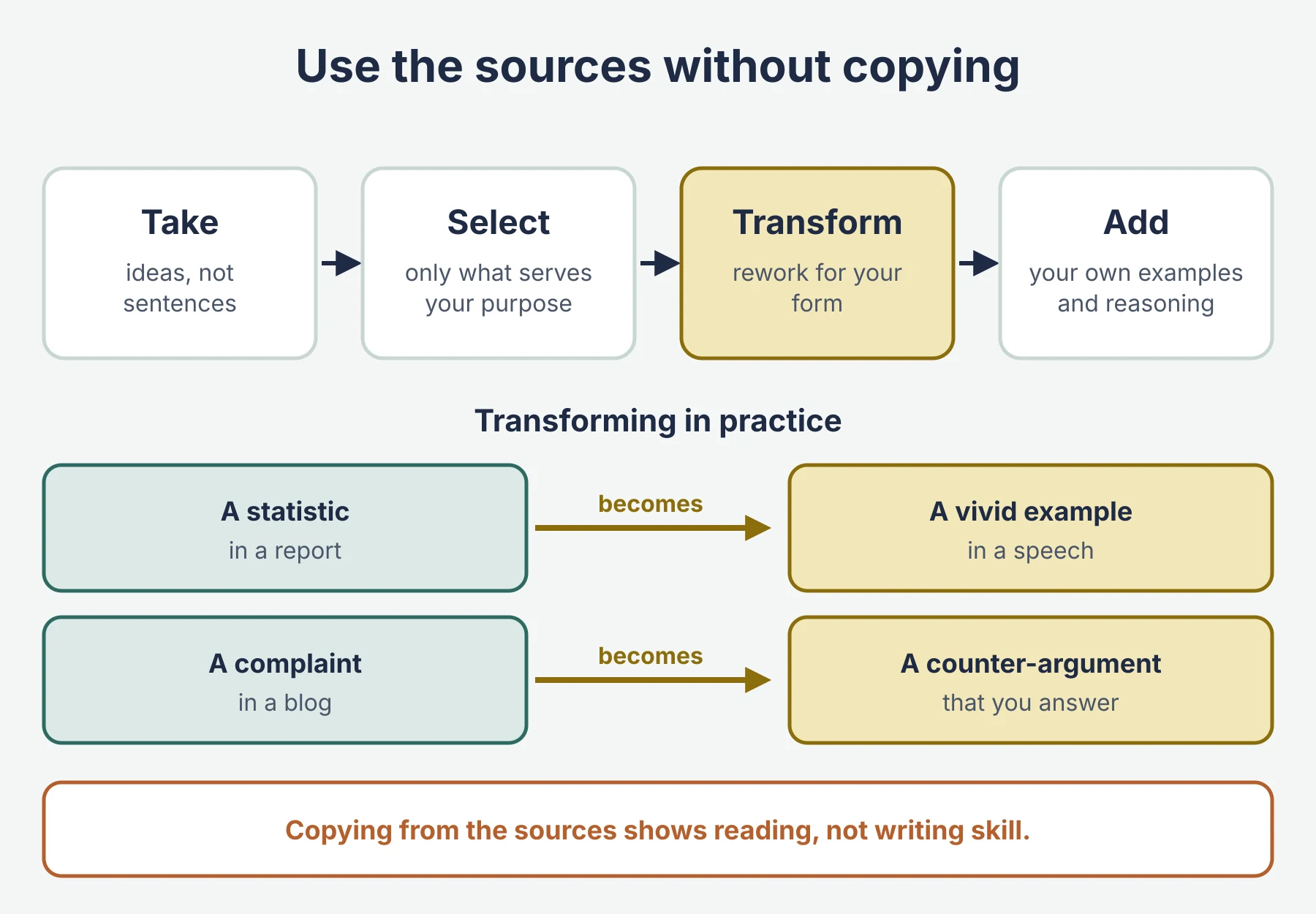
- Ideas, not sentences.
- Select only what serves your purpose.
- Transform source details into your form and voice.
- Add your own examples and reasoning.
Form conventions in brief
| Form | Must-have features |
|---|---|
| Formal letter | “Dear…”, purpose stated early, paragraphs, “Yours sincerely” (named recipient) or “Yours faithfully” (“Dear Sir or Madam”) |
| Article | Headline, strapline (optional), hook opening, paragraphs or sub-headings |
| Speech | Greeting to audience, direct address, signposting, repetition, memorable close (“Thank you”) |
| Leaflet | Title, sub-headings, short sections, call to action or contact point |
| Report | Title, purpose, sections, findings, recommendations |
| Review | Overview, strengths and weaknesses, recommendation |
| Blog | Engaging title, personal voice, conversational links |
Register ladder
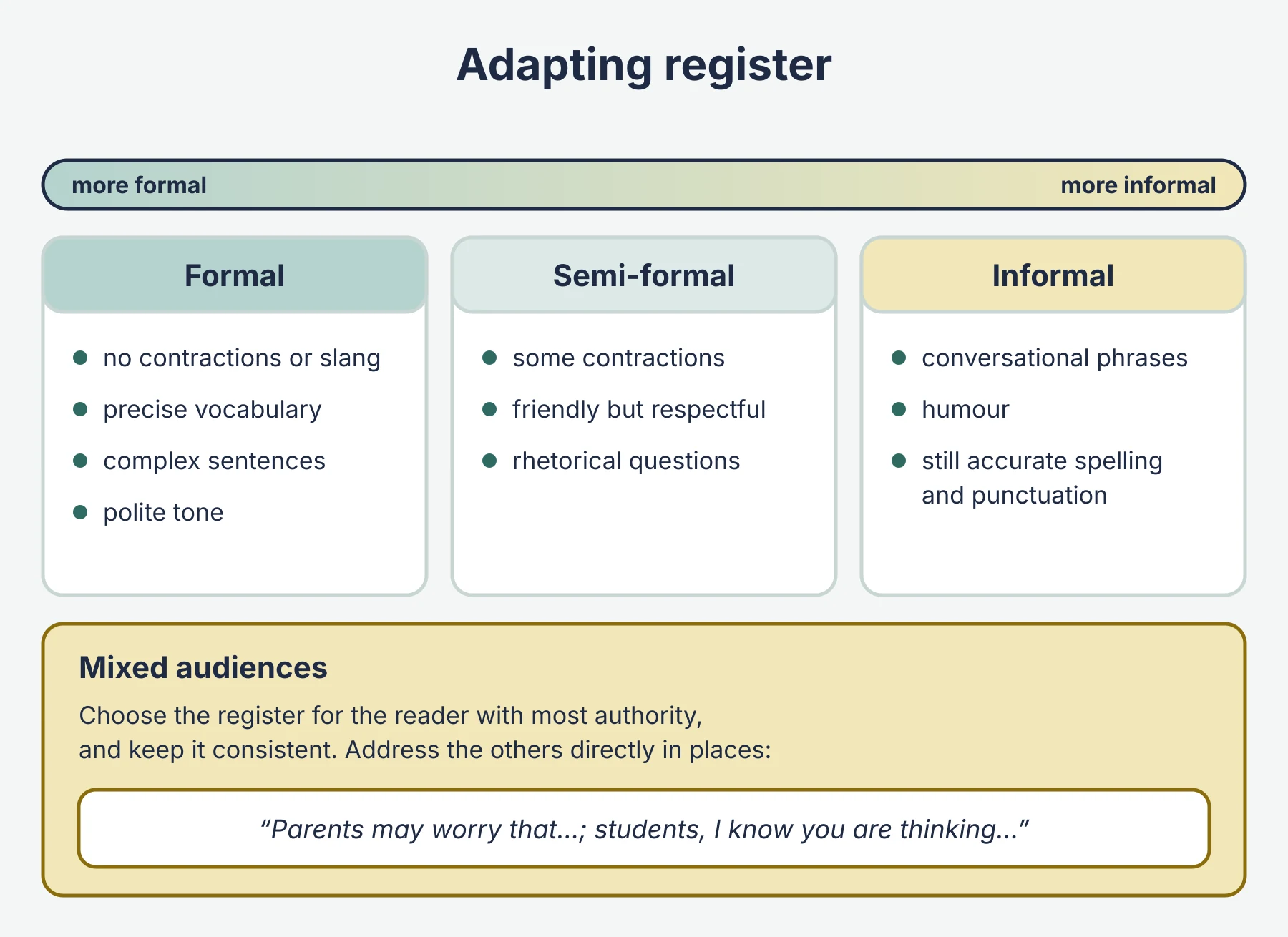
| Level | Signs | Typical audience |
|---|---|---|
| Formal | No contractions or slang; precise vocabulary; complex sentences | Head teacher, council, employer |
| Semi-formal | Some contractions; friendly but respectful; rhetorical questions | Parents, local residents, school magazine |
| Informal | Conversational, humour, slang avoided in exams | Friend, peer blog |
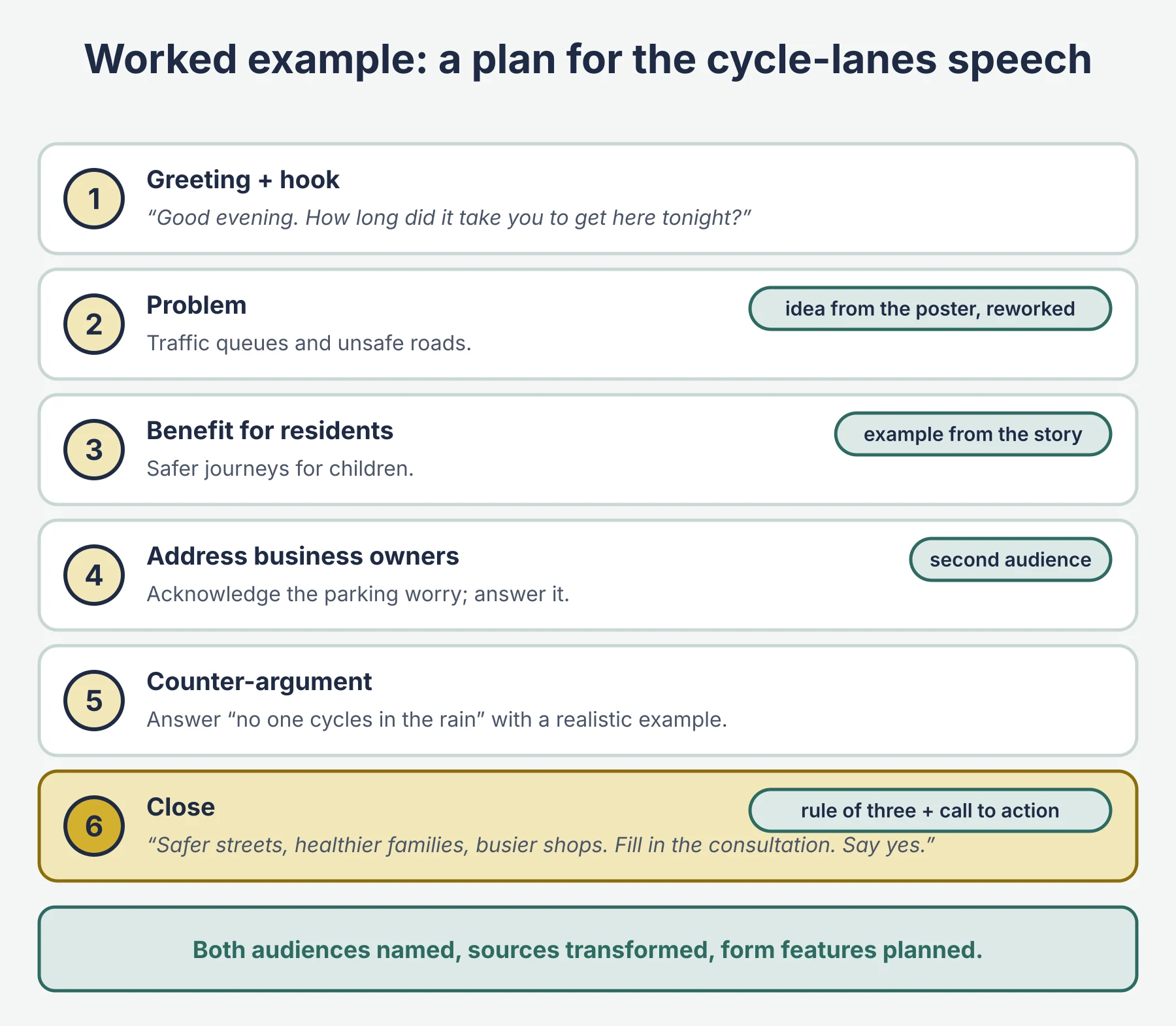
Mixed audiences: pitch to the one with most authority; turn to address the others directly.
Paragraph engine
Topic sentence  ->  development  ->  example (own or transformed from a source)
->  link back to purpose or audience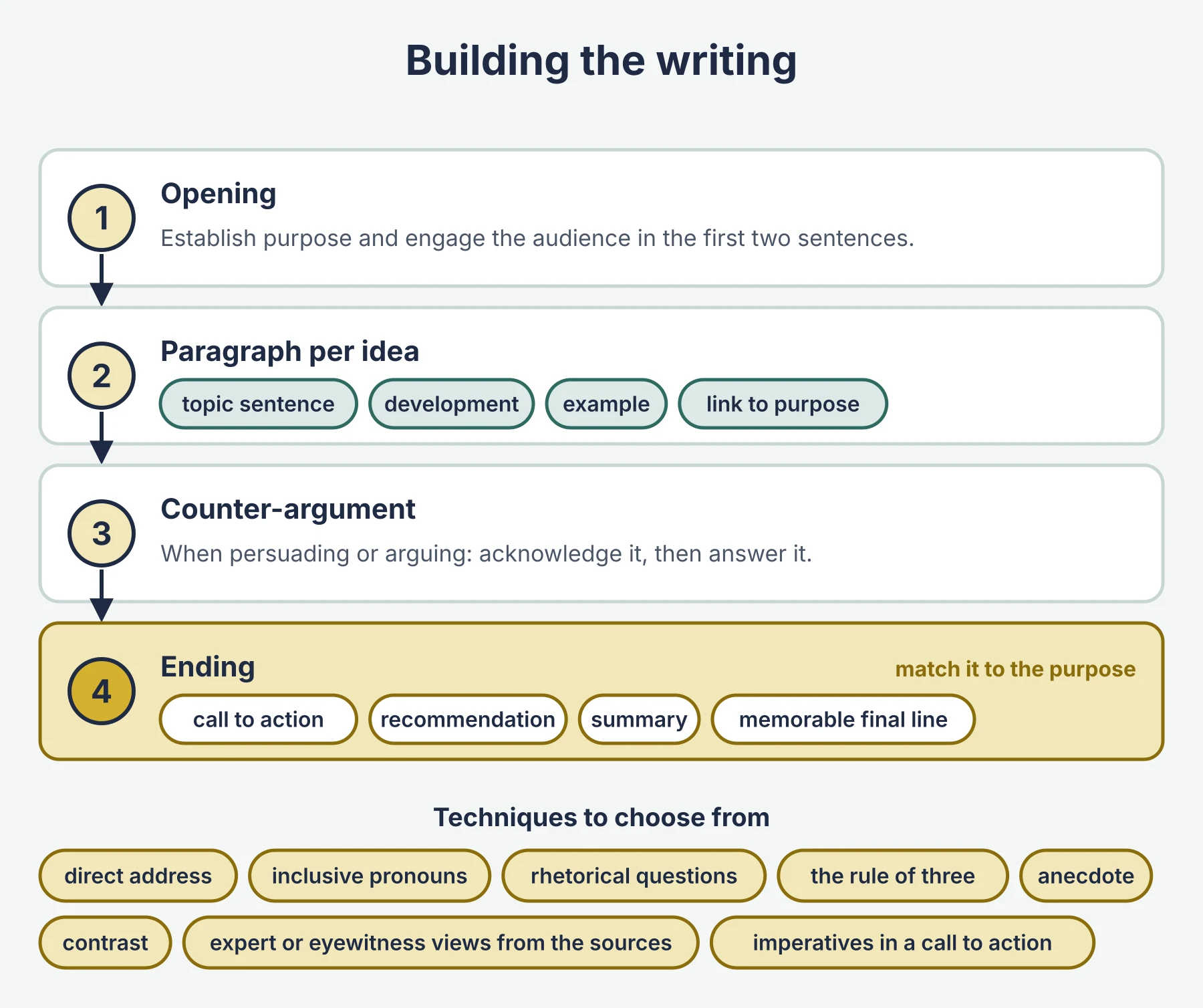
Persuasive and explanatory tools
| Tool | Best for |
|---|---|
| Direct address, inclusive “we” | Building connection |
| Rhetorical question | Making readers think |
| Rule of three | Memorable emphasis |
| Anecdote | Making an issue personal |
| Counter-argument and rebuttal | Persuading sceptical readers |
| Signposting (“firstly”, “above all”) | Speeches and explanations |
| Imperatives | Calls to action, advice |
Openings and endings
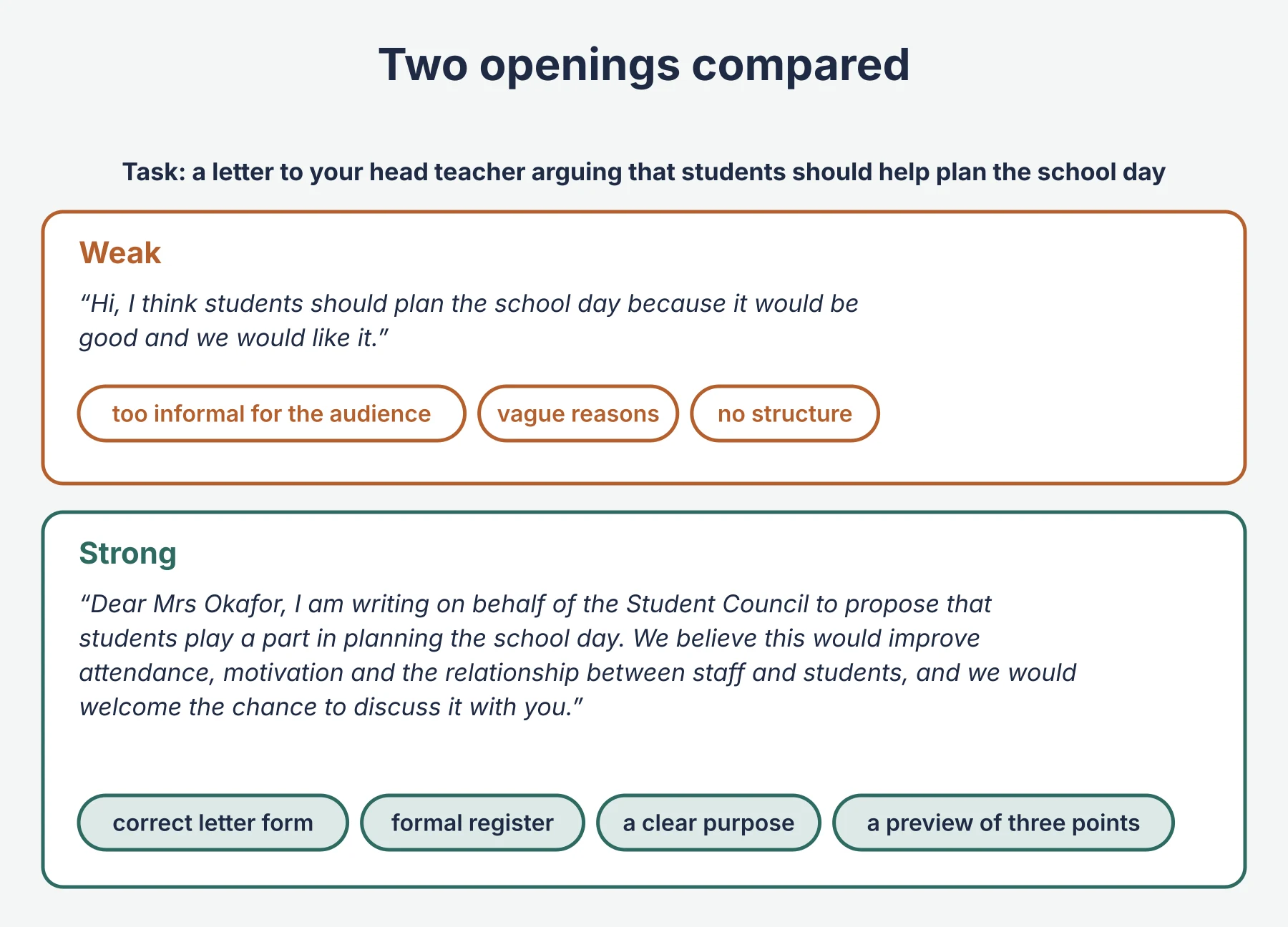
- Open with purpose plus engagement: a question, a scenario, a clear statement of what you propose.
- End to match purpose: call to action (persuade), recommendation (report), summary and advice (inform/advise), final verdict (review).
Five-minute plan template
Task in one line:      ______________________________
Audience(s):           ______  and  ______
Purpose(s):            ______  then ______
Form features:         opening ____ / headings? ____ / sign-off ____
Paragraph order:       1 ____  2 ____  3 ____  4 ____  5 ____
Source ideas to transform:  ____ , ____
Ending type:           call to action / recommendation / verdict
Fill it in before writing a sentence of the response; tick each line again at the end.
Key terms
| Term | Meaning |
|---|---|
| Audience | The intended reader or listener |
| Purpose | What the writing aims to achieve |
| Form | The type of text and its conventions |
| Register | The level of formality |
| Strapline | A short line under a headline expanding it |
| Signposting | Phrases that guide a listener through a speech |
| Call to action | A direct request for the audience to do something |
| Rebuttal | Answering an opposing view |
Exam traps
- An essay in place of the named form.
- One audience ignored when the task names two.
- Lifting sentences from the sources.
- Register drifting from formal to chatty.
- Drawing layout instead of writing headings in words.
- No ending: the piece simply stops.
- No proofreading time.
Self-test
- How many writing tasks are offered in Paper 2 Section B?
- What is the focus of the writing task according to the specification?
- What does “multiple and diverse” audience and purpose mean in practice?
- How is Section B linked to Section A?
- Give two rules for using the sources.
- Name three conventions of a formal letter.
- When do you sign off “Yours faithfully”?
- Give three features of a speech.
- Which register suits a letter to a local council?
- How should you handle a task with two different audiences?
- Name two ways to end a persuasive piece.
- Which writing objective covers spelling, punctuation and grammar?
Answers: 1. Two; you answer one. 2. Writing for audience and purpose. 3. A task may address more than one group of readers or combine purposes, such as informing and persuading, so the writing must respond to each. 4. The writing is linked with the reading sources. 5. Any two: take ideas, not sentences; select; transform; add your own. 6. Any three: greeting, purpose stated early, paragraphs, formal sign-off, formal register. 7. When the letter begins “Dear Sir or Madam” and the recipient is not named. 8. Any three: greeting to the audience, direct address, signposting, repetition, a memorable close. 9. Formal. 10. Pitch the register to the reader with most authority and address each group directly at points in the writing. 11. Any two: a call to action, a memorable final line, a rule of three summary, a direct appeal. 12. W4.
More resources on this topic
- Paper 2 Section B writing practice questions
- Paper 2 revision notes
- Paper 2 Section A reading revision notes
Source: OxfordAQA International GCSE English Language (9270) specification, Version 5.1.
Related resources
-
Study guides
OxfordAQA IGCSE English Language: Source-Based Reading and Directed Writing (9270)
OxfordAQA International GCSE English Language 9270 Paper 2: reading modern-world source texts and writing for a set audience and purpose, the exam route.
English · OxfordAQA · IGCSE
Read guide -
Revision notes
OxfordAQA IGCSE English Language: Source-Based Reading and Directed Writing — Revision Notes
Condensed recall notes on modern-issue source reading and directed writing technique for OxfordAQA International GCSE English Language Paper 2 (9270).
English · OxfordAQA · IGCSE
Revise topic -
Practice questions
OxfordAQA IGCSE English Language: Source-Based Reading and Directed Writing — Practice Questions
Original practice with worked answers on modern-world sources, visual and graphic texts and directed writing for OxfordAQA GCSE English Language 9270.
English · OxfordAQA · IGCSE
Try questions
Get free revision emails (optional)
Occasional emails with practice questions, worked explanations and links to free resources for the qualification and subjects you choose. No spam, and you can unsubscribe from any email. The free tools on this site never need an email.