
Revision Notes
OxfordAQA International GCSE English Language (9270): Paper 2 Section A — Reading — Revision Notes
Recall notes on reading five or six sources, visual texts, synthesis and comparison for OxfordAQA International GCSE English Language 9270 Paper 2 Section A.
- Subject
- English
- Level
- IGCSE
- Topic
- Paper 2 – Source-based Reading and Directed Writing
- Author
- Marlbridge Academic Team
- Updated
- Reviewed by
- Ammar Bilal (what this means)
Aligned to OxfordAQA IGCSE English (9270), Version 5.1, for exams May/June 2018 onwards. Official specification .
Syllabus page (what it covers and how it is assessed): OxfordAQA IGCSE English Language.
Found an error? Report a correction.
Need help with this topic? Request a free trial class for IGCSE English Language (9270).
These notes condense Paper 2 Section A of OxfordAQA International GCSE English Language (9270): source-based reading. For full explanations and a model comparison, use the Paper 2 Section A reading study guide.
The facts to know
| Feature | What the specification says |
|---|---|
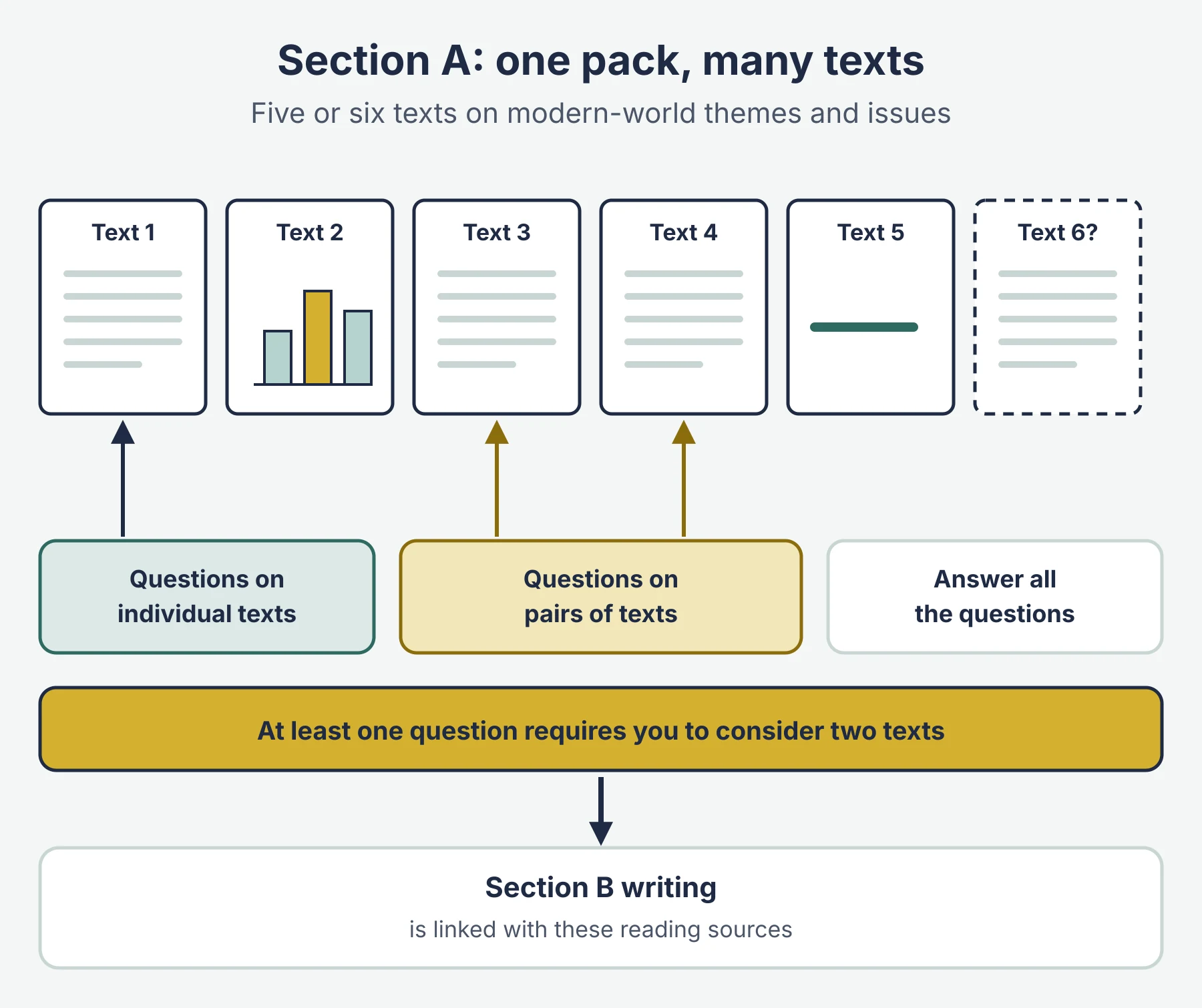
| Marks | Section A: 40 of Paper 2’s 80 |
| Texts | 5–6 texts of stimulus material |
| Themes | Modern world themes and issues |
| Types | Fiction or non-fiction; some brief or solely visual |
| Questions | On individual texts and pairs of texts |
| Two-text rule | At least one question requires two texts |
| Link | Section B writing is linked to these sources |
Paper 2 lasts 2 hours and carries 40% of the qualification; it is the exam alternative to the non-exam assessment project.
R1–R4 with several sources
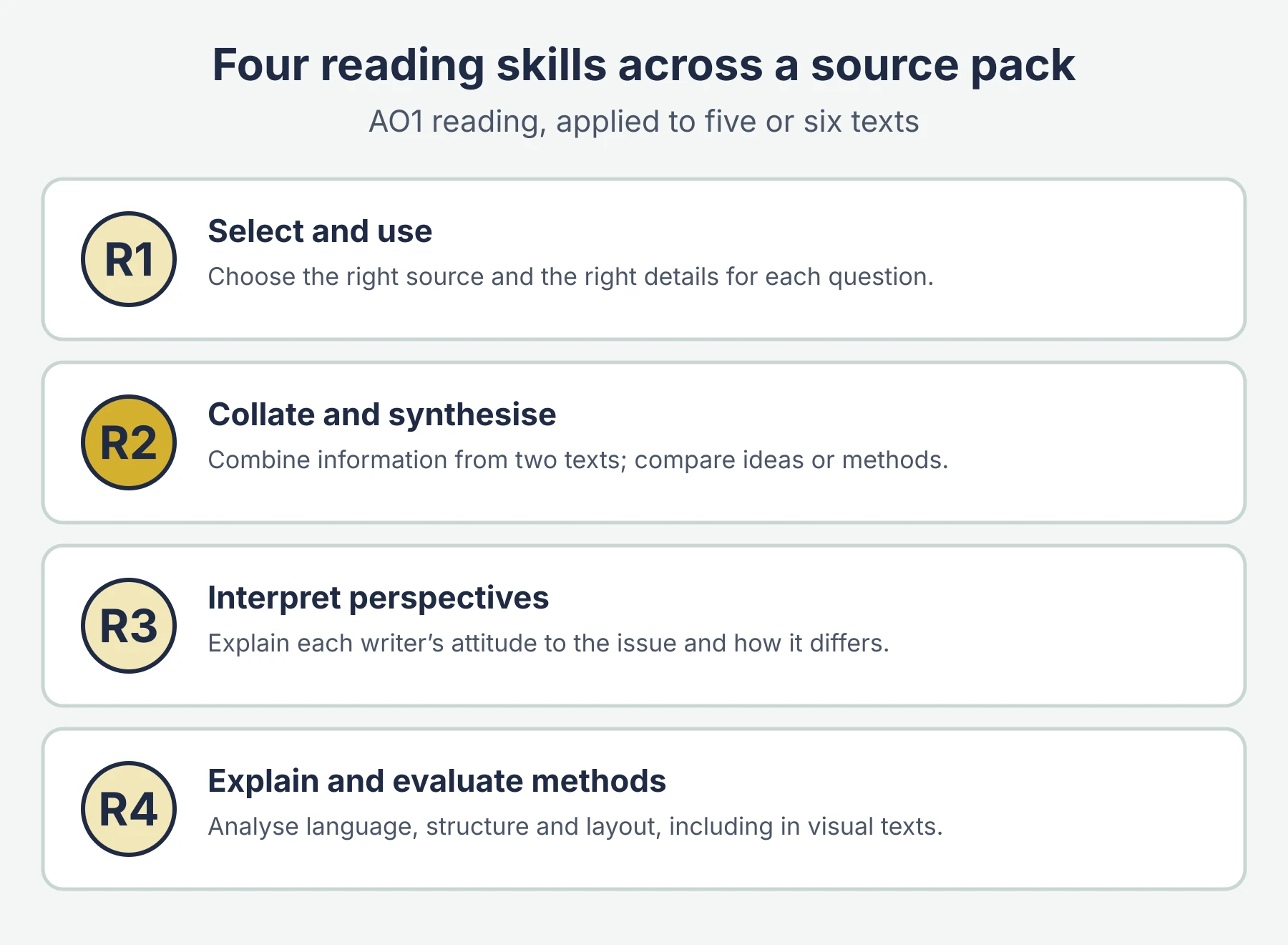
- R1 — select: right source, right details, used for the question’s purpose.
- R2 — synthesise and compare: combine details across texts; cross-reference and compare.
- R3 — interpret perspectives: what each writer thinks about the issue.
- R4 — analyse and evaluate methods: language, grammar, structure and presentation.
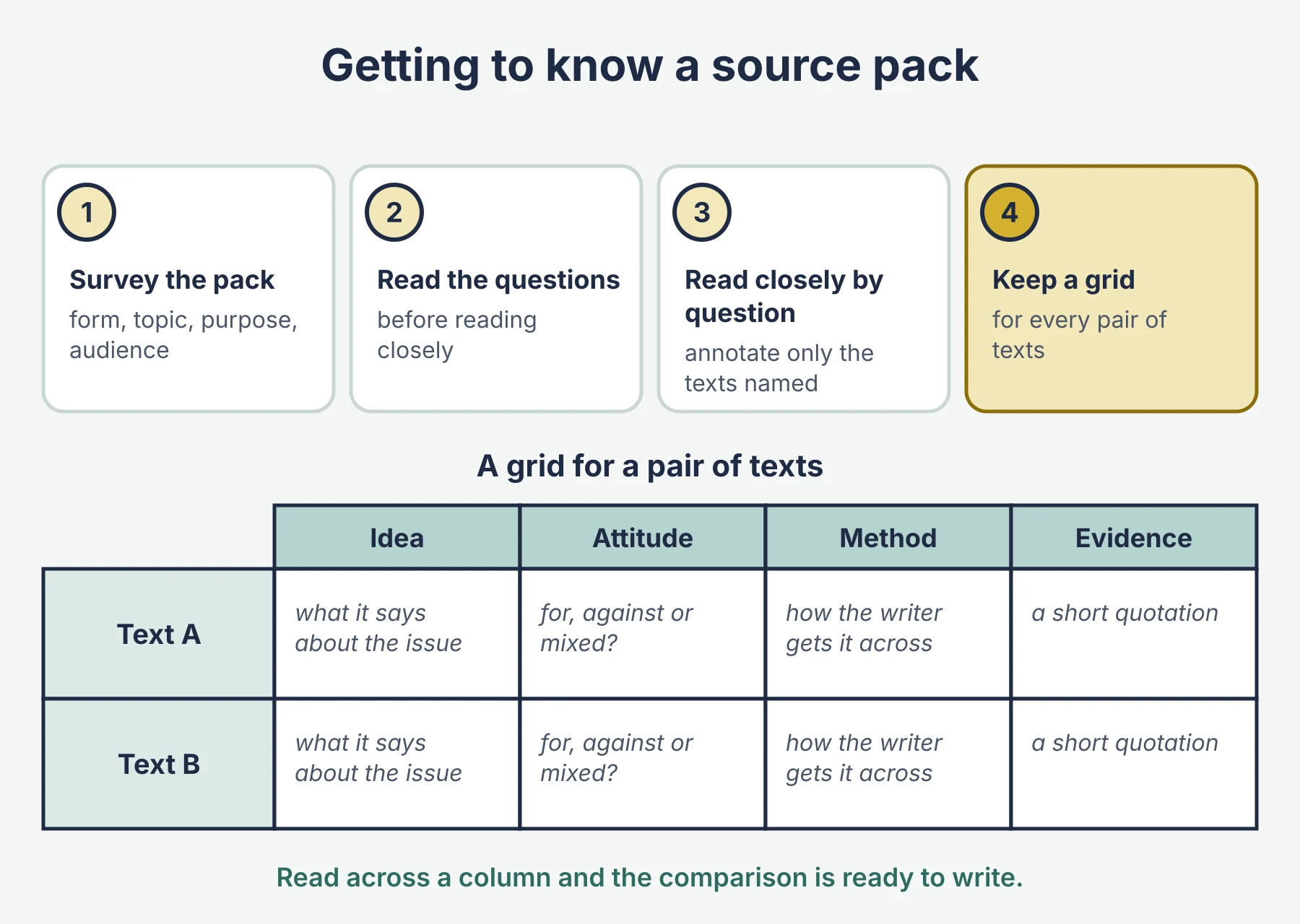
First five minutes: survey grid
| Text | Form | Topic | Purpose | Audience | Attitude |
|---|---|---|---|---|---|
| A | |||||
| B | |||||
| … |
Fill it in brief words. It makes pairing questions much faster.
Source types and what to look for
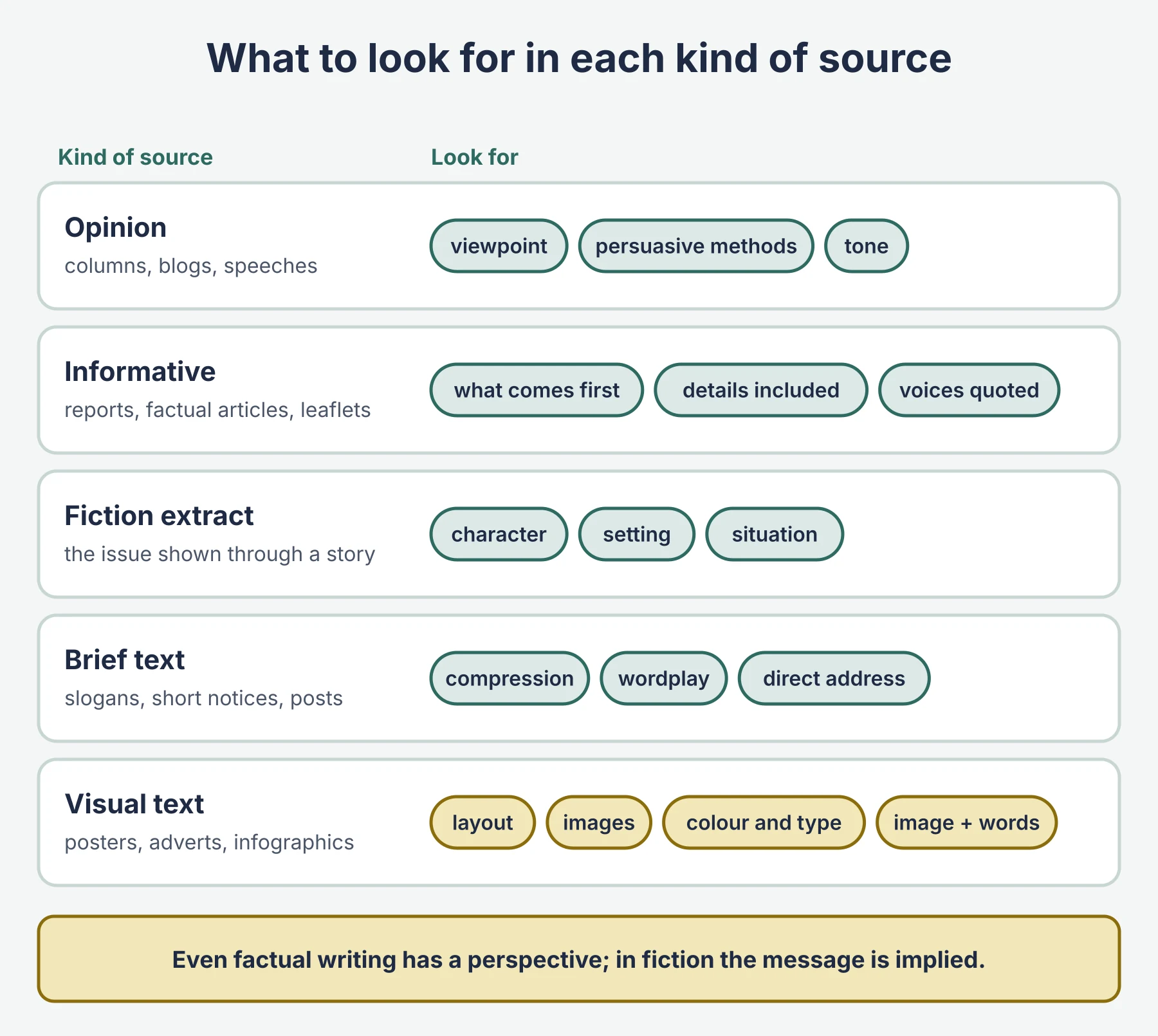
| Source type | Look for |
|---|---|
| Opinion (column, blog, speech) | Viewpoint, persuasive methods, tone, call to action |
| Informative (report, article, leaflet) | Selection and order of facts, whose voices are quoted, headings |
| Fiction extract | Character, setting and situation carrying an implied view of the issue |
| Brief text (slogan, notice, post) | Compression, wordplay, imperatives, direct address |
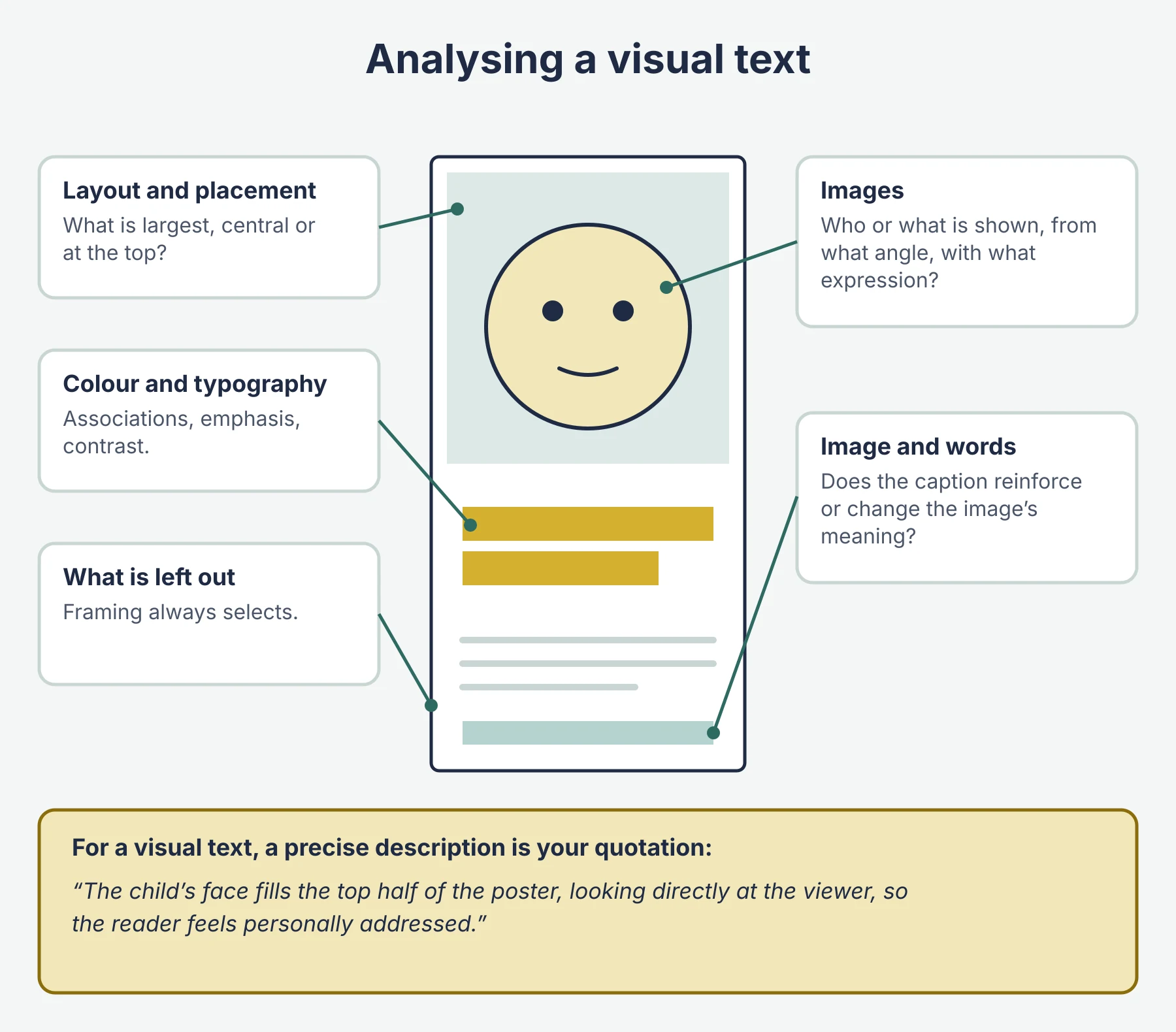
| Visual (poster, advert, infographic) | Layout, image, colour, typography, image–word link, omission |
Presentational features checklist
- Size and position: what is largest or central = main message.
- Image: subject, angle, gaze (looking at the viewer?), expression.
- Colour: associations (red = danger, green = nature) and contrast.
- Typography: bold, capitals, font style, size.
- Image and text: does the caption confirm, sharpen or change the image?
- Framing and omission: what has been cropped out or not mentioned?
Synthesis vs comparison
SYNTHESIS   combine information:  "Together, A and B show that…"
COMPARISON  set side by side:     "Whereas A presents…, B presents…"
Integrated paragraph shape:
1. Shared point or key difference (topic sentence naming both texts)
2. Evidence from text 1 + brief analysis
3. Comparative connective + evidence from text 2 + brief analysis
4. What the similarity or difference reveals about purpose or perspective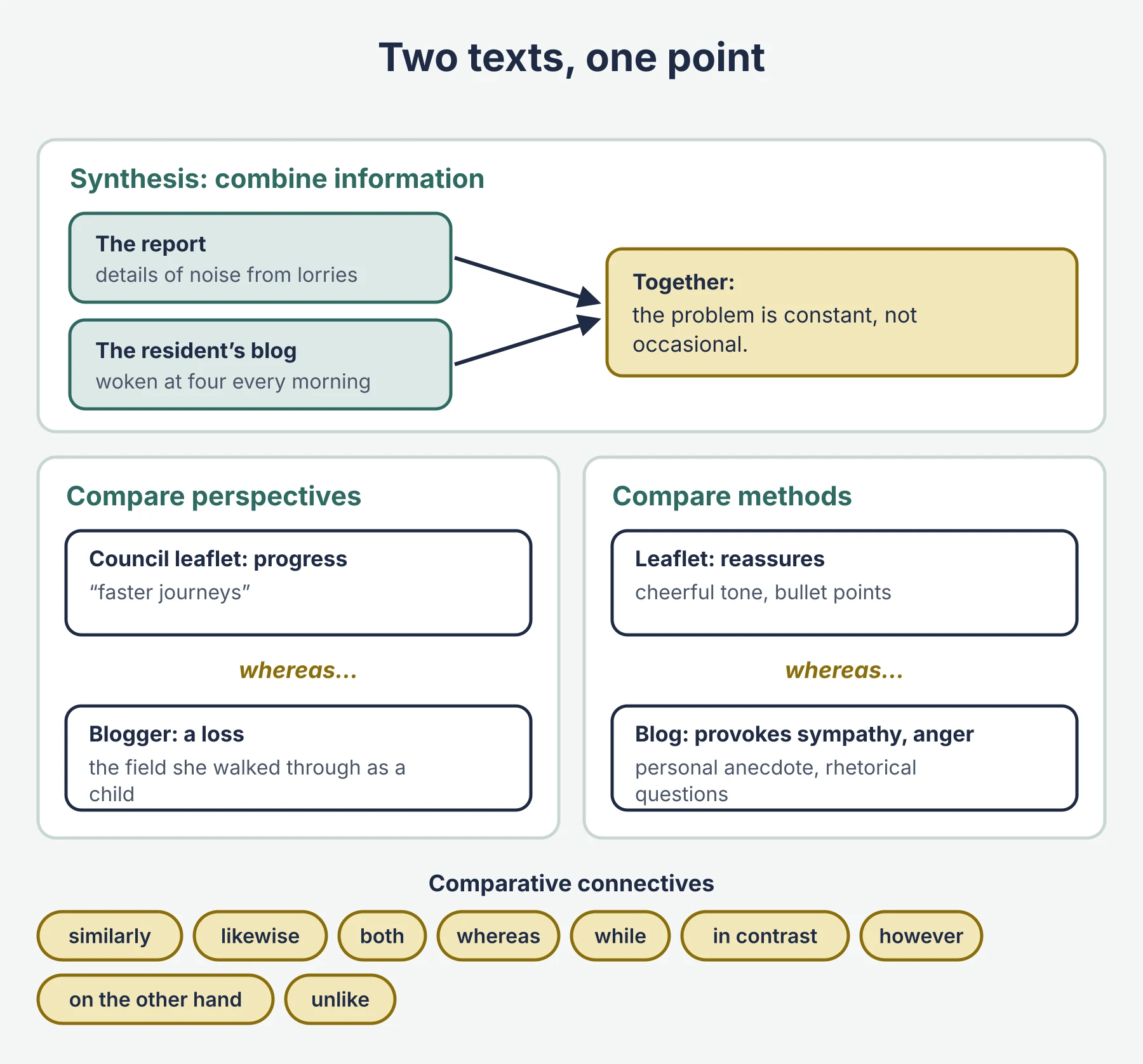
Comparative connectives
| Similarity | Difference |
|---|---|
| both, similarly, likewise, in the same way, also | whereas, while, in contrast, however, unlike, on the other hand, conversely |
Perspective clues
- Loaded vocabulary and connotation.
- Who is quoted and who is not.
- Headline or opening framing.
- What is emphasised visually.
- Tone: enthusiastic, sceptical, angry, neutral-seeming.
Key terms
| Term | Meaning |
|---|---|
| Stimulus material | The set of texts provided |
| Synthesis | Combining details from more than one source into one point |
| Cross-reference | Linking a detail in one text to a detail in another |
| Presentational features | Layout, images, colour, typography and design |
| Perspective | A writer’s viewpoint on an issue |
| Implicit meaning | What is suggested rather than stated |
| Multimodal text | A text using words and images together |
Exam traps
- Using the wrong text, or all texts, for a question that names one.
- Writing “Text A says… Text B says…” in separate paragraphs for a pair question.
- Describing a picture without explaining its effect.
- Treating facts as neutral.
- Arguing your own view of the issue instead of analysing the writers’.
- Copying sentences from sources into Section B.
- Leaving too little time for Section B’s 40 marks.
Self-test
- How many texts make up the stimulus material?
- What theme do Paper 2 reading texts relate to?
- Can Paper 2 sources be fiction?
- What is the minimum number of questions that require two texts?
- Which reading objective covers synthesis and comparison?
- Give four presentational features to analyse in a visual text.
- What is the difference between synthesis and comparison?
- Write a topic sentence comparing two texts with different attitudes to a new shopping centre.
- Name three connectives for difference.
- How can a factual report show a perspective?
- Why is a survey grid useful at the start?
- How is Section A connected to Section B?
Answers: 1. Five or six. 2. Modern world themes and issues. 3. Yes; texts may be fiction or non-fiction. 4. One. 5. R2. 6. Any four: size and position, image, colour, typography, the link between image and words, framing or omission. 7. Synthesis combines information from texts into one point; comparison sets ideas or methods side by side to show similarities and differences. 8. For example: “Whereas the developer’s brochure presents the shopping centre as a boost for the town, the local shop owner’s letter treats it as a threat to small businesses.” 9. Any three: whereas, while, in contrast, however, unlike, on the other hand, conversely. 10. Through which facts it selects and places first, whose views it quotes, its headline and its vocabulary. 11. It records form, purpose, audience and attitude for each text, so pairs can be compared quickly. 12. The Section B writing task is linked with the reading sources from Section A.
More resources on this topic
- Paper 2 Section A reading practice questions
- Paper 2 revision notes
- Paper 2 Section B writing revision notes
Source: OxfordAQA International GCSE English Language (9270) specification, Version 5.1.
Related resources
-
Study guides
OxfordAQA International GCSE English Language (9270): Paper 2 Section B — Writing
How to write for a set audience and purpose, use the sources and control form in OxfordAQA International GCSE English Language 9270 Paper 2 Section B.
English · OxfordAQA · IGCSE
Read guide -
Practice questions
OxfordAQA International GCSE English Language (9270): Paper 2 Section B — Writing — Practice Questions
Twelve original tasks on audience, purpose, form, register and sources, with model answers, for OxfordAQA International GCSE English Language 9270 Paper 2.
English · OxfordAQA · IGCSE
Try questions -
Revision notes
OxfordAQA International GCSE English Language (9270): Paper 2 Section B — Writing — Revision Notes
Recall notes on audience, purpose, form, register and using sources for OxfordAQA International GCSE English Language 9270 Paper 2 Section B writing.
English · OxfordAQA · IGCSE
Revise topic
Get free revision emails (optional)
Occasional emails with practice questions, worked explanations and links to free resources for the qualification and subjects you choose. No spam, and you can unsubscribe from any email. The free tools on this site never need an email.