
Study Guides
OxfordAQA International GCSE English Language (9270): Paper 2 Section B — Writing
How to write for a set audience and purpose, use the sources and control form in OxfordAQA International GCSE English Language 9270 Paper 2 Section B.
- Subject
- English
- Level
- IGCSE
- Topic
- Paper 2 – Source-based Reading and Directed Writing
- Author
- Marlbridge Academic Team
- Updated
- Reviewed by
- Ammar Bilal (what this means)
Aligned to OxfordAQA IGCSE English (9270), Version 5.1, for exams May/June 2018 onwards. Official specification .
Syllabus page (what it covers and how it is assessed): OxfordAQA IGCSE English Language.
Found an error? Report a correction.
Need help with this topic? Request a free trial class for IGCSE English Language (9270).
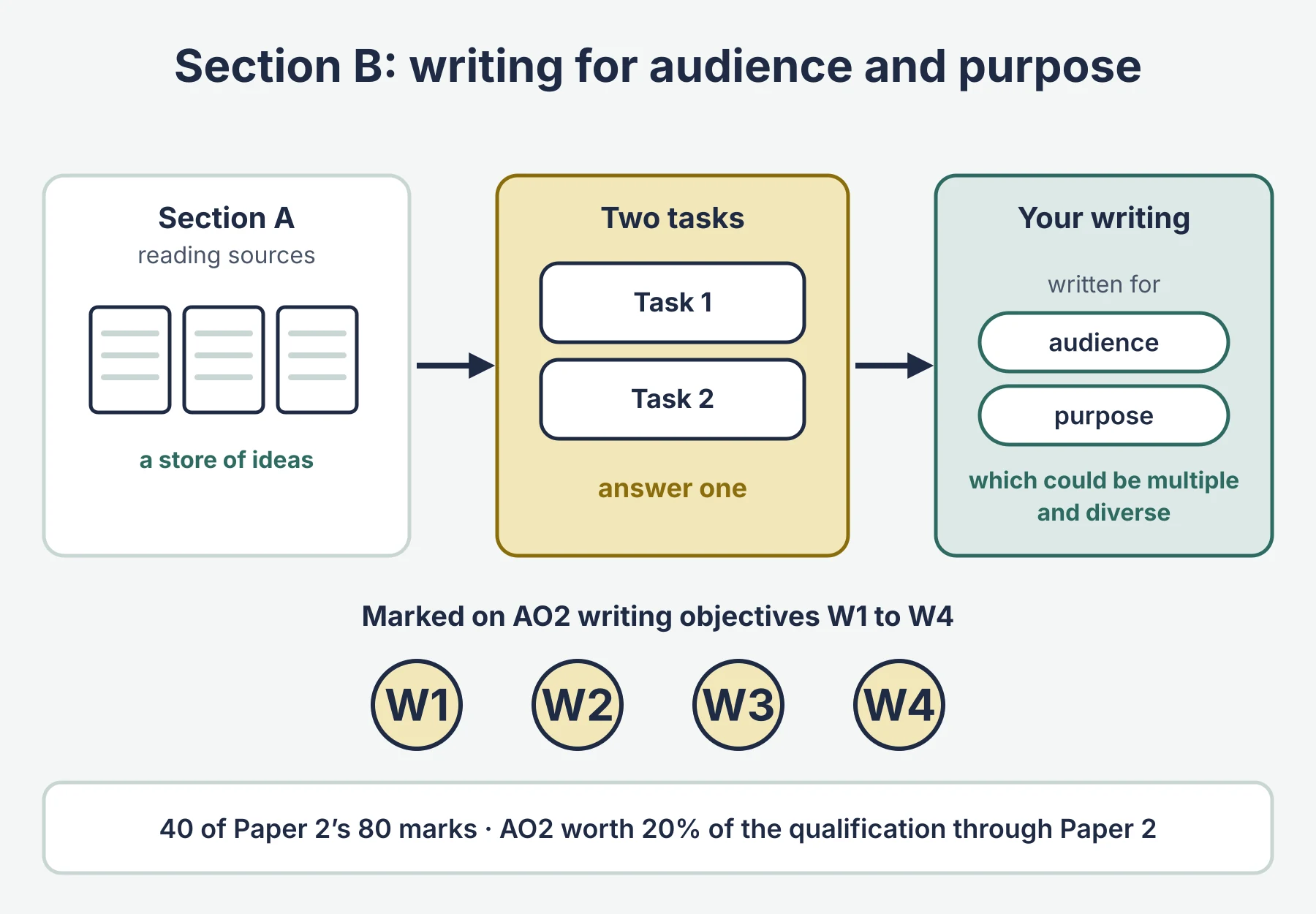
Section B of Paper 2 in OxfordAQA International GCSE English Language (9270) is a writing task focused on audience and purpose. It carries 40 of the paper’s 80 marks. There is a choice of two tasks, and the writing is linked with the reading sources from Section A. The specification notes that audience and purpose “could be both multiple and diverse”, and that the most successful responses show they can respond to this demand. This guide explains how to read the task, use the sources and adapt your writing.
What the specification says
- The focus of the writing task is writing for audience and purpose.
- Audience and purpose could be both multiple and diverse.
- Writing is linked with the reading sources from Section A.
- There is a choice from two tasks; students answer one.
- Writing is assessed against AO2 (W1–W4), worth 20% of the qualification through Paper 2.
Decoding the task: AFP plus
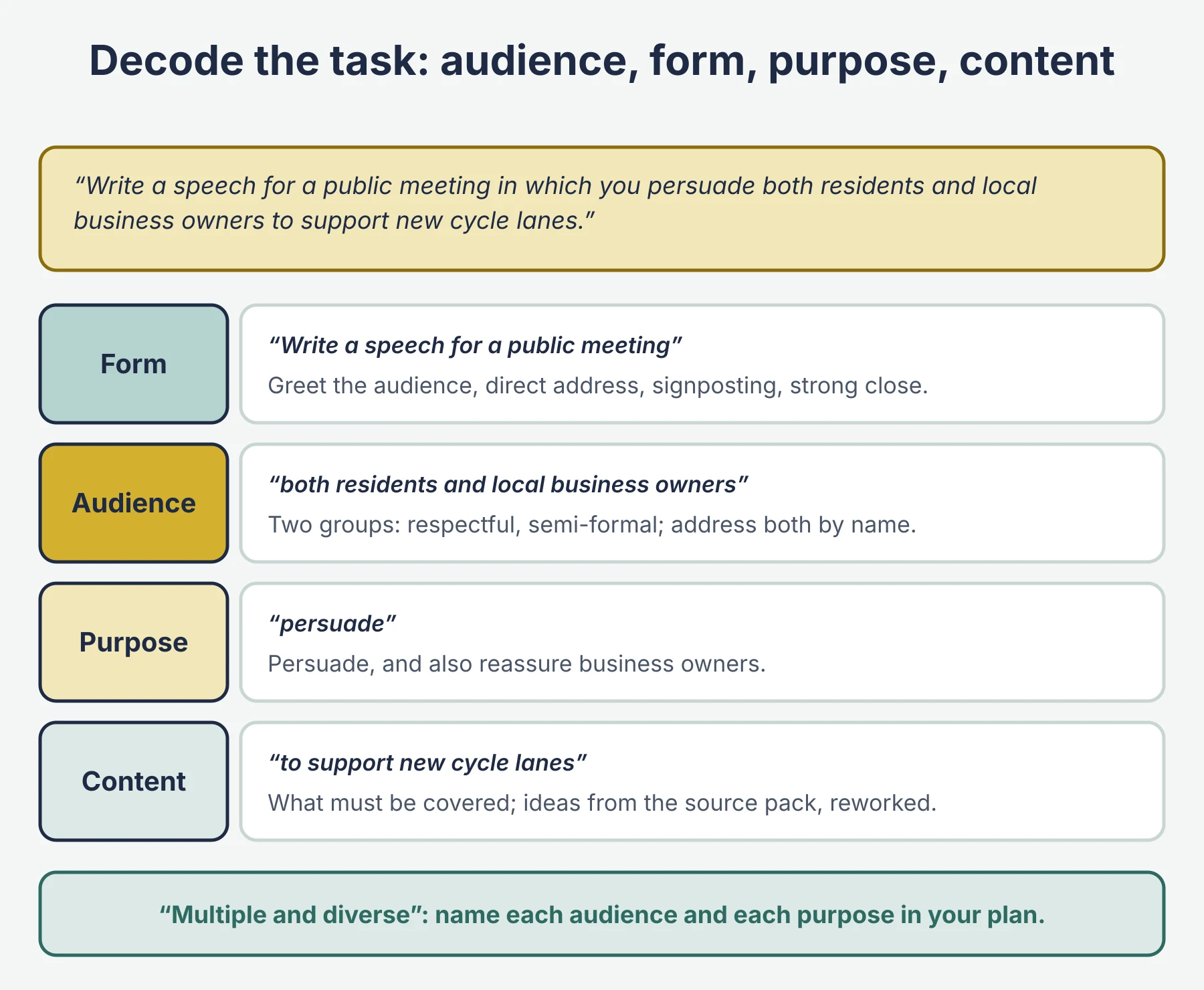
Underline four things in every task:
| Element | Question to ask | Example |
|---|---|---|
| Audience | Who exactly will read or hear it? Is there more than one group? | Parents and students; local residents and the council |
| Purpose | Persuade, argue, inform, explain, advise, describe, review? Is there more than one? | Inform readers about a plan and persuade them to support it |
| Form | Letter, article, speech, leaflet, report, review, blog? | A speech to a school assembly |
| Content | What must be covered? What can the sources supply? | The benefits of a scheme, using ideas from the sources |
“Multiple and diverse” means you may need to balance different readers (for example, a letter that must be respectful to a head teacher but also represent students’ views) or combine purposes (explain a problem, then persuade). Name each in your plan.
Using the sources well
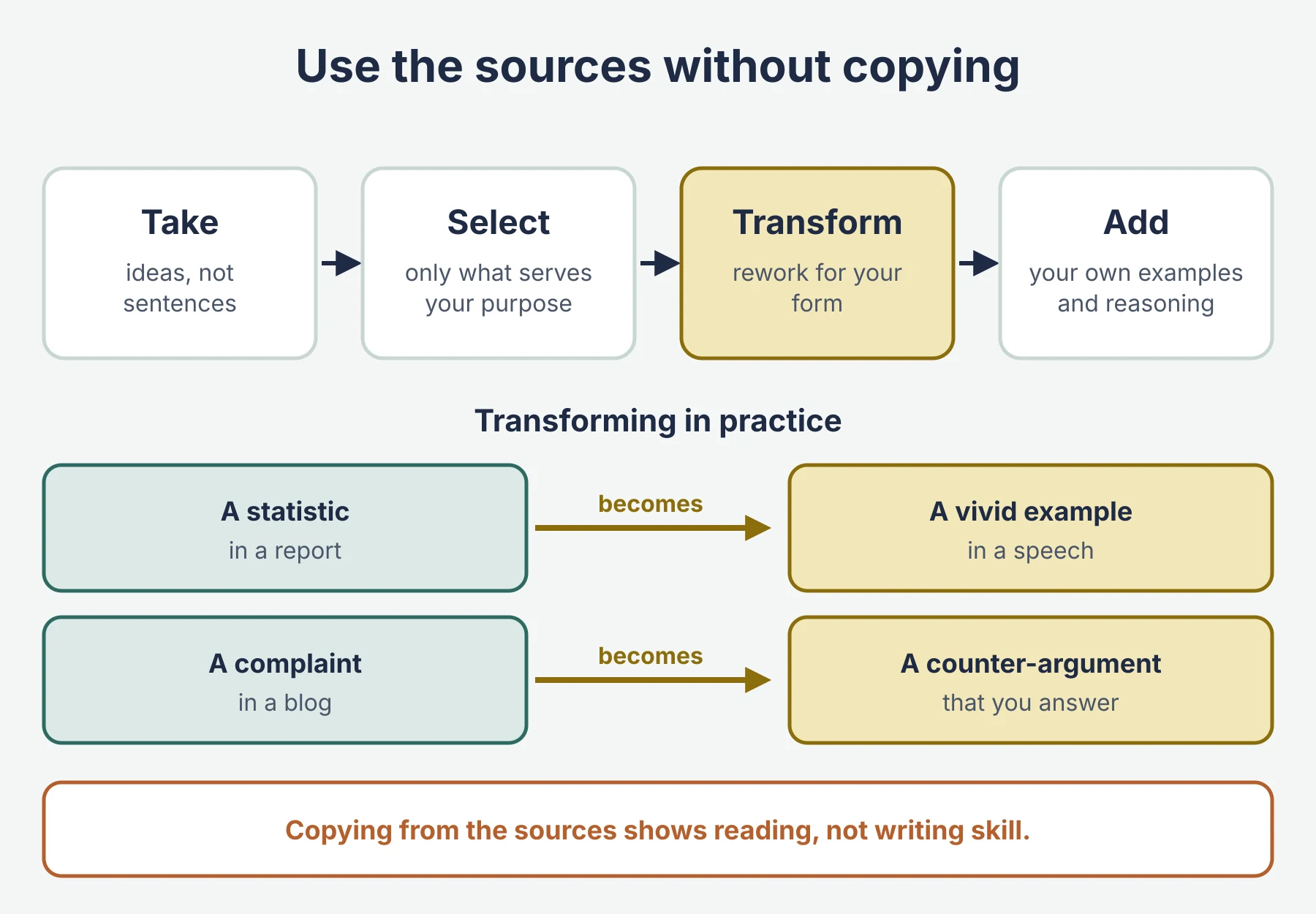
Because the writing is linked with Section A, the sources are a store of ideas. Use them without copying:
- Take ideas, not sentences. Rework details in your own words and for your own purpose.
- Select. Only use what serves your argument or explanation.
- Transform. A statistic in a report can become a vivid example in a speech; a complaint in a blog can become a counter-argument you answer.
- Add your own. Original examples and reasoning show independent thinking.
Form conventions
| Form | Conventions | Register |
|---|---|---|
| Formal letter | Address/greeting (“Dear…”), clear purpose in opening, paragraphs, formal sign-off | Formal |
| Informal letter or email | Friendly greeting, personal tone, sign-off by first name | Informal but accurate |
| Article | Headline, possible strapline, engaging opening, paragraphs or sub-headings | Depends on publication |
| Speech | Address to audience, direct address, signposting, repetition, memorable close | Matches occasion |
| Leaflet | Title, sub-headings, short sections, bullet points where useful, contact or call to action | Clear and direct |
| Report | Title, introduction stating purpose, sections, findings, recommendations | Formal and impersonal |
| Review | Title, overview, evaluation of strengths and weaknesses, recommendation | Personal but informed |
| Blog | Engaging title, personal voice, conversational links | Usually informal |
Spend your time on the writing itself: show layout features such as headings and sub-headings in words rather than drawing boxes or pictures.
Adapting register
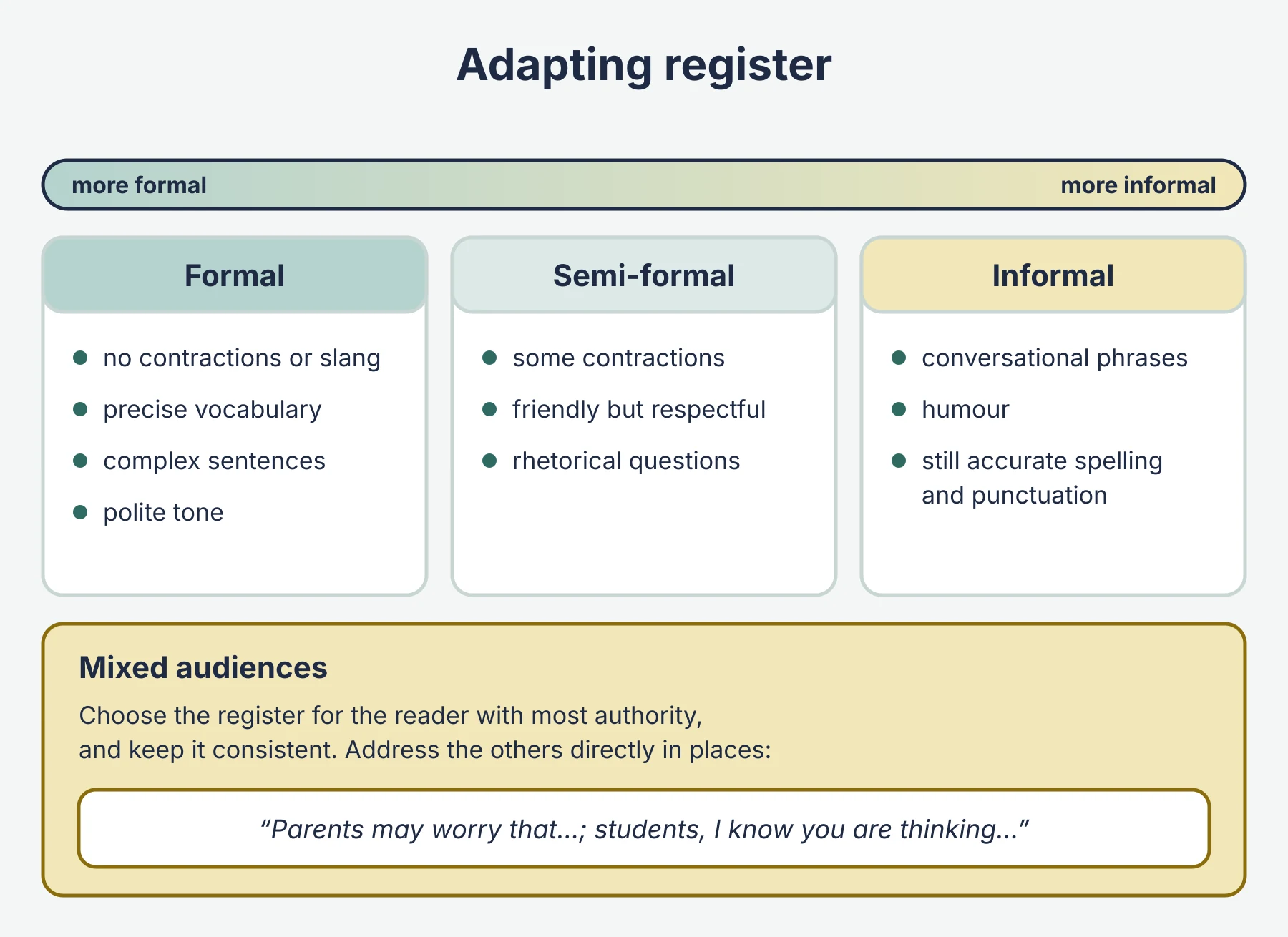
Register should match the most important audience and stay consistent:
- Formal: no contractions or slang, precise vocabulary, complex sentences, polite tone.
- Semi-formal: some contractions, a friendly but respectful voice, rhetorical questions.
- Informal: conversational phrases and humour, but still accurate spelling and punctuation.
When audiences are mixed, choose the register for the reader with most authority and address the others directly in places: “Parents may worry that…; students, I know you are thinking…”.
Building the writing
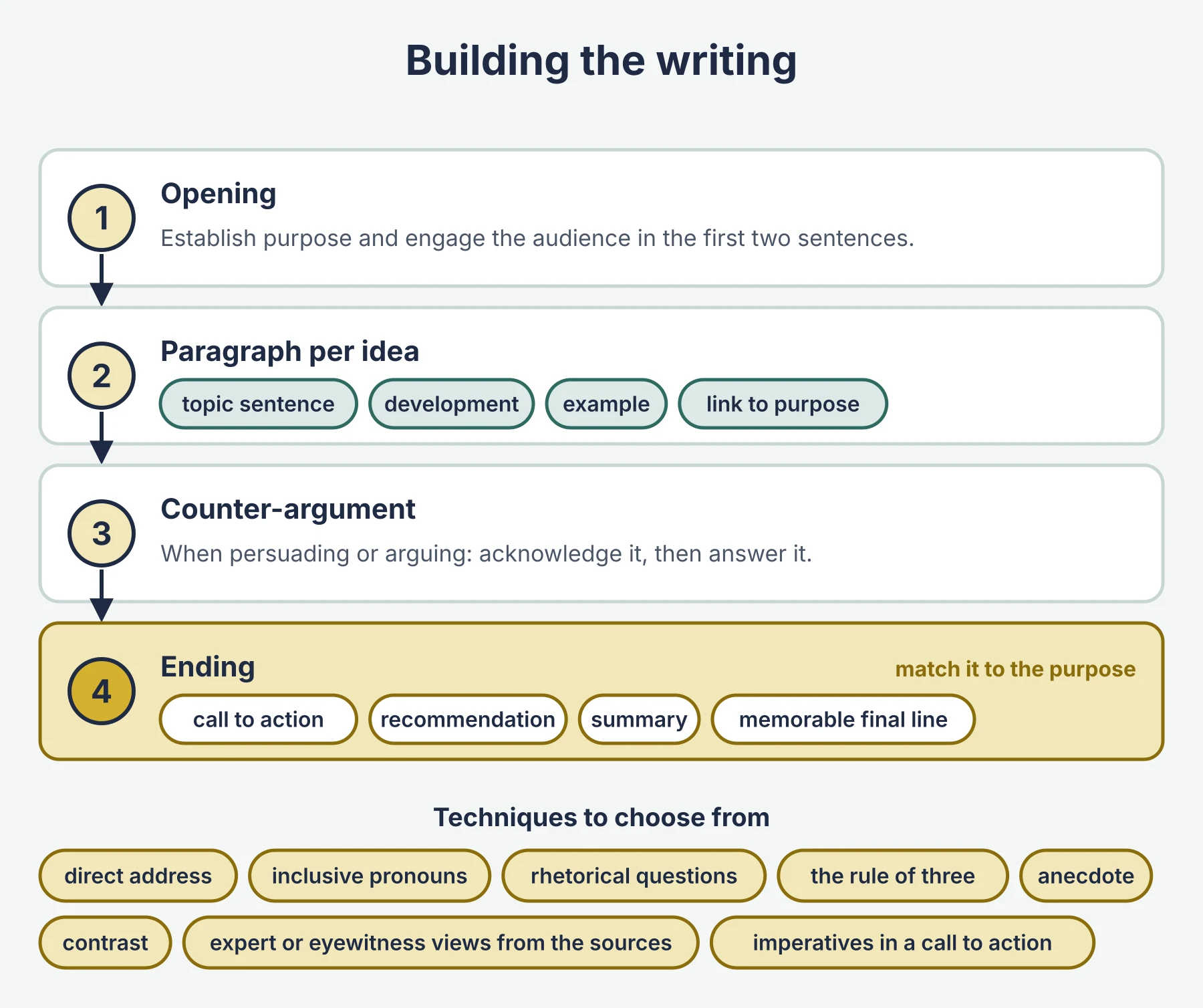
- Opening: establish purpose and engage the audience in the first two sentences.
- Paragraph per idea: topic sentence, development, example, link to purpose.
- Counter-argument where persuading or arguing: acknowledge and answer.
- Ending: match purpose: a call to action, recommendation, summary or memorable final line.
Techniques to choose from: direct address; inclusive pronouns (“we”, “our community”); rhetorical questions; the rule of three; anecdote; contrast; expert or eyewitness views drawn from the sources; imperatives in a call to action.
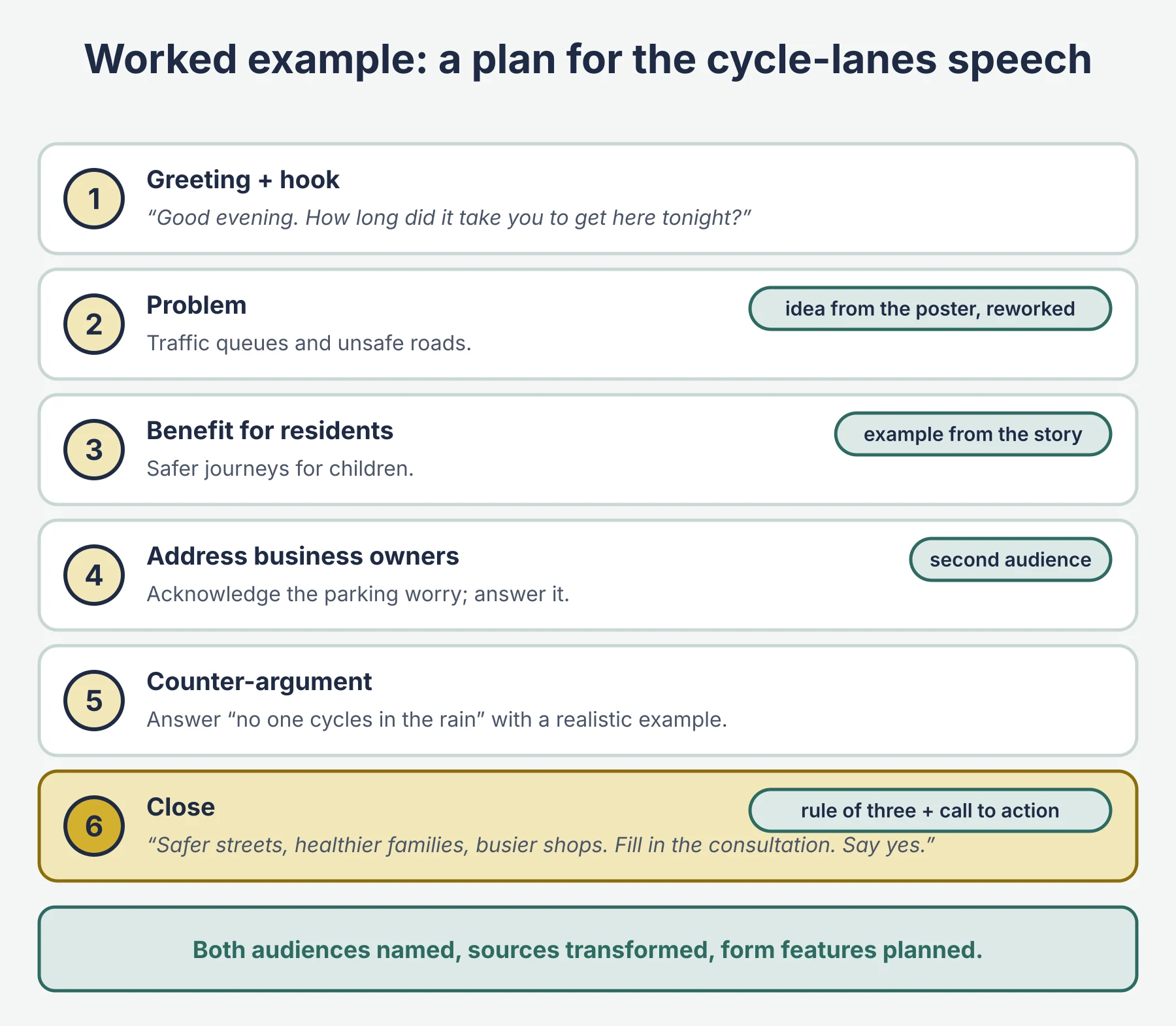
Worked example: a plan
Task (original, linked to a source pack on city cycling): Write a speech for a public meeting in which you persuade both residents and local business owners to support new cycle lanes.
Audience:  residents (some cyclists, some drivers) AND business owners -> respectful, semi-formal
Purpose:   persuade; also reassure business owners
Form:      speech -> greet the audience, direct address, signposting, strong close

1. Greeting + hook: "Good evening. How long did it take you to get here tonight?"
2. Problem: traffic queues and unsafe roads (idea from the poster, reworked)
3. Benefit for residents: safer journeys for children (from the story, as an example)
4. Address business owners: acknowledge the worry about parking; answer it
   (cyclists can stop easily at local shops; consultation is still open)
5. Counter the "no one cycles in the rain" claim with a realistic example
6. Close: rule of three + call to action: "Safer streets, healthier families,
   busier shops. Fill in the consultation. Say yes."
Why it works: both audiences are named and addressed; ideas from the sources are transformed into the speaker’s own reasoning; the form’s features are planned, not added at the end.
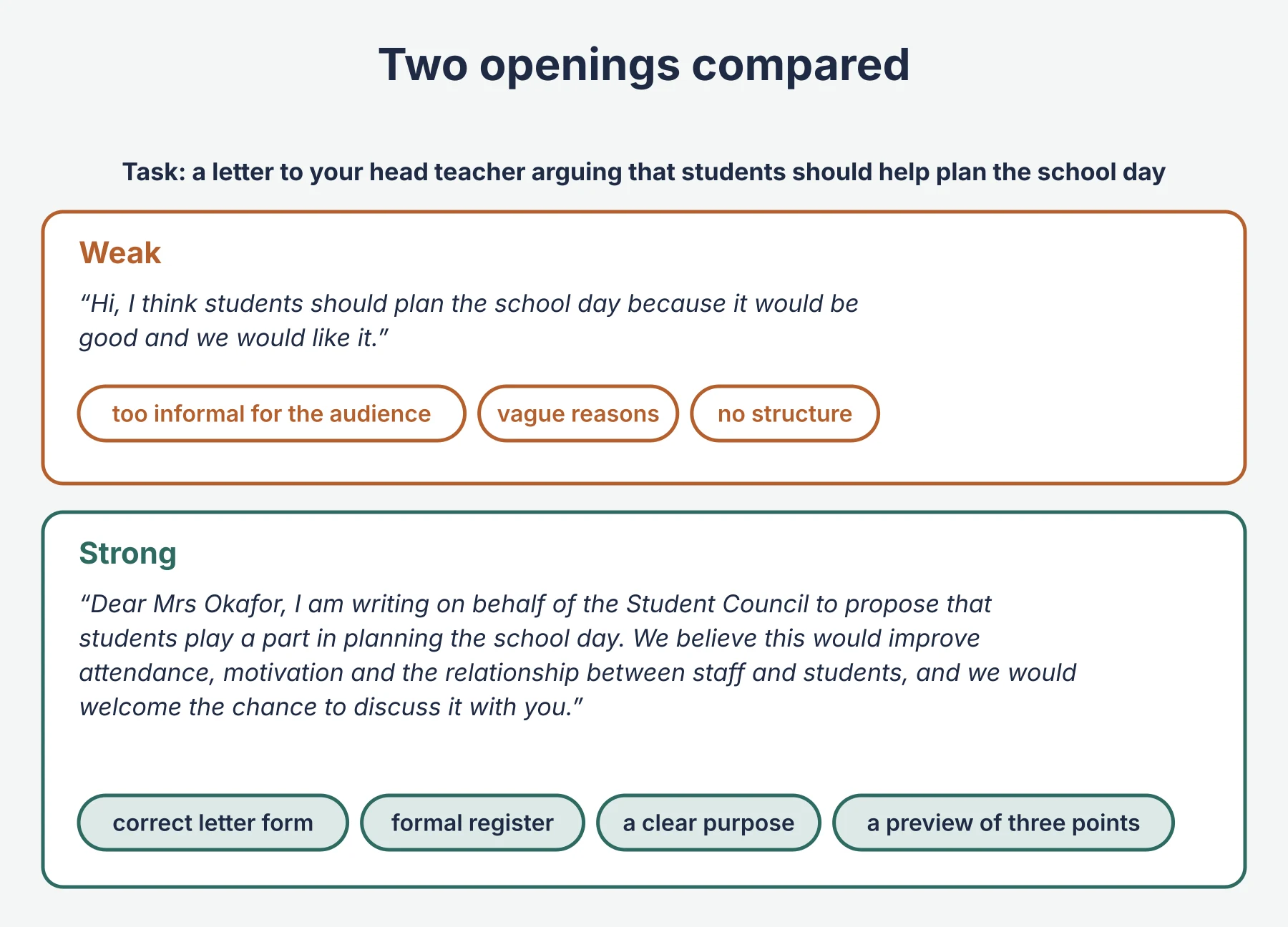
Worked example: two openings compared
Task (original): Write a letter to your head teacher arguing that students should help to plan the school day.
- Weak: “Hi, I think students should plan the school day because it would be good and we would like it.” Too informal for the audience, vague reasons, no structure.
- Strong: “Dear Mrs Okafor, I am writing on behalf of the Student Council to propose that students play a part in planning the school day. We believe this would improve attendance, motivation and the relationship between staff and students, and we would welcome the chance to discuss it with you.” Correct form, formal register, a clear purpose and a preview of three points.
Checking against the writing objectives
Before you finish, test your draft against each objective:
- W1: Does every paragraph serve the named audience and purpose? Is the form clear from the opening?
- W2: Have I varied sentence types for effect, including at least one short sentence for emphasis?
- W3: Do paragraphs follow a logical order, joined by clear links, and does the ending answer the opening?
- W4: Have I checked sentence boundaries, apostrophes, homophones and the spelling of key words from the task?
Common mistakes
- Writing an essay when the task asks for a speech, letter or leaflet.
- Ignoring one audience when the task names two.
- Copying from the sources, which shows reading rather than writing skill.
- Switching register half way through.
- Ending abruptly without a call to action or conclusion.
- Neglecting accuracy under time pressure.
Exam technique
- Read both tasks fully before choosing.
- Spend a few minutes planning AFP, content and order.
- Keep checking: “Would this sentence work for this audience and this purpose?”
- Leave time to proofread for W4.
More resources on this topic
- Paper 2 Section B writing revision notes
- Paper 2 Section B writing practice questions
- Paper 2 study guide
- Paper 2 Section A reading study guide
Source: OxfordAQA International GCSE English Language (9270) specification, Version 5.1, sections 2.2, 3.2.2 and 4.2.
Related resources
-
Practice questions
OxfordAQA International GCSE English Language (9270): Paper 2 Section B — Writing — Practice Questions
Twelve original tasks on audience, purpose, form, register and sources, with model answers, for OxfordAQA International GCSE English Language 9270 Paper 2.
English · OxfordAQA · IGCSE
Try questions -
Revision notes
OxfordAQA International GCSE English Language (9270): Paper 2 Section B — Writing — Revision Notes
Recall notes on audience, purpose, form, register and using sources for OxfordAQA International GCSE English Language 9270 Paper 2 Section B writing.
English · OxfordAQA · IGCSE
Revise topic -
Study guides
OxfordAQA IGCSE English Language: Source-Based Reading and Directed Writing (9270)
OxfordAQA International GCSE English Language 9270 Paper 2: reading modern-world source texts and writing for a set audience and purpose, the exam route.
English · OxfordAQA · IGCSE
Read guide
Get free revision emails (optional)
Occasional emails with practice questions, worked explanations and links to free resources for the qualification and subjects you choose. No spam, and you can unsubscribe from any email. The free tools on this site never need an email.