
Study Guides
OxfordAQA International GCSE English Literature (9275): Poetry (Route B)
How to prepare the People and Places anthology question on Route B Paper 2b of OxfordAQA 9275: theme grids, form, context and a worked comparison.
- Subject
- English Literature
- Level
- IGCSE
- Topic
- Route B: Poetry and non-exam assessment
- Author
- Marlbridge Academic Team
- Updated
- Reviewed by
- Ammar Bilal (what this means)
Aligned to OxfordAQA IGCSE English Literature (9275), Version 5.1, for exams May/June 2018 onwards. Official specification .
Syllabus page (what it covers and how it is assessed): OxfordAQA IGCSE English Literature.
Syllabus points this page covers
9275
- 3.3.1 Poetry
Found an error? Report a correction.
Need help with this topic? Request a free trial class for IGCSE English Literature (9275).
This guide covers 3.3.1 Poetry in Route B of OxfordAQA International GCSE English Literature (9275). The specification says students “will study the OxfordAQA Exams Poetry Anthology People and Places”, whose 20 poems “are thematically linked in a variety of ways, allowing students to study a range of connected and linked ideas and themes from poets and poetry from different times and contexts”. On Route B this is assessed in Section A of Paper 2b: Poetry.
It concentrates on what is specific to Route B and on skills the general anthology pages treat briefly: building a theme grid, writing precisely about form, and using context. For the whole of Route B, see the Route B poetry and non-exam assessment study guide; for the anthology question on both routes, see the People and Places poetry study guide. This page has its own Route B poetry revision notes and Route B poetry practice questions.
Paper 2b at a glance
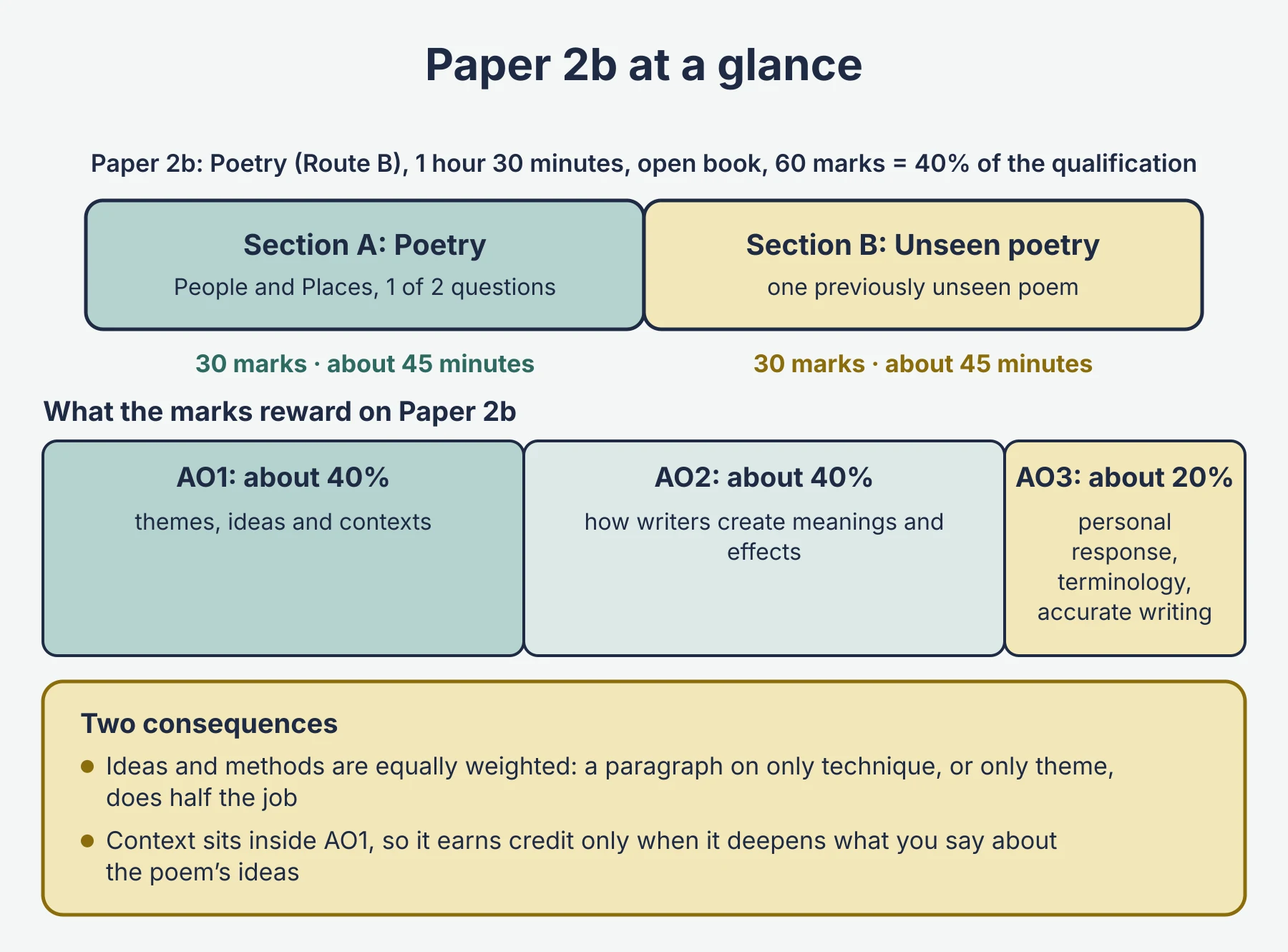
| Feature | Paper 2b: Poetry (Route B) |
|---|---|
| Length | 1 hour 30 minutes |
| Format | Open book |
| Marks | 60, which is 40% of the qualification |
| Section A: Poetry | 30 marks: one question from a choice of two on People and Places |
| Section B: Unseen poetry | 30 marks: one question on a previously unseen poem |
On Route B the non-exam assessment replaces Route A’s unseen prose, so Paper 2b is your only exam on poetry and it carries the same weight as Paper 1. The anthology and the 30-mark question are the same as on Route A; the difference is that you have two sections, not three, in 90 minutes, so about 45 minutes for each.
The anthology and the set-text lists can change between specification versions, so check with your teacher which edition of People and Places applies to your exam series.
What the marks reward
The specification’s assessment objective weightings give Paper 2b 16% of the qualification for AO1, 16% for AO2 and 8% for AO3. Within the paper, that is roughly 40% AO1, 40% AO2 and 20% AO3:
- AO1: understanding of, and engagement with, themes, ideas and contexts;
- AO2: analysis of how writers create meanings and effects;
- AO3: informed, personal responses, using appropriate terminology, and coherent, accurate writing.
Two practical consequences follow. First, ideas and methods are equally weighted, so a paragraph that only analyses technique, or only discusses theme, is doing half the job. Second, context sits inside AO1, alongside themes and ideas, so it earns credit only when it deepens what you say about the poem’s ideas.
Building a theme grid
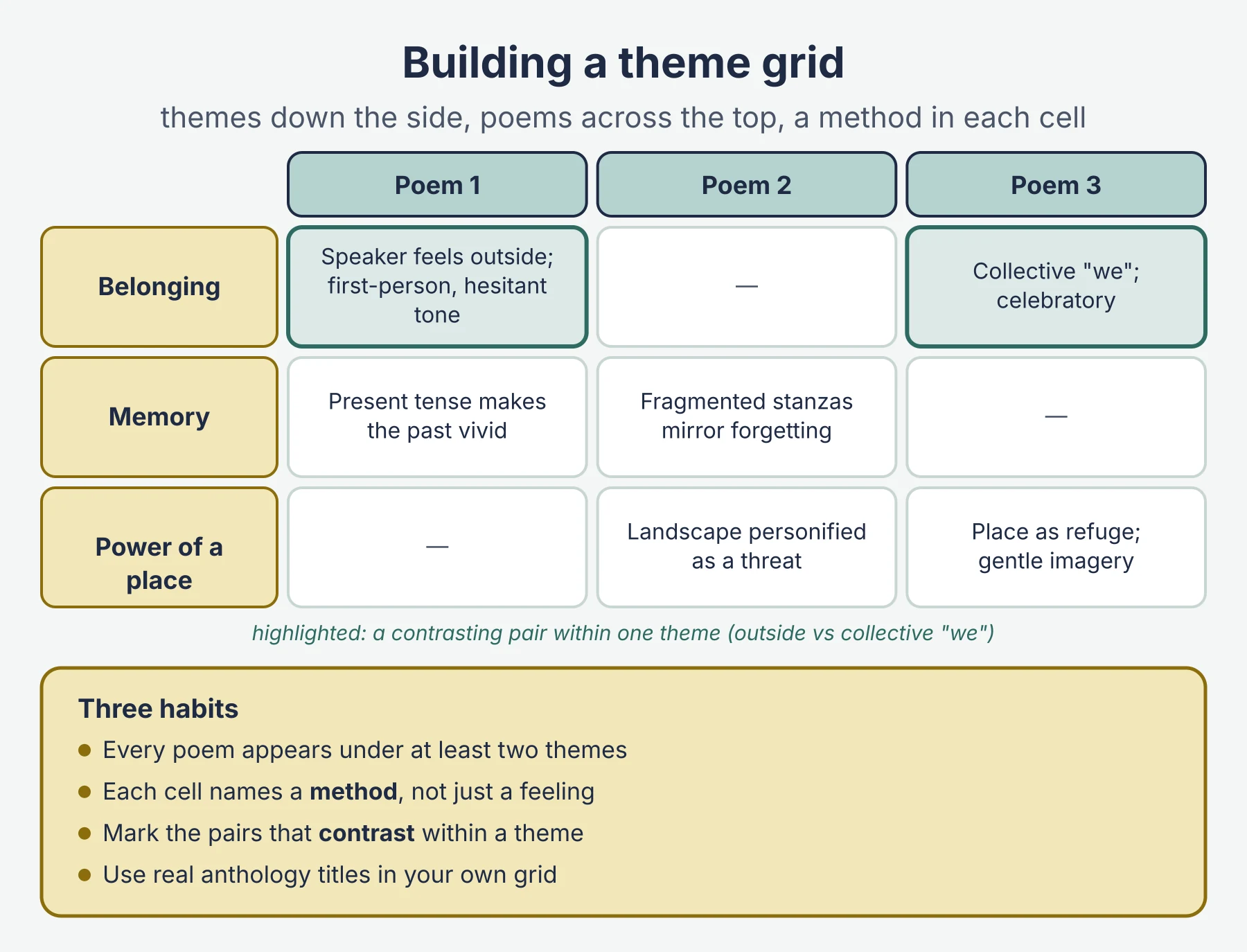
With 20 poems, revising one poem at a time leaves you unready for a question that cuts across them. Build a grid instead: themes down the side, poems across the top, and in each cell a few words on how that poem treats that theme.
| Theme | Poem 1 | Poem 2 | Poem 3 |
|---|---|---|---|
| Belonging | Speaker feels outside; first-person, hesitant tone | — | Collective “we”; celebratory |
| Memory | Present tense makes the past vivid | Fragmented stanzas mirror forgetting | — |
| Power of a place | — | Landscape personified as a threat | Place as refuge; gentle imagery |
Use real anthology titles in your own grid. Three habits make it work:
- Every poem should appear under at least two themes, so you have flexible choices on the day.
- Each cell names a method, not just a feeling.
- Mark the pairs that contrast within a theme. Two poems that treat belonging differently give you more to compare than two that agree.
Writing precisely about form
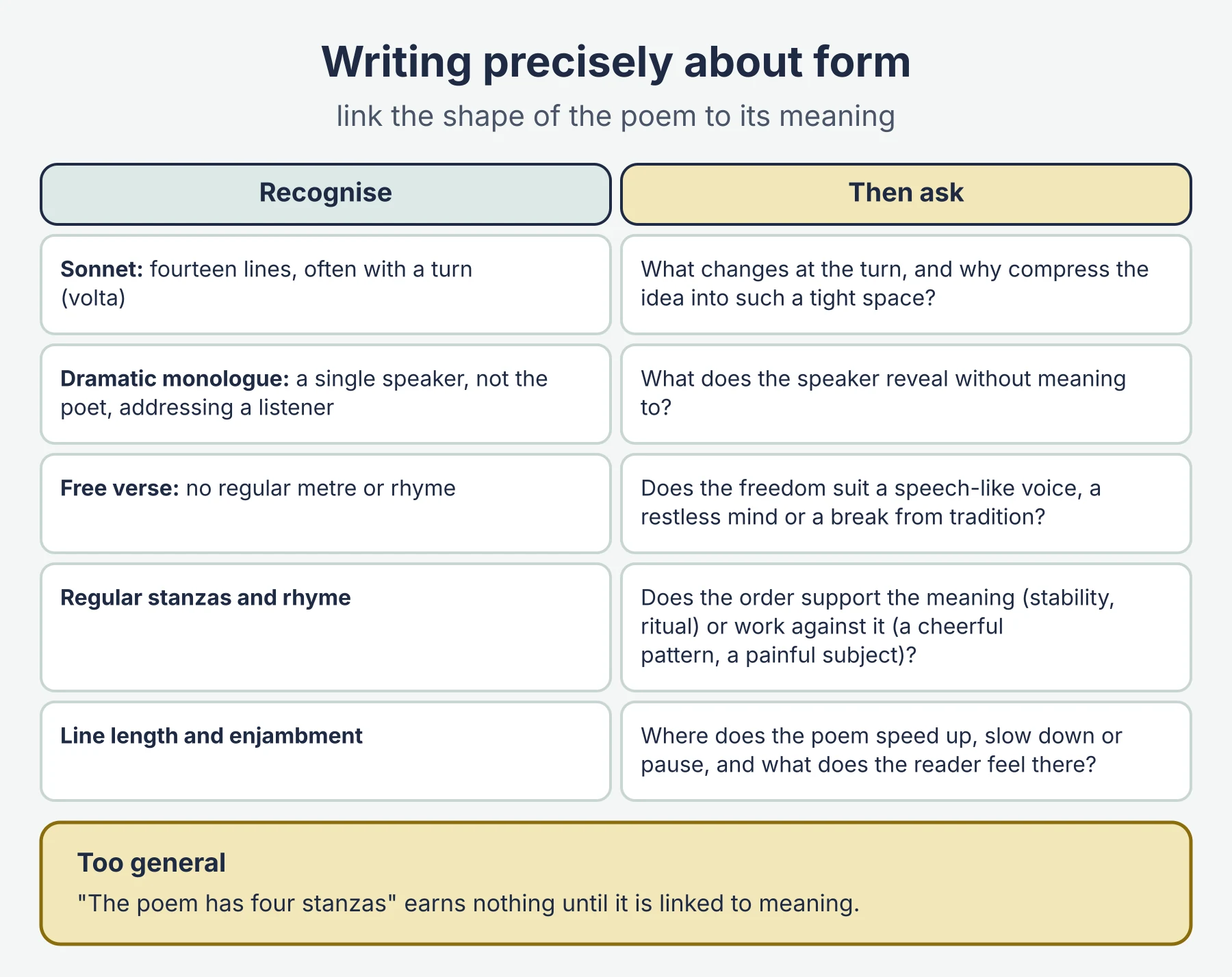
Form comments are where many answers stay general (“the poem has four stanzas”). A form comment earns AO2 credit when it links the shape of the poem to its meaning. Useful forms to recognise:
- Sonnet: fourteen lines, often with a turn (volta). Ask what changes at the turn and why the poet compresses the idea into such a tight space.
- Dramatic monologue: a single speaker, not the poet, addressing a listener. Ask what the speaker reveals without meaning to.
- Free verse: no regular metre or rhyme. Ask whether the freedom suits a speech-like voice, a restless mind or a break from tradition.
- Regular stanzas and rhyme: ask whether the order supports the meaning, such as stability or ritual, or works against it, for example a cheerful pattern carrying a painful subject.
- Line length and enjambment: ask where the poem speeds up, slows down or pauses, and what the reader feels at that point.
Using context well
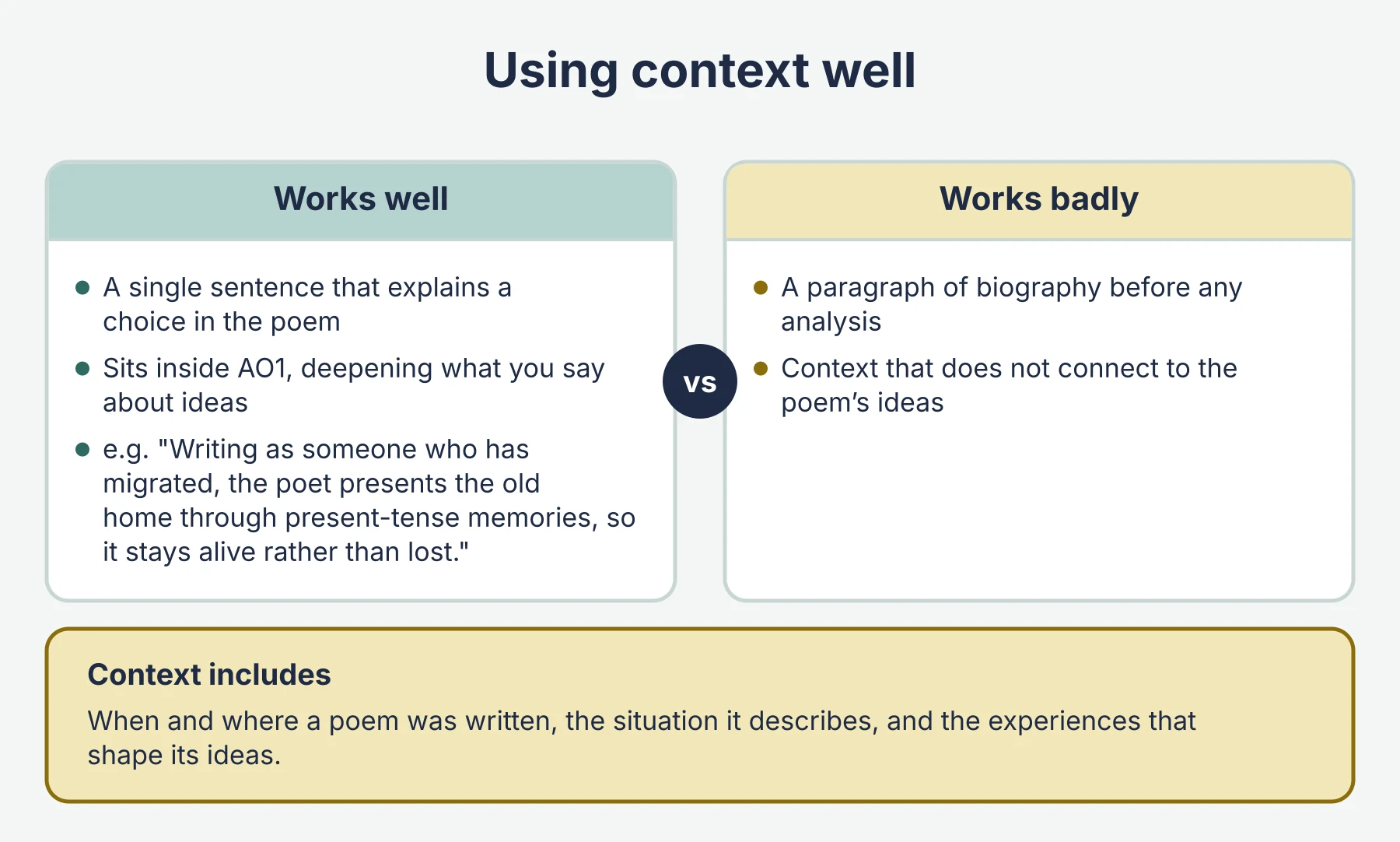
Context includes when and where a poem was written, the situation it describes and the experiences that shape its ideas. It works best as a single sentence that explains a choice in the poem: “Writing as someone who has migrated, the poet presents the old home through present-tense memories, so it stays alive rather than lost.” It works badly as a paragraph of biography before any analysis.
Worked example: comparing voice and form
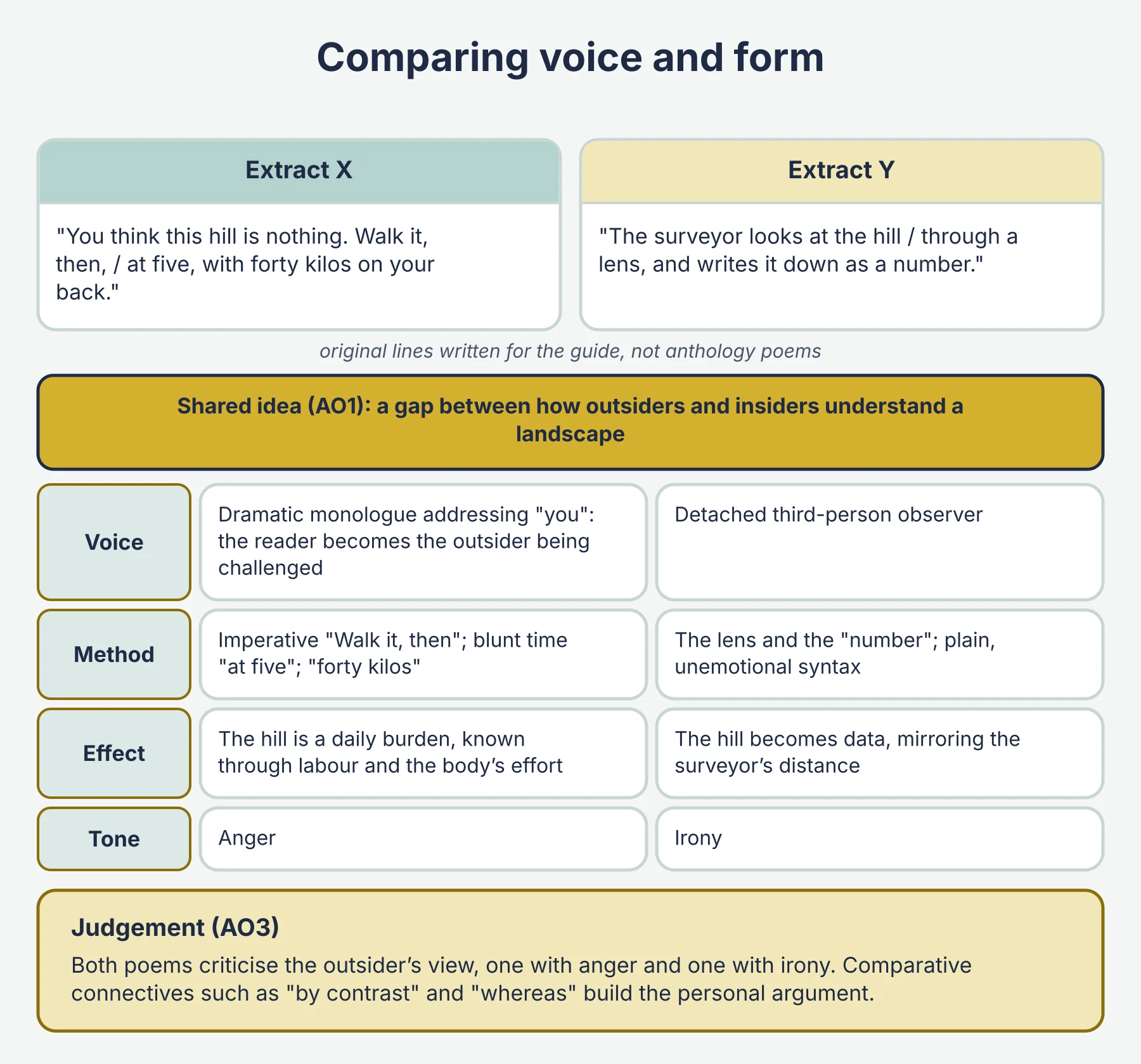
The two extracts below are original lines written for this guide, not anthology poems. Imagine they come from two poems about how people see the land.
Extract X: You think this hill is nothing. Walk it, then, / at five, with forty kilos on your back.
Extract Y: The surveyor looks at the hill / through a lens, and writes it down as a number.
A comparative paragraph:
Both poets present a gap between how outsiders and insiders understand a landscape, but they use voice to place the reader on opposite sides of that gap. Extract X is a dramatic monologue that addresses “you” directly, so the reader becomes the outsider being challenged; the imperative “Walk it, then” and the blunt time “at five” make the hill a daily burden, measured in the body’s effort and “forty kilos”. Extract Y, by contrast, uses a detached third-person observer. The lens and the “number” turn the hill into data, and the plain, unemotional syntax mirrors the surveyor’s distance. Whereas X insists the land is known through labour, Y quietly suggests what is lost when it is known only through measurement, so both poems criticise the outsider’s view, one with anger and one with irony.
Notice how the paragraph names a shared idea (AO1), compares a method in each poem with its effect (AO2), and builds a personal argument with comparative connectives (AO3).
A model opening and ending
Opening: “Both poets explore how a place shapes the people who live in it, but while one presents that influence as a burden the speaker resents, the other presents it as an inheritance the speaker chooses to keep.”
Ending: “Ultimately, both poems suggest that a place is never simply scenery. The difference lies in whether the speaker is held by it or holds on to it, and each poet’s form, one tense and one spacious, makes the reader feel that difference.”
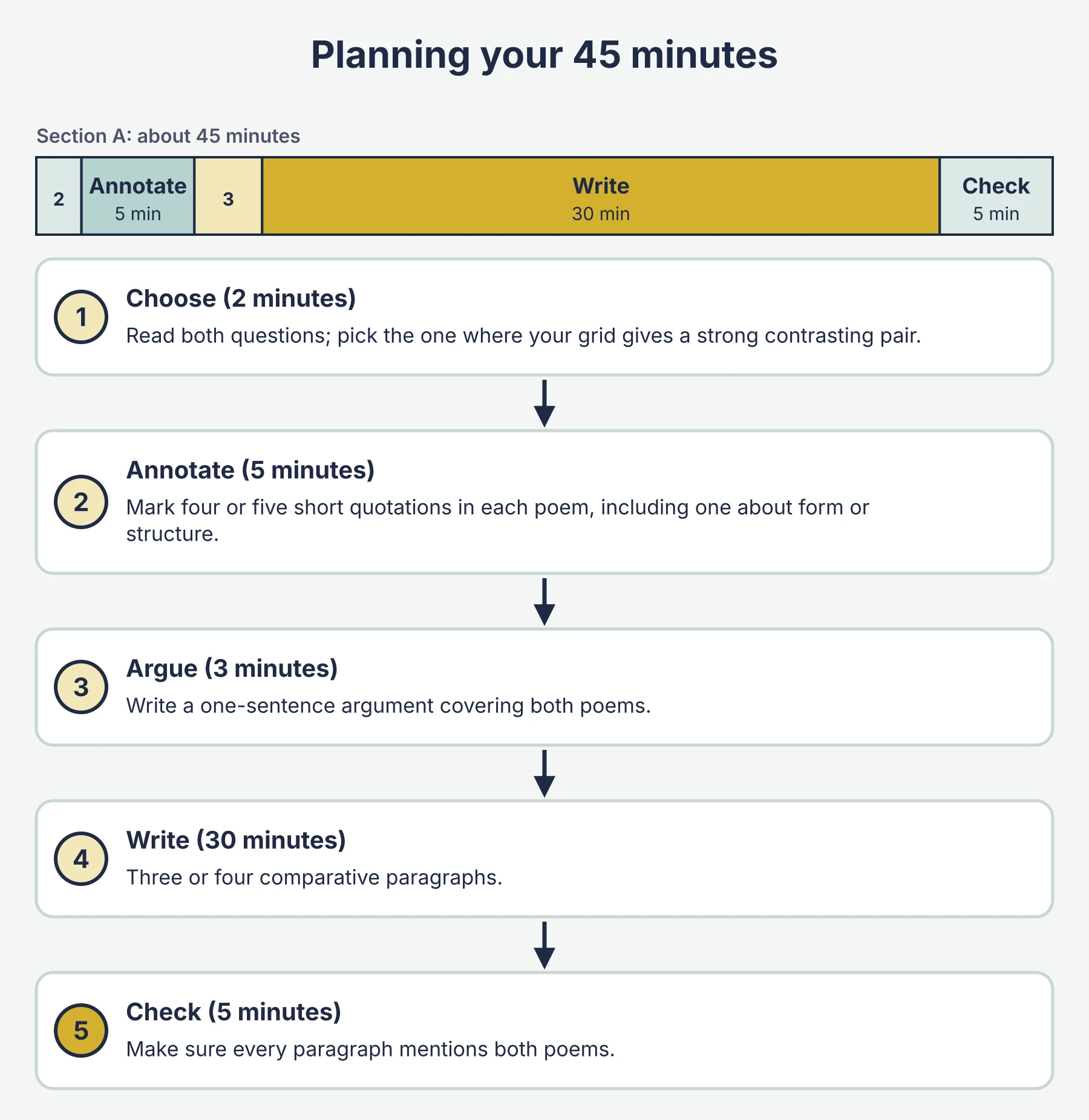
Planning your 45 minutes
- Choose (2 minutes). Read both questions and pick the one where your grid gives a strong contrasting pair.
- Annotate (5 minutes). Mark four or five short quotations in each poem, including one about form or structure.
- Argue (3 minutes). Write a one-sentence argument covering both poems.
- Write (30 minutes). Three or four comparative paragraphs.
- Check (5 minutes). Make sure every paragraph mentions both poems.
Common mistakes
- Choosing the two poems you like best rather than the pair that best fits the question.
- Describing form (“it is a sonnet”) without explaining what it does.
- Adding context that does not connect to the poem’s ideas.
- Spending too long on Section A and rushing the unseen poem in Section B.
- Calling the speaker “the poet” in a dramatic monologue.
Command words
- Compare asks for similarities and differences throughout, not only at the end.
- How do the poets present…? asks for methods and effects in relation to the named idea.
- Explore invites more than one interpretation, so use tentative phrasing such as “this could suggest”.
Frequently asked questions
Is the anthology question the same on Route A and Route B? The specification lists the same anthology and the same 30-mark section on both routes; what differs is the rest of the paper.
Can I prepare quotations in advance if the exam is open book? Yes: know where your key quotations are, because finding them quickly saves planning time.
Official specification
OxfordAQA International GCSE English Literature (9275) specification, 3.3.1 Poetry — oxfordaqa.com.
Related resources
-
Practice questions
OxfordAQA International GCSE English Literature (9275): Poetry (Route B) – Practice Questions
Comparison skills practice on two original poems plus three 30-mark anthology tasks for OxfordAQA 9275 Route B Paper 2b, with mark-scheme style answers.
English Literature · OxfordAQA · IGCSE
Try questions -
Revision notes
OxfordAQA International GCSE English Literature (9275): Poetry (Route B) – Revision Notes
Revision notes for the Route B anthology question in OxfordAQA 9275 Paper 2b: paper facts, AO balance, form terms, comparison phrases and a self-test.
English Literature · OxfordAQA · IGCSE
Revise topic -
Study guides
OxfordAQA International GCSE English Literature (9275): Unseen poetry (Route B)
The unseen poetry question on Route B Paper 2b of OxfordAQA 9275: four reading lenses, handling difficulty, and an original poem with improved model paragraphs.
English Literature · OxfordAQA · IGCSE
Read guide
Get free revision emails (optional)
Occasional emails with practice questions, worked explanations and links to free resources for the qualification and subjects you choose. No spam, and you can unsubscribe from any email. The free tools on this site never need an email.