
Revision Notes
OxfordAQA International GCSE English Literature (9275): Poetry (Route B) – Revision Notes
Revision notes for the Route B anthology question in OxfordAQA 9275 Paper 2b: paper facts, AO balance, form terms, comparison phrases and a self-test.
- Subject
- English Literature
- Level
- IGCSE
- Topic
- Route B: Poetry and non-exam assessment
- Author
- Marlbridge Academic Team
- Updated
- Reviewed by
- Ammar Bilal (what this means)
Aligned to OxfordAQA IGCSE English Literature (9275), Version 5.1, for exams May/June 2018 onwards. Official specification .
Syllabus page (what it covers and how it is assessed): OxfordAQA IGCSE English Literature.
Syllabus points this page covers
9275
- 3.3.1 Poetry
Found an error? Report a correction.
Need help with this topic? Request a free trial class for IGCSE English Literature (9275).
Condensed notes for 3.3.1 Poetry, Route B of OxfordAQA International GCSE English Literature (9275), assessed in Section A of Paper 2b. For full explanations and a worked comparison, read the Route B poetry study guide; then practise with the Route B poetry practice questions. Notes covering the anthology on both routes are in the People and Places poetry revision notes.
Paper facts
| Fact | Detail |
|---|---|
| Specification point | 3.3.1 Poetry: the OxfordAQA Exams Poetry Anthology People and Places, 20 thematically linked poems |
| Paper | Paper 2b: Poetry, Route B only |
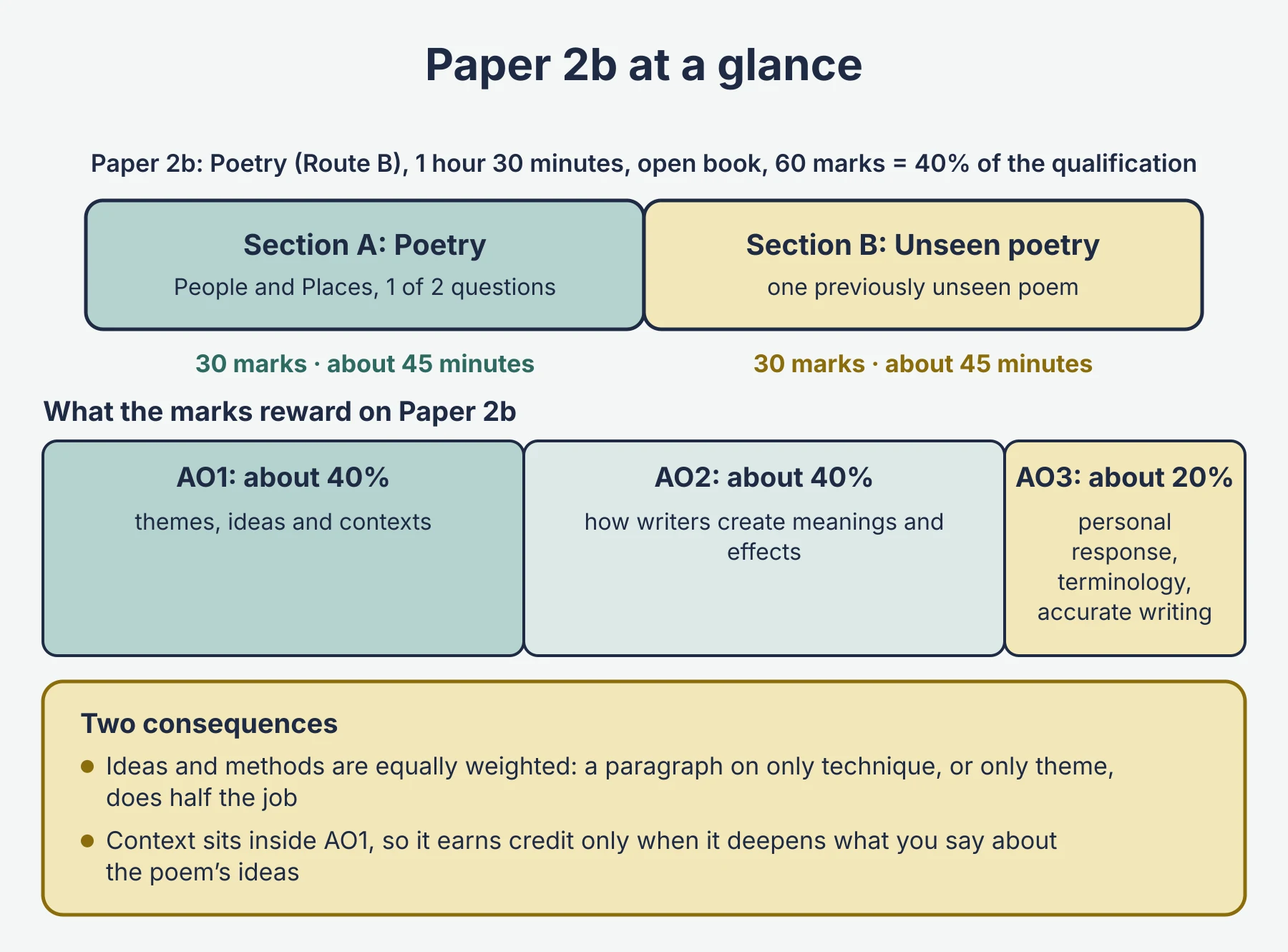
| Time and format | 1 hour 30 minutes, open book |
| Marks | 60 in total (40% of the qualification) |
| Section A | 30 marks: one question from a choice of two on the anthology |
| Section B | 30 marks: one question on a previously unseen poem |
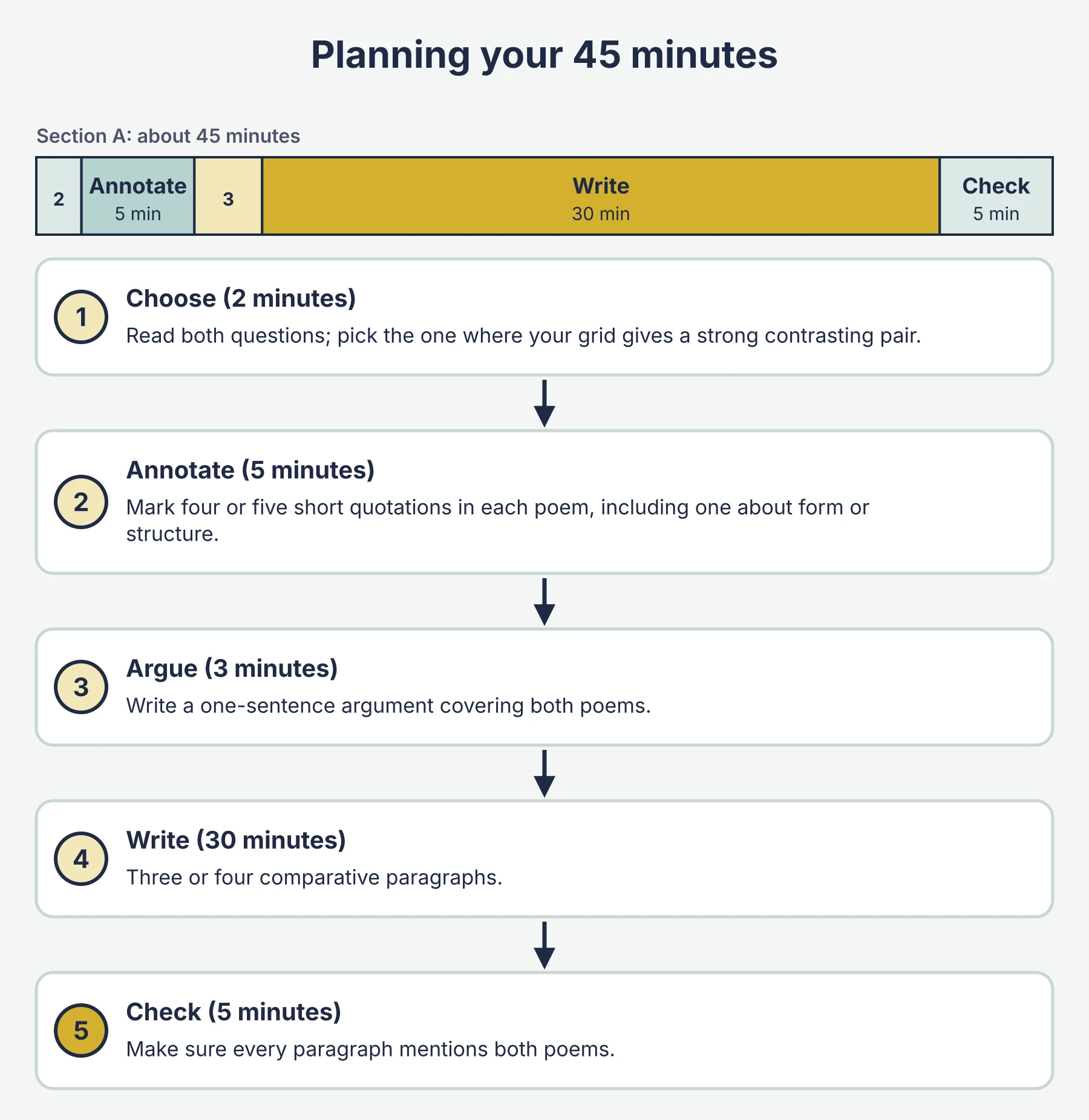
| Time for Section A | About 45 minutes |
Check with your teacher which edition of the anthology applies to your exam series.
AO balance on Paper 2b
| AO | What it rewards | Share of Paper 2b (approx.) | In practice |
|---|---|---|---|
| AO1 | Themes, ideas and contexts | 40% | A clear argument about the idea in the question, with context only where it explains a choice |
| AO2 | How writers create meanings and effects | 40% | Language, form and structure, each linked to an effect |
| AO3 | Informed personal response, terminology, coherent and accurate writing | 20% | An organised comparison, precise terms, accurate expression |
Ideas and methods carry equal weight: every paragraph needs both.
Key terms
| Term | Meaning |
|---|---|
| Speaker / persona | The voice of the poem, which may not be the poet |
| Dramatic monologue | A poem spoken by one character to a listener, revealing more than they intend |
| Free verse | Poetry without regular metre or rhyme |
| Sonnet | A fourteen-line poem, often with a turn in thought |
| Volta | The turn or shift in a poem’s argument or mood |
| Quatrain | A four-line stanza |
| Enjambment | A sentence running over a line break |
| Caesura | A pause within a line, often marked by punctuation |
| End-stopped line | A line that ends with punctuation and a pause |
| Juxtaposition | Placing contrasting images or ideas side by side |
| Semantic field | A group of words linked by topic, such as words about water |
| Tone | The attitude the voice conveys, such as bitter, tender or ironic |
The theme grid, condensed
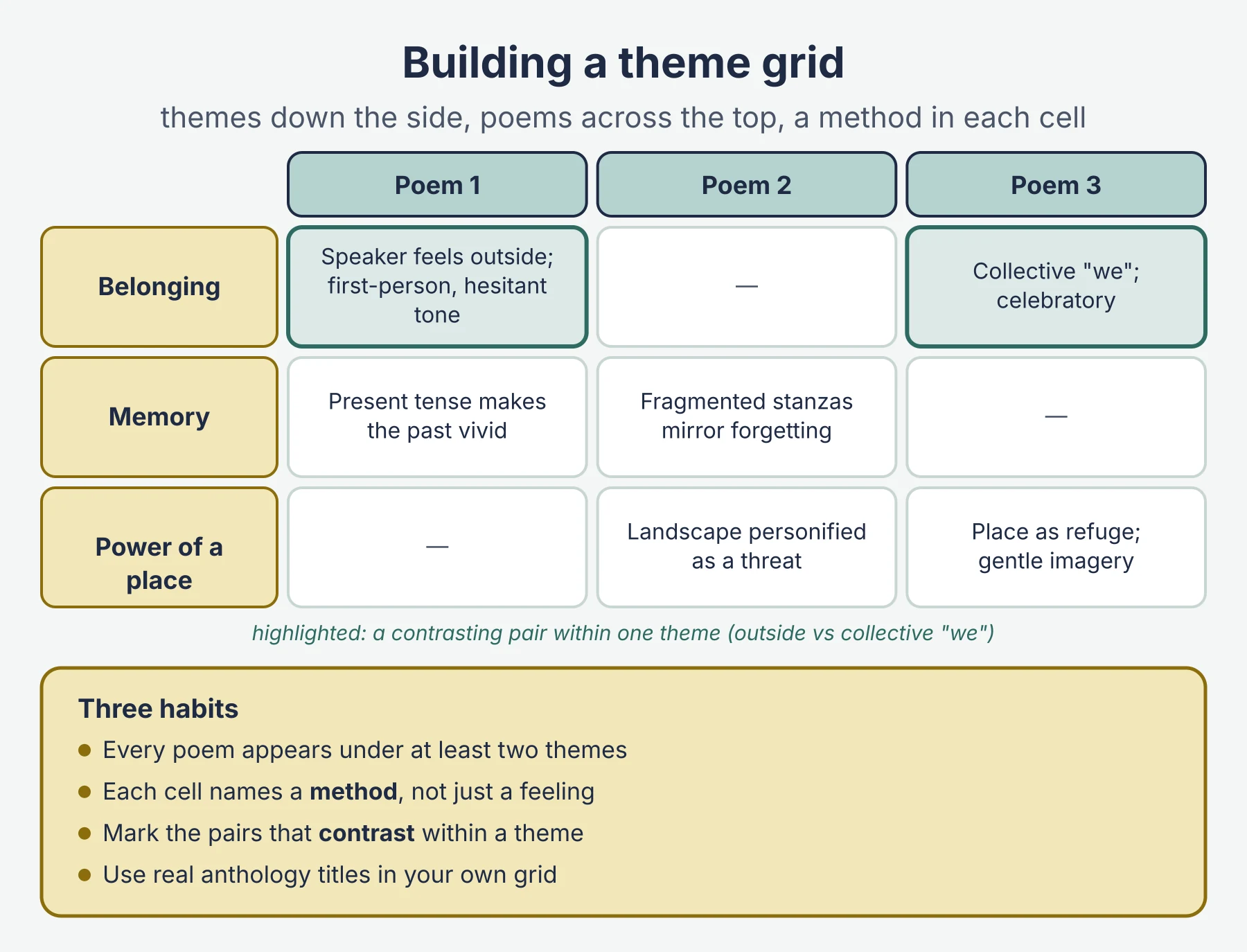
- Themes down the side, poems across the top, a method in each cell.
- Each poem under at least two themes.
- Star the contrasting pairs: poems that treat the same idea differently.
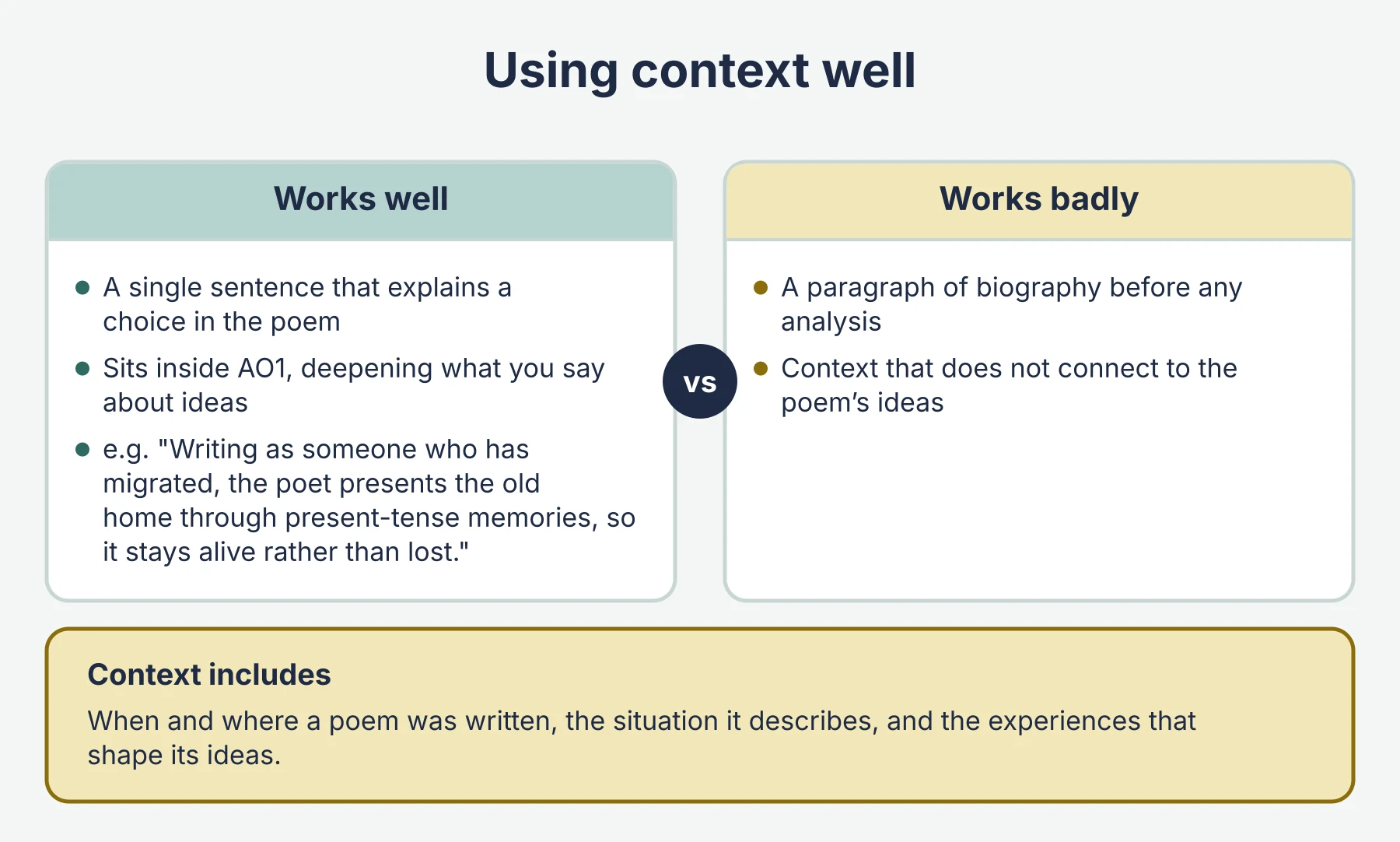
- Add one context note per poem, only where it explains a choice.
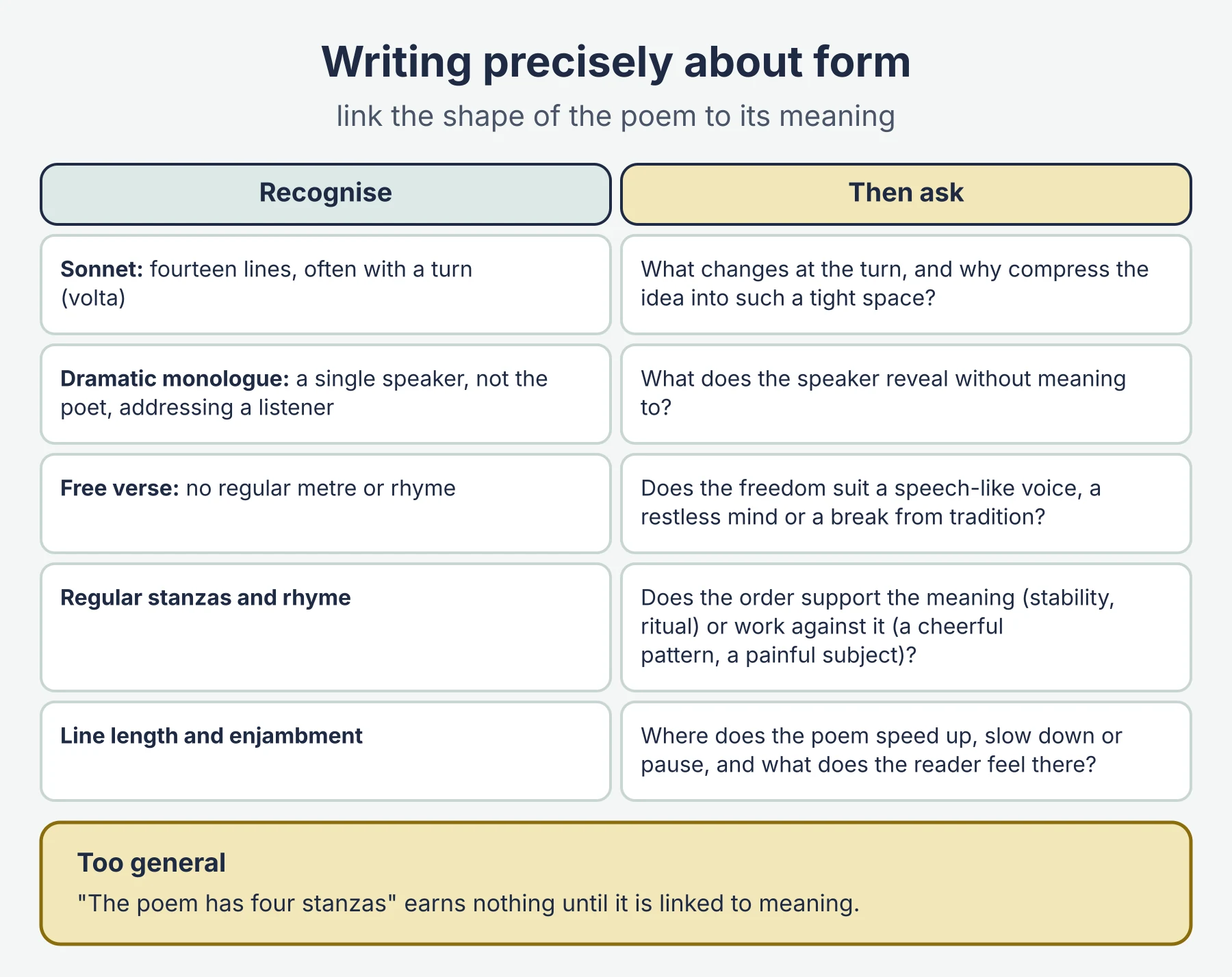
Form in one line each
- Sonnet: what changes at the turn, and why so compressed?
- Dramatic monologue: what does the speaker give away?
- Free verse: does freedom suit a speaking voice or a restless mind?
- Regular rhyme and stanzas: does order support the meaning or clash with it?
- Line breaks: where does the poem pause or speed up, and what does the reader feel there?
Comparison toolkit
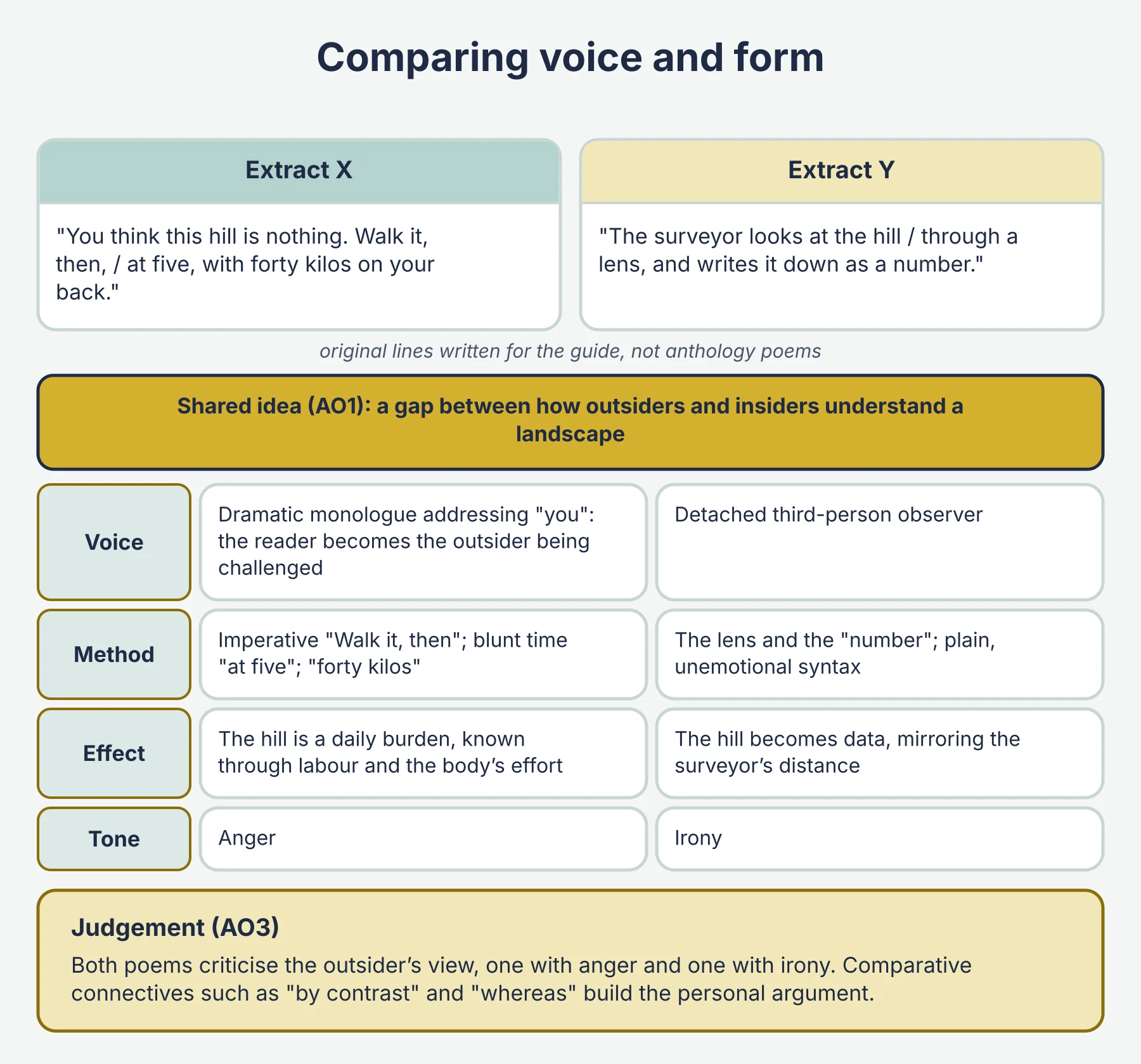
Connectives for difference: whereas, by contrast, however, on the other hand, unlike. Connectives for similarity: similarly, likewise, both, in the same way, equally. Sentence frame: “Both poets present [idea], but whereas [poem 1] uses [method] to suggest [effect], [poem 2] uses [method] to suggest [different effect].”
Paragraph order: shared idea → method and effect in poem 1 → contrasting method and effect in poem 2 → what the difference reveals.
Exam traps
- Two separate essays with a final sentence of comparison.
- Naming a form without saying what it does.
- Context as biography rather than explanation.
- Treating the speaker as the poet.
- Overrunning Section A and starving the unseen poem.
- Long quotations: the anthology is open, so pick key words.
Self-test
- Which section of which paper assesses 3.3.1 on Route B?
- How many poems are in People and Places?
- How many questions do you answer in Section A, and from how many?
- How long is Paper 2b, and how many marks is it worth?
- Which assessment objective includes context?
- Roughly what share of Paper 2b does AO3 carry?
- What is a dramatic monologue?
- What is a volta?
- Give two connectives that signal difference.
- Why should a theme grid show contrasting pairs?
- Give one way to make a comment on form earn credit.
- What replaces unseen prose on Route B?
Answers
- Section A of Paper 2b: Poetry.
-
- One question, from a choice of two.
- 1 hour 30 minutes; 60 marks.
- AO1 (themes, ideas and contexts).
- About 20% (8% of the qualification out of Paper 2b’s 40%).
- A poem spoken by one character, not the poet, to a listener, often revealing more than they mean to.
- A turn or shift in thought or mood, often in a sonnet.
- Any two: whereas, by contrast, however, unlike, on the other hand.
- Contrasting treatments of the same idea give more to compare and support a stronger argument.
- Link the shape of the poem, such as line length or a regular pattern, to its meaning or effect on the reader.
- The non-exam assessment on a prose fiction text.
Frequently asked questions
Should I learn quotations if the paper is open book? Know where they are and what they do. Speed of finding evidence matters more than memorising it word for word.
How many quotations do I need per poem? Four or five short, well-chosen quotations per poem, including one about form or structure, are usually enough for a 45-minute answer.
Official specification
OxfordAQA International GCSE English Literature (9275) specification, 3.3.1 Poetry — oxfordaqa.com.
Related resources
-
Study guides
OxfordAQA International GCSE English Literature (9275): Unseen poetry (Route B)
The unseen poetry question on Route B Paper 2b of OxfordAQA 9275: four reading lenses, handling difficulty, and an original poem with improved model paragraphs.
English Literature · OxfordAQA · IGCSE
Read guide -
Practice questions
OxfordAQA International GCSE English Literature (9275): Unseen poetry (Route B) – Practice Questions
Three original poems with eight skills questions and two 30-mark unseen tasks for OxfordAQA 9275 Route B Paper 2b Section B, with mark-scheme style answers.
English Literature · OxfordAQA · IGCSE
Try questions -
Revision notes
OxfordAQA International GCSE English Literature (9275): Unseen poetry (Route B) – Revision Notes
Revision notes for the unseen poem on OxfordAQA 9275 Route B Paper 2b: the four lenses, structure prompts, tentative phrasing, exam traps and a self-test.
English Literature · OxfordAQA · IGCSE
Revise topic
Get free revision emails (optional)
Occasional emails with practice questions, worked explanations and links to free resources for the qualification and subjects you choose. No spam, and you can unsubscribe from any email. The free tools on this site never need an email.