
Revision Notes
OxfordAQA International GCSE English Literature (9275): Unseen poetry (Route B) – Revision Notes
Revision notes for the unseen poem on OxfordAQA 9275 Route B Paper 2b: the four lenses, structure prompts, tentative phrasing, exam traps and a self-test.
- Subject
- English Literature
- Level
- IGCSE
- Topic
- Route B: Poetry and non-exam assessment
- Author
- Marlbridge Academic Team
- Updated
- Reviewed by
- Ammar Bilal (what this means)
Aligned to OxfordAQA IGCSE English Literature (9275), Version 5.1, for exams May/June 2018 onwards. Official specification .
Syllabus page (what it covers and how it is assessed): OxfordAQA IGCSE English Literature.
Syllabus points this page covers
9275
- 3.3.2 Unseen poetry
Found an error? Report a correction.
Need help with this topic? Request a free trial class for IGCSE English Literature (9275).
Condensed notes for 3.3.2 Unseen poetry, Route B of OxfordAQA International GCSE English Literature (9275), assessed in Section B of Paper 2b. For the full method and a worked poem, read the Route B unseen poetry study guide; then practise with the Route B unseen poetry practice questions. The unseen poetry revision notes for both routes summarise the five-step method.
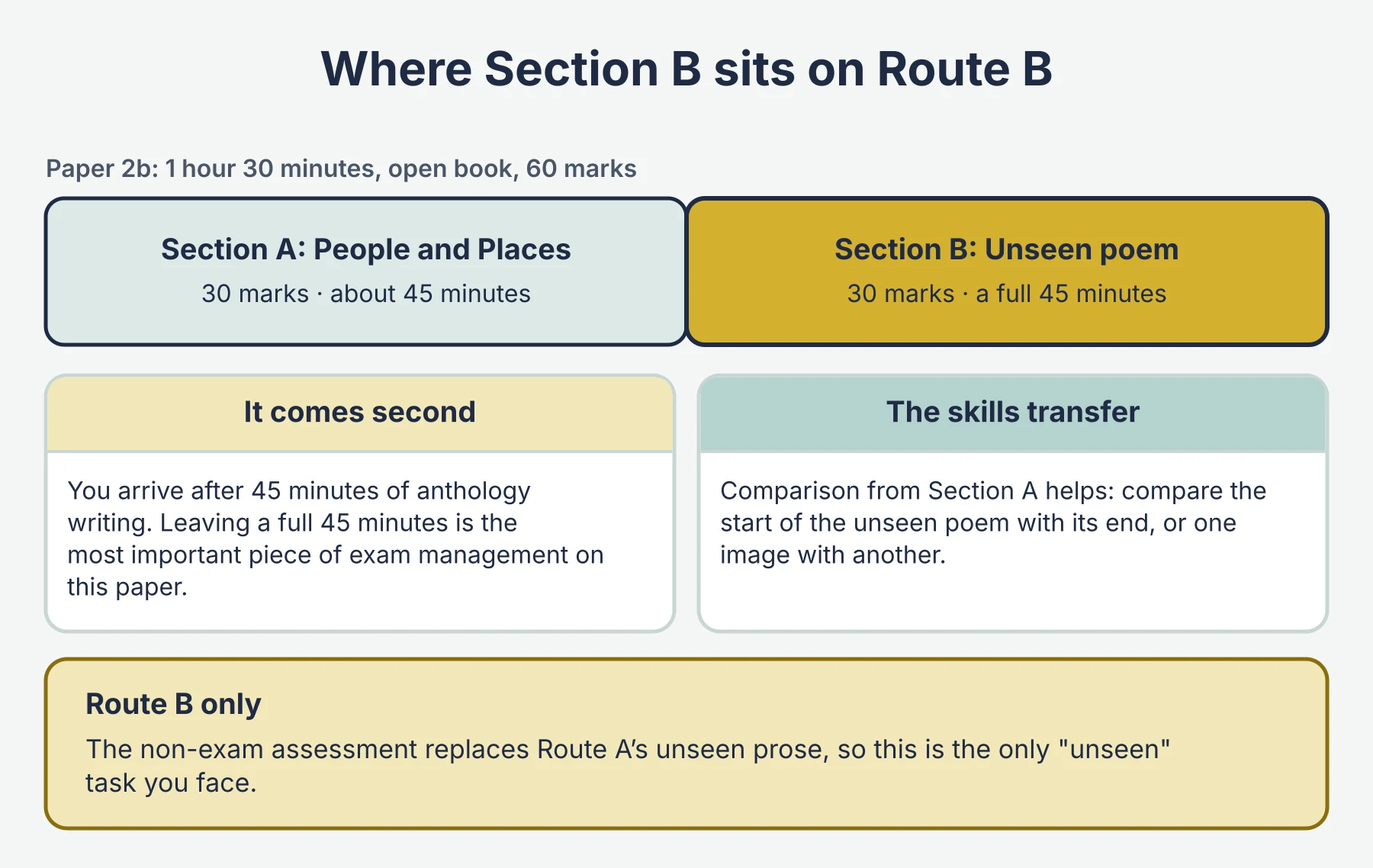
Paper facts
| Fact | Detail |
|---|---|
| Specification point | 3.3.2 Unseen poetry |
| What the specification says | Experience a wide range of poetry; analyse and compare content, theme, structure and use of language |
| Paper and section | Paper 2b: Poetry, Section B (Route B) |
| Task | One question on a previously unseen poem |
| Marks | 30 of the paper’s 60 |
| Time | About 45 minutes, after the anthology question |
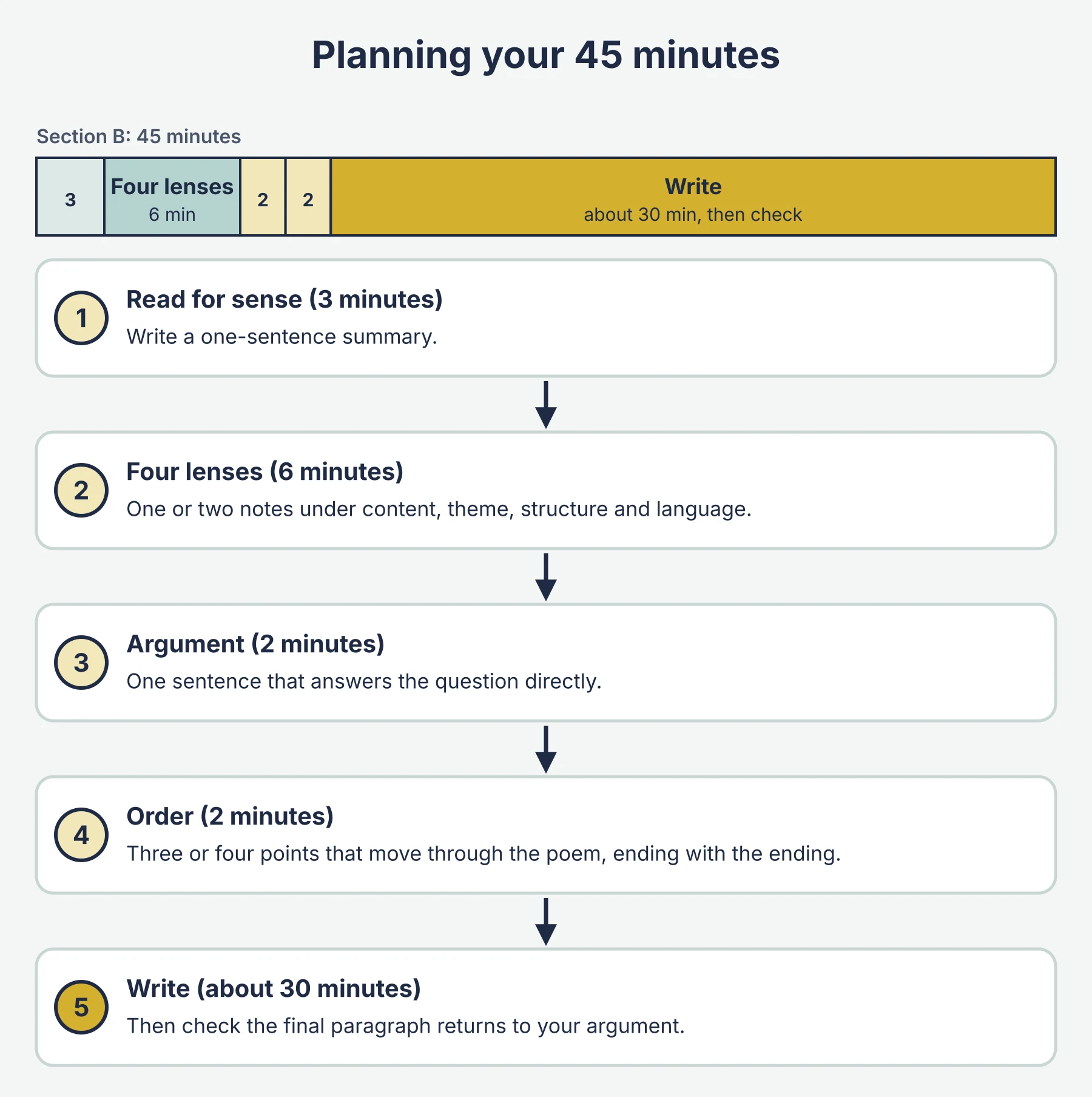
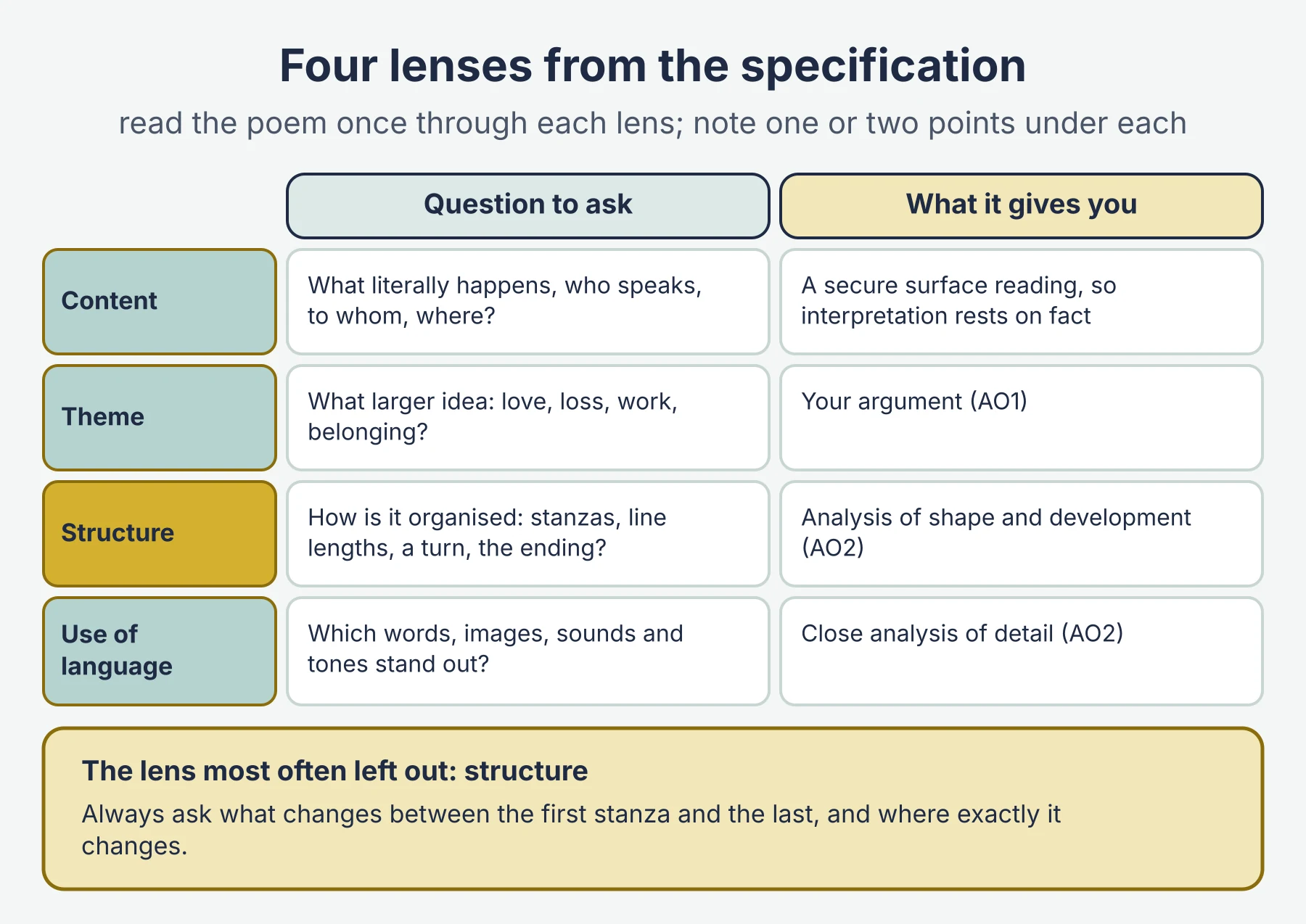
The four lenses
| Lens | Ask | Note down |
|---|---|---|
| Content | Who, where, what happens? | A one-sentence summary |
| Theme | What bigger idea? | Your argument |
| Structure | How is it shaped and how does it develop? | Stanza pattern, line lengths, the turn, the ending |
| Use of language | Which details stand out? | Five or six short quotations with effects |
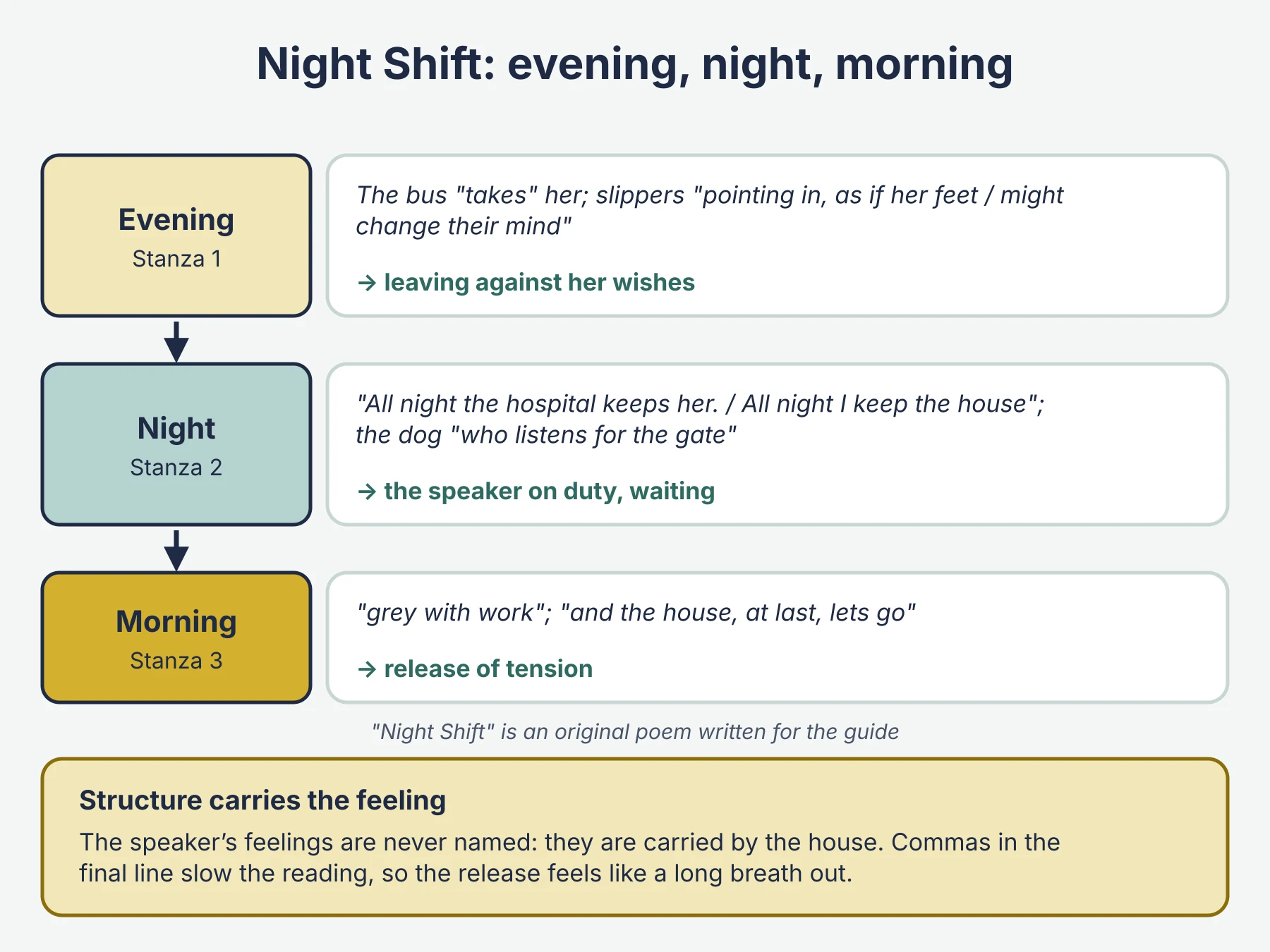
Structure prompts
- How many stanzas, and are they regular? Does a pattern break?
- Where is the turn, and what changes there: time, tone, speaker, place?
- Which lines are longest or shortest, and why?
- Where does enjambment carry the reader on, and where does an end-stopped line or caesura force a pause?
- How does the poem end, and does the ending echo the opening?
- Is there repetition or parallel structure, and what does it emphasise?
Key terms
| Term | Meaning |
|---|---|
| Speaker | The voice of the poem, not necessarily the poet |
| Turn (volta) | A shift in thought, mood or direction |
| Enjambment | A sentence running on over a line break |
| Caesura | A pause within a line |
| End-stopped line | A line that ends with a pause |
| Parallelism | Repeated grammatical structure, such as “All night… / All night…” |
| Imagery | Language that creates a picture or sensation |
| Personification | Giving human qualities to something non-human |
| Tone | The attitude of the voice: tender, bitter, wry, anxious |
| Ambiguity | A word or line open to more than one reading |
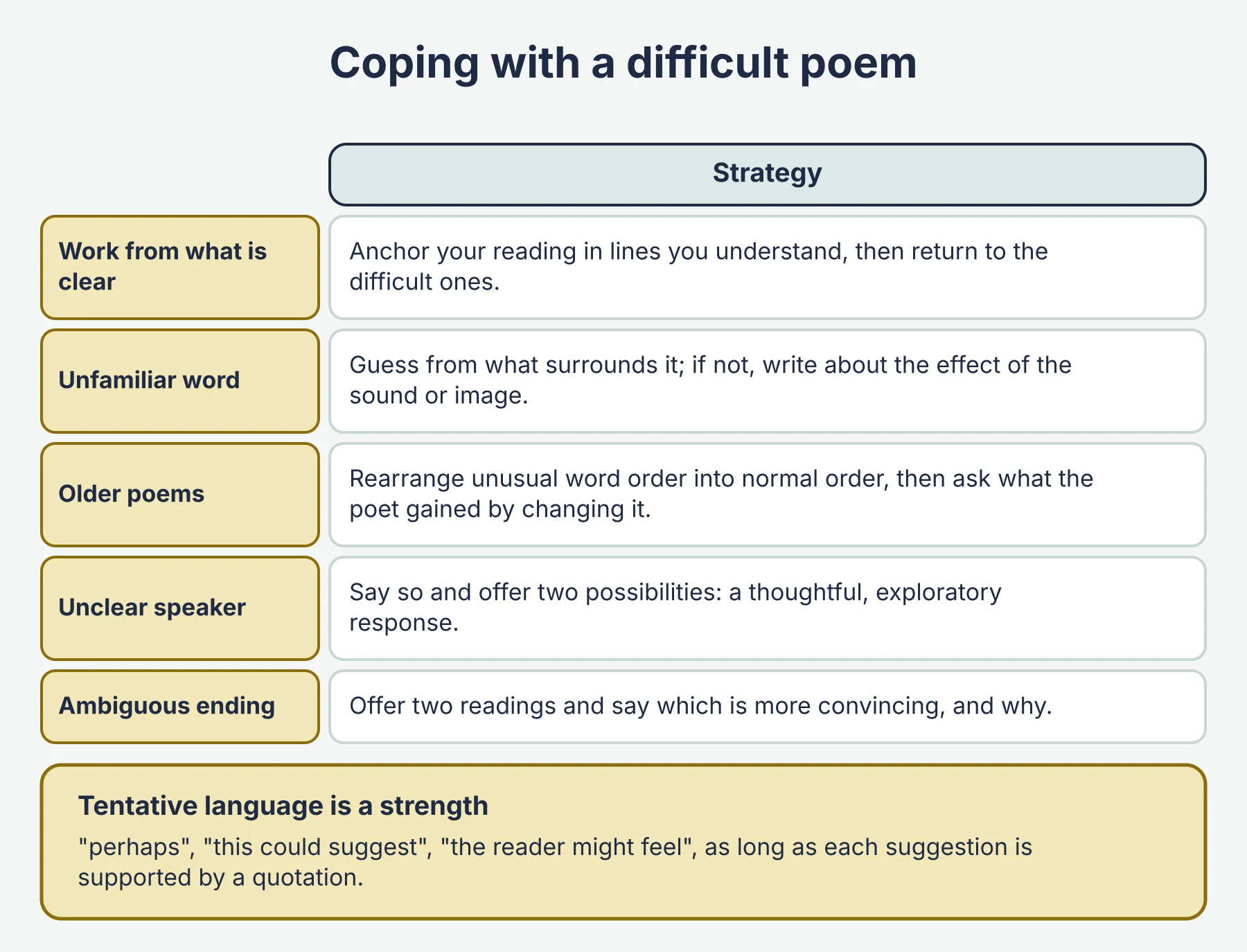
Tentative phrasing that earns credit
- “This could suggest…” / “Perhaps the speaker…”
- “One reading is…; another is…”
- “The reader might feel…”
- “By the final stanza, this shifts to…”
Always pair a tentative idea with a quotation.
Handling difficulty
- Start from the clear lines; return to the hard ones.
- Guess unknown words from surrounding words, or write about sound and image instead.
- In older poems, put the sentence into normal order, then ask why the poet changed it.
- If the speaker is unclear, offer two possibilities.
- For an open ending, give two readings and choose one.
Paragraph pattern
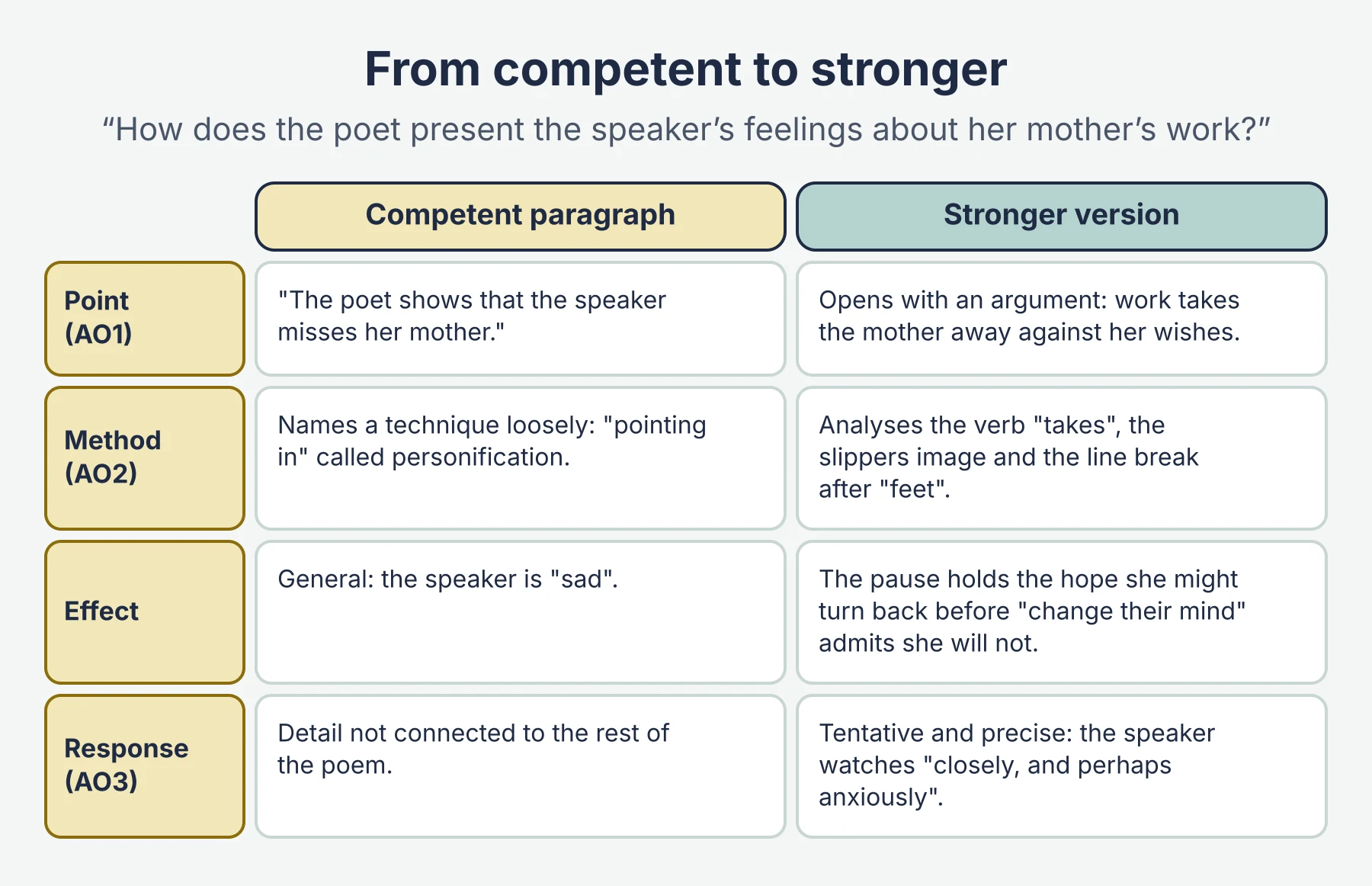
Point about the feeling or idea → short quotation → method named precisely → effect on meaning → link to the poem’s development or ending.
Worked mini-example
The lines below are original, written for these notes.
My grandmother’s hands knew bread before they knew me; now they hold my face as if checking it has risen.
Four-lens notes: content: a grandmother touching the speaker’s face; theme: love expressed through habit and care; structure: the semicolon splits past and present; language: the bread metaphor running through both lines.
Model paragraph: The poet presents the grandmother’s love through the language of her daily work. Her hands “knew bread before they knew me”, so the speaker is placed after her lifetime of labour, perhaps with gentle humour. The semicolon then turns the poem from past to present, and the simile “as if checking it has risen” treats the speaker like a loaf she has made, suggesting pride and a habit of care so deep that tenderness and baking have become the same gesture.
Exam traps
- Leaving less than 45 minutes because Section A overran.
- No comment on structure.
- One-word feelings (“sad”) instead of developed ideas (“resigned but protective”).
- Inventing biography for the poet.
- Line-by-line retelling instead of an argument.
- Never reaching the final stanza.
Self-test
- Which section of Paper 2b assesses unseen poetry?
- Name the four features the specification lists.
- How many marks is the unseen question worth?
- Why does the unseen question need careful time management on Route B?
- What is a turn in a poem?
- What is the difference between enjambment and caesura?
- What is parallelism? Give a made-up example.
- Why should you always comment on the ending?
- Give two tentative phrases.
- What should you do with a line you do not understand?
- Which lens supplies your argument?
- How can the “compare” skill named in the specification help with a single poem?
Answers
- Section B.
- Content, theme, structure, use of language.
-
- It comes after the anthology question, so if Section A overruns, the unseen answer is rushed.
- A shift in thought, mood or direction.
- Enjambment runs a sentence over a line break; caesura is a pause in the middle of a line.
- Repeating a grammatical pattern for emphasis, for example “We waited for the rain. / We waited for the call.”
- Endings often resolve or change the meaning and show the poem’s final attitude.
- Any two: “this could suggest”, “perhaps”, “one reading is”, “the reader might feel”.
- Offer a tentative reading supported by nearby words, or comment on its sound or image.
- Theme.
- You can compare parts of the poem, such as the opening and ending, or two contrasting images.
Frequently asked questions
How many quotations should I use? Five or six short, well-chosen quotations, analysed closely, usually give more credit than many long ones.
Should I write an introduction? A one- or two-sentence opening that states your interpretation is enough.
Official specification
OxfordAQA International GCSE English Literature (9275) specification, 3.3.2 Unseen poetry — oxfordaqa.com.
Related resources
-
Study guides
OxfordAQA International GCSE English Literature (9275): Poetry (Route B)
How to prepare the People and Places anthology question on Route B Paper 2b of OxfordAQA 9275: theme grids, form, context and a worked comparison.
English Literature · OxfordAQA · IGCSE
Read guide -
Practice questions
OxfordAQA International GCSE English Literature (9275): Poetry (Route B) – Practice Questions
Comparison skills practice on two original poems plus three 30-mark anthology tasks for OxfordAQA 9275 Route B Paper 2b, with mark-scheme style answers.
English Literature · OxfordAQA · IGCSE
Try questions -
Revision notes
OxfordAQA International GCSE English Literature (9275): Poetry (Route B) – Revision Notes
Revision notes for the Route B anthology question in OxfordAQA 9275 Paper 2b: paper facts, AO balance, form terms, comparison phrases and a self-test.
English Literature · OxfordAQA · IGCSE
Revise topic
Get free revision emails (optional)
Occasional emails with practice questions, worked explanations and links to free resources for the qualification and subjects you choose. No spam, and you can unsubscribe from any email. The free tools on this site never need an email.