
Study Guides
OxfordAQA International GCSE English Literature (9275): Unseen poetry (Route B)
The unseen poetry question on Route B Paper 2b of OxfordAQA 9275: four reading lenses, handling difficulty, and an original poem with improved model paragraphs.
- Subject
- English Literature
- Level
- IGCSE
- Topic
- Route B: Poetry and non-exam assessment
- Author
- Marlbridge Academic Team
- Updated
- Reviewed by
- Ammar Bilal (what this means)
Aligned to OxfordAQA IGCSE English Literature (9275), Version 5.1, for exams May/June 2018 onwards. Official specification .
Syllabus page (what it covers and how it is assessed): OxfordAQA IGCSE English Literature.
Syllabus points this page covers
9275
- 3.3.2 Unseen poetry
Found an error? Report a correction.
Need help with this topic? Request a free trial class for IGCSE English Literature (9275).
This guide covers 3.3.2 Unseen poetry in Route B of OxfordAQA International GCSE English Literature (9275). The specification says that “students should experience a wide range of poetry in order to develop their ability to closely analyse poems. They should be able to analyse and compare key features such as their content, theme, structure and use of language.” On Route B it is assessed in Section B of Paper 2b: Poetry: one 30-mark question on a previously unseen poem.
The unseen poetry study guide for both routes sets out a five-step reading method. This page builds on it with what that method needs in practice: reading through the specification’s four named features, coping with difficult poems, and turning a competent paragraph into a strong one. Revise it with the Route B unseen poetry revision notes and test yourself with the Route B unseen poetry practice questions.
Where Section B sits on Route B
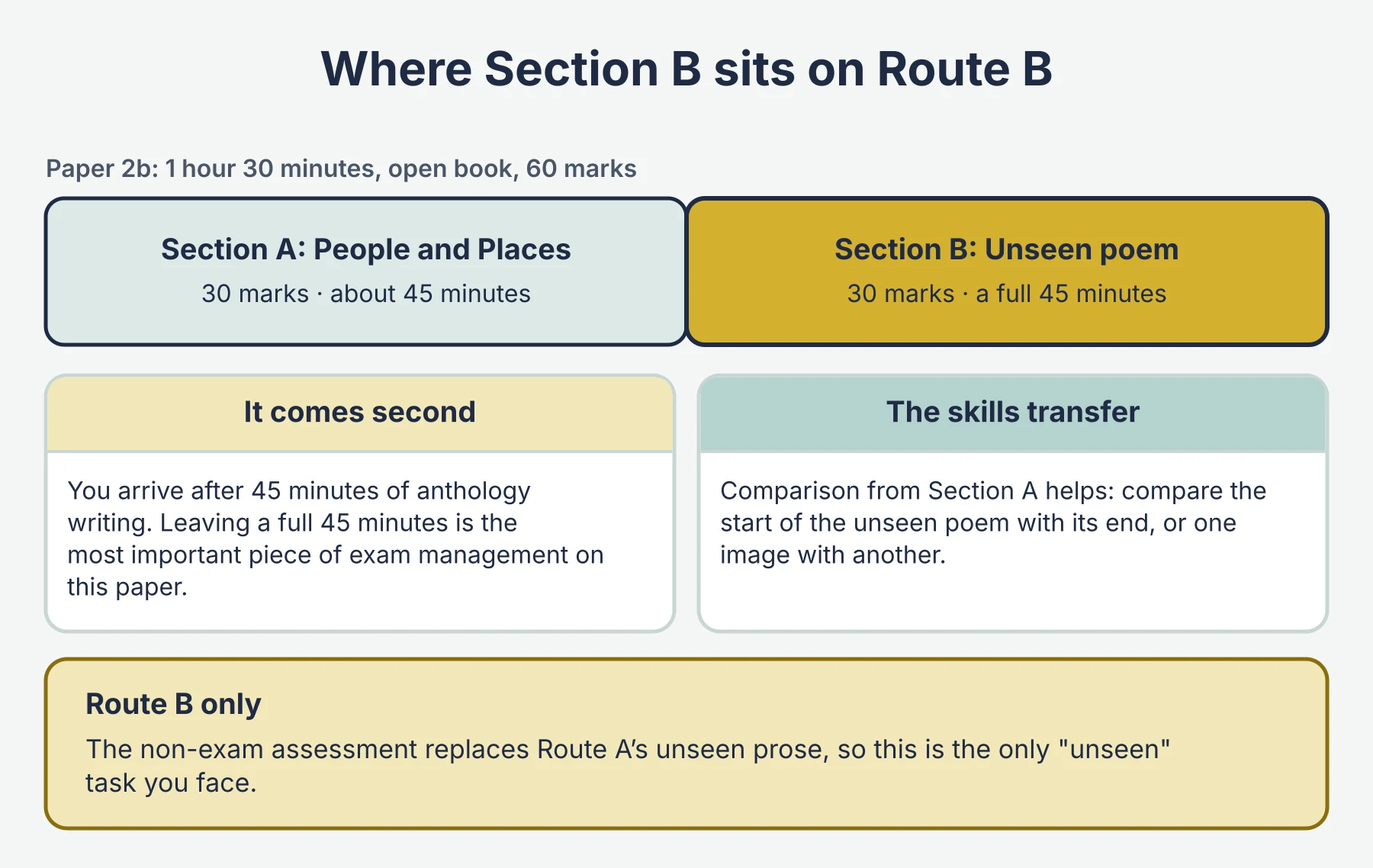
Paper 2b lasts 1 hour 30 minutes, is open book and is worth 60 marks: Section A on the People and Places anthology (30 marks) and Section B on the unseen poem (30 marks). On Route B the non-exam assessment replaces Route A’s unseen prose, so this is the only “unseen” task you face. Two consequences matter:
- It comes second. You arrive at the unseen poem after 45 minutes of anthology writing. Leaving a full 45 minutes is the single most important piece of exam management on this paper.
- The skills transfer. The comparison work you did in Section A helps here: comparing the start of the unseen poem with its end, or one image with another, gives the same analytical depth.
Four lenses from the specification
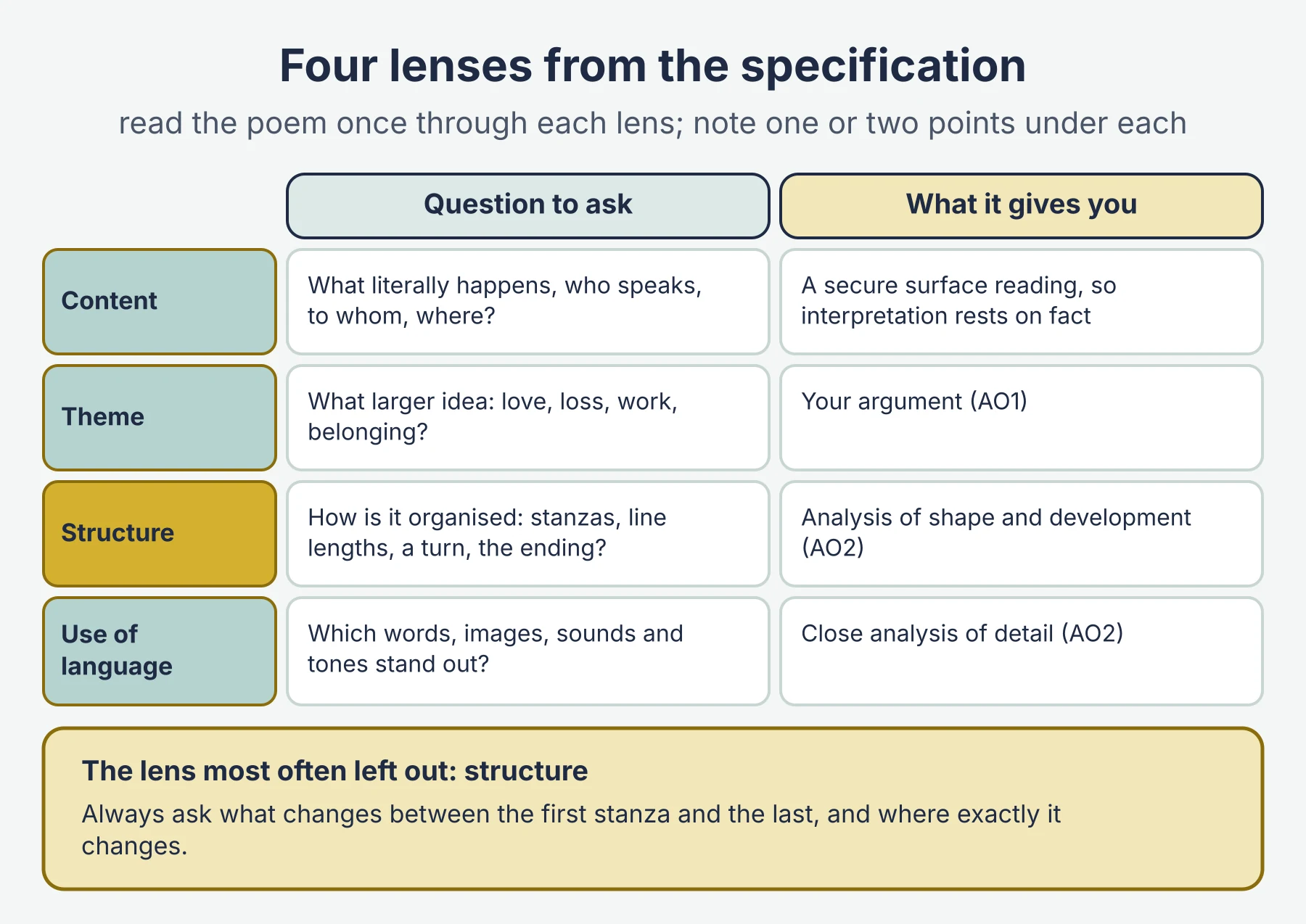
The specification names four key features. Read the poem once through each lens and note one or two points under each heading.
| Lens | Question to ask | What it gives you |
|---|---|---|
| Content | What literally happens, who speaks, to whom, where? | A secure surface reading, so interpretation rests on fact |
| Theme | What larger idea is the poem exploring: love, loss, work, belonging? | Your argument (AO1) |
| Structure | How is it organised: stanzas, line lengths, a turn, the ending? | Analysis of shape and development (AO2) |
| Use of language | Which words, images, sounds and tones stand out? | Close analysis of detail (AO2) |
Structure is the lens most often left out, yet it is the one most poems reward. Always ask: what changes between the first stanza and the last, and where exactly does it change?
Coping with a difficult poem
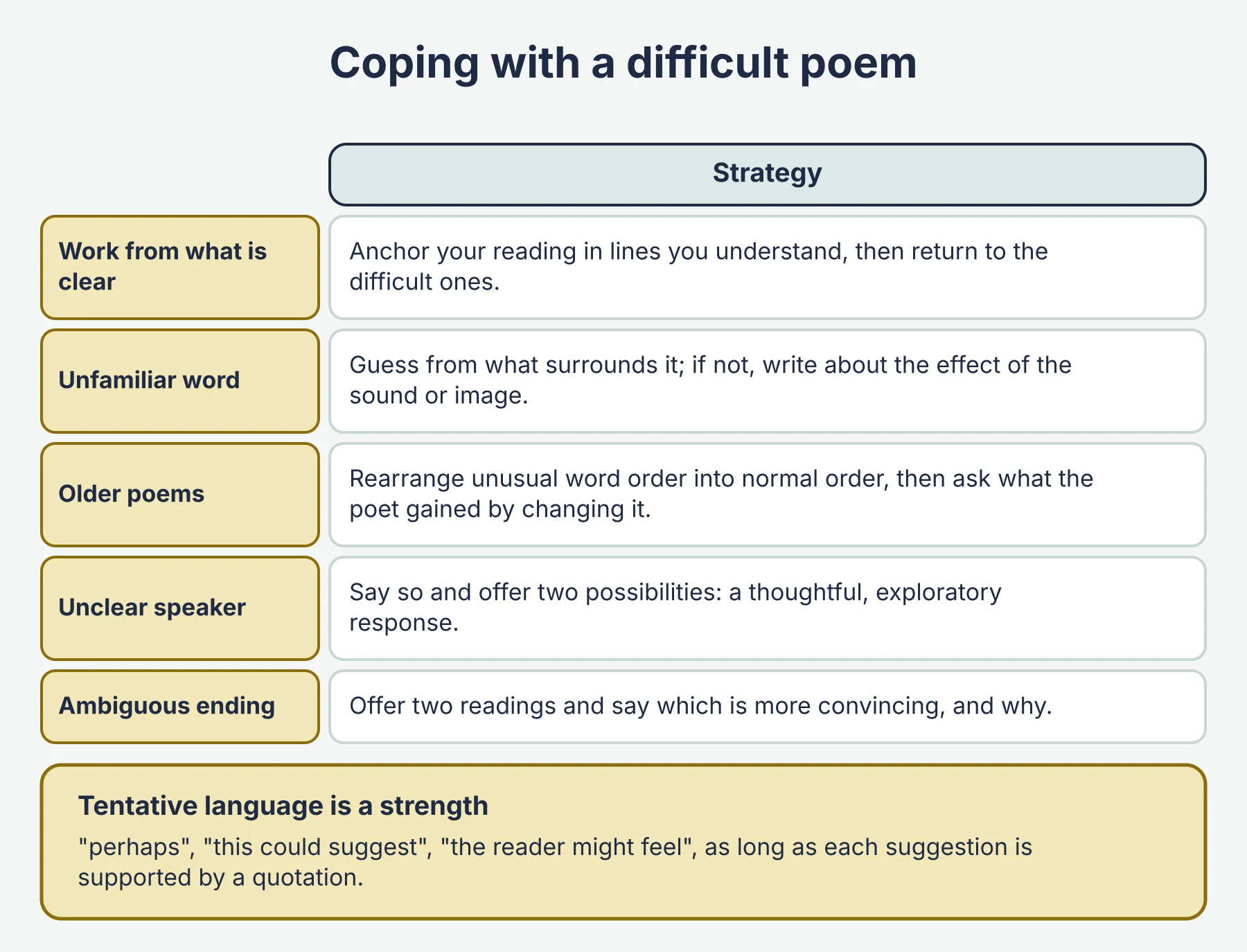
Every candidate meets a line they do not understand. Strong candidates handle it calmly:
- Work from what is clear. Anchor your reading in the lines you understand, then return to the difficult ones.
- Use context in the poem. An unfamiliar word can often be guessed from what surrounds it. If not, write about the effect of the sound or the image rather than the dictionary meaning.
- Older poems. Unusual word order is often there for rhyme or emphasis: rearrange the sentence in your head into normal order, then ask what the poet gained by changing it.
- Unclear speaker. If you cannot tell who is speaking, say so and offer two possibilities. This can show a thoughtful, exploratory response.
- Ambiguous endings. Offer two readings and say which you find more convincing and why.
Tentative language (“perhaps”, “this could suggest”, “the reader might feel”) is a strength here, as long as each suggestion is supported by a quotation.
Worked example
The poem below is an original poem written for this guide.
Night Shift
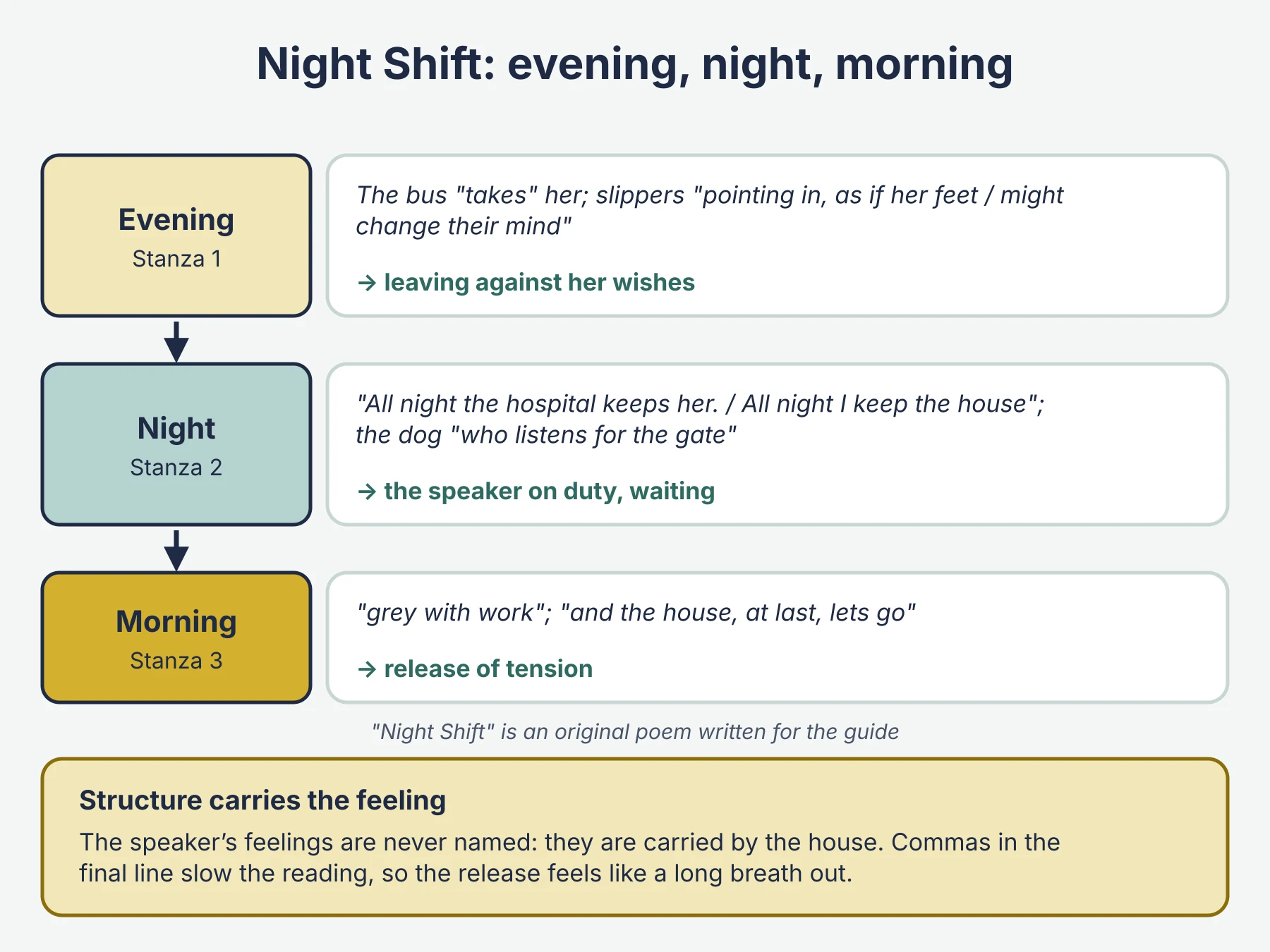
The bus that takes my mother out comes when the street lamps do. She leaves her slippers by the door pointing in, as if her feet might change their mind.
All night the hospital keeps her. All night I keep the house: the clock, the tap that drips, the dog who listens for the gate.
At six she comes back grey with work and smelling of a place I’ve never been, and sleeps the whole bright morning, and the house, at last, lets go.
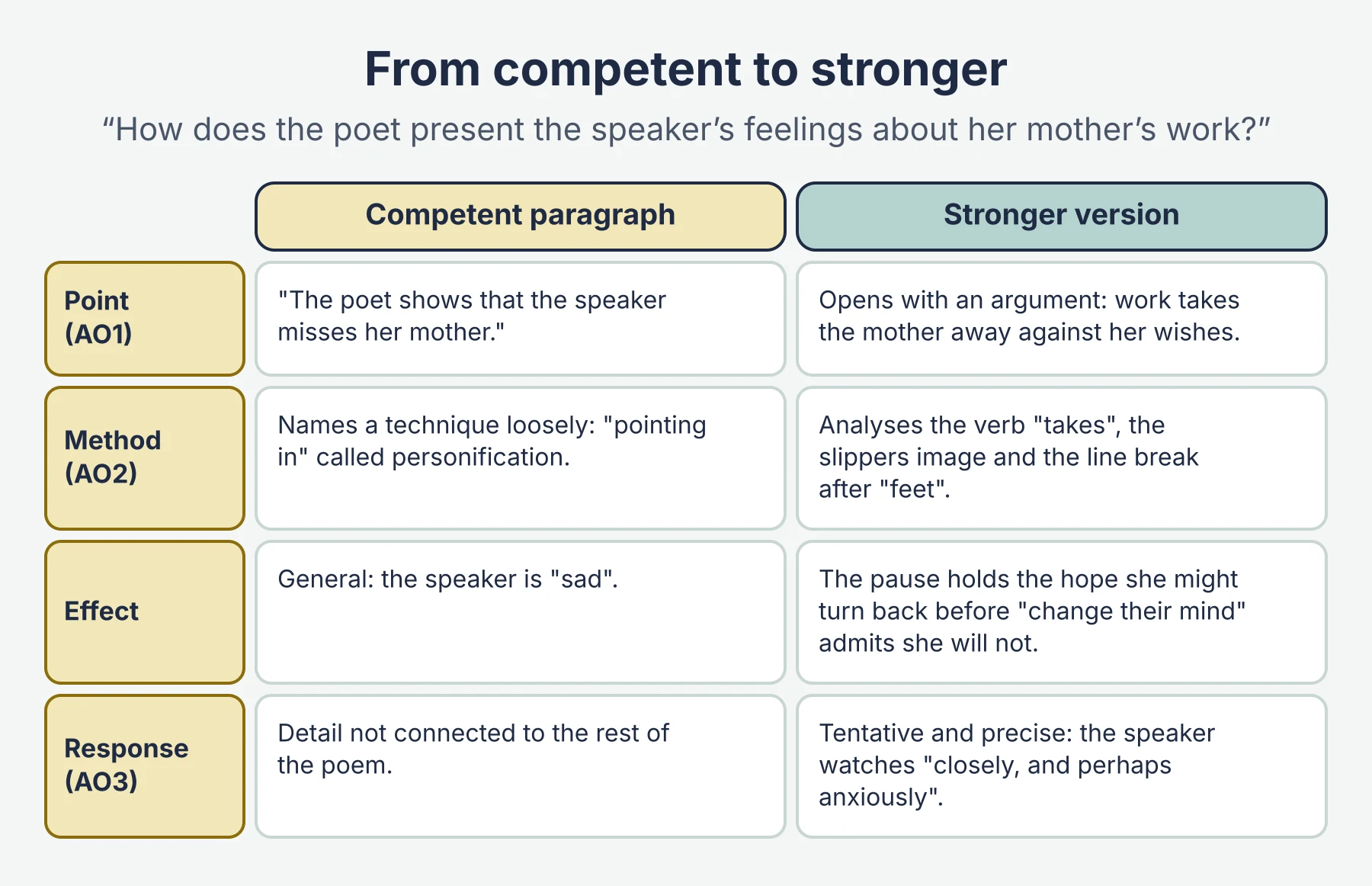
Question: How does the poet present the speaker’s feelings about her mother’s work?
Four-lens notes:
- Content: a child at home while the mother works a night shift at a hospital, then returns and sleeps.
- Theme: love, absence and the cost of work on a family.
- Structure: three stanzas follow evening, night and morning; the poem ends when the mother is home and the tension releases.
- Language: the slippers “pointing in”; repeated “All night”; “keeps”; “grey with work”; “lets go”.
A competent paragraph
The poet shows that the speaker misses her mother. The slippers are “pointing in”, which is personification because it is like the feet want to stay. This shows the speaker is sad that her mother has to go to work.
This paragraph has a relevant point and a quotation, but it names a technique loosely, explains the effect only in general terms (“sad”), and does not connect the detail to the rest of the poem.
A stronger version
From the first stanza, the speaker presents her mother’s work as something that takes her away against her wishes. The bus “takes” her, as if she has no choice, and the slippers left “pointing in, as if her feet / might change their mind” suggest that part of her wants to stay. The line break after “feet” makes the reader pause on the hope that she might turn back, before “change their mind” admits that she will not. The speaker notices this tiny detail, which suggests how closely, and perhaps anxiously, she watches her mother leave.
The stronger version opens with an argument (AO1), analyses the verb, the image and the line break (AO2), and uses tentative, precise phrasing (“perhaps anxiously”) to show a personal response (AO3).
Developing the argument through structure
The middle stanza turns the speaker into a carer. The parallel lines “All night the hospital keeps her. / All night I keep the house” balance mother and child: both are on duty. The list of what the speaker “keeps”, the clock, the dripping tap and the dog “who listens for the gate”, suggests a long, watchful night, and the dog’s listening mirrors the speaker’s own waiting. The final line, “and the house, at last, lets go”, is broken by commas that slow the reading, so the release of tension feels like a long breath out. Her feelings are never named; they are carried by the house.
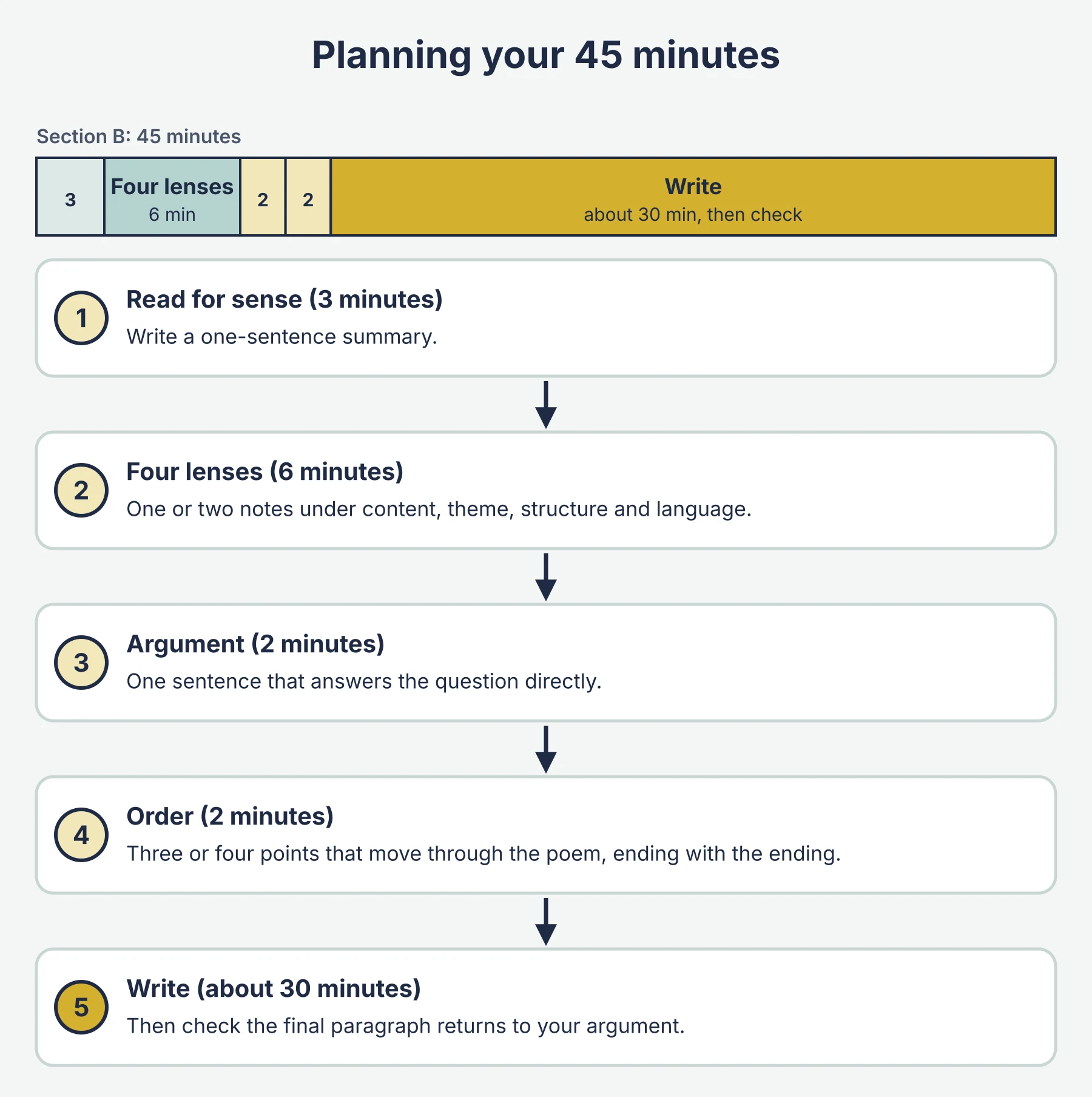
Planning your 45 minutes
- Read for sense (3 minutes) and write a one-sentence summary.
- Four lenses (6 minutes): one or two notes under each.
- Argument (2 minutes): one sentence that answers the question directly.
- Order (2 minutes): three or four points that move through the poem, ending with the ending.
- Write (about 30 minutes), then check the final paragraph returns to your argument.
Common mistakes
- Running out of time because Section A overran.
- Writing only about language and ignoring structure.
- Explaining feelings with single words (“sad”, “happy”) instead of precise, developed ideas.
- Guessing at the poet’s life instead of reading the poem.
- Dropping a difficult line instead of offering a tentative reading.
- Stopping before the final stanza.
Command words
- How does the poet present…? asks for methods and their effects, focused on the subject named.
- Explore invites alternative readings: offer them, then judge between them.
Building experience before the exam
The specification asks you to “experience a wide range of poetry”. Keep a reading log: for each poem you read, one line for each of the four lenses. Vary the poems: rhymed and free verse, older and modern, poems from different countries. After a few weeks, compare two entries and ask how the poets approached a similar subject differently, which practises the “compare” skill the specification also names.
Frequently asked questions
Is the unseen poem question the same on both routes? Yes: one 30-mark question on a previously unseen poem; on Route B it is Section B of Paper 2b.
Do I need to know who wrote the unseen poem? No. Everything you need is on the page.
Official specification
OxfordAQA International GCSE English Literature (9275) specification, 3.3.2 Unseen poetry — oxfordaqa.com.
Related resources
-
Practice questions
OxfordAQA International GCSE English Literature (9275): Unseen poetry (Route B) – Practice Questions
Three original poems with eight skills questions and two 30-mark unseen tasks for OxfordAQA 9275 Route B Paper 2b Section B, with mark-scheme style answers.
English Literature · OxfordAQA · IGCSE
Try questions -
Revision notes
OxfordAQA International GCSE English Literature (9275): Unseen poetry (Route B) – Revision Notes
Revision notes for the unseen poem on OxfordAQA 9275 Route B Paper 2b: the four lenses, structure prompts, tentative phrasing, exam traps and a self-test.
English Literature · OxfordAQA · IGCSE
Revise topic -
Study guides
OxfordAQA International GCSE English Literature (9275): Poetry (Route B)
How to prepare the People and Places anthology question on Route B Paper 2b of OxfordAQA 9275: theme grids, form, context and a worked comparison.
English Literature · OxfordAQA · IGCSE
Read guide
Get free revision emails (optional)
Occasional emails with practice questions, worked explanations and links to free resources for the qualification and subjects you choose. No spam, and you can unsubscribe from any email. The free tools on this site never need an email.