
Study Guides
OxfordAQA International GCSE Islamiat (9237): Rights of Neighbours, Amanat, Backbiting, Arrogance and Jealousy
The social impact of the sources of authority: rights of neighbours, Amanat, and the prohibition of backbiting, arrogance and jealousy, for 9237 topic 3.2.2.9.
- Subject
- Islamiyat
- Level
- IGCSE
- Topic
- Paper 2 – The Life of Hazrat Muhammad (pbuh) and Sources of Authority in Islam
- Author
- Marlbridge Academic Team
- Updated
- Reviewed by
- Azam Siddique (what this means)
Aligned to OxfordAQA IGCSE Islamiyat (9237), Version 1.1. Official specification .
Syllabus page (what it covers and how it is assessed): OxfordAQA IGCSE Islamiyat.
Syllabus points this page covers
9237
- 3.2.2 Sources of authority in Islam
Found an error? Report a correction.
Need help with this topic? Request a free trial class for IGCSE Islamiyat (9237).
This guide covers content area 3.2.2.9 of OxfordAQA International GCSE Islamiat (9237), The social impact of sources of authority on the character of a Muslim: “The rights of neighbours including the importance of Amanat” and “The prohibition of backbiting, arrogance and jealousy.” The Sources of Authority in Islam study guide covers how the Qur’an and Hadith work as sources and leaves their effect on daily conduct to separate pages. This page shows what the sources teach on these five topics and how to use that evidence in Paper 2 Section B.
What “social impact” means
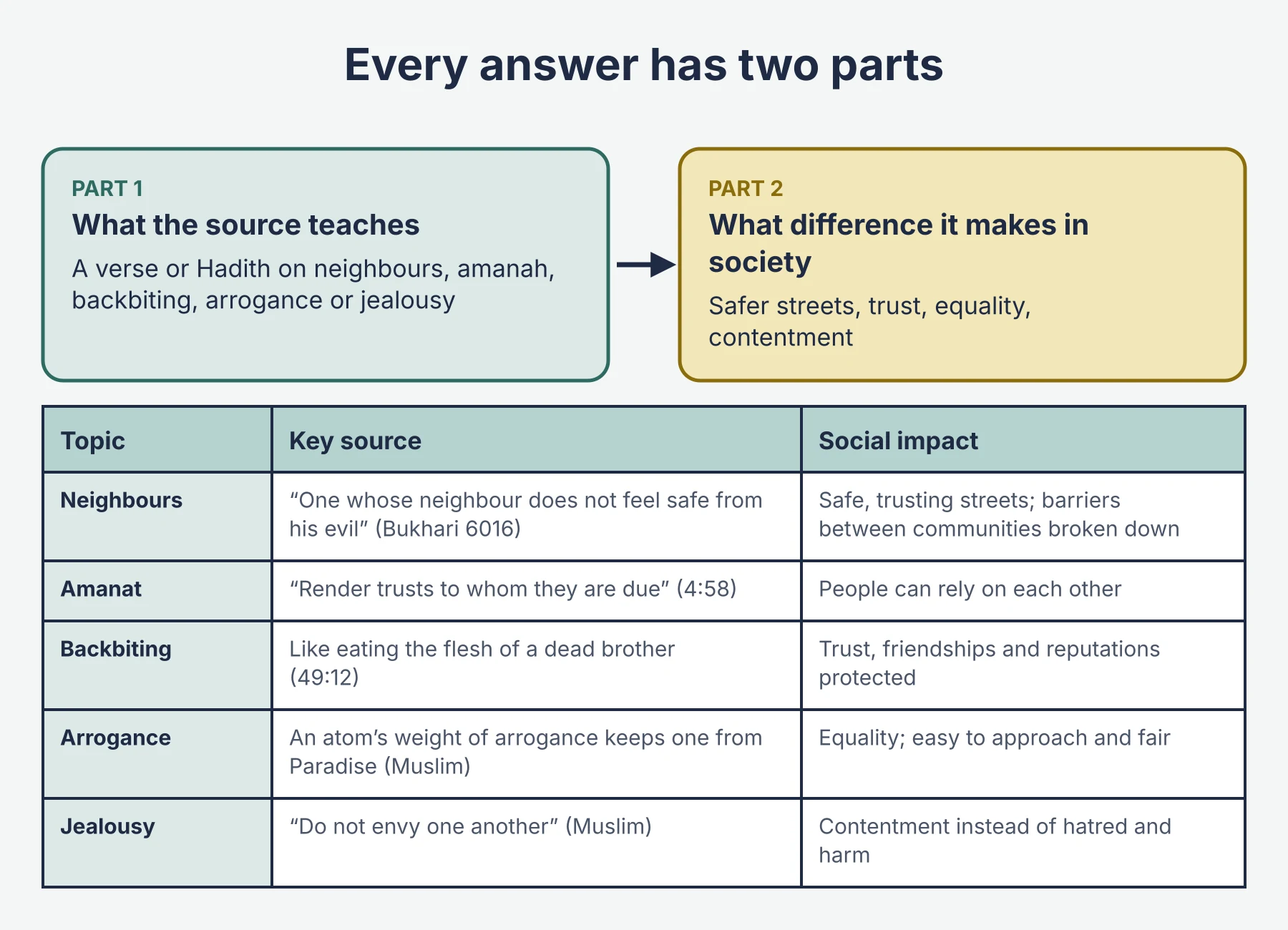
Content areas 3.2.2.8 to 3.2.2.10 ask how the Qur’an and Sunnah shape a Muslim’s character. 3.2.2.9 is about character towards other people: how a Muslim treats the people next door, the trust others place in them, and the attitudes and words that damage relationships. Every answer should therefore have two parts: what the source teaches and what difference it makes in society.
The rights of neighbours
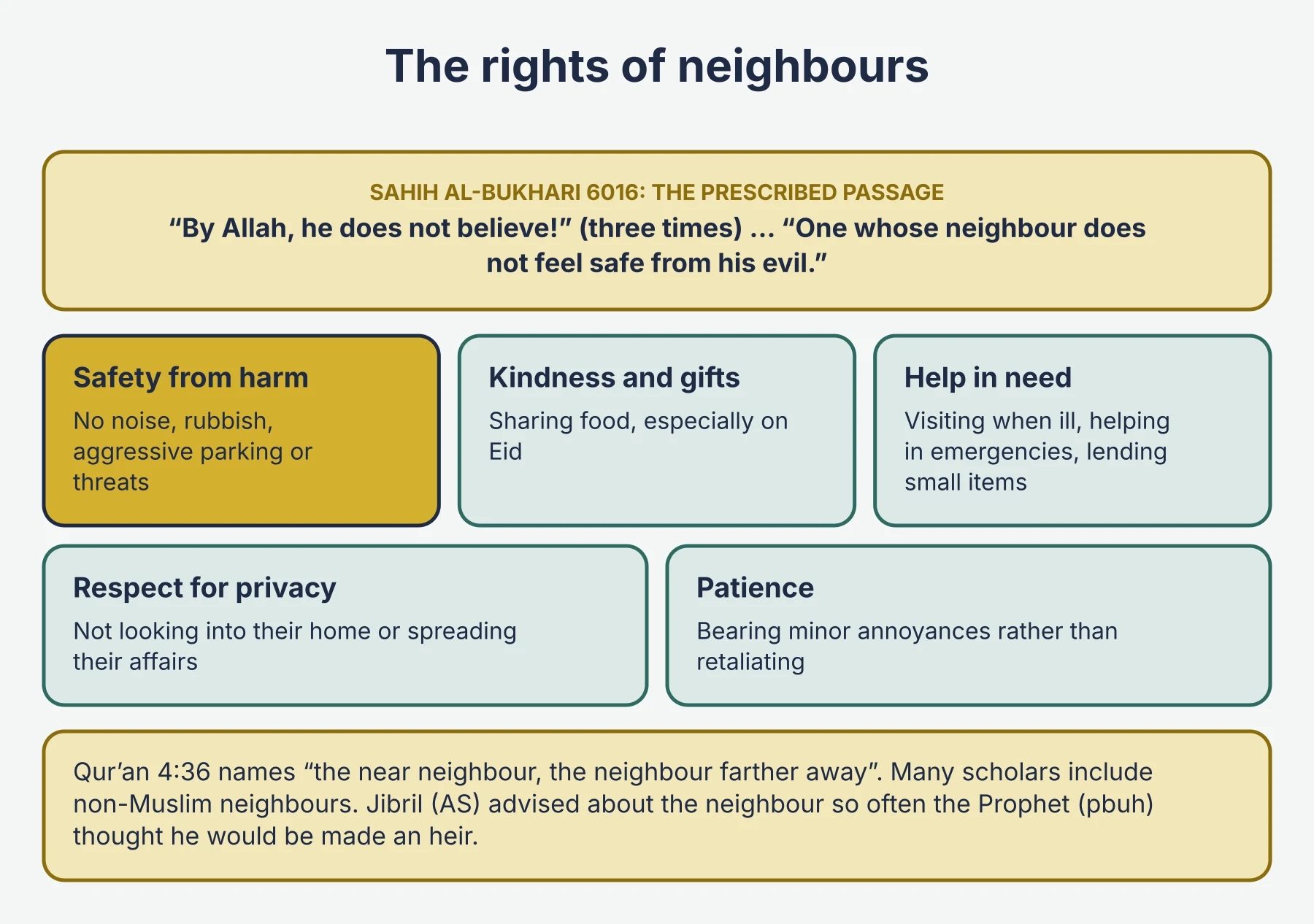
The Qur’an lists neighbours among those to whom Muslims must do good: “Worship Allah and associate nothing with Him, and to parents do good, and to relatives, orphans, the needy, the near neighbour, the neighbour farther away, the companion at your side, the traveller” (4:36). Scholars explain “near” and “farther away” as closeness of kinship or of distance, and many include non-Muslim neighbours.
The Hadith make the duty very strong:
- The Prophet (pbuh) said that Jibril (AS) kept advising him about the neighbour until he thought the neighbour would be made an heir (Sahih al-Bukhari and Sahih Muslim).
- “Whoever believes in Allah and the Last Day, let him honour his neighbour” (Sahih al-Bukhari).
- The prescribed passage for 3.2.2.9 (Sahih al-Bukhari 6016): the Prophet (pbuh) said three times, “By Allah, he does not believe!” and, when asked who, said, “One whose neighbour does not feel safe from his evil.”
What the rights include in practice:
| Right | Example |
|---|---|
| Safety from harm | No noise, rubbish, aggressive parking or threats |
| Kindness and gifts | Sharing food, especially on Eid or when cooking something special |
| Help in need | Visiting when they are ill, helping in emergencies, lending small items |
| Respect for privacy | Not looking into their home or spreading their affairs |
| Patience | Bearing minor annoyances rather than retaliating |
Why it matters: the Bukhari passage links faith itself to the neighbour’s safety, so a Muslim who prays but harms the neighbour has an incomplete faith. Socially, good neighbours create safe, trusting streets and break down barriers between communities.
Amanat: trust
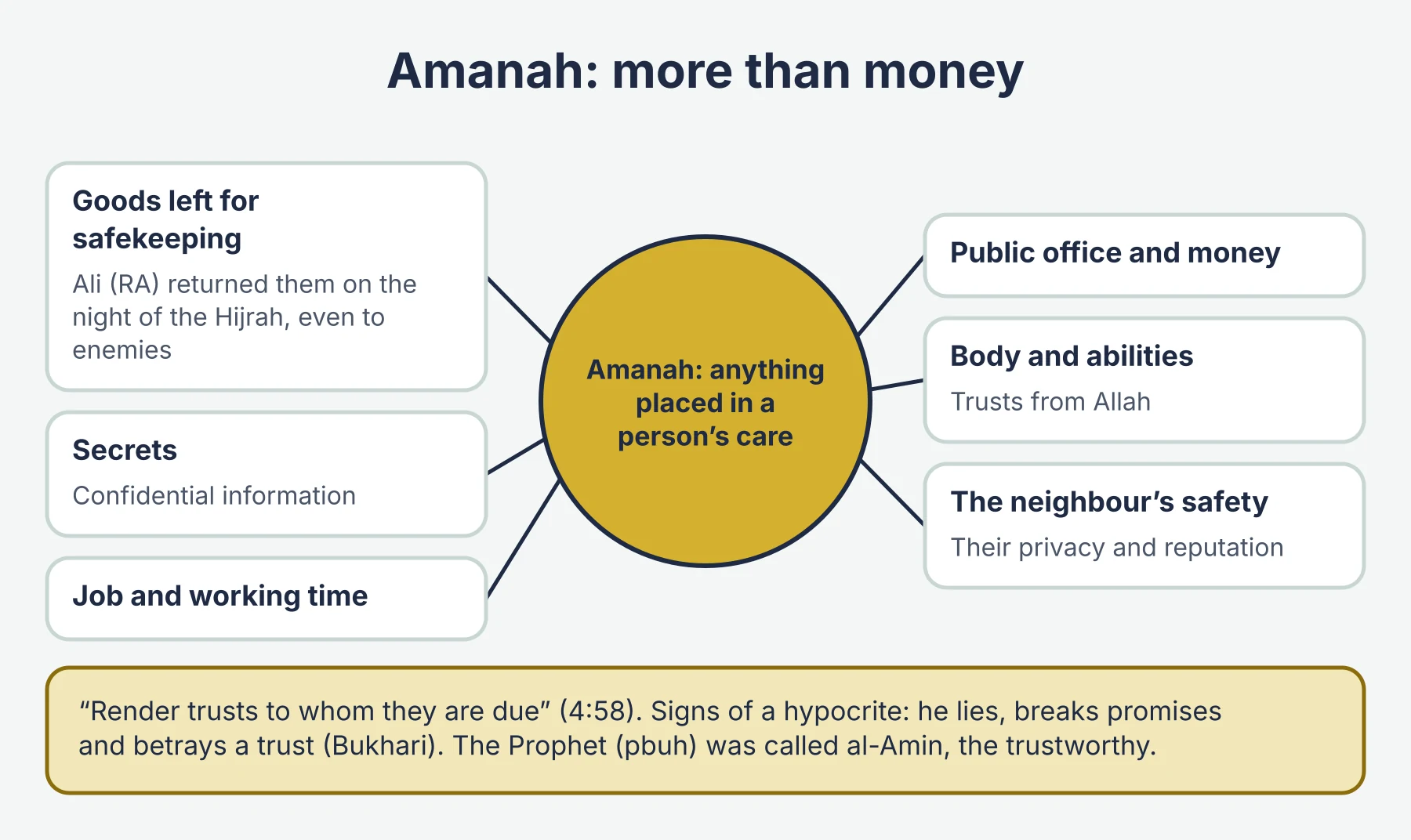
Amanah (plural amanat) means a trust: anything placed in a person’s care, whether property, a secret, a job, a promise or a responsibility.
- “Indeed, Allah commands you to render trusts to whom they are due and when you judge between people to judge with justice” (4:58).
- The believers are described as “those who are to their trusts and their promises attentive” (23:8).
- The Prophet (pbuh) said that the signs of a hypocrite are three: when he speaks he lies, when he promises he breaks it, and when he is trusted he betrays (Sahih al-Bukhari).
- Before prophethood, the people of Makkah called him al-Amin, the trustworthy. On the night of the Hijrah, Hazrat Ali (RA) stayed behind to return the goods that people, including his enemies, had left with him.
Forms of amanah: money or goods left for safekeeping; secrets and confidential information; one’s job and working time; public office and public money; one’s own body and abilities, which Muslims believe are trusts from Allah.
Link to neighbours: the neighbour trusts you with their safety, privacy and reputation, so keeping amanah and honouring the neighbour are closely connected.
The prohibition of backbiting (ghibah)
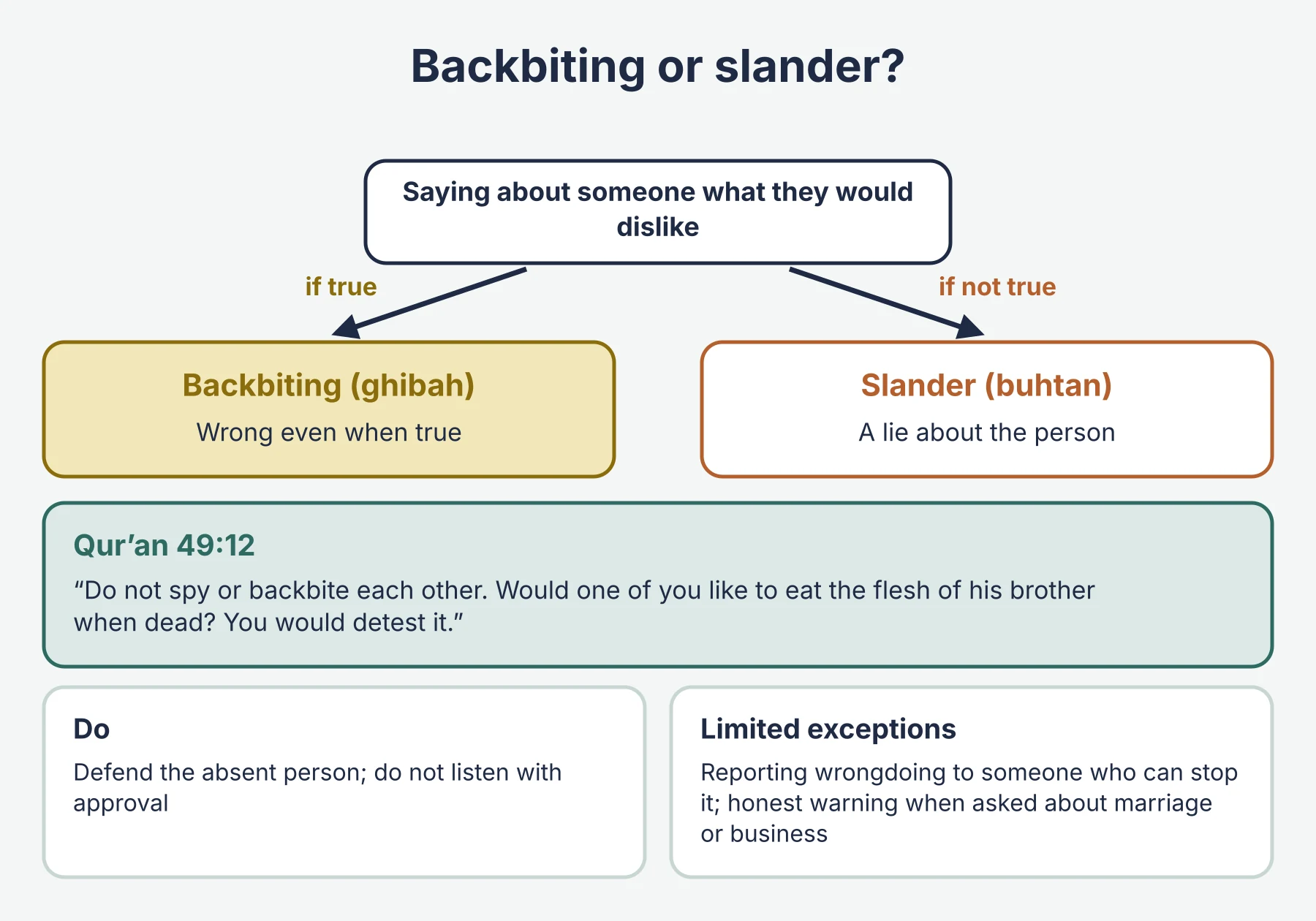
The Qur’an gives a vivid image: “do not spy or backbite each other. Would one of you like to eat the flesh of his brother when dead? You would detest it” (49:12). The Prophet (pbuh) defined backbiting as saying about your brother what he would dislike. When asked what if it is true, he said that if it is true you have backbitten him, and if it is not true you have slandered him (buhtan) (Sahih Muslim).
- Backbiting is wrong even when true: this is the point most students miss.
- Listening to it with approval shares in the wrong; Muslims are encouraged to defend the absent person.
- Limited exceptions recognised by scholars include reporting wrongdoing to someone who can stop it, or giving an honest warning when asked about a person’s character for marriage or business.
- Its social harm is clear: it destroys trust, friendships and reputations, which is why the Qur’an places it alongside spying and suspicion.
This connects with 3.2.2.8, hiding the faults of others.
The prohibition of arrogance (kibr)
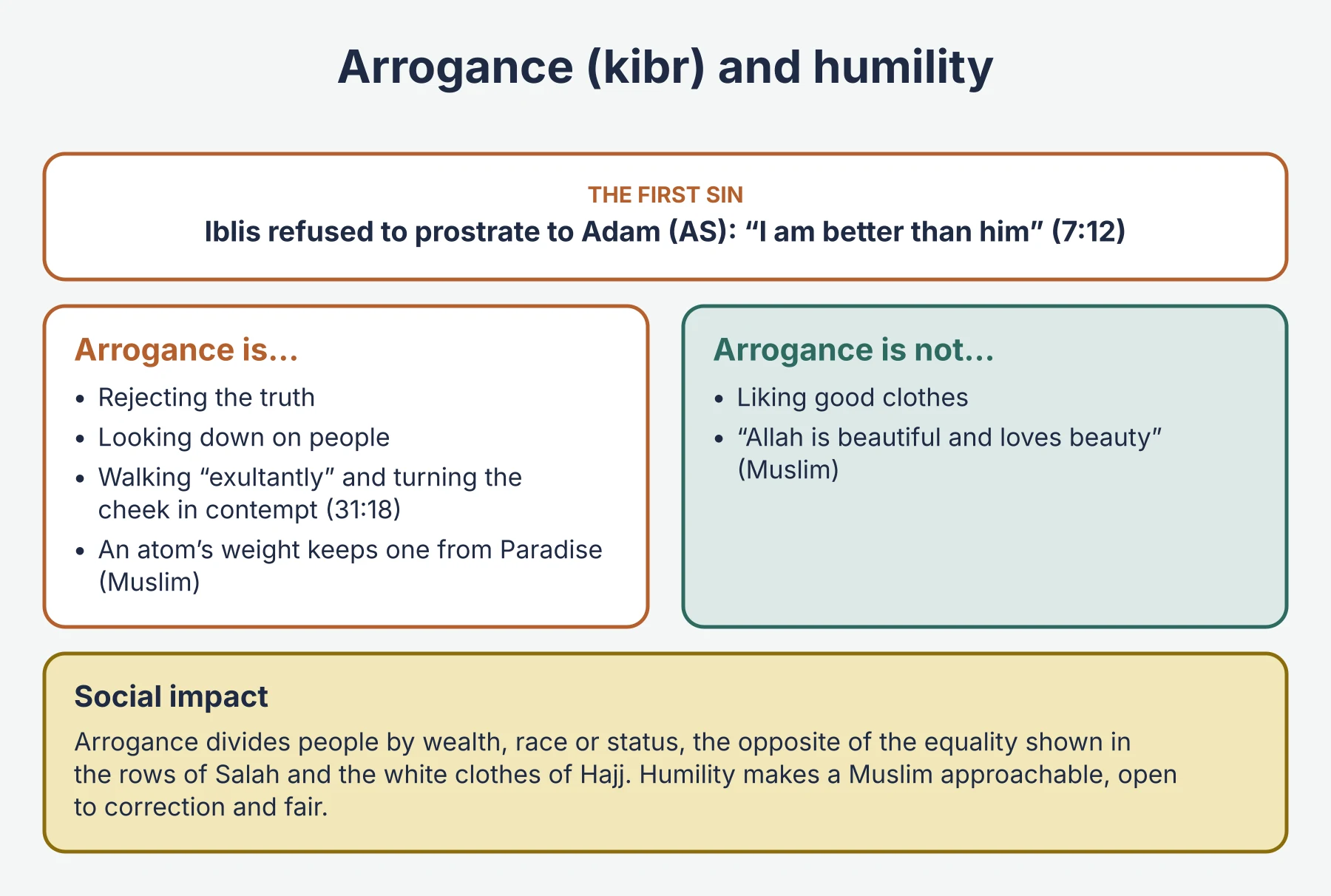
- The first sin was arrogance: Iblis refused to prostrate to Adam (AS), saying “I am better than him” (7:12).
- “Do not turn your cheek [in contempt] toward people and do not walk through the earth exultantly. Indeed, Allah does not like everyone self-deluded and boastful” (31:18).
- The Prophet (pbuh) said that no one will enter Paradise who has an atom’s weight of arrogance in his heart, and explained that arrogance is rejecting the truth and looking down on people (Sahih Muslim). In the same Hadith he made clear that liking good clothes is not arrogance, because “Allah is beautiful and loves beauty”.
Social impact: arrogance divides people by wealth, race or status, the opposite of the equality taught in the Farewell Sermon and shown in the rows of Salah and the white clothes of Hajj. Humility makes a Muslim easy to approach, willing to accept correction and fair to others.
The prohibition of jealousy (hasad)
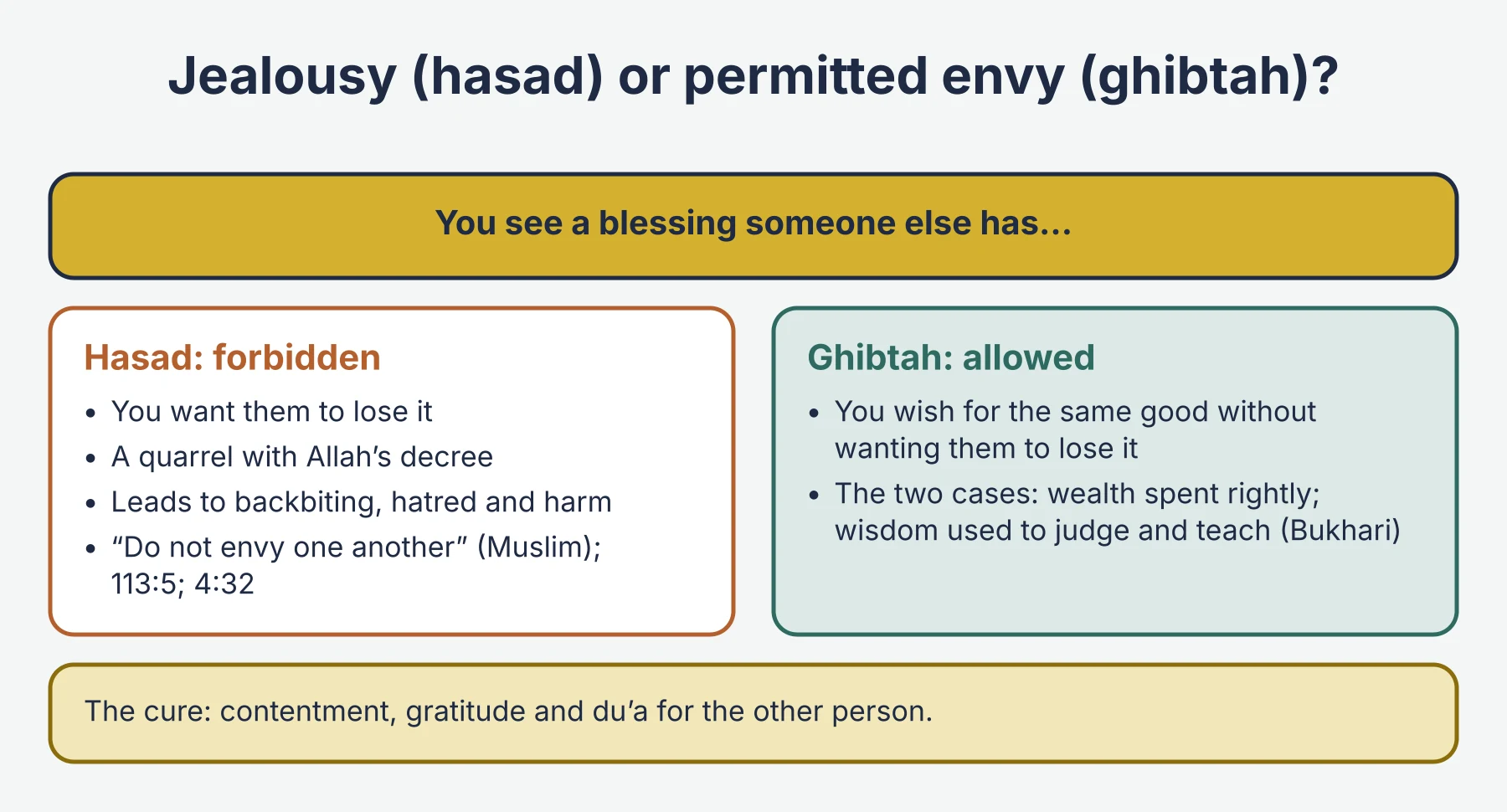
- Muslims seek protection “from the evil of an envier when he envies” (113:5).
- “Do not wish for that by which Allah has made some of you exceed others” (4:32).
- The Prophet (pbuh) said, “Do not envy one another, do not hate one another, do not turn away from one another, and be, O servants of Allah, brothers” (Sahih Muslim).
- Permitted “envy” (ghibtah): the Prophet (pbuh) said there is no envy except in two cases: a person whom Allah has given wealth and who spends it rightly, and a person whom Allah has given wisdom and who judges and teaches by it (Sahih al-Bukhari). Wishing to have the same good as someone, without wanting them to lose it, is allowed.
Why it is serious: hasad is a quarrel with Allah’s decree, since it resents what Allah has given another; it leads to backbiting, hatred and sometimes harm. The cure the sources point to is contentment, gratitude and du’a for the other person.
Worked example: a 6-mark answer
Question: Explain two reasons why Muslims should not backbite. Apply one teaching from a source of authority in your answer. [6]
First, backbiting is forbidden even when what is said is true [1]. The Prophet (pbuh) explained that saying something true that a person dislikes is backbiting, and saying something false is slander, so a Muslim cannot excuse gossip by saying “but it’s true” [1]. Second, backbiting destroys trust in a community [1]. If people speak behind each other’s backs, friends and neighbours stop feeling safe with one another, which goes against the brotherhood Islam teaches [1]. The Qur’an compares backbiting to eating the flesh of one’s dead brother (49:12), showing that it attacks someone who cannot defend himself and is as disgusting to Allah as that image is to us [2].
Common mistakes
- Treating backbiting and lying as the same. Backbiting can be true; lying about someone is slander.
- Confusing hasad with ghibtah. Wishing for the same blessing is allowed; wishing someone to lose it is not.
- Limiting neighbours to Muslims. The sources speak of neighbours generally.
- Defining amanah as money only. It includes secrets, jobs, promises and responsibilities.
- Stopping at the teaching. “Social impact” questions need the effect on society.
Exam technique
Give two rights of neighbours wants two specific rights. Explain questions want the teaching plus its effect. In the 12-mark question, the prescribed passage is the Bukhari Hadith on neighbours: build points around “By Allah, he does not believe!” (faith and conduct are linked) and “does not feel safe from his evil” (safety is the minimum right).
Related pages
- Rights of neighbours, Amanat, backbiting, arrogance and jealousy revision notes
- Rights of neighbours, Amanat, backbiting, arrogance and jealousy practice questions
- Sources of Authority in Islam revision notes
Source: OxfordAQA, International GCSE Islamiat (9237) specification, Version 1.1, content area 3.2.2.9 and its prescribed passage.
Related resources
-
Practice questions
OxfordAQA International GCSE Islamiat (9237): Rights of Neighbours, Amanat, Backbiting, Arrogance and Jealousy – Practice Questions
Twelve original questions with mark guidance on the rights of neighbours, Amanat, backbiting, arrogance and jealousy, for 9237 topic 3.2.2.9.
Islamiyat · OxfordAQA · IGCSE
Try questions -
Revision notes
OxfordAQA International GCSE Islamiat (9237): Rights of Neighbours, Amanat, Backbiting, Arrogance and Jealousy – Revision Notes
Recall notes on the rights of neighbours, Amanat and the prohibition of backbiting, arrogance and jealousy, with key sources and a self-test (9237).
Islamiyat · OxfordAQA · IGCSE
Revise topic -
Study guides
OxfordAQA International GCSE Islamiat (9237): The Schools of Thought in Islam
The origins and role of the Hanafi, Maliki, Shafi'i, Hanbali and Ja'fari schools of law, their founders, methods and differences, for 9237 topic 3.2.2.5.
Islamiyat · OxfordAQA · IGCSE
Read guide
Get free revision emails (optional)
Occasional emails with practice questions, worked explanations and links to free resources for the qualification and subjects you choose. No spam, and you can unsubscribe from any email. The free tools on this site never need an email.