
Study Guides
OxfordAQA International GCSE Islamiat (9237): The Schools of Thought in Islam
The origins and role of the Hanafi, Maliki, Shafi'i, Hanbali and Ja'fari schools of law, their founders, methods and differences, for 9237 topic 3.2.2.5.
- Subject
- Islamiyat
- Level
- IGCSE
- Topic
- Paper 2 – The Life of Hazrat Muhammad (pbuh) and Sources of Authority in Islam
- Author
- Marlbridge Academic Team
- Updated
- Reviewed by
- Azam Siddique (what this means)
Aligned to OxfordAQA IGCSE Islamiyat (9237), Version 1.1. Official specification .
Syllabus page (what it covers and how it is assessed): OxfordAQA IGCSE Islamiyat.
Syllabus points this page covers
9237
- 3.2.2 Sources of authority in Islam
Found an error? Report a correction.
Need help with this topic? Request a free trial class for IGCSE Islamiyat (9237).
This guide covers content area 3.2.2.5 of OxfordAQA International GCSE Islamiat (9237), The different schools of thought in Islam: “The origins and role of the major law schools in Islam including: Hanafi, Shaf’i, Maliki, Hanbali and Ja’fari.” The Sources of Authority in Islam study guide explains the Qur’an, Hadith, Ijma and Qiyas, but it does not cover the schools that use them. This page explains what a law school (madhhab) is, why the schools arose, who founded each one and how their methods differ.
What is a school of thought?
A madhhab (plural madhahib) is a school of Islamic law (fiqh): a body of rulings and, more importantly, a method for deriving rulings from the sources. All the schools agree on the fundamentals: Tawhid, the Five Pillars, the authority of the Qur’an and the Sunnah. They differ on details of practice where the sources can be understood in more than one way, or where the sources are silent and scholars must reason.
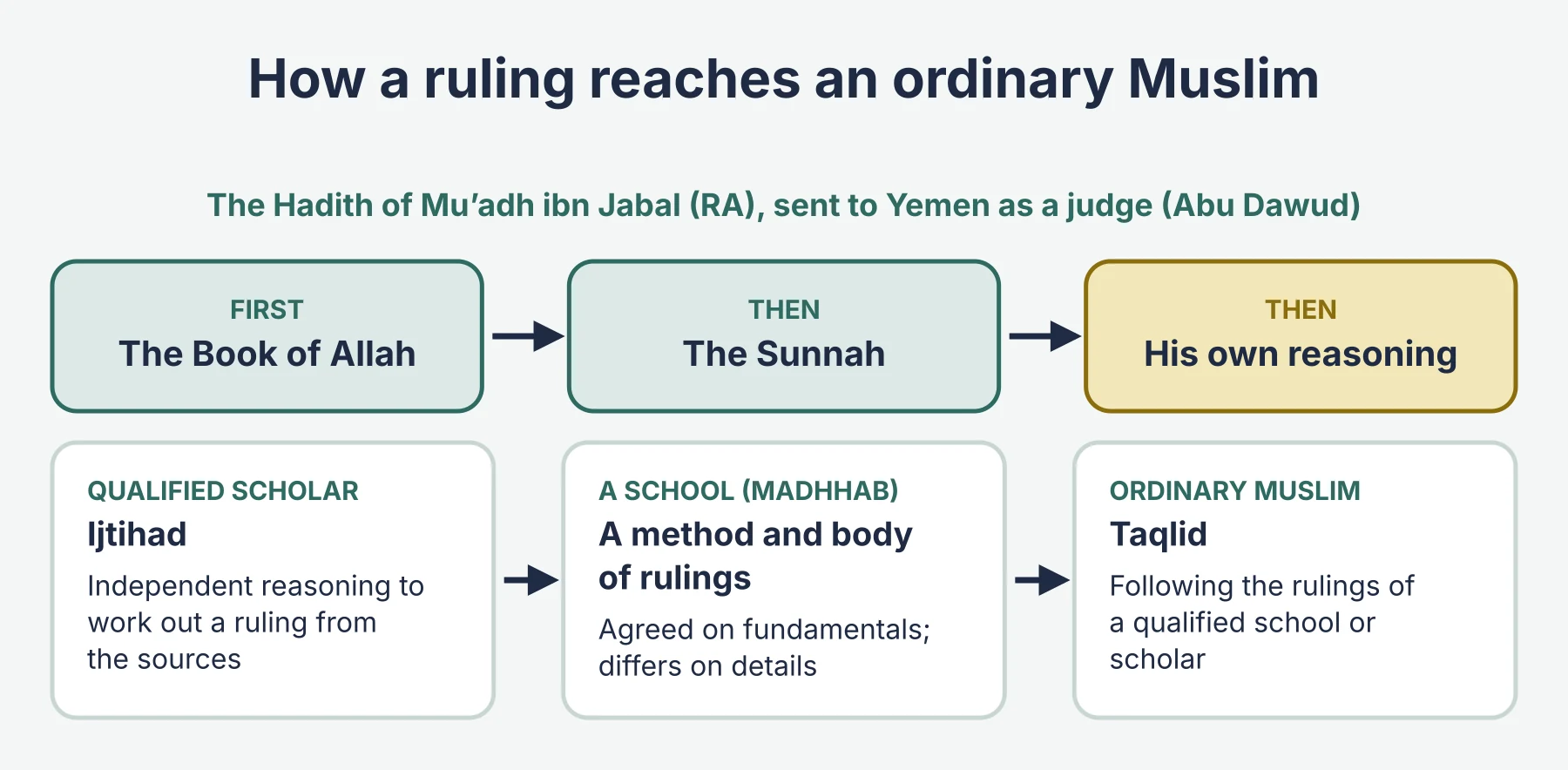
The scholar who works out a ruling from the sources performs ijtihad (independent reasoning). Most Muslims are not trained to do this, so they follow the rulings of a qualified school or scholar; this is called taqlid. The Hadith of Mu’adh ibn Jabal (RA), reported in Abu Dawud, shows the method: sent to Yemen as a judge, he said he would judge by the Book of Allah, then by the Sunnah, and then by his own reasoning, and the Prophet (pbuh) approved.
Why did the schools develop?
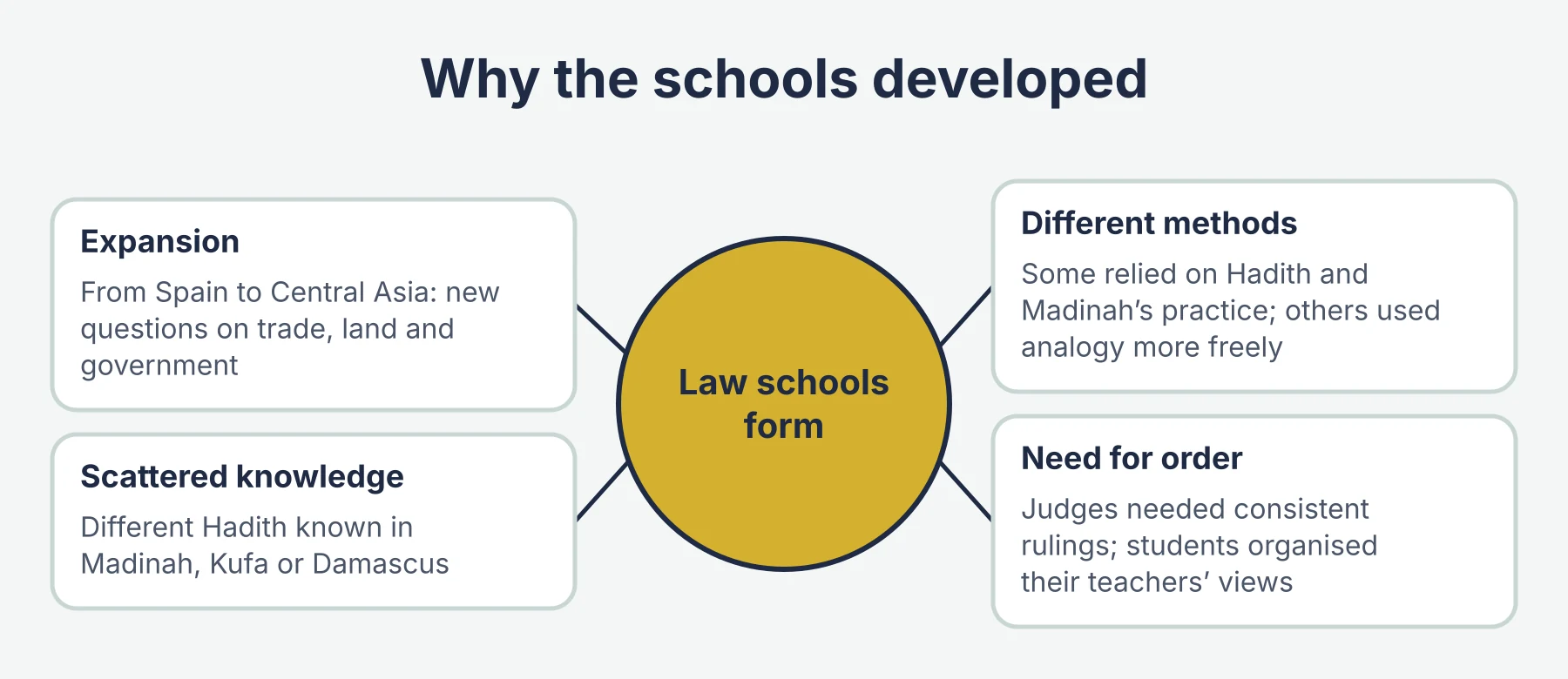
- Expansion: within a century of the Prophet’s (pbuh) death, Muslims lived from Spain to Central Asia and faced questions about trade, land and government that had not arisen in Madinah.
- Scattered knowledge: the companions had settled in different cities, so different Hadith were known in Madinah, Kufa or Damascus.
- Different methods: some scholars relied heavily on Hadith and the practice of Madinah; others used reasoning by analogy more freely.
- Need for order: judges and ordinary Muslims needed consistent rulings; students recorded and organised their teachers’ views, and these became schools.
The five schools named in the specification
Hanafi
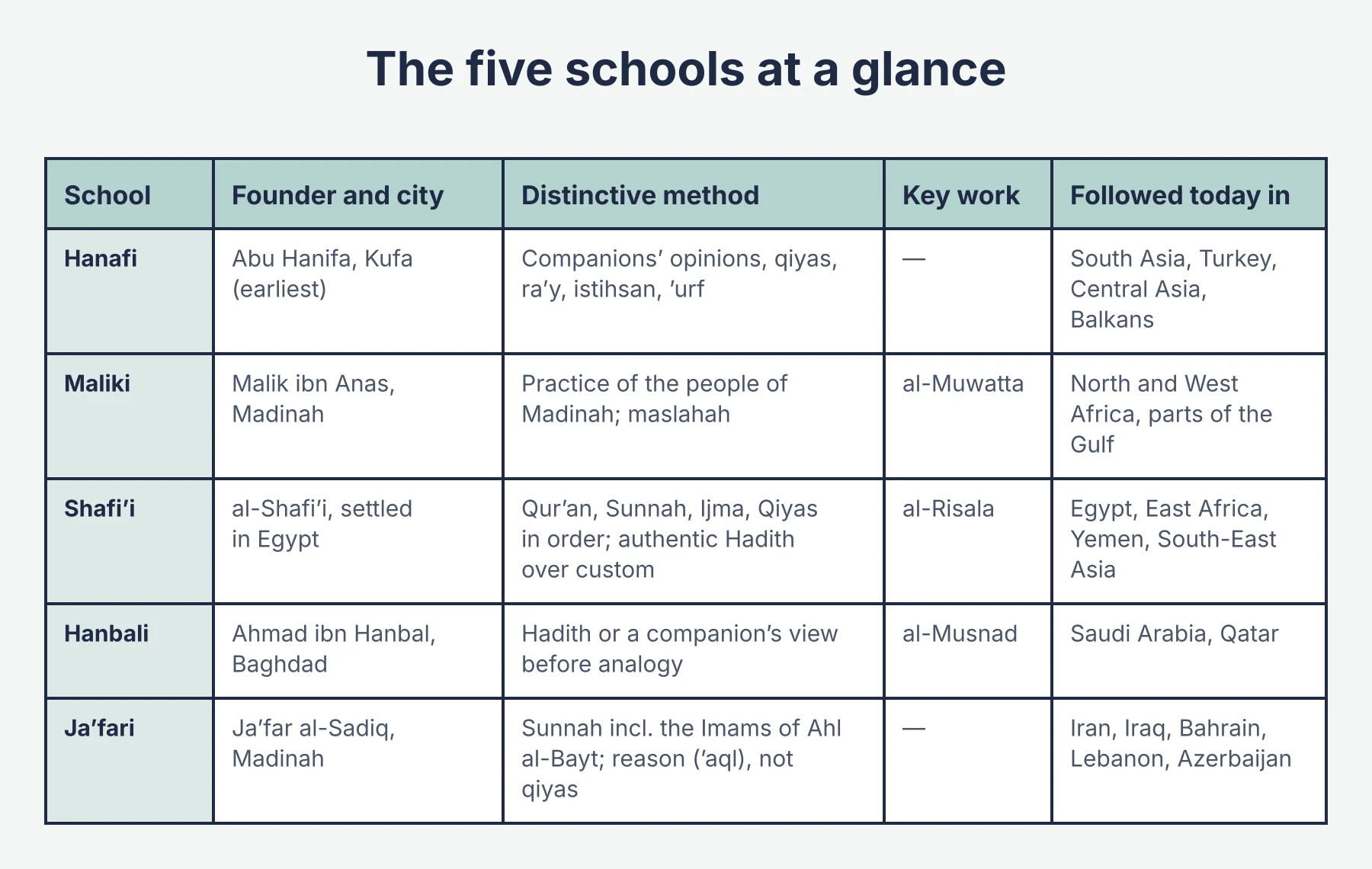
- Founder: Imam Abu Hanifa (al-Nu’man ibn Thabit), in Kufa, Iraq. He is the earliest of the four Sunni imams.
- Method: the Qur’an and Sunnah first, then the opinions of the companions, then qiyas and reasoned judgement (ra’y), including istihsan (preferring a ruling that better serves fairness) and local custom (’urf).
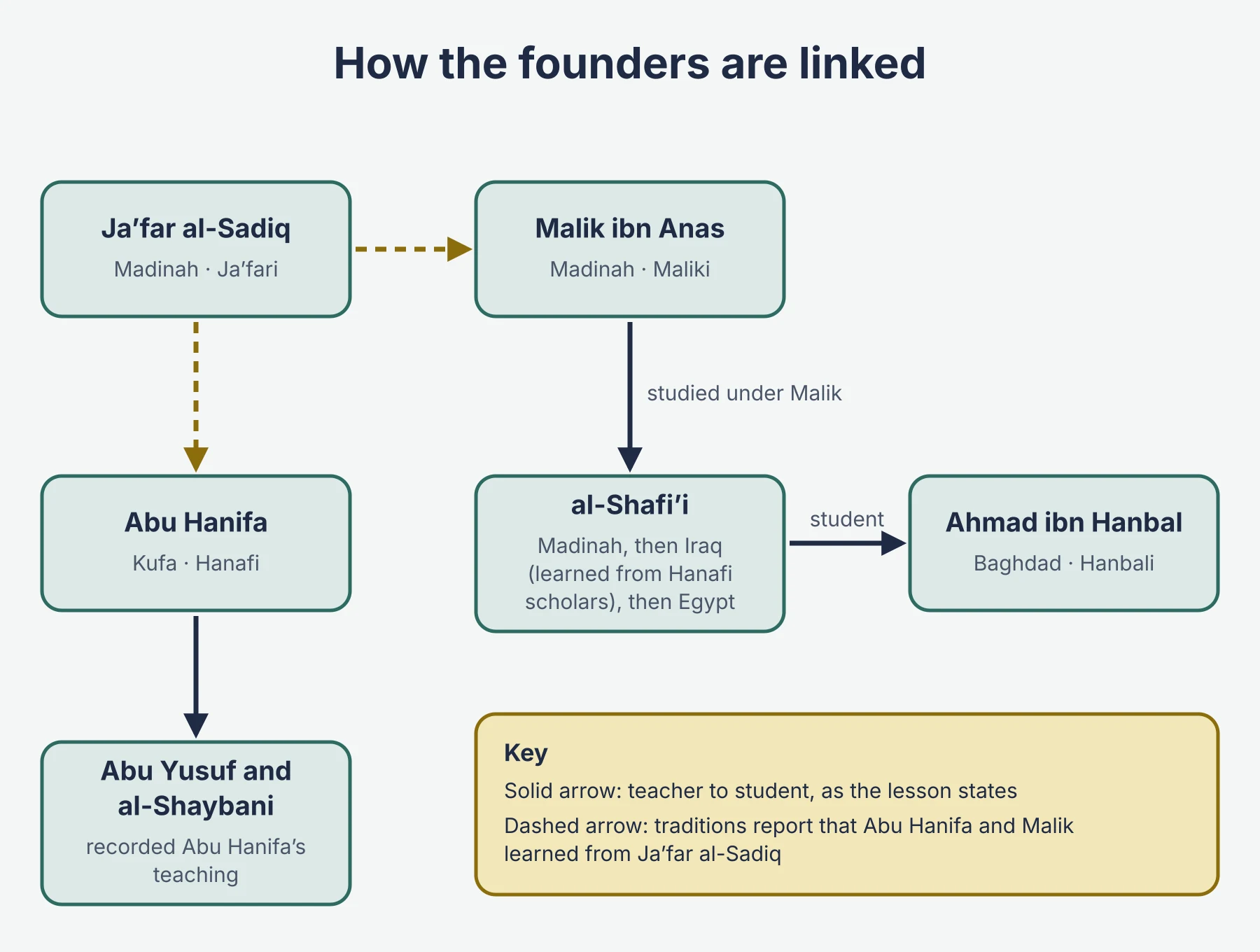
- Spread: his students, Abu Yusuf and Muhammad al-Shaybani, recorded and developed his teaching. It became the official school of the Ottoman Empire.
- Today: the largest school, followed widely in South Asia, Turkey, Central Asia and the Balkans.
Maliki
- Founder: Imam Malik ibn Anas, in Madinah.
- Method: the Qur’an and Sunnah, and also the practice of the people of Madinah (’amal ahl al-Madinah), since the city had lived with the Prophet’s (pbuh) example; he also weighed public interest (maslahah).
- Key work: al-Muwatta, one of the earliest written collections of Hadith and legal opinion.
- Today: North and West Africa and parts of the Gulf.
Shafi’i
- Founder: Imam Muhammad ibn Idris al-Shafi’i, who studied under Imam Malik in Madinah, learned from Hanafi scholars in Iraq, and settled in Egypt.
- Method: he set out the principles of law in a systematic way in al-Risala, often called the first work on the principles of jurisprudence (usul al-fiqh). He fixed the four sources in order: Qur’an, Sunnah, Ijma, Qiyas, insisted that an authentic Hadith outweighs local custom, and limited the use of free opinion.
- Today: Egypt, East Africa, Yemen and South-East Asia, including Indonesia and Malaysia.
Hanbali
- Founder: Imam Ahmad ibn Hanbal, a student of al-Shafi’i, in Baghdad.
- Method: a strong preference for the texts. He would follow a Hadith, or the view of a companion, rather than reason by analogy, and used qiyas only where necessary.
- Key work: al-Musnad, a very large collection of Hadith.
- Character: he was imprisoned and beaten during the mihna (inquisition) for refusing to accept the official doctrine that the Qur’an was created; his steadfastness made him a model of principle.
- Today: Saudi Arabia and Qatar especially.
Ja’fari
- Founder: Imam Ja’far al-Sadiq, a descendant of the Prophet (pbuh) through Hazrat Ali (RA) and Hazrat Fatima (RA), in Madinah. Twelver Shi’a Muslims regard him as the sixth Imam. He was a leading teacher of his time, and traditions report that both Abu Hanifa and Malik learned from him.
- Method: the Qur’an; the Sunnah, including the teachings of the Imams of the Prophet’s (pbuh) family (Ahl al-Bayt); consensus; and reason (’aql). It does not use qiyas in the Sunni sense.
- Ijtihad today: qualified scholars (mujtahids) continue to give rulings, and ordinary Shi’a Muslims follow a living senior scholar (marja’).
- Today: Iran, Iraq, Bahrain, Lebanon, Azerbaijan, and Shi’a communities in Pakistan and elsewhere.
Examples of differences
These are the kind of examples that earn credit when a question asks how the schools differ:
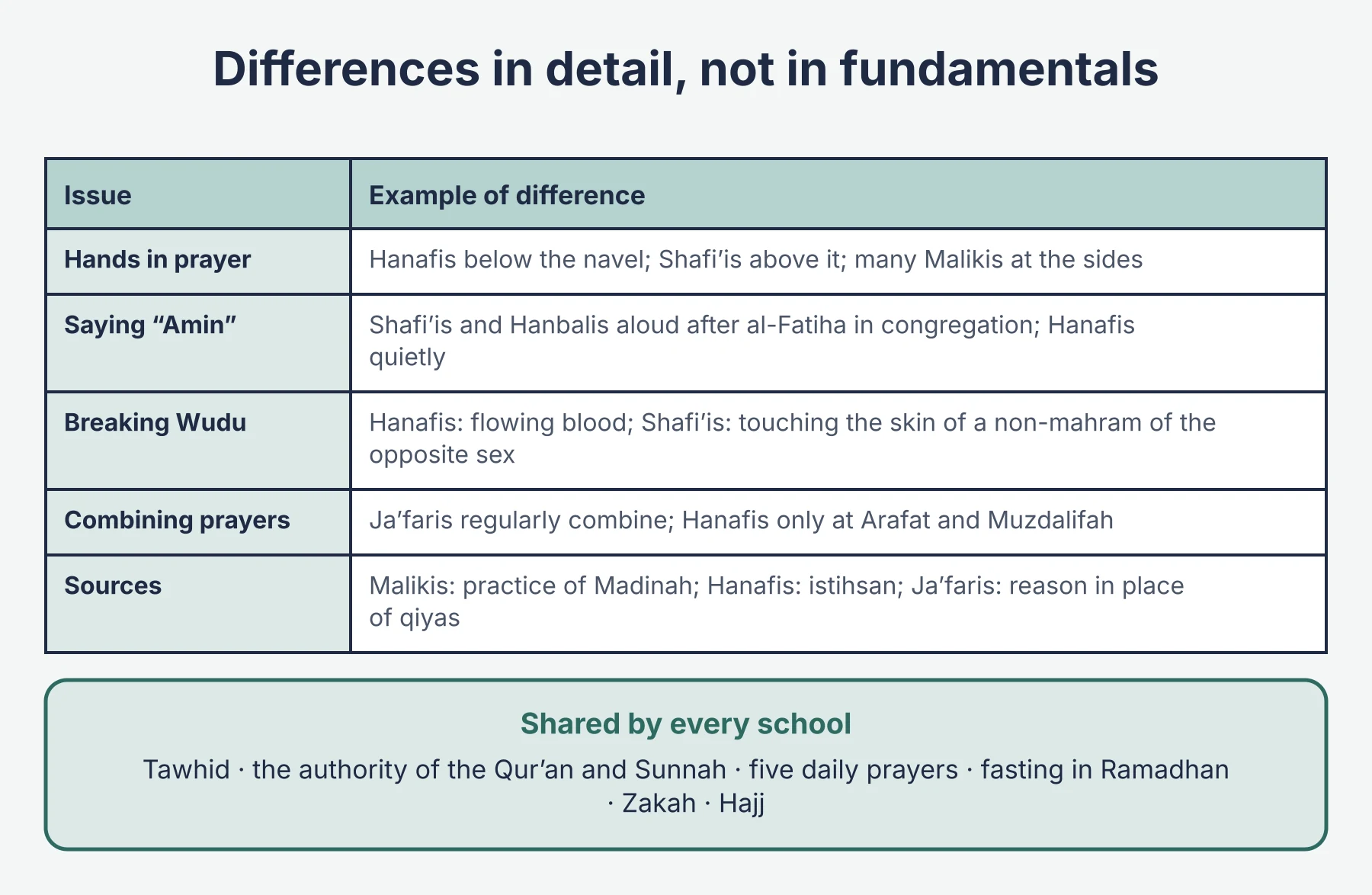
| Issue | Example of difference |
|---|---|
| Hands in prayer | Hanafis place the hands below the navel; Shafi’is above it; many Malikis leave them at the sides |
| Saying “Amin” | Shafi’is and Hanbalis say it aloud after al-Fatiha in congregation; Hanafis say it quietly |
| Breaking Wudu | Hanafis: flowing blood breaks it; Shafi’is: touching the skin of a non-mahram of the opposite sex breaks it |
| Combining prayers | Ja’faris regularly combine Zuhr with Asr and Maghrib with Isha; Hanafis combine only at Arafat and Muzdalifah |
| Sources | Malikis use the practice of Madinah; Hanafis use istihsan; Ja’faris use reason in place of qiyas |
None of these touches the fundamentals. Every school prays five times, fasts in Ramadhan, pays Zakah and performs Hajj.
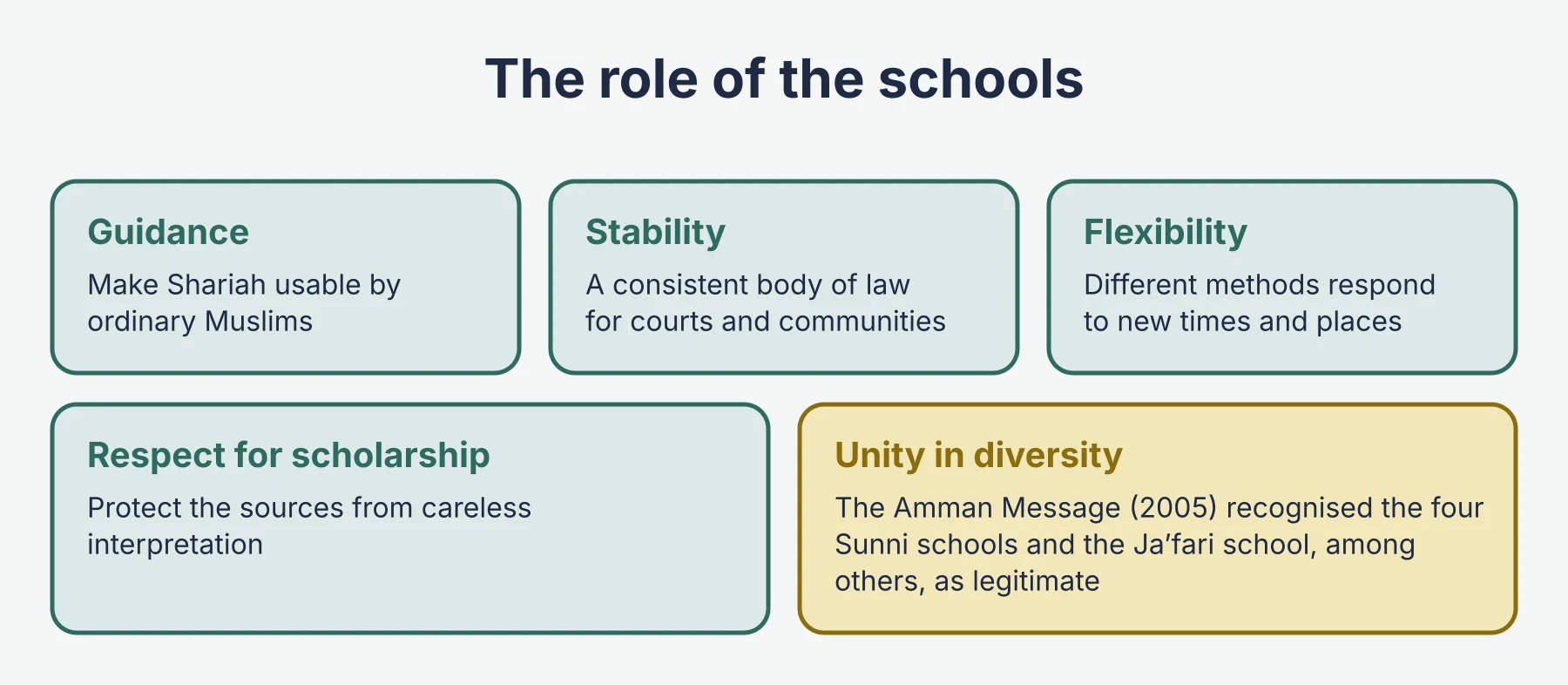
The role of the schools
- Guidance: they make Shariah usable by ordinary Muslims, who cannot derive rulings themselves.
- Stability: they preserve a consistent body of law for courts and communities.
- Flexibility: different methods let the law respond to new times and places.
- Respect for scholarship: they protect the sources from being interpreted carelessly.
- Unity in diversity: the Sunni schools accept each other as valid, and in 2005 the Amman Message, endorsed by scholars from across the Muslim world, recognised the four Sunni schools and the Ja’fari school, among others, as legitimate.
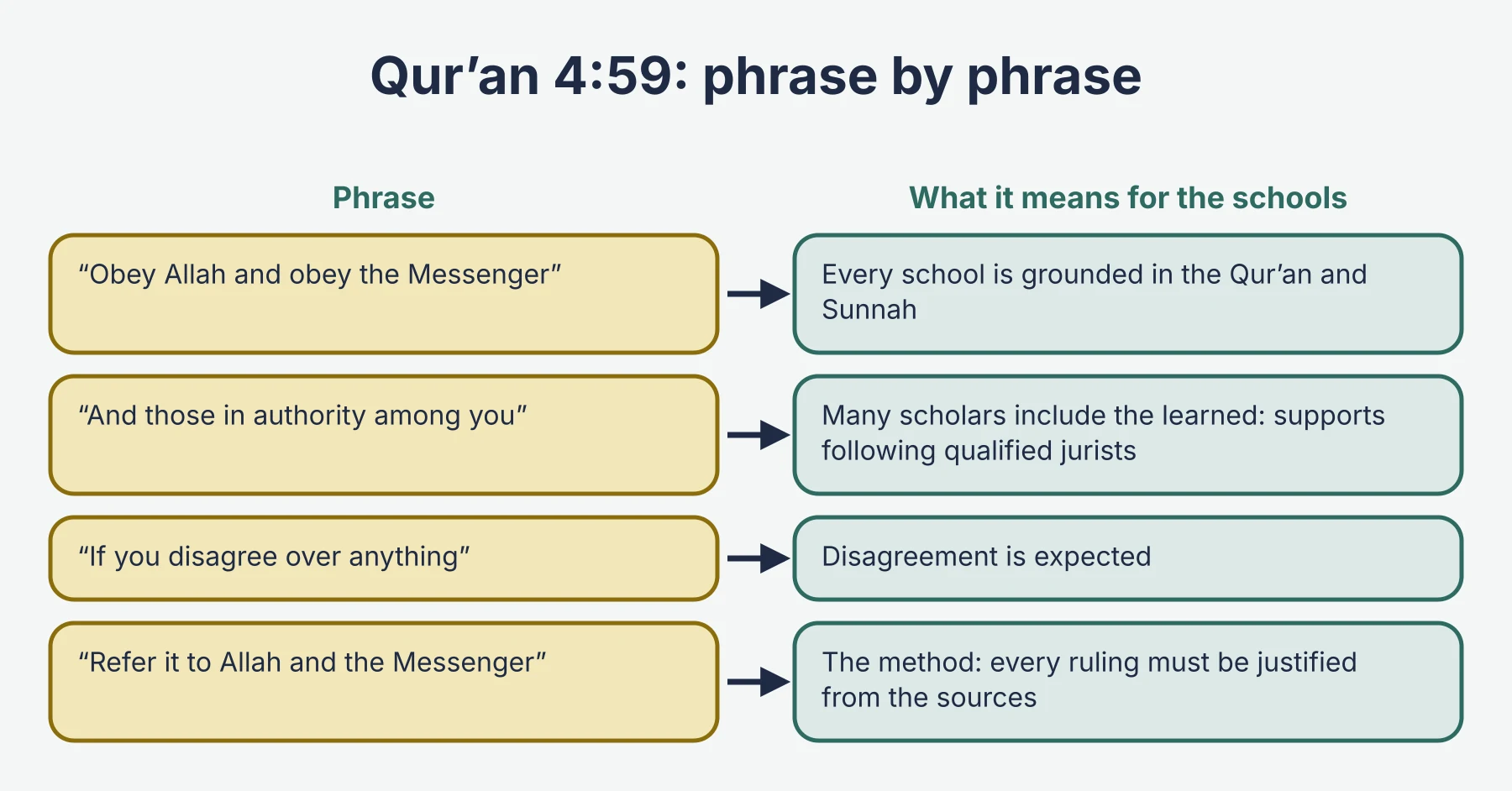
The prescribed passage: Qur’an 4:59
“O you who have believed, obey Allah and obey the Messenger and those in authority among you. And if you disagree over anything, refer it to Allah and the Messenger, if you should believe in Allah and the Last Day. That is the best [way] and best in result.”
- “Obey Allah and obey the Messenger” grounds every school in the Qur’an and Sunnah.
- “Those in authority among you” is understood by many scholars to include the learned, which supports following qualified jurists.
- “If you disagree over anything” accepts that disagreement will happen.
- “Refer it to Allah and the Messenger” gives the method: every school must justify its rulings from the sources.
Worked example: a 4-mark answer
Question: Explain two differences between the Maliki and Hanbali schools. [4]
The Maliki school uses the practice of the people of Madinah as a source of law [1], because Imam Malik believed the city’s way of life preserved the Prophet’s (pbuh) example; the Hanbali school does not give local practice that status [1]. The Hanbali school relies on Hadith, even the opinion of a companion, before using analogy [1], while the Maliki school is more ready to weigh public interest (maslahah) when the texts do not settle a question [1].
Exam technique
Name or give questions want a founder, a city, a book or a method. Explain questions want a feature plus why it matters, as above. In a 6-mark answer, Qur’an 4:59 or the Hadith of Mu’adh ibn Jabal (RA) are the clearest sources to apply. A 12-mark statement such as “Having different schools of law weakens the Ummah” needs both sides: diversity as mercy and flexibility, against the risk of division, using the passage’s “if you disagree over anything, refer it to Allah and the Messenger”.
Common mistakes
- Calling the schools sects. They are schools of law; the four Sunni schools share one creed.
- Saying the schools disagree on the pillars. Differences are in details.
- Mixing up founders and cities. Abu Hanifa: Kufa; Malik: Madinah; al-Shafi’i: Egypt (after Madinah and Iraq); Ahmad: Baghdad; Ja’far al-Sadiq: Madinah.
- Leaving out the Ja’fari school. The specification names five, not four.
- Describing without the role. “Origins and role” means saying why each school matters, not just who founded it.
Related pages
- Schools of thought revision notes
- Schools of thought practice questions
- Sources of Authority in Islam revision notes
Source: OxfordAQA, International GCSE Islamiat (9237) specification, Version 1.1, content area 3.2.2.5 and its prescribed passage.
Related resources
-
Practice questions
OxfordAQA International GCSE Islamiat (9237): The Schools of Thought in Islam – Practice Questions
Twelve original questions with mark guidance on the origins and role of the Hanafi, Maliki, Shafi'i, Hanbali and Ja'fari schools, for 9237 topic 3.2.2.5.
Islamiyat · OxfordAQA · IGCSE
Try questions -
Revision notes
OxfordAQA International GCSE Islamiat (9237): The Schools of Thought in Islam – Revision Notes
Recall notes on the Hanafi, Maliki, Shafi'i, Hanbali and Ja'fari schools: founders, cities, methods, key works, differences and role, for 9237 topic 3.2.2.5.
Islamiyat · OxfordAQA · IGCSE
Revise topic -
Study guides
OxfordAQA International GCSE Islamiat (9237): The Social Impact of Sources of Authority on the Character of a Muslim
The rights of neighbours, the importance of Amanat, and the prohibition of backbiting, arrogance and jealousy, for 9237 topic 3.2.2.9.
Islamiyat · OxfordAQA · IGCSE
Read guide
Get free revision emails (optional)
Occasional emails with practice questions, worked explanations and links to free resources for the qualification and subjects you choose. No spam, and you can unsubscribe from any email. The free tools on this site never need an email.