
Revision Notes
OxfordAQA International GCSE Islamiat (9237): The Schools of Thought in Islam – Revision Notes
Recall notes on the Hanafi, Maliki, Shafi'i, Hanbali and Ja'fari schools: founders, cities, methods, key works, differences and role, for 9237 topic 3.2.2.5.
- Subject
- Islamiyat
- Level
- IGCSE
- Topic
- Paper 2 – The Life of Hazrat Muhammad (pbuh) and Sources of Authority in Islam
- Author
- Marlbridge Academic Team
- Updated
- Reviewed by
- Azam Siddique (what this means)
Aligned to OxfordAQA IGCSE Islamiyat (9237), Version 1.1. Official specification .
Syllabus page (what it covers and how it is assessed): OxfordAQA IGCSE Islamiyat.
Syllabus points this page covers
9237
- 3.2.2 Sources of authority in Islam
Found an error? Report a correction.
Need help with this topic? Request a free trial class for IGCSE Islamiyat (9237).
These notes condense content area 3.2.2.5 of 9237: “The origins and role of the major law schools in Islam including: Hanafi, Shaf’i, Maliki, Hanbali and Ja’fari.” The full explanation is in the schools of thought study guide; the sources the schools draw on are in the Sources of Authority in Islam revision notes.
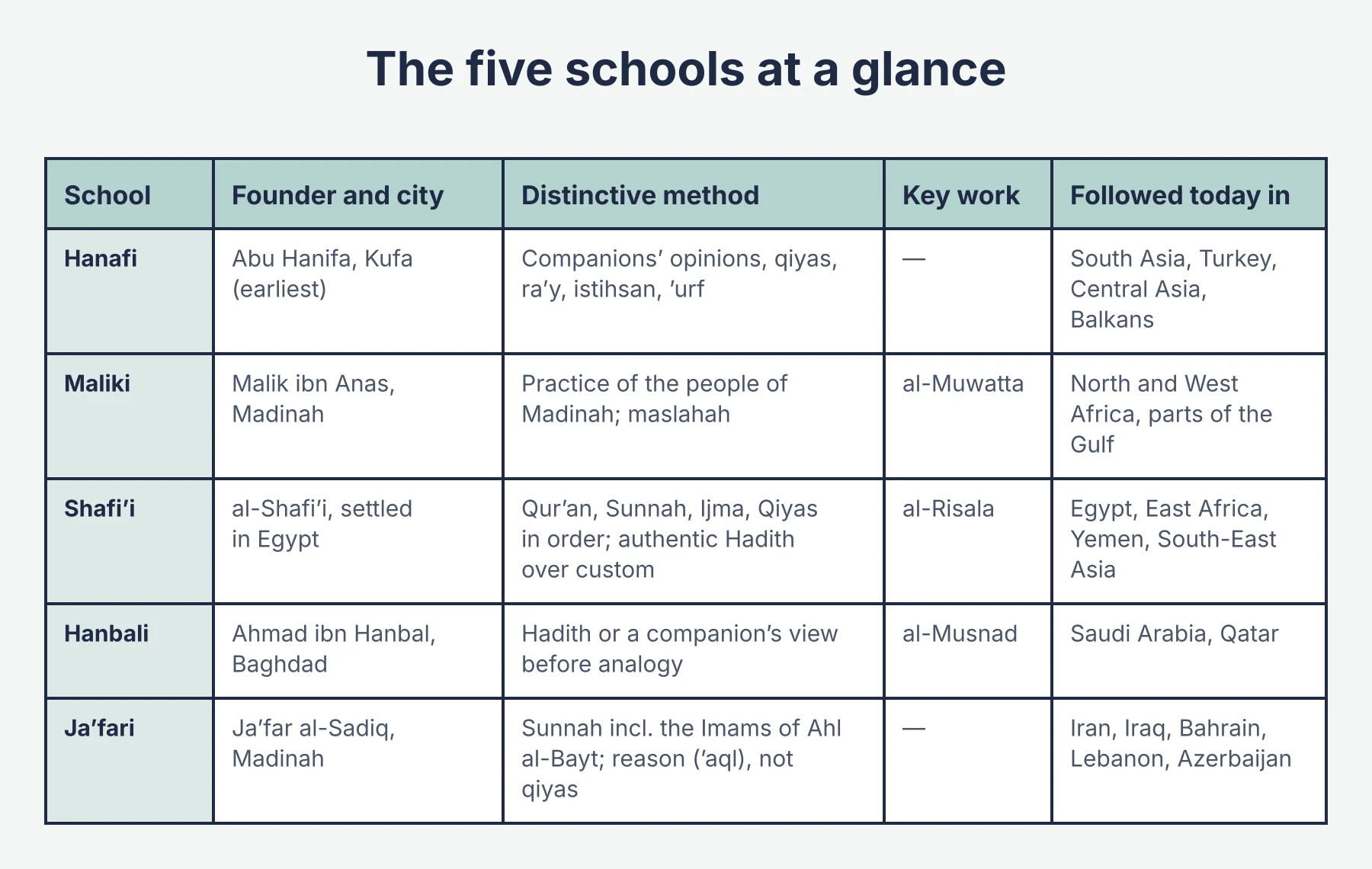
The five schools in one table
| School | Founder | City | Distinctive method | Key work | Main regions today |
|---|---|---|---|---|---|
| Hanafi | Abu Hanifa | Kufa | Qiyas, ra’y, istihsan, custom | Recorded by Abu Yusuf and al-Shaybani | South Asia, Turkey, Central Asia, Balkans |
| Maliki | Malik ibn Anas | Madinah | Practice of the people of Madinah; maslahah | al-Muwatta | North and West Africa |
| Shafi’i | al-Shafi’i | Madinah, Iraq, then Egypt | Systematic usul: Qur’an, Sunnah, Ijma, Qiyas | al-Risala | Egypt, East Africa, Yemen, South-East Asia |
| Hanbali | Ahmad ibn Hanbal | Baghdad | Texts first; little analogy | al-Musnad | Saudi Arabia, Qatar |
| Ja’fari | Ja’far al-Sadiq | Madinah | Teachings of the Ahl al-Bayt; reason (’aql) instead of qiyas; living mujtahids | Teachings recorded by students | Iran, Iraq, Bahrain, Lebanon, Azerbaijan |
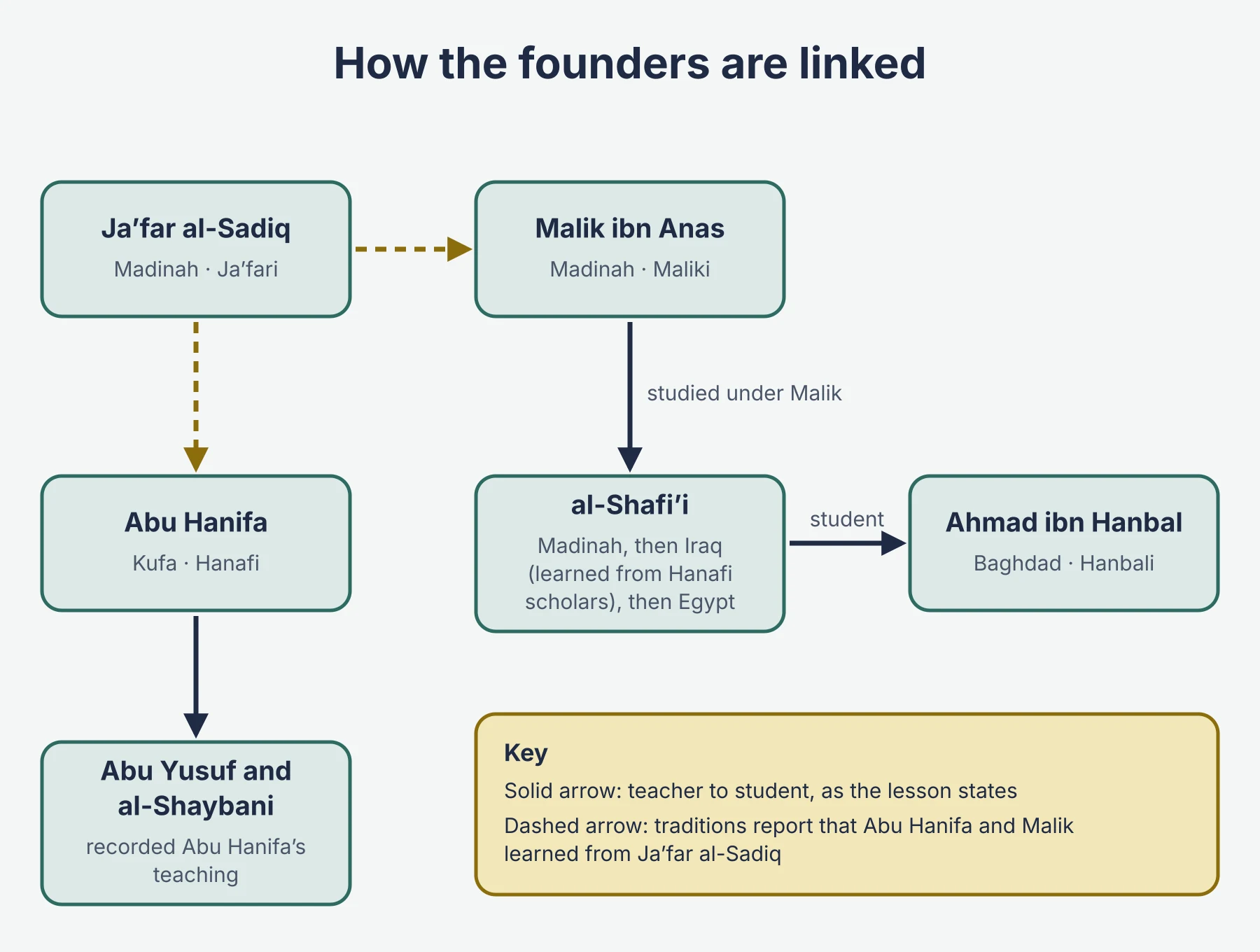
Teacher–student links
Ja’far al-Sadiq taught in Madinah (traditions report that Abu Hanifa and Malik learned from him) → Malik taught al-Shafi’i → al-Shafi’i taught Ahmad ibn Hanbal. The schools grew from a connected world of scholarship, not from rival camps.
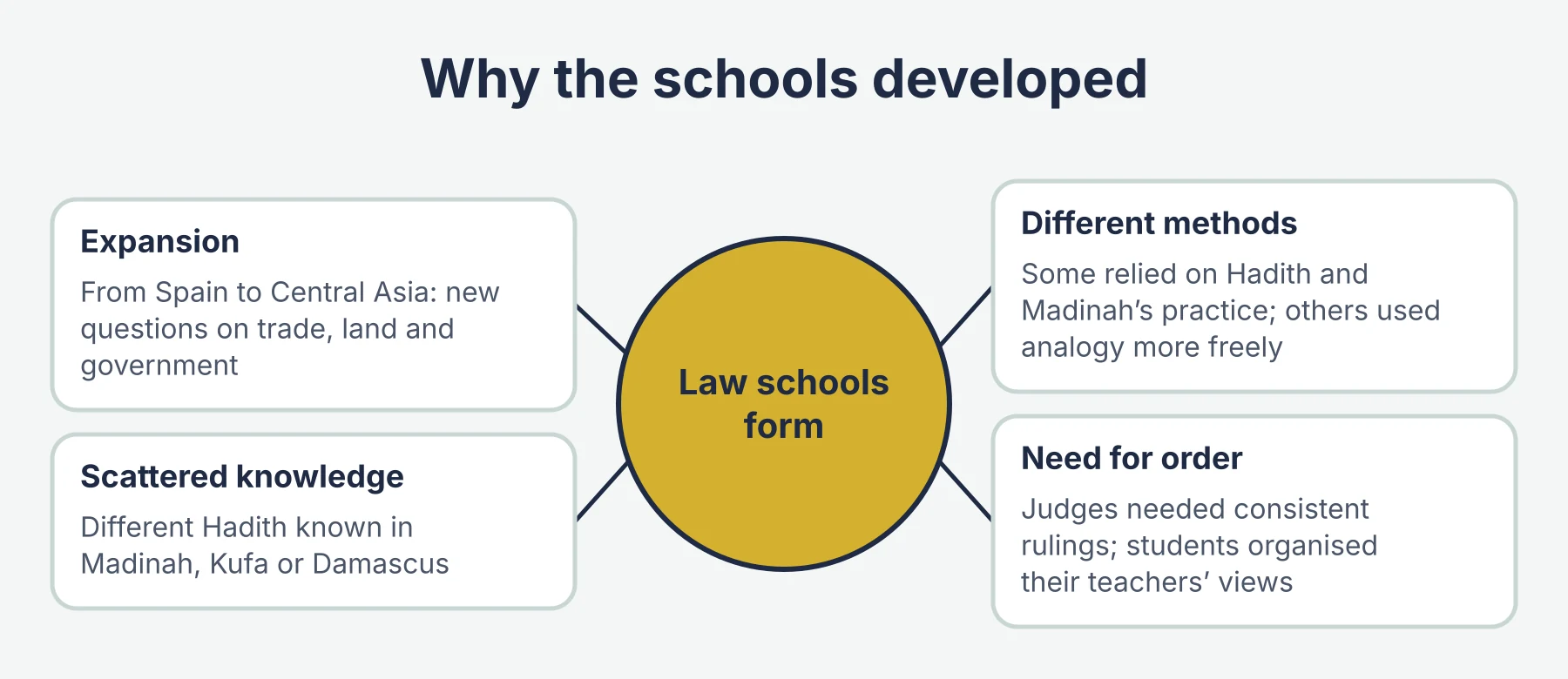
Why the schools arose
- The Muslim world expanded fast and met new questions.
- Companions and their knowledge of Hadith were spread across many cities.
- Scholars used different methods to reason from the sources.
- Courts and communities needed consistent, organised rulings.
Methods: who stresses what
- Reasoning and fairness: Hanafi (istihsan).
- Living practice: Maliki (’amal of Madinah).
- System and order of sources: Shafi’i.
- Texts above reasoning: Hanbali.
- Imams of the Prophet’s (pbuh) family and reason: Ja’fari.
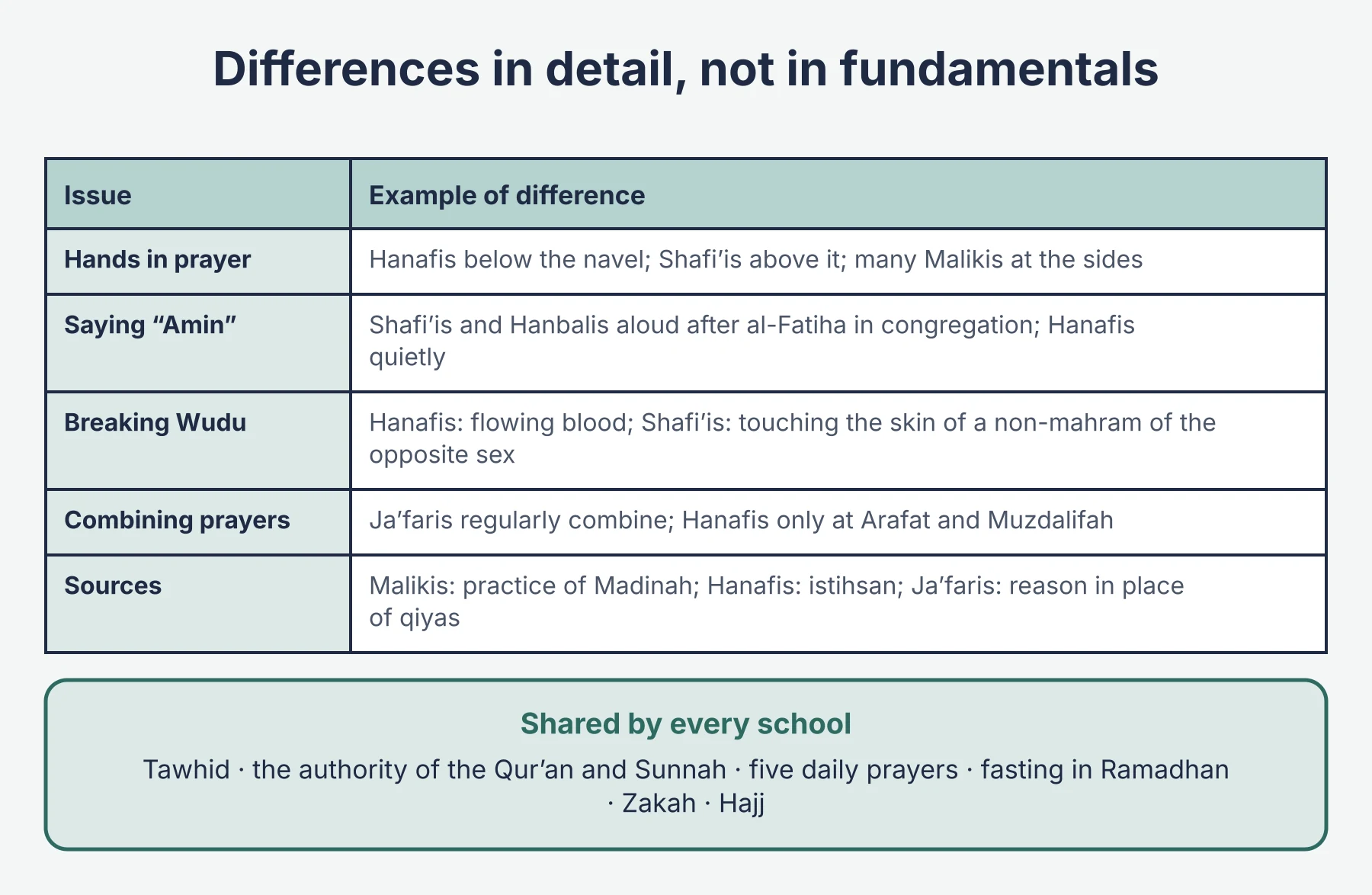
Differences you can quote
| Issue | Difference |
|---|---|
| Hands in Salah | Hanafi below the navel; Shafi’i above; many Malikis at the sides |
| “Amin” | Aloud for Shafi’i and Hanbali; quietly for Hanafi |
| Wudu | Hanafi: flowing blood breaks it. Shafi’i: skin contact with a non-mahram of the opposite sex breaks it |
| Combining prayers | Ja’fari: regularly; Hanafi: only at Arafat and Muzdalifah |
What they all share: Tawhid, the Five Pillars, the authority of the Qur’an and Sunnah.
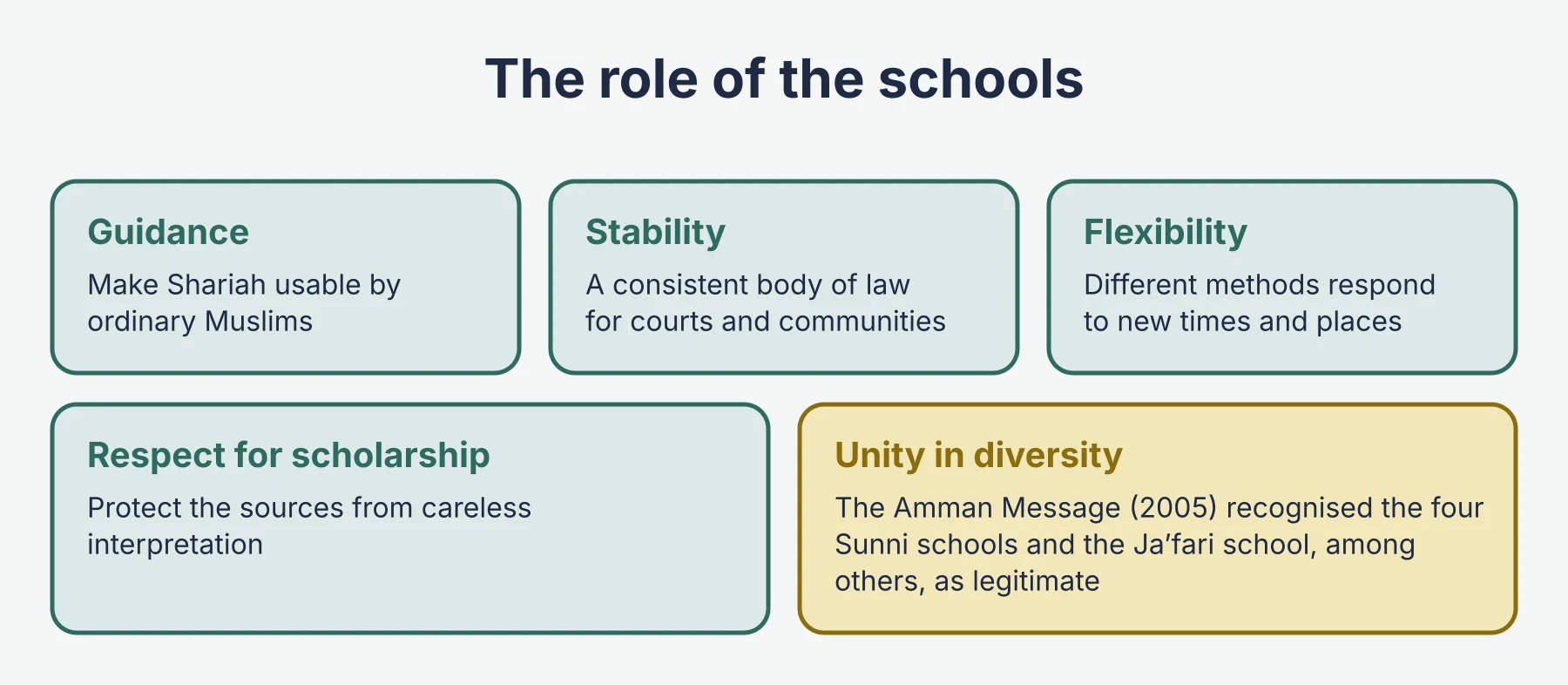
Role of the schools: five points
- Make Shariah practical for ordinary Muslims (taqlid).
- Keep law consistent for courts and communities.
- Allow flexibility for new times and places.
- Protect the sources from careless interpretation.
- Show unity in diversity: mutual recognition; the Amman Message (2005) recognised the four Sunni schools and the Ja’fari school, among others.
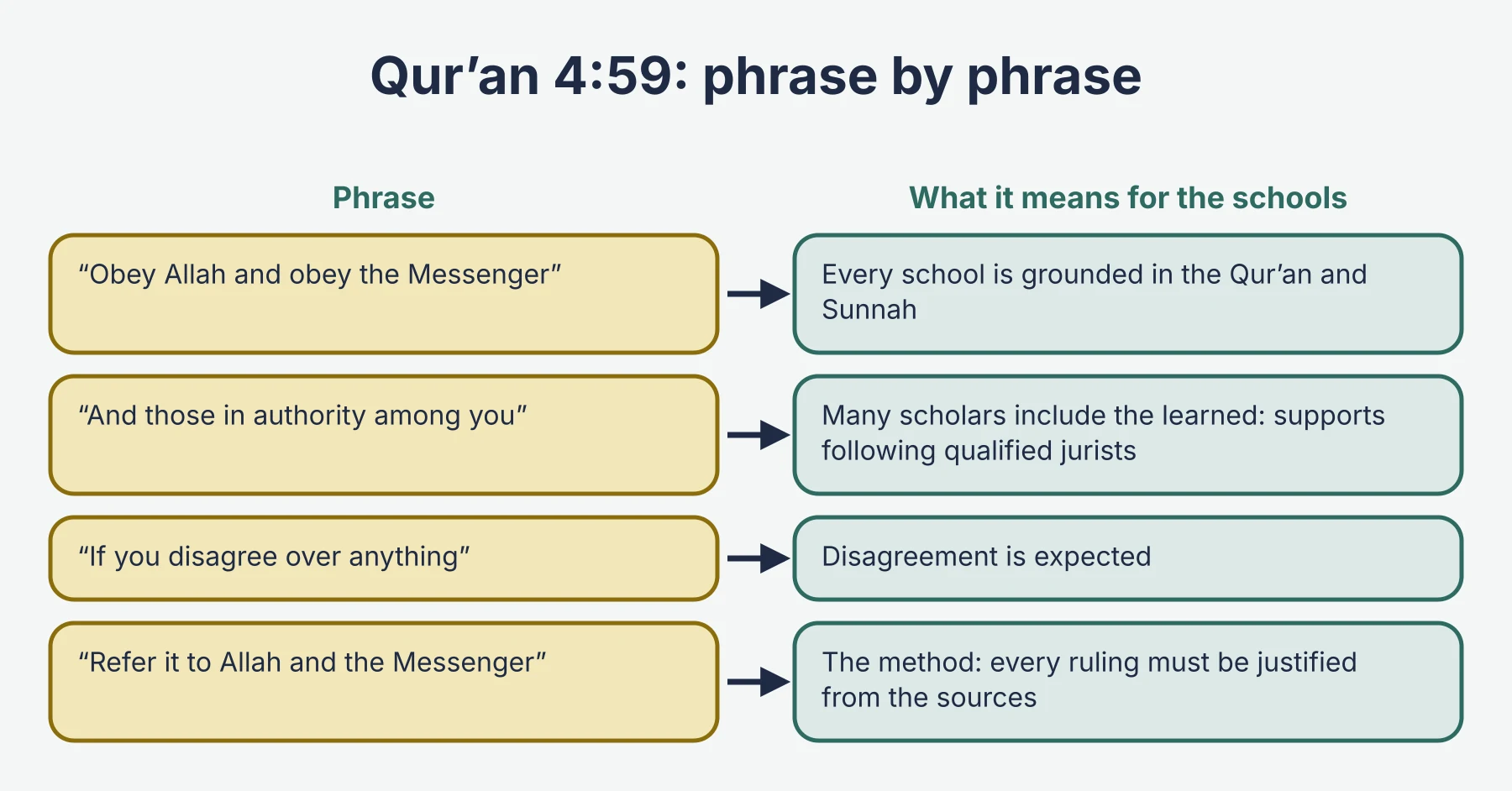
The prescribed passage: Qur’an 4:59
| Phrase | Point it supports |
|---|---|
| “Obey Allah and obey the Messenger” | All schools rest on the Qur’an and Sunnah |
| “and those in authority among you” | Many scholars include the learned: grounds for following jurists |
| “if you disagree over anything” | Disagreement is expected |
| “refer it to Allah and the Messenger” | Every ruling must be justified from the sources |
| “best [way] and best in result” | Following this method brings good outcomes |
Key terms
| Term | Meaning |
|---|---|
| Madhhab | A school of Islamic law |
| Fiqh | Islamic jurisprudence; the understanding of law |
| Usul al-fiqh | The principles of jurisprudence |
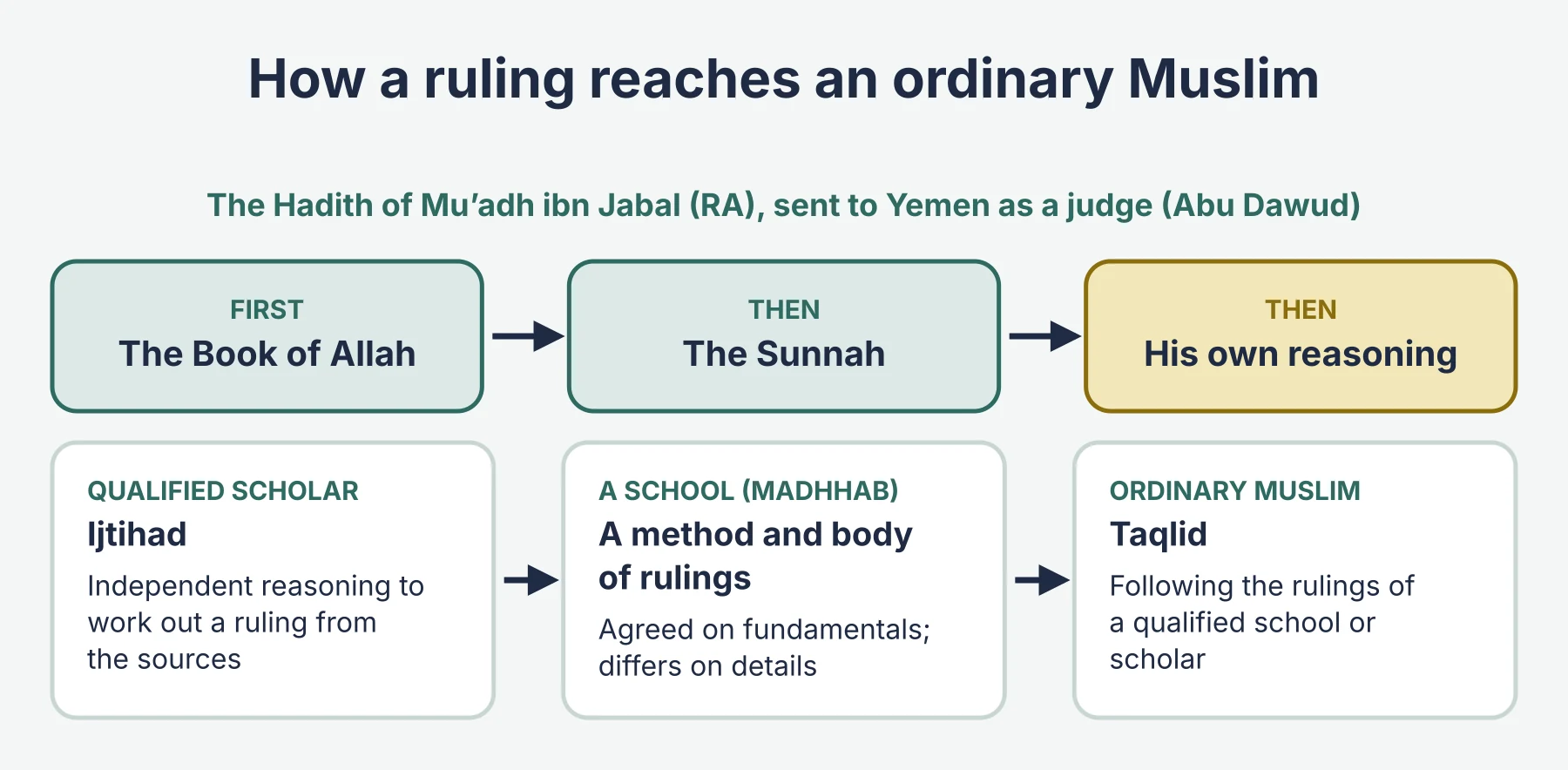
| Ijtihad | Independent reasoning by a qualified scholar |
| Mujtahid | A scholar qualified to perform ijtihad |
| Taqlid | Following the rulings of a school or scholar |
| Ra’y | Considered opinion |
| Istihsan | Juristic preference for the fairer ruling |
| Maslahah | Public interest |
| ’Amal ahl al-Madinah | The practice of the people of Madinah |
| Marja’ | A senior Shi’a scholar whose rulings others follow |
Exam traps
- Five schools are named: do not stop at four.
- The schools are not sects; the Sunni four share one creed.
- Differences are in details, never in the pillars.
- Get the cities right: Kufa, Madinah, Egypt, Baghdad, Madinah.
- “Origins and role” needs both: who and why, then what the school does for Muslims.
Self-test
- What is a madhhab?
- In which city did Abu Hanifa teach?
- Name the book compiled by Imam Malik.
- Which school uses the practice of the people of Madinah as a source?
- Which imam wrote al-Risala, and why is it important?
- Who was the teacher of Ahmad ibn Hanbal?
- Why was Ahmad ibn Hanbal imprisoned?
- Whom do Twelver Shi’a Muslims regard as the sixth Imam and founder of their school of law?
- What does the Ja’fari school use instead of qiyas?
- What is the difference between ijtihad and taqlid?
- Give one example of a difference between the schools in prayer.
- Which phrase in Qur’an 4:59 accepts that Muslims will disagree?
Answers: 1. A school of Islamic law with its own method for deriving rulings. 2. Kufa. 3. al-Muwatta. 4. The Maliki school. 5. Imam al-Shafi’i; it set out the principles of jurisprudence systematically, fixing the order Qur’an, Sunnah, Ijma, Qiyas. 6. Imam al-Shafi’i. 7. He refused to accept the official doctrine that the Qur’an was created, during the mihna. 8. Imam Ja’far al-Sadiq. 9. Reason (’aql), with the teachings of the Imams of the Prophet’s (pbuh) family. 10. Ijtihad is a qualified scholar’s own reasoning from the sources; taqlid is following the rulings of a school or scholar. 11. Any one: position of the hands; saying “Amin” aloud or quietly; when prayers may be combined. 12. “If you disagree over anything”.
Practise with the schools of thought practice questions.
Source: OxfordAQA, International GCSE Islamiat (9237) specification, Version 1.1, content area 3.2.2.5.
Related resources
-
Study guides
OxfordAQA International GCSE Islamiat (9237): The Social Impact of Sources of Authority on the Character of a Muslim
The rights of neighbours, the importance of Amanat, and the prohibition of backbiting, arrogance and jealousy, for 9237 topic 3.2.2.9.
Islamiyat · OxfordAQA · IGCSE
Read guide -
Practice questions
OxfordAQA International GCSE Islamiat (9237): The Social Impact of Sources of Authority on the Character of a Muslim – Practice Questions
Original questions with mark guidance on neighbours' rights, Amanat, backbiting, arrogance and jealousy, for 9237 topic 3.2.2.9.
Islamiyat · OxfordAQA · IGCSE
Try questions -
Revision notes
OxfordAQA International GCSE Islamiat (9237): The Social Impact of Sources of Authority on the Character of a Muslim – Revision Notes
Recall notes on the rights of neighbours, Amanat, backbiting, arrogance and jealousy, with Sahih al-Bukhari 6016, for 9237 topic 3.2.2.9.
Islamiyat · OxfordAQA · IGCSE
Revise topic
Get free revision emails (optional)
Occasional emails with practice questions, worked explanations and links to free resources for the qualification and subjects you choose. No spam, and you can unsubscribe from any email. The free tools on this site never need an email.