
Revision Notes
OxfordAQA International GCSE Islamiat (9237): Rights of Neighbours, Amanat, Backbiting, Arrogance and Jealousy – Revision Notes
Recall notes on the rights of neighbours, Amanat and the prohibition of backbiting, arrogance and jealousy, with key sources and a self-test (9237).
- Subject
- Islamiyat
- Level
- IGCSE
- Topic
- Paper 2 – The Life of Hazrat Muhammad (pbuh) and Sources of Authority in Islam
- Author
- Marlbridge Academic Team
- Updated
- Reviewed by
- Azam Siddique (what this means)
Aligned to OxfordAQA IGCSE Islamiyat (9237), Version 1.1. Official specification .
Syllabus page (what it covers and how it is assessed): OxfordAQA IGCSE Islamiyat.
Syllabus points this page covers
9237
- 3.2.2 Sources of authority in Islam
Found an error? Report a correction.
Need help with this topic? Request a free trial class for IGCSE Islamiyat (9237).
These notes condense content area 3.2.2.9 of 9237: “The rights of neighbours including the importance of Amanat. The prohibition of backbiting, arrogance and jealousy.” The full explanation is in the rights of neighbours, Amanat, backbiting, arrogance and jealousy study guide; the sources themselves are summarised in the Sources of Authority in Islam revision notes.
Five topics, five key sources
| Topic | Arabic term | Best Qur’an evidence | Best Hadith evidence |
|---|---|---|---|
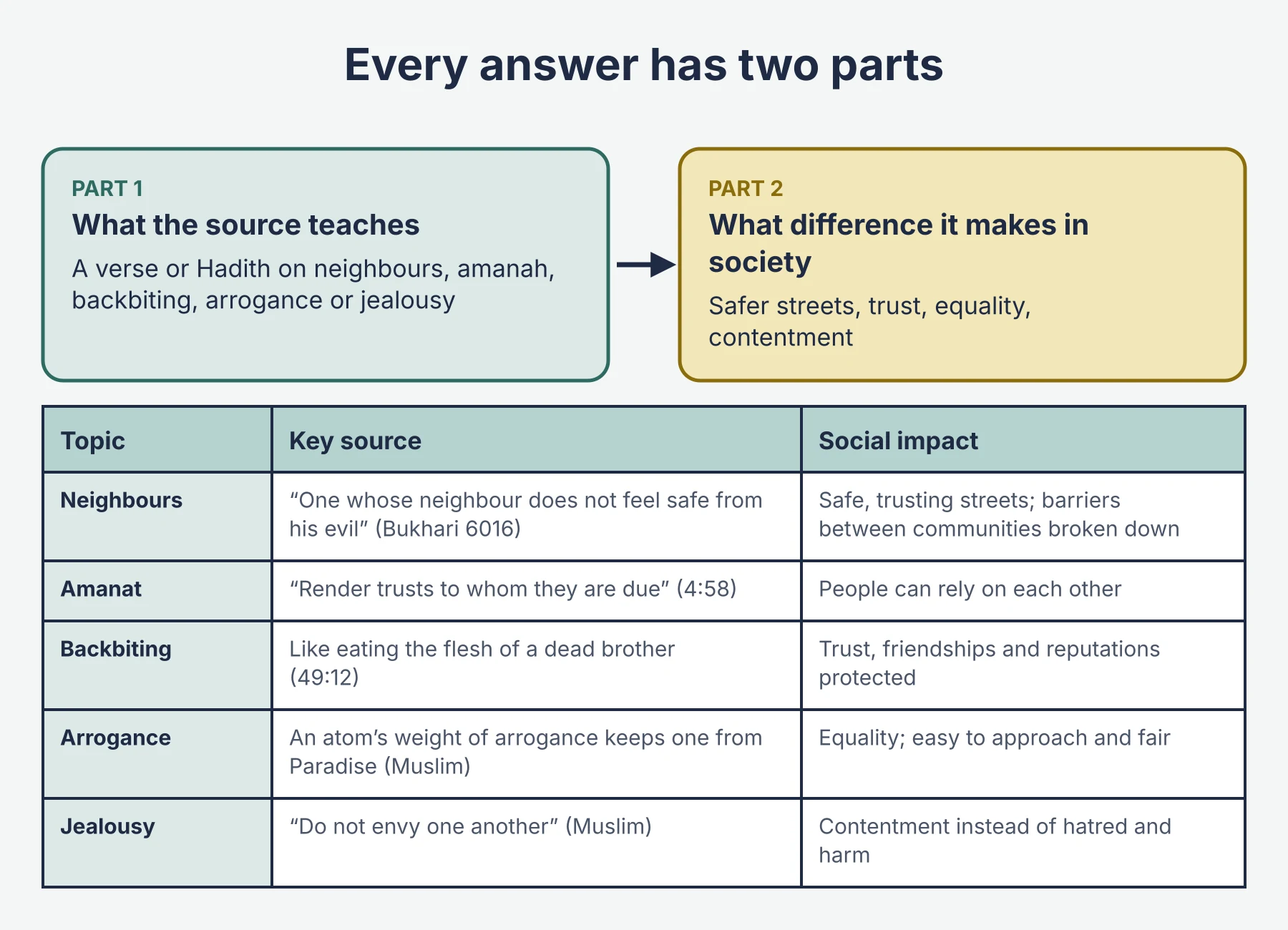
| Neighbours | Jar (neighbour) | “the near neighbour, the neighbour farther away” (4:36) | “He does not believe … one whose neighbour does not feel safe from his evil” (Bukhari 6016, prescribed) |
| Trust | Amanah | “render trusts to whom they are due” (4:58) | Signs of a hypocrite: lies, breaks promises, betrays trust (Bukhari) |
| Backbiting | Ghibah | Eating the flesh of a dead brother (49:12) | True = backbiting; false = slander (Muslim) |
| Arrogance | Kibr | “do not walk through the earth exultantly” (31:18) | An atom’s weight of arrogance keeps a person from Paradise (Muslim) |
| Jealousy | Hasad | “from the evil of an envier when he envies” (113:5); 4:32 | “Do not envy one another … be brothers” (Muslim) |
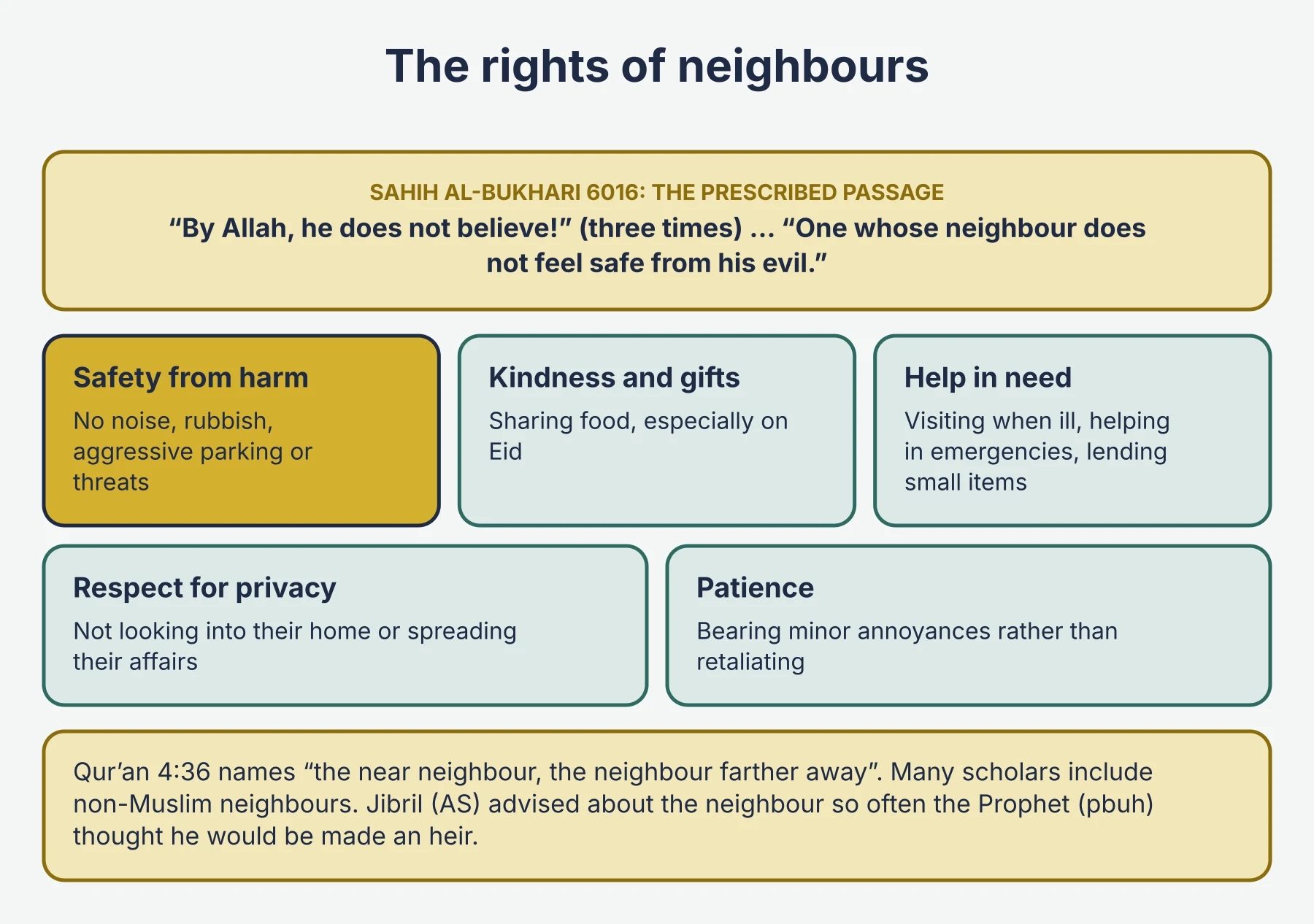
Neighbours: rights checklist
- Safety from harm (the prescribed Hadith).
- Kindness, gifts, sharing food.
- Help when ill or in need.
- Privacy; not spying.
- Patience with minor annoyances.
- Applies to non-Muslim neighbours too.
- Jibril (AS) stressed the neighbour so often that the Prophet (pbuh) thought the neighbour would inherit (Bukhari and Muslim).
- “Whoever believes in Allah and the Last Day, let him honour his neighbour” (Bukhari).
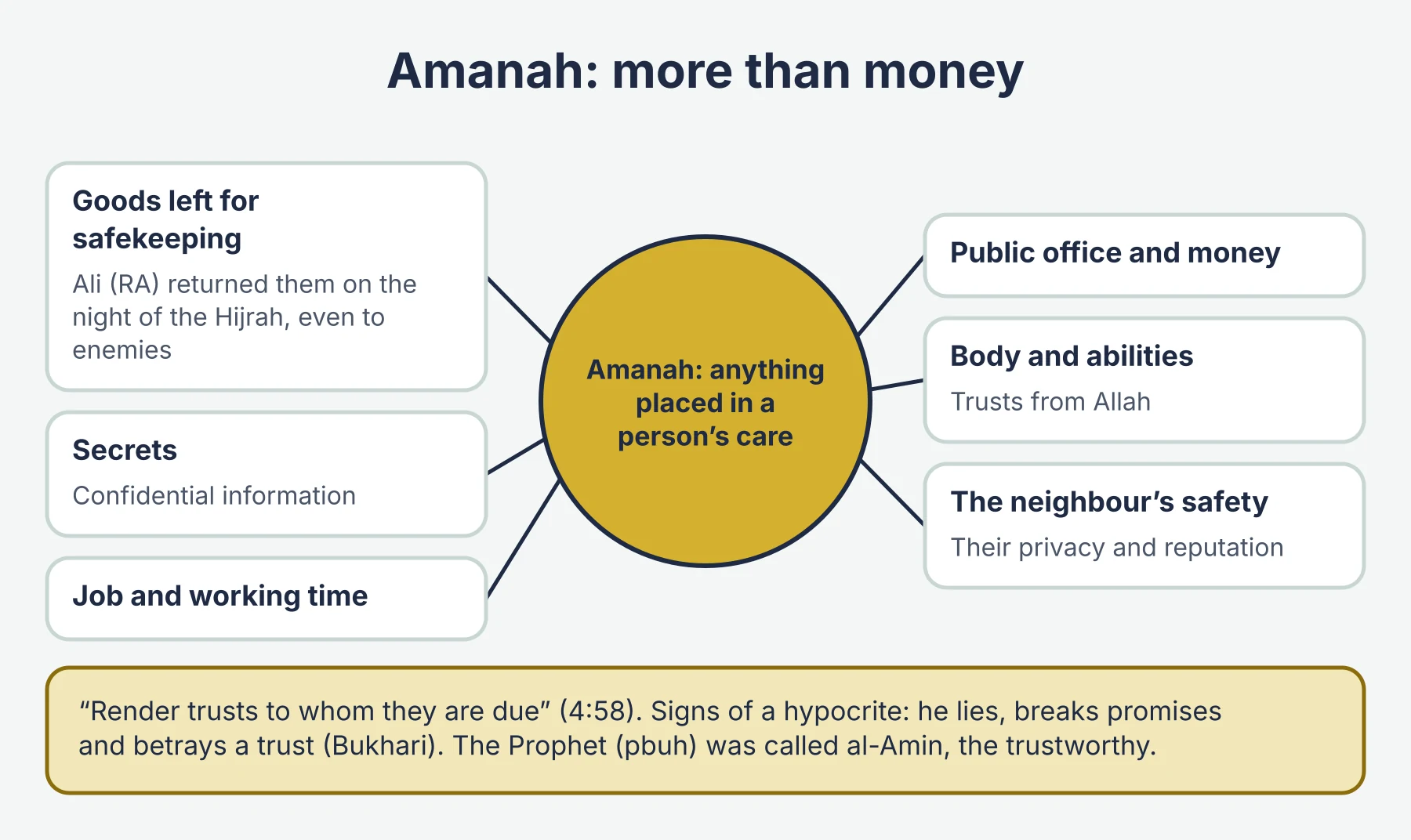
Amanah: what counts as a trust
Property left for safekeeping · secrets · promises · a job and working time · public office and public money · one’s own body, time and talents.
Examples to quote: the Prophet (pbuh) known as al-Amin; Ali (RA) returning the trusts in Makkah at the Hijrah; believers “to their trusts and their promises attentive” (23:8).
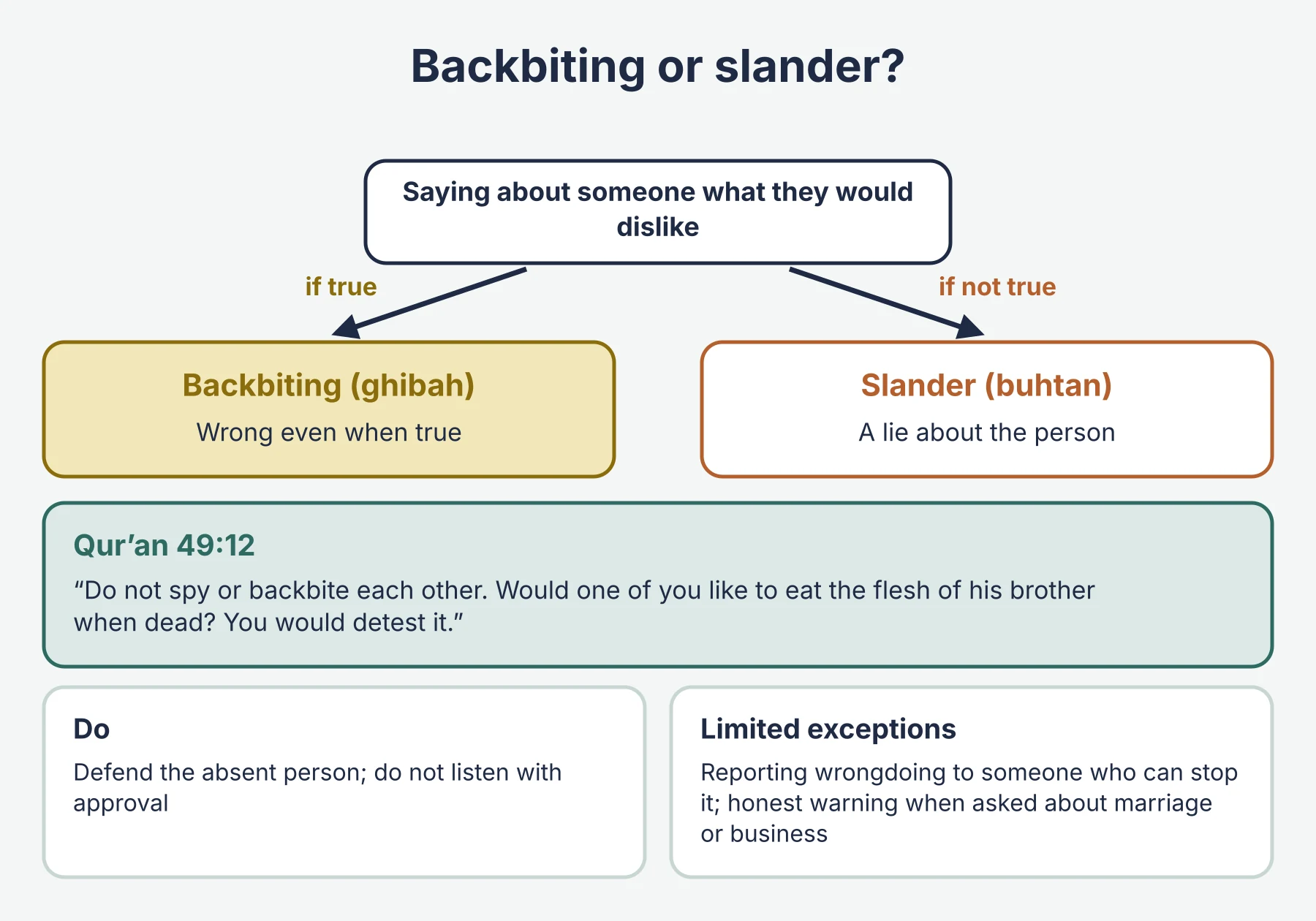
Backbiting: four facts
- Saying about someone what they would dislike, in their absence.
- Wrong even if true; if false it is buhtan (slander).
- Listening with approval shares the sin; defend the absent person.
- Limited exceptions: stopping wrongdoing, or honest advice when asked (for marriage or business).
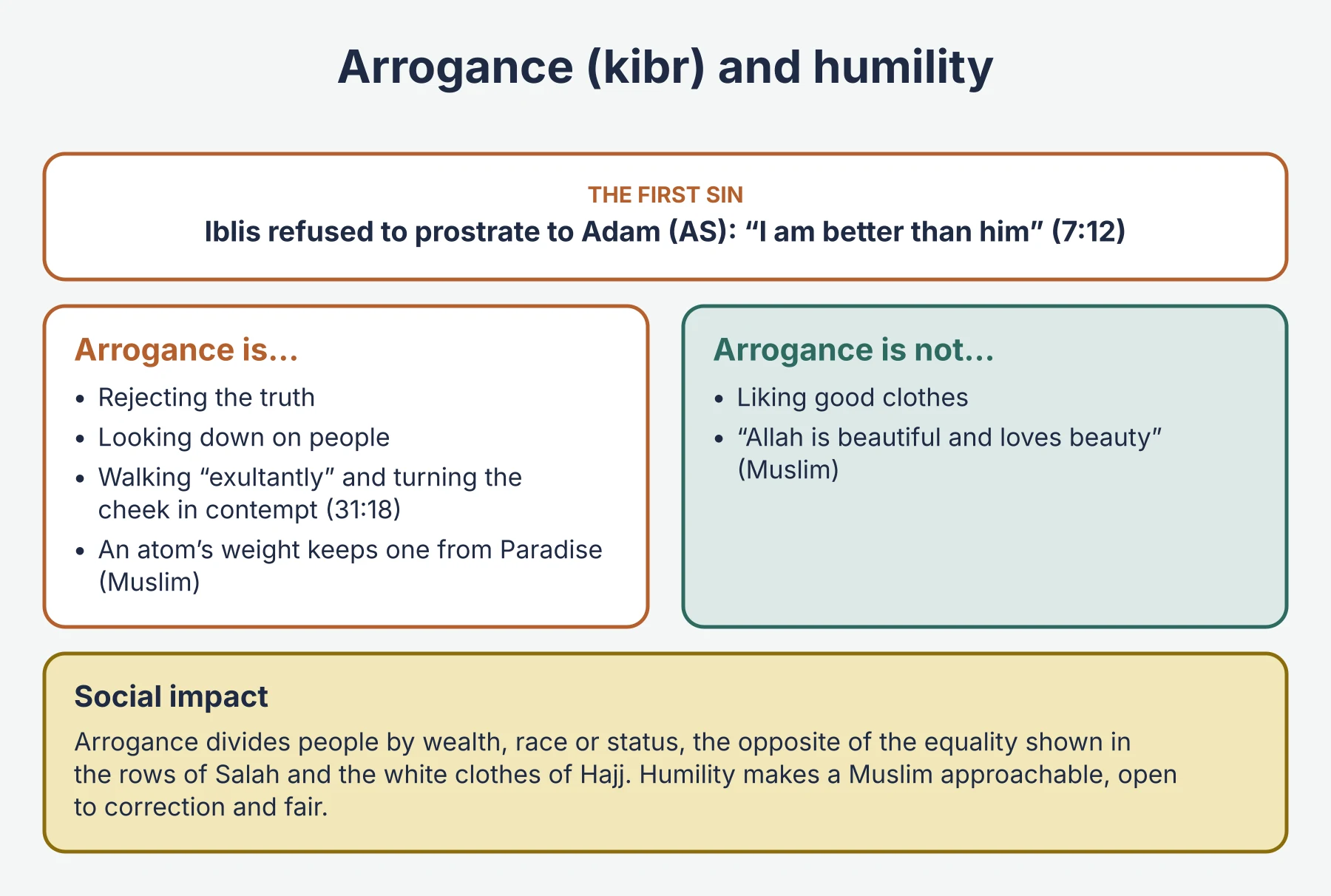
Arrogance: four facts
- The sin of Iblis: “I am better than him” (7:12).
- Defined by the Prophet (pbuh) as rejecting the truth and looking down on people.
- Not the same as liking good clothes: “Allah is beautiful and loves beauty”.
- Opposite: humility (tawadu’), shown in the equality of Salah rows and Hajj clothing.
Jealousy: four facts
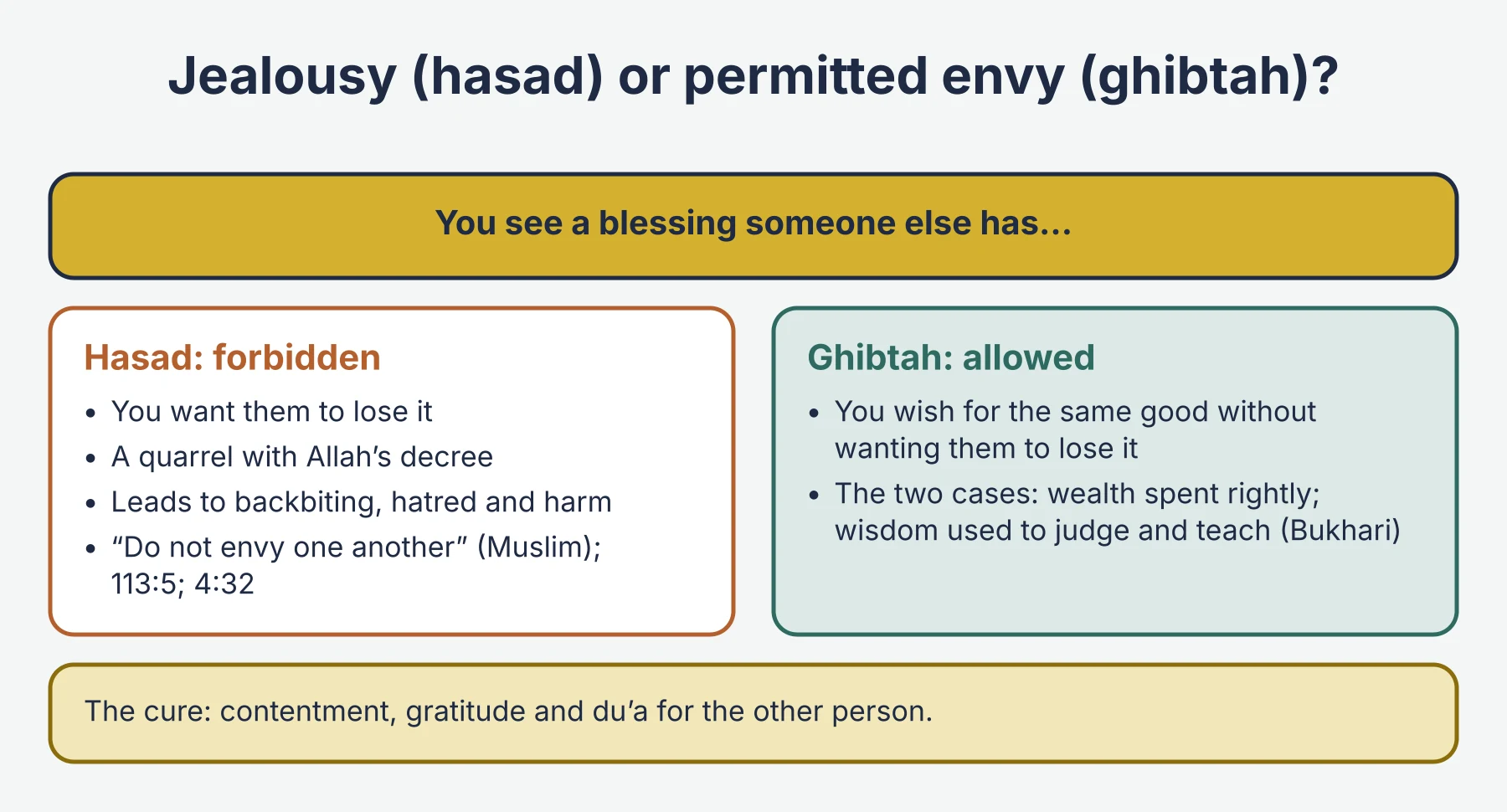
- Hasad = wanting another person to lose a blessing.
- A complaint against Allah’s decree.
- Leads to hatred, backbiting and harm.
- Ghibtah = wishing for the same good without wanting the other to lose it; allowed for wealth spent rightly and wisdom used to judge and teach (Bukhari).
Social impact: one line each
- Neighbours: safe, trusting streets; good relations across communities.
- Amanah: honest business, reliable workers, trustworthy government.
- Backbiting: its absence protects reputations and friendships.
- Arrogance: its absence supports equality and fairness.
- Jealousy: its absence reduces conflict and resentment.
Key terms
| Term | Meaning |
|---|---|
| Jar | Neighbour |
| Amanah / Amanat | Trust / trusts |
| Al-Amin | “The Trustworthy”, a title of the Prophet (pbuh) |
| Ghibah | Backbiting |
| Buhtan | Slander: saying something false about someone |
| Kibr | Arrogance |
| Tawadu’ | Humility |
| Hasad | Envy that wishes a blessing removed from another |
| Ghibtah | Permitted wish for the same blessing |
| Akhlaq | Character and manners |
Using the prescribed Hadith (Sahih al-Bukhari 6016)
The 12-mark question on 3.2.2.9 is built on this Hadith. Three moves: the repeated oath “By Allah, he does not believe” links faith to conduct; “one whose neighbour does not feel safe” sets safety as the minimum right; “from his evil” covers words as well as actions, which lets you bring in backbiting and arrogance.
Exam traps
- Backbiting can be true; that is what makes it backbiting rather than slander.
- Amanah is more than money.
- Hasad ≠ ghibtah.
- Neighbours are not only Muslim neighbours.
- “Social impact” needs the effect on society, not just the rule.
- The prescribed passage is a Hadith (Bukhari 6016), not a verse.
Self-test
- Which verse lists “the near neighbour, the neighbour farther away”?
- In the prescribed Hadith, who did the Prophet (pbuh) say “does not believe”?
- What did Jibril (AS) advise about neighbours so often?
- What does amanah mean? Give two examples.
- Name the three signs of a hypocrite.
- To what does the Qur’an compare backbiting?
- What is the difference between ghibah and buhtan?
- Whose sin was the first act of arrogance?
- How did the Prophet (pbuh) define arrogance?
- What is ghibtah, and when is it allowed?
- Which surah asks for protection from “an envier when he envies”?
- Give one social benefit of avoiding jealousy.
Answers: 1. Qur’an 4:36. 2. One whose neighbour does not feel safe from his evil. 3. The rights of the neighbour, until the Prophet (pbuh) thought the neighbour would be made an heir. 4. A trust; any two: property left for safekeeping, a secret, a promise, a job, public office, one’s body and talents. 5. When he speaks he lies; when he promises he breaks it; when he is trusted he betrays. 6. Eating the flesh of one’s dead brother (49:12). 7. Ghibah is saying something true that a person dislikes; buhtan is saying something false. 8. Iblis. 9. Rejecting the truth and looking down on people. 10. Wishing for the same blessing as someone without wanting them to lose it; allowed for wealth spent rightly and wisdom used to judge and teach. 11. Surah al-Falaq (113). 12. Any one: less conflict; less resentment; stronger brotherhood; less backbiting.
Practise with the rights of neighbours, Amanat, backbiting, arrogance and jealousy practice questions.
Source: OxfordAQA, International GCSE Islamiat (9237) specification, Version 1.1, content area 3.2.2.9.
Related resources
-
Study guides
OxfordAQA International GCSE Islamiat (9237): The Schools of Thought in Islam
The origins and role of the Hanafi, Maliki, Shafi'i, Hanbali and Ja'fari schools of law, their founders, methods and differences, for 9237 topic 3.2.2.5.
Islamiyat · OxfordAQA · IGCSE
Read guide -
Practice questions
OxfordAQA International GCSE Islamiat (9237): The Schools of Thought in Islam – Practice Questions
Twelve original questions with mark guidance on the origins and role of the Hanafi, Maliki, Shafi'i, Hanbali and Ja'fari schools, for 9237 topic 3.2.2.5.
Islamiyat · OxfordAQA · IGCSE
Try questions -
Revision notes
OxfordAQA International GCSE Islamiat (9237): The Schools of Thought in Islam – Revision Notes
Recall notes on the Hanafi, Maliki, Shafi'i, Hanbali and Ja'fari schools: founders, cities, methods, key works, differences and role, for 9237 topic 3.2.2.5.
Islamiyat · OxfordAQA · IGCSE
Revise topic
Get free revision emails (optional)
Occasional emails with practice questions, worked explanations and links to free resources for the qualification and subjects you choose. No spam, and you can unsubscribe from any email. The free tools on this site never need an email.