
Study Guides
OxfordAQA International GCSE History (9245): Paper 1 Section A, Source-Based Depth Studies
Paper 1 Section A of OxfordAQA International GCSE History 9245: the four source questions, pre-release method, and key knowledge for both depth-study options.
- Subject
- World History
- Level
- IGCSE
- Topic
- Paper 1 – International Relations Depth Studies
- Author
- Marlbridge Academic Team
- Updated
- Reviewed by
- Azam Siddique (what this means)
Aligned to OxfordAQA IGCSE World History (9245), Version 1.1. Official specification .
Syllabus page (what it covers and how it is assessed): OxfordAQA IGCSE World History.
Syllabus points this page covers
9245
- 3.1.1 Section A
Found an error? Report a correction.
Need help with this topic? Request a free trial class for IGCSE World History (9245).
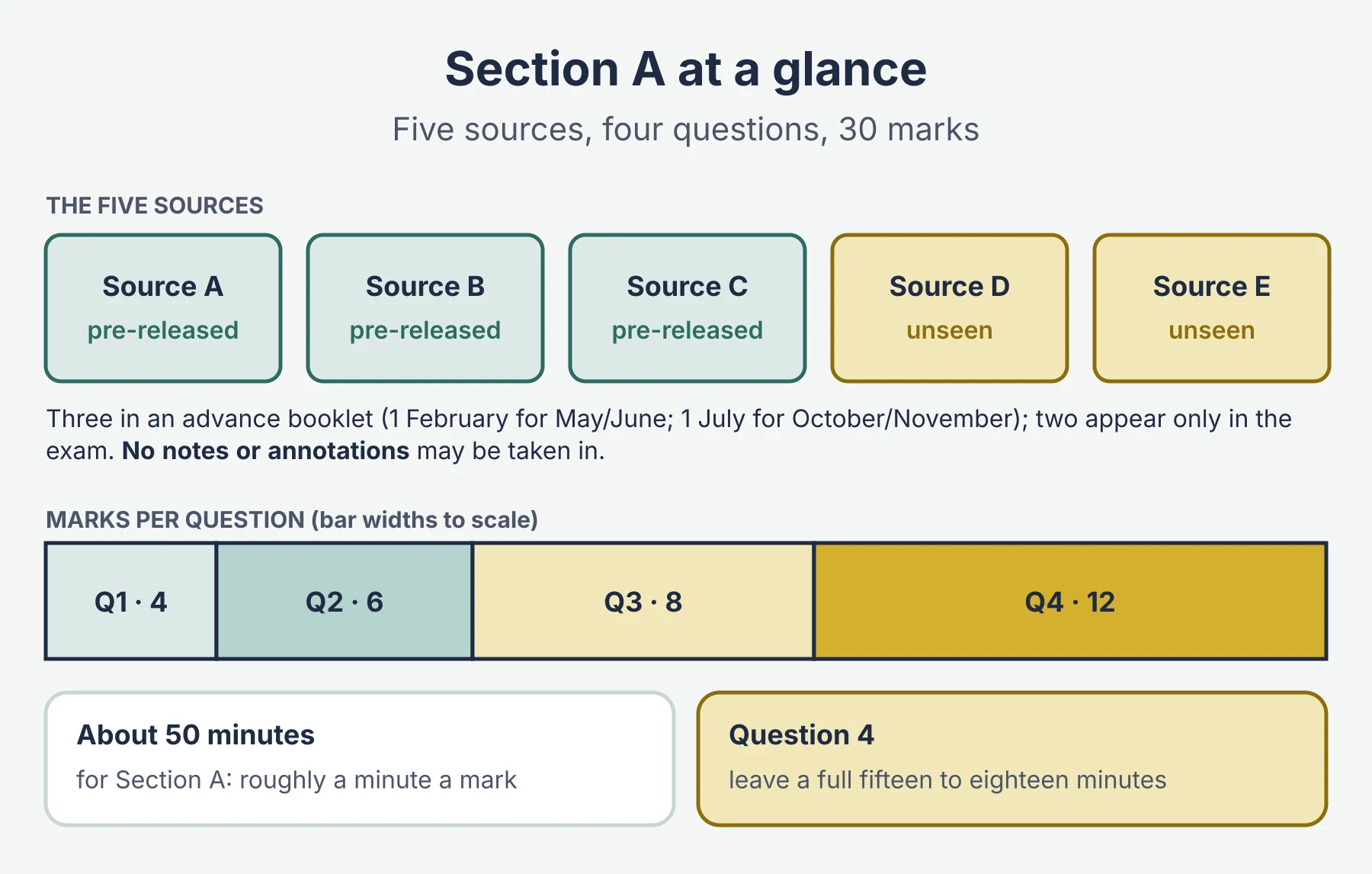
Section A of Paper 1 in OxfordAQA International GCSE History (9245) is a source-based depth study. You study one of two options, Peacemaking and the League of Nations, c1919-1939 or Crises of the Cold War, 1960-1975, and every question tests source skills (AO3). The International Relations Depth Studies overview explains the paper as a whole; this guide covers the Section A questions and the knowledge you need to use sources well in either option. 9245 is taught from September 2026 and first examined in May/June 2028.
How Section A works
- Five sources: a booklet of three is released in advance (1 February for the May/June series, 1 July for October/November); two are unseen and appear only in the exam.
- No notes or annotations may be taken in. A clean copy of all five sources is provided.
- The sources may be visual or written, primary or secondary.
The specification describes four questions:
| Question | Marks | Task |
|---|---|---|
| 1 | 4 | Use an unseen source’s content and/or provenance, and contextual knowledge, to support a given claim |
| 2 | 6 | Explain a difference between an unseen source and a pre-released one, using the content of each and your own knowledge |
| 3 | 8 | Evaluate how an unseen source is useful to a historian studying a given issue, using content, provenance and contextual knowledge |
| 4 | 12 | Analyse and evaluate a given issue or development using a range of the sources and your own knowledge |
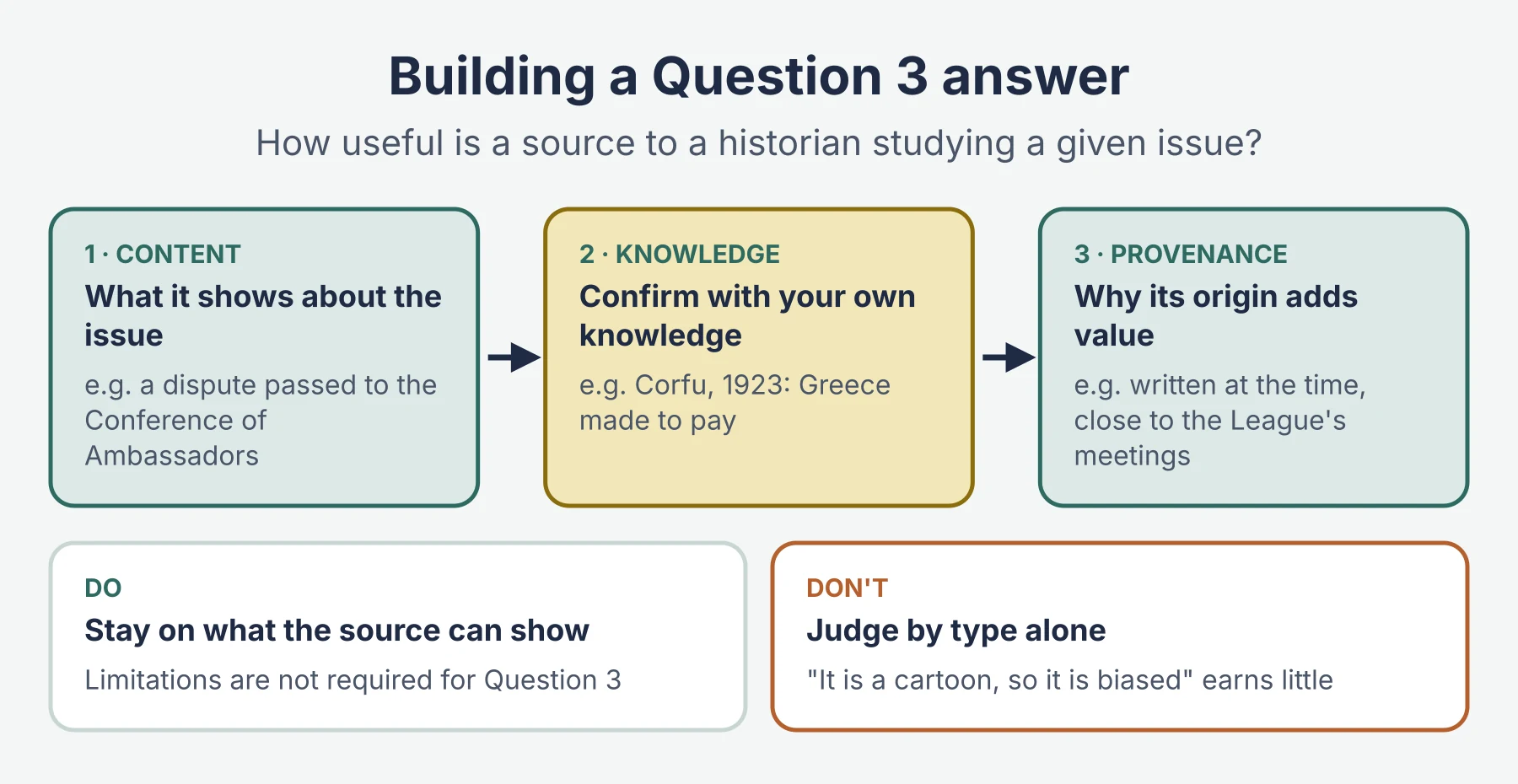
Questions 1-4 each target Part 1 or Part 2 of the option’s content. For Question 3 the specification states that evaluating a source’s limitations, how it is not useful, is not required: concentrate on what the source can show.
Using the pre-release well
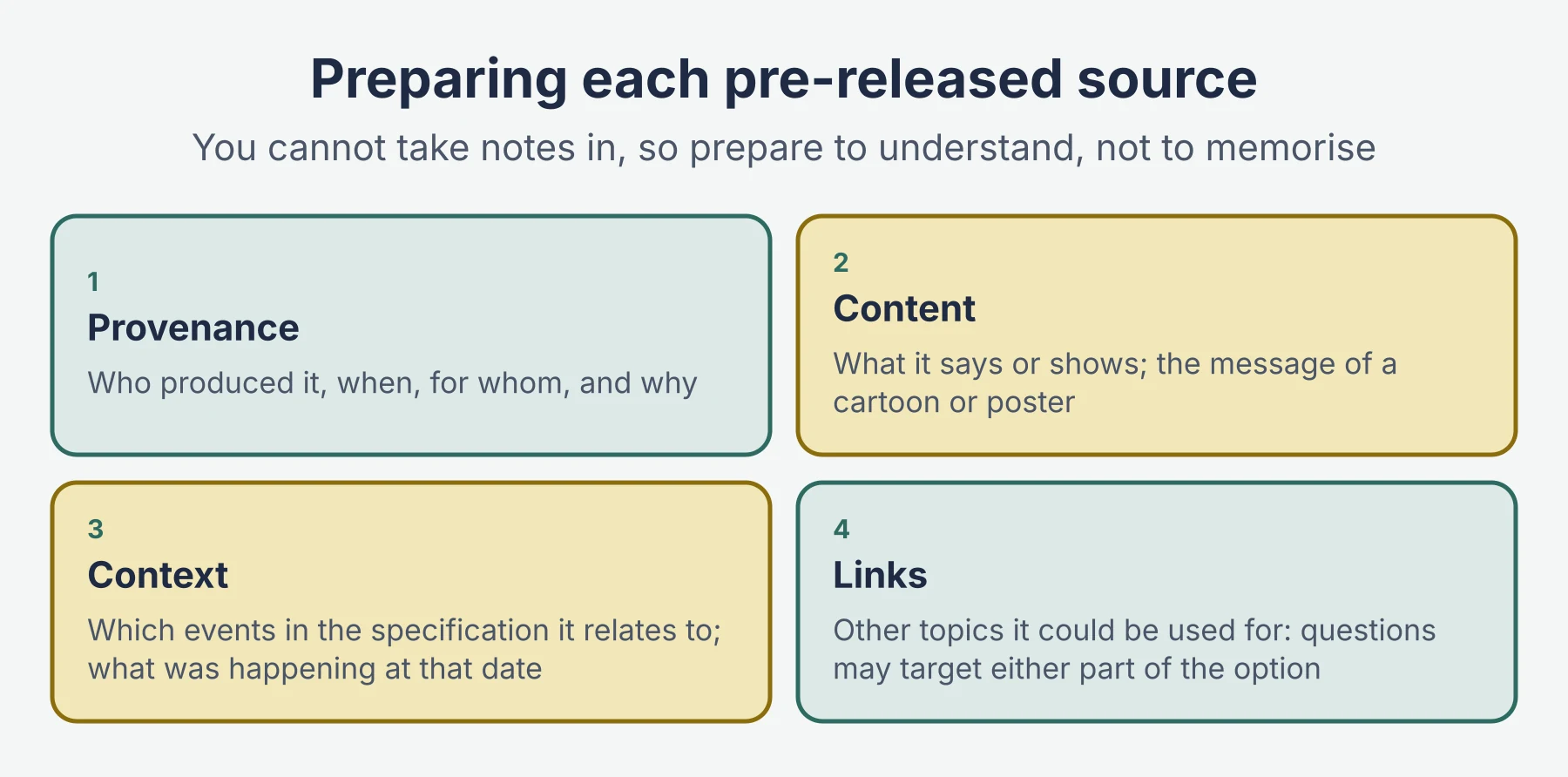
You cannot take notes in, so preparation means understanding, not memorising annotations. For each pre-released source, work out:
- Provenance: who produced it, when, for whom, and why.
- Content: what it says or shows, and the message of a cartoon or poster.
- Context: which events in the specification it relates to, and what was happening at that date.
- Links: which other topics it could be used for, since the question may target either part of the option.
Method for each question
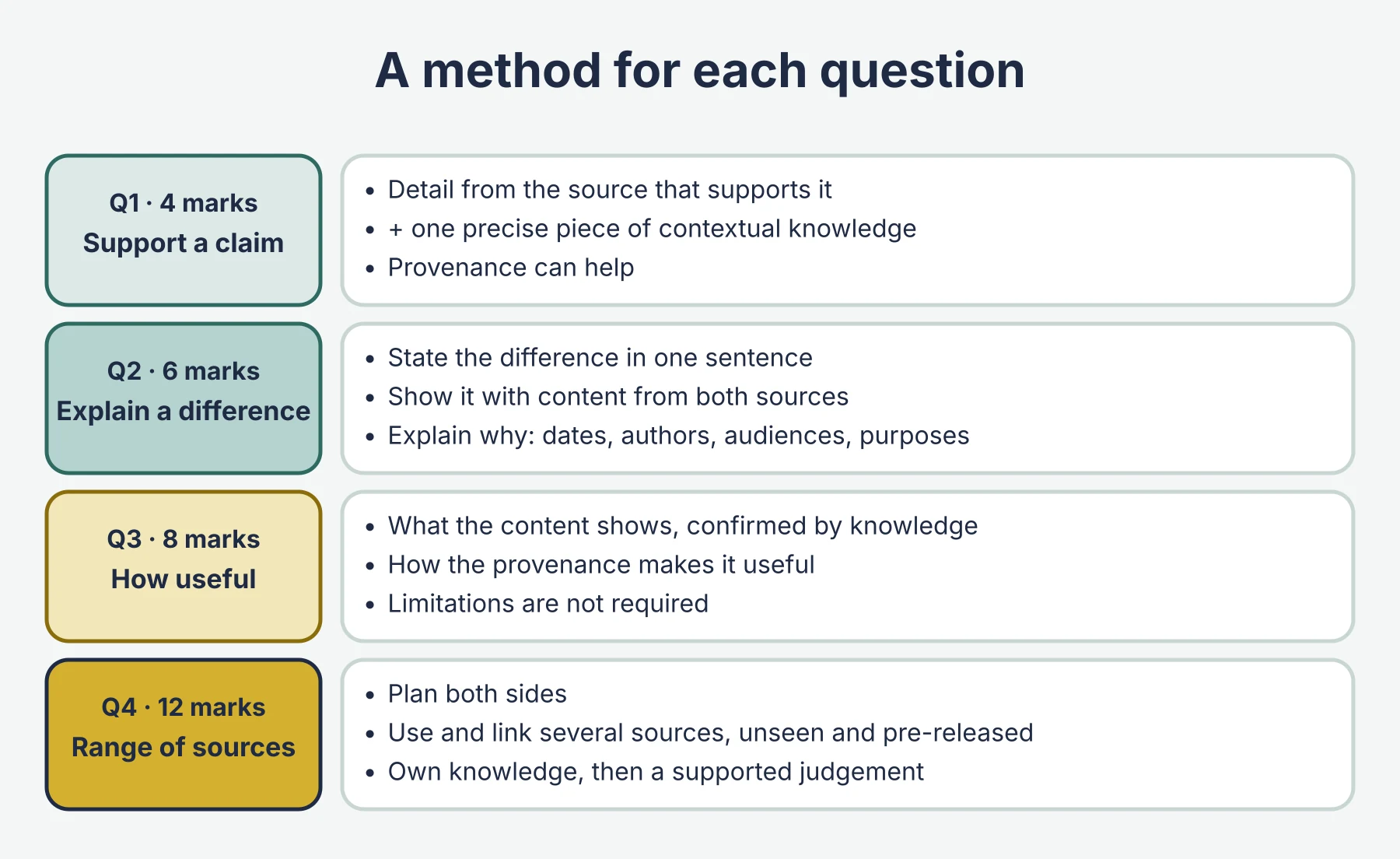
Question 1 (support a claim). Quote or describe a detail from the source that supports the claim, then add one precise piece of contextual knowledge that also supports it. Provenance can help: a source produced by someone in a position to know is strong support.
Question 2 (explain a difference). State the difference clearly in one sentence, show it with content from both sources, then explain why they differ, using your own knowledge: different dates, authors, audiences or purposes.
Question 3 (usefulness). Explain what the content tells a historian about the named issue, with knowledge confirming it; then explain how the provenance makes the source useful. A government poster is useful as evidence of what that government wanted people to believe; a private letter is useful for one person’s reaction.
Question 4 (range of sources and knowledge). Plan for both sides of the issue. Use and link several sources, both unseen and pre-released, add your own knowledge, and finish with a supported judgement.
Option 1: Peacemaking and the League of Nations, c1919-1939
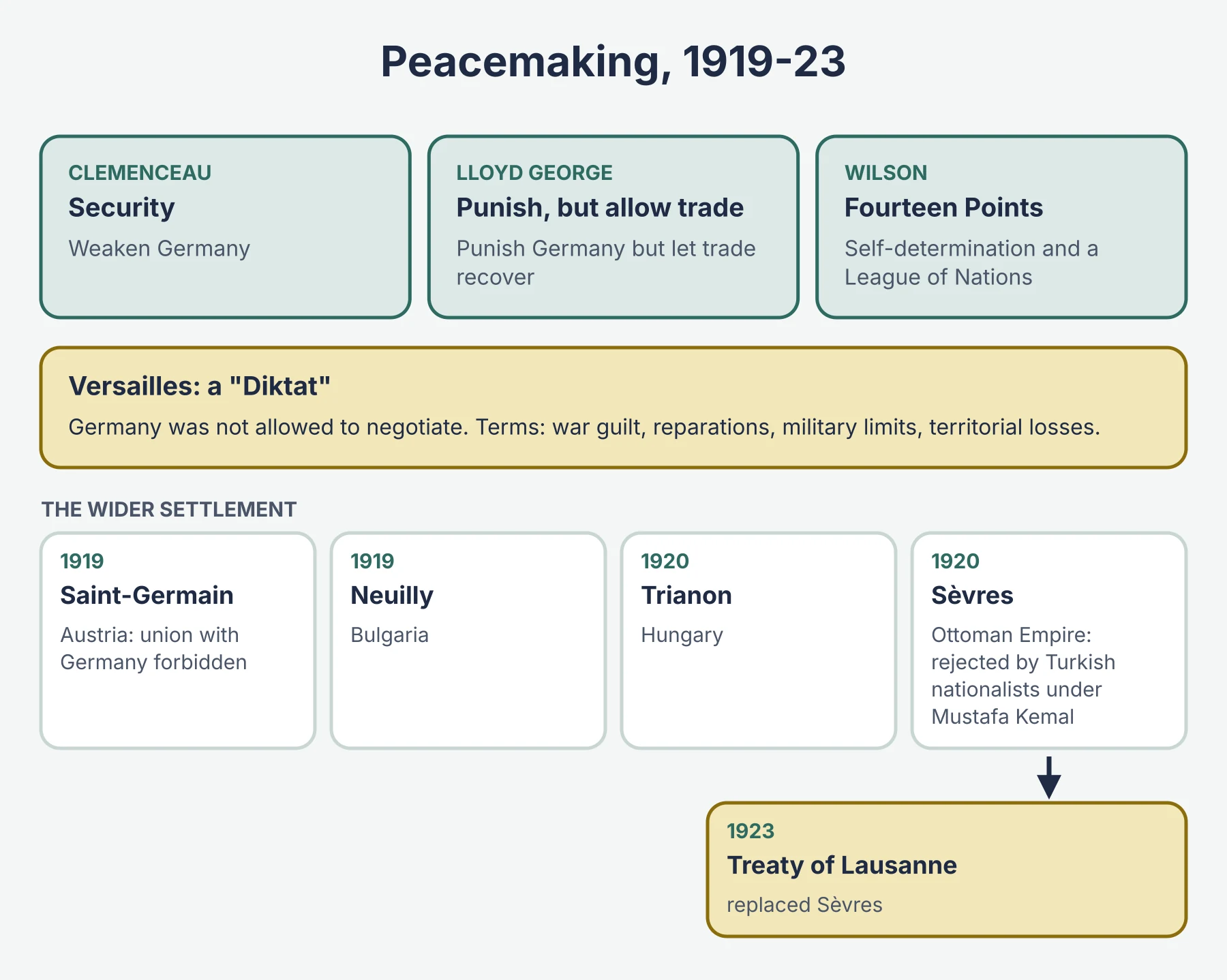
Part 1: peacemaking, 1919-23. The Big Three had different aims: Clemenceau wanted security and to weaken Germany; Lloyd George wanted a peace that punished Germany but allowed trade to recover; Wilson’s Fourteen Points included self-determination and a League of Nations. Germany called the Treaty of Versailles a Diktat because it was not allowed to negotiate. Beyond the terms you should know (war guilt, reparations, military limits, territorial losses), learn the wider settlement: Saint-Germain with Austria (1919), which forbade union with Germany; Neuilly with Bulgaria (1919); Trianon with Hungary (1920); and Sèvres with the Ottoman Empire (1920), which Turkish nationalists led by Mustafa Kemal rejected, leading to its replacement by the Treaty of Lausanne (1923).
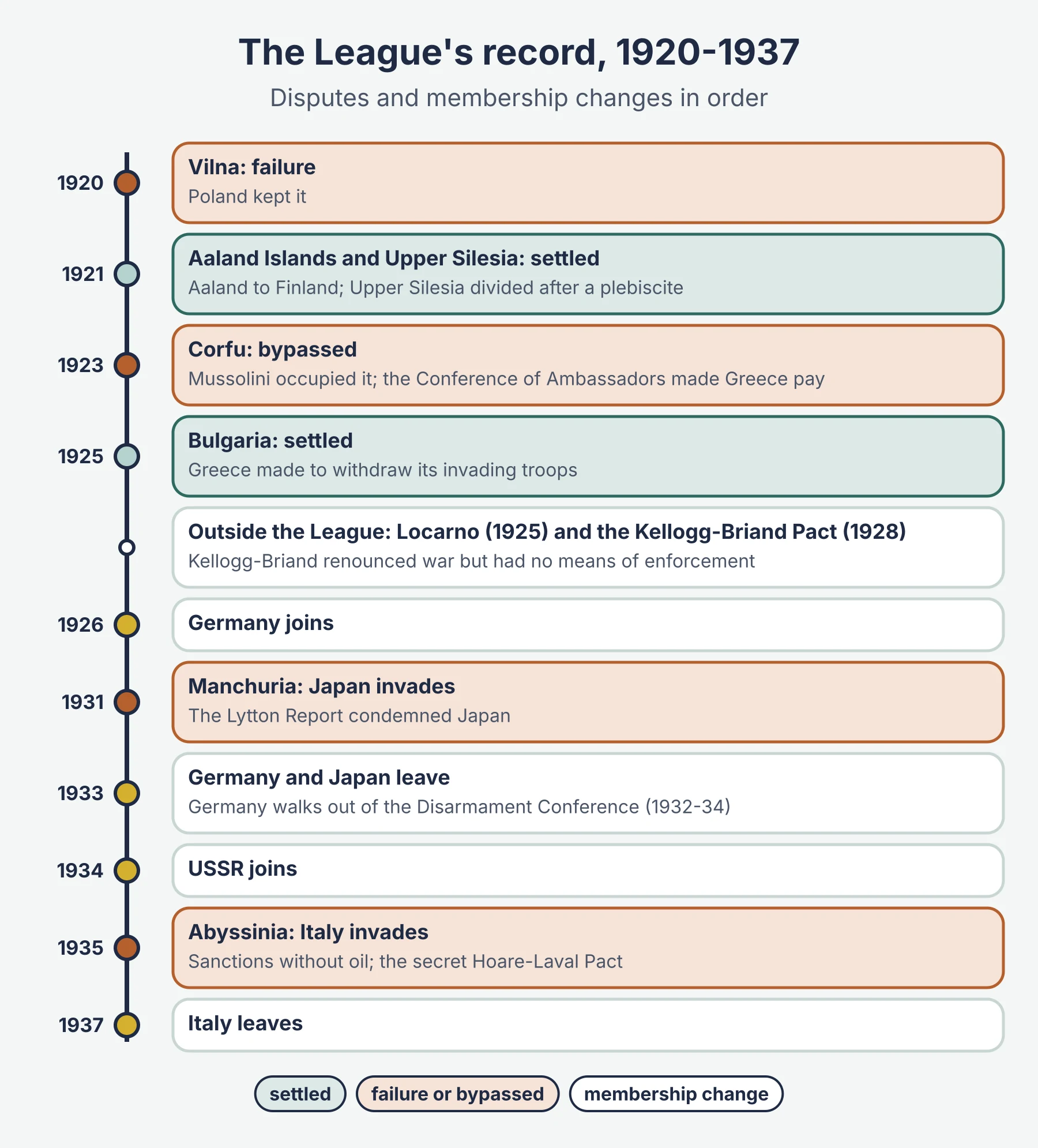
Part 2: the League. The Covenant set out the League’s purpose; it worked through the Assembly, the Council, the Permanent Court of International Justice and a Secretariat, with agencies such as the International Labour Organization. Its powers ran from moral condemnation to economic sanctions and, in theory, military action by members. Membership changed: the USA never joined; Germany joined in 1926 and left in 1933, as did Japan in 1933; the USSR joined in 1934; Italy left in 1937.
In the 1920s it settled the Aaland Islands (1921, awarded to Finland) and Upper Silesia (1921, divided after a plebiscite). It failed over Vilna (1920), which Poland kept. Over Corfu (1923), Mussolini occupied the island after an Italian general was murdered; the Conference of Ambassadors made Greece pay compensation, a sign that great powers could bypass the League. In Bulgaria (1925) the League made Greece withdraw its invading troops. Outside the League, the Locarno treaties (1925) confirmed Germany’s western borders, and the Kellogg-Briand Pact (1928) renounced war as an instrument of policy, but had no means of enforcement. The Geneva Protocol of 1924, which would have strengthened the League’s dispute procedures, never came into force.
The 1930s: the Depression weakened cooperation; Japan invaded Manchuria (1931), the Lytton Report condemned Japan and Japan left the League (1933); Italy invaded Abyssinia (1935), and sanctions did not include oil while Britain and France negotiated the secret Hoare-Laval Pact; Britain and France followed non-intervention in the Spanish Civil War; the World Disarmament Conference (1932-34) collapsed after Germany walked out in 1933.
Option 2: Crises of the Cold War, 1960-1975
Part 1: threats to peace in the 1960s. In May 1960 an American U2 spy plane was shot down over the USSR and its pilot, Gary Powers, captured; the Paris Summit collapsed when Eisenhower would not apologise. In August 1961 East Germany began building the Berlin Wall to stop emigration to the West; Kennedy protested but accepted it, later visiting West Berlin in 1963. The arms race produced intercontinental ballistic missiles and submarine-launched Polaris missiles; in the space race, Yuri Gagarin became the first person in space in April 1961, and the Apollo programme landed Americans on the Moon in 1969.
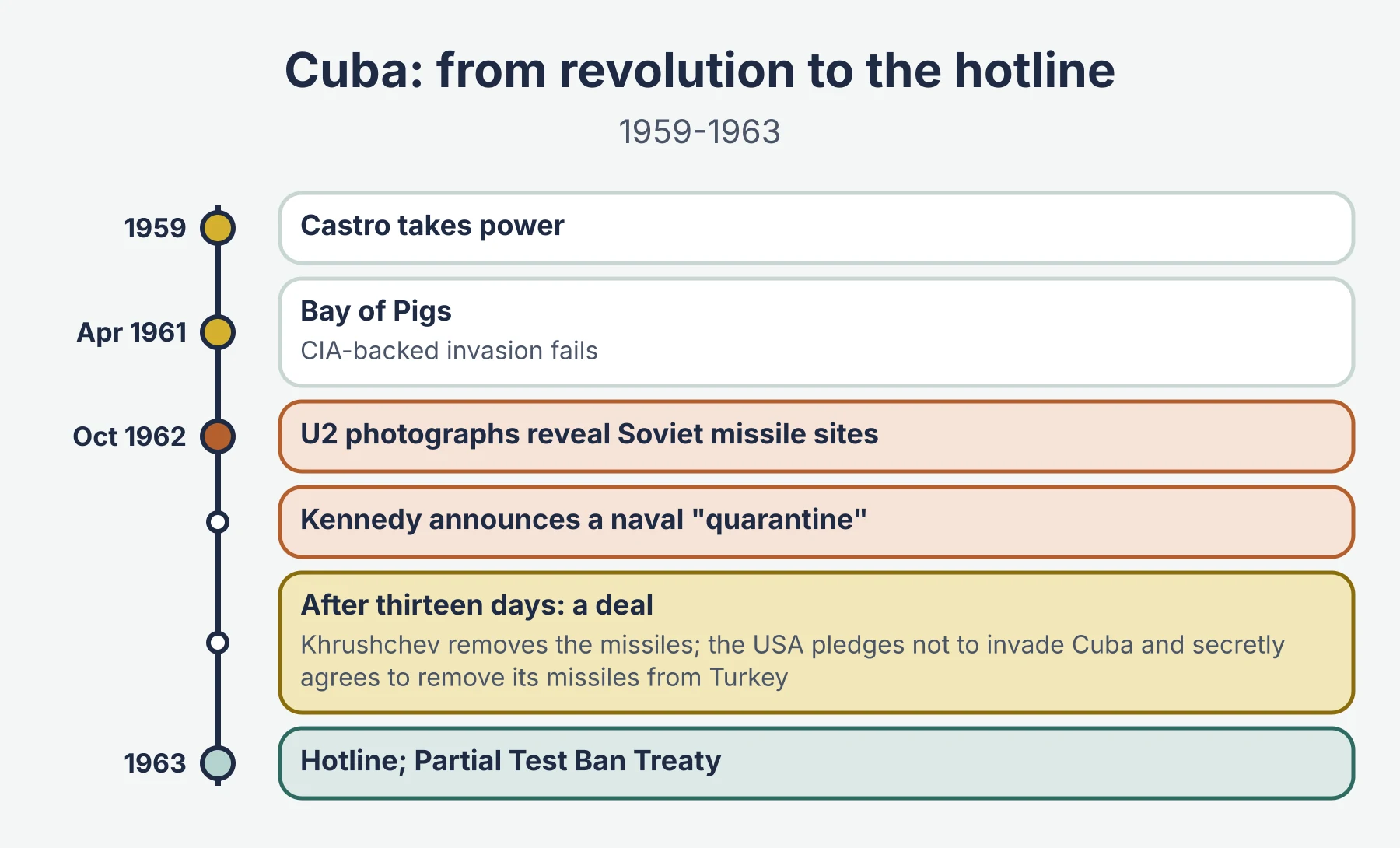
Cuba: Castro took power in 1959; the CIA-backed Bay of Pigs invasion failed in April 1961; in October 1962 U2 photographs revealed Soviet missile sites. Kennedy announced a naval “quarantine”; after thirteen days Khrushchev agreed to remove the missiles in return for a US pledge not to invade Cuba, and the USA secretly agreed to remove its missiles from Turkey. A hotline followed in 1963, and the Partial Test Ban Treaty that year.
Czechoslovakia, 1968: Alexander Dubček’s reforms in the Prague Spring relaxed censorship; fearing the spread of reform, Warsaw Pact forces invaded in August 1968. The Brezhnev Doctrine stated that the USSR would intervene where communism was threatened in the Eastern bloc.
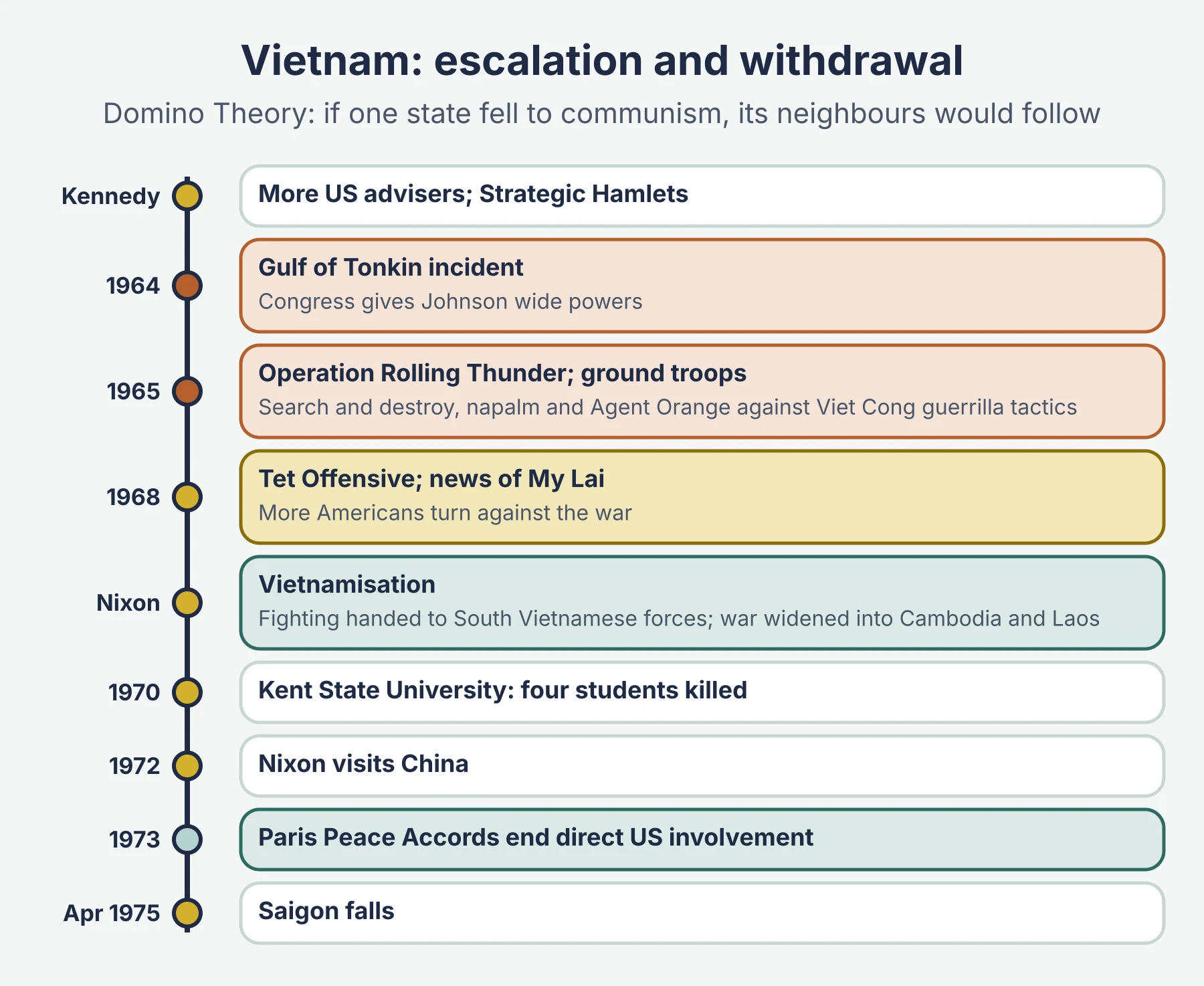
Part 2: Vietnam. The Domino Theory held that if one state fell to communism, its neighbours would follow. Kennedy increased the number of US advisers and backed the Strategic Hamlets programme. After the Gulf of Tonkin incident (1964), Congress gave Johnson wide powers; bombing (Operation Rolling Thunder) and ground troops followed from 1965. The Viet Cong used guerrilla tactics; the US used search and destroy, napalm and the defoliant Agent Orange. The Tet Offensive (1968) and news of the My Lai massacre (1968) turned more Americans against the war. Nixon’s Vietnamisation handed fighting to South Vietnamese forces while widening the war into Cambodia and Laos; four students were killed at Kent State University in 1970. Nixon visited China in 1972; the Paris Peace Accords of 1973 ended direct US involvement; Saigon fell in April 1975.
Worked example: Question 3
Source (invented for this guide, not a real document): a report written in September 1923 by a fictional British journalist in Geneva: “The League’s members spoke bravely of justice, but when Italy refused to accept its judgement, the matter was handed to the Conference of Ambassadors, and Greece was told to pay.”
How useful is this source to a historian studying the weaknesses of the League in the 1920s?
The source is useful because its content shows a key weakness: when a great power refused to cooperate, the dispute was passed to the Conference of Ambassadors instead of being settled by the League. My own knowledge supports this, since after Mussolini occupied Corfu, Greece was made to pay compensation even though the Greek government was not proven responsible for the general’s murder. The provenance adds to its usefulness: a journalist writing in Geneva in September 1923 was reporting at the time and close to the League’s meetings, so the source shows how the crisis was seen by observers as it happened and that the League’s authority was already being questioned in 1923, not only after its failures in the 1930s.
The answer uses content, knowledge and provenance, and stays on what the source can show.
Common mistakes
- Describing a source without linking it to the question’s issue.
- In Question 2, describing the two sources separately without stating the difference.
- In Question 3, judging usefulness by source type alone (“it is a cartoon, so it is biased”).
- In Question 4, using only one or two sources, or using sources with no own knowledge.
- Bringing annotated pre-release material into the exam: it is not permitted.
Exam technique
Paper 1 lasts 1 hour 45 minutes for 60 marks, so Section A’s 30 marks deserve about 50 minutes. Spend roughly a minute a mark, and leave Question 4 a full fifteen to eighteen minutes.
More resources on this topic
Specification
OxfordAQA International GCSE History (9245) specification, Version 1.1, sections 3.1.1 and 4.4.1 — oxfordaqa.com.
Related resources
-
Practice questions
OxfordAQA International GCSE History (9245): Paper 1 Section A, Source-Based Depth Studies – Practice Questions
Original 9245 Paper 1 Section A practice: knowledge checks and two full four-question source sets on the League and on Cold War crises, with marking guides.
World History · OxfordAQA · IGCSE
Try questions -
Revision notes
OxfordAQA International GCSE History (9245): Paper 1 Section A, Source-Based Depth Studies – Revision Notes
Recall notes for 9245 Paper 1 Section A: the four source questions, timelines for the League and Cold War crises options, key terms, exam traps and a self-test.
World History · OxfordAQA · IGCSE
Revise topic -
Study guides
OxfordAQA International GCSE History (9245): Paper 1 Section B, Knowledge-Based Depth Studies
Paper 1 Section B of OxfordAQA International GCSE History 9245: the 3, 6, 9 and 12-mark questions and key knowledge for all four depth-study options.
World History · OxfordAQA · IGCSE
Read guide
Get free revision emails (optional)
Occasional emails with practice questions, worked explanations and links to free resources for the qualification and subjects you choose. No spam, and you can unsubscribe from any email. The free tools on this site never need an email.