
Study Guides
OxfordAQA International GCSE History (9245): Paper 1 Section B, Knowledge-Based Depth Studies
Paper 1 Section B of OxfordAQA International GCSE History 9245: the 3, 6, 9 and 12-mark questions and key knowledge for all four depth-study options.
- Subject
- World History
- Level
- IGCSE
- Topic
- Paper 1 – International Relations Depth Studies
- Author
- Marlbridge Academic Team
- Updated
- Reviewed by
- Azam Siddique (what this means)
Aligned to OxfordAQA IGCSE World History (9245), Version 1.1. Official specification .
Syllabus page (what it covers and how it is assessed): OxfordAQA IGCSE World History.
Syllabus points this page covers
9245
- 3.1.2 Section B
Found an error? Report a correction.
Need help with this topic? Request a free trial class for IGCSE World History (9245).
Section B of Paper 1 in OxfordAQA International GCSE History (9245) is a knowledge-based depth study. You study one of four options, and the questions test what you know (AO1) and how well you explain and judge causes and consequences (AO2). The International Relations Depth Studies overview introduces the paper; this guide sets out the question types and the core knowledge for each option, with emphasis on the explanations examiners ask for.
The four options
- The origins of the First World War, c1890-1915
- Hitler’s foreign policy and the origins of the Second World War, 1933-1941
- The origins and development of the Cold War, 1945-1960
- Détente and the collapse of communism, c1969-1991
Your centre will choose one. There are no prohibited combinations with your Section A option.
The four questions
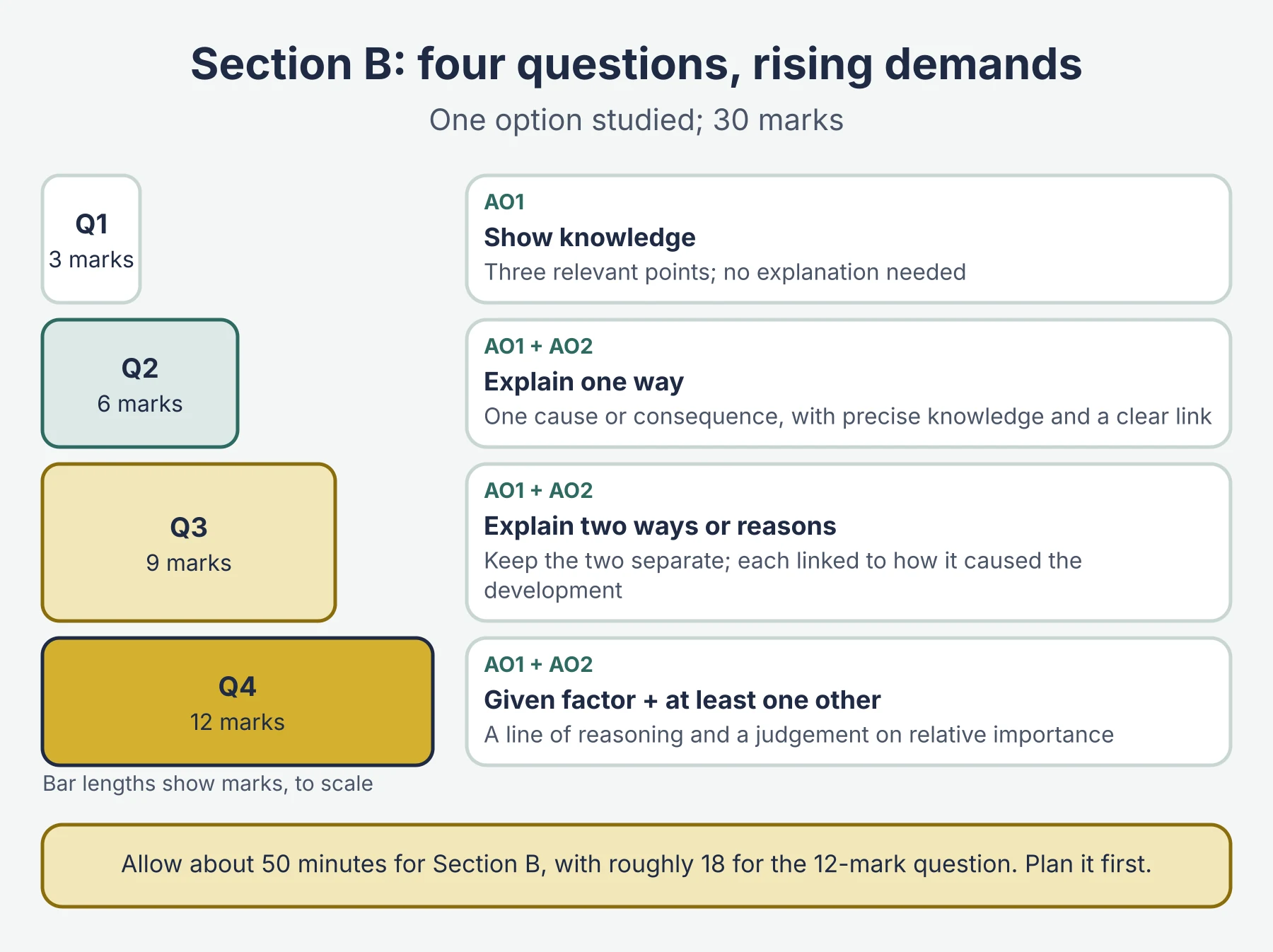
| Question | Marks | AOs | Task |
|---|---|---|---|
| 1 | 3 | AO1 | Show knowledge of a given issue |
| 2 | 6 | AO1, AO2 | Explain one way in which an issue developed (cause or consequence) |
| 3 | 9 | AO1, AO2 | Explain two ways or reasons why an issue developed |
| 4 | 12 | AO1, AO2 | Explain a given cause, consequence or change and at least one other, in a line of reasoning, reaching a judgement on their relative importance |
The 3-mark question rewards relevant points. The 6- and 9-mark questions reward explanation: each way or reason needs precise knowledge and a clear link showing how it caused or affected the development. The 12-mark question needs a line of reasoning across the whole answer and a judgement that compares factors, not just a list.
Option 1: The origins of the First World War, c1890-1915
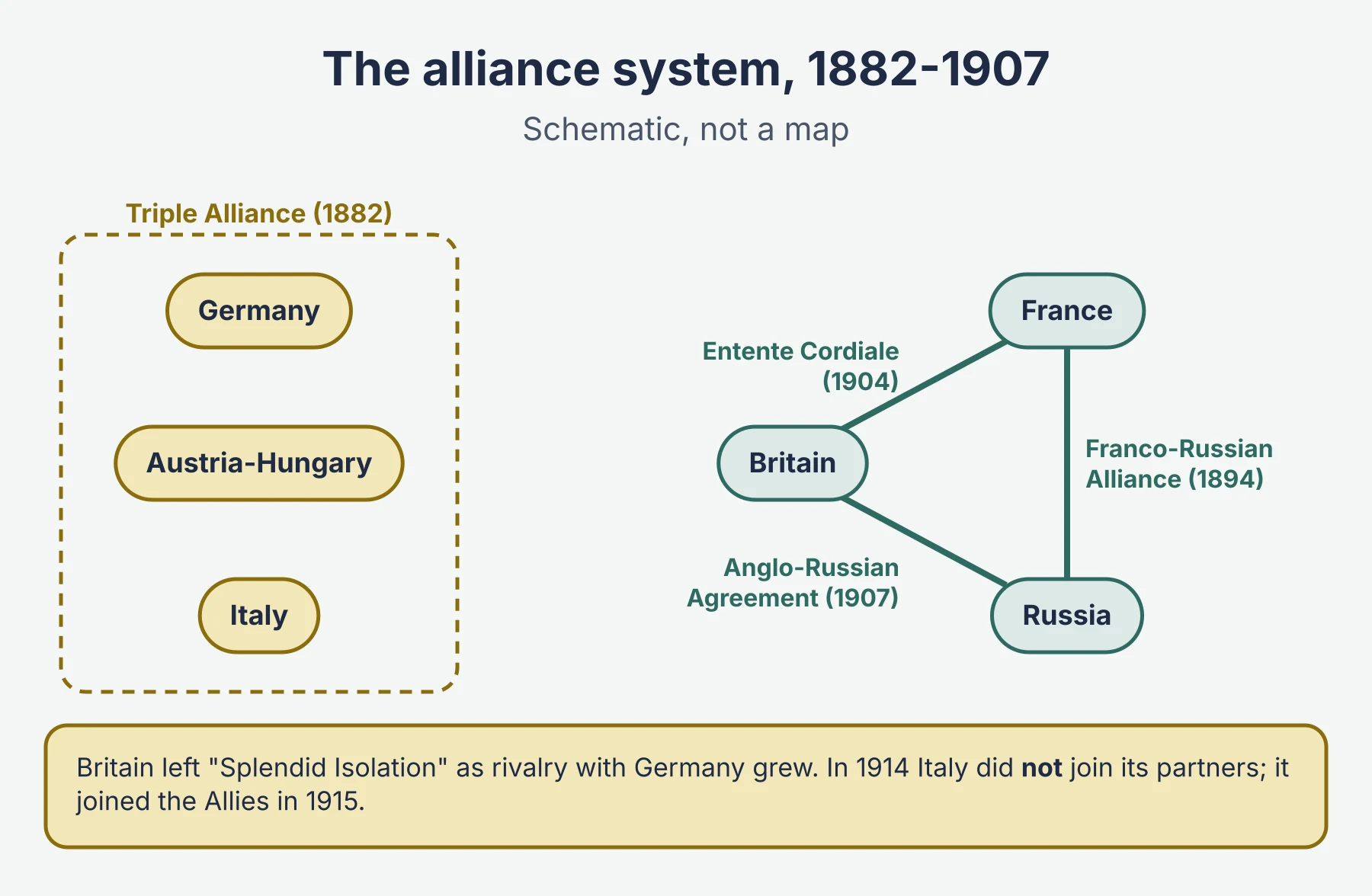
- Alliances: the Triple Alliance of Germany, Austria-Hungary and Italy (1882); the Franco-Russian Alliance (1894); the Entente Cordiale between Britain and France (1904); the Anglo-Russian Agreement (1907). Britain left “Splendid Isolation” as rivalry with Germany grew.
- Kaiser Wilhelm II: Weltpolitik and the demand for “a place in the sun”; fear of encirclement; the naval race after the launch of HMS Dreadnought (1906).
- Crises: Morocco in 1905-06 and 1911 (Agadir), both of which drew Britain and France closer; Austria-Hungary’s annexation of Bosnia (1908-09), which angered Serbia and Russia; the Balkan Wars (1912-13), which enlarged Serbia.
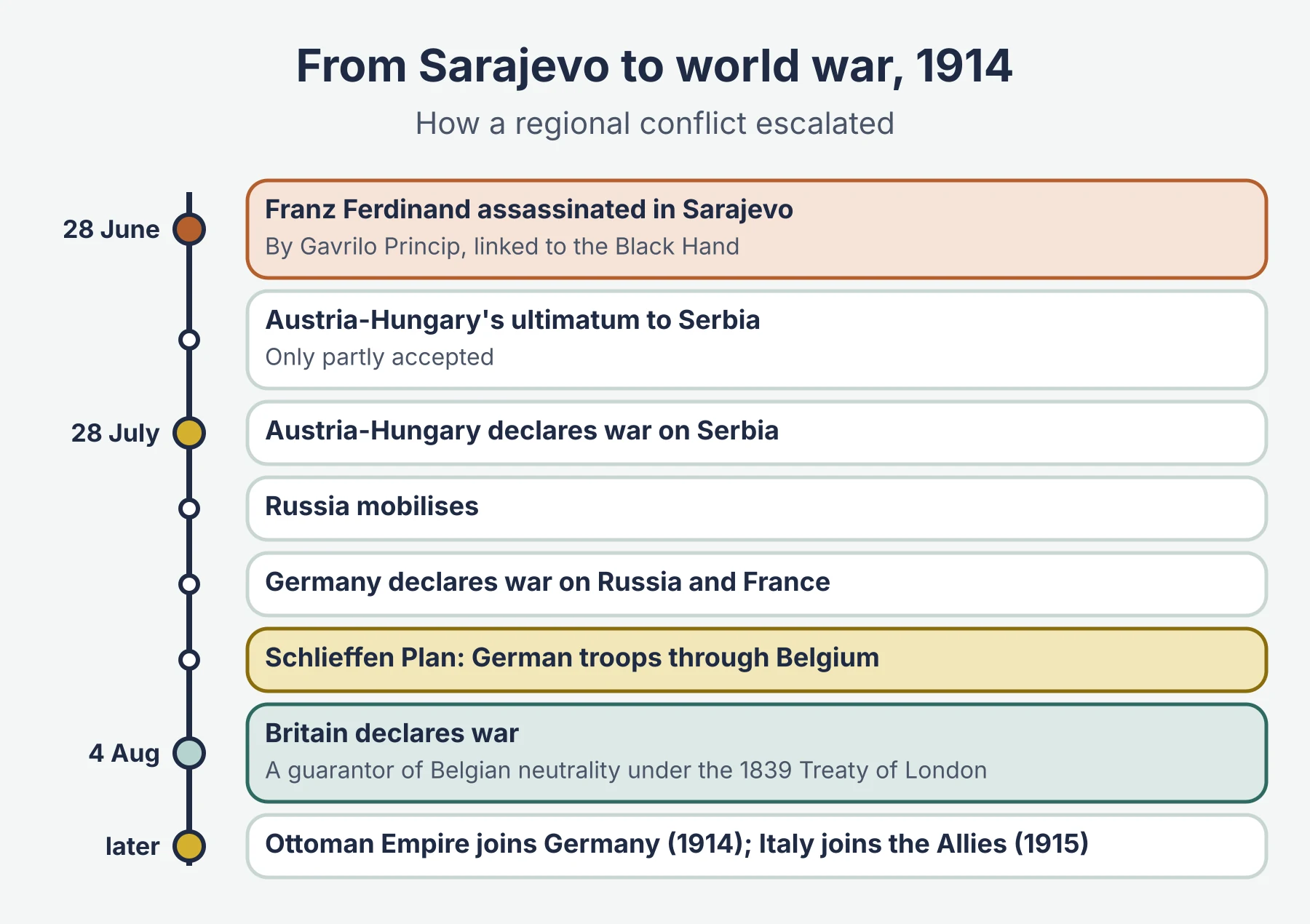
- The July Crisis: Archduke Franz Ferdinand was assassinated in Sarajevo on 28 June 1914 by Gavrilo Princip, linked to the Black Hand; Austria-Hungary’s ultimatum to Serbia was only partly accepted; Austria-Hungary declared war on Serbia on 28 July; Russia mobilised; Germany declared war on Russia and France.
- The Schlieffen Plan sent German troops through Belgium; Britain, a guarantor of Belgian neutrality under the 1839 Treaty of London, declared war on 4 August. The Ottoman Empire joined Germany later in 1914 and Italy joined the Allies in 1915.
Option 2: Hitler’s foreign policy and the origins of the Second World War, 1933-1941
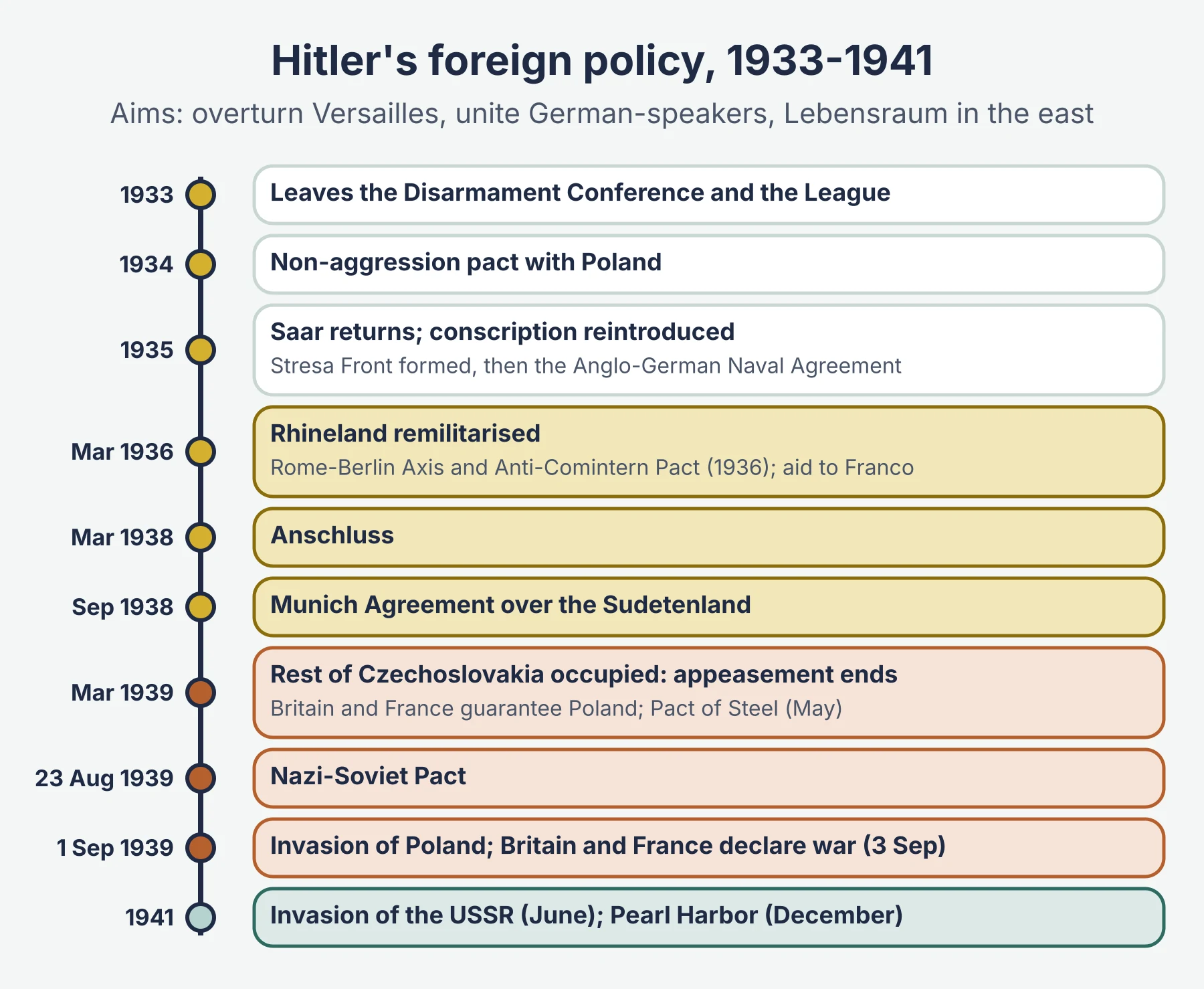
- Aims: overturning Versailles, uniting German-speaking peoples, and Lebensraum in the east.
- 1933-35: Germany left the Disarmament Conference and the League (1933); the non-aggression pact with Poland (1934); the Saar voted to return to Germany (1935); conscription was reintroduced (1935); Britain, France and Italy formed the Stresa Front (1935), but Britain then signed the Anglo-German Naval Agreement (1935).
- 1936-38: Rhineland remilitarised (March 1936); the Rome-Berlin Axis and the Anti-Comintern Pact (1936); German aid to Franco in the Spanish Civil War; the Anschluss (March 1938); the Munich Agreement over the Sudetenland (September 1938).
- 1939: the occupation of the rest of Czechoslovakia (March) ended appeasement; Britain and France guaranteed Poland; the Pact of Steel with Italy (May); the Nazi-Soviet Pact (23 August); the invasion of Poland (1 September); Britain and France declared war (3 September).
- To 1941: the war widened with Germany’s invasion of the USSR (June 1941) and Japan’s attack on Pearl Harbor (December 1941).
Option 3: The origins and development of the Cold War, 1945-1960
- 1945: the Yalta (February) and Potsdam (July-August) conferences; Truman replaced Roosevelt and Attlee replaced Churchill; atomic bombs on Hiroshima and Nagasaki; Germany and Berlin divided into four zones.
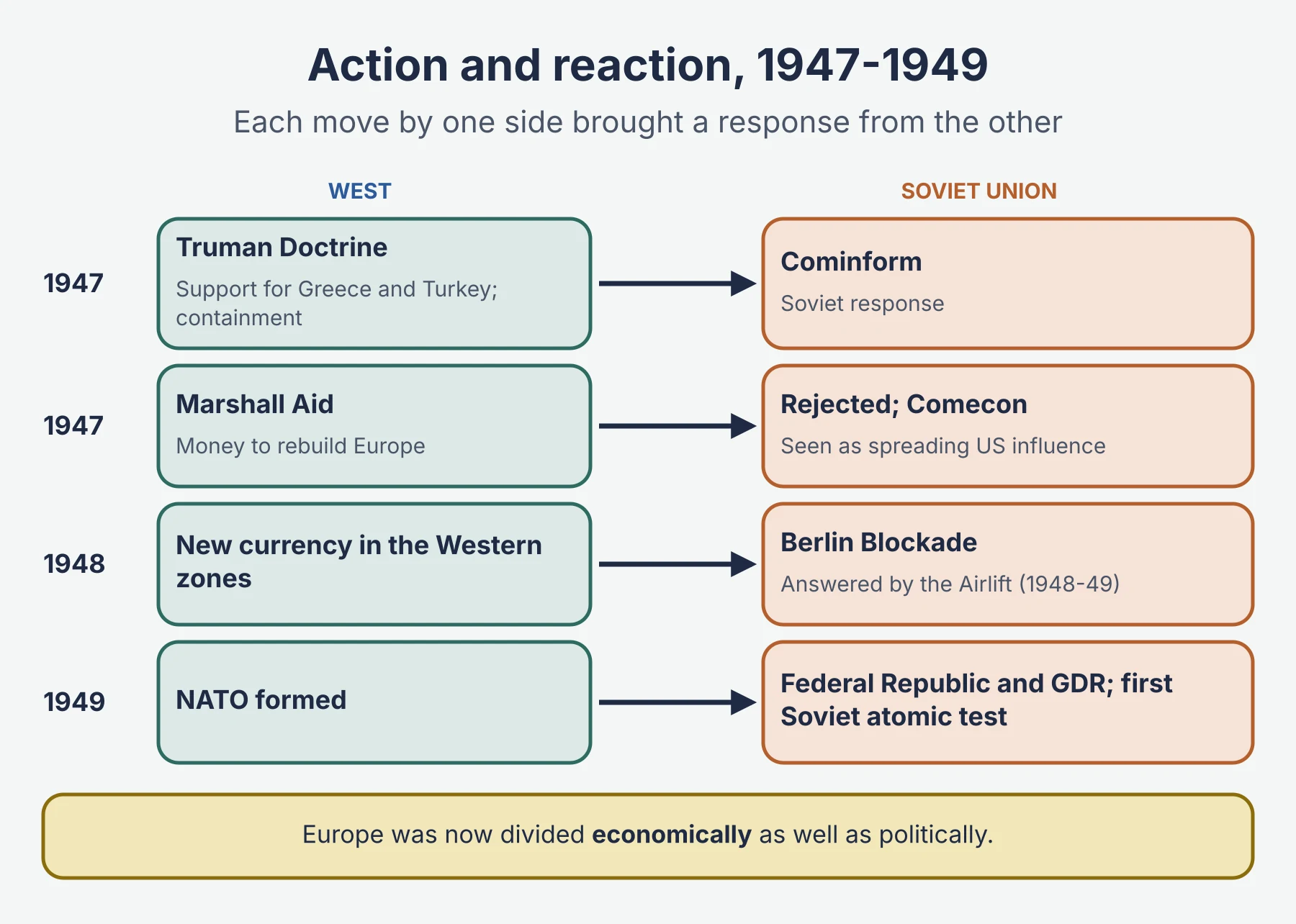
- The Iron Curtain: Soviet control over Eastern Europe; the communist takeover in Czechoslovakia (1948); the Truman Doctrine (1947), offering support to Greece and Turkey and setting out containment; Marshall Aid (1947), rejected by the USSR, which created Cominform and Comecon; Tito’s Yugoslavia broke with Stalin in 1948.
- Germany: the Berlin Blockade and Airlift (1948-49); the Federal Republic and the GDR (1949); NATO (1949); the first Soviet atomic test (1949).
- Asia: the communist victory in China (1949); the Korean War (1950-53), with UN forces under MacArthur, Chinese intervention, stalemate and an armistice in 1953; the Geneva Agreement on Vietnam (1954).
- The “Thaw”: Stalin died in 1953; Austria became neutral (1955); Khrushchev spoke of peaceful co-existence; the Warsaw Pact formed (1955); the Hungarian rising of 1956, crushed when Nagy’s government announced it would leave the Warsaw Pact; Sputnik 1 (1957).
Option 4: Détente and the collapse of communism, c1969-1991
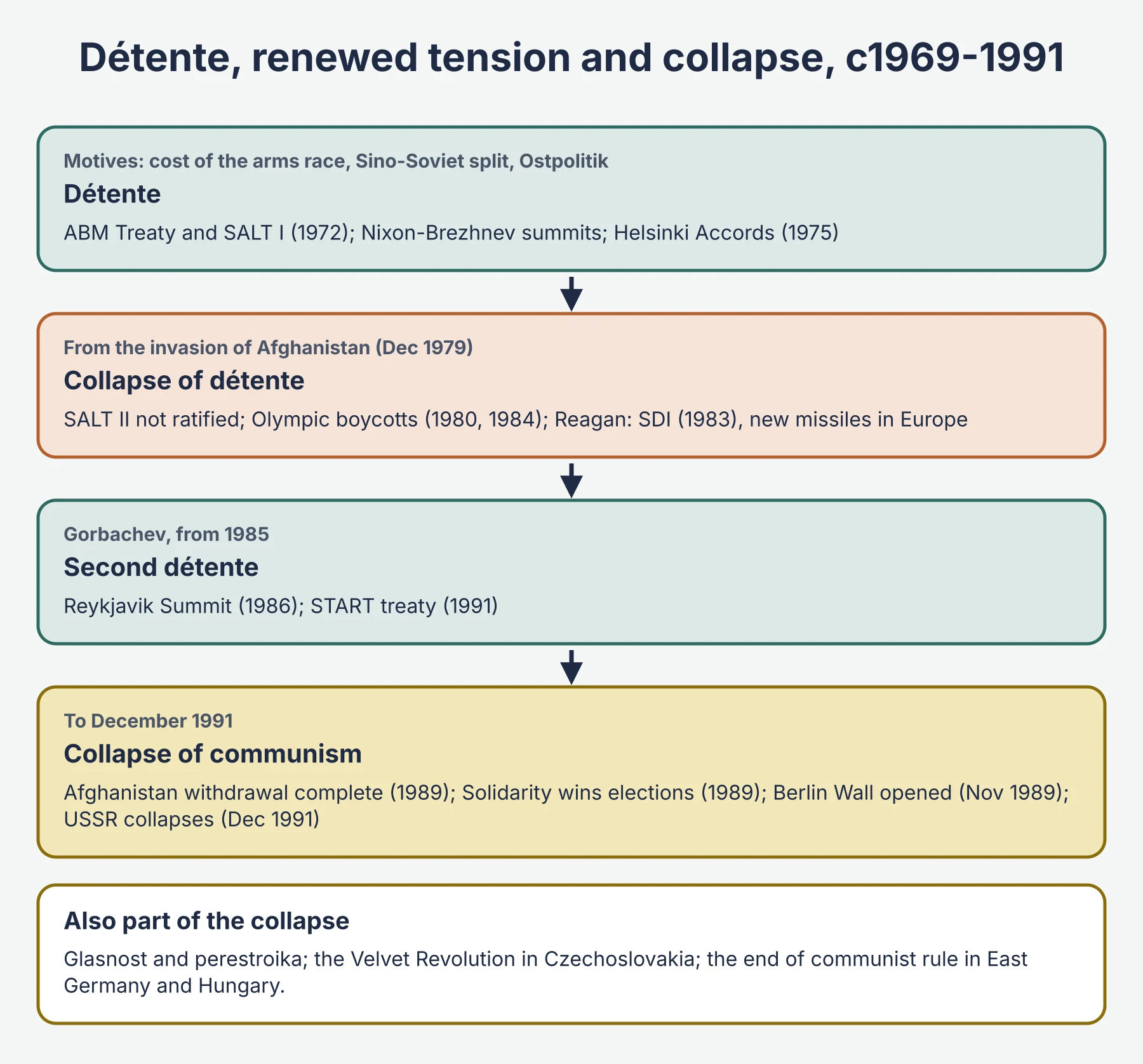
- Détente: motives included the cost of the arms race, the Sino-Soviet split and West German Ostpolitik; the Anti-Ballistic Missile Treaty and SALT I (1972); Nixon-Brezhnev summits; the Helsinki Accords (1975).
- Collapse of détente: the Soviet invasion of Afghanistan (December 1979); Carter’s response, including the failure of SALT II to be ratified; the US-led boycott of the 1980 Moscow Olympics and the Soviet boycott of 1984; Reagan’s renewed Cold War, the Strategic Defence Initiative (1983) and new missiles in Europe.
- Second détente: Gorbachev (from 1985), the Reykjavik Summit (1986), and the START treaty (1991).
- Collapse: the costly war in Afghanistan, with Soviet withdrawal completed in 1989; Solidarity in Poland under Lech Wałęsa (1980-81), suppressed by martial law, then winning elections in 1989; glasnost and perestroika; the opening of the Berlin Wall (November 1989); the Velvet Revolution in Czechoslovakia; the end of communist rule in East Germany and Hungary; the collapse of the USSR in December 1991.
Worked example: a 9-mark answer
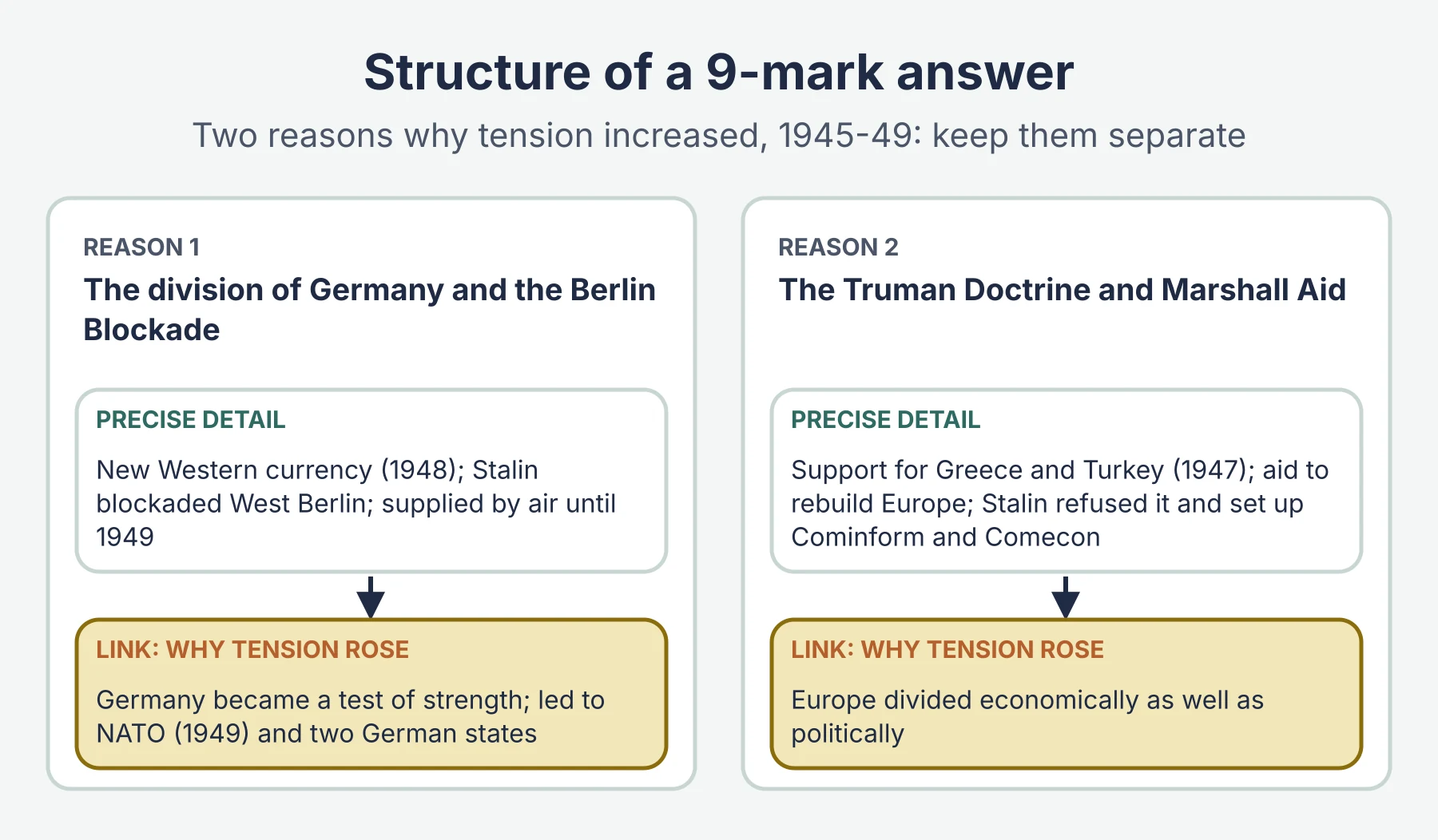
Question shape (original): Explain two reasons why tension between the USA and the USSR increased in the years 1945-49.
Reason one: the division of Germany and the Berlin Blockade. The zones agreed at Potsdam became the front line of the Cold War. In 1948 the Western powers introduced a new currency in their zones, and Stalin responded by blockading West Berlin. The USA and Britain supplied the city by air until the blockade was lifted in 1949, and the crisis increased tension because both sides now saw Germany as a test of strength; it led directly to the creation of NATO in 1949 and two separate German states.
Reason two: the Truman Doctrine and Marshall Aid. In 1947 Truman promised support to countries resisting communism, beginning with Greece and Turkey, and Marshall Aid offered money to rebuild Europe. Stalin saw the aid as an attempt to spread American influence, refused it for the Eastern bloc and set up Cominform and Comecon. Tension rose because Europe was now divided economically as well as politically.
Each reason is named, supported with precise detail and linked to why tension increased.
Worked example: planning a 12-mark answer
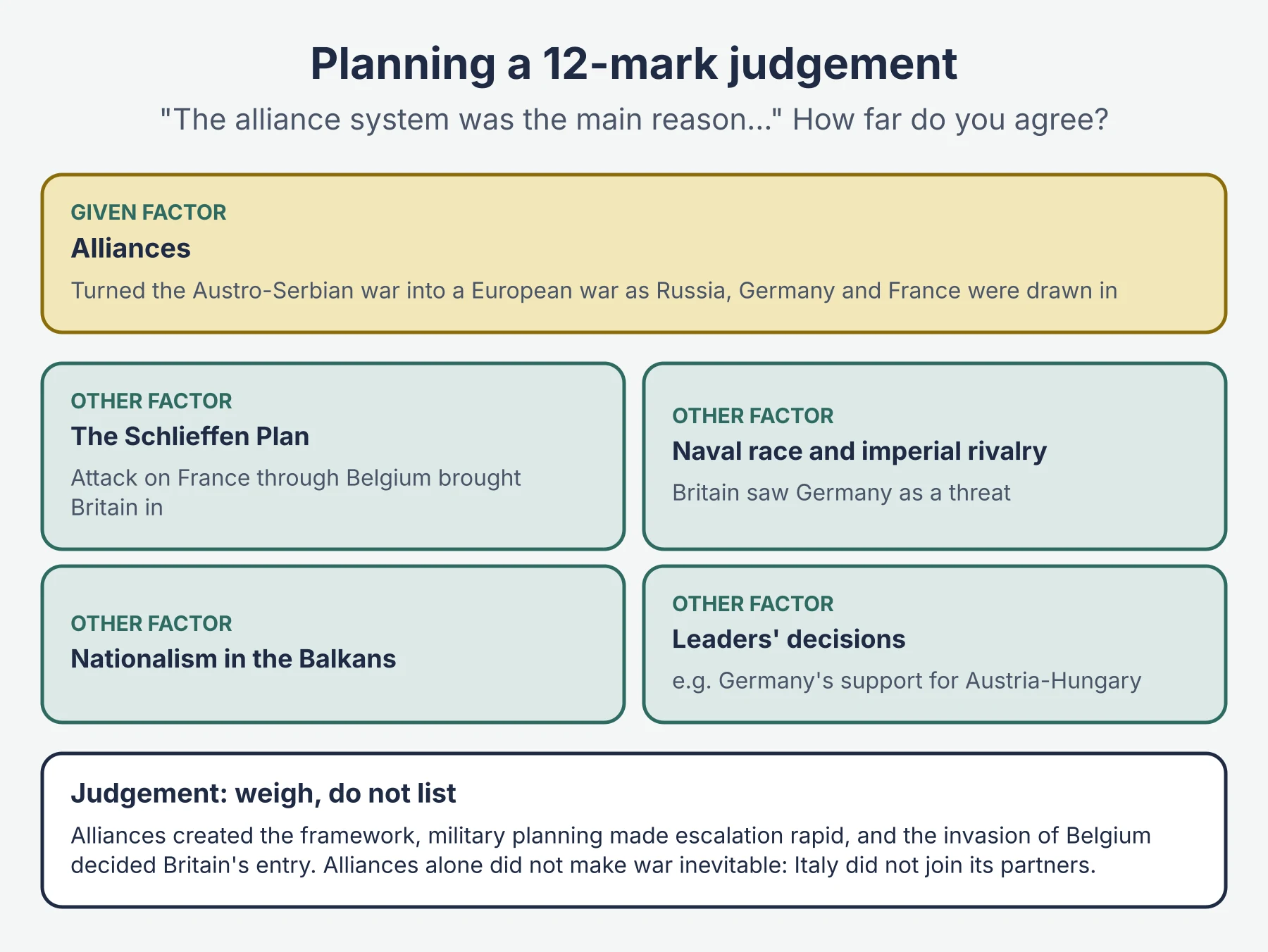
Question shape (original): “The alliance system was the main reason a regional conflict in the Balkans became a world war in 1914.” How far do you agree?
- Given factor: alliances turned the Austro-Serbian war into a European war as Russia, Germany and France were drawn in.
- Other factors: the Schlieffen Plan, which required an attack on France through Belgium and brought Britain in; the naval race and imperial rivalry, which made Britain see Germany as a threat; nationalism in the Balkans; decisions by leaders, such as Germany’s support for Austria-Hungary.
- Judgement: the alliances created the framework, but military planning made the escalation rapid, and the invasion of Belgium decided Britain’s entry; the alliances alone did not make war inevitable, since Italy did not join its partners in 1914.
Common mistakes
- 3-mark questions answered with explanation instead of three relevant points.
- Two reasons blended together in the 9-mark question; separate them clearly.
- Narrative: telling the story of events without explaining how they caused the development.
- 12-mark answers with no comparison: explain why one factor matters more than another.
- Vague detail: dates, names, treaties and figures turn description into evidence.
Exam technique
Section B is 30 marks, so allow about 50 minutes of the 1 hour 45 minute paper, with roughly 18 minutes for the 12-mark question. Plan the 12-mark answer before writing.
More resources on this topic
Specification
OxfordAQA International GCSE History (9245) specification, Version 1.1, sections 3.1.2 and 4.4.1 — oxfordaqa.com.
Related resources
-
Practice questions
OxfordAQA International GCSE History (9245): Paper 1 Section B, Knowledge-Based Depth Studies – Practice Questions
Twelve original 9245 Paper 1 Section B questions across all four depth-study options, from 3-mark knowledge to 12-mark judgements, with marking guides.
World History · OxfordAQA · IGCSE
Try questions -
Revision notes
OxfordAQA International GCSE History (9245): Paper 1 Section B, Knowledge-Based Depth Studies – Revision Notes
Recall notes for 9245 Paper 1 Section B: question types, timelines for all four depth-study options, key terms, exam traps and a twelve-question self-test.
World History · OxfordAQA · IGCSE
Revise topic -
Study guides
OxfordAQA International GCSE History (9245): Section A Question 4 – Using a Range of Sources
How to answer the 12-mark Question 4 in 9245 Paper 1 Section A: linking pre-released and unseen sources, weighing provenance and reaching a judgement.
World History · OxfordAQA · IGCSE
Read guide
Get free revision emails (optional)
Occasional emails with practice questions, worked explanations and links to free resources for the qualification and subjects you choose. No spam, and you can unsubscribe from any email. The free tools on this site never need an email.