
Revision Notes
OxfordAQA International GCSE History (9245): Paper 1 Section B, Knowledge-Based Depth Studies – Revision Notes
Recall notes for 9245 Paper 1 Section B: question types, timelines for all four depth-study options, key terms, exam traps and a twelve-question self-test.
- Subject
- World History
- Level
- IGCSE
- Topic
- Paper 1 – International Relations Depth Studies
- Author
- Marlbridge Academic Team
- Updated
- Reviewed by
- Azam Siddique (what this means)
Aligned to OxfordAQA IGCSE World History (9245), Version 1.1. Official specification .
Syllabus page (what it covers and how it is assessed): OxfordAQA IGCSE World History.
Syllabus points this page covers
9245
- 3.1.2 Section B
Found an error? Report a correction.
Need help with this topic? Request a free trial class for IGCSE World History (9245).
Condensed notes for the knowledge-based section of Paper 1. For explanations and worked answers, use the Paper 1 Section B study guide.
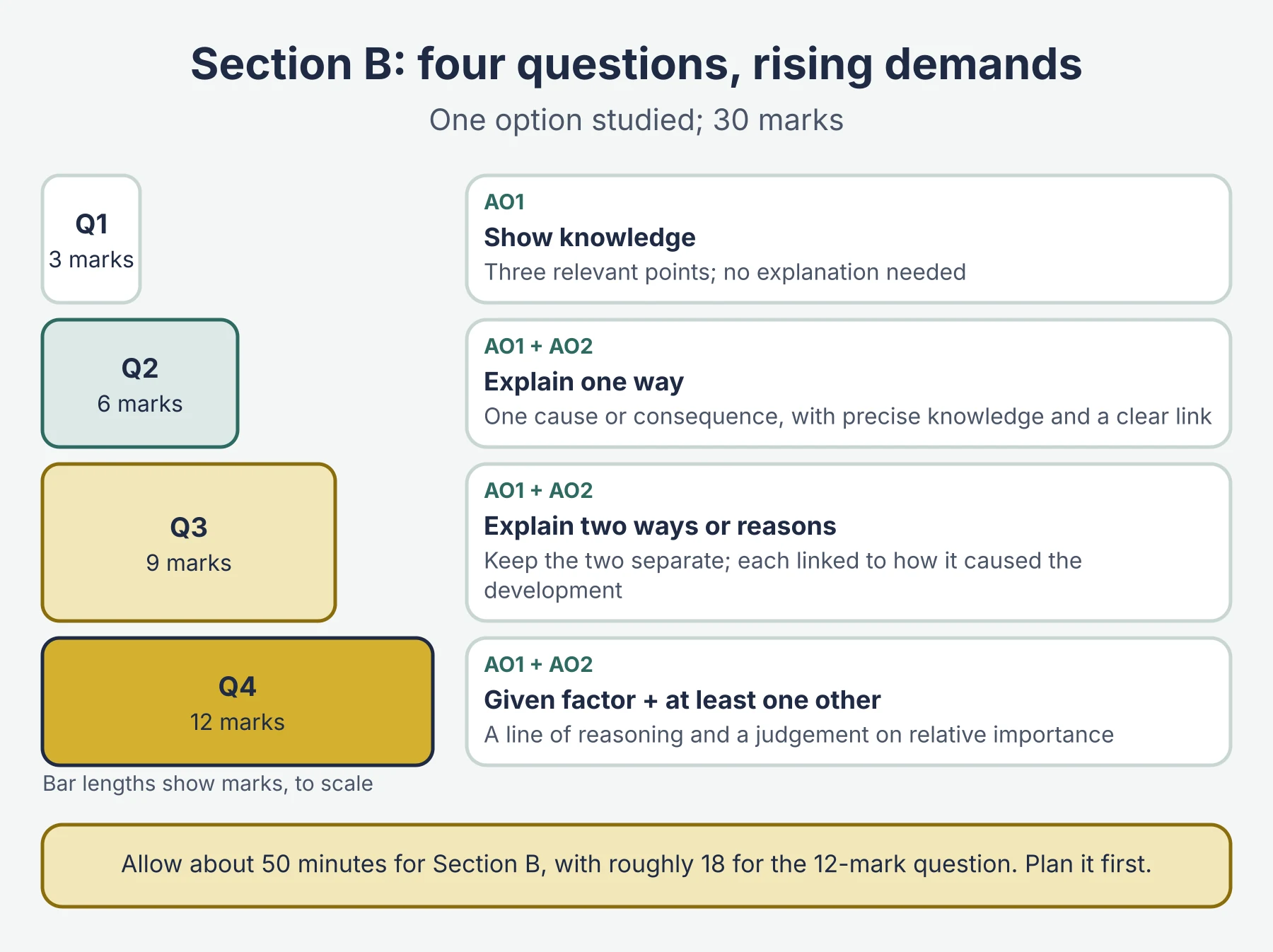
Section B in one box
- One option from four.
- Question 1 (3 marks, AO1): show knowledge.
- Question 2 (6 marks, AO1/AO2): explain one way an issue developed.
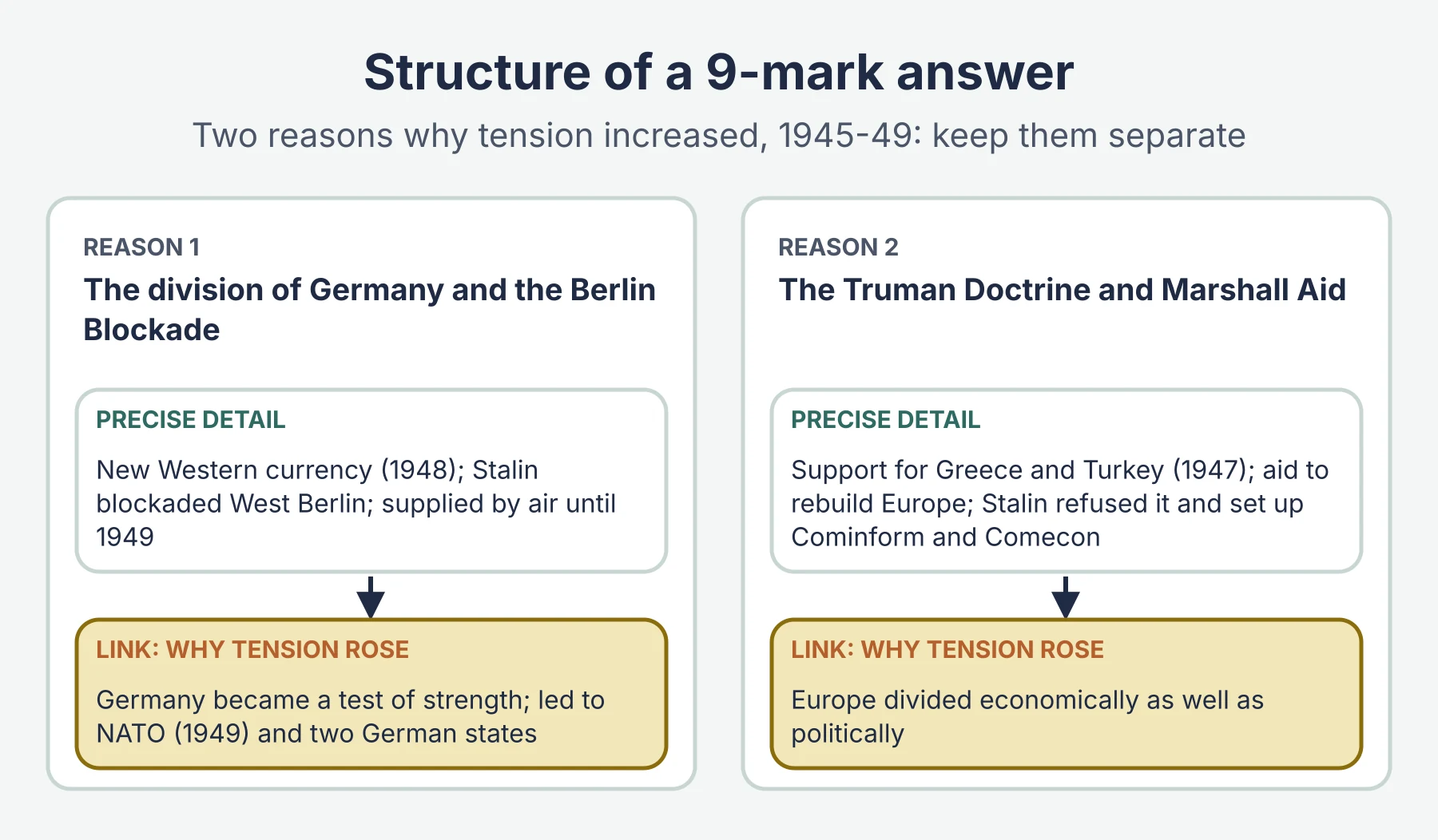
- Question 3 (9 marks, AO1/AO2): explain two ways or reasons.
- Question 4 (12 marks, AO1/AO2): a line of reasoning on a given factor and at least one other, ending in a judgement on relative importance.
Option 1: First World War origins, c1890-1915
| Date | Event |
|---|---|
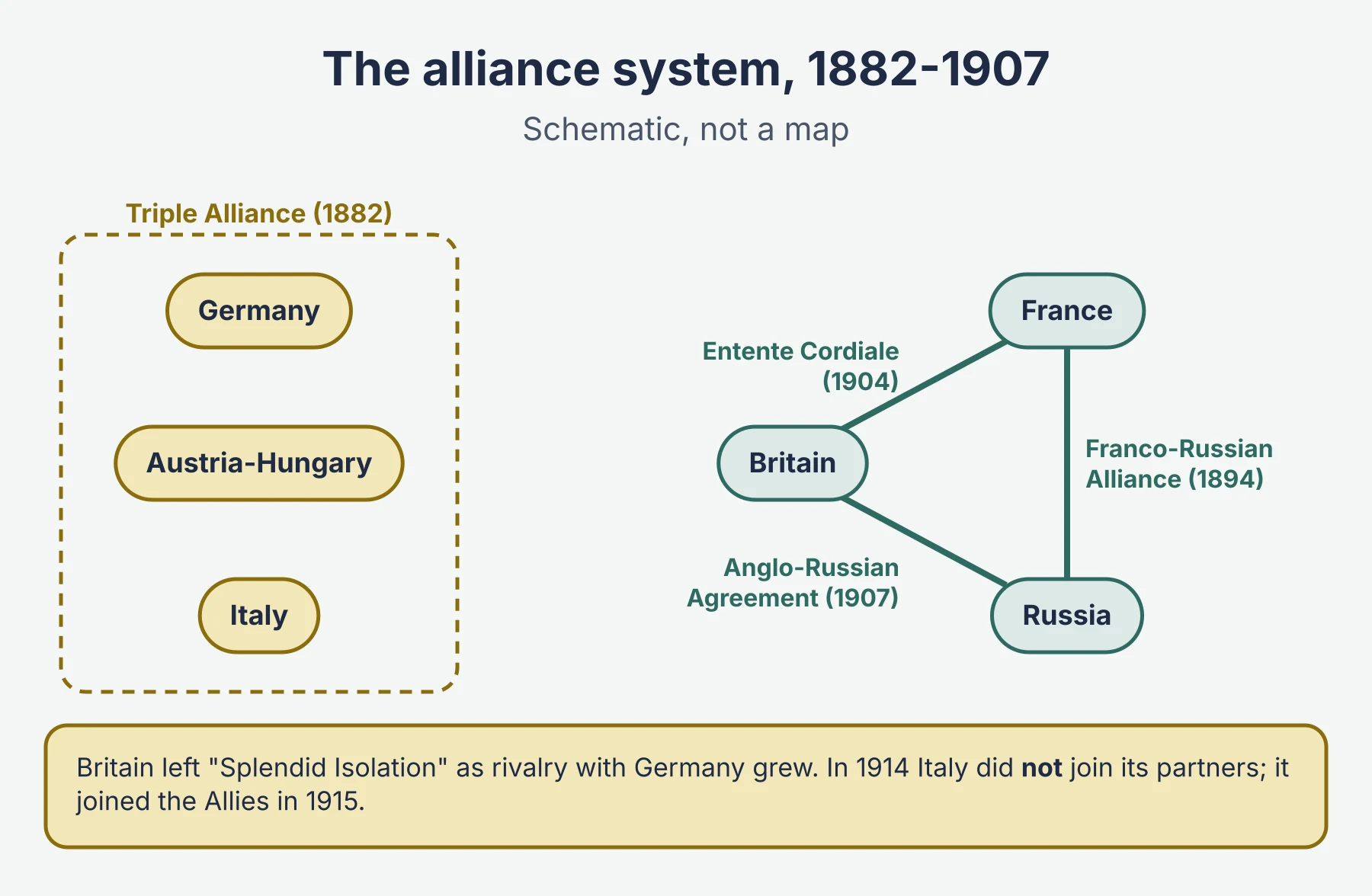
| 1882 | Triple Alliance: Germany, Austria-Hungary, Italy |
| 1894 | Franco-Russian Alliance |
| 1904 | Entente Cordiale: Britain and France |
| 1905-06 | First Moroccan Crisis |
| 1906 | HMS Dreadnought launched |
| 1907 | Anglo-Russian Agreement |
| 1908-09 | Bosnian Crisis |
| 1911 | Second Moroccan (Agadir) Crisis |
| 1912-13 | Balkan Wars |
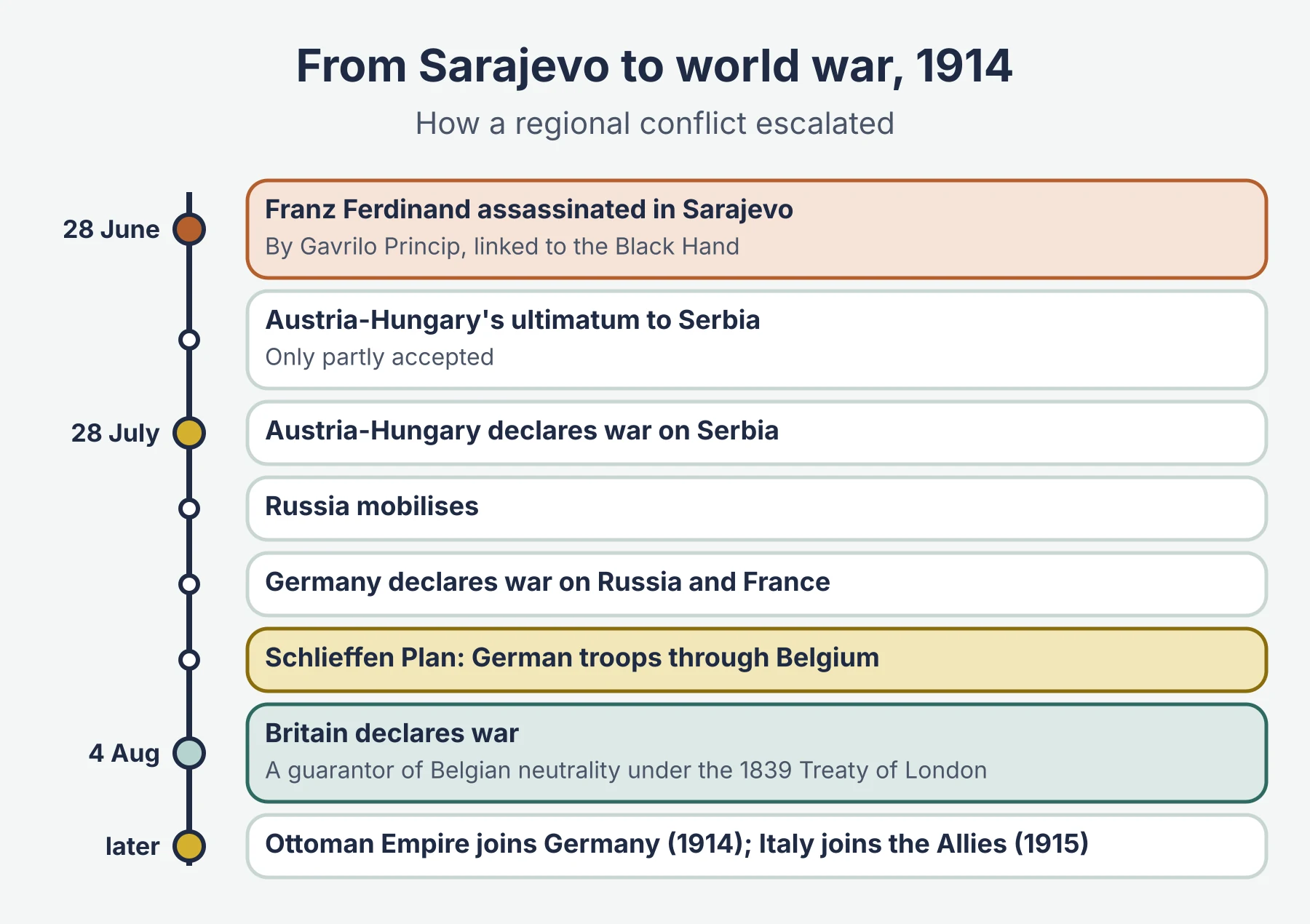
| 28 June 1914 | Assassination of Franz Ferdinand at Sarajevo |
| 28 July 1914 | Austria-Hungary declares war on Serbia |
| 4 August 1914 | Britain declares war after the invasion of Belgium |
| 1914-15 | Ottoman Empire joins Germany; Italy joins the Allies (1915) |
Option 2: Hitler’s foreign policy, 1933-1941
| Date | Event |
|---|---|
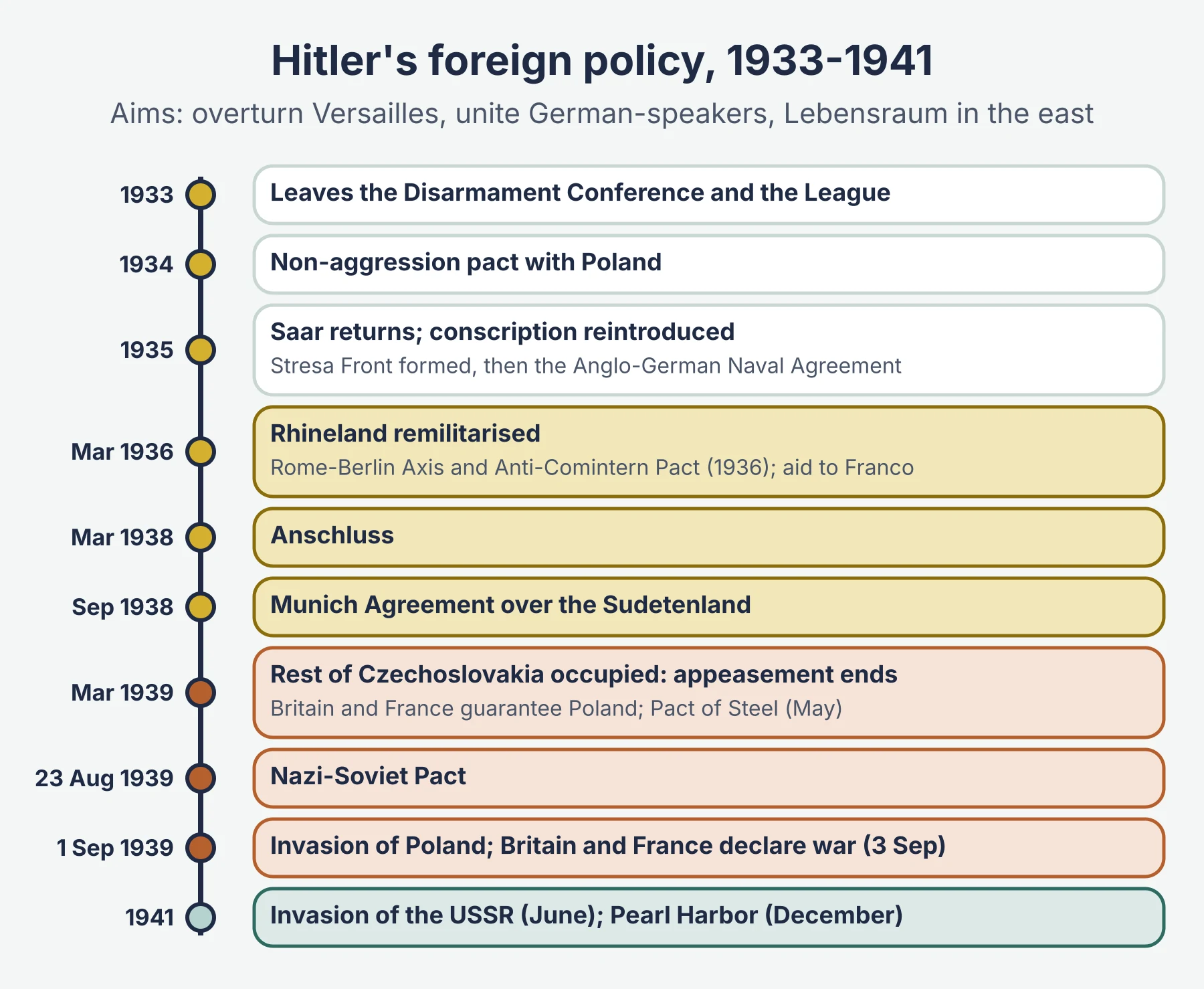
| 1933 | Germany leaves the Disarmament Conference and the League |
| 1934 | Non-aggression pact with Poland |
| 1935 | Saar plebiscite; conscription; Stresa Front; Anglo-German Naval Agreement |
| 1936 | Rhineland remilitarised; Rome-Berlin Axis; Anti-Comintern Pact; Spanish Civil War begins |
| 1938 | Anschluss (March); Munich Agreement (September) |
| 1939 | Rest of Czechoslovakia occupied (March); guarantee to Poland; Pact of Steel; Nazi-Soviet Pact; invasion of Poland; war |
| 1941 | Invasion of the USSR (June); Pearl Harbor (December) |
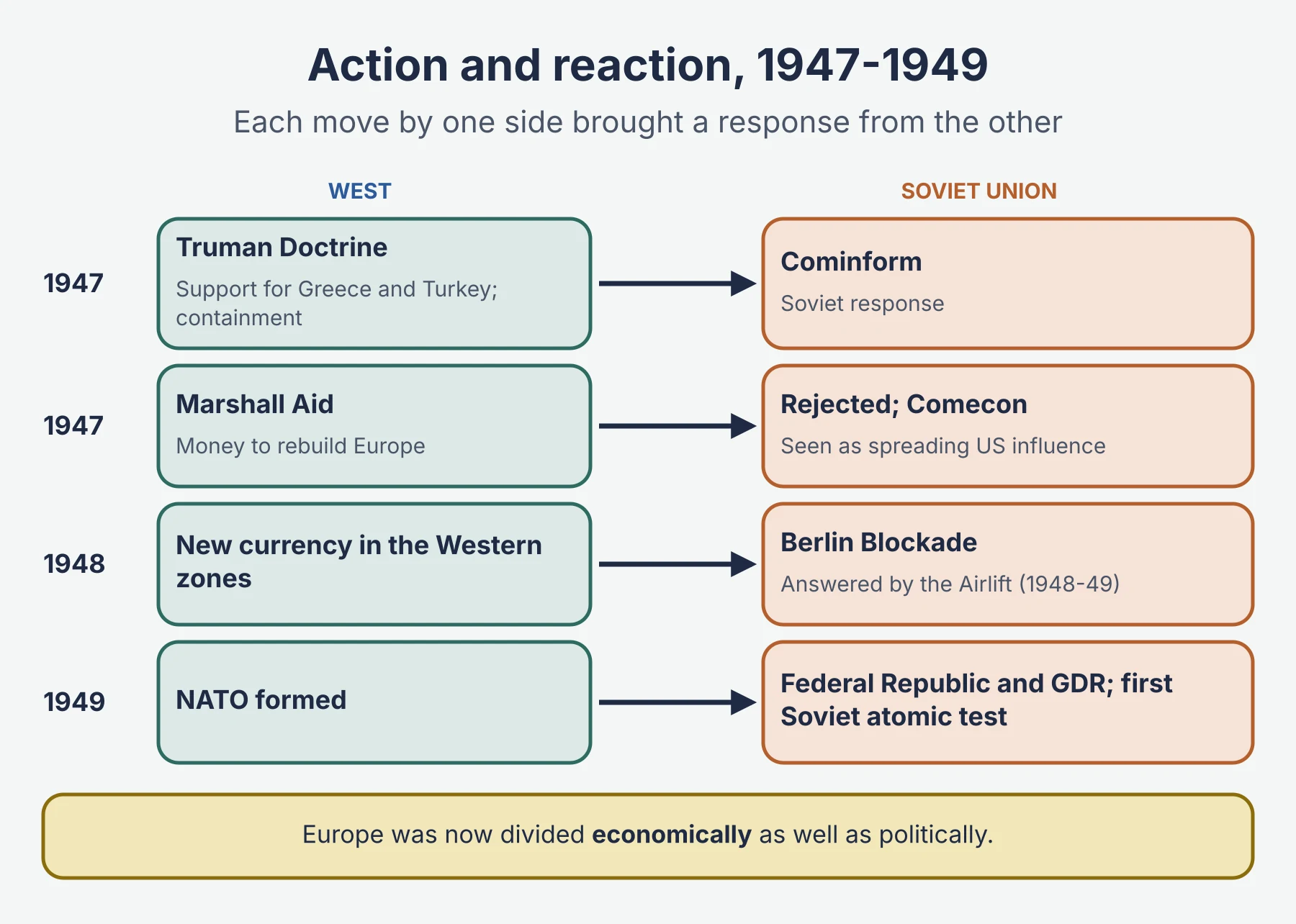
Option 3: Cold War, 1945-1960
| Date | Event |
|---|---|
| 1945 | Yalta; Potsdam; Hiroshima and Nagasaki |
| 1947 | Truman Doctrine; Marshall Plan; Cominform |
| 1948 | Communist takeover in Czechoslovakia; Tito-Stalin split; Berlin Blockade begins |
| 1949 | Airlift ends blockade; NATO; FRG and GDR; Soviet atomic bomb; Comecon; communist China |
| 1950-53 | Korean War |
| 1953 | Death of Stalin |
| 1954 | Geneva Agreement on Vietnam |
| 1955 | Warsaw Pact; Austrian neutrality |
| 1956 | Hungarian rising crushed |
| 1957 | Sputnik 1 |
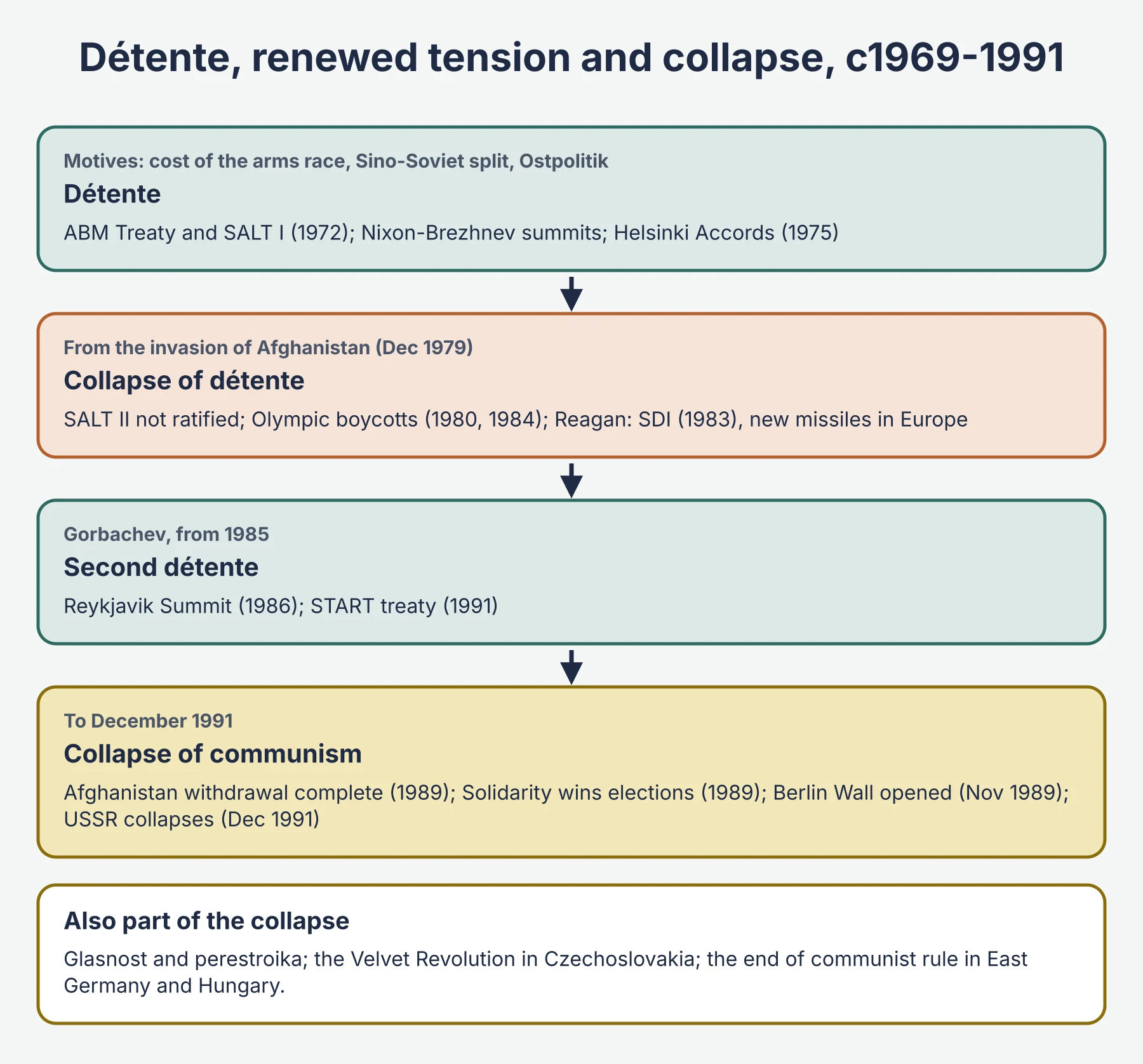
Option 4: Détente and the collapse of communism, c1969-1991
| Date | Event |
|---|---|
| 1972 | SALT I and the ABM Treaty; Nixon-Brezhnev summit in Moscow |
| 1975 | Helsinki Accords |
| 1979 | Soviet invasion of Afghanistan; SALT II signed but not ratified by the USA |
| 1980 | Moscow Olympics boycott; Solidarity formed in Poland |
| 1981 | Martial law in Poland |
| 1983 | Strategic Defence Initiative announced |
| 1984 | Soviet boycott of the Los Angeles Olympics |
| 1985 | Gorbachev becomes Soviet leader |
| 1986 | Reykjavik Summit |
| 1989 | Soviet withdrawal from Afghanistan; Solidarity wins Polish elections; Berlin Wall opened; Velvet Revolution |
| 1991 | START treaty; collapse of the USSR (December) |
Key terms
| Term | Meaning |
|---|---|
| Weltpolitik | Wilhelm II’s policy of making Germany a world power |
| Schlieffen Plan | German plan to defeat France quickly through Belgium before turning on Russia |
| Lebensraum | “Living space” for Germans in eastern Europe |
| Appeasement | Avoiding war by meeting reasonable-seeming demands |
| Containment | US policy of stopping the spread of communism |
| Iron Curtain | The division between Soviet-controlled Eastern Europe and the West |
| Peaceful co-existence | Khrushchev’s idea that East and West could compete without war |
| Détente | Easing of tension between the superpowers |
| Glasnost | Gorbachev’s policy of openness |
| Perestroika | Gorbachev’s policy of economic restructuring |
Answer frames
- 3 marks: three precise, relevant points; no explanation needed.
- 6 marks: name the way, give precise knowledge, explain how it changed the situation, and extend with a second detail.
- 9 marks: two clearly separated reasons, each with precise knowledge and an explained link.
- 12 marks: given factor, at least one other, comparison throughout, a judgement that says why one mattered more.
Exam traps
- Explaining in the 3-mark question instead of giving points.
- One reason given twice in different words in the 9-mark question.
- Narrative of events with no causal link.
- No comparison or judgement in the 12-mark question.
- Confusing dates or sequence, such as the Anschluss and Munich, or SALT I and SALT II.
Self-test
- Which countries formed the Triple Alliance?
- Why did the Schlieffen Plan bring Britain into the war?
- What was the Black Hand?
- Give three steps Hitler took in 1935.
- Why did the occupation of Prague in March 1939 end appeasement?
- What did the Nazi-Soviet Pact mean for Hitler’s plans in 1939?
- What was the purpose of the Marshall Plan, and how did Stalin respond?
- Why did the Berlin Blockade increase tension?
- Why did the USSR invade Hungary in 1956?
- Give two agreements of the first period of détente.
- Give two reasons why détente collapsed after 1979.
- Give two reasons for the collapse of Soviet control in Eastern Europe in 1989.
Answers
- Germany, Austria-Hungary and Italy.
- It sent German troops through Belgium, whose neutrality Britain had guaranteed.
- A secret Serbian nationalist society linked to the assassination at Sarajevo.
- Any three: the Saar returned after a plebiscite; conscription reintroduced; the Anglo-German Naval Agreement signed; rearmament announced openly.
- It showed Hitler’s aims went beyond German-speaking lands, so his promises could not be trusted.
- It removed the danger of a war on two fronts, so he could invade Poland.
- To rebuild Europe’s economies and limit communism; Stalin refused aid for the Eastern bloc and set up Cominform and Comecon.
- It was a direct test of strength over Germany, leading to NATO and two German states.
- Nagy’s government announced it would leave the Warsaw Pact, threatening Soviet control.
- Any two: the ABM Treaty; SALT I; the Helsinki Accords.
- Any two: the Soviet invasion of Afghanistan; the failure to ratify SALT II; the Olympic boycotts; Reagan’s renewed arms race and SDI.
- Any two: Gorbachev’s refusal to use force; economic weakness; the success of Solidarity; glasnost encouraging criticism; mass protest movements.
Practise every question type in the Paper 1 Section B practice questions, then return to the Section A revision notes for source skills.
Related resources
-
Study guides
OxfordAQA International GCSE History (9245): Section A Question 4 – Using a Range of Sources
How to answer the 12-mark Question 4 in 9245 Paper 1 Section A: linking pre-released and unseen sources, weighing provenance and reaching a judgement.
World History · OxfordAQA · IGCSE
Read guide -
Practice questions
OxfordAQA International GCSE History (9245): Section A Question 4 – Using a Range of Sources – Practice Questions
Two original five-source sets for 9245 Paper 1 Section A, on Versailles and Berlin 1960-63, with sorting tasks, 12-mark Question 4 essays and marking guides.
World History · OxfordAQA · IGCSE
Try questions -
Revision notes
OxfordAQA International GCSE History (9245): Section A Question 4 – Using a Range of Sources – Revision Notes
Revision notes for 9245 Paper 1 Section A Question 4: the sorting grid, five ways to link sources, weighing provenance, timing, traps and a self-test.
World History · OxfordAQA · IGCSE
Revise topic
Get free revision emails (optional)
Occasional emails with practice questions, worked explanations and links to free resources for the qualification and subjects you choose. No spam, and you can unsubscribe from any email. The free tools on this site never need an email.