
Study Guides
OxfordAQA International GCSE History (9245): Section A Question 4 – Using a Range of Sources
How to answer the 12-mark Question 4 in 9245 Paper 1 Section A: linking pre-released and unseen sources, weighing provenance and reaching a judgement.
- Subject
- World History
- Level
- IGCSE
- Topic
- Paper 1 – International Relations Depth Studies
- Author
- Marlbridge Academic Team
- Updated
- Reviewed by
- Azam Siddique (what this means)
Aligned to OxfordAQA IGCSE World History (9245), Version 1.1. Official specification .
Syllabus page (what it covers and how it is assessed): OxfordAQA IGCSE World History.
Syllabus points this page covers
9245
- 3.1.1 Section A
Found an error? Report a correction.
Need help with this topic? Request a free trial class for IGCSE World History (9245).
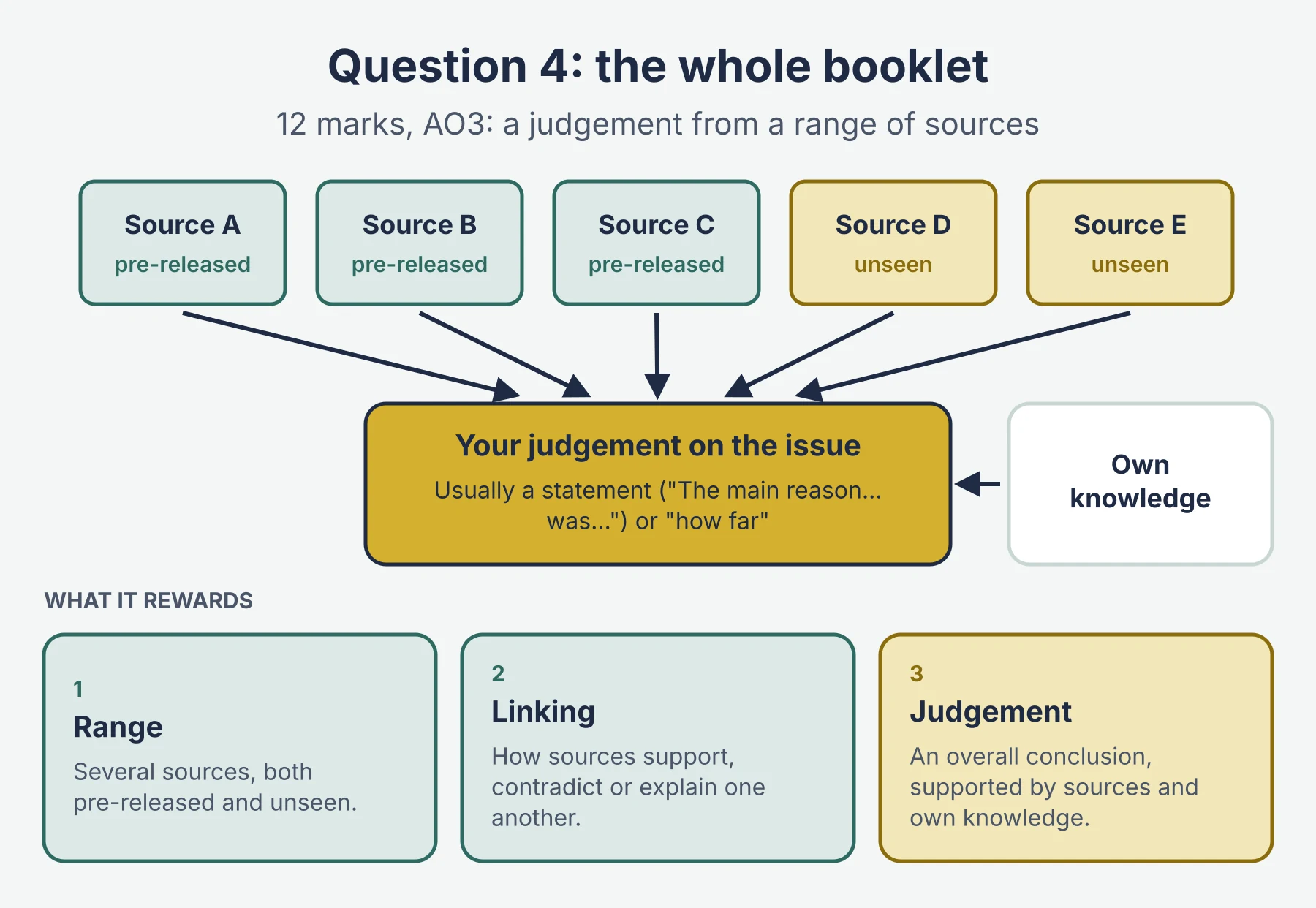
This guide covers the highest-tariff question in Paper 1 Section A of OxfordAQA International GCSE History (9245). The specification states that Question 4 “tests AO3 and is worth 12 marks. It requires students to analyse and evaluate a given issue or development using evidence from a range of the sources (both unseen and in the pre-release pack) and their own knowledge. Students should aim to use and link together a range sources to support their reasoning.” The Paper 1 Section A study guide describes all four source questions in a few lines each; this page takes Question 4 apart, with a planning method and a full worked answer.
What makes Question 4 different
Questions 1-3 each focus on one or two named sources. Question 4 asks you to use the whole source booklet, five sources in all, to reach a judgement about an issue, usually framed as a statement (“The main reason… was…”) or a “how far” question. It rewards three things that the earlier questions only touch on:
- Range: using several sources, both pre-released and unseen, rather than one or two.
- Linking: showing how sources support, contradict or explain one another.
- Judgement: an overall conclusion on the issue, supported by the sources and your own knowledge.
The question can target Part 1 or Part 2 of your option’s content, so it may draw on sources you have studied for weeks alongside two you meet for the first time in the exam.
Preparing the pre-release for Question 4
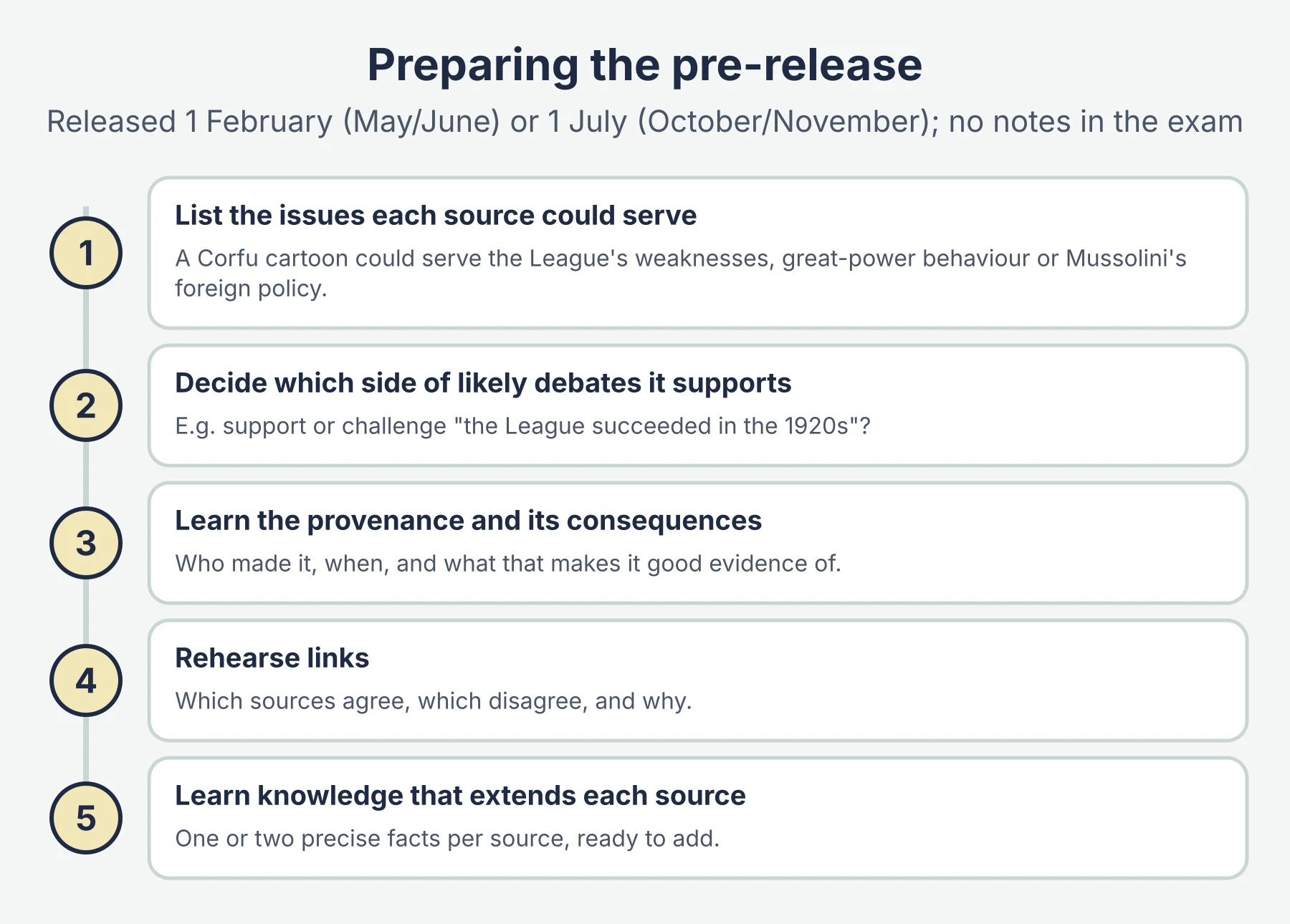
The three pre-released sources arrive on 1 February for the May/June series and 1 July for October/November. You may not take notes into the exam, so preparation means knowing the sources well enough to use them quickly.
- List the issues each source could serve. A cartoon about the Corfu crisis could be used for the League’s weaknesses, the behaviour of great powers, or Mussolini’s foreign policy.
- Decide which side of likely debates each source supports. For example, would it support or challenge the view that the League succeeded in the 1920s?
- Learn the provenance and its consequences. Who made it, when, and what that makes it good evidence of.
- Rehearse links. Which pre-released source agrees with which? Where do they disagree, and why?
- Learn knowledge that extends each source. One or two precise facts per source, ready to add.
A four-step method in the exam
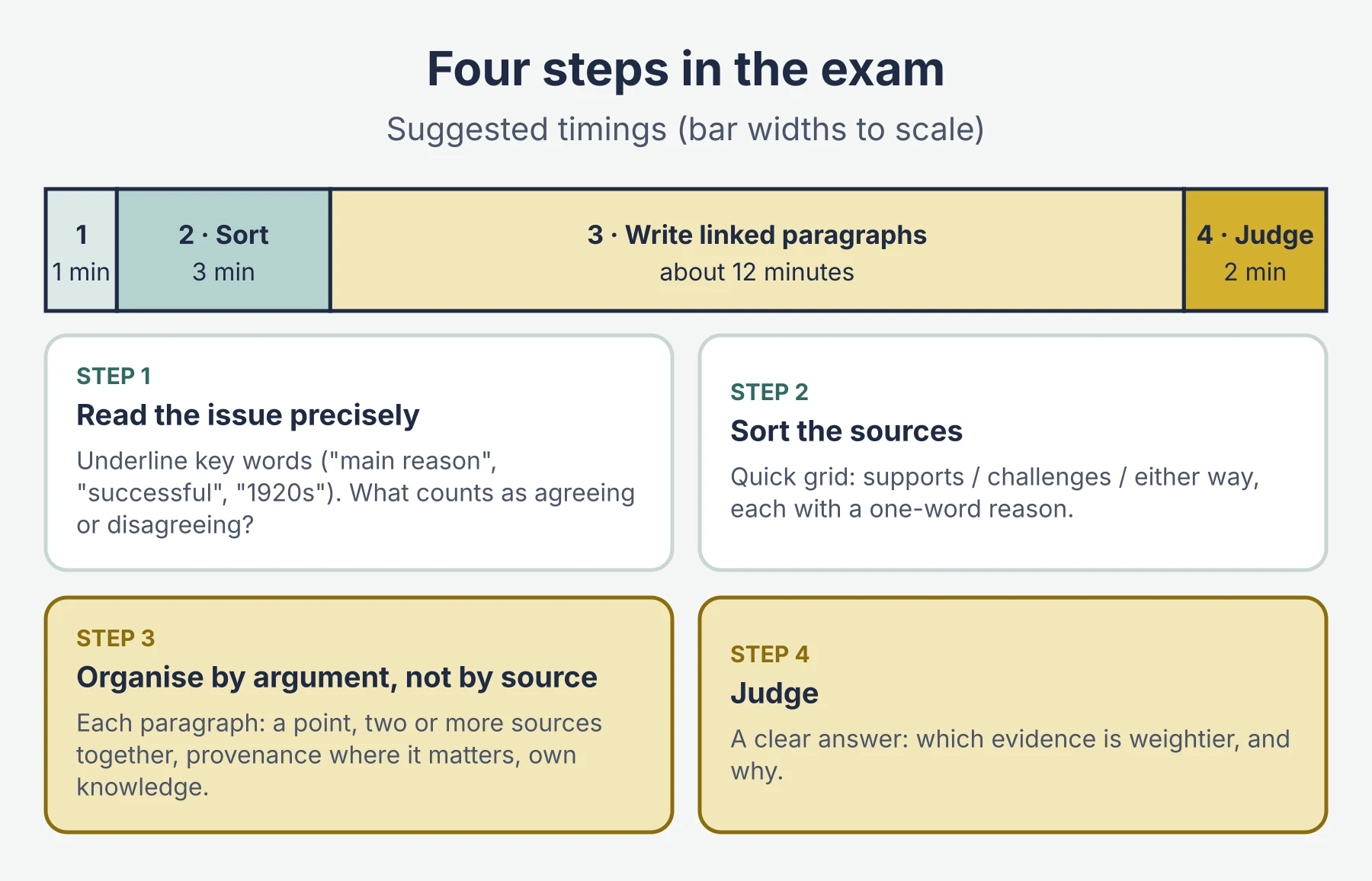
Step 1: read the issue precisely (about 1 minute). Underline the key words: “main reason”, “successful”, “1920s”, “the USA”. Decide what would count as agreeing and disagreeing.
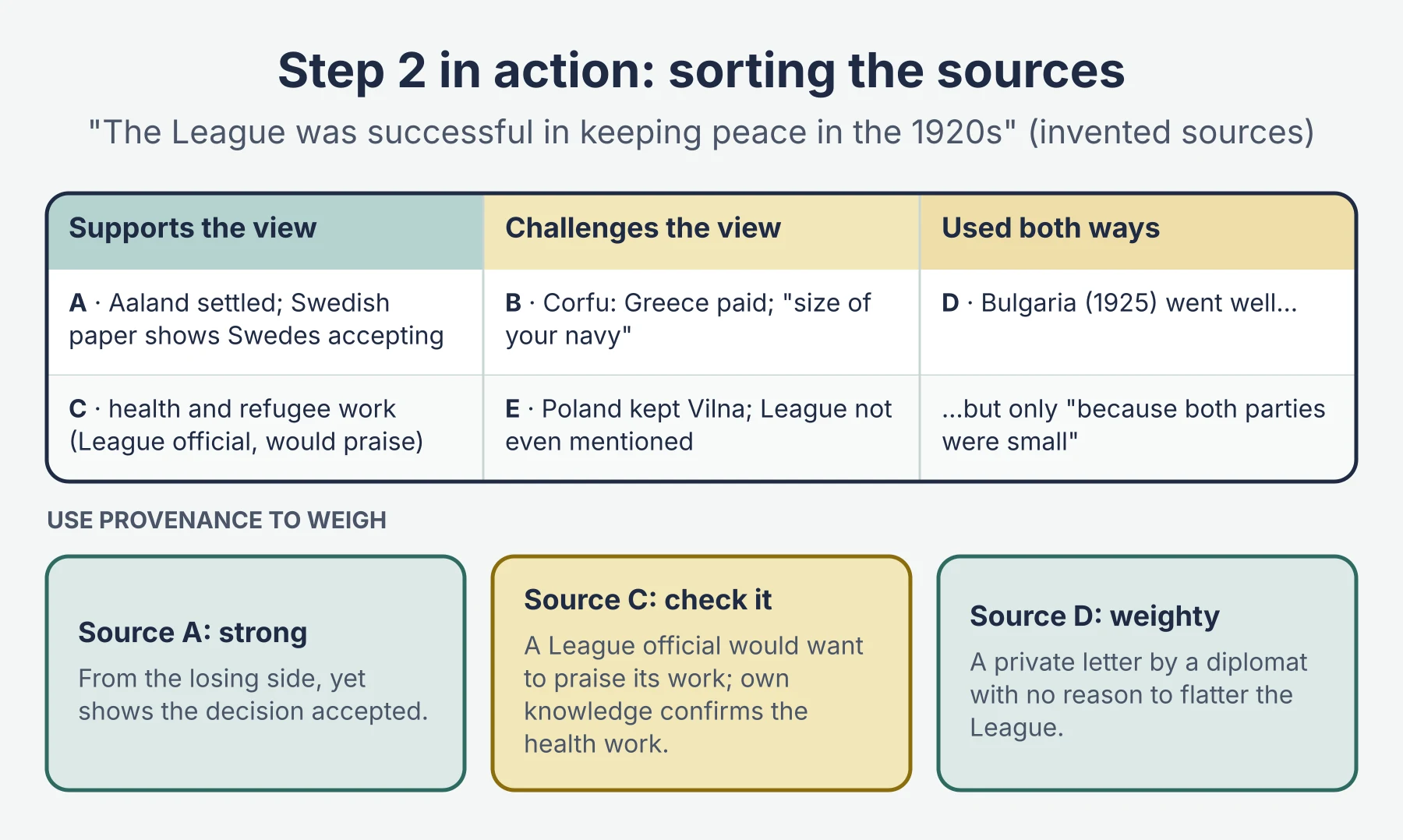
Step 2: sort the sources (about 3 minutes). Draw a quick grid on your answer paper or question paper.
| Supports the view | Challenges the view | Could be used either way |
|---|---|---|
| Source letters with a one-word reason | Source letters with a one-word reason | Source letters and how |
Most booklets include at least one source on each side, and one that can be used both ways depending on how you read its provenance.
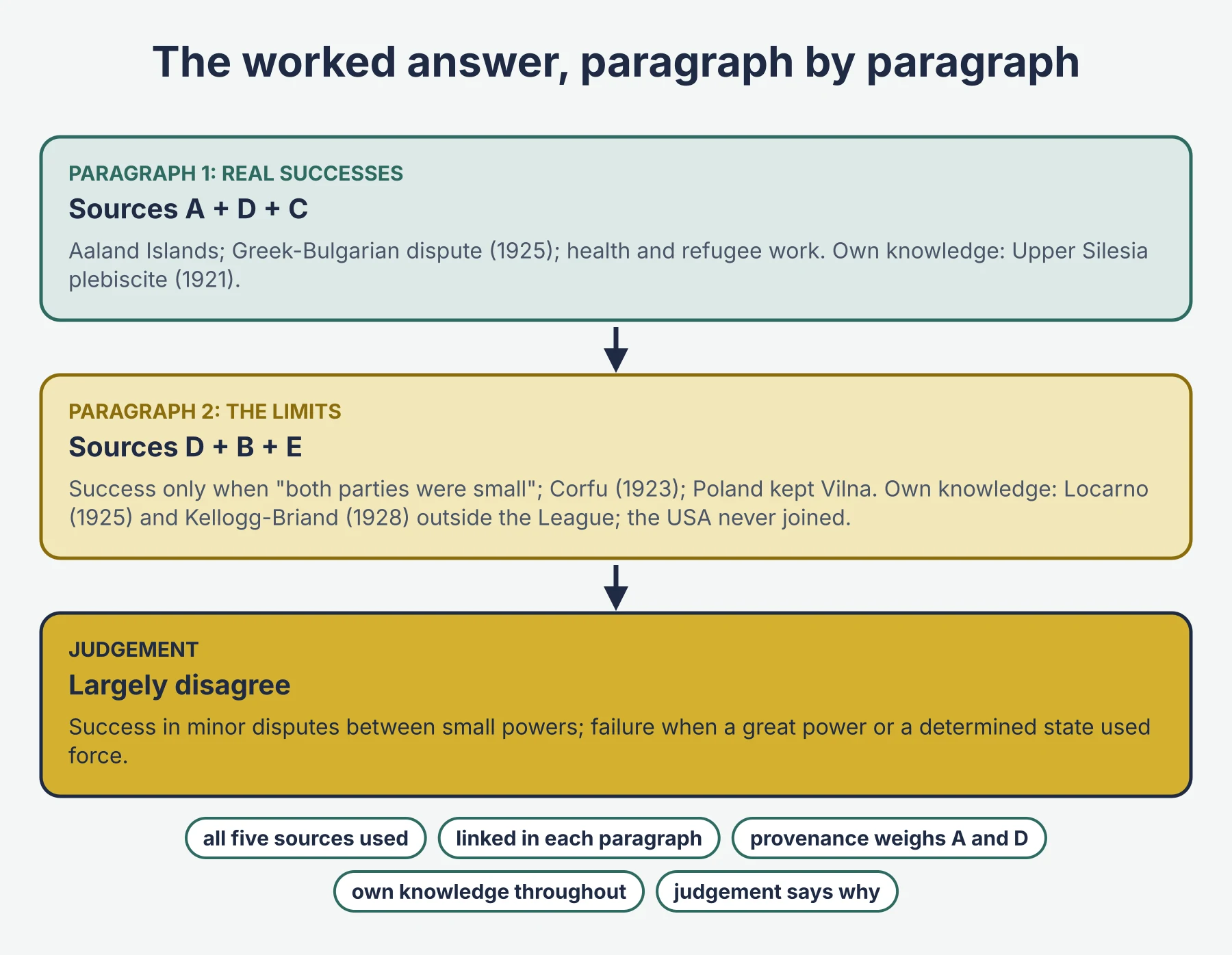
Step 3: write in linked paragraphs (about 12 minutes). Organise by argument, not by source. Each paragraph should make a point about the issue, use two or more sources together, evaluate them using provenance where it matters, and add own knowledge.
Step 4: judge (about 2 minutes). Finish with a clear answer to the question, explaining which evidence is weightier and why.
Ways of linking sources
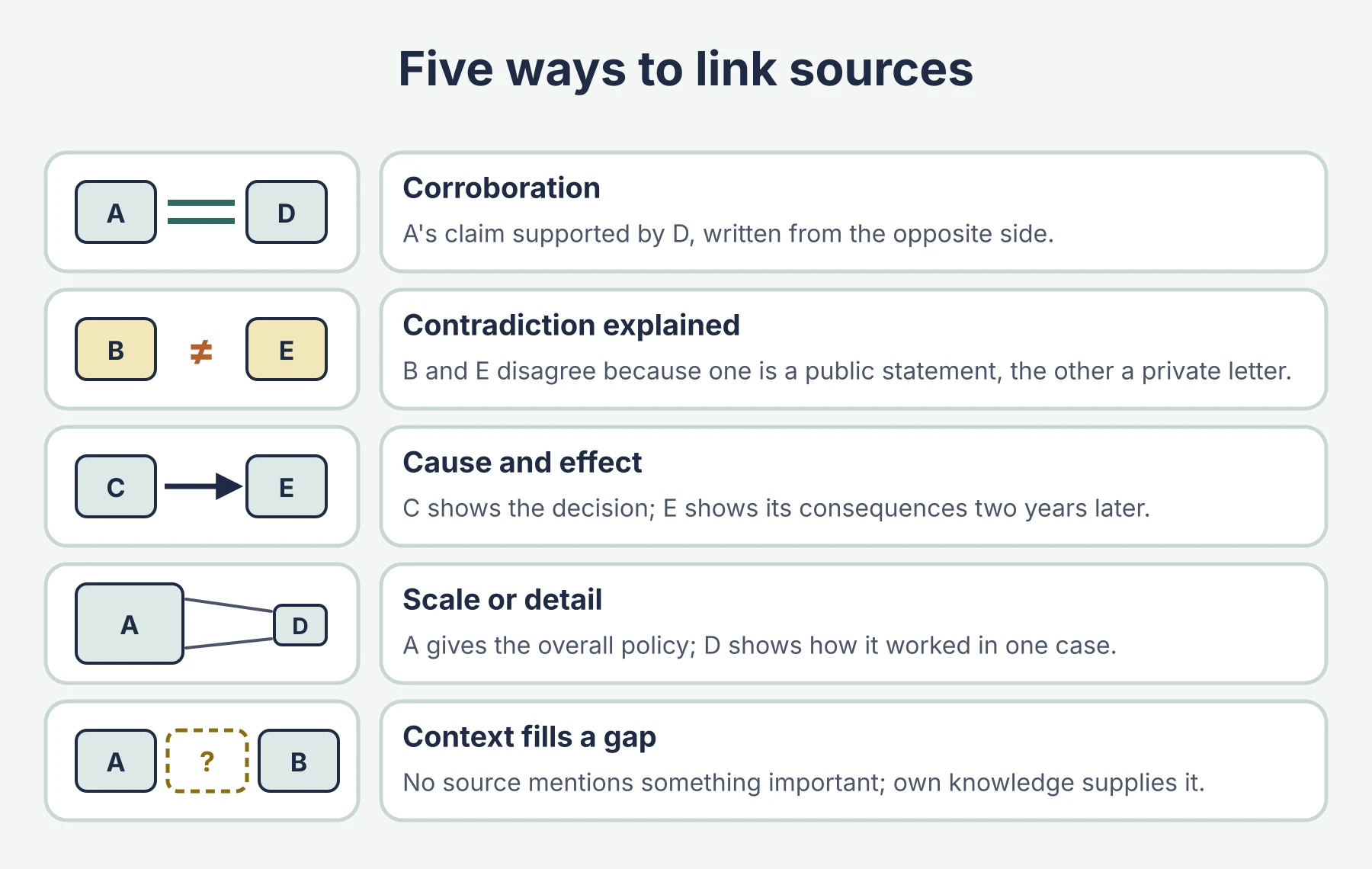
| Link | What it looks like |
|---|---|
| Corroboration | “Source A’s claim is supported by Source D, written from the opposite side, which makes the point stronger.” |
| Contradiction explained | “B and E disagree because B is a government statement for the public while E is a private letter.” |
| Cause and effect | “Source C shows the decision; Source E shows its consequences two years later.” |
| Scale or detail | “Source A gives the overall policy; Source D shows how it worked in one case.” |
| Context fills a gap | “None of the sources mentions the USA’s absence from the League, but my knowledge shows…” |
Using provenance to weigh sources
In Question 4 provenance helps you decide how much weight a source can bear. A speech by a League official claiming success is evidence of how the League presented itself; a confidential report showing doubts carries more weight on what officials really believed. You do not need to discuss every source’s provenance; use it where it changes your argument.
Worked example: Peacemaking and the League of Nations
The five sources below are invented for this guide. A, B and C stand for a pre-release booklet; D and E stand for unseen sources.
Source A – A description of a cartoon imagined as published in a Swedish newspaper in 1921: a League official hands a small island labelled “Aaland” to a Finnish figure while a Swedish figure shakes his hand.
Source B – From a speech imagined as given by a Greek politician in 1923: “When Italy bombarded Corfu, the League spoke and the Ambassadors decided. Greece paid. Justice in Geneva depends on the size of your navy.”
Source C – From a report imagined as written by a League health official in 1927: “Our commissions have fought typhus in eastern Europe and returned prisoners of war to their homes. Governments that will not talk to one another will talk to us.”
Source D – From a letter imagined as written by a British diplomat in 1925: “The Bulgarian affair went well because both parties were small and the great powers agreed. I doubt it would have ended so neatly had a great power been involved.”
Source E – A description of a poster imagined as issued in Poland in 1922 celebrating Polish rule in Vilna, with no mention of the League.
“The League of Nations was successful in keeping peace in the 1920s.” Using the sources and your own knowledge, how far do you agree? [12]
The League did have real successes in the 1920s. Source A shows the Aaland Islands dispute settled peacefully, and the fact that it comes from a Swedish newspaper, the side that lost the islands, yet shows Swedes accepting the decision, makes it strong evidence that the League’s judgement was respected. Source D adds the Greek-Bulgarian dispute of 1925, when the League made Greece withdraw its troops. My knowledge adds the division of Upper Silesia after a plebiscite in 1921. Source C shows that the League’s agencies helped peace in a wider sense, returning prisoners of war and fighting disease; although it is written by a League official who would want to praise its work, the refugee and health work of the 1920s is well documented.
However, the sources also show the limits of this success. Source D, a private letter by a diplomat who had no reason to flatter the League, suggests that Bulgaria worked only because “both parties were small”. Source B confirms this from the other side: in the Corfu crisis of 1923 Mussolini ignored the League, and the Conference of Ambassadors made Greece pay compensation. Source E shows that Poland kept Vilna after seizing it in 1920, and its silence about the League suggests the League was irrelevant to the outcome. My knowledge adds that major agreements such as Locarno (1925) and the Kellogg-Briand Pact (1928) were made outside the League, and that the USA never joined.
Overall, I largely disagree. Sources A, C and D show the League was successful when small powers were involved and the great powers agreed, but Sources B, D and E together show that when a great power or a determined state used force, the League could not stop it. Its 1920s record suggests success in minor disputes rather than in keeping peace among the powers that mattered most.
The answer uses all five sources, links them in each paragraph, uses provenance to weigh A and D, adds own knowledge, and reaches a judgement that explains why one side is stronger.
Common mistakes
- Working through Sources A to E one at a time, with no argument connecting them.
- Using only the pre-released sources, which you know best, and ignoring the unseen ones.
- Copying long quotations instead of using short phrases as evidence.
- Treating own knowledge as an add-on paragraph at the end instead of using it to test each source.
- A judgement that simply repeats “it depends”, without saying on what.
- Spending so long on Questions 1-3 that Question 4 gets less than fifteen minutes.
Further practice
Specification
OxfordAQA International GCSE History (9245) specification, Version 1.1, sections 3.1.1 and 4.4.1 – oxfordaqa.com.
Related resources
-
Practice questions
OxfordAQA International GCSE History (9245): Section A Question 4 – Using a Range of Sources – Practice Questions
Two original five-source sets for 9245 Paper 1 Section A, on Versailles and Berlin 1960-63, with sorting tasks, 12-mark Question 4 essays and marking guides.
World History · OxfordAQA · IGCSE
Try questions -
Revision notes
OxfordAQA International GCSE History (9245): Section A Question 4 – Using a Range of Sources – Revision Notes
Revision notes for 9245 Paper 1 Section A Question 4: the sorting grid, five ways to link sources, weighing provenance, timing, traps and a self-test.
World History · OxfordAQA · IGCSE
Revise topic -
Study guides
OxfordAQA International GCSE History (9245): The 12-Mark Judgement Question
How to write the 12-mark Question 4 in 9245 Paper 1 Section B: a line of reasoning, linked factors and a judgement on relative importance, with two plans.
World History · OxfordAQA · IGCSE
Read guide
Get free revision emails (optional)
Occasional emails with practice questions, worked explanations and links to free resources for the qualification and subjects you choose. No spam, and you can unsubscribe from any email. The free tools on this site never need an email.