
Study Guides
OxfordAQA International GCSE History (9245): The 12-Mark Judgement Question
How to write the 12-mark Question 4 in 9245 Paper 1 Section B: a line of reasoning, linked factors and a judgement on relative importance, with two plans.
- Subject
- World History
- Level
- IGCSE
- Topic
- Paper 1 – International Relations Depth Studies
- Author
- Marlbridge Academic Team
- Updated
- Reviewed by
- Azam Siddique (what this means)
Aligned to OxfordAQA IGCSE World History (9245), Version 1.1. Official specification .
Syllabus page (what it covers and how it is assessed): OxfordAQA IGCSE World History.
Syllabus points this page covers
9245
- 3.1.2 Section B
Found an error? Report a correction.
Need help with this topic? Request a free trial class for IGCSE World History (9245).
This guide covers the extended-response question that ends Paper 1 Section B in OxfordAQA International GCSE History (9245). The specification says Question 4 “tests AO1 and AO2 and is worth 12 marks. It requires students to construct an extended response with a line of reasoning”, explaining “a given cause/ consequence/ change and at least [one other] cause/ consequence/ change in the context of a broader development leading to a judgement that evaluates their relative importance.” The Paper 1 Section B study guide gives one short plan for this question; this page explains what the mark scheme principles reward and how to build the line of reasoning, with worked plans from two options. The same question type closes both sections of Paper 2, so the method transfers.
What the question looks like
Most 12-mark questions give you a statement and ask how far you agree:
- “The alliance system was the main reason a Balkan conflict became a world war in 1914.” How far do you agree?
- “Appeasement was the main reason for the outbreak of war in 1939.” How far do you agree?
- “The Korean War was the most important reason for the spread of the Cold War to Asia.” How far do you agree?
- “The Soviet invasion of Afghanistan was the main reason détente collapsed.” How far do you agree?
The given factor is in the statement. You must explain it, explain at least one other factor, and then judge their relative importance.
What the levels reward
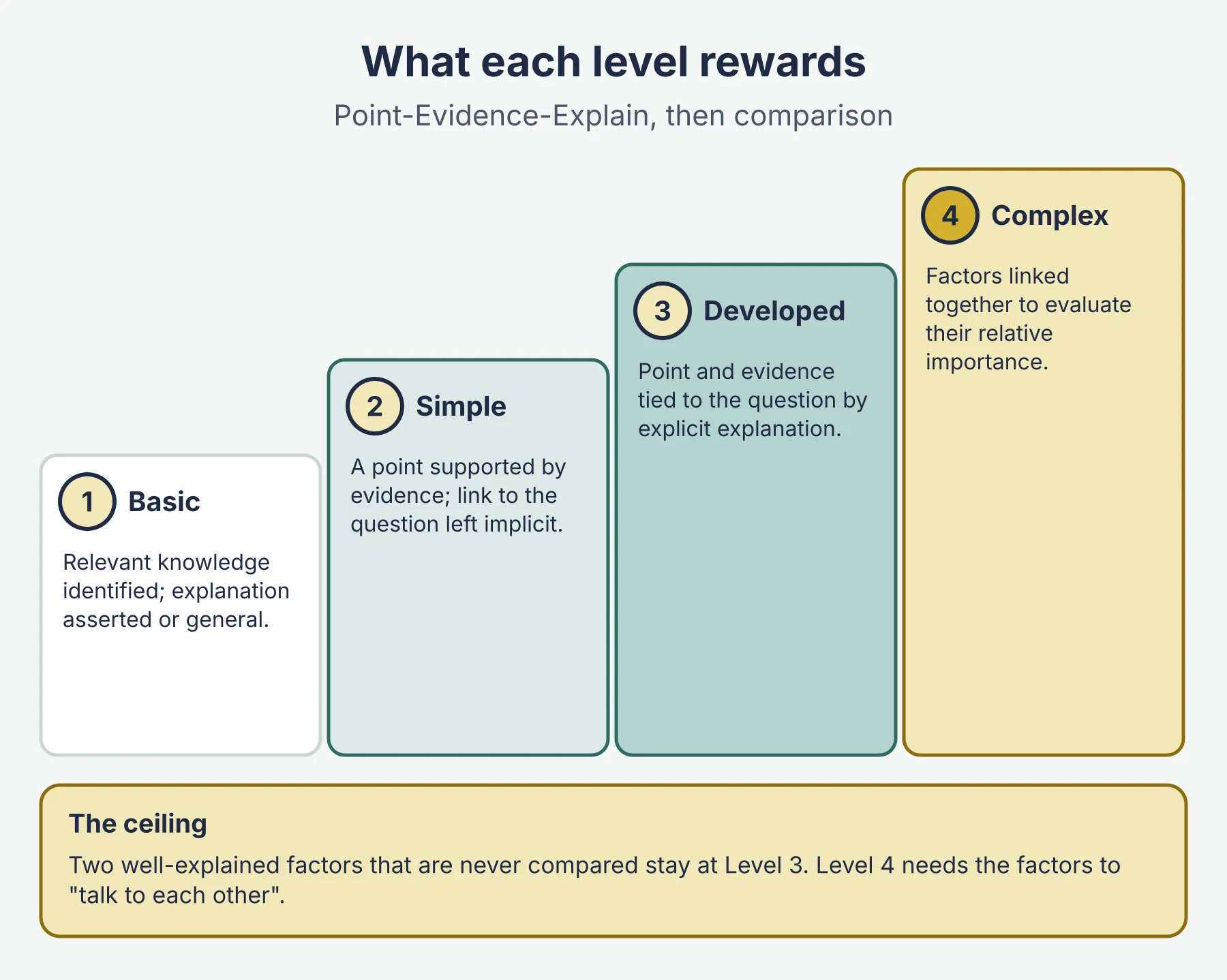
The specification describes progression in quality of thinking, using Point-Evidence-Explain as a model:
| Level | Quality of thinking | What it looks like |
|---|---|---|
| 1 | Basic | Relevant knowledge identified; explanation asserted or general |
| 2 | Simple | A point supported by evidence, but the link to the question left implicit |
| 3 | Developed | Point and evidence connected to the question by an explicit explanation |
| 4 | Complex (extended responses only) | Different causes, consequences or changes linked together to evaluate their relative importance |
So a well-explained essay on two factors that never compares them is stuck at Level 3. Level 4 needs the factors to talk to each other.
Building a line of reasoning
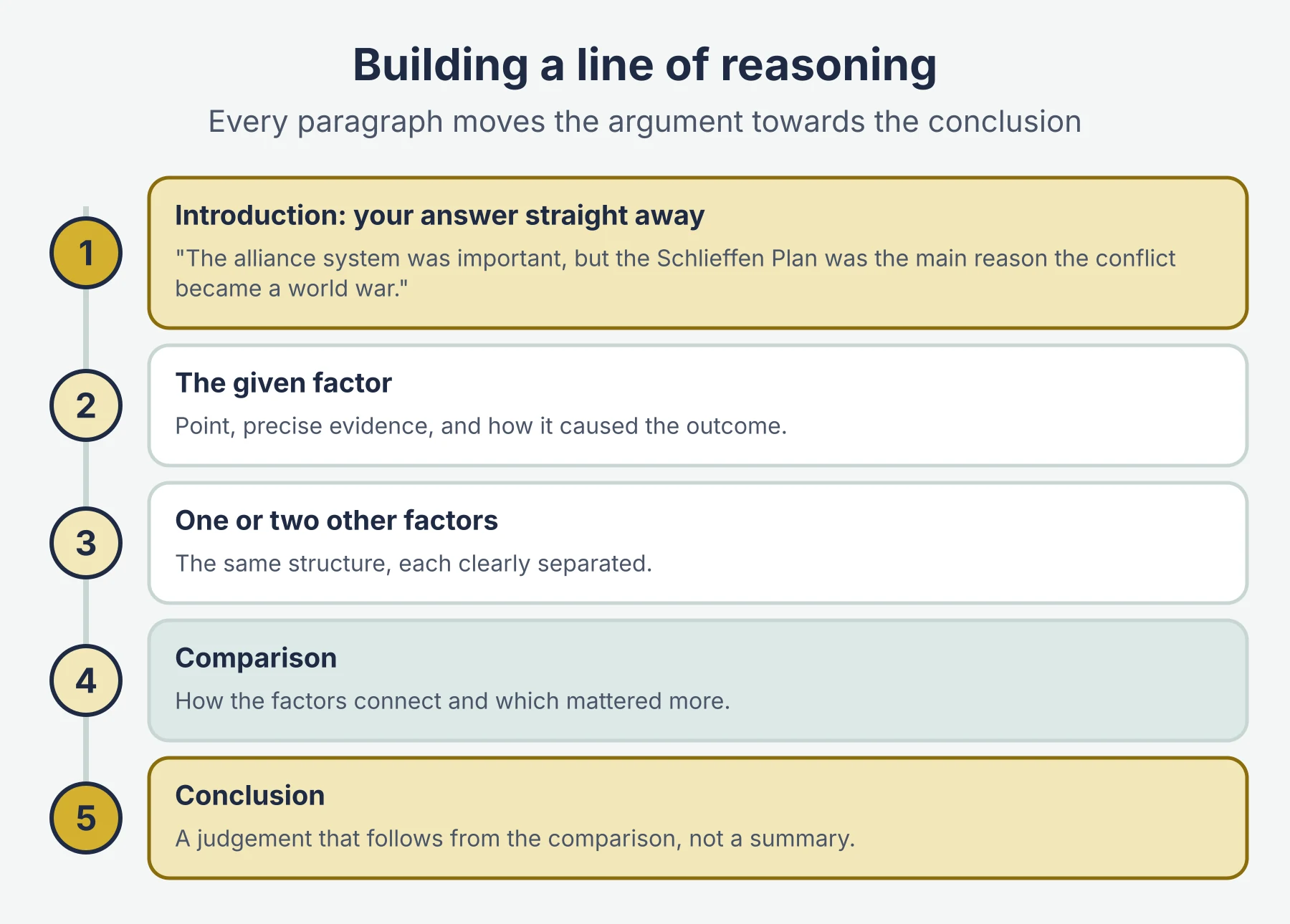
A line of reasoning means every paragraph moves your argument forward towards your conclusion. A reliable structure:
- Introduction (two or three sentences). State your overall answer straight away: “The alliance system was important, but the Schlieffen Plan was the main reason the conflict became a world war.”
- The given factor. Point, precise evidence, explanation of how it caused the outcome.
- One or two other factors. The same structure, each clearly separated.
- Comparison. Show how the factors connect and which mattered more: did one make another possible? Was one necessary but not sufficient? Did one decide the timing and another the outcome?
- Conclusion. A clear judgement that follows from your comparison, not a summary.
Tools for comparing factors
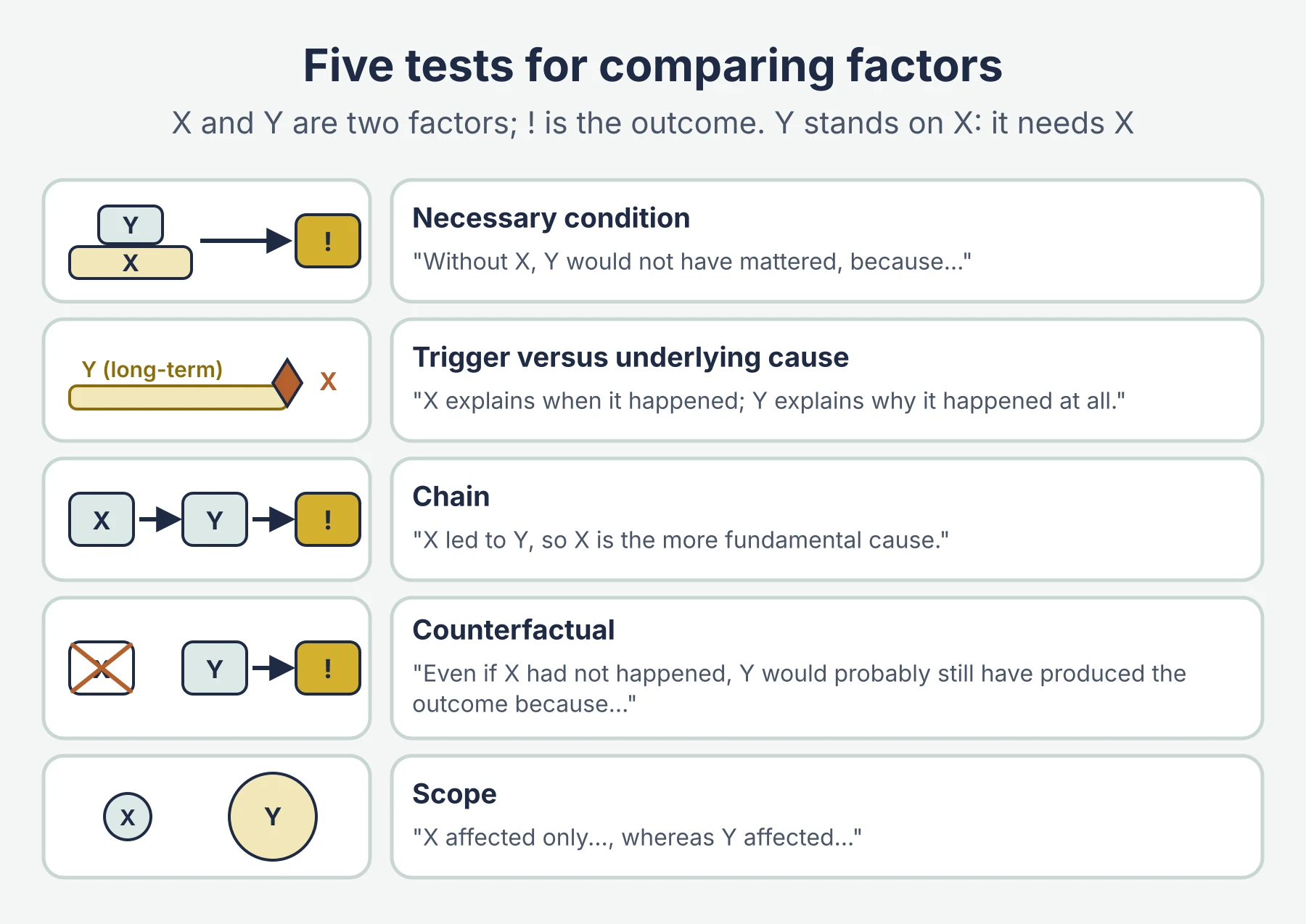
| Comparison test | Sentence starter |
|---|---|
| Necessary condition | “Without X, Y would not have mattered, because…” |
| Trigger versus underlying cause | “X explains when it happened; Y explains why it happened at all.” |
| Chain | “X led to Y, so X is the more fundamental cause.” |
| Counterfactual | “Even if X had not happened, Y would probably still have produced the outcome because…” |
| Scope | “X affected only…, whereas Y affected…” |
Worked plan 1: Détente and the collapse of communism
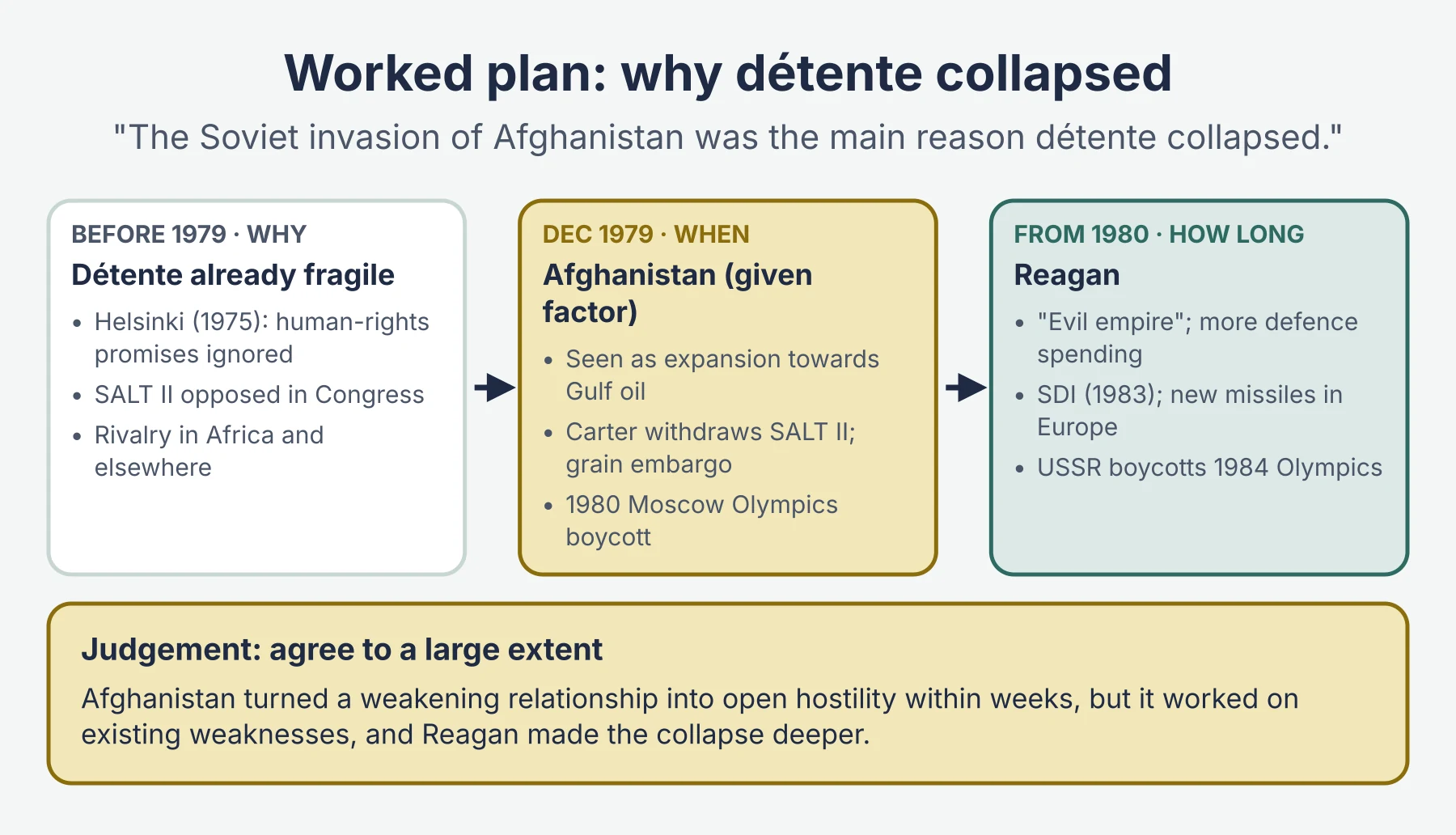
“The Soviet invasion of Afghanistan was the main reason détente collapsed.” How far do you agree? [12]
Introduction: The invasion was the immediate cause of the collapse, but détente was already weakening, and the arrival of Reagan turned the collapse into a renewed Cold War.
Given factor: Afghanistan. Soviet forces invaded in December 1979 to support a communist government. Carter saw it as Soviet expansion towards the Gulf’s oil. He withdrew the SALT II treaty from the Senate, imposed a grain embargo and led a boycott of the 1980 Moscow Olympics. This ended co-operation suddenly, which is why it is often seen as the end of détente.
Other factor: weaknesses of détente before 1979. The Helsinki Accords (1975) had included human-rights commitments the USSR ignored, angering American critics; SALT II had faced opposition in Congress; the superpowers competed in Africa and elsewhere. These problems meant détente was fragile before the invasion.
Other factor: Reagan. Elected in 1980, Reagan called the USSR an “evil empire”, increased defence spending, launched the Strategic Defence Initiative (1983) and deployed new missiles in Europe; the USSR boycotted the 1984 Los Angeles Olympics.
Comparison: Afghanistan gave the critics of détente the evidence they needed and decided the timing; the earlier weaknesses explain why the reaction was so strong; Reagan explains why the collapse lasted.
Judgement: I agree to a large extent. Afghanistan was the main reason because it turned a weakening relationship into open hostility within weeks, but it worked on existing weaknesses, and Reagan made the collapse deeper.
Worked plan 2: Hitler’s foreign policy
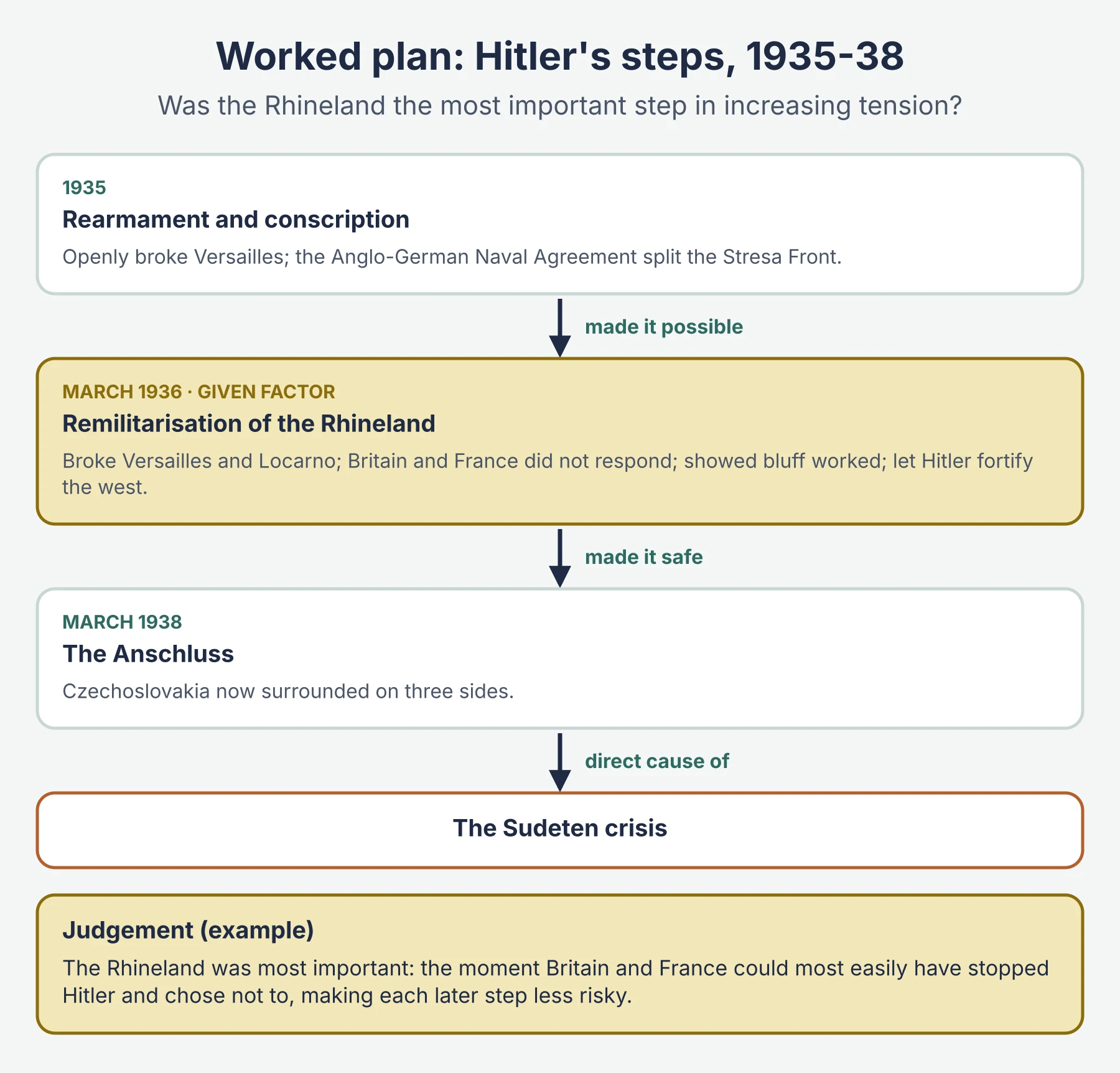
“The remilitarisation of the Rhineland was the most important step in increasing tension in Europe in the years 1933-38.” How far do you agree? [12]
- Given factor: March 1936; broke Versailles and Locarno; Britain and France did not respond; Hitler’s generals had feared French action; it showed Hitler that bluff worked and let him fortify the west.
- Other factor: rearmament and conscription (1935). Openly broke Versailles; Britain’s Anglo-German Naval Agreement split the Stresa Front.
- Other factor: the Anschluss (March 1938). Doubled the threat to Czechoslovakia, which was now surrounded on three sides.
- Comparison: rearmament made the Rhineland possible; the Rhineland made later steps safer by removing the risk of a French attack in the west; the Anschluss was the direct cause of the Sudeten crisis.
- Judgement: for example, the Rhineland was most important because it was the moment Britain and France could most easily have stopped Hitler and chose not to, making each later step less risky.
A comparison paragraph written out
Rearmament and conscription in 1935 were important because they gave Hitler the forces he needed, but on their own they did not change the balance in the west, since the Rhineland was still demilitarised and France could have marched in. The remilitarisation of March 1936 removed that danger: once German troops and, later, fortifications stood on the French border, Britain and France could no longer threaten Germany quickly, so Hitler could turn east to Austria and Czechoslovakia. The Rhineland was therefore the step that made the Anschluss safe, which is why it matters more than either.
Notice that the paragraph never describes a factor in isolation: each sentence compares or connects.
Common mistakes
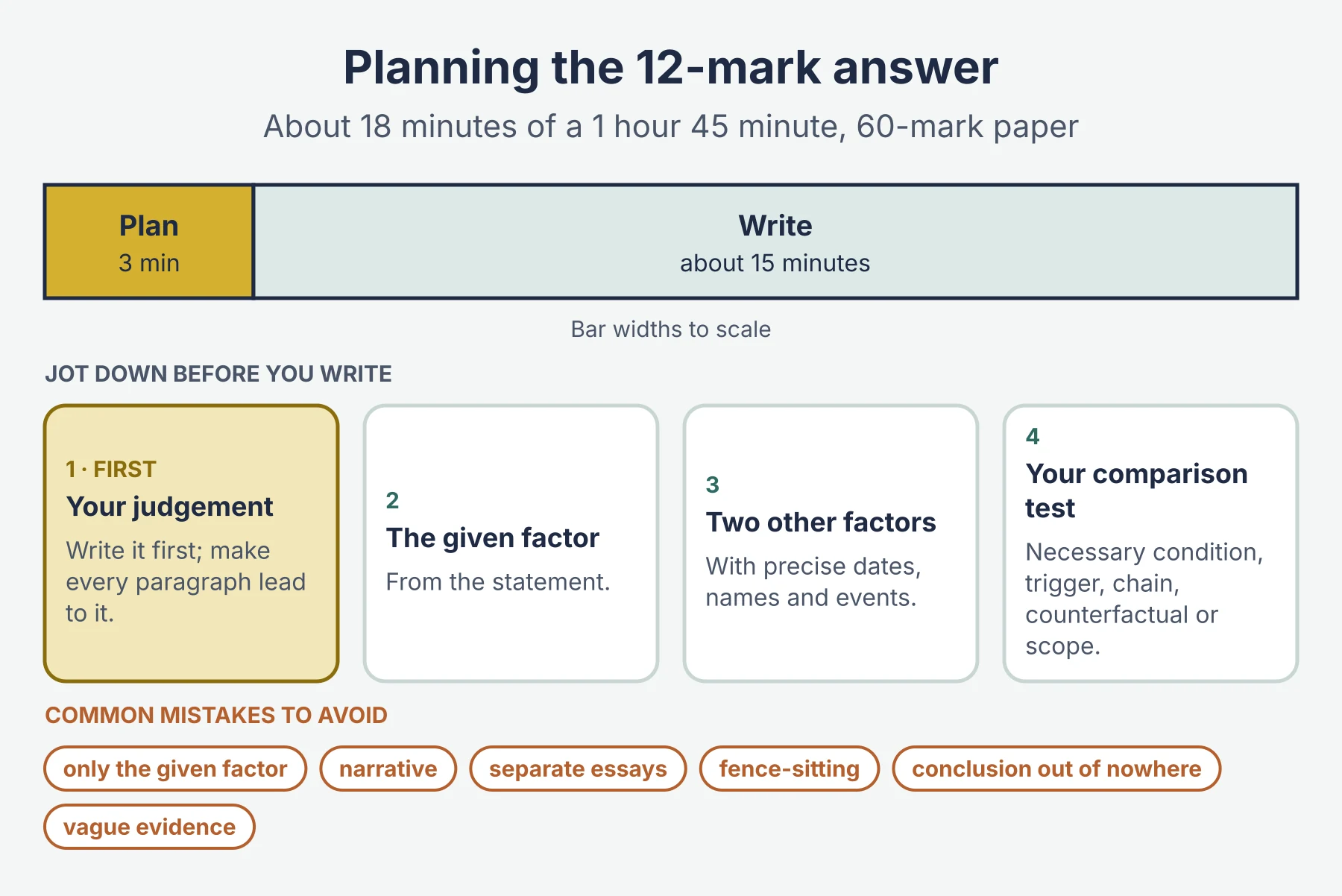
- Only the given factor, or the other factors mentioned in one line.
- Narrative: a story of events with no explanation of how they caused the outcome.
- Separate essays: two good paragraphs that never meet.
- Fence-sitting: “both were important” with no decision.
- Conclusion out of nowhere: a judgement that does not follow from the argument.
- Vague evidence: no dates, names, treaties or events.
Exam technique
Paper 1 lasts 1 hour 45 minutes for 60 marks, so the 12-mark question deserves about 18 minutes, including three minutes to plan. Jot the given factor, two other factors and the comparison test you will use before you write. Write the judgement first in your plan, then make every paragraph lead to it.
Further practice
- 12-mark judgement question revision notes
- 12-mark judgement question practice
- Paper 1 Section B practice questions
Specification
OxfordAQA International GCSE History (9245) specification, Version 1.1, sections 3.1.2, 4.4.1 and 4.5 – oxfordaqa.com.
Related resources
-
Practice questions
OxfordAQA International GCSE History (9245): The 12-Mark Judgement Question – Practice Questions
Original 9245 Paper 1 Section B practice: planning tasks and eight 12-mark judgement questions across all four depth-study options, with marking guides.
World History · OxfordAQA · IGCSE
Try questions -
Revision notes
OxfordAQA International GCSE History (9245): The 12-Mark Judgement Question – Revision Notes
Revision notes for the 9245 12-mark Question 4: the four levels, line of reasoning, comparison tools, factor banks for all four options and a self-test.
World History · OxfordAQA · IGCSE
Revise topic -
Study guides
OxfordAQA International GCSE History (9245): The Wider Peace Settlement and the Treaty of Lausanne
The 1919-23 treaties with Austria, Hungary, Bulgaria and the Ottoman Empire for 9245 Paper 1 Section A: terms, strengths, difficulties and Lausanne.
World History · OxfordAQA · IGCSE
Read guide
Get free revision emails (optional)
Occasional emails with practice questions, worked explanations and links to free resources for the qualification and subjects you choose. No spam, and you can unsubscribe from any email. The free tools on this site never need an email.