
Revision Notes
OxfordAQA International GCSE History (9245): The 12-Mark Judgement Question – Revision Notes
Revision notes for the 9245 12-mark Question 4: the four levels, line of reasoning, comparison tools, factor banks for all four options and a self-test.
- Subject
- World History
- Level
- IGCSE
- Topic
- Paper 1 – International Relations Depth Studies
- Author
- Marlbridge Academic Team
- Updated
- Reviewed by
- Azam Siddique (what this means)
Aligned to OxfordAQA IGCSE World History (9245), Version 1.1. Official specification .
Syllabus page (what it covers and how it is assessed): OxfordAQA IGCSE World History.
Syllabus points this page covers
9245
- 3.1.2 Section B
Found an error? Report a correction.
Need help with this topic? Request a free trial class for IGCSE World History (9245).
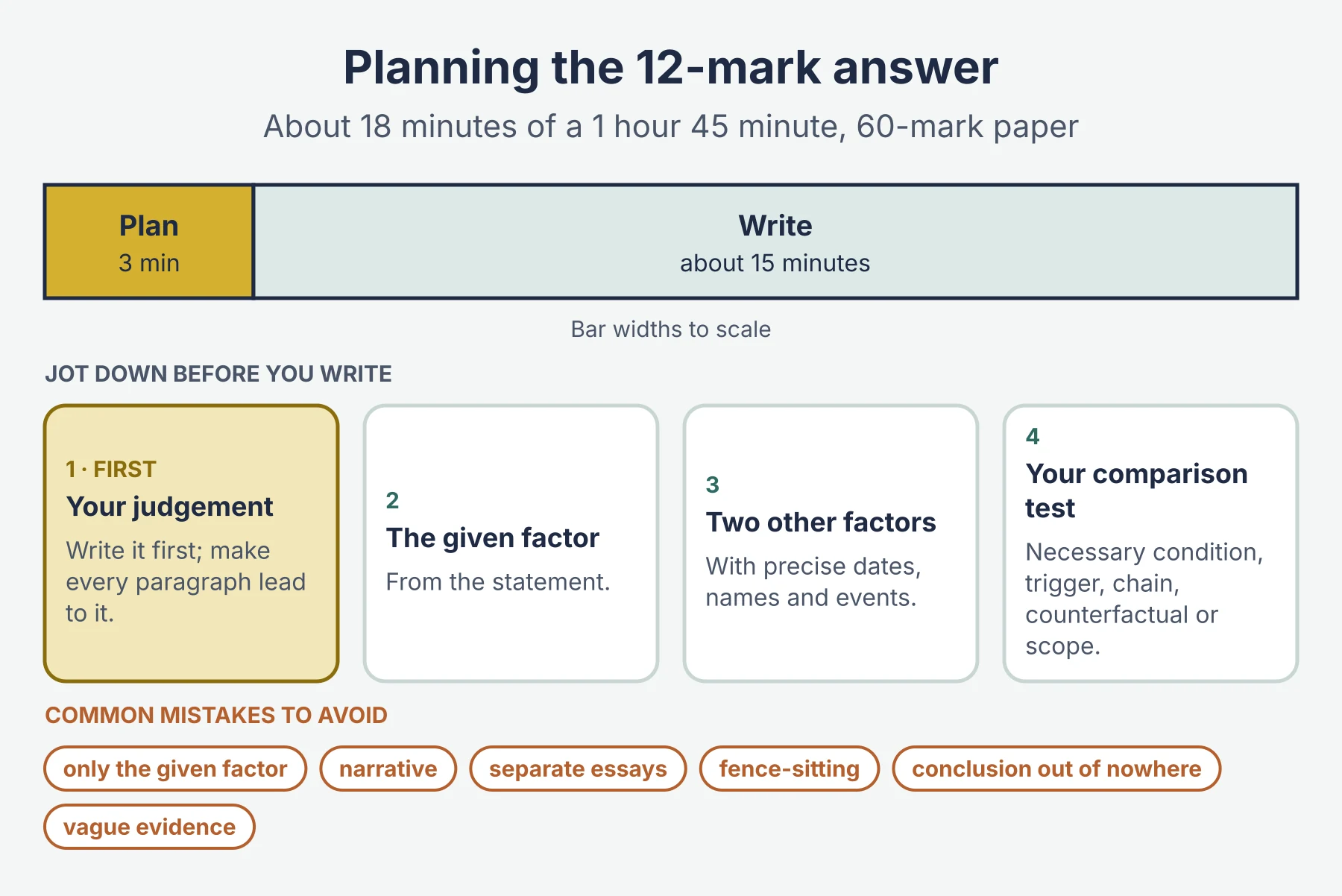
Condensed notes on the 12-mark Question 4 in Paper 1 Section B. The specification requires “an extended response with a line of reasoning”, explaining “a given cause/ consequence/ change and at least [one other]… leading to a judgement that evaluates their relative importance.” Worked plans are in the 12-mark judgement question study guide; the option content is summarised in the Paper 1 Section B revision notes.
The question in one box
- 12 marks, AO1 and AO2, about 18 minutes.
- A given factor (cause, consequence or change) in a statement.
- Explain it and at least one other.
- Link them and judge relative importance.
- The same question type ends both sections of Paper 2.
The four levels in brief
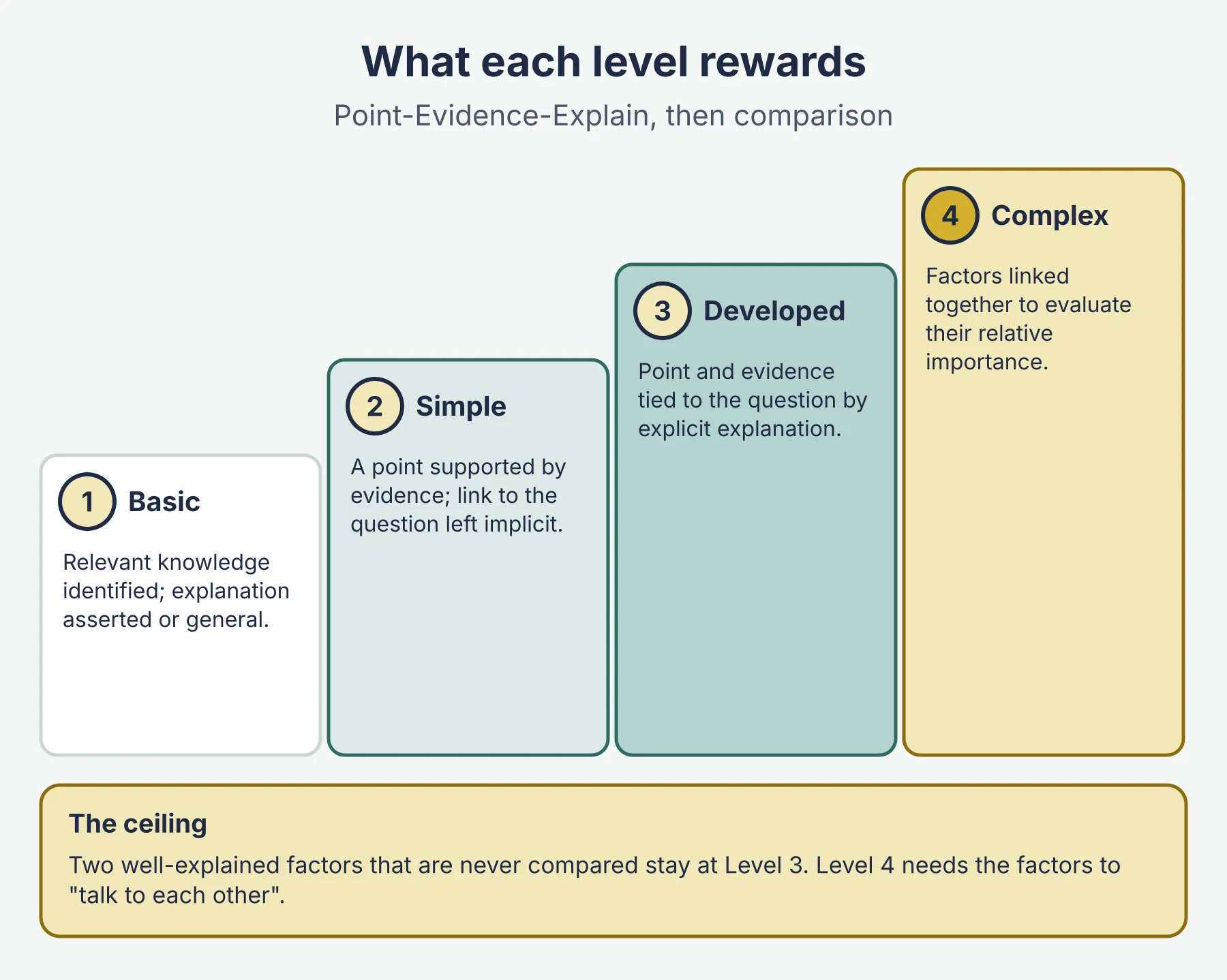
- Basic: relevant knowledge; general or asserted explanation.
- Simple: point plus evidence; link to the question implicit.
- Developed: point, evidence and explicit explanation linked to the question.
- Complex: factors linked together to evaluate relative importance.
Two separate, well-explained factors with no comparison stay at Level 3.
Structure
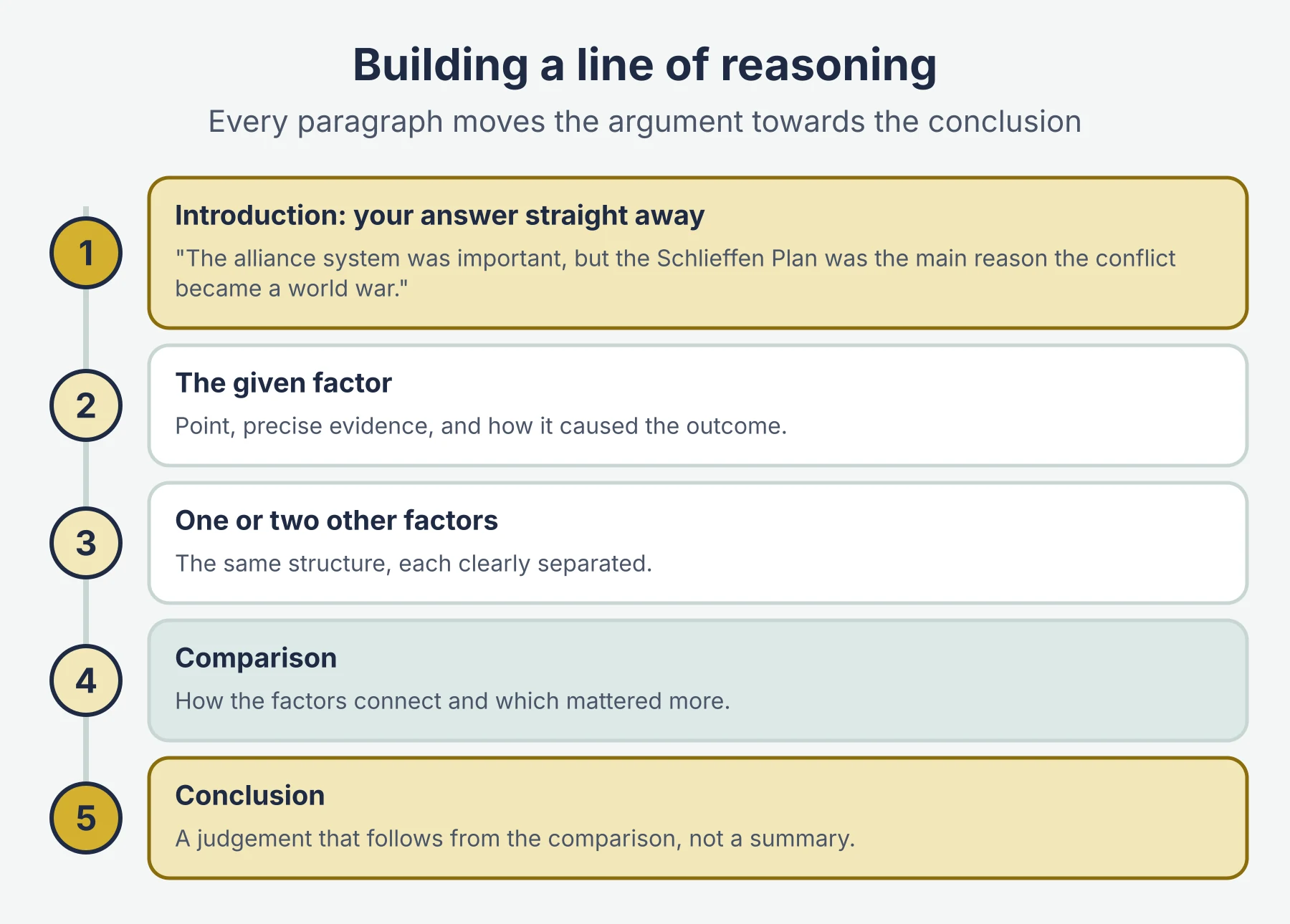
- Introduction with your answer.
- Given factor: Point, Evidence, Explain.
- Other factor(s): Point, Evidence, Explain.
- Comparison paragraph.
- Conclusion that follows from the comparison.
Comparison tools
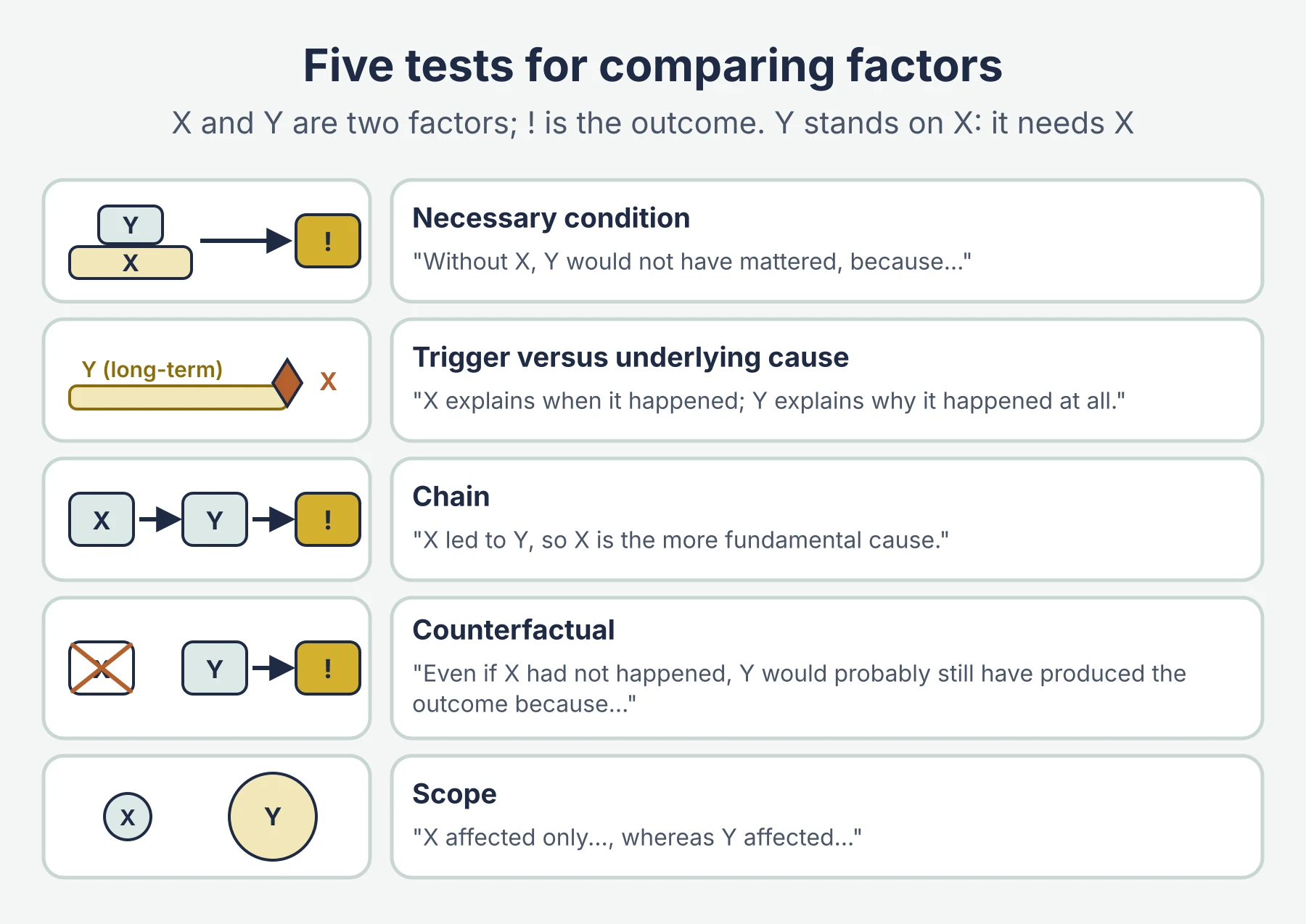
| Tool | Use it when |
|---|---|
| Necessary condition | One factor made the other possible |
| Trigger versus underlying | One explains timing, the other the deeper cause |
| Chain | One factor led to the other |
| Counterfactual | You can argue the outcome would or would not have happened without a factor |
| Scope | One factor affected more people, places or areas of policy |
Factor banks by option
The origins of the First World War, c1890-1915
- Alliance system: Triple Alliance (1882), Franco-Russian Alliance (1894), ententes (1904, 1907).
- Kaiser Wilhelm II’s Weltpolitik and the naval race.
- Crises in Morocco (1905, 1911), Bosnia (1908-09), the Balkan Wars (1912-13).
- Sarajevo (28 June 1914) and the July Crisis.
- The Schlieffen Plan and Belgium; Britain’s declaration on 4 August.
Hitler’s foreign policy and the origins of the Second World War, 1933-1941
- Hitler’s aims: overturning Versailles, uniting Germans, Lebensraum.
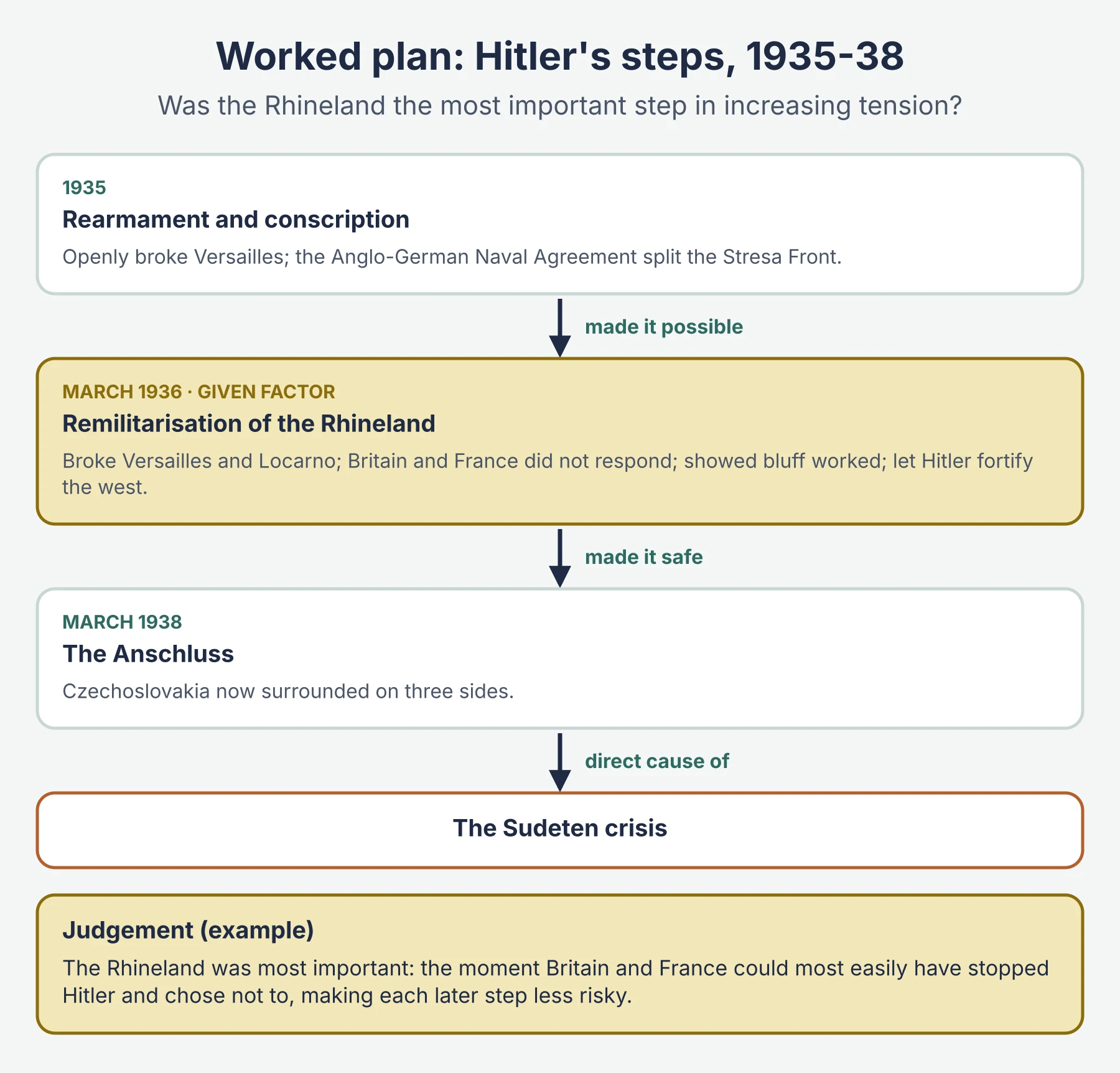
- Rearmament, conscription, the Saar (1935); Rhineland (1936); Anschluss (1938).
- Appeasement and Munich (September 1938).
- The Nazi-Soviet Pact (23 August 1939).
- The guarantee to Poland and the invasion of 1 September 1939.
The origins and development of the Cold War, 1945-1960
- Ideological differences; Yalta and Potsdam; the atomic bomb.
- Soviet control of Eastern Europe; Czechoslovakia (1948).
- Truman Doctrine and Marshall Aid (1947); Cominform and Comecon.
- Berlin Blockade (1948-49) and NATO (1949).
- Korea (1950-53); the “Thaw” and Hungary (1956); the arms and space race.
Détente and the collapse of communism, c1969-1991
- Motives for détente: cost of the arms race, Sino-Soviet split, Ostpolitik.
- SALT I and the ABM Treaty (1972); Helsinki (1975).
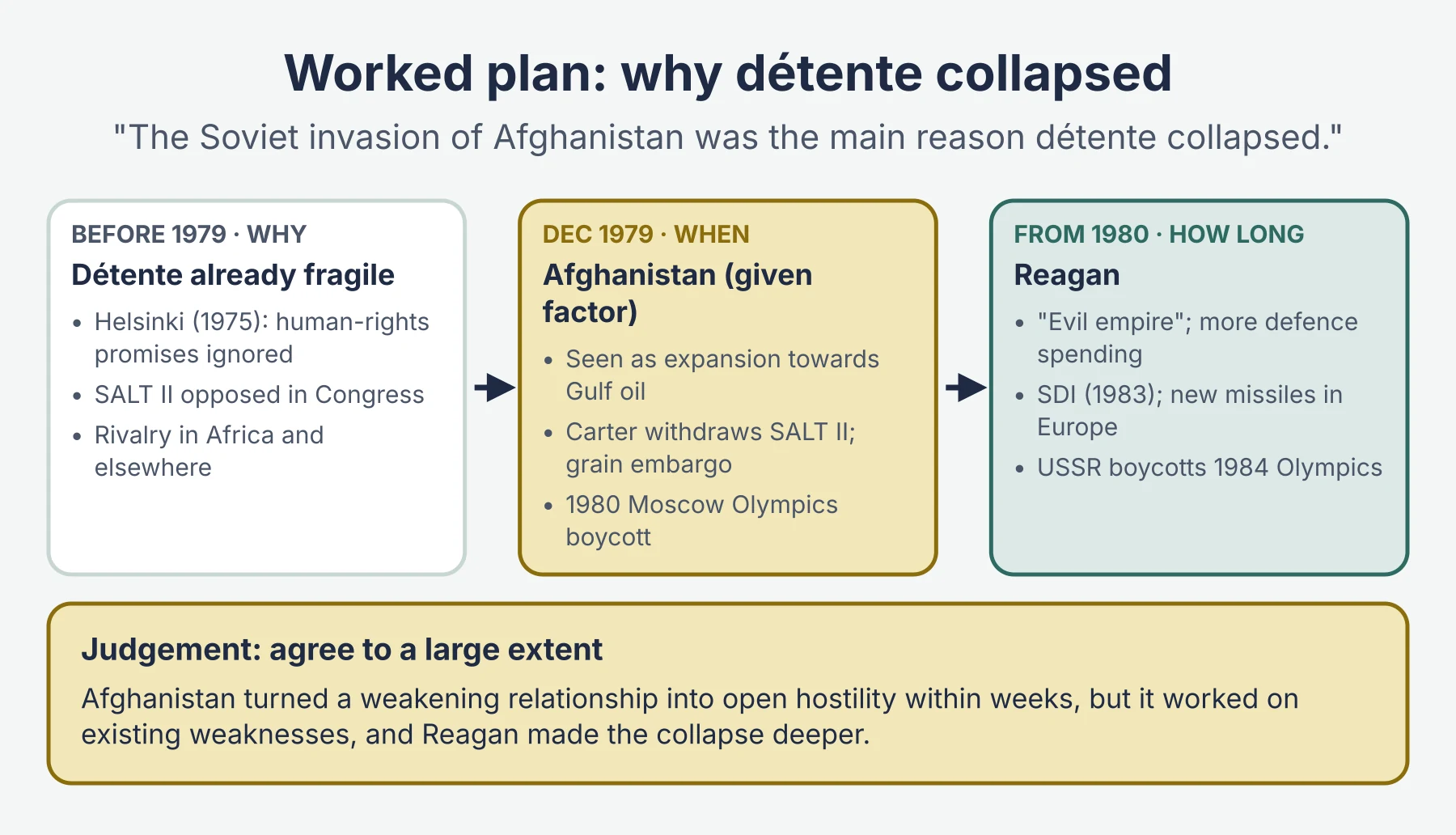
- Afghanistan (1979); Carter’s response; Olympic boycotts; Reagan and SDI.
- Gorbachev: glasnost, perestroika, Reykjavik (1986).
- Solidarity; 1989 revolutions; the collapse of the USSR (December 1991).
Model sentences
- Introduction: “The Berlin Blockade raised tension sharply, but the Truman Doctrine and Marshall Aid were the main reason, because they divided Europe into rival blocs first.”
- Comparison: “The pact explains why Hitler invaded in September 1939; his aims explain why he wanted to invade at all.”
- Conclusion: “Afghanistan decided the timing of the collapse of détente, but its earlier weaknesses explain why the reaction was so severe.”
Key terms
| Term | Meaning |
|---|---|
| Line of reasoning | An argument in which each paragraph leads to the conclusion |
| Given factor | The cause, consequence or change named in the question |
| Relative importance | How much one factor mattered compared with another |
| Trigger | The immediate event that set off an outcome |
| Underlying cause | A longer-term condition that made the outcome likely |
| Necessary condition | Something without which the outcome would not have happened |
| Judgement | A clear, supported answer to the question |
| PEE | Point, Evidence, Explain |
Exam traps
- Writing only about the given factor.
- Listing many factors briefly instead of explaining two or three well.
- Telling the story of events.
- Comparing factors only in the last sentence.
- Concluding “both were important” without saying which mattered more.
- Losing time on the 3-, 6- and 9-mark questions so that the 12-mark answer is rushed.
Self-test
- How many marks is Question 4, and which assessment objectives does it test?
- How many factors must you explain at minimum?
- What is the difference between Level 3 and Level 4?
- What does “line of reasoning” mean?
- What does PEE stand for?
- Name three comparison tools.
- In an essay on the outbreak of war in 1914, what could you argue explains the timing of war?
- In an essay on the outbreak of war in 1939, what could be a necessary condition for Hitler’s invasion of Poland?
- Give two factors for the development of the Cold War, 1945-49.
- Give two factors for the collapse of communism in Eastern Europe.
- How long should you spend on Question 4?
- Where should your judgement first appear?
Answers
- 12 marks; AO1 and AO2.
- Two: the given factor and at least one other.
- Level 4 links factors together to evaluate their relative importance; Level 3 explains them without doing so.
- An argument in which every paragraph moves towards the conclusion.
- Point, Evidence, Explain.
- Any three: necessary condition; trigger versus underlying; chain; counterfactual; scope.
- The assassination at Sarajevo and the July Crisis, or the Schlieffen Plan’s need for speed.
- The Nazi-Soviet Pact, which removed the threat of a war on two fronts.
- Any two: ideological differences; Soviet control of Eastern Europe; the Truman Doctrine; Marshall Aid; the Berlin Blockade.
- Any two: Gorbachev’s reforms and refusal to use force; economic weakness; Solidarity; the cost of Afghanistan; mass protests in 1989.
- About 18 minutes.
- In the introduction.
Plan and write answers in the 12-mark judgement question practice.
Related resources
-
Study guides
OxfordAQA International GCSE History (9245): The Wider Peace Settlement and the Treaty of Lausanne
The 1919-23 treaties with Austria, Hungary, Bulgaria and the Ottoman Empire for 9245 Paper 1 Section A: terms, strengths, difficulties and Lausanne.
World History · OxfordAQA · IGCSE
Read guide -
Practice questions
OxfordAQA International GCSE History (9245): The Wider Peace Settlement and the Treaty of Lausanne – Practice Questions
Original 9245 practice on the treaties with Austria, Hungary, Bulgaria and the Ottoman Empire: knowledge checks and a five-source set with marking guides.
World History · OxfordAQA · IGCSE
Try questions -
Revision notes
OxfordAQA International GCSE History (9245): The Wider Peace Settlement and the Treaty of Lausanne – Revision Notes
Revision notes for 9245 on the wider peace settlement: Saint-Germain, Neuilly, Trianon, Sèvres and Lausanne, strengths, difficulties and a self-test.
World History · OxfordAQA · IGCSE
Revise topic
Get free revision emails (optional)
Occasional emails with practice questions, worked explanations and links to free resources for the qualification and subjects you choose. No spam, and you can unsubscribe from any email. The free tools on this site never need an email.