
Revision Notes
OxfordAQA International GCSE History (9245): The Wider Peace Settlement and the Treaty of Lausanne – Revision Notes
Revision notes for 9245 on the wider peace settlement: Saint-Germain, Neuilly, Trianon, Sèvres and Lausanne, strengths, difficulties and a self-test.
- Subject
- World History
- Level
- IGCSE
- Topic
- Paper 1 – International Relations Depth Studies
- Author
- Marlbridge Academic Team
- Updated
- Reviewed by
- Azam Siddique (what this means)
Aligned to OxfordAQA IGCSE World History (9245), Version 1.1. Official specification .
Syllabus page (what it covers and how it is assessed): OxfordAQA IGCSE World History.
Syllabus points this page covers
9245
- 3.1.1 Section A
- 3.1.1.1 Peacemaking and the League of Nations, c1919-1939
Found an error? Report a correction.
Need help with this topic? Request a free trial class for IGCSE World History (9245).
Condensed notes on “The wider settlement” in Part 1 of Peacemaking and the League of Nations, c1919-1939. The specification names “the peacemakers’ treatment of Austria, Hungary and the Ottoman Empire; strengths of the treaties and the difficulties they created for different states; the Treaty of Lausanne.” Fuller explanation and a source-question example are in the wider peace settlement study guide; the whole option’s timeline is in the Paper 1 Section A revision notes.
Timeline
| Date | Event |
|---|---|
| 1915 | Treaty of London promises Italy land, including Dalmatia |
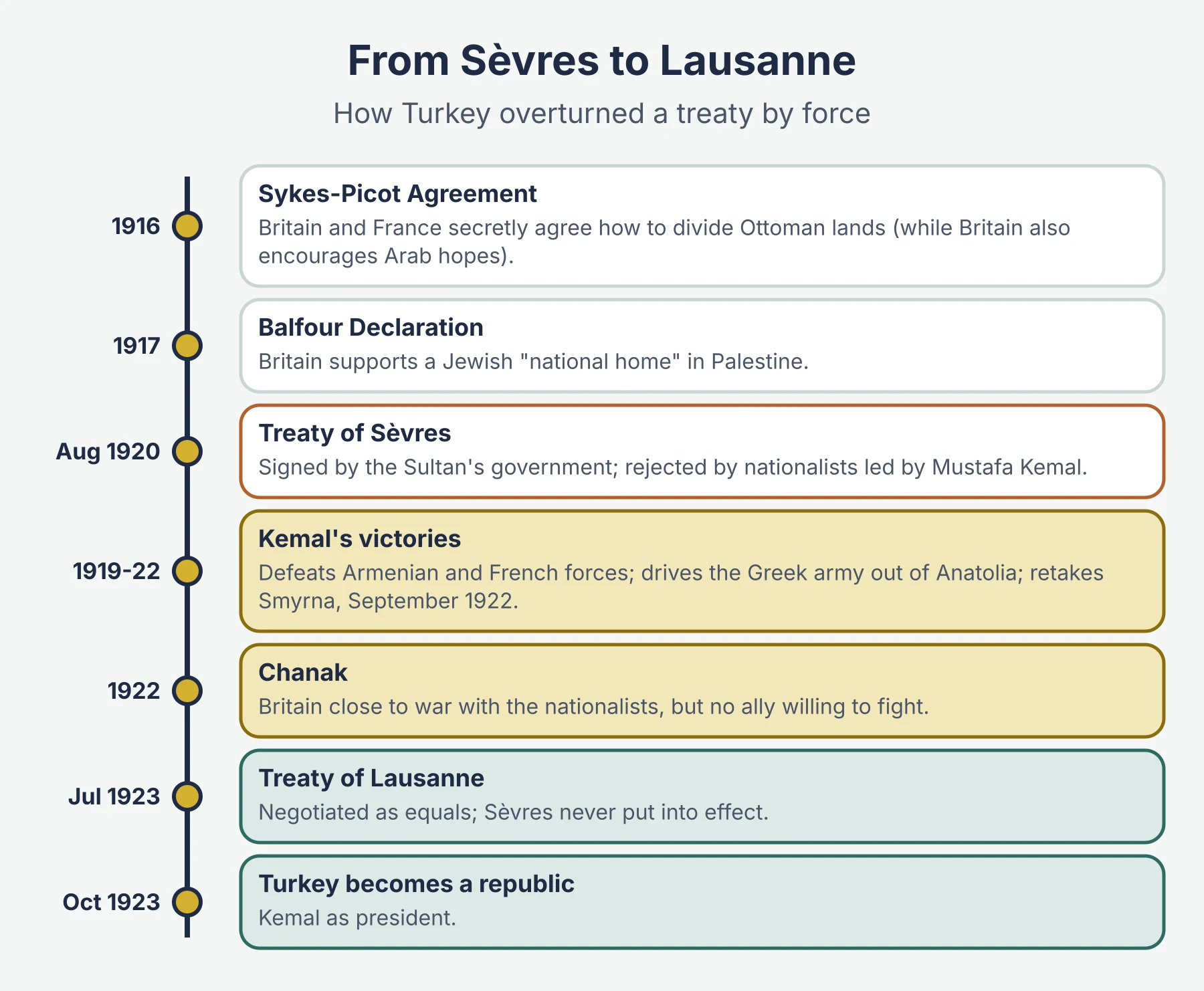
| 1916 | Sykes-Picot Agreement: Britain and France plan to divide Ottoman lands |
| 1917 | Balfour Declaration |
| Oct-Nov 1918 | Austria-Hungary breaks up; new states declared |
| January 1919 | Paris Peace Conference opens |
| September 1919 | Treaty of Saint-Germain (Austria); D’Annunzio seizes Fiume |
| November 1919 | Treaty of Neuilly (Bulgaria) |
| June 1920 | Treaty of Trianon (Hungary) |
| August 1920 | Treaty of Sèvres (Ottoman Empire) |
| 1919-22 | Greco-Turkish War |
| September 1922 | Turkish nationalists retake Smyrna; Chanak crisis follows |
| July 1923 | Treaty of Lausanne |
| October 1923 | Turkish Republic proclaimed, with Mustafa Kemal as president |
Treaty by treaty
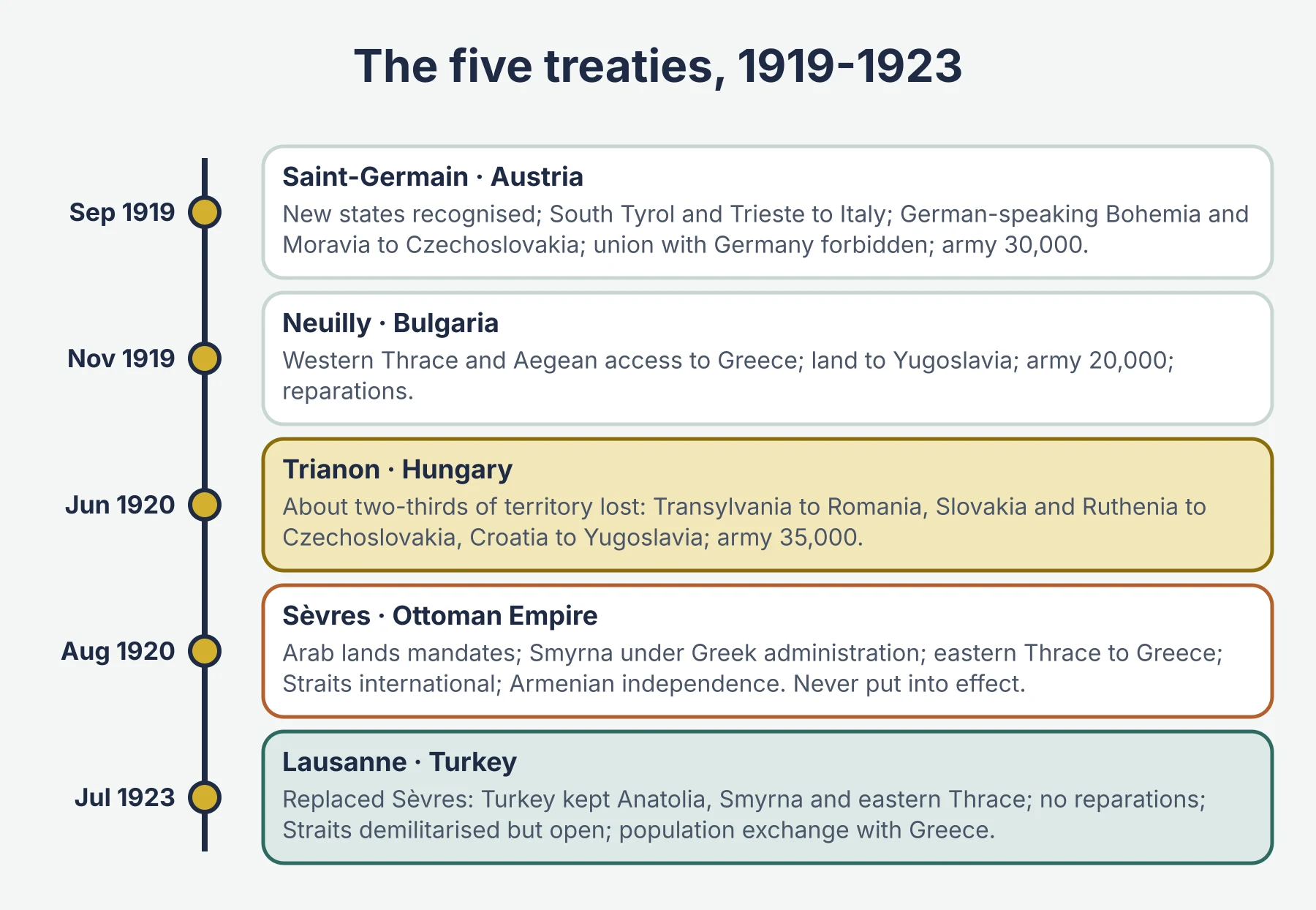
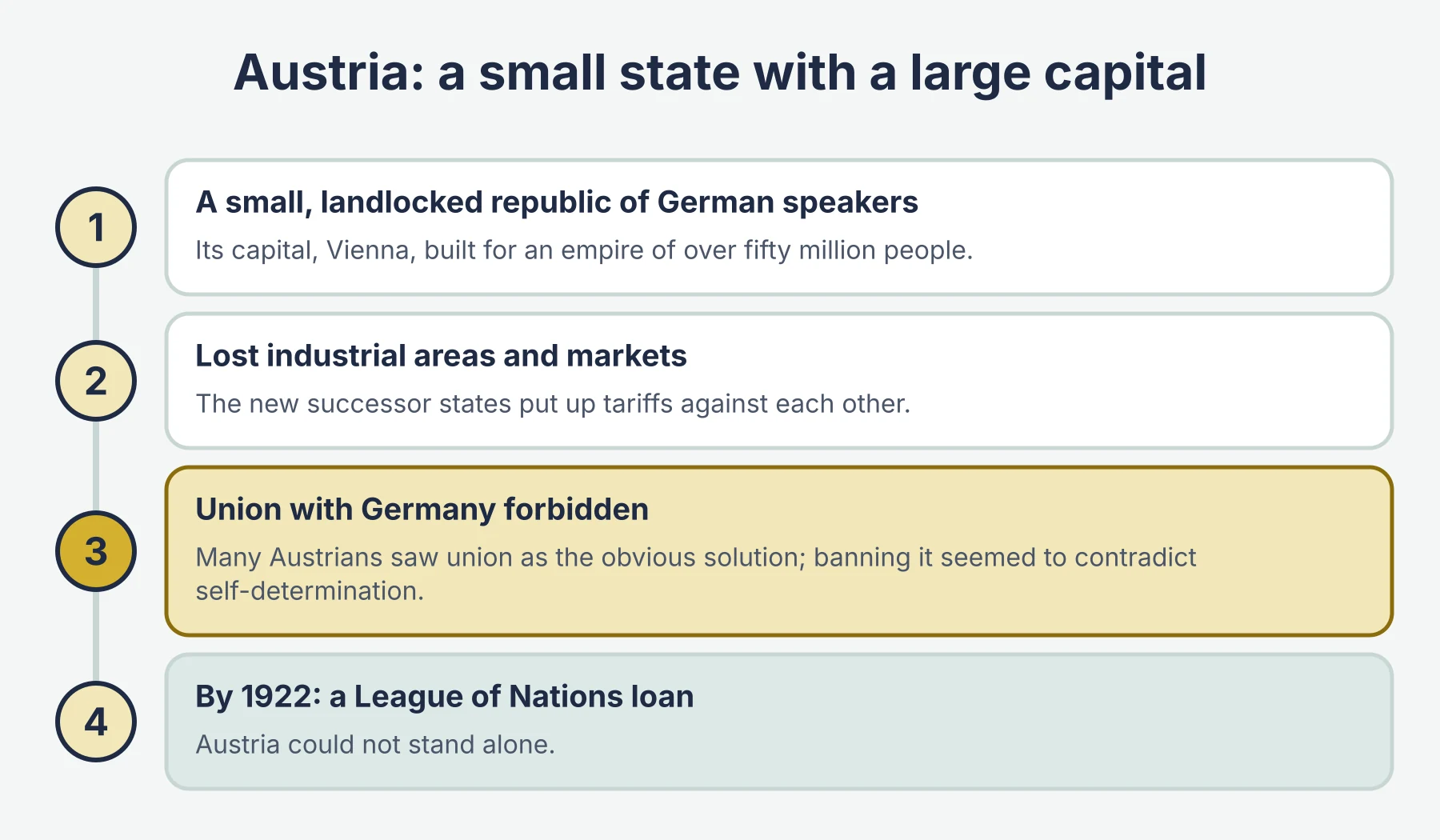
Saint-Germain (Austria): recognised Czechoslovakia, Poland, Hungary and Yugoslavia; South Tyrol and Trieste to Italy; Bohemia and Moravia to Czechoslovakia; union with Germany forbidden; army 30,000. Result: small landlocked state; economic crisis; League loan by 1922.
Neuilly (Bulgaria): Western Thrace to Greece (lost Aegean coast); land to Yugoslavia; army 20,000; reparations. Result: refugees, hostility to neighbours.
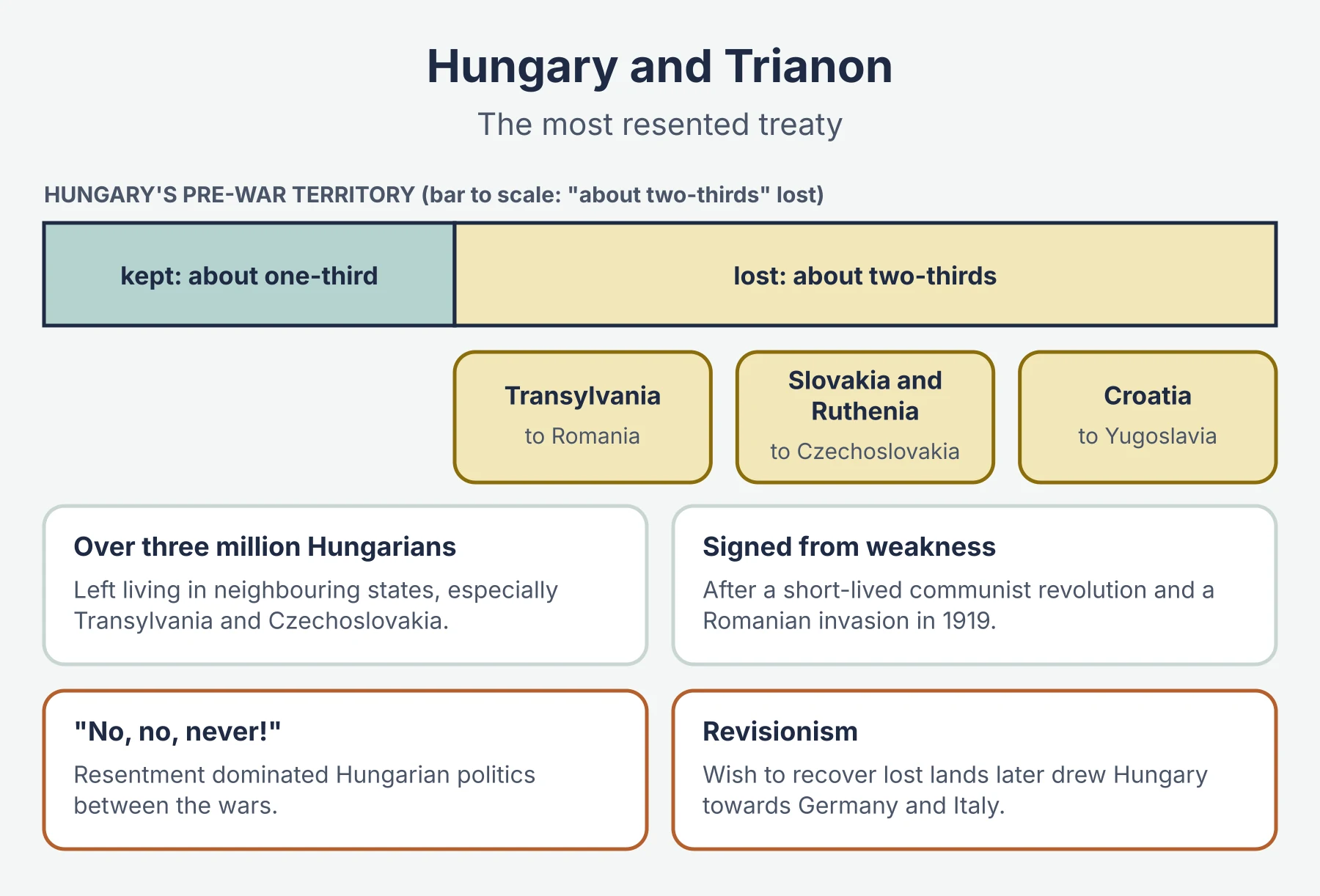
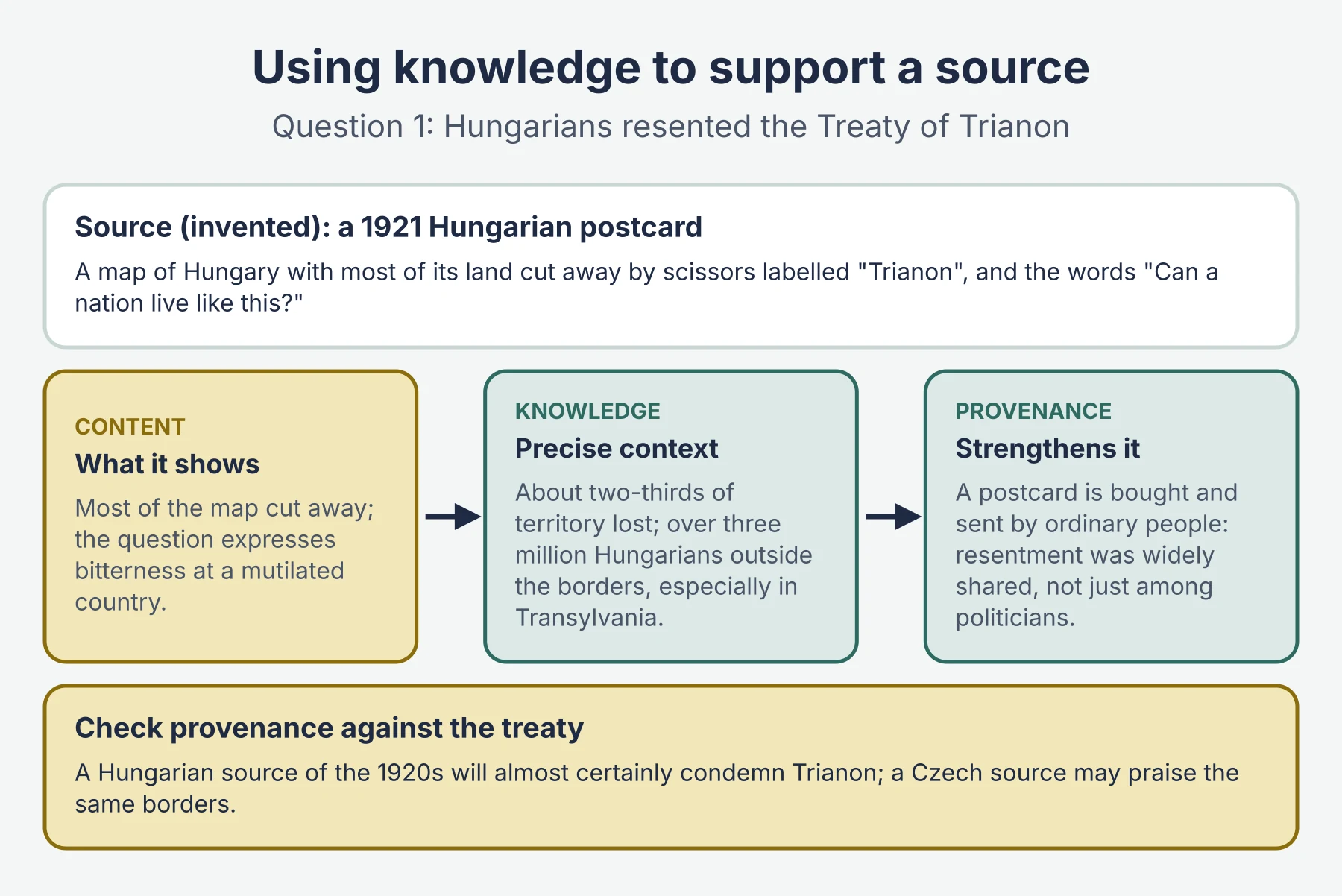
Trianon (Hungary): about two-thirds of territory lost; Transylvania to Romania; Slovakia and Ruthenia to Czechoslovakia; Croatia to Yugoslavia; army 35,000; over three million Hungarians outside the new borders. Result: deep resentment (“No, no, never!”); later drift towards Germany and Italy.
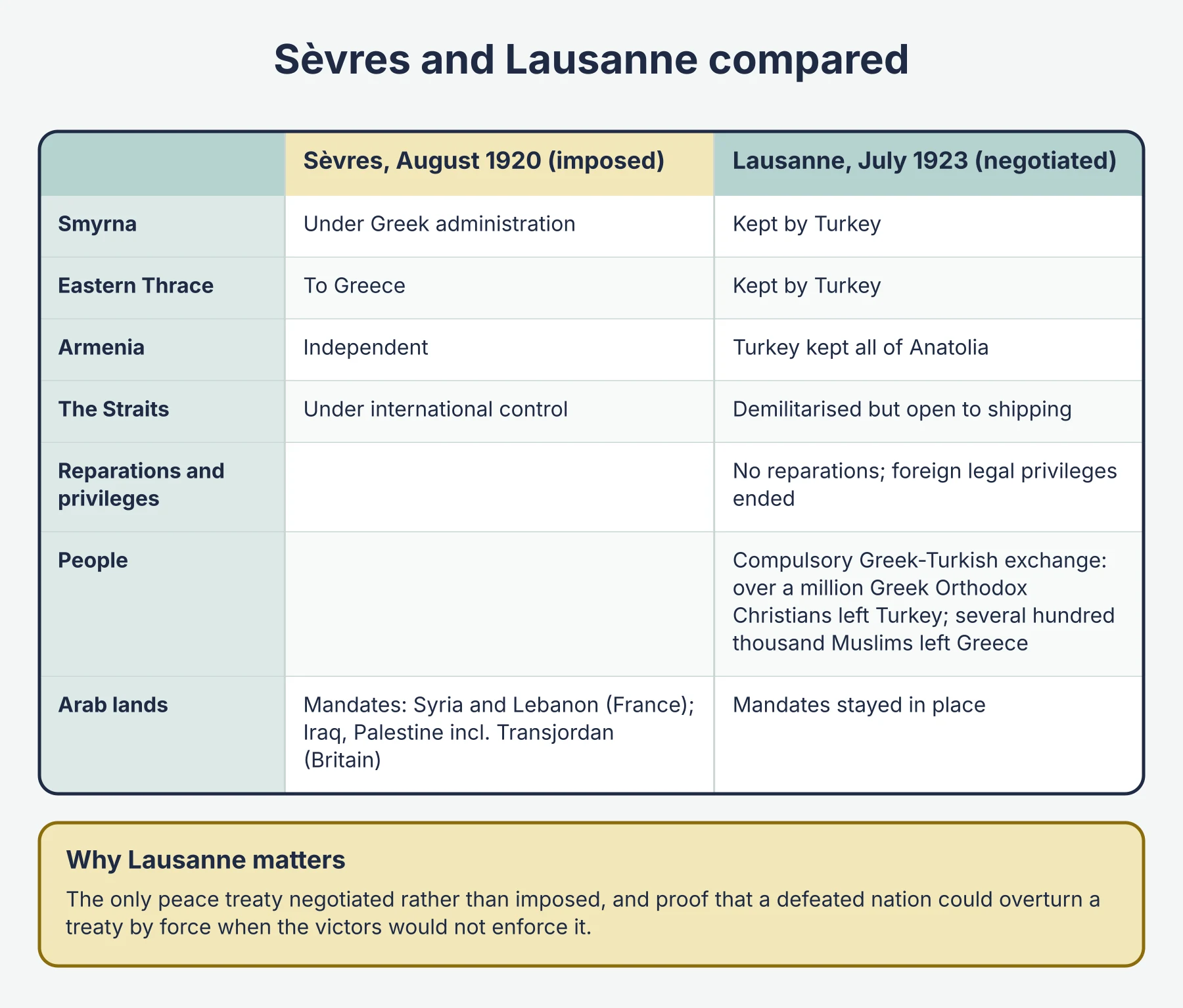
Sèvres (Ottoman Empire): Arab lands as mandates (Syria and Lebanon to France; Iraq and Palestine to Britain); Smyrna under Greek administration; eastern Thrace to Greece; Straits internationalised; Armenia independent. Result: rejected by Kemal’s nationalists; never enforced.
Lausanne (Turkey): Turkey kept Anatolia, Smyrna and eastern Thrace; no reparations; foreign privileges ended; Straits demilitarised but open; Greek-Turkish population exchange; mandates unchanged. Significance: the only treaty negotiated rather than imposed; showed a treaty could be overturned by force.
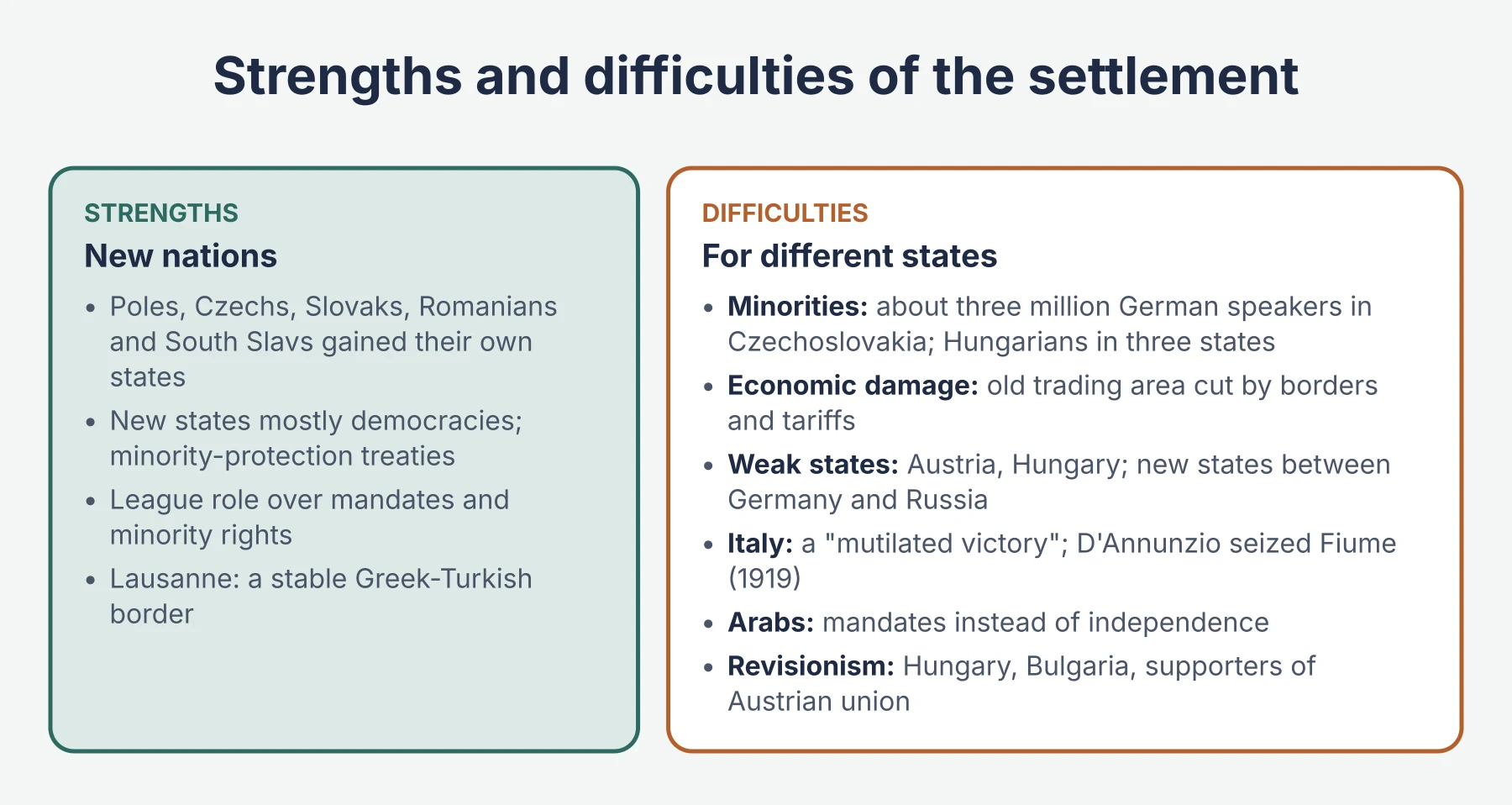
Strengths and difficulties
| Strengths | Difficulties |
|---|---|
| New nations for Poles, Czechs, Slovaks, Romanians, South Slavs | Minorities in every new state, e.g. about three million German speakers in Czechoslovakia |
| Mostly democratic new states; minority treaties | Old trading area broken by borders and tariffs |
| League supervision of mandates and minorities | Austria and Hungary too weak to stand alone |
| Lasting Greek-Turkish border after Lausanne | Italy’s “mutilated victory”; Fiume seized |
| Arab hopes of independence replaced by mandates | |
| Revisionism in Hungary and Bulgaria |
Turning knowledge into source answers
Section A is entirely source-based, so learn facts as tests for sources:
- A source praising self-determination: test it with the German speakers in Czechoslovakia or the Hungarians in Romania.
- A source calling Austria doomed: support it with the ban on union and the League loan; qualify it with Austria’s survival through the 1920s.
- A source on Turkey: check the date. Before September 1922 Sèvres stood; after it, the nationalists had the upper hand.
- Provenance shortcuts: Czech, Polish or Romanian sources tend to defend the borders; Austrian, Hungarian, Bulgarian and Turkish nationalist sources tend to attack them.
Key terms
| Term | Meaning |
|---|---|
| Self-determination | The right of peoples to govern themselves |
| Successor states | States formed from the collapsed empires |
| Mandate | Territory governed by a League member on the League’s behalf |
| Minority treaty | Agreement by a new state to protect minorities |
| Revisionism | The aim of overturning a treaty |
| Landlocked | Having no coastline |
| Population exchange | Agreed transfer of peoples between states |
| “Mutilated victory” | Italian nationalist complaint about the settlement |
| The Straits | The Dardanelles and Bosphorus linking the Black Sea and Mediterranean |
Exam traps
- Confusing Trianon (Hungary) and Saint-Germain (Austria).
- Saying Sèvres was enforced: it was replaced by Lausanne.
- Assuming the victors were all satisfied: Italy was not.
- Forgetting the strengths of the treaties.
- In source questions, describing the treaty instead of using knowledge to test the source.
- Ignoring provenance: a Hungarian and a Czech source on the same border will disagree for clear reasons.
Self-test
- Which treaty dealt with Austria?
- What did that treaty forbid Austria to do?
- Which treaty dealt with Hungary, and roughly how much territory did Hungary lose?
- Which state gained Transylvania?
- What did Bulgaria lose to Greece under the Treaty of Neuilly?
- What was a mandate?
- Which Arab lands became French mandates?
- Who led the Turkish nationalists who rejected Sèvres?
- Give two terms of the Treaty of Lausanne.
- Why is Lausanne different from the other peace treaties?
- Why did Italian nationalists call the settlement a “mutilated victory”?
- Give one strength and one difficulty of the wider settlement.
Answers
- Saint-Germain (1919).
- Unite with Germany.
- Trianon (1920); about two-thirds.
- Romania.
- Western Thrace and its Aegean coastline.
- A territory governed by a League member on the League’s behalf.
- Syria and Lebanon.
- Mustafa Kemal.
- Any two: Turkey kept Anatolia, Smyrna and eastern Thrace; no reparations; foreign privileges ended; Straits demilitarised but open; Greek-Turkish population exchange.
- It was negotiated with the defeated state rather than imposed, after Turkey overturned Sèvres by force.
- Italy did not receive all the land, such as Dalmatia, promised in 1915.
- Strength: new nations for peoples such as Czechs and Poles, or minority treaties. Difficulty: minorities in new states, economic disruption, weak states, revisionism or Arab disappointment.
Use this knowledge in the source-based tasks of the wider peace settlement practice questions.
Related resources
-
Study guides
OxfordAQA IGCSE World History: International Relations Depth Studies (9245)
Paper 1 of OxfordAQA International GCSE History 9245, International relations depth studies: the source-based and knowledge-based sections and their options.
World History · OxfordAQA · IGCSE
Read guide -
Practice questions
IGCSE History: International Relations Depth Studies — Practice Questions
Original OxfordAQA International GCSE History 9245 Paper 1 practice: source-based Peacemaking and the League, and knowledge-based Hitler's foreign policy.
World History · OxfordAQA · IGCSE
Try questions -
Revision notes
IGCSE History: International Relations Depth Studies — Revision Notes
Condensed recall notes on the peace treaties, the League of Nations, the origins of the Second World War and the Cold War for International GCSE History.
World History · OxfordAQA · IGCSE
Revise topic
Get free revision emails (optional)
Occasional emails with practice questions, worked explanations and links to free resources for the qualification and subjects you choose. No spam, and you can unsubscribe from any email. The free tools on this site never need an email.