
Revision Notes
OxfordAQA International GCSE History (9245): Paper 1 Section A, Source-Based Depth Studies – Revision Notes
Recall notes for 9245 Paper 1 Section A: the four source questions, timelines for the League and Cold War crises options, key terms, exam traps and a self-test.
- Subject
- World History
- Level
- IGCSE
- Topic
- Paper 1 – International Relations Depth Studies
- Author
- Marlbridge Academic Team
- Updated
- Reviewed by
- Azam Siddique (what this means)
Aligned to OxfordAQA IGCSE World History (9245), Version 1.1. Official specification .
Syllabus page (what it covers and how it is assessed): OxfordAQA IGCSE World History.
Syllabus points this page covers
9245
- 3.1.1 Section A
Found an error? Report a correction.
Need help with this topic? Request a free trial class for IGCSE World History (9245).
Condensed notes for the source-based section of Paper 1. For the method and a worked answer, use the Paper 1 Section A study guide.
Section A in one box
- One option from two: Peacemaking and the League of Nations, c1919-1939, or Crises of the Cold War, 1960-1975.
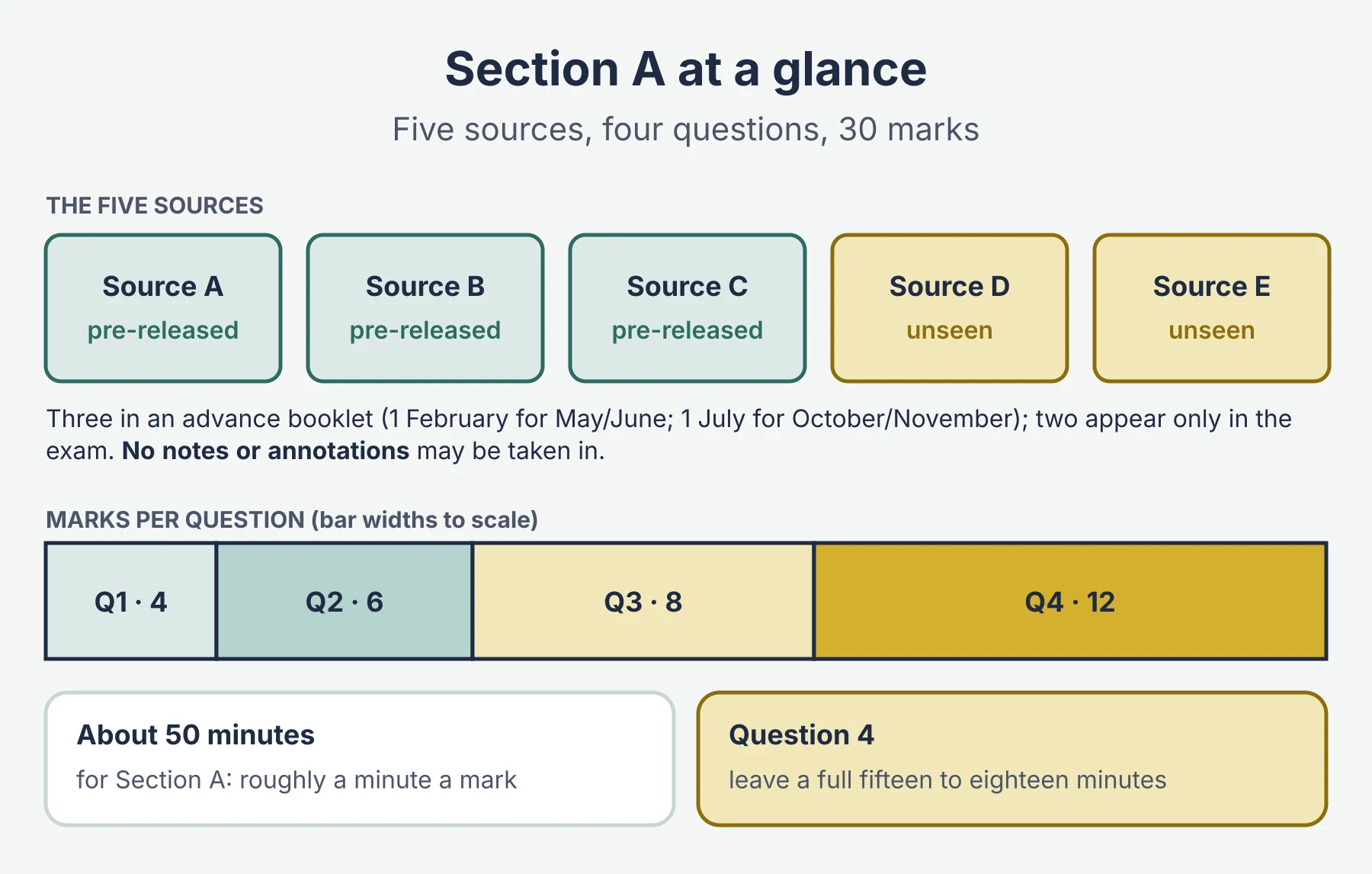
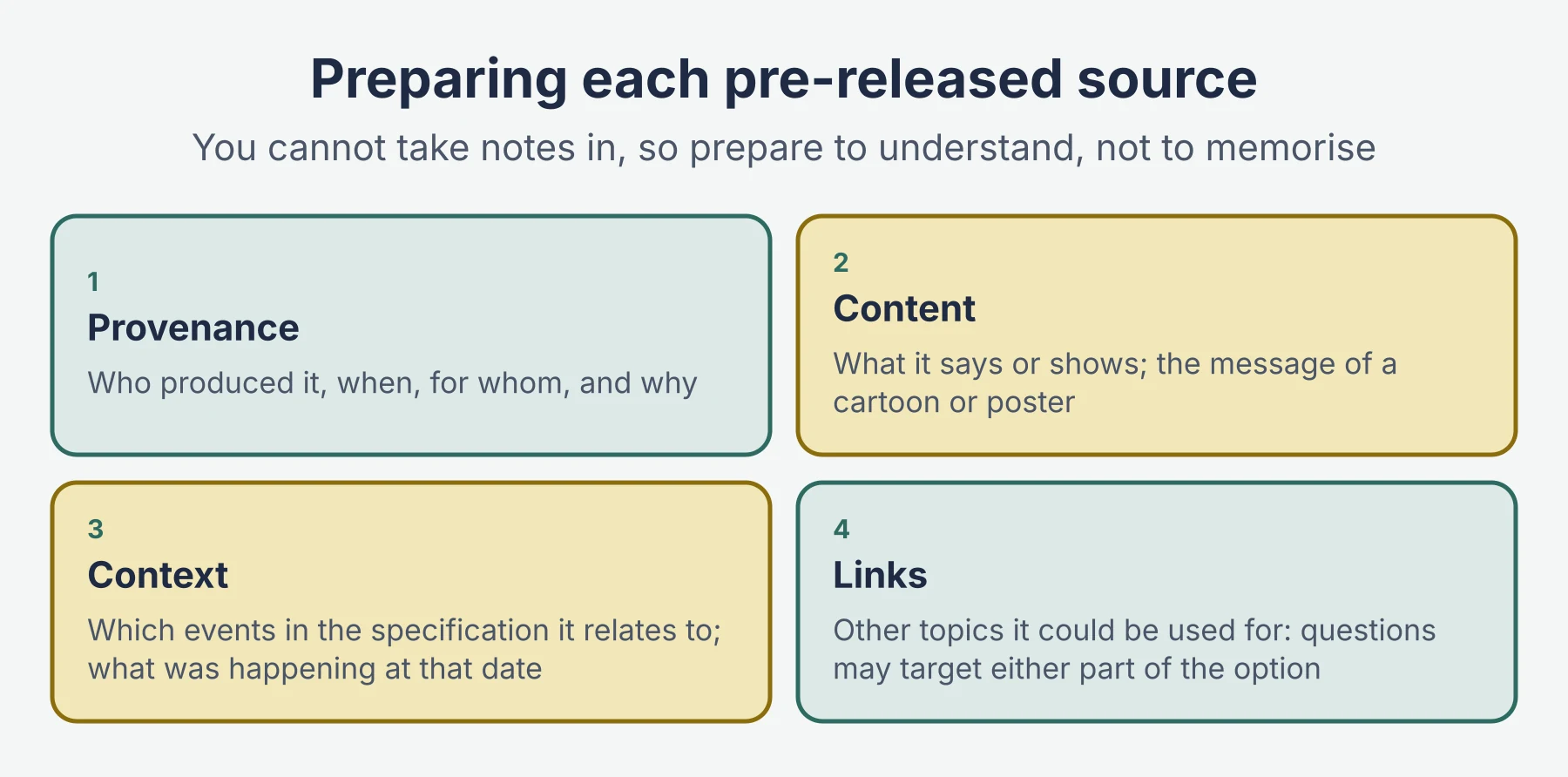
- Five sources: three pre-released (1 February for May/June; 1 July for October/November), two unseen. Clean copies provided; no notes allowed.
- All AO3: Question 1 (4 marks), Question 2 (6), Question 3 (8), Question 4 (12).
The four questions in a line each
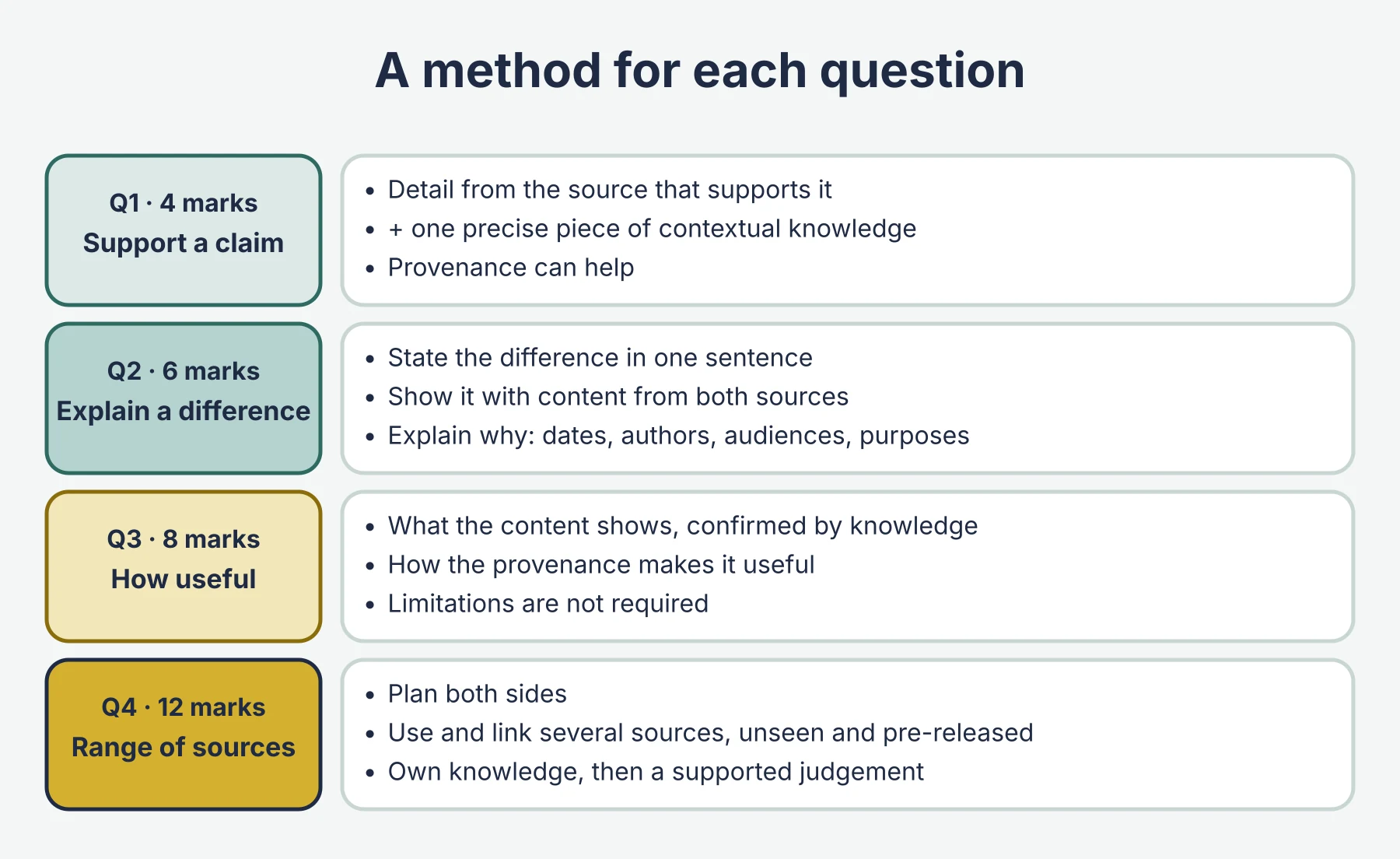
- Support a claim: source detail + contextual knowledge (+ provenance if helpful).
- Explain a difference: state it, show it from both sources, explain why with knowledge.
- Usefulness: content + knowledge, provenance + knowledge. Limitations are not required.
- Issue or development: link a range of sources, add own knowledge, reach a judgement.
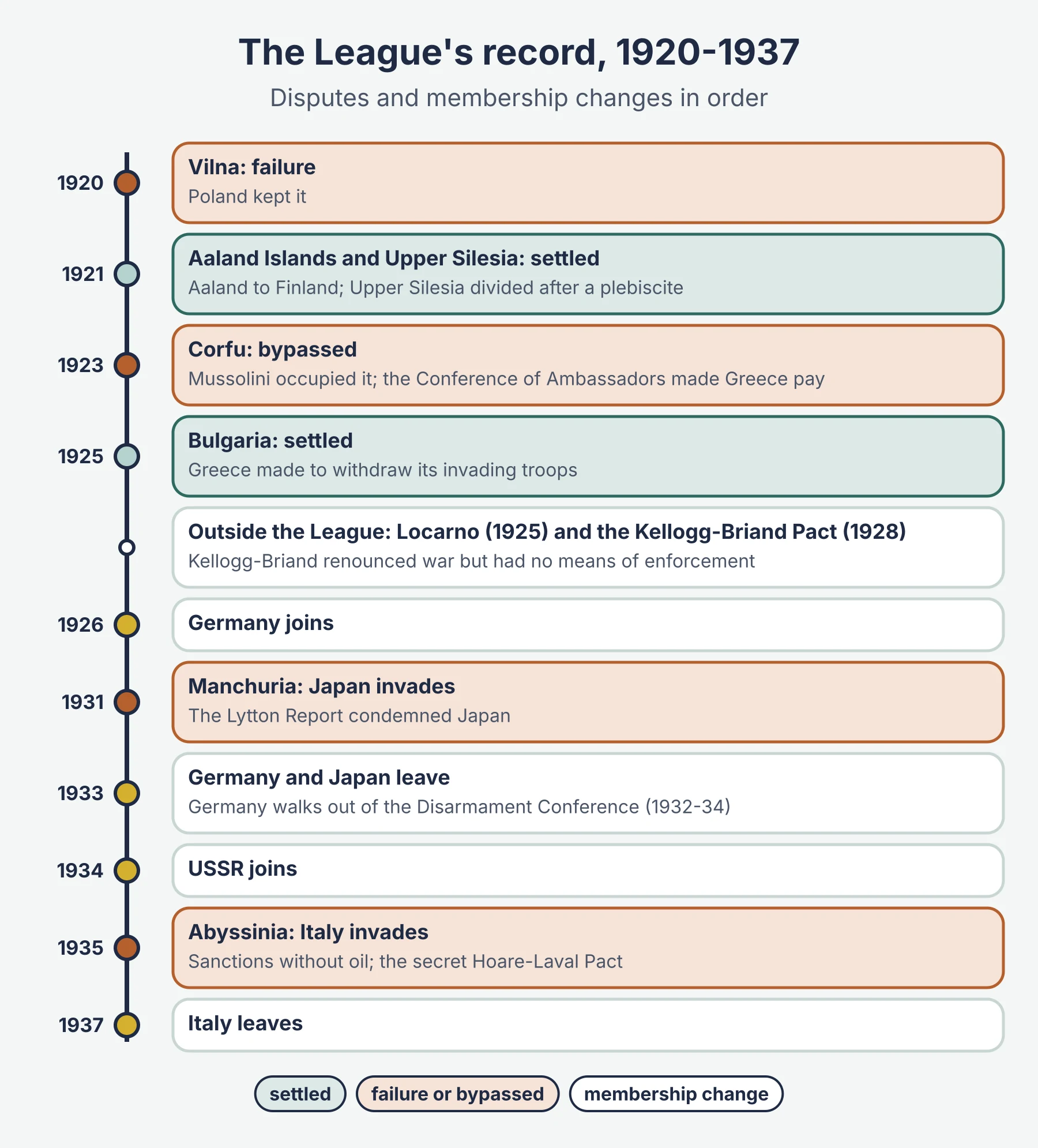
Option 1 timeline: Peacemaking and the League
| Date | Event |
|---|---|
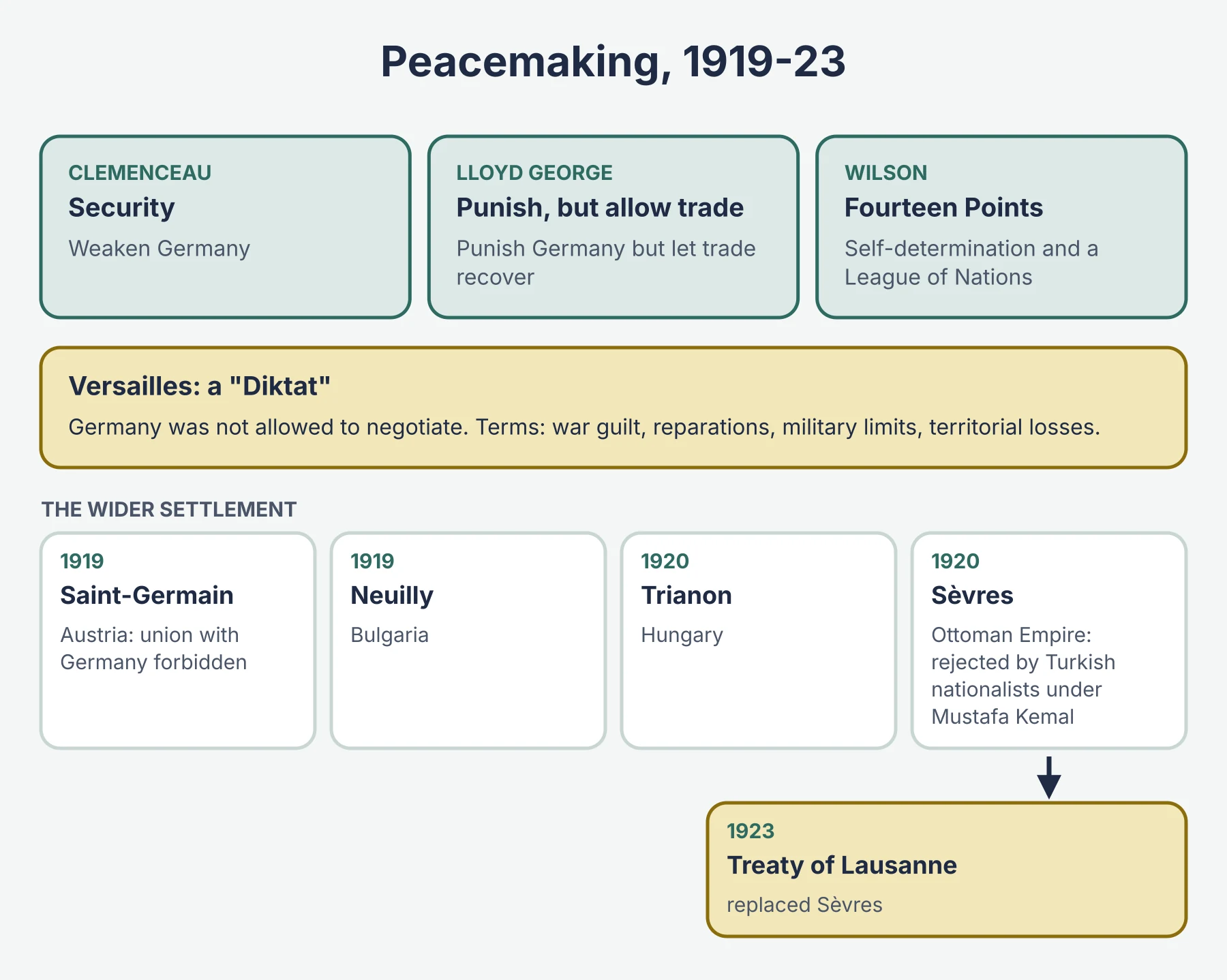
| 1919 | Paris Peace Conference; Treaty of Versailles; Saint-Germain (Austria); Neuilly (Bulgaria) |
| 1920 | Trianon (Hungary); Sèvres (Ottoman Empire); League begins work; Vilna seized by Poland |
| 1921 | Aaland Islands to Finland; Upper Silesia divided after plebiscite |
| 1923 | Corfu crisis; Treaty of Lausanne replaces Sèvres |
| 1924 | Geneva Protocol proposed, never in force |
| 1925 | Locarno treaties; Greek invasion of Bulgaria ended by the League |
| 1926 | Germany joins the League |
| 1928 | Kellogg-Briand Pact |
| 1929 | Wall Street Crash; world depression follows |
| 1931 | Japan invades Manchuria |
| 1932-34 | World Disarmament Conference |
| 1933 | Japan and Germany leave the League |
| 1935-36 | Italy invades Abyssinia; Hoare-Laval Pact |
| 1936-39 | Spanish Civil War; policy of non-intervention |
Why the League struggled: the USA never joined; decisions needed agreement; it had no army of its own; sanctions were slow and partial; Britain and France put their own interests first.
Option 2 timeline: Crises of the Cold War
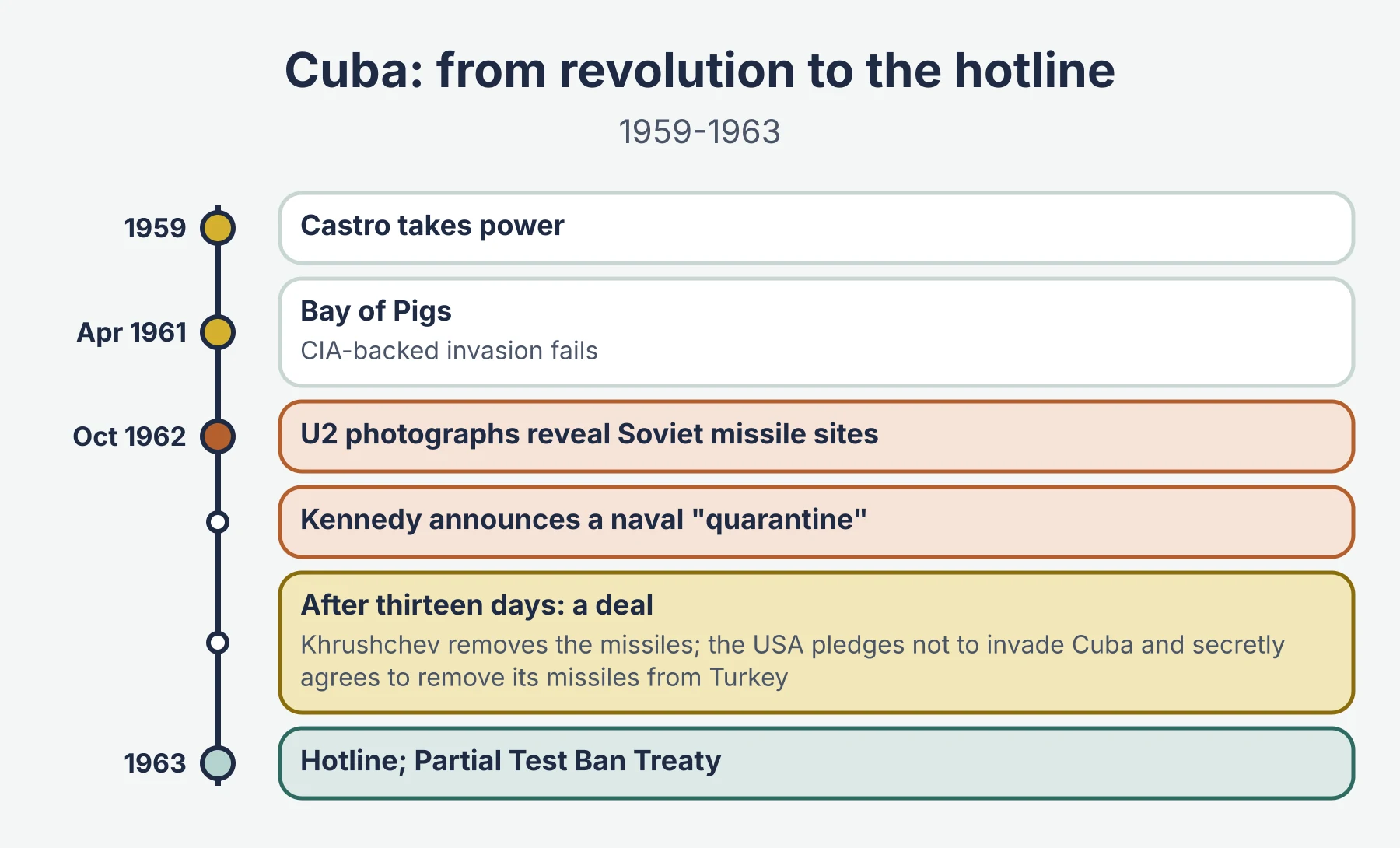
| Date | Event |
|---|---|
| 1959 | Castro takes power in Cuba |
| 1960 | U2 shot down; Paris Summit collapses |
| 1961 | Gagarin in space (April); Bay of Pigs (April); Berlin Wall begun (August) |
| 1962 | Strategic Hamlets programme; Cuban Missile Crisis (October) |
| 1963 | Hotline; Partial Test Ban Treaty; Kennedy in West Berlin |
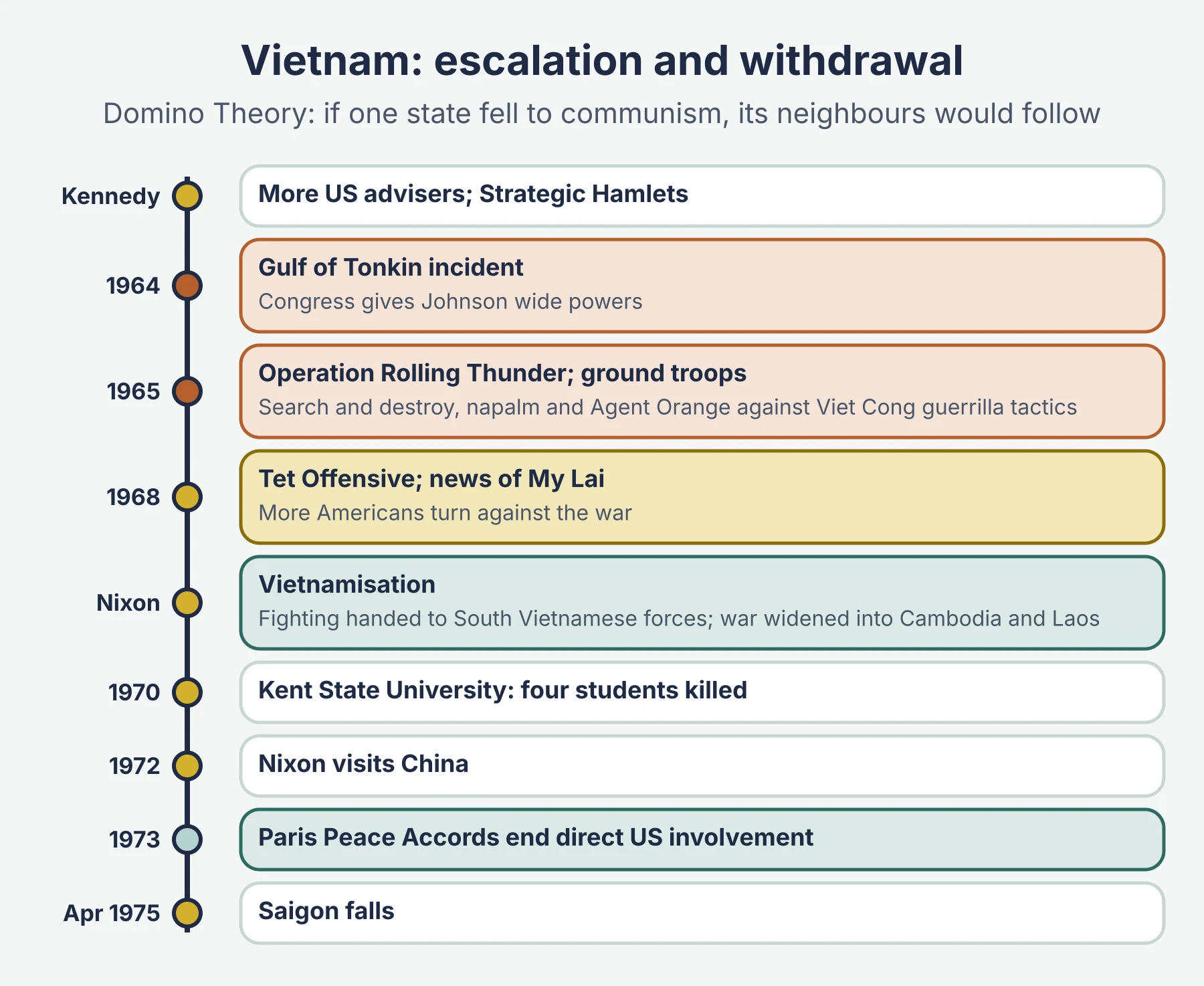
| 1964 | Gulf of Tonkin incident |
| 1965 | Rolling Thunder bombing; US ground troops in Vietnam |
| 1968 | Tet Offensive; My Lai; Prague Spring crushed (August); Brezhnev Doctrine |
| 1969 | Vietnamisation begins; Apollo Moon landing |
| 1970 | US forces enter Cambodia; Kent State shootings |
| 1972 | Nixon visits China |
| 1973 | Paris Peace Accords |
| 1975 | Fall of Saigon |
Why crises escalated and eased: mutual fear and the arms race raised the stakes; brinkmanship over Berlin and Cuba was followed by measures to reduce risk (the hotline, test ban); in Vietnam, US commitment grew under Kennedy and Johnson and was reduced under Nixon as opposition at home rose.
Key terms
| Term | Meaning |
|---|---|
| Provenance | Who made a source, when, why and for whom |
| Self-determination | The right of peoples to govern themselves |
| Diktat | A dictated peace, Germany’s view of Versailles |
| Covenant | The League’s founding rules |
| Collective security | Members acting together against an aggressor |
| Sanctions | Penalties, economic or military, against a state |
| Brinkmanship | Pushing a crisis to the edge of war to force the other side back |
| Containment | US policy of stopping the spread of communism |
| Domino Theory | Belief that one state falling to communism would bring down its neighbours |
| Vietnamisation | Nixon’s policy of handing the fighting to South Vietnam |
| Brezhnev Doctrine | Soviet claim to intervene where communism was threatened in the Eastern bloc |
Exam traps
- Describing a source without using it for the question’s issue.
- In Question 2, two separate summaries with no stated difference.
- In Question 3, dismissing a source as “biased” instead of explaining what it is useful for.
- In Question 4, too few sources, or no own knowledge, or no judgement.
- Confusing the order of events (for example, placing the Bay of Pigs after the missile crisis).
Self-test
- How many sources are pre-released, and how many are unseen?
- On what dates is the pre-release booklet made available?
- Which Section A question does not require you to evaluate limitations?
- What were Wilson’s main aims at the peace conference?
- Which treaty replaced the Treaty of Sèvres, and in what year?
- Name one League success and one failure of the early 1920s.
- What did the Locarno treaties confirm?
- Why did sanctions against Italy in 1935 fail to stop the invasion of Abyssinia?
- What happened in the U2 incident of 1960, and what was its effect?
- Give two terms of the agreement that ended the Cuban Missile Crisis.
- What was the Brezhnev Doctrine?
- What was Vietnamisation?
Answers
- Three pre-released; two unseen.
- 1 February for the May/June series and 1 July for the October/November series.
- Question 3 (usefulness).
- His Fourteen Points, including self-determination and a League of Nations.
- The Treaty of Lausanne, 1923.
- Success: the Aaland Islands or Upper Silesia (1921), or Bulgaria (1925). Failure: Vilna (1920) or Corfu (1923).
- Germany’s western borders with France and Belgium.
- Sanctions did not include oil, Britain and France did not close the Suez Canal, and they negotiated the Hoare-Laval Pact, undermining the League.
- A US spy plane was shot down over the USSR and its pilot captured; the Paris Summit collapsed.
- Any two: Soviet missiles removed from Cuba; a US pledge not to invade Cuba; secret removal of US missiles from Turkey.
- The Soviet claim to intervene in Eastern bloc states where communism was threatened, announced after the invasion of Czechoslovakia in 1968.
- Nixon’s policy of withdrawing US troops and handing the fighting to South Vietnamese forces.
Practise all four question types in the Paper 1 Section A practice questions, then revise the knowledge-based half with the Paper 1 Section B revision notes.
Related resources
-
Study guides
OxfordAQA International GCSE History (9245): Paper 1 Section B, Knowledge-Based Depth Studies
Paper 1 Section B of OxfordAQA International GCSE History 9245: the 3, 6, 9 and 12-mark questions and key knowledge for all four depth-study options.
World History · OxfordAQA · IGCSE
Read guide -
Practice questions
OxfordAQA International GCSE History (9245): Paper 1 Section B, Knowledge-Based Depth Studies – Practice Questions
Twelve original 9245 Paper 1 Section B questions across all four depth-study options, from 3-mark knowledge to 12-mark judgements, with marking guides.
World History · OxfordAQA · IGCSE
Try questions -
Revision notes
OxfordAQA International GCSE History (9245): Paper 1 Section B, Knowledge-Based Depth Studies – Revision Notes
Recall notes for 9245 Paper 1 Section B: question types, timelines for all four depth-study options, key terms, exam traps and a twelve-question self-test.
World History · OxfordAQA · IGCSE
Revise topic
Get free revision emails (optional)
Occasional emails with practice questions, worked explanations and links to free resources for the qualification and subjects you choose. No spam, and you can unsubscribe from any email. The free tools on this site never need an email.