
Study Guides
OxfordAQA International GCSE History (9245): The Wider Peace Settlement and the Treaty of Lausanne
The 1919-23 treaties with Austria, Hungary, Bulgaria and the Ottoman Empire for 9245 Paper 1 Section A: terms, strengths, difficulties and Lausanne.
- Subject
- World History
- Level
- IGCSE
- Topic
- Paper 1 – International Relations Depth Studies
- Author
- Marlbridge Academic Team
- Updated
- Reviewed by
- Azam Siddique (what this means)
Aligned to OxfordAQA IGCSE World History (9245), Version 1.1. Official specification .
Syllabus page (what it covers and how it is assessed): OxfordAQA IGCSE World History.
Syllabus points this page covers
9245
- 3.1.1 Section A
- 3.1.1.1 Peacemaking and the League of Nations, c1919-1939
Found an error? Report a correction.
Need help with this topic? Request a free trial class for IGCSE World History (9245).
This guide covers one content statement in Part 1 of the Section A option Peacemaking and the League of Nations, c1919-1939. The specification names “The wider settlement: the peacemakers’ treatment of Austria, Hungary and the Ottoman Empire; strengths of the treaties and the difficulties they created for different states; the Treaty of Lausanne.” The Paper 1 Section A study guide lists these treaties in one paragraph; this page explains what each did, why it caused problems, and how to use this knowledge when you meet sources on the peace settlement.
Why a “wider” settlement was needed
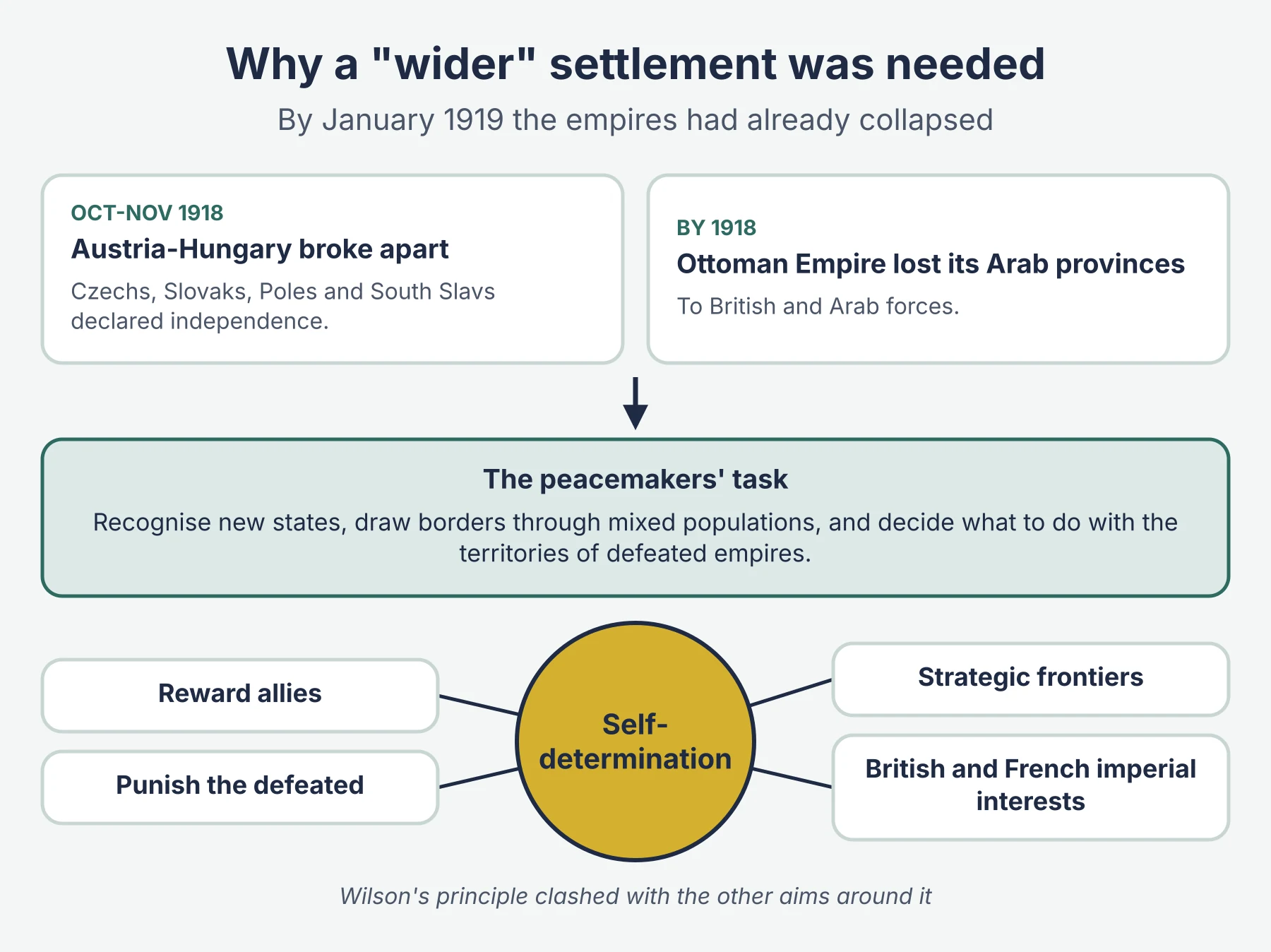
By the time the peacemakers met in Paris in January 1919, the empires of Central and Eastern Europe had already collapsed. Austria-Hungary had broken apart in October and November 1918, as Czechs, Slovaks, Poles and South Slavs declared independence. The Ottoman Empire had lost its Arab provinces to British and Arab forces. The peacemakers therefore had to recognise new states, draw borders through mixed populations and decide what to do with the territories of defeated empires.
Wilson’s principle of self-determination, the right of peoples to govern themselves, guided much of the redrawing, but it clashed with other aims: rewarding allies, punishing the defeated, securing strategic frontiers and protecting British and French imperial interests.
The treaties
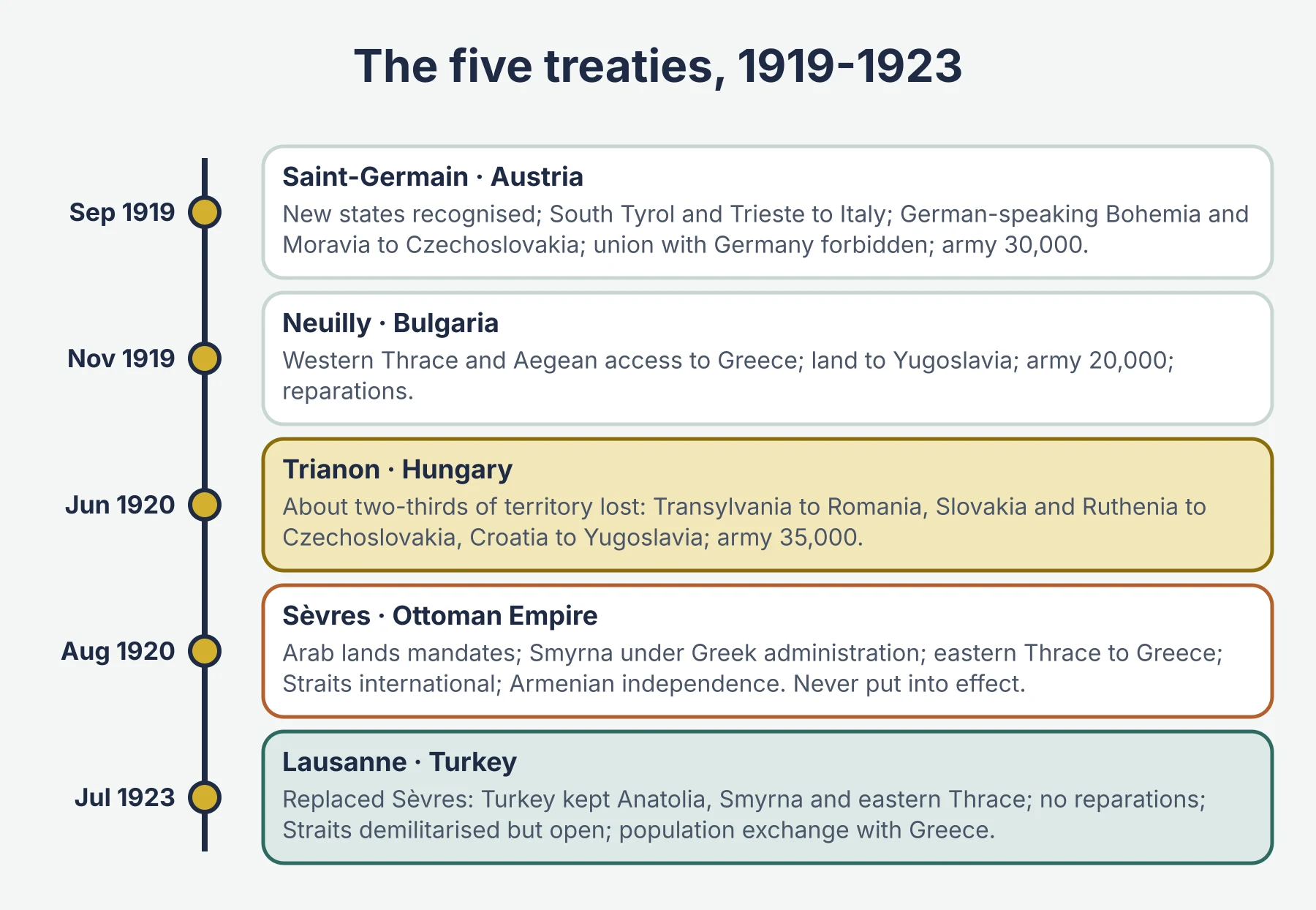
| Treaty | Date | Defeated state | Main terms |
|---|---|---|---|
| Saint-Germain | September 1919 | Austria | Recognised Czechoslovakia, Poland, Hungary and Yugoslavia; lost South Tyrol and Trieste to Italy; lost German-speaking Bohemia and Moravia to Czechoslovakia; union with Germany forbidden; army limited to 30,000 |
| Neuilly | November 1919 | Bulgaria | Lost Western Thrace, and with it access to the Aegean, to Greece; land to Yugoslavia; army limited to 20,000; reparations |
| Trianon | June 1920 | Hungary | Lost about two-thirds of its territory: Transylvania to Romania, Slovakia and Ruthenia to Czechoslovakia, Croatia to Yugoslavia; army limited to 35,000 |
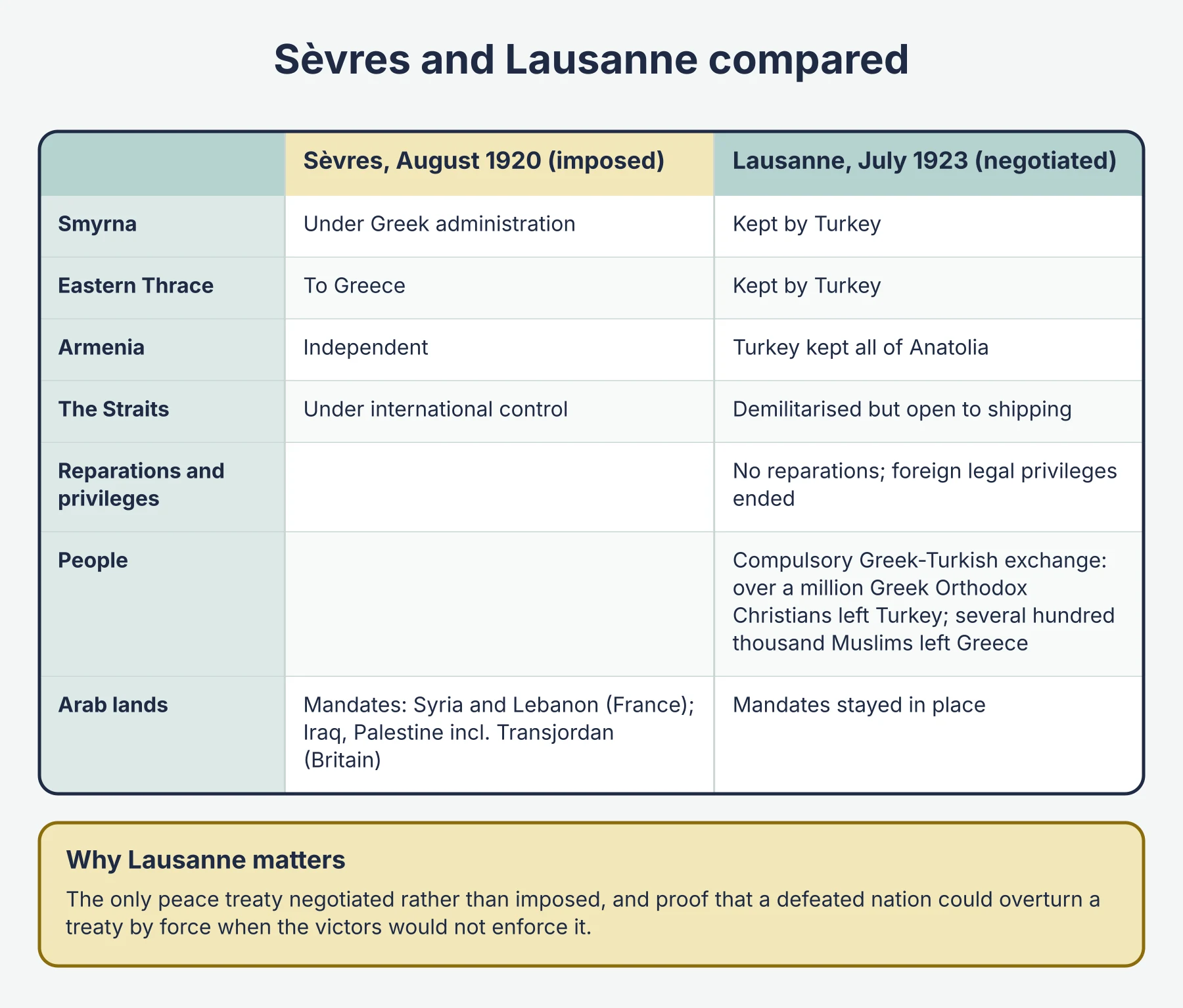
| Sèvres | August 1920 | Ottoman Empire | Arab lands became mandates; Smyrna under Greek administration; eastern Thrace to Greece; the Straits under international control; Armenian independence |
| Lausanne | July 1923 | Turkey | Replaced Sèvres: Turkey kept Anatolia, Smyrna and eastern Thrace; no reparations; the Straits demilitarised but open to shipping; exchange of populations with Greece |
Austria: a small state with a large capital
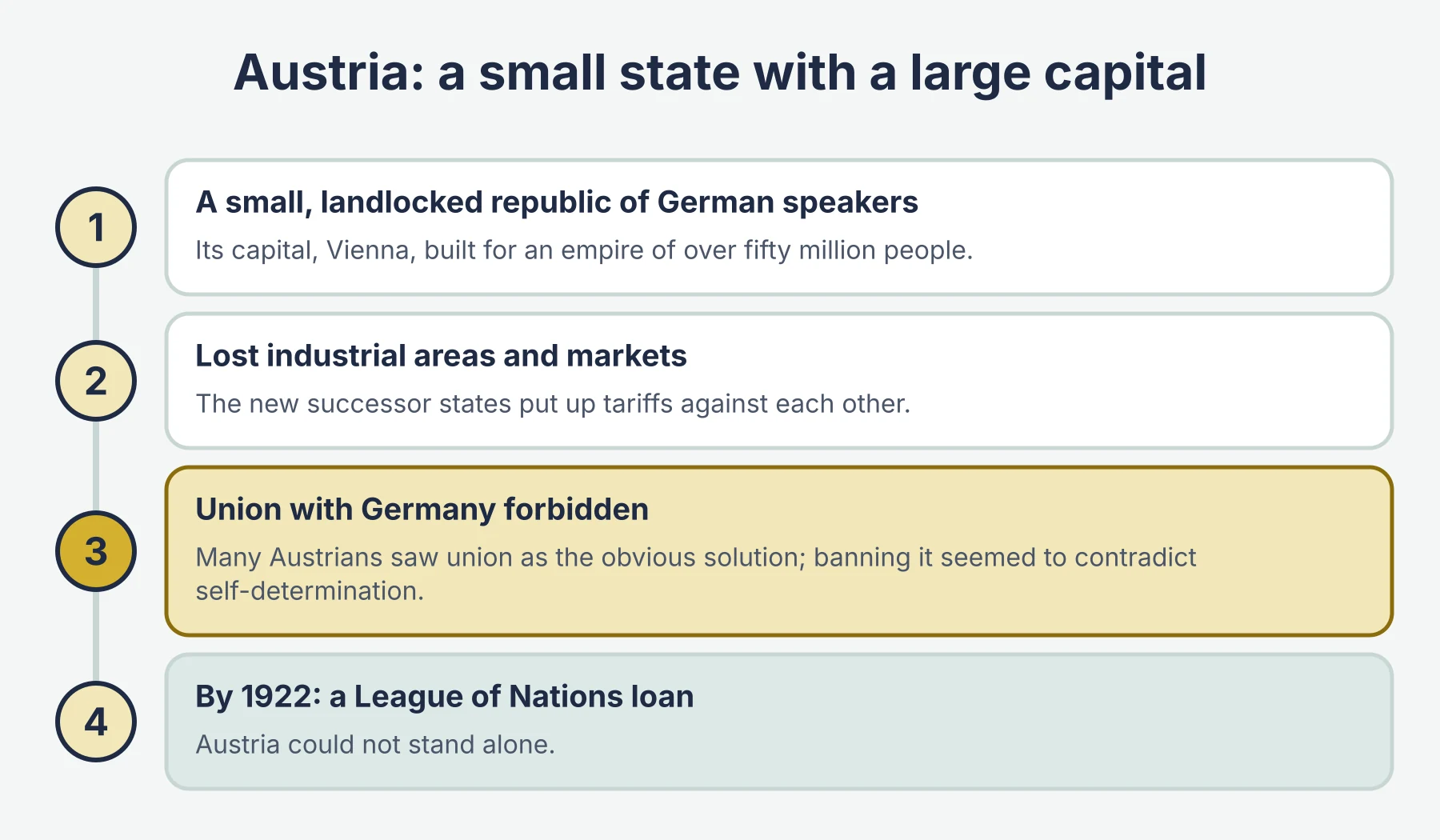
Austria became a small, landlocked republic of German speakers, its capital Vienna built for an empire of over fifty million people. It lost its industrial areas and its markets in the new successor states, which put up tariffs against each other. Many Austrians wanted union with Germany as the obvious solution, but the treaty forbade it, which seemed to contradict self-determination. By 1922 Austria needed a loan arranged through the League of Nations.
Hungary: the most resented treaty
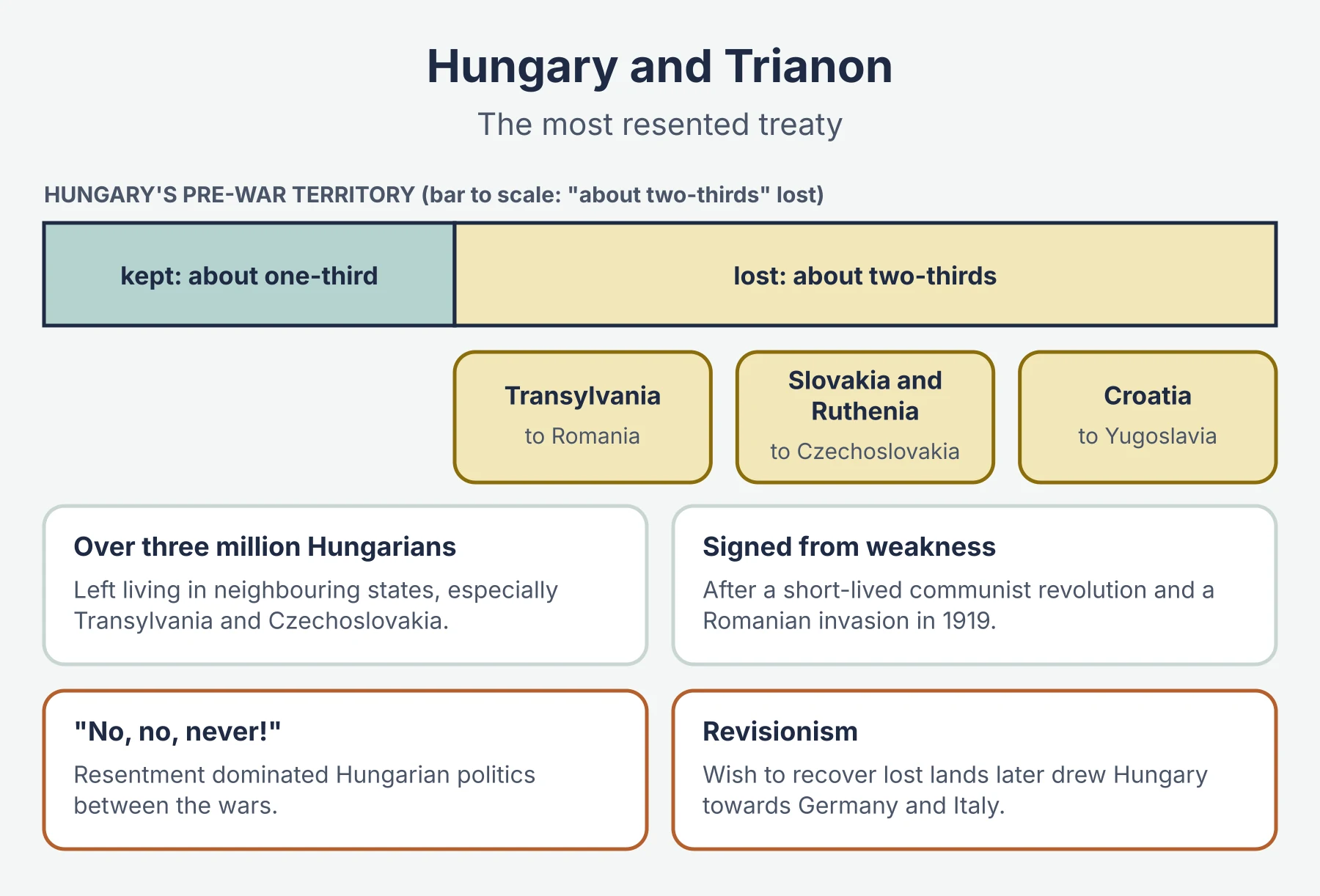
Hungary lost about two-thirds of its land, and over three million Hungarians found themselves living in neighbouring states, especially in Romanian Transylvania and in Czechoslovakia. Hungary had been through a short-lived communist revolution and a Romanian invasion in 1919, and Trianon was signed by a government in no position to resist. Resentment of the treaty, summed up in the slogan “No, no, never!”, dominated Hungarian politics between the wars, and Hungary’s wish to recover its lost lands later drew it towards Germany and Italy.
Bulgaria
Bulgaria, which had joined the Central Powers in 1915, lost its outlet to the Aegean Sea and territory to Yugoslavia and Greece, and had to pay reparations. Refugees from the lost lands added to economic hardship, and Bulgaria remained hostile to its neighbours, as the border clash with Greece in 1925 showed.
The Ottoman Empire, Sèvres and the rise of Turkey
During the war Britain and France had secretly agreed in the Sykes-Picot Agreement (1916) how to divide Ottoman lands, while Britain had also encouraged Arab hopes of independence and, in the Balfour Declaration (1917), supported a Jewish “national home” in Palestine. At Sèvres the Arab lands became mandates supervised by the League: Syria and Lebanon under France; Iraq and Palestine, including Transjordan, under Britain. The Turkish heartland itself was to be weakened: Greece would administer Smyrna, Armenia would be independent, and the Straits would be international.
The Sultan’s government signed Sèvres, but Turkish nationalists led by Mustafa Kemal rejected it. They defeated Armenian and French forces, and in the war with Greece (1919-22) drove the Greek army out of Anatolia, retaking Smyrna in September 1922. Britain came close to war with the nationalists at Chanak in 1922, but no ally was willing to fight. Sèvres was never put into effect.
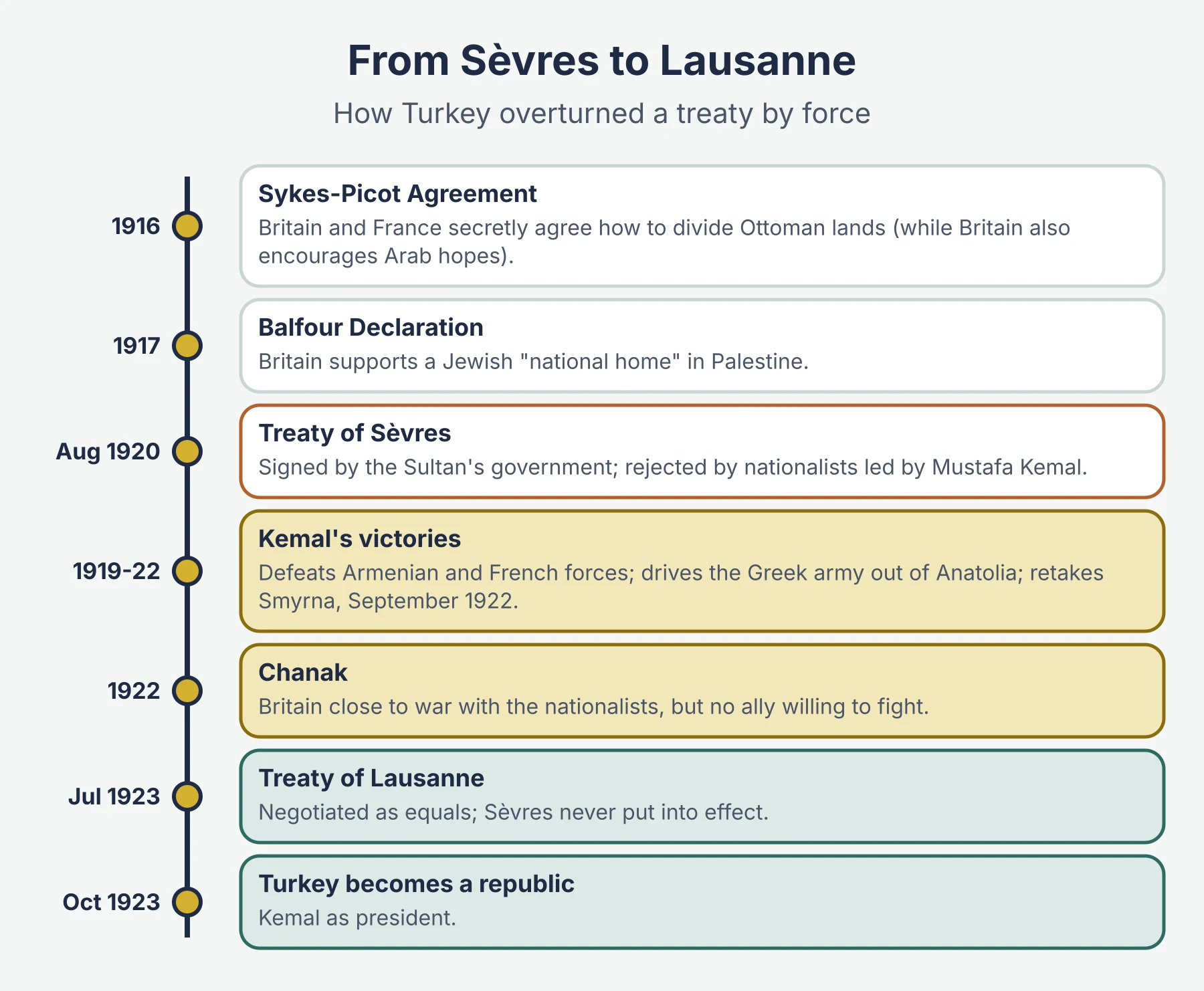
The Treaty of Lausanne, 1923
At Lausanne the Allies negotiated with the Turkish nationalists as equals. Turkey kept all of Anatolia, Smyrna and eastern Thrace, paid no reparations and ended the special legal privileges foreign powers had enjoyed. The Straits were demilitarised but opened to shipping. Greece and Turkey agreed a compulsory exchange of populations: over a million Greek Orthodox Christians left Turkey, and several hundred thousand Muslims left Greece. The mandates in the Arab lands stayed in place. In October 1923 Turkey became a republic, with Kemal as president.
Lausanne is significant because it was the only peace treaty negotiated rather than imposed, and because it showed that a defeated nation could overturn a treaty by force when the victors were unwilling to enforce it, a lesson later noted by others.
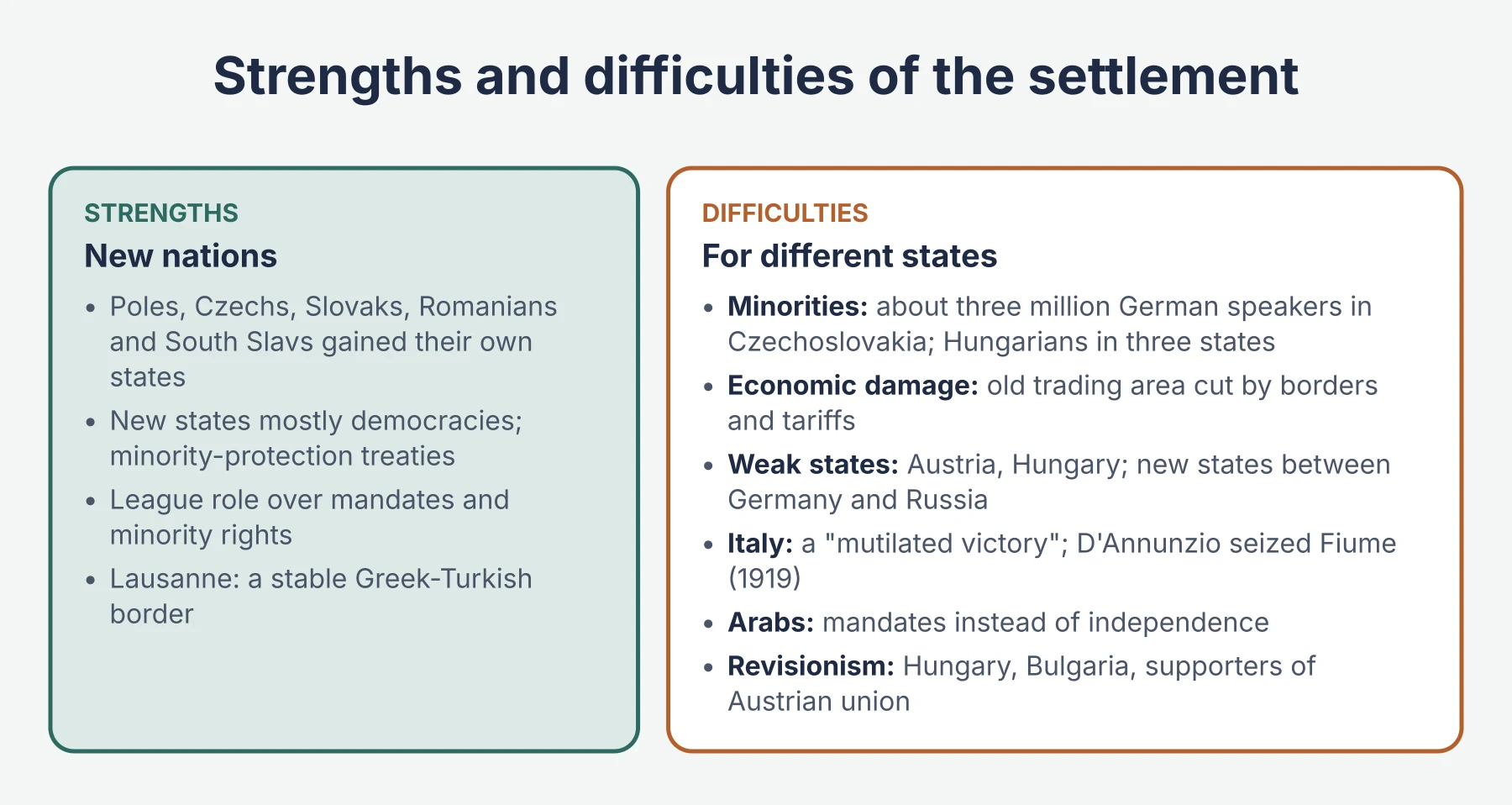
Strengths and difficulties
Strengths
- Millions of Poles, Czechs, Slovaks, Romanians and South Slavs gained states of their own.
- New states were mostly founded as democracies, and minority-protection treaties were signed.
- The League was given a role in supervising mandates and minority rights.
- Lausanne produced a stable border between Greece and Turkey.
Difficulties for different states
- Minorities everywhere: about three million German speakers in Czechoslovakia; Hungarians in Romania, Czechoslovakia and Yugoslavia; Serbs and Croats uneasy together in Yugoslavia.
- Economic damage: the trading area of the old Austro-Hungarian Empire was broken up by new borders and tariffs.
- Weak states: Austria and Hungary were too small to stand alone, and the new states between Germany and Russia were vulnerable.
- Discontented victors: Italy, promised Dalmatia in 1915, called the result a “mutilated victory”, and the nationalist poet D’Annunzio seized Fiume in 1919.
- Arab disappointment: hopes of independence were replaced by British and French mandates.
- Revisionism: Hungary, Bulgaria and later Austria’s supporters of union looked for ways to overturn the treaties.
Using this knowledge with sources
In Section A your knowledge is used to judge sources. When you meet a source on the wider settlement:
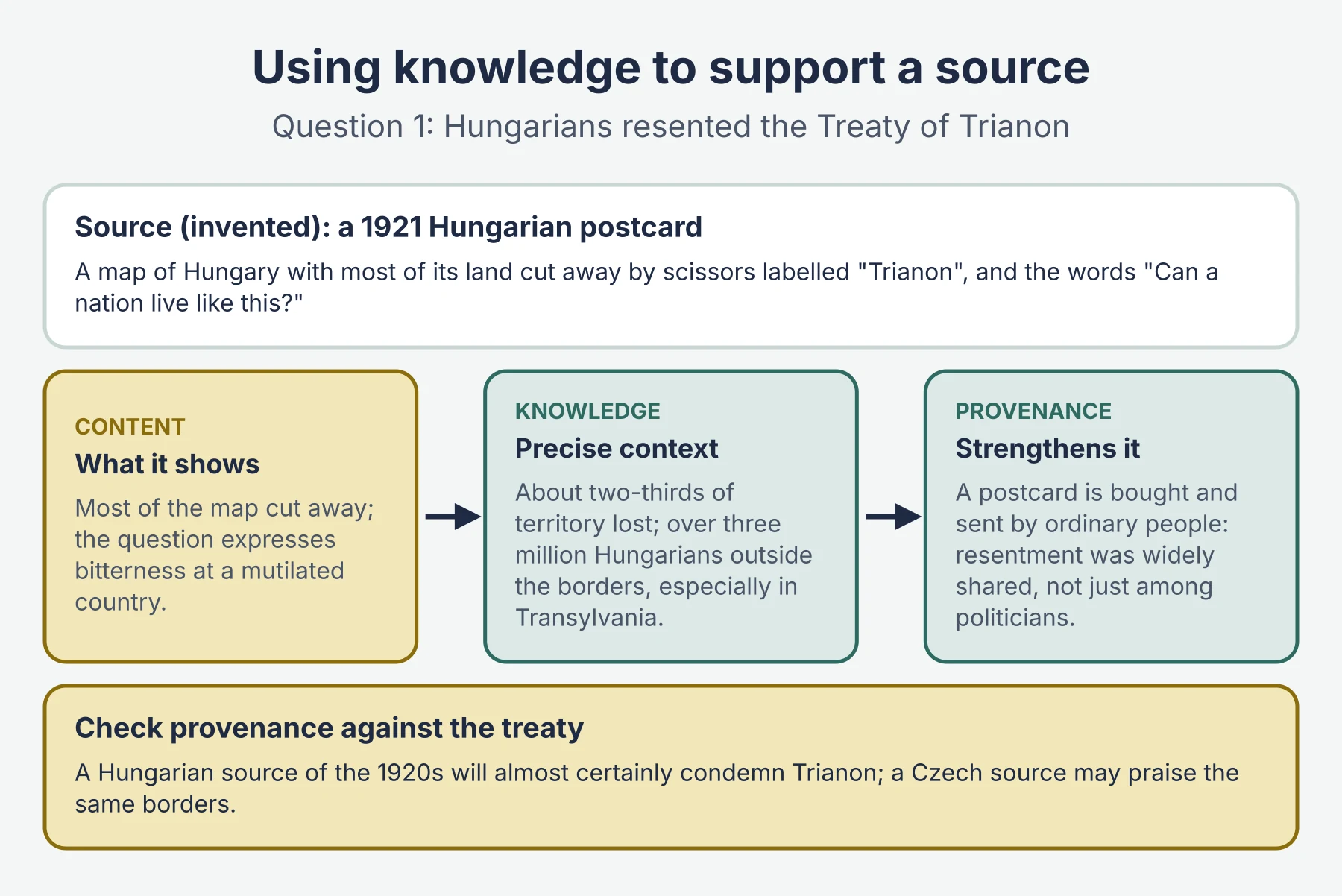
- Check its provenance against the treaty it describes. A Hungarian source of the 1920s will almost certainly condemn Trianon; a Czech source may praise the same borders.
- Use precise terms as context. “Union with Germany was forbidden” or “Hungary lost about two-thirds of its land” turns a general comment into supported analysis.
- Link to self-determination. Many sources argue about whether the principle was applied fairly; your knowledge of German speakers in Czechoslovakia or Hungarians in Romania lets you test the claim.
Worked example: Question 1 (4 marks)
Source (invented for this guide): a 1921 Hungarian postcard showing a map of Hungary with most of its land cut away by scissors labelled “Trianon”, and the words “Can a nation live like this?”
Use the source and your contextual knowledge to support the claim that Hungarians resented the Treaty of Trianon.
The postcard shows most of Hungary’s map being cut away, and its question “Can a nation live like this?” expresses bitterness that the country has been mutilated. This supports the claim because my knowledge shows that Trianon took about two-thirds of Hungary’s territory and left over three million Hungarians outside the new borders, especially in Transylvania. The provenance strengthens the support: a postcard is made to be bought and sent by ordinary people, so its existence in 1921 suggests resentment was widely shared, not limited to politicians.
Common mistakes
- Treating the Treaty of Versailles as the whole settlement.
- Mixing up Trianon (Hungary) with Saint-Germain (Austria).
- Saying Sèvres was enforced; it was replaced by Lausanne.
- Overlooking the strengths: self-determination did create new nations.
- Using knowledge of the settlement only to describe, rather than to test a source’s claim.
Further practice
- Wider peace settlement revision notes
- Wider peace settlement practice questions
- Paper 1 Section A revision notes
Specification
OxfordAQA International GCSE History (9245) specification, Version 1.1, section 3.1.1.1 – oxfordaqa.com.
Related resources
-
Practice questions
OxfordAQA International GCSE History (9245): The Wider Peace Settlement and the Treaty of Lausanne – Practice Questions
Original 9245 practice on the treaties with Austria, Hungary, Bulgaria and the Ottoman Empire: knowledge checks and a five-source set with marking guides.
World History · OxfordAQA · IGCSE
Try questions -
Revision notes
OxfordAQA International GCSE History (9245): The Wider Peace Settlement and the Treaty of Lausanne – Revision Notes
Revision notes for 9245 on the wider peace settlement: Saint-Germain, Neuilly, Trianon, Sèvres and Lausanne, strengths, difficulties and a self-test.
World History · OxfordAQA · IGCSE
Revise topic -
Study guides
OxfordAQA IGCSE World History: International Relations Depth Studies (9245)
Paper 1 of OxfordAQA International GCSE History 9245, International relations depth studies: the source-based and knowledge-based sections and their options.
World History · OxfordAQA · IGCSE
Read guide
Get free revision emails (optional)
Occasional emails with practice questions, worked explanations and links to free resources for the qualification and subjects you choose. No spam, and you can unsubscribe from any email. The free tools on this site never need an email.