
Revision Notes
OxfordAQA International GCSE History (9245): Section A Question 4 – Using a Range of Sources – Revision Notes
Revision notes for 9245 Paper 1 Section A Question 4: the sorting grid, five ways to link sources, weighing provenance, timing, traps and a self-test.
- Subject
- World History
- Level
- IGCSE
- Topic
- Paper 1 – International Relations Depth Studies
- Author
- Marlbridge Academic Team
- Updated
- Reviewed by
- Azam Siddique (what this means)
Aligned to OxfordAQA IGCSE World History (9245), Version 1.1. Official specification .
Syllabus page (what it covers and how it is assessed): OxfordAQA IGCSE World History.
Syllabus points this page covers
9245
- 3.1.1 Section A
Found an error? Report a correction.
Need help with this topic? Request a free trial class for IGCSE World History (9245).
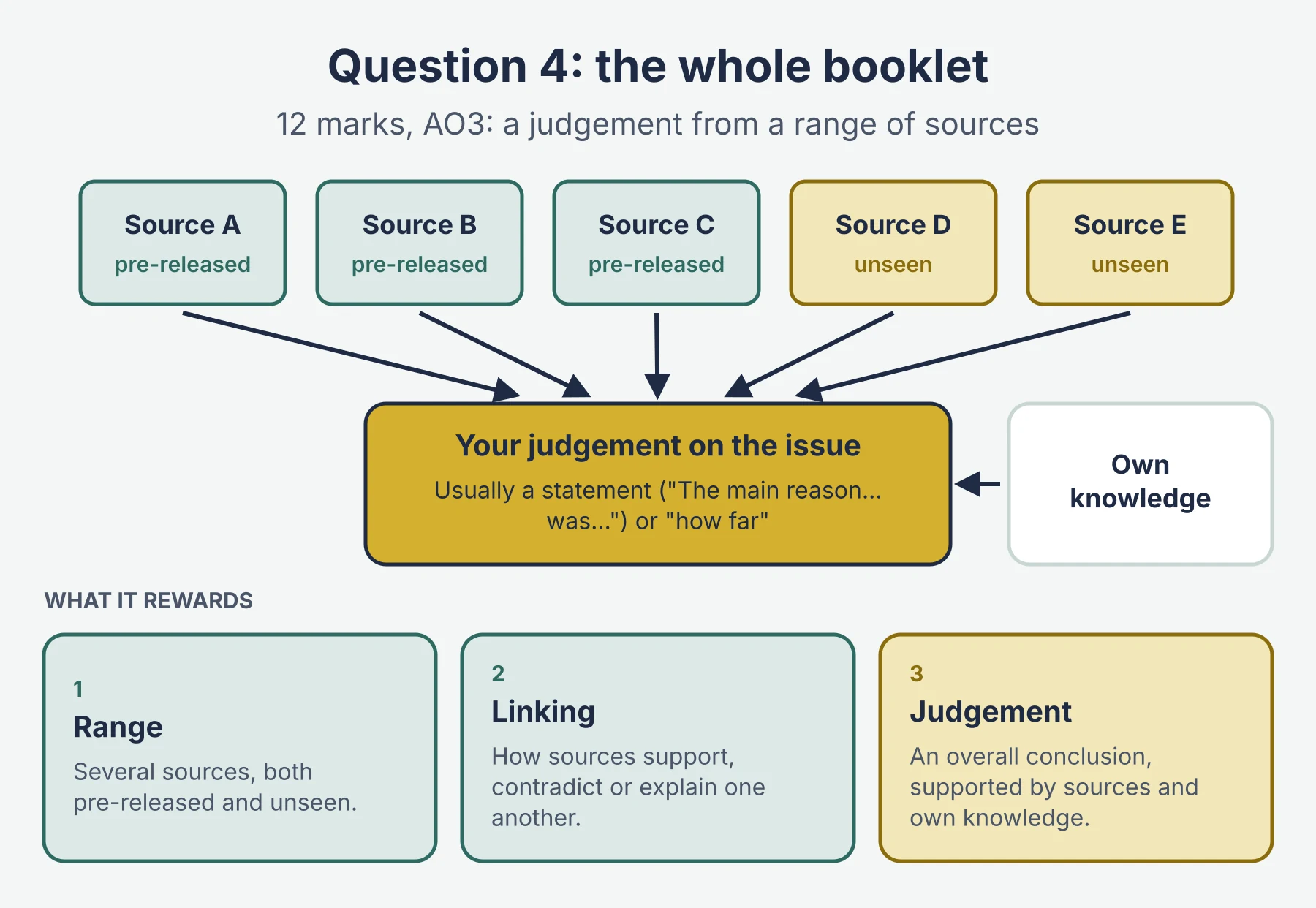
Condensed notes on the 12-mark Question 4 in Paper 1 Section A. The specification says it requires students “to analyse and evaluate a given issue or development using evidence from a range of the sources (both unseen and in the pre-release pack) and their own knowledge”, and that they “should aim to use and link together a range sources to support their reasoning”. The planning method and a worked League of Nations answer are in the Question 4 study guide; the other three questions are summarised in the Paper 1 Section A revision notes.
Question 4 at a glance
| Feature | Detail |
|---|---|
| Marks | 12 (AO3) |
| Sources | A range from all five: three pre-released, two unseen |
| Task | Analyse and evaluate an issue or development |
| Content focus | Part 1 or Part 2 of your option |
| Ingredients | Range, linking, provenance where relevant, own knowledge, judgement |
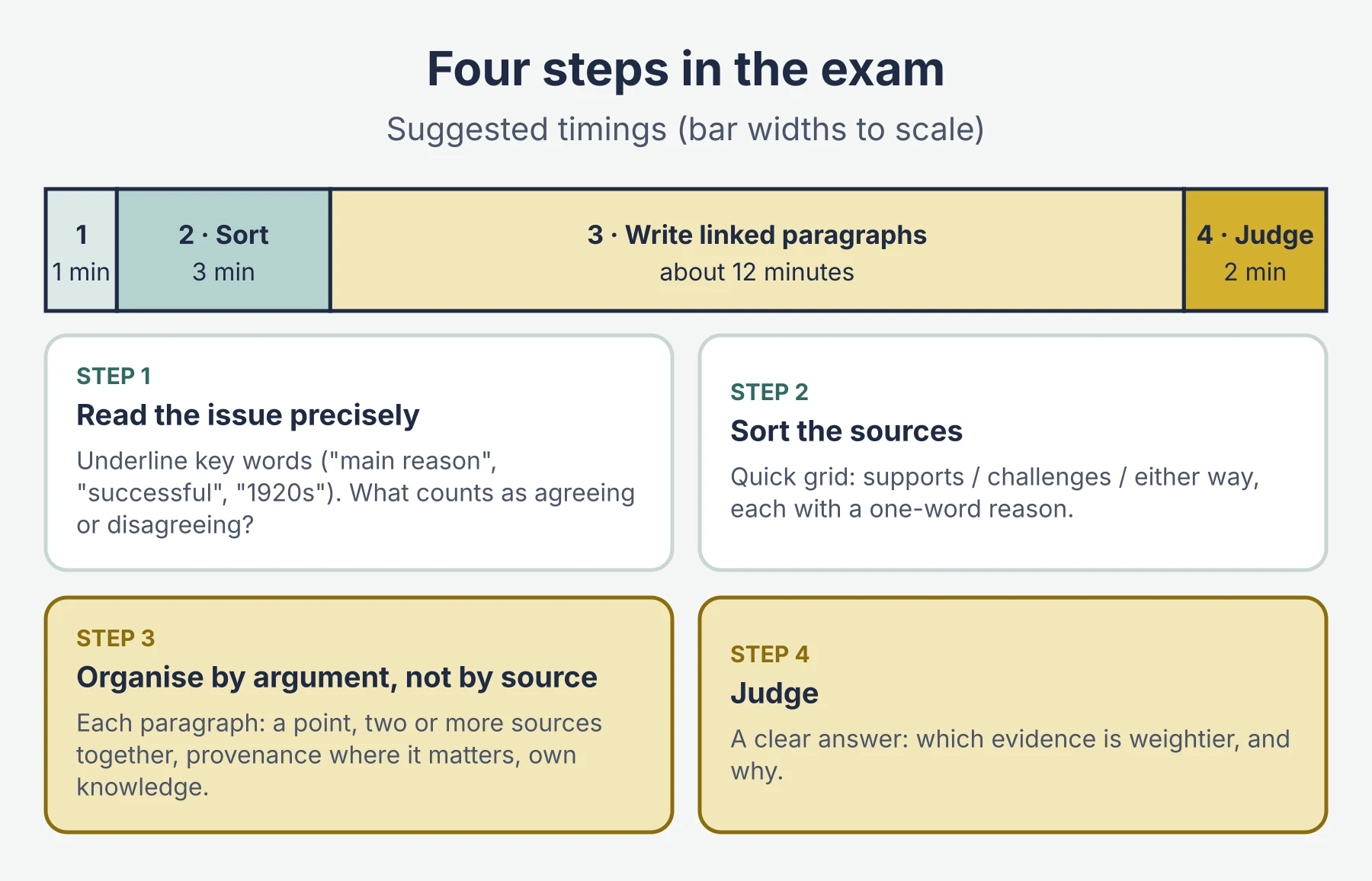
| Time | About 18 minutes of Section A’s roughly 50 |
How it differs from Questions 1-3
- Questions 1-3 each work with one or two specified sources.
- Question 4 expects you to choose and combine sources yourself, across the booklet.
- Question 3 does not require limitations; in Question 4, provenance helps you decide how much weight a source can bear, so judging strengths and weaknesses can support your argument.
The four-step method
- Issue – underline key words; decide what agreeing and disagreeing would mean.
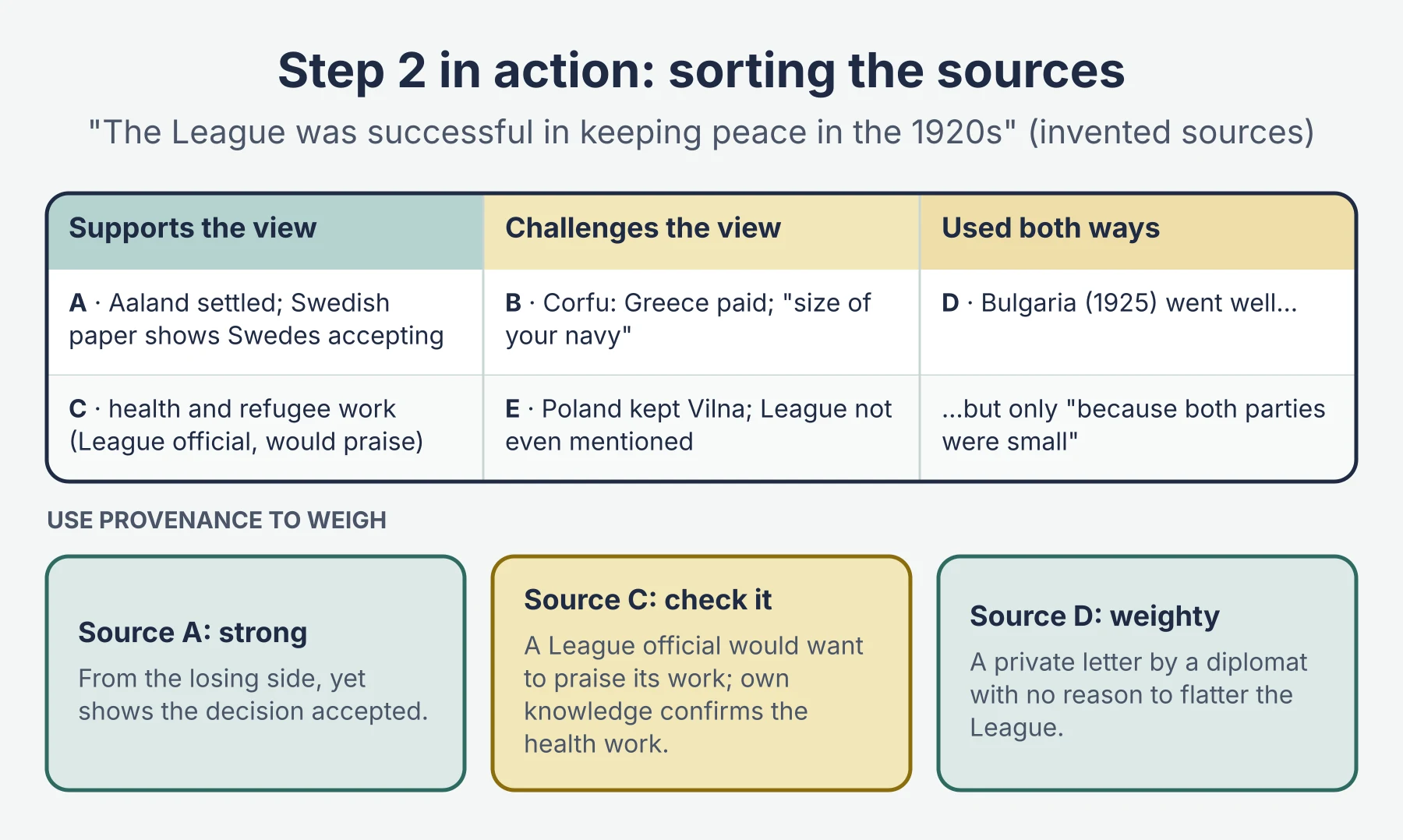
- Sort – grid of supports, challenges, either way.
- Write – paragraphs by argument; each uses two or more sources, provenance where useful, and own knowledge.
- Judge – answer the question and say why one side carries more weight.
Five ways to link sources
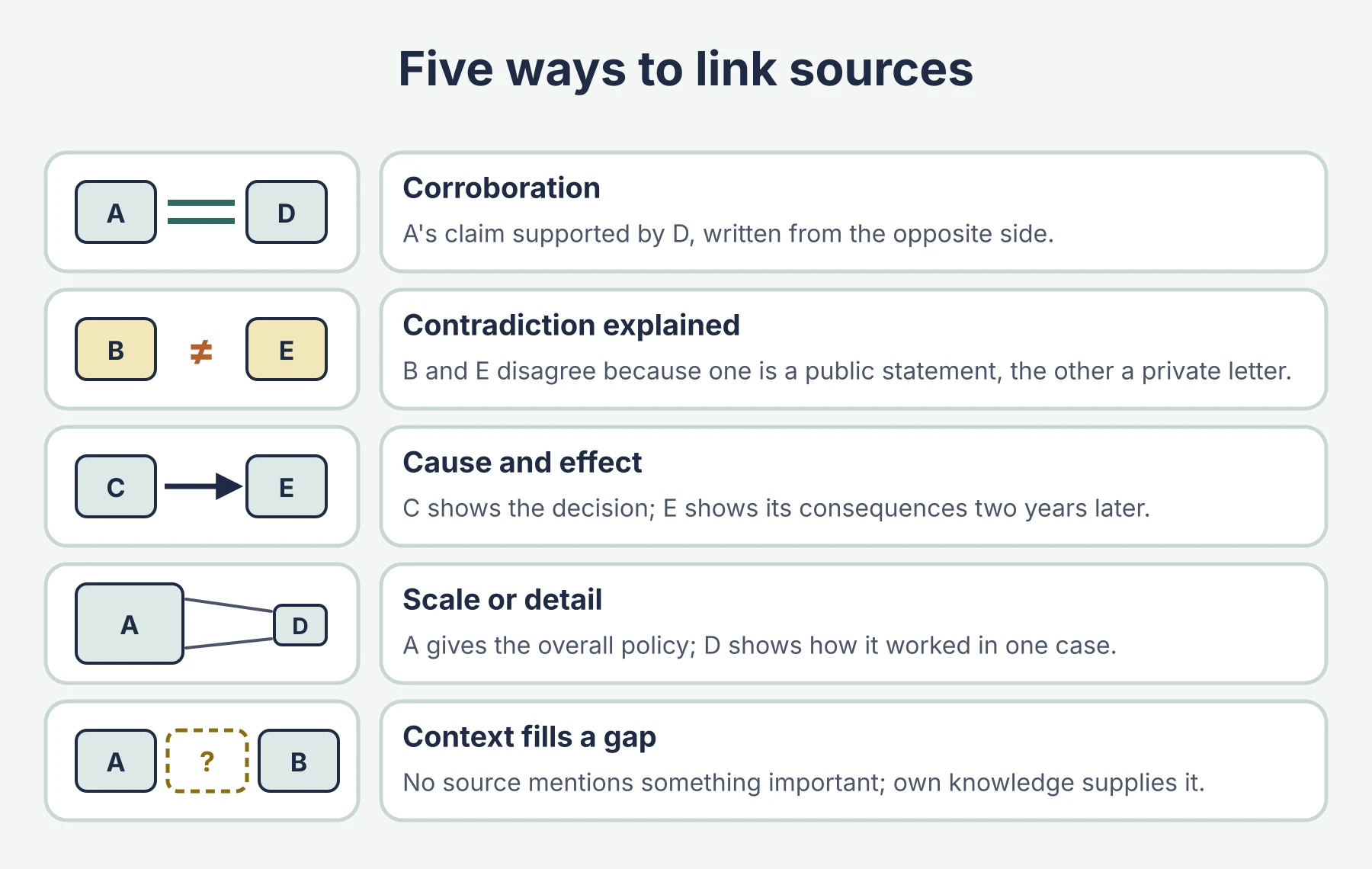
| Link | Signal phrases |
|---|---|
| Corroboration | “is supported by”, “agrees with”, “confirms” |
| Contradiction explained | “disagrees with… because its author…”, “unlike” |
| Cause and effect | “shows the decision, while… shows its result” |
| General and particular | “gives the policy; … shows it in practice” |
| Gap filled by knowledge | “none of the sources mentions…, but” |
Weighing provenance in Question 4
| Type of source | Strong evidence of | Weaker evidence of |
|---|---|---|
| Official speech or statement | What a government or organisation wanted people to believe | What its leaders privately thought |
| Private letter or diary | Personal views and reactions | The wider picture |
| Newspaper report or cartoon | Public opinion in that country | Events the paper could not see |
| Report by an insider | What officials knew | How others saw the issue |
| Later secondary source | An overview with hindsight | The feelings of people at the time |
A source from the “losing” or opposing side that still supports a view is especially strong evidence.
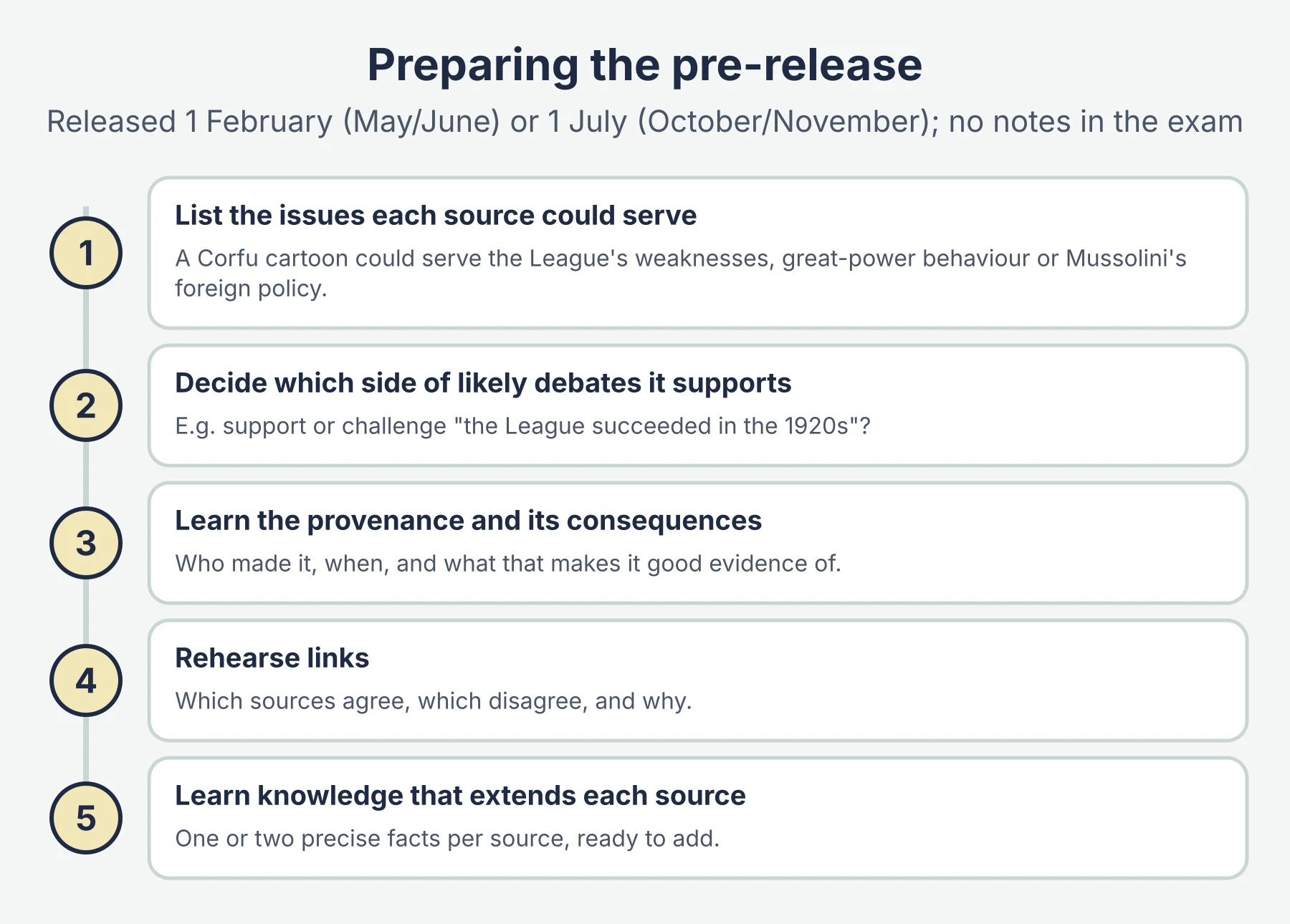
Preparing the pre-release
- Know each source’s provenance and message without notes.
- List three possible issues each source could be used for.
- Decide which side of likely debates each one supports.
- Learn one or two facts to extend each source.
- Rehearse links between the three pre-released sources.
Key terms
| Term | Meaning |
|---|---|
| Pre-release | The three sources published before the exam (1 February or 1 July) |
| Unseen source | A source met for the first time in the exam |
| Range | Using several sources, not just one or two |
| Corroborate | Confirm with independent evidence |
| Cross-reference | Compare what different sources say |
| Weight | How much a source can be trusted to support a claim |
| Judgement | A supported conclusion answering the question |
| AO3 | Analysing and evaluating sources as part of an enquiry |
Exam traps
- Source-by-source tours: A, then B, then C, with no argument.
- Ignoring the unseen sources because the pre-release is more familiar.
- Long quotations: use a few words as evidence.
- Knowledge bolted on at the end rather than testing each source.
- “It depends” as a conclusion, with no decision.
- Running out of time: Question 4 is 12 of Section A’s 30 marks.
- Bringing annotated material: no notes or annotations are allowed; a clean copy of all five sources is provided.
Self-test
- How many marks is Question 4, and which assessment objective does it test?
- How many sources are in the booklet, and how many of those are unseen?
- Name two things the specification says Question 4 requires.
- What are the three columns of the sorting grid?
- Should paragraphs be organised by source or by argument?
- Give two ways of linking sources.
- Why is a source from the opposing side that agrees with a view strong evidence?
- When is the pre-release booklet published for the May/June series?
- Can you take annotated copies of the pre-release into the exam?
- Roughly how long should Question 4 take?
- What is the weakness of a conclusion that says “it depends”?
- Which parts of the option content can Question 4 target?
Answers
- 12 marks; AO3.
- Five; two are unseen.
- Any two: analyse and evaluate an issue or development; use a range of the sources, both unseen and pre-released; use own knowledge; link sources together to support reasoning.
- Supports the view; challenges the view; could be used either way.
- By argument.
- Any two: corroboration; contradiction explained by provenance; cause and effect; general and particular; a gap filled by own knowledge.
- Its author has no reason to support the view, so the agreement is less likely to be the result of bias.
- 1 February.
- No. A clean copy of all five sources is provided.
- About 18 minutes.
- It does not decide which side is stronger or explain why.
- Part 1 or Part 2.
Work through the five-source sets in the Question 4 practice questions.
Related resources
-
Study guides
OxfordAQA International GCSE History (9245): The 12-Mark Judgement Question
How to write the 12-mark Question 4 in 9245 Paper 1 Section B: a line of reasoning, linked factors and a judgement on relative importance, with two plans.
World History · OxfordAQA · IGCSE
Read guide -
Practice questions
OxfordAQA International GCSE History (9245): The 12-Mark Judgement Question – Practice Questions
Original 9245 Paper 1 Section B practice: planning tasks and eight 12-mark judgement questions across all four depth-study options, with marking guides.
World History · OxfordAQA · IGCSE
Try questions -
Revision notes
OxfordAQA International GCSE History (9245): The 12-Mark Judgement Question – Revision Notes
Revision notes for the 9245 12-mark Question 4: the four levels, line of reasoning, comparison tools, factor banks for all four options and a self-test.
World History · OxfordAQA · IGCSE
Revise topic
Get free revision emails (optional)
Occasional emails with practice questions, worked explanations and links to free resources for the qualification and subjects you choose. No spam, and you can unsubscribe from any email. The free tools on this site never need an email.