
Revision Notes
OxfordAQA International GCSE History (9245): The Printing Revolution, c1440-c1800 – Revision Notes
Revision notes for the 9245 Printing Revolution: Asian printing, Gutenberg's press, the book trade, type, women, copyright, Reformation, literacy and science.
- Subject
- World History
- Level
- IGCSE
- Topic
- Paper 2 – Studies in Change
- Author
- Marlbridge Academic Team
- Updated
- Reviewed by
- Azam Siddique (what this means)
Aligned to OxfordAQA IGCSE World History (9245), Version 1.1. Official specification .
Syllabus page (what it covers and how it is assessed): OxfordAQA IGCSE World History.
Syllabus points this page covers
9245
- 3.2.2 Section B - Thematic Studies
- 3.2.2.1 Technology and change, c800 – present day
Found an error? Report a correction.
Need help with this topic? Request a free trial class for IGCSE World History (9245).
Condensed notes on “The Printing Revolution (c1440-c1800)” in Technology and change, c800-present day. The specification names printing in Asia, Gutenberg’s press, “the economies of book production; the development of printing industry, typefaces and layouts; new professions and opportunities, including for women; vernacular languages, copyright and intellectual property; the impact on the Renaissance and Reformation in Europe; increased literacy… libraries and universities; the printing revolution and global scientific progress.” Full explanations are in the Printing Revolution study guide; the other five periods are in the Paper 2 Section B revision notes.
Timeline
| Date | Development |
|---|---|
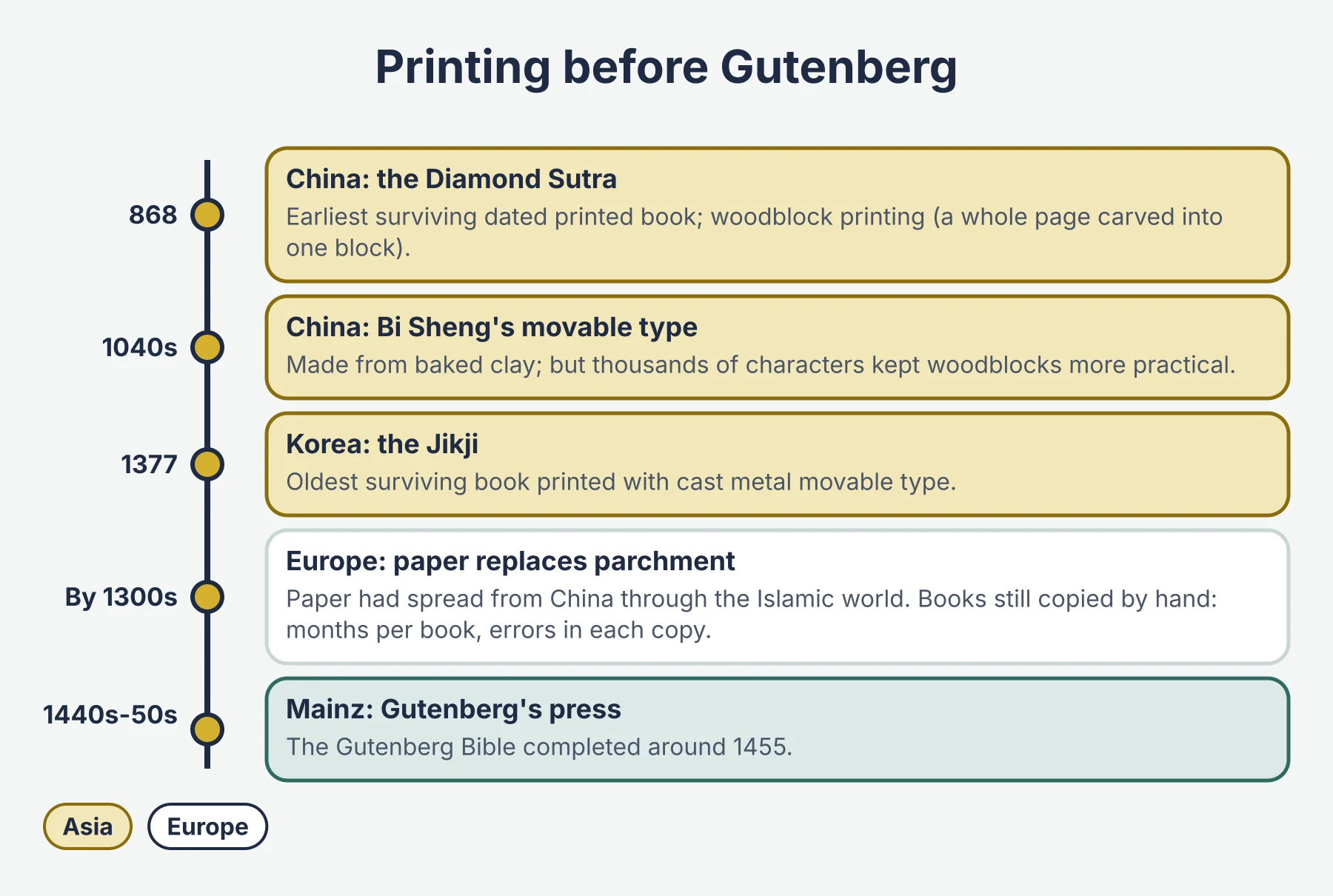
| 868 | Diamond Sutra: earliest dated printed book (China) |
| 1040s | Bi Sheng’s clay movable type |
| 1377 | Jikji printed with metal type in Korea |
| 1440s-1450s | Gutenberg develops his press in Mainz |
| c1455 | Gutenberg Bible; Fust’s lawsuit |
| 1476 | Caxton’s press at Westminster |
| by 1500 | Presses in more than two hundred European towns |
| 1501 | Italic type introduced by Aldus Manutius in Venice |
| 1516 | Erasmus’s Greek New Testament |
| 1517 | Luther’s criticisms of the Church spread in print |
| 1522 / 1526 | Luther’s German / Tyndale’s English New Testament |
| 1543 | Copernicus and Vesalius publish |
| 1557 | Stationers’ Company chartered in England |
| 1559 | Index of Prohibited Books |
| 1602 | Bodleian Library opens |
| early 1600s | First printed newspapers in German cities |
| 1665 | Philosophical Transactions begins |
| 1687 | Newton’s Principia |
| 1710 | Statute of Anne: first copyright law |
| 1720s | First Ottoman Turkish press in Istanbul |
| 1751-72 | French Encyclopédie |
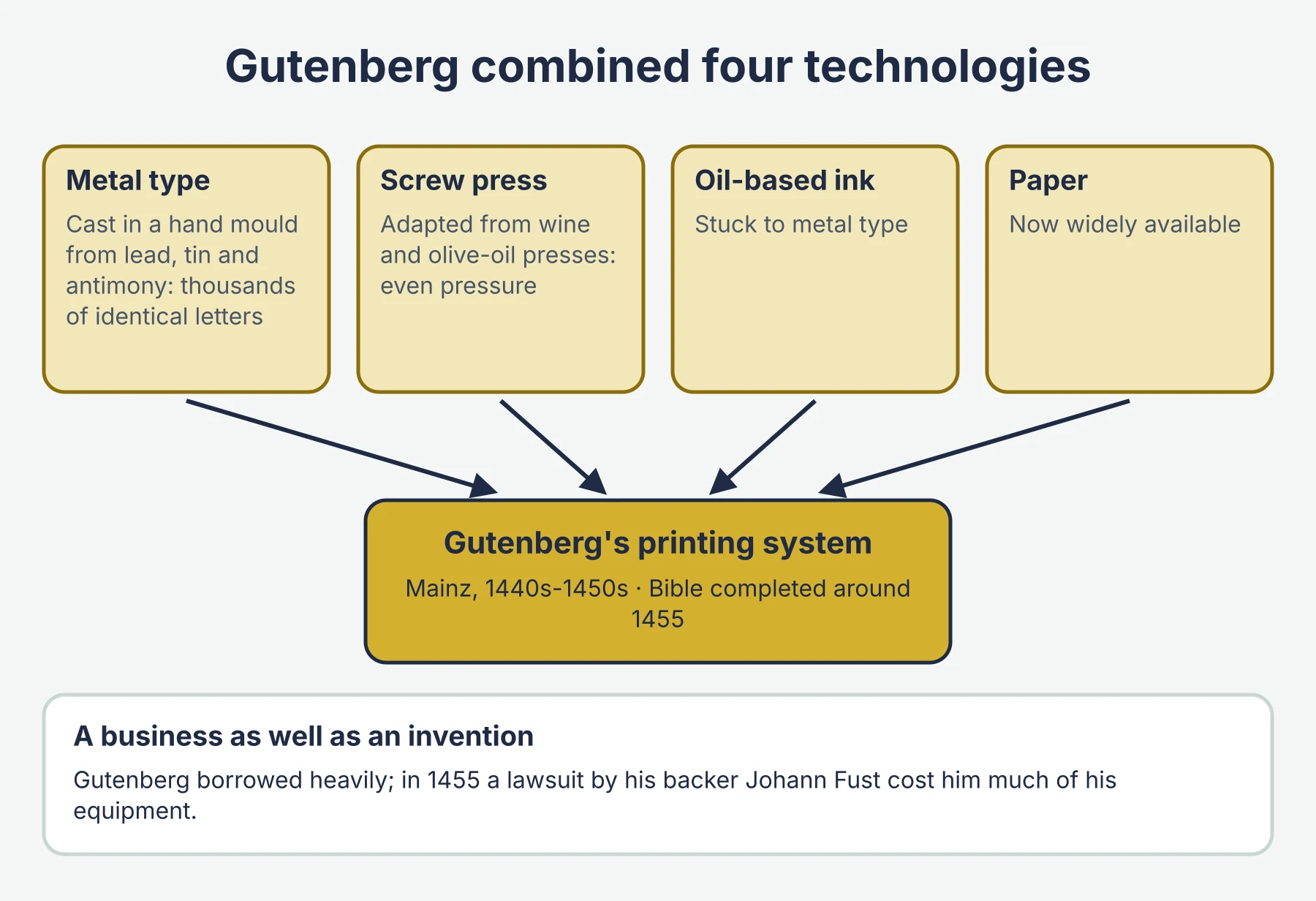
Gutenberg’s system
| Element | Why it mattered |
|---|---|
| Metal type cast in a hand mould | Thousands of identical, reusable letters |
| Screw press | Even pressure; fast printing |
| Oil-based ink | Stuck to metal type |
| Paper | Cheaper than parchment |
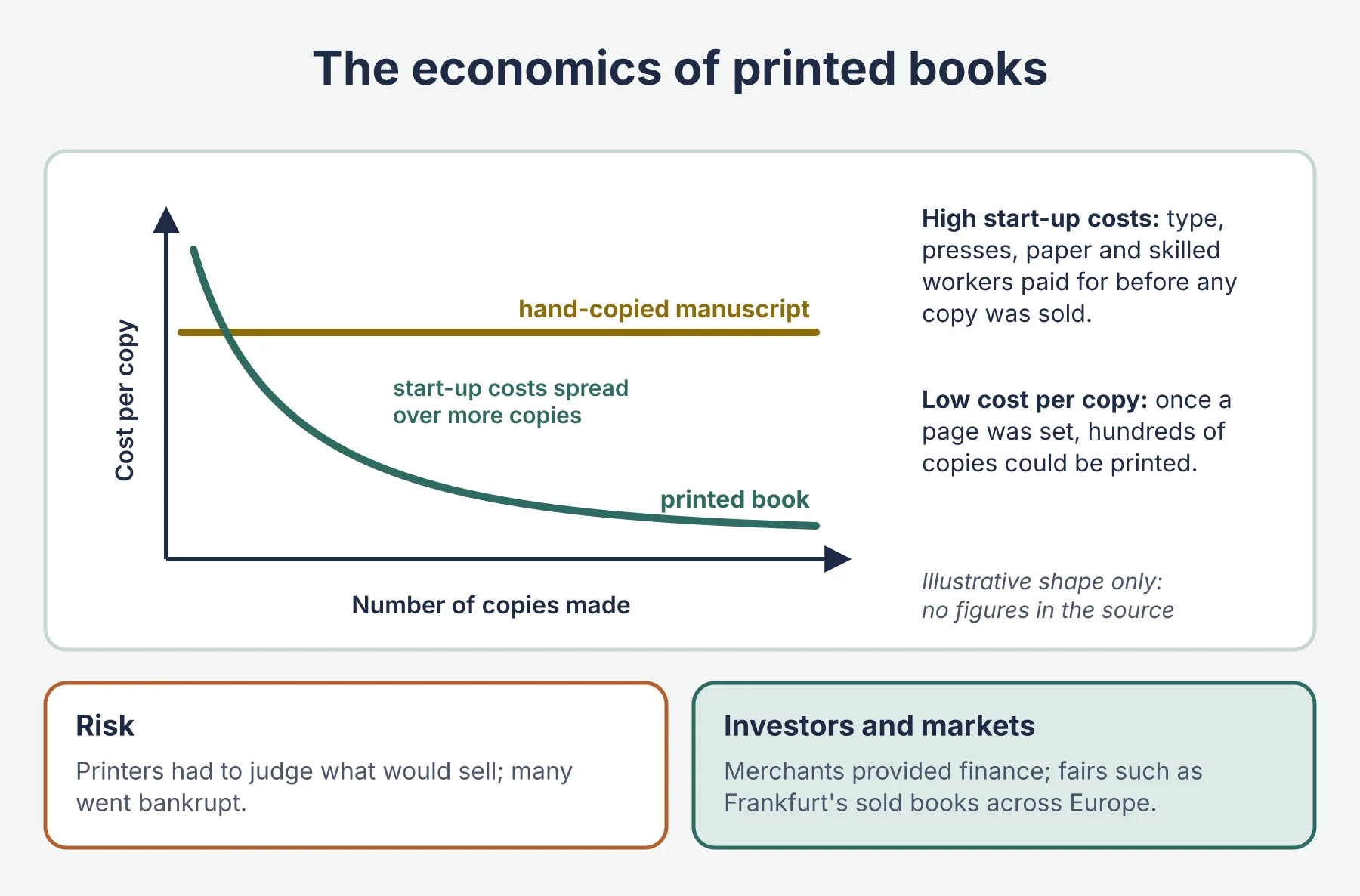
Economics of printing
- High start-up costs; low cost per copy.
- Risk of unsold stock; many printers failed.
- Finance from merchants; sales at fairs such as Frankfurt.
Industry, type and layout
- Centres: Mainz, Venice (Aldus Manutius), Westminster (Caxton).
- Type: Gothic (blackletter), roman, italic.
- Layout: title pages, page numbers, chapter headings, indexes, woodcut and engraved illustrations.
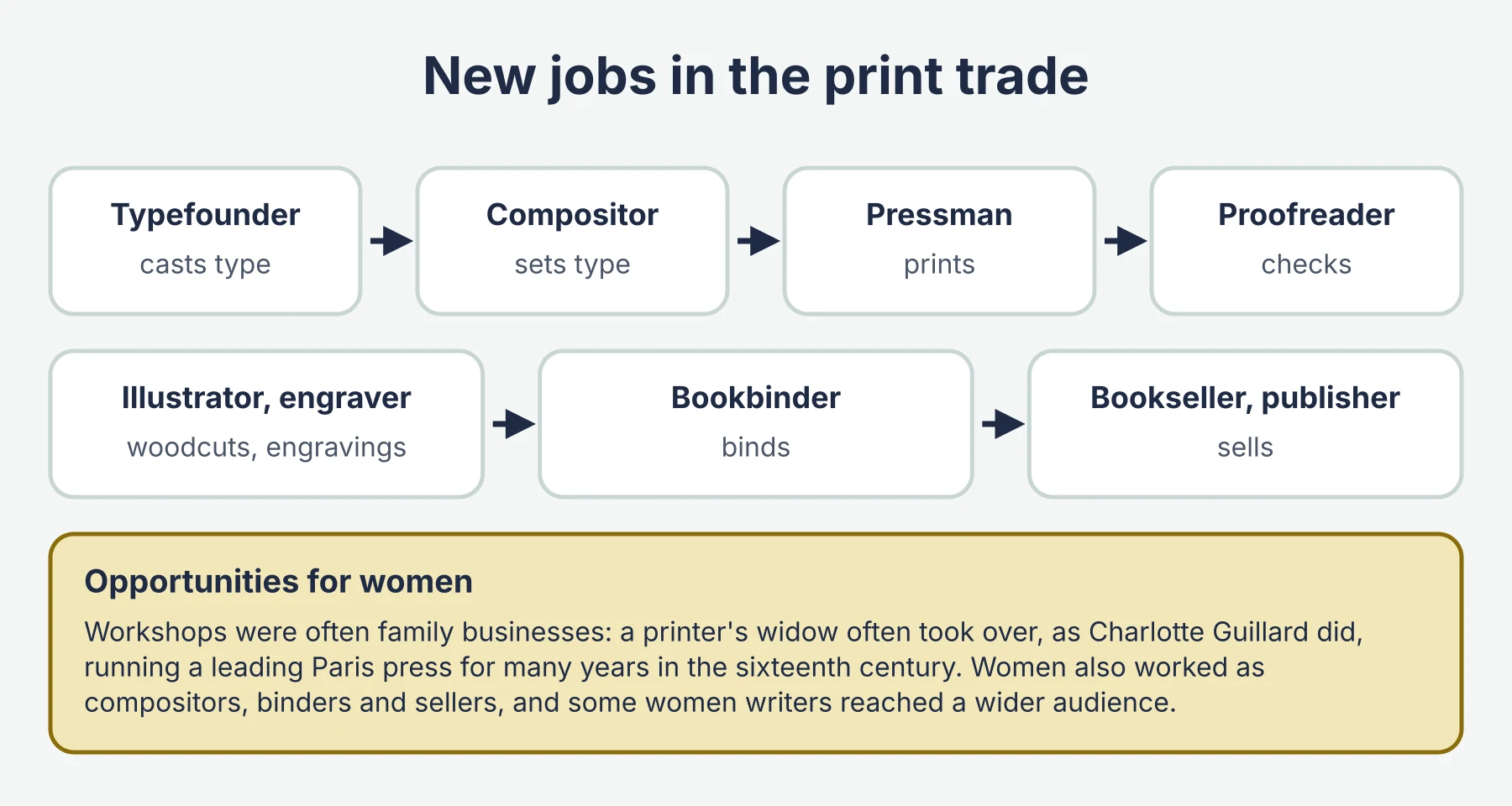
Jobs and women
- New jobs: typefounder, compositor, pressman, proofreader, illustrator, binder, bookseller, publisher.
- Widows ran presses, e.g. Charlotte Guillard in Paris; women as compositors, binders, sellers and authors.
Language and law
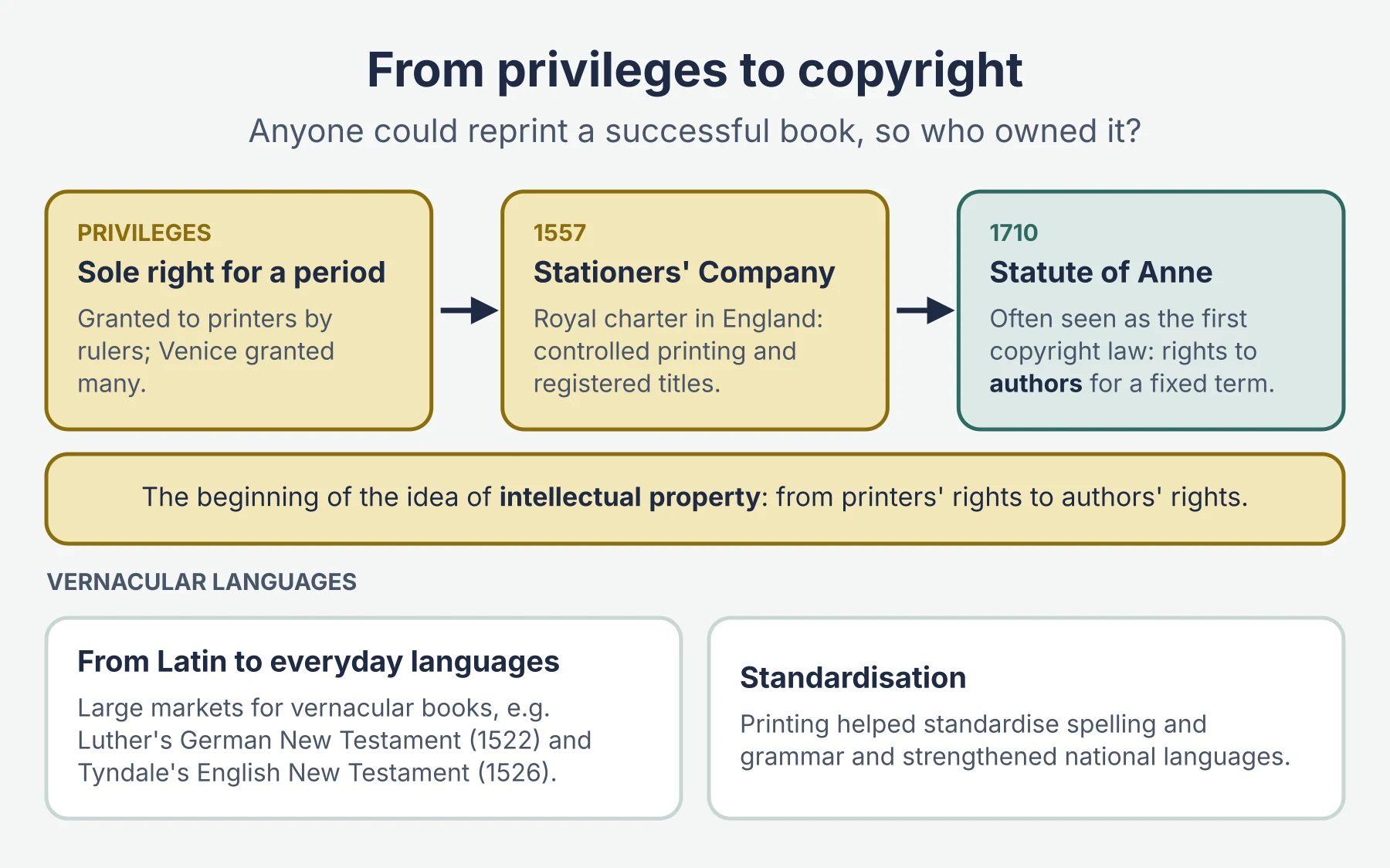
- From Latin to vernacular books; Luther’s and Tyndale’s New Testaments.
- Standardised spelling and national languages.
- Privileges from rulers; Stationers’ Company (1557); Statute of Anne (1710): origins of intellectual property.
Consequences
| Area | Consequence |
|---|---|
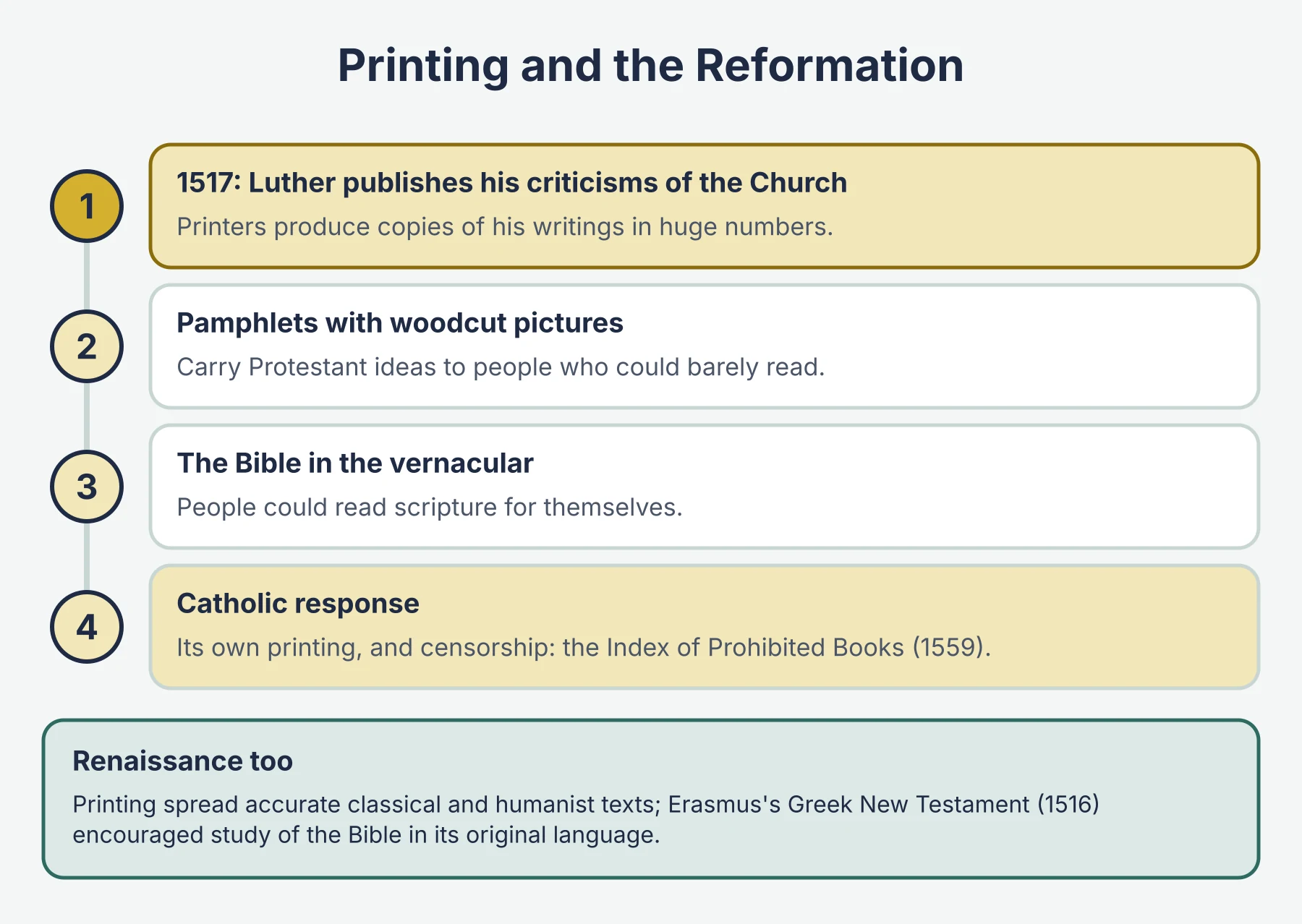
| Renaissance | Accurate classical texts shared; Erasmus’s Greek New Testament |
| Reformation | Luther’s ideas spread rapidly; illustrated pamphlets; vernacular Bibles; Catholic censorship |
| Literacy | Cheaper print; more readers in towns |
| Politics | Newspapers; pamphlet wars; Enlightenment ideas; censorship and licensing |
| Education | Larger libraries; standard textbooks |
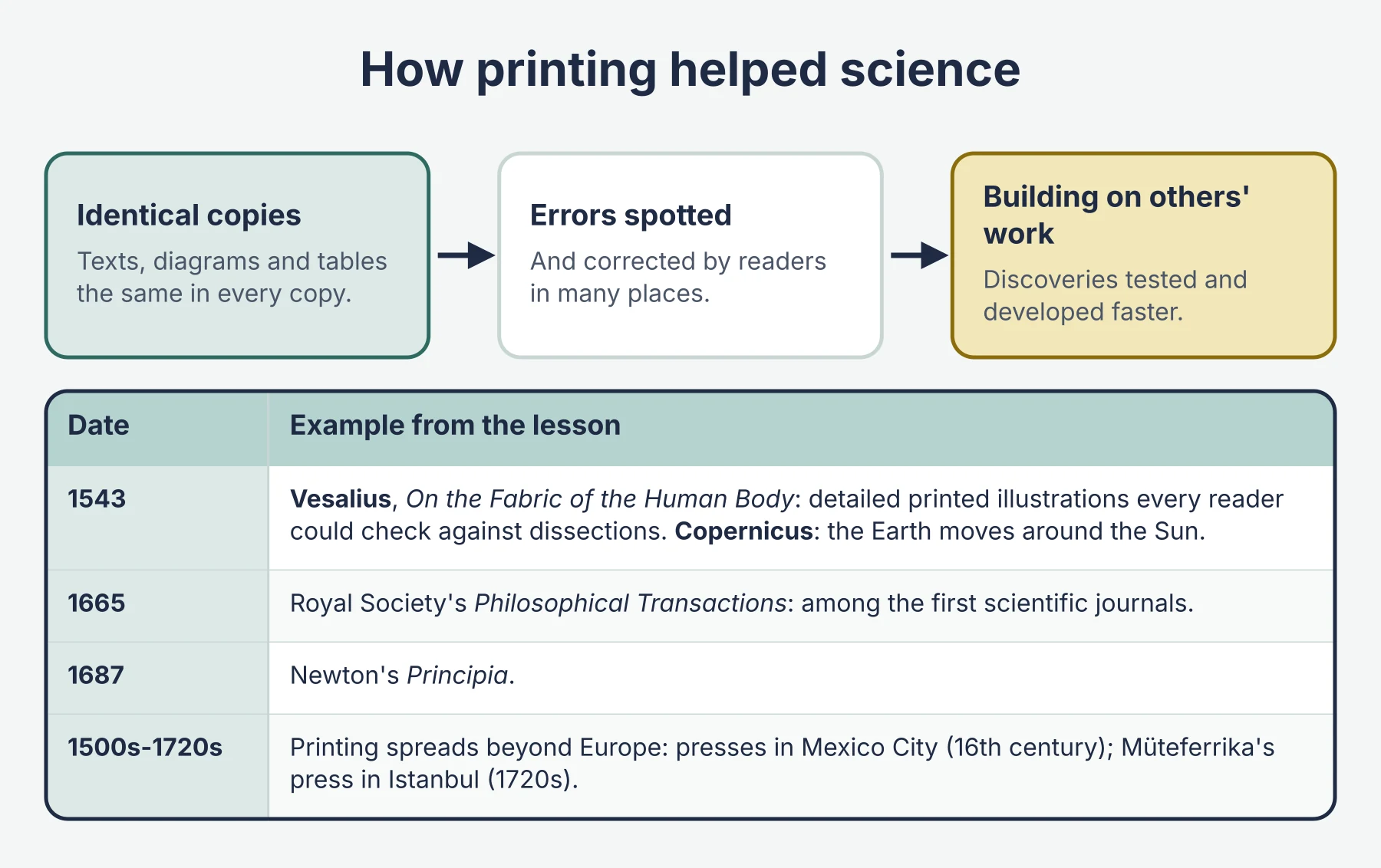
| Science | Identical diagrams and data; journals; Copernicus, Vesalius, Newton |
| Global | Presses in Mexico City and Istanbul |
Linking to the rest of the thematic study
- Compared with the Islamic Golden Age: both periods preserved and spread knowledge, but printing multiplied identical copies, while the House of Wisdom depended on translation and hand-copying.
- Compared with the Communications Revolution: printing spread ideas over months and years; the telegraph, telephone and radio spread them in seconds.
- Factors: individuals (Gutenberg, Manutius, Caxton), economics (profit, investors), religion (the Reformation) and government (privileges, censorship) all shaped the period.
Key terms
| Term | Meaning |
|---|---|
| Woodblock printing | Printing a page carved into one block of wood |
| Movable type | Individual letters arranged and reused |
| Compositor | Worker who sets type |
| Vernacular | The everyday language of a region |
| Privilege | A ruler’s grant of sole right to print a work |
| Copyright | Legal right to copy and sell a work |
| Intellectual property | Ownership of ideas and creative work |
| Pamphlet | Short, cheap printed work |
| Censorship | Control of what may be printed |
Exam traps
- Saying Gutenberg invented printing.
- Describing the press but not its consequences.
- Forgetting women, copyright and the global spread.
- Writing only about religion when the question asks about science or society.
- In a 9-mark answer, mixing two ways into one paragraph.
Self-test
- What is the earliest dated printed book, and where was it found?
- Who made clay movable type in the 1040s?
- Why did movable type suit European languages better than Chinese?
- Name three elements Gutenberg combined.
- Why did printing need investors?
- Who introduced italic type, and where?
- Who set up the first press in England?
- Give two jobs created by printing.
- Which 1710 law is often seen as the first copyright law?
- Give two ways printing helped the Reformation.
- Name two scientific works published in 1543.
- Where did Ibrahim Müteferrika set up a press?
Answers
- The Diamond Sutra of 868, found at Dunhuang.
- Bi Sheng.
- European alphabets need a few dozen letters; Chinese uses thousands of characters.
- Any three: metal type cast in a mould; a screw press; oil-based ink; paper.
- Type, presses, paper and workers had to be paid for before any copies were sold.
- Aldus Manutius, in Venice (1501).
- William Caxton, at Westminster (1476).
- Any two: typefounder, compositor, pressman, proofreader, illustrator, binder, bookseller, publisher.
- The Statute of Anne.
- Any two: rapid spread of Luther’s ideas; illustrated pamphlets; vernacular Bibles; cheap copies beyond Church control.
- Copernicus’s work on the Earth moving around the Sun; Vesalius’s On the Fabric of the Human Body.
- Istanbul, in the 1720s.
Related resources
-
Practice questions
OxfordAQA International GCSE History (9245): Paper 2 Section A, Societies in Change — Practice Questions
Original OxfordAQA 9245 Paper 2 Section A practice: full four-question sets on life in Germany, Russia and the USSR, and the USA, with worked answers.
World History · OxfordAQA · IGCSE
Try questions -
Revision notes
OxfordAQA International GCSE History (9245): Paper 2 Section A, Societies in Change — Revision Notes
Revision notes for OxfordAQA 9245 Paper 2 Section A: who gained and lost in Germany 1919-49, Russia and the USSR 1914-53 and the USA 1920-68, with technique.
World History · OxfordAQA · IGCSE
Revise topic -
Study guides
OxfordAQA International GCSE History (9245): Paper 2 Section A, Societies in Change — Study Guide
Study guide to OxfordAQA International GCSE History 9245 Paper 2 Section A: life in Germany 1919-49, Russia 1914-53 or the USA 1920-68, and the four questions.
World History · OxfordAQA · IGCSE
Read guide
Get free revision emails (optional)
Occasional emails with practice questions, worked explanations and links to free resources for the qualification and subjects you choose. No spam, and you can unsubscribe from any email. The free tools on this site never need an email.