
Study Guides
OxfordAQA International GCSE History (9245): The Printing Revolution, c1440-c1800
The Printing Revolution for 9245 Technology and change: Asian printing, Gutenberg, the book trade, vernaculars, copyright, Reformation, literacy and science.
- Subject
- World History
- Level
- IGCSE
- Topic
- Paper 2 – Studies in Change
- Author
- Marlbridge Academic Team
- Updated
- Reviewed by
- Azam Siddique (what this means)
Aligned to OxfordAQA IGCSE World History (9245), Version 1.1. Official specification .
Syllabus page (what it covers and how it is assessed): OxfordAQA IGCSE World History.
Syllabus points this page covers
9245
- 3.2.2 Section B - Thematic Studies
- 3.2.2.1 Technology and change, c800 – present day
Found an error? Report a correction.
Need help with this topic? Request a free trial class for IGCSE World History (9245).
This guide covers the second period of the thematic study Technology and change, c800-present day: “The Printing Revolution (c1440-c1800)”. The specification names “Printing before the 15th Century, including innovations in Asia; [Johannes Gutenberg] and the invention of the printing press; the economies of book production; the development of printing industry, typefaces and layouts; new professions and opportunities, including for women; vernacular languages, copyright and intellectual property; the impact on the Renaissance and Reformation in Europe; increased literacy and its impact on society and politics; libraries and universities; the printing revolution and global scientific progress.” The Paper 2 Section B study guide covers this period in a short paragraph; this page explains each element and the consequences examiners ask about.
Printing before the fifteenth century
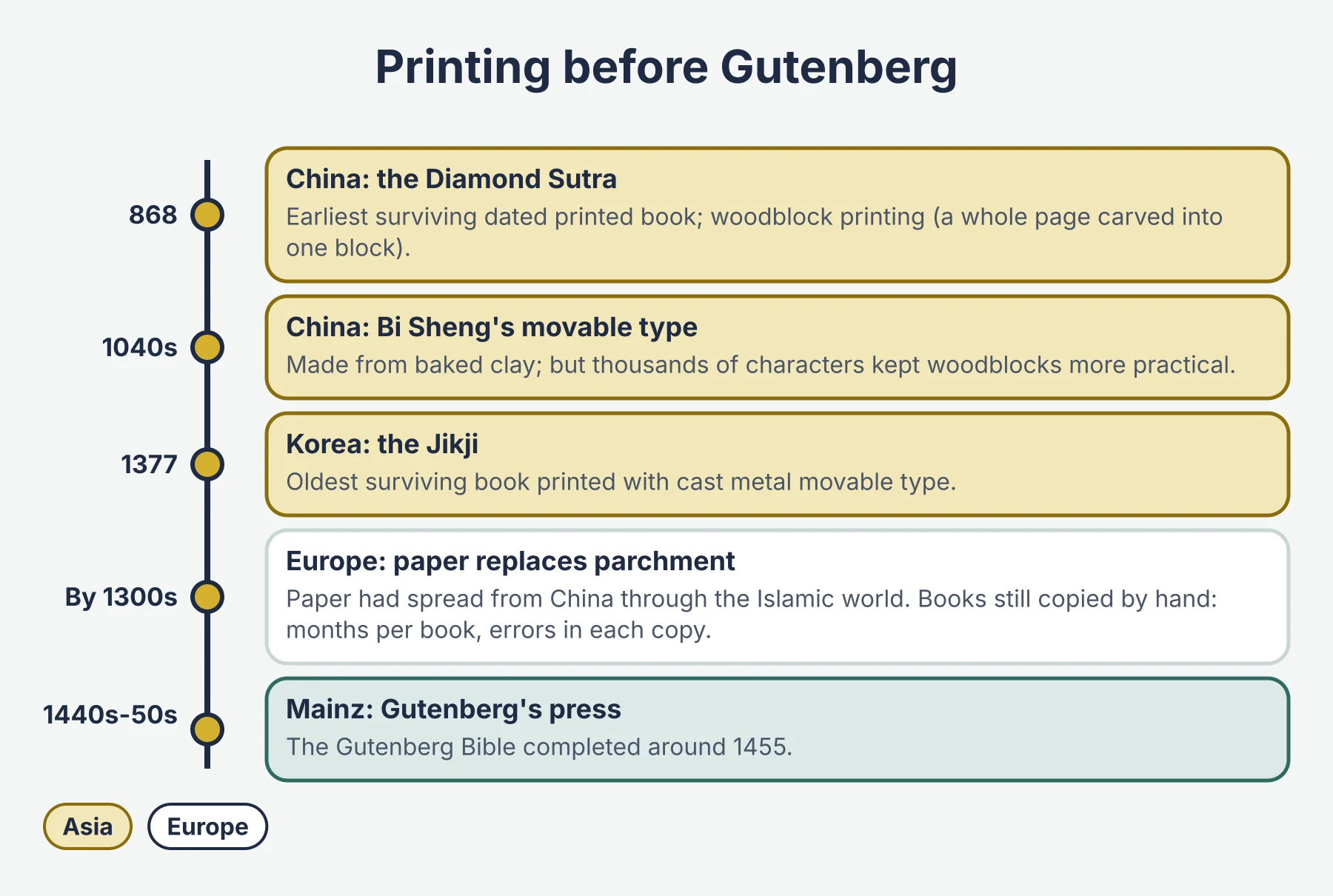
China. Woodblock printing, in which a whole page was carved into a block of wood, was used in China for Buddhist texts, calendars and paper money. The Diamond Sutra of 868, found at Dunhuang, is the earliest surviving printed book with a date. In the 1040s Bi Sheng made movable type from baked clay, but Chinese writing uses thousands of characters, so woodblocks remained more practical for most work.
Korea. Korean printers cast metal movable type; the Jikji, a Buddhist text printed in 1377, is the oldest surviving book printed with metal type.
Europe before printing. Books were copied by hand, by monks in monasteries and later by professional scribes in university towns. A single book could take months to copy, so books were rare and expensive, and errors crept in with each copy. Paper, which had spread from China through the Islamic world, was replacing parchment by the fourteenth century, making cheaper books possible.
Gutenberg and the printing press
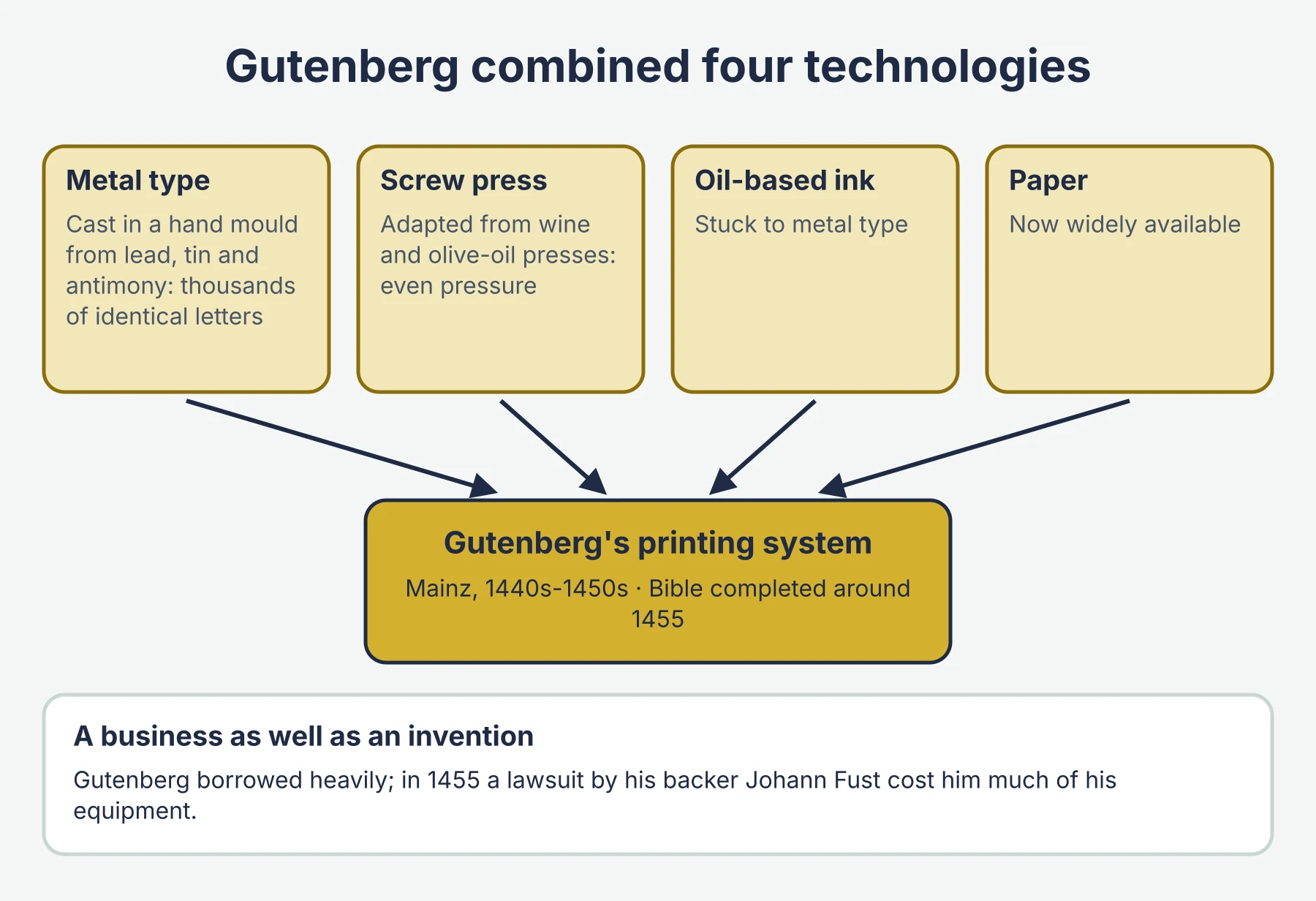
Johannes Gutenberg of Mainz developed a printing system in the 1440s and 1450s that combined several technologies:
- metal type cast in a hand mould from an alloy of lead, tin and antimony, so that thousands of identical letters could be made quickly;
- a screw press, adapted from presses used to make wine or olive oil, to press paper evenly onto the inked type;
- an oil-based ink that stuck to metal;
- paper, now widely available.
His most famous work, the Gutenberg Bible, was completed around 1455. Gutenberg borrowed heavily to finance his workshop, and in 1455 a lawsuit by his backer Johann Fust cost him much of his equipment: a reminder that printing was a business as well as an invention.
The economies of book production
Printing changed the costs of making books:
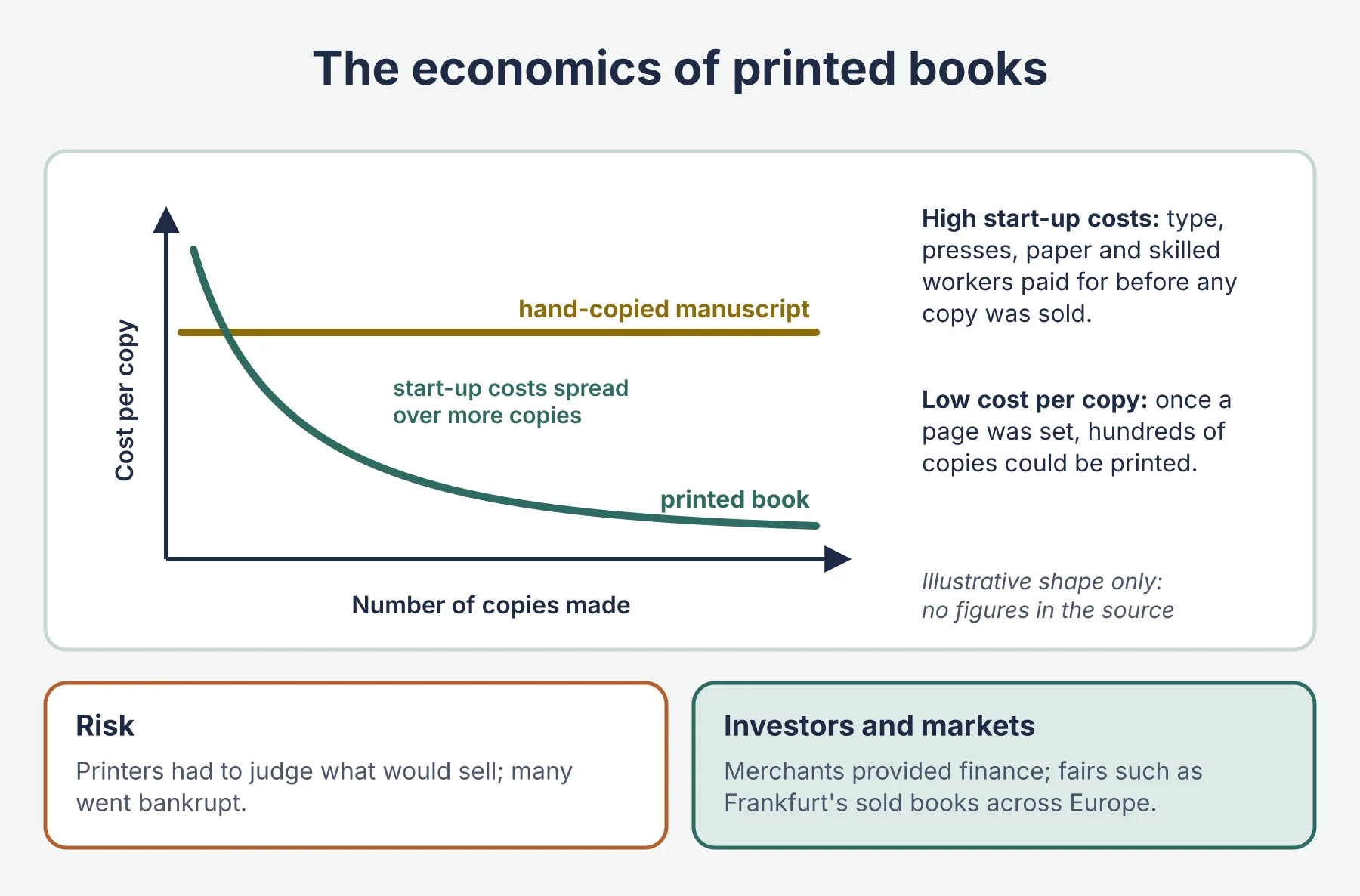
- High start-up costs: type, presses, paper and skilled workers had to be paid for before a single copy was sold.
- Low cost per copy: once a page was set, hundreds of copies could be printed, so each book was far cheaper than a manuscript.
- Risk: printers had to judge what would sell; many went bankrupt.
- Investors and markets: printers relied on merchants for finance and on fairs, such as Frankfurt’s, to sell books across Europe.
The printing industry, typefaces and layouts
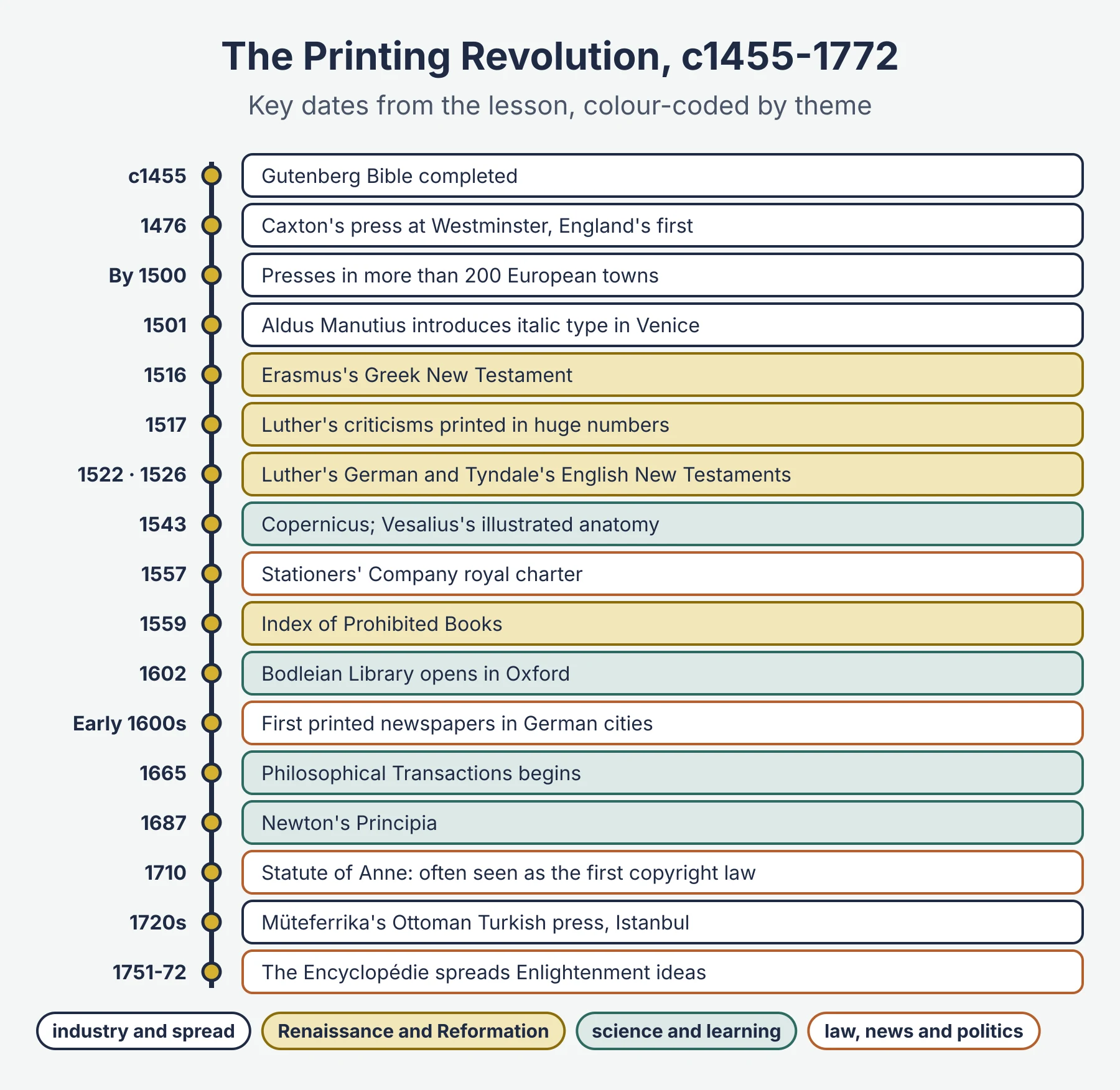
Printing spread rapidly: by 1500 presses were working in more than two hundred European towns. Venice became a major centre, where Aldus Manutius printed small, portable editions of classical texts and introduced italic type in 1501. William Caxton set up the first press in England at Westminster in 1476 and printed works such as Chaucer’s Canterbury Tales.
Early books imitated manuscripts, using heavy Gothic (blackletter) type. Roman type, based on humanist handwriting, spread from Italy and became standard in much of Europe. Printers gradually developed title pages, page numbers, chapter headings, indexes and printed illustrations from woodcuts and later engravings, making books easier to use.
New professions and opportunities, including for women
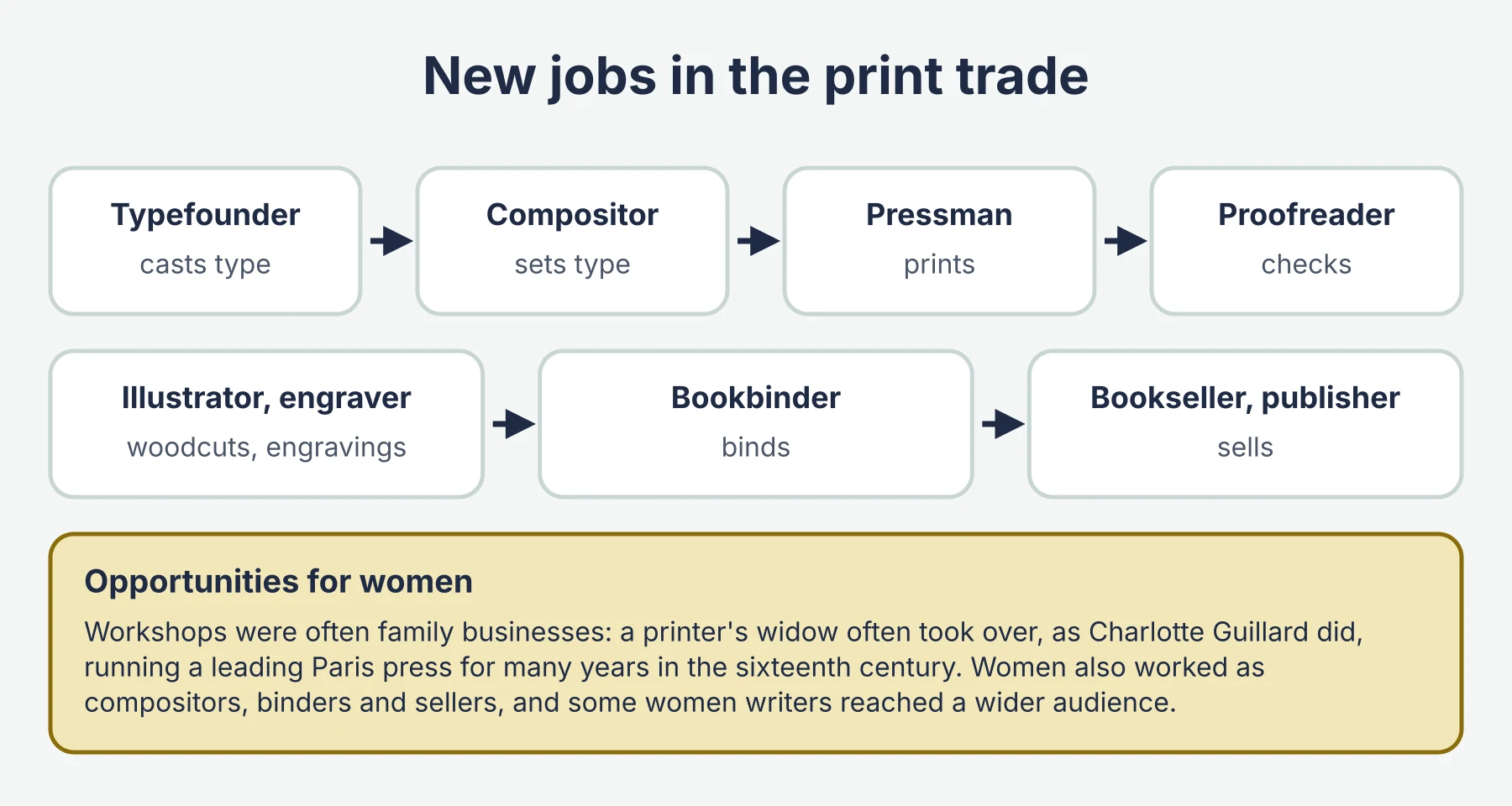
Printing created new jobs: typefounders, compositors who set type, pressmen, proofreaders, illustrators, engravers, bookbinders, booksellers and publishers. Printing workshops were often family businesses, and when a printer died his widow often took over: in sixteenth-century Paris, Charlotte Guillard ran a leading press for many years. Women also worked as compositors, binders and sellers, and printing gave some women writers a wider audience.
Vernacular languages, copyright and intellectual property
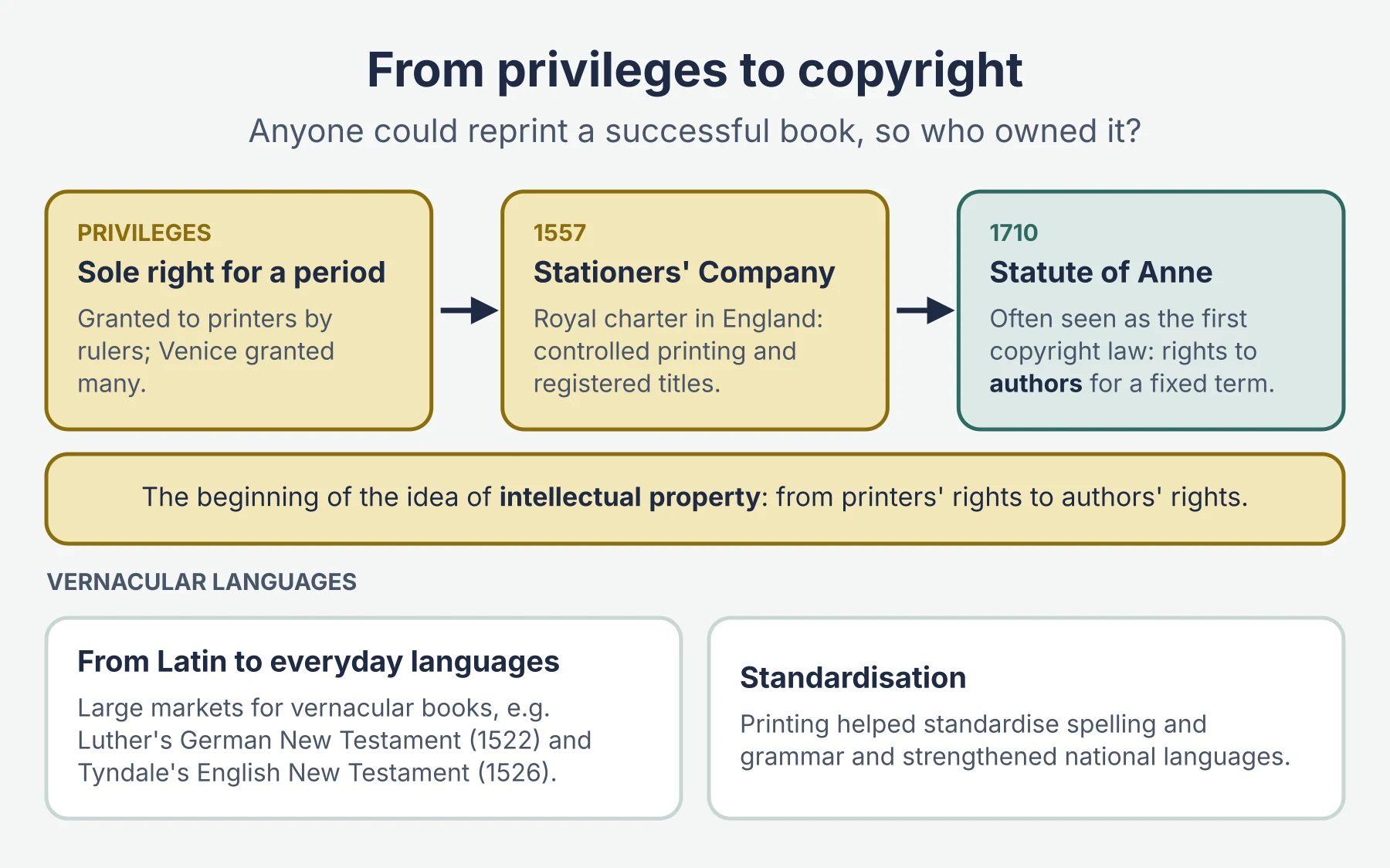
Most early printed books were in Latin, the language of the Church and universities, but printers soon found large markets for books in vernacular languages, the everyday languages of their readers. Martin Luther’s German translation of the New Testament (1522) and William Tyndale’s English New Testament (1526) were widely read. Printing helped to standardise spelling and grammar, and strengthened national languages.
Because anyone could reprint a successful book, printers sought privileges from rulers, giving them the sole right to print a work for a period; Venice granted many. In England the Stationers’ Company received a royal charter in 1557, controlling printing and registering titles. The Statute of Anne (1710) is often seen as the first copyright law, giving rights to authors for a fixed term: the beginning of the idea of intellectual property.
The Renaissance and the Reformation
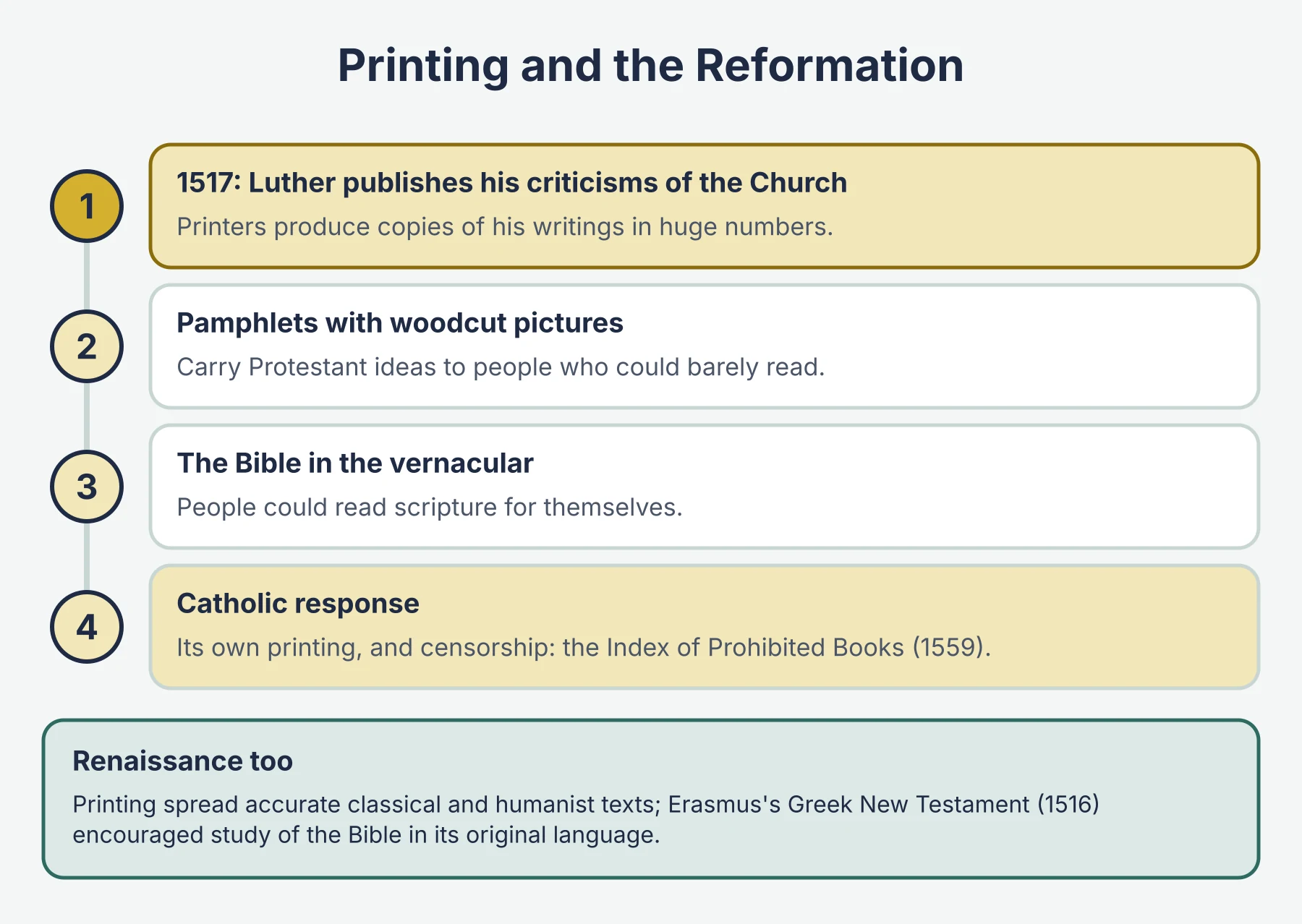
Renaissance. Printing spread classical and humanist texts quickly and in accurate editions; scholars across Europe could read and compare the same books. Erasmus published his Greek New Testament in 1516, encouraging scholars to study the Bible in its original language.
Reformation. When Luther published his criticisms of the Church in 1517, printers produced copies of his writings in huge numbers. Pamphlets with woodcut pictures carried Protestant ideas to people who could barely read, and the Bible in the vernacular let people read scripture for themselves. The Catholic Church responded with its own printing and with censorship, including the Index of Prohibited Books (1559).
Literacy, society and politics
As books, pamphlets and broadsheets became cheaper, more people learned to read, especially in towns and among merchants and craftsmen. Printed newspapers appeared in the seventeenth century, beginning in German cities in the early 1600s. Printed material spread political ideas, propaganda and news: pamphlet wars accompanied the English Civil War, and in the eighteenth century the French Encyclopédie (1751-72) spread the ideas of the Enlightenment. Governments both used printing and tried to control it through licensing and censorship.
Libraries and universities
Printed books made libraries larger and more widespread. The Bodleian Library in Oxford opened in 1602. Universities could buy many identical textbooks, so teaching became more standardised, and students could own books rather than copying lectures.
Printing and global scientific progress
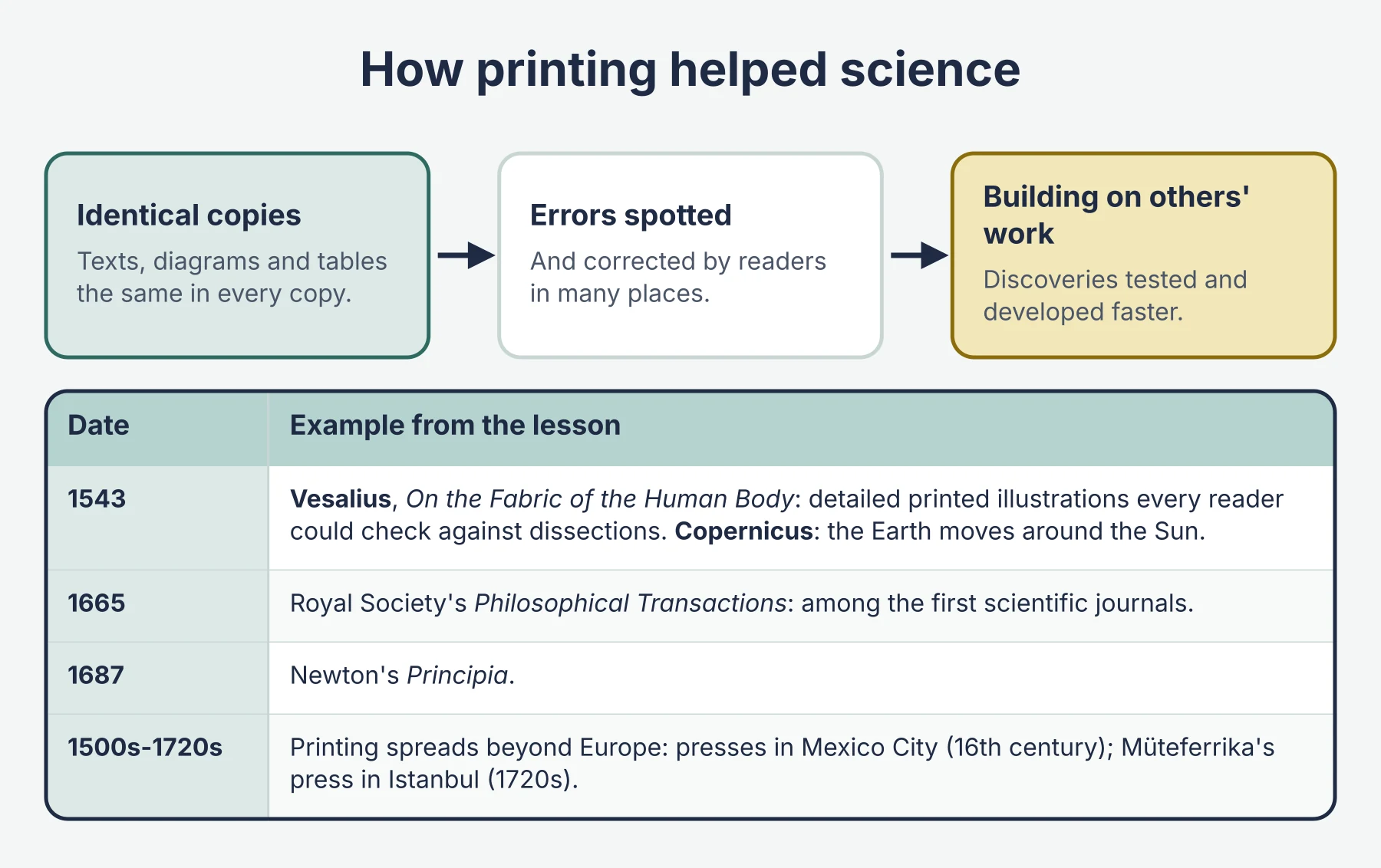
Printing allowed identical copies of texts, diagrams and tables to be shared, so errors could be spotted and corrected and scientists could build on each other’s work. In 1543 Copernicus published his theory that the Earth moves around the Sun, and Vesalius published On the Fabric of the Human Body with detailed printed illustrations. In 1665 the Royal Society began publishing Philosophical Transactions, among the first scientific journals, and Newton’s Principia followed in 1687. Printing also spread beyond Europe: presses were set up in Mexico City in the sixteenth century, and Ibrahim Müteferrika opened the first Ottoman Turkish press in Istanbul in the 1720s.
Worked example: a 9-mark answer
Explain two ways in which the printing press affected science. [9]
First, it allowed accurate diagrams and data to be shared. Before printing, every hand-copied illustration could differ. After 1543, when Vesalius’s book on anatomy was printed with detailed woodcuts, every reader saw the same accurate drawings, so doctors across Europe could check his findings against their own dissections.
Second, it allowed scientists to communicate and build on each other’s work. Printed journals such as the Royal Society’s Philosophical Transactions (from 1665) reported experiments to readers in many countries. As a result, discoveries were tested and developed far more quickly, contributing to works such as Newton’s Principia (1687).
Common mistakes
- Claiming Gutenberg invented printing: printing existed in China and Korea centuries earlier.
- Describing the press without explaining its consequences, which most questions target.
- Ignoring the business side: costs, risk and markets.
- Forgetting copyright, women’s work and the global spread, all named in the specification.
- Writing only about the Reformation when a question asks about society or science.
Further practice
- Printing Revolution revision notes
- Printing Revolution practice questions
- Paper 2 Section B practice
Specification
OxfordAQA International GCSE History (9245) specification, Version 1.1, section 3.2.2.1, Technology and change, c800-present day – oxfordaqa.com.
Related resources
-
Practice questions
OxfordAQA International GCSE History (9245): The Printing Revolution, c1440-c1800 – Practice Questions
Eleven original 9245 Technology and change questions on the Printing Revolution, from 3-mark recall to 12-mark judgements, with point-by-point marking guides.
World History · OxfordAQA · IGCSE
Try questions -
Revision notes
OxfordAQA International GCSE History (9245): The Printing Revolution, c1440-c1800 – Revision Notes
Revision notes for the 9245 Printing Revolution: Asian printing, Gutenberg's press, the book trade, type, women, copyright, Reformation, literacy and science.
World History · OxfordAQA · IGCSE
Revise topic -
Practice questions
OxfordAQA International GCSE History (9245): Paper 2 Section A, Societies in Change — Practice Questions
Original OxfordAQA 9245 Paper 2 Section A practice: full four-question sets on life in Germany, Russia and the USSR, and the USA, with worked answers.
World History · OxfordAQA · IGCSE
Try questions
Get free revision emails (optional)
Occasional emails with practice questions, worked explanations and links to free resources for the qualification and subjects you choose. No spam, and you can unsubscribe from any email. The free tools on this site never need an email.