
Revision Notes
OxfordAQA International GCSE History (9245): Medieval Islamic Medicine – Revision Notes
Revision notes for 9245 medieval Islamic medicine: translators, Al-Razi, Ibn Sina, bimaristans, Al-Zahrawi, public health, Al-Kindi, Ibn al-Baytar and legacy.
- Subject
- World History
- Level
- IGCSE
- Topic
- Paper 2 – Studies in Change
- Author
- Marlbridge Academic Team
- Updated
- Reviewed by
- Azam Siddique (what this means)
Aligned to OxfordAQA IGCSE World History (9245), Version 1.1. Official specification .
Syllabus page (what it covers and how it is assessed): OxfordAQA IGCSE World History.
Syllabus points this page covers
9245
- 3.2.2 Section B - Thematic Studies
- 3.2.2.2 Medicine and change, c800 – present day
Found an error? Report a correction.
Need help with this topic? Request a free trial class for IGCSE World History (9245).
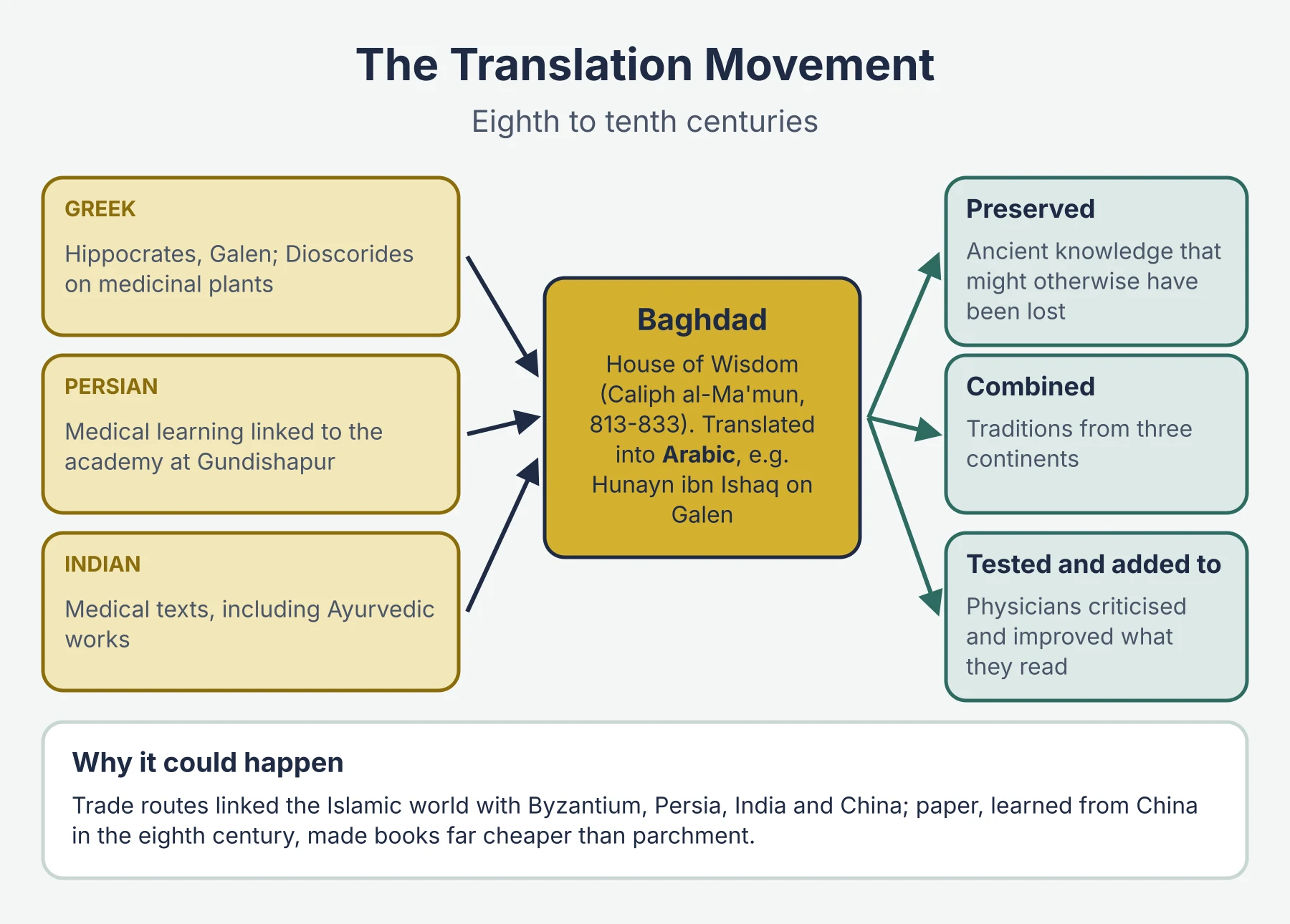
Condensed notes on the first period of Medicine and change, c800-present day. The specification names “the ‘Translation Movement’; the development of universities and centres of learning; Islamic physicians - ethics and knowledge, including Al-Razi and Ibn-Sina; hospitals - bimaristans; surgery, tools, techniques, including the work of Al-Zahrawi; developments in public health, hygiene, water supply, and sanitation; innovations in pharmacology, including the work of Al-Baytar, and Al-Kindi; contribution to medicine in Europe and Asia.” The full explanation is in the medieval Islamic medicine study guide; the other five periods are summarised in the Paper 2 Section B revision notes.
Timeline
| Date | Development |
|---|---|
| 762 | Baghdad founded as the Abbasid capital |
| 8th century | Paper-making learned from China |
| 813-833 | Reign of al-Ma’mun; House of Wisdom flourishes |
| 9th century | Hunayn ibn Ishaq translates Galen; Al-Kindi’s work on drug strength |
| 859 | Al-Qarawiyyin founded in Fez by Fatima al-Fihri |
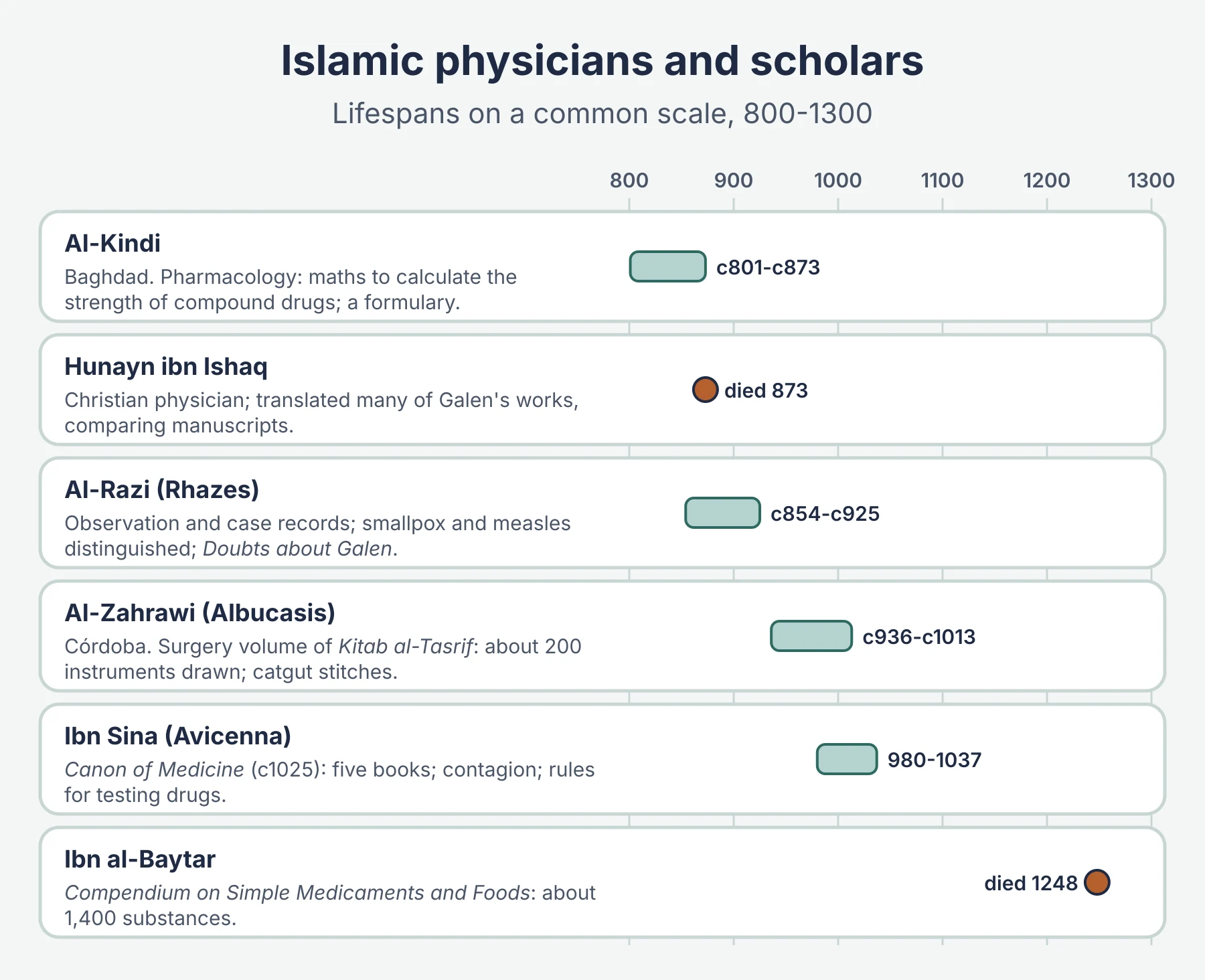
| c854-c925 | Life of Al-Razi |
| 931 | Examination of physicians ordered in Baghdad |
| 970s | Al-Azhar founded in Cairo |
| 982 | Adudi hospital, Baghdad |
| c936-1013 | Life of Al-Zahrawi in Córdoba |
| c1025 | Ibn Sina completes the Canon of Medicine |
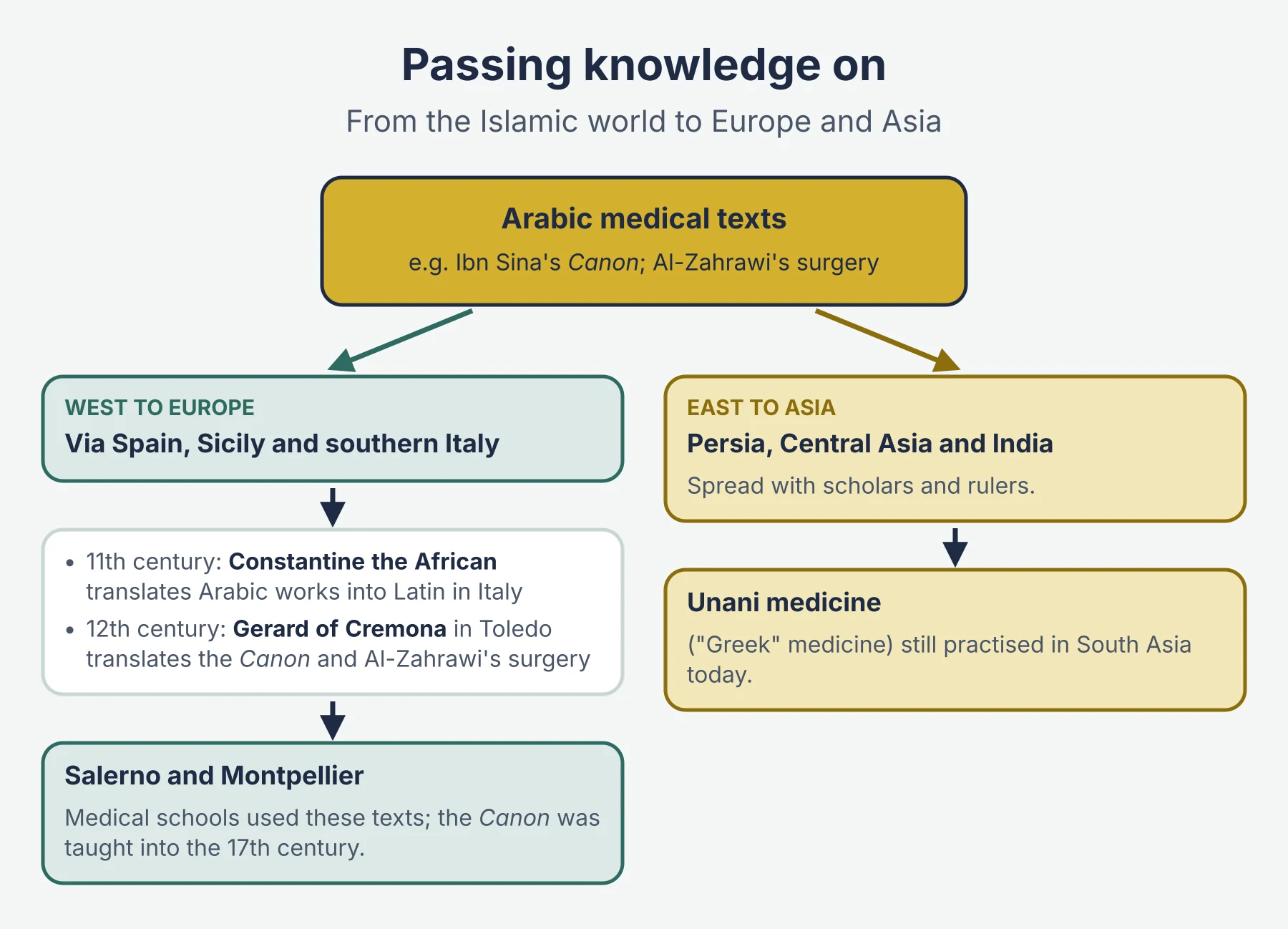
| 11th century | Constantine the African translates Arabic texts into Latin |
| 1154 | Hospital of Nur al-Din, Damascus |
| 12th century | Gerard of Cremona translates the Canon and Al-Zahrawi in Toledo |
| d. 1248 | Ibn al-Baytar, author of the Compendium on Simple Medicaments |
| 1284 | Mansuri hospital, Cairo |
Who did what
| Person | Known for |
|---|---|
| Hunayn ibn Ishaq | Accurate translations of Galen |
| Al-Kindi | Mathematics to measure the strength of compound drugs; formulary |
| Al-Razi (Rhazes) | Observation; case records; smallpox and measles distinguished; Doubts about Galen; hospital director |
| Al-Zahrawi (Albucasis) | Kitab al-Tasrif; surgery volume with around 200 instruments; cautery, ligatures, catgut |
| Ibn Sina (Avicenna) | Canon of Medicine; contagion; rules for testing drugs |
| Ibn al-Baytar | Compendium of about 1,400 medicinal substances |
| Al-Ruhawi | Practical Ethics of the Physician |
| Gerard of Cremona | Translated Arabic medicine into Latin at Toledo |
Bimaristans: five features
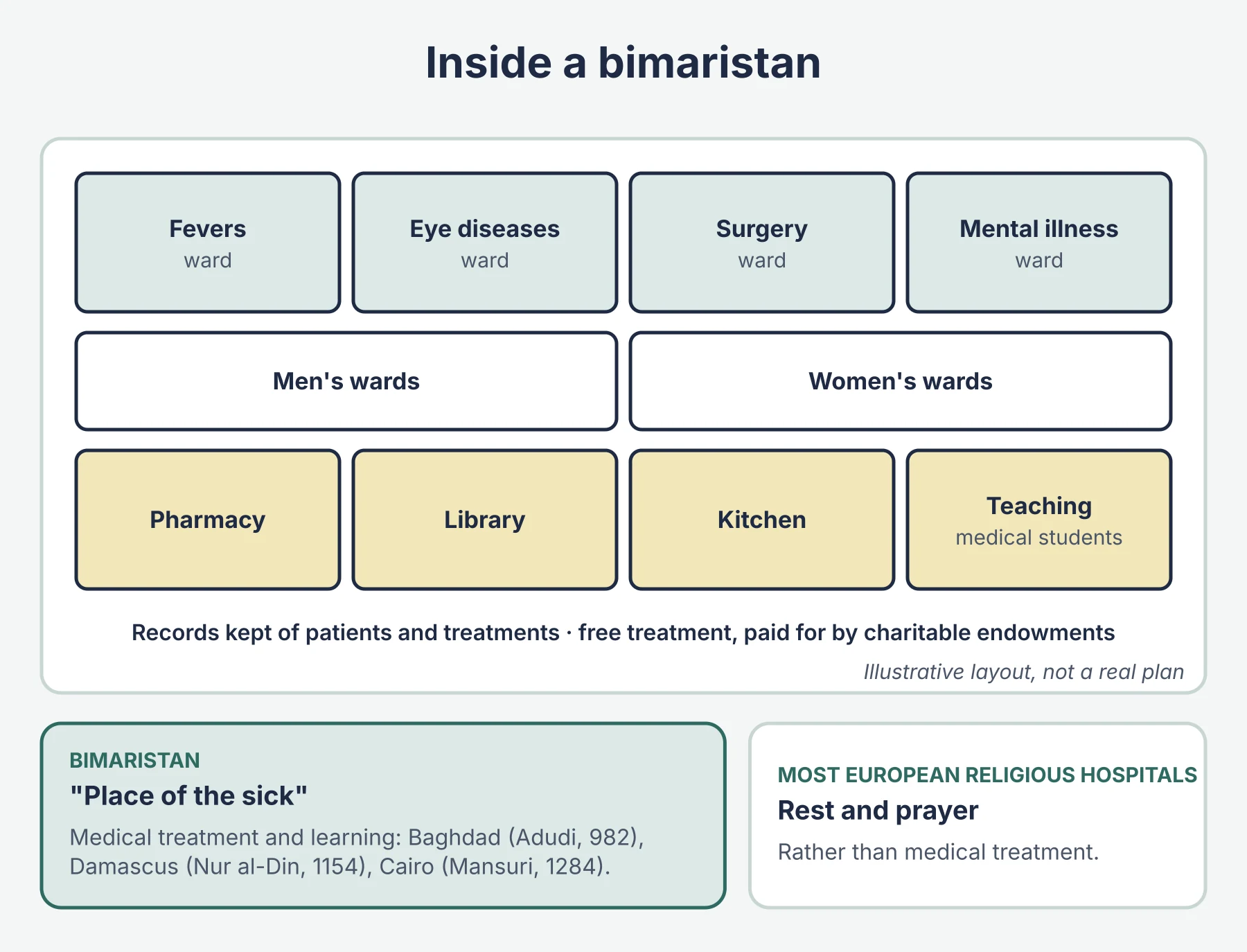
- Free care for all, funded by charitable endowments.
- Separate wards by sex and by illness (fevers, eyes, surgery, mental illness).
- Pharmacies, libraries and kitchens.
- Teaching of students.
- Patient records.
Public health
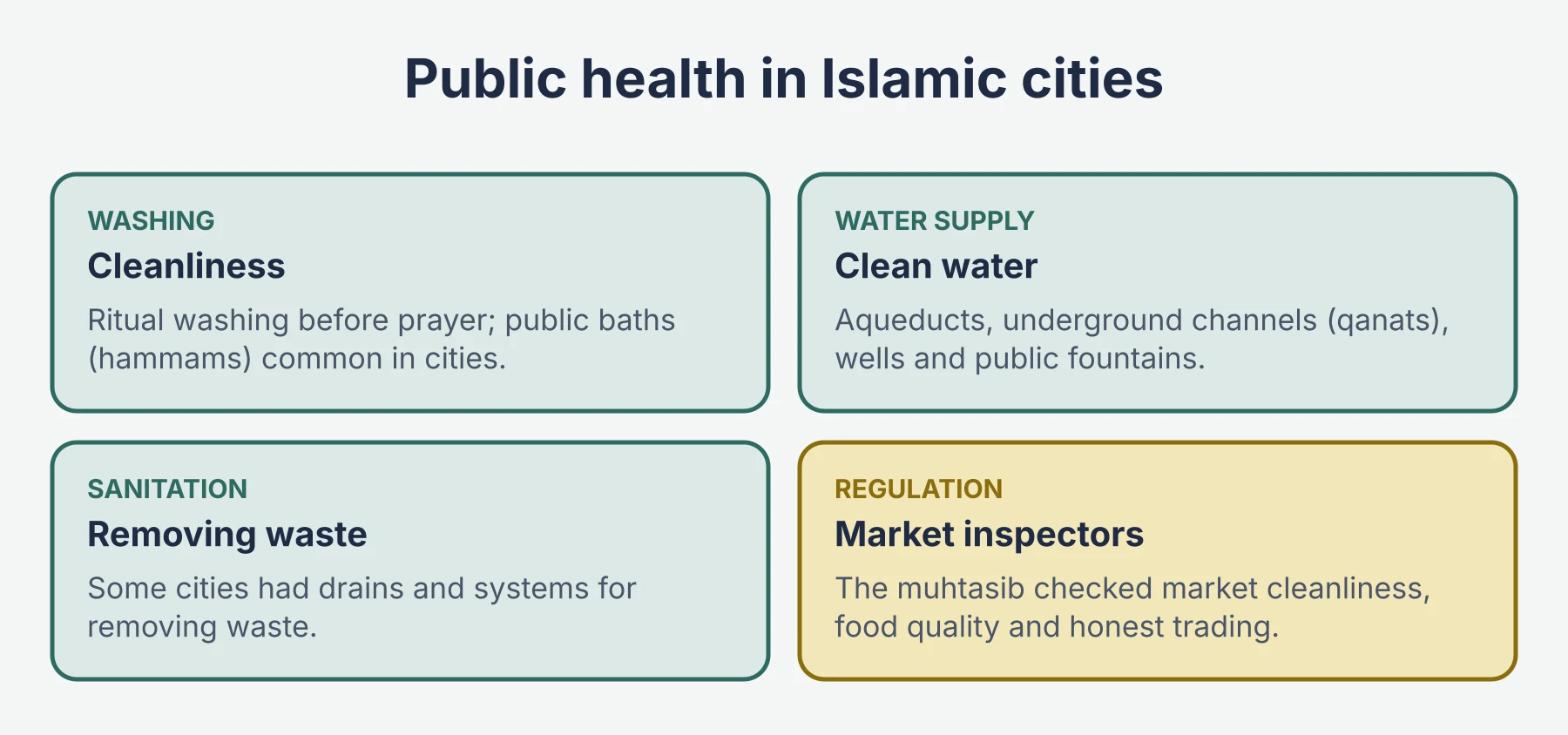
- Ritual washing and public baths (hammams).
- Aqueducts, qanats, wells and fountains.
- Drains and waste removal in some cities.
- Market inspectors (muhtasib) checking food, cleanliness and traders.
Why this period mattered
- Preservation: Greek, Persian and Indian knowledge kept and combined.
- Progress: observation, questioning of Galen, new drugs and surgical tools.
- Institutions: hospitals, licensing and organised pharmacy.
- Transmission: to Europe via Spain, Sicily and Italy (Salerno, Montpellier); to Asia as Unani medicine.
Comparing with medieval Europe
Useful for “change” questions and for linking this period to the rest of the thematic study:
- Hospitals: bimaristans gave medical treatment by physicians; most European religious hospitals of the time offered rest, food and prayer.
- Authority: Islamic physicians such as Al-Razi questioned Galen; in Europe, his authority was rarely challenged before the sixteenth century.
- Learning: European universities later taught from Latin translations of Arabic works, so much “European” medieval medicine came through this route.
Factors at work
| Factor | Example |
|---|---|
| Individuals | Al-Razi, Ibn Sina, Al-Zahrawi |
| Religion | Duty of care and charity funding hospitals; ritual washing |
| Government | Caliphs’ patronage; licensing in 931; market inspectors |
| Communication | Translation; paper; trade routes |
| Science and technology | Pharmacology; surgical instruments; mathematics |
Key terms
| Term | Meaning |
|---|---|
| Translation Movement | Translation of Greek, Persian and Indian works into Arabic, 8th-10th centuries |
| House of Wisdom | Centre of learning and translation in Baghdad |
| Bimaristan | Hospital in the medieval Islamic world |
| Pharmacology | The study of drugs and their effects |
| Simple medicament | A drug made from one substance |
| Cauterisation | Sealing a wound or vessel with heat |
| Ligature | Thread tied round a blood vessel to stop bleeding |
| Muhtasib | Market inspector |
| Unani | The Greek-Islamic medical tradition in South Asia |
Exam traps
- Saying Islamic physicians only copied: they questioned and added.
- Mixing up Al-Razi and Ibn Sina.
- Forgetting Al-Kindi and Ibn al-Baytar (pharmacology) or public health.
- Vague statements about “good hospitals”: give precise features.
- In a 12-mark answer, compare factors and reach a judgement.
Self-test
- What was the Translation Movement?
- Which caliph is especially associated with the House of Wisdom?
- Who translated many of Galen’s works?
- Which two diseases did Al-Razi distinguish?
- What was the title of Ibn Sina’s great medical encyclopaedia?
- What does “bimaristan” mean?
- Give two features of bimaristans.
- Which surgeon worked in Córdoba and drew around 200 instruments?
- How did Al-Kindi contribute to pharmacology?
- What did Ibn al-Baytar compile?
- Who translated the Canon into Latin, and where?
- What is Unani medicine?
Answers
- The translation of Greek, Persian and Indian works into Arabic, especially in Baghdad, from the eighth to tenth centuries.
- Al-Ma’mun.
- Hunayn ibn Ishaq.
- Smallpox and measles.
- The Canon of Medicine.
- “Place of the sick”, a hospital.
- Any two: free care; separate wards; pharmacies; libraries; teaching; records.
- Al-Zahrawi.
- He used mathematics to calculate the strength of compound drugs.
- A compendium describing about 1,400 medicinal substances.
- Gerard of Cremona, at Toledo, in the twelfth century.
- The tradition of Greek-Islamic medicine that developed in South Asia and is still practised.
Related resources
-
Study guides
OxfordAQA International GCSE History (9245): Post-war Germany, 1945-49
Life in Germany 1945-49 for 9245 Paper 2: refugees, expulsions, zones, denazification, Nuremberg, Soviet reparations, Marshall Aid, the Blockade and two states.
World History · OxfordAQA · IGCSE
Read guide -
Practice questions
OxfordAQA International GCSE History (9245): Post-war Germany, 1945-49 – Practice Questions
Twelve original 9245 Paper 2 questions on Germany 1945-49, from 3-mark recall to 12-mark judgements on expulsions, denazification, the Blockade and division.
World History · OxfordAQA · IGCSE
Try questions -
Revision notes
OxfordAQA International GCSE History (9245): Post-war Germany, 1945-49 – Revision Notes
Revision notes for 9245 Life in Germany, 1945-49: zero hour, expulsions, zones, denazification, Nuremberg, reparations, the Blockade and two states.
World History · OxfordAQA · IGCSE
Revise topic
Get free revision emails (optional)
Occasional emails with practice questions, worked explanations and links to free resources for the qualification and subjects you choose. No spam, and you can unsubscribe from any email. The free tools on this site never need an email.