
Study Guides
OxfordAQA International GCSE History (9245): Medieval Islamic Medicine
Medieval Islamic medicine for 9245 Medicine and change: the Translation Movement, Al-Razi, Ibn Sina, bimaristans, Al-Zahrawi, public health and pharmacology.
- Subject
- World History
- Level
- IGCSE
- Topic
- Paper 2 – Studies in Change
- Author
- Marlbridge Academic Team
- Updated
- Reviewed by
- Azam Siddique (what this means)
Aligned to OxfordAQA IGCSE World History (9245), Version 1.1. Official specification .
Syllabus page (what it covers and how it is assessed): OxfordAQA IGCSE World History.
Syllabus points this page covers
9245
- 3.2.2 Section B - Thematic Studies
- 3.2.2.2 Medicine and change, c800 – present day
Found an error? Report a correction.
Need help with this topic? Request a free trial class for IGCSE World History (9245).
This guide covers the first period of the thematic study Medicine and change, c800-present day. The specification names “Medieval Islamic Medicine: preserving, translating, and passing on ancient and new knowledge from Europe and Asia, the ‘Translation Movement’; the development of universities and centres of learning; Islamic physicians - ethics and knowledge, including Al-Razi and Ibn-Sina; hospitals - bimaristans; surgery, tools, techniques, including the work of Al-Zahrawi; developments in public health, hygiene, water supply, and sanitation; innovations in pharmacology, including the work of Al-Baytar, and Al-Kindi; contribution to medicine in Europe and Asia.” The Paper 2 Section B study guide summarises this period in one paragraph; this page explains each named element and why the period mattered for the rest of the thematic study.
Setting the scene
From the eighth century the Abbasid caliphate, with its capital at Baghdad (founded in 762), ruled a vast area from Central Asia to North Africa. Other great cities of the Islamic world included Damascus, Cairo and Córdoba in al-Andalus (Muslim Spain). Trade routes linked these cities with Byzantium, Persia, India and China, so goods, people and ideas moved across them. The making of paper, learned from China in the eighth century, made books far cheaper than parchment and helped knowledge spread.
The Translation Movement
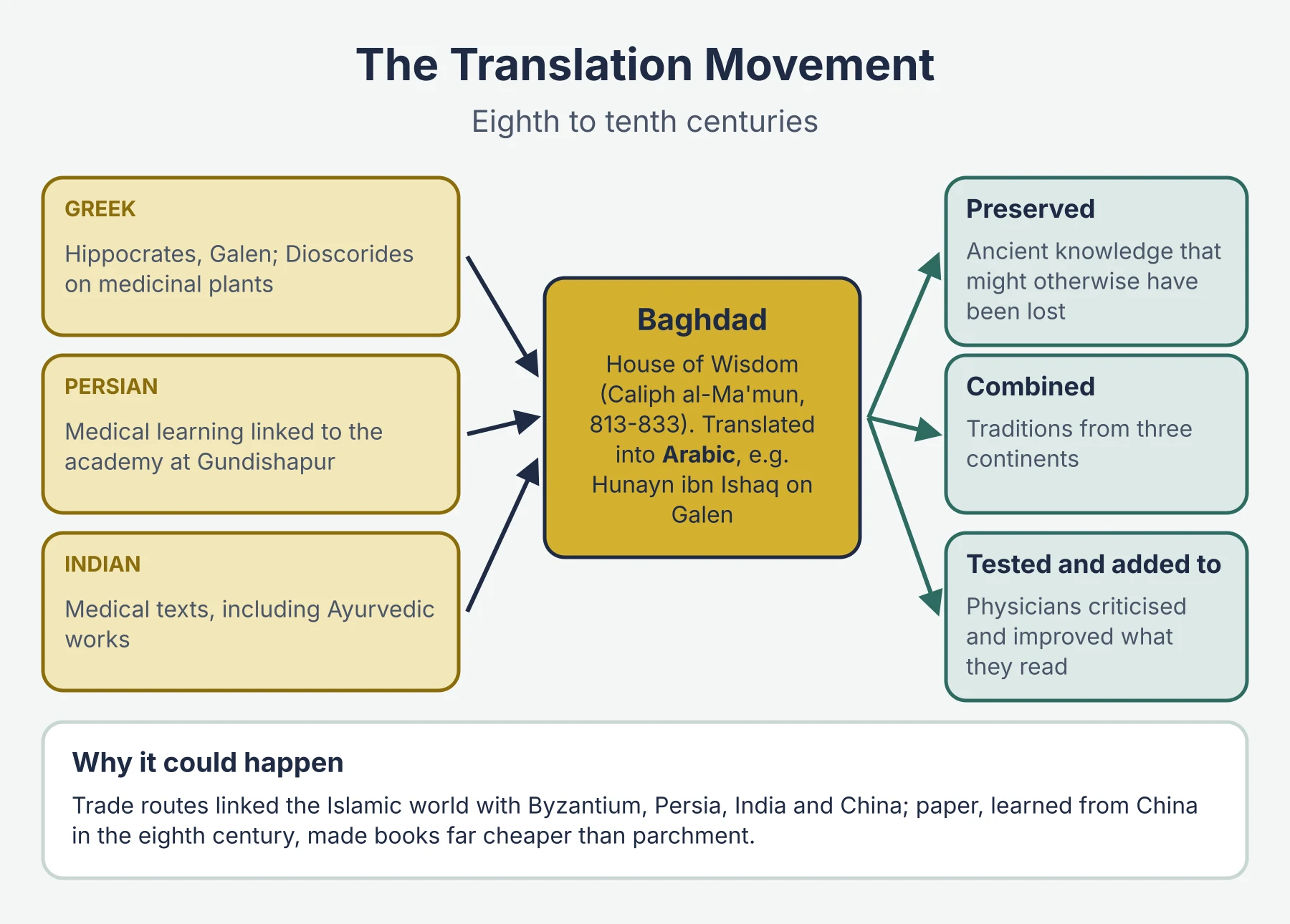
Between the eighth and tenth centuries scholars in Baghdad translated large numbers of works into Arabic:
- Greek medicine and science, including the works of Hippocrates and Galen, and Dioscorides on medicinal plants;
- Persian medical learning, associated with the academy at Gundishapur;
- Indian medical texts, including Ayurvedic works.
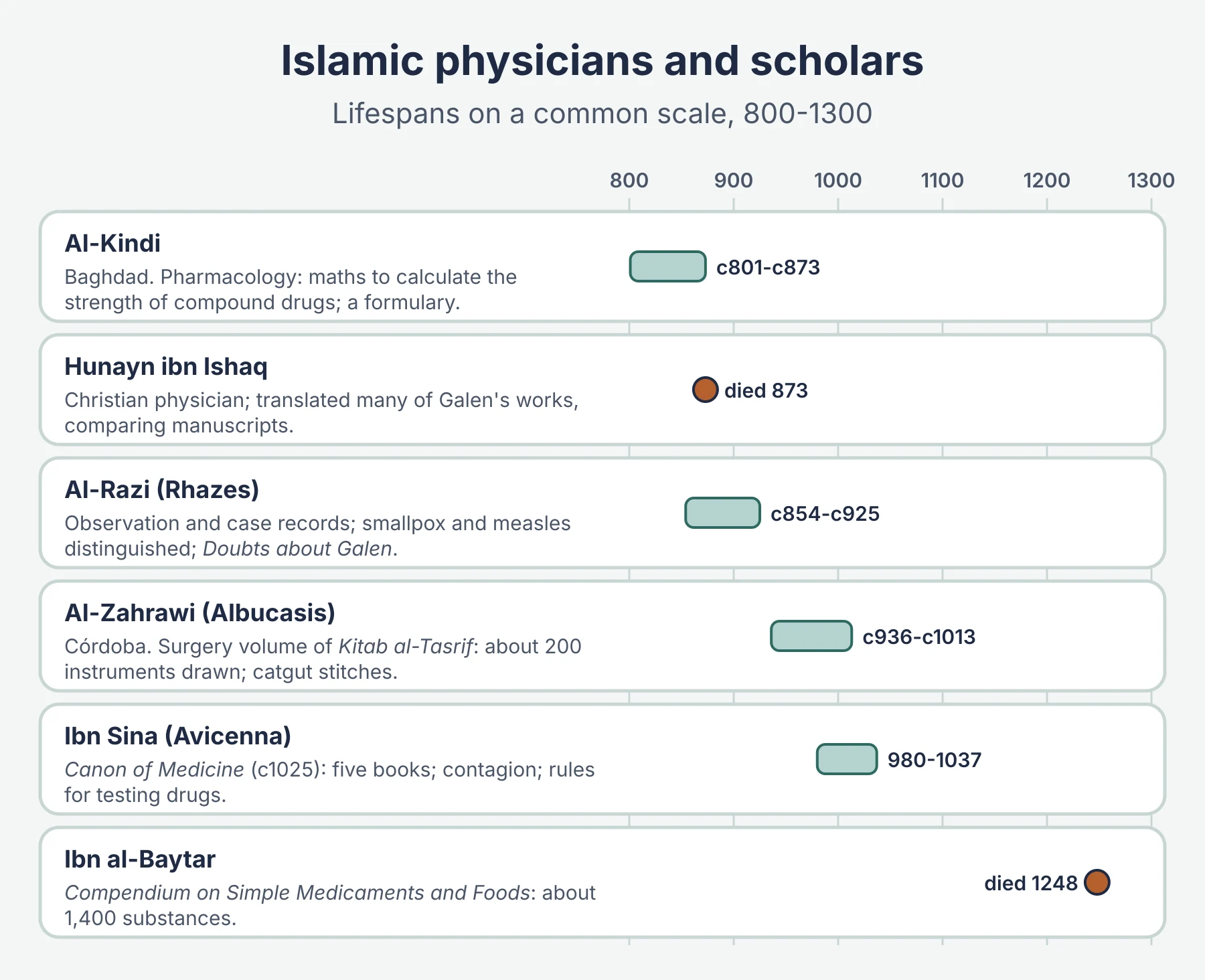
The House of Wisdom in Baghdad, associated especially with the Caliph al-Ma’mun (ruled 813-833), became a centre of translation and research. Hunayn ibn Ishaq (died 873), a Christian physician, translated many of Galen’s works, comparing manuscripts to produce accurate versions. Translators often worked for patrons who paid well for books.
The movement preserved ancient knowledge that might otherwise have been lost and combined traditions from three continents. Physicians did not simply copy: they tested, criticised and added to what they read.
Universities and centres of learning
Learning was supported by mosques, libraries, hospitals and wealthy patrons. Among the oldest continuously operating places of learning are al-Qarawiyyin in Fez, founded in 859 by Fatima al-Fihri, and al-Azhar in Cairo, founded in the 970s. Medicine was often taught through apprenticeship and in hospitals, where students watched experienced physicians examine patients. Large libraries in Baghdad, Cairo and Córdoba held medical texts for study.
Physicians: ethics and knowledge
Ethics. Physicians were expected to be learned, honest and compassionate, and to treat rich and poor alike. A ninth-century book, Practical Ethics of the Physician by al-Ruhawi, set out the duties of the doctor. In 931 the caliph in Baghdad ordered that physicians should be examined before being allowed to practise, an early form of licensing.
Al-Razi (c854-c925), known in Europe as Rhazes, directed hospitals in Rayy and Baghdad. He stressed careful observation of patients and recording of cases. His treatise on smallpox and measles was the first to distinguish clearly between the two diseases. He wrote Doubts about Galen, showing a willingness to question the greatest ancient authority when observation disagreed with it, and his huge medical notebook was compiled after his death as The Comprehensive Book. He also wrote a guide for people who could not reach a doctor.
Ibn Sina (980-1037), known in Europe as Avicenna, was a physician and philosopher from Bukhara. His Canon of Medicine, completed around 1025, organised the medical knowledge of Greek, Islamic and other traditions into five books covering the body, diseases, treatments and drugs. It discussed the spread of disease by contagion and set out rules for testing whether a drug worked. The Canon became a standard textbook in the Islamic world and, after its Latin translation, in European universities for centuries.
Hospitals: bimaristans
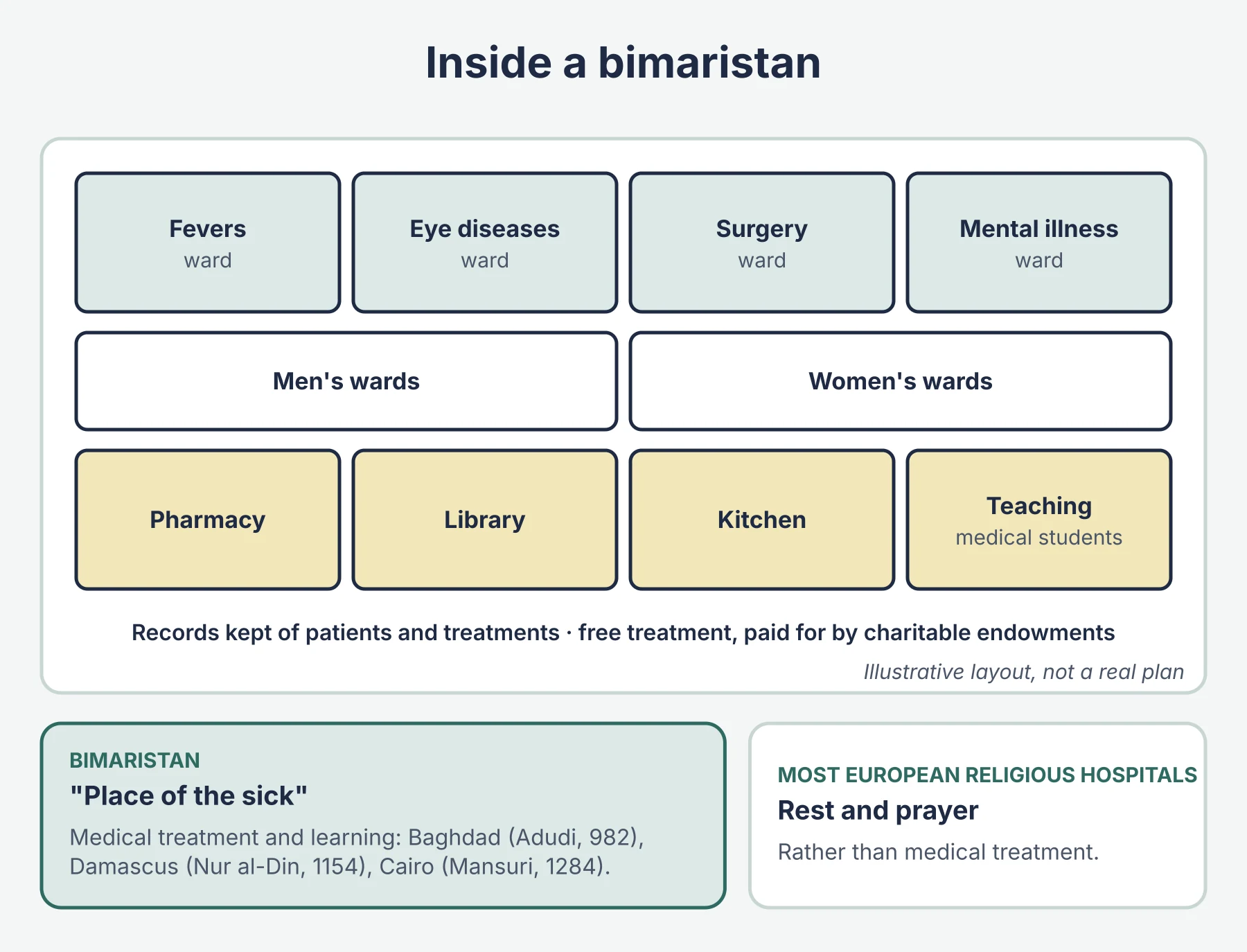
The word bimaristan comes from Persian words meaning “place of the sick”. Large hospitals were founded in cities including Baghdad (the Adudi hospital, 982), Damascus (the hospital of Nur al-Din, 1154) and Cairo (the Mansuri hospital, 1284). Their features included:
- free treatment for patients regardless of wealth or religion, paid for by charitable endowments;
- separate wards for men and women and for different conditions, such as fevers, eye diseases, surgery and mental illness;
- pharmacies, libraries and kitchens;
- teaching of medical students;
- records of patients and treatments.
Bimaristans were centres of both care and learning, very different from most religious hospitals in Europe at the time, which offered rest and prayer rather than medical treatment.
Surgery: Al-Zahrawi
Al-Zahrawi (c936-1013), known in Europe as Albucasis, worked in Córdoba. His encyclopaedia, Kitab al-Tasrif (The Method of Medicine), ended with a volume on surgery that described operations and included drawings of around two hundred surgical instruments, many of his own design. He wrote on cauterisation to stop bleeding, tying blood vessels, stitching wounds (including the use of catgut), setting bones, removing bladder stones, dentistry and childbirth. Its Latin translation influenced European surgeons for centuries.
Public health, hygiene, water and sanitation
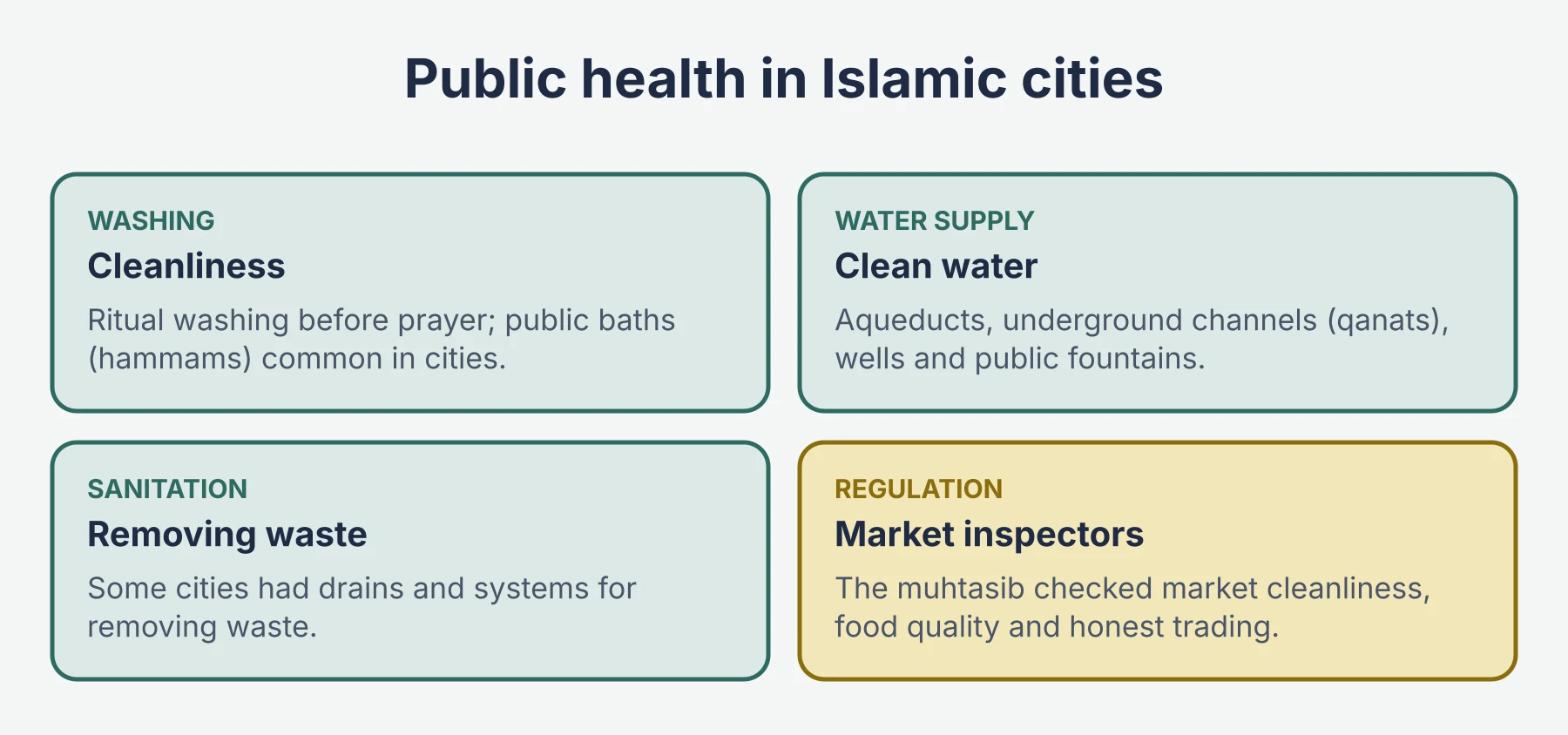
- Washing. Ritual washing before prayer encouraged regular cleanliness, and public baths (hammams) were common in cities.
- Water supply. Aqueducts, underground channels (qanats), wells and public fountains supplied towns.
- Sanitation. Some cities had drains and systems for removing waste.
- Regulation. Market inspectors (muhtasib) checked the cleanliness of markets, the quality of food and the honesty of traders.
Pharmacology
Pharmacy became a separate profession, and pharmacists were inspected.
Al-Kindi (c801-873), a philosopher in Baghdad, applied mathematics to medicine, attempting to calculate the strength of compound drugs from the strengths of their ingredients; he also compiled a formulary of medicines.
Ibn al-Baytar (died 1248), born near Málaga in al-Andalus, travelled across North Africa and the Middle East studying plants and worked in Cairo and Damascus. His Compendium on Simple Medicaments and Foods described about 1,400 substances, including many not recorded before, and their uses.
Contribution to medicine in Europe and Asia
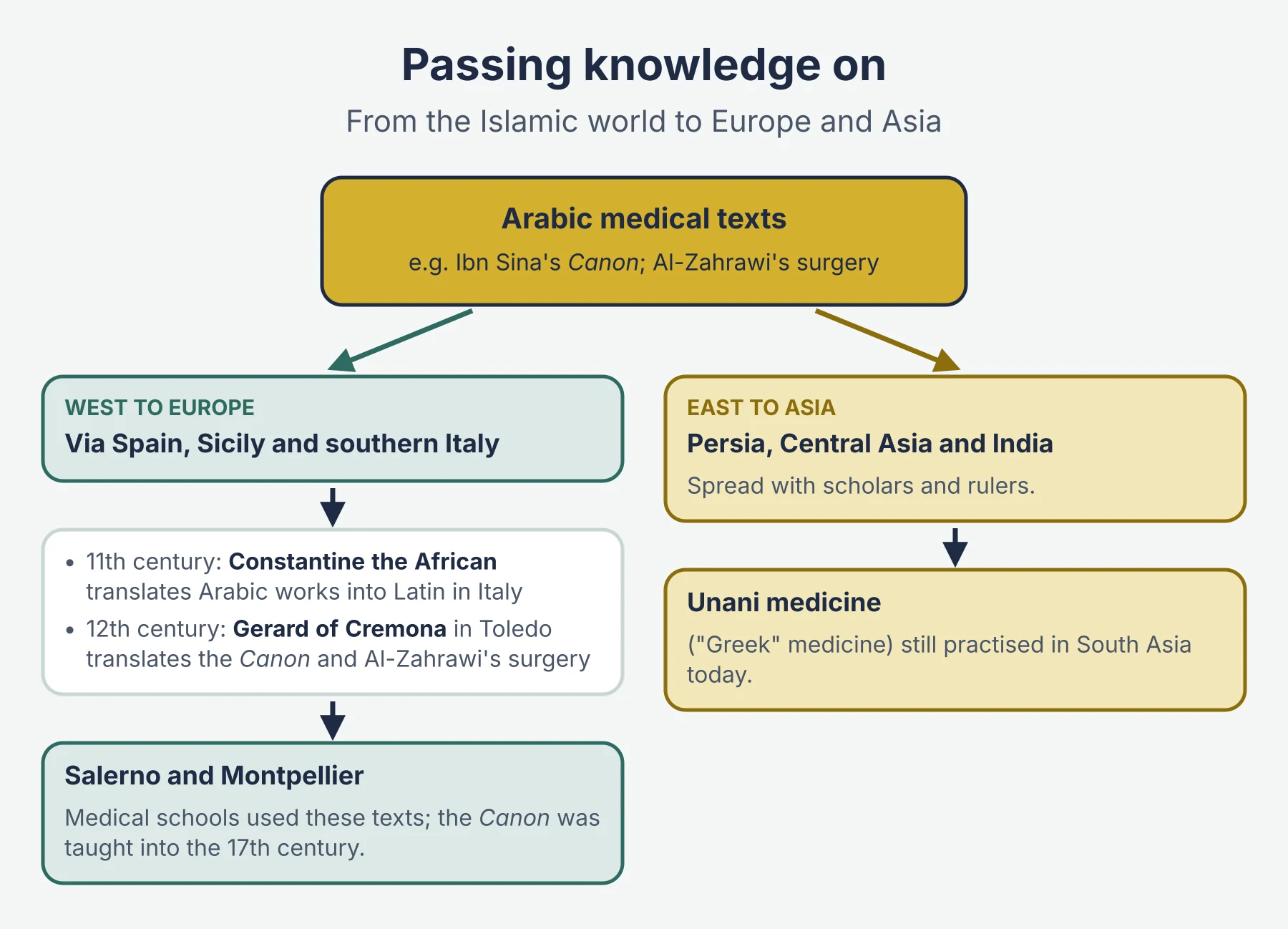
Europe. Arabic texts reached Europe through Spain, Sicily and southern Italy. In the eleventh century Constantine the African translated Arabic medical works into Latin in Italy, and in the twelfth century Gerard of Cremona in Toledo translated the Canon and Al-Zahrawi’s surgery. Medical schools such as Salerno and Montpellier used these texts, and the Canon remained part of university teaching into the seventeenth century.
Asia. The tradition spread east with scholars and rulers to Persia, Central Asia and India, where it developed into Unani medicine (“Greek” medicine), still practised in South Asia today.
Worked example: a 6-mark answer
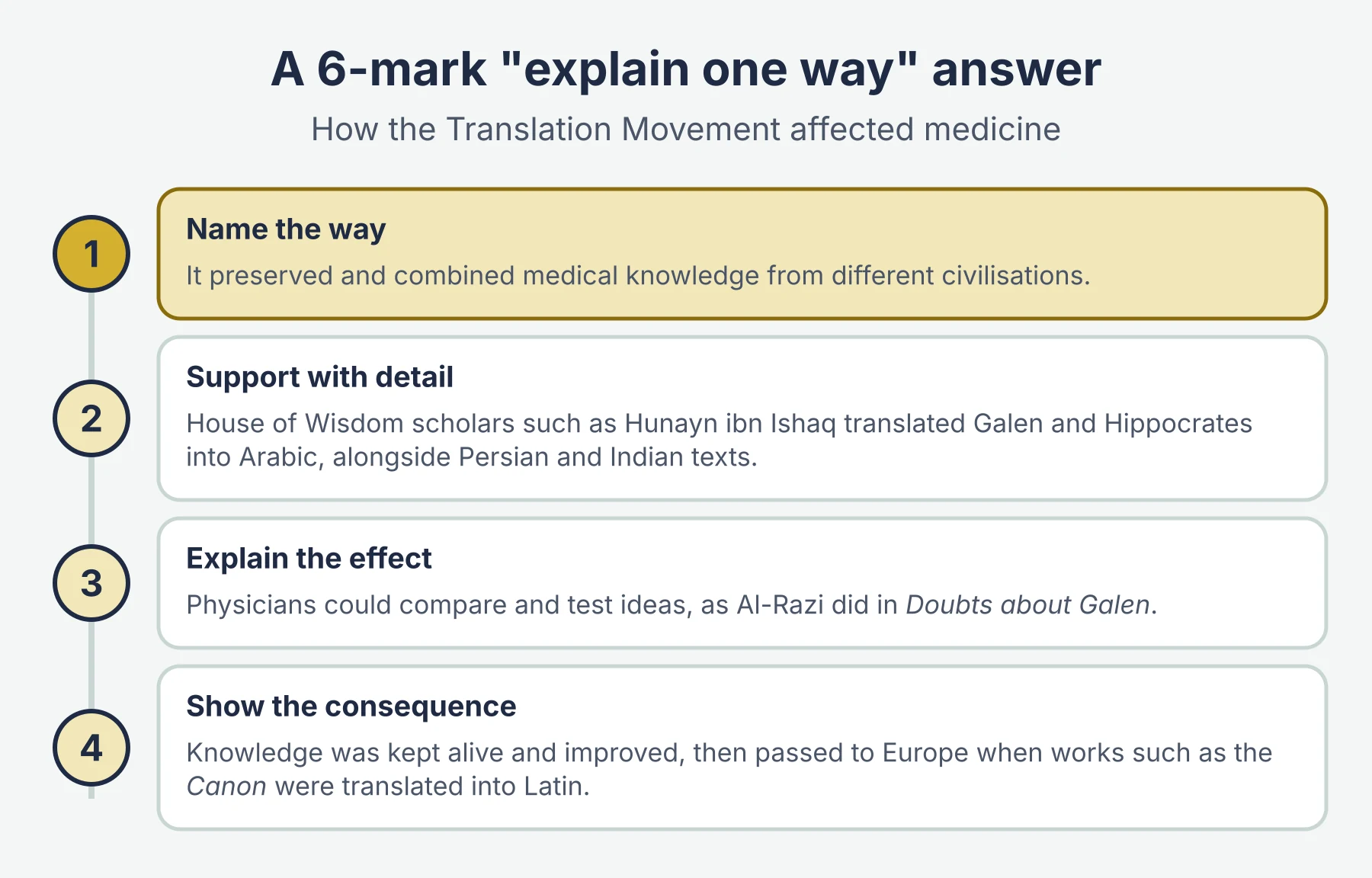
Explain one way in which the Translation Movement affected medicine. [6]
One way was that it preserved and combined medical knowledge from different civilisations. In Baghdad, scholars at the House of Wisdom, such as Hunayn ibn Ishaq, translated the works of Galen and Hippocrates into Arabic, alongside Persian and Indian texts. This meant that physicians had access to a wider range of knowledge than any single tradition offered, so they could compare and test ideas, as Al-Razi did when he wrote Doubts about Galen. As a result, the knowledge was not only kept alive but improved, and it later passed to Europe when Arabic works such as Ibn Sina’s Canon were translated into Latin.
Common mistakes
- Describing Islamic physicians as only copying the Greeks: they observed, questioned and added.
- Confusing Al-Razi (smallpox and measles) with Ibn Sina (the Canon).
- Leaving out pharmacology or public health, both named in the specification.
- Treating Islamic medicine as separate from later European medicine, instead of explaining how it passed on.
- Using vague statements (“they had good hospitals”) instead of precise features.
Further practice
- Medieval Islamic medicine revision notes
- Medieval Islamic medicine practice questions
- Paper 2 Section B practice
Specification
OxfordAQA International GCSE History (9245) specification, Version 1.1, Medicine and change, c800-present day – oxfordaqa.com.
Related resources
-
Practice questions
OxfordAQA International GCSE History (9245): Medieval Islamic Medicine – Practice Questions
Eleven original 9245 Medicine and change questions on medieval Islamic medicine, from 3-mark recall to 12-mark judgements, with point-by-point marking guides.
World History · OxfordAQA · IGCSE
Try questions -
Revision notes
OxfordAQA International GCSE History (9245): Medieval Islamic Medicine – Revision Notes
Revision notes for 9245 medieval Islamic medicine: translators, Al-Razi, Ibn Sina, bimaristans, Al-Zahrawi, public health, Al-Kindi, Ibn al-Baytar and legacy.
World History · OxfordAQA · IGCSE
Revise topic -
Study guides
OxfordAQA International GCSE History (9245): Post-war Germany, 1945-49
Life in Germany 1945-49 for 9245 Paper 2: refugees, expulsions, zones, denazification, Nuremberg, Soviet reparations, Marshall Aid, the Blockade and two states.
World History · OxfordAQA · IGCSE
Read guide
Get free revision emails (optional)
Occasional emails with practice questions, worked explanations and links to free resources for the qualification and subjects you choose. No spam, and you can unsubscribe from any email. The free tools on this site never need an email.