
Study Guides
OxfordAQA International GCSE History (9245): Post-war Germany, 1945-49
Life in Germany 1945-49 for 9245 Paper 2: refugees, expulsions, zones, denazification, Nuremberg, Soviet reparations, Marshall Aid, the Blockade and two states.
- Subject
- World History
- Level
- IGCSE
- Topic
- Paper 2 – Studies in Change
- Author
- Marlbridge Academic Team
- Updated
- Reviewed by
- Azam Siddique (what this means)
Aligned to OxfordAQA IGCSE World History (9245), Version 1.1. Official specification .
Syllabus page (what it covers and how it is assessed): OxfordAQA IGCSE World History.
Syllabus points this page covers
9245
- 3.2.1 Section A – Societies in change
- 3.2.1.1 Life in Germany, 1919-1949
Found an error? Report a correction.
Need help with this topic? Request a free trial class for IGCSE World History (9245).
This guide covers the final part of the Section A option Life in Germany, 1919-1949: “Post Second World War Germany, 1945-49”. The specification names “Peoples’ problems at the end of the Second World [War]: refugees, living conditions and forced labour; Allied control and the division of Germany; Denazification and the Nuremberg Trials; the expulsions of ethnic Germans; penalties imposed on the Soviet zone and sector, including reparations” and “The impact of the Cold War on Germany: the Marshall Plan and [its] impact; life for Berliners during the Berlin Blockade; the creation of the Federal Republic and GDR.” The Paper 2 Section A study guide covers this part in one paragraph; this page explains how these developments affected people’s lives, which is the focus of the whole option.
Germany in 1945
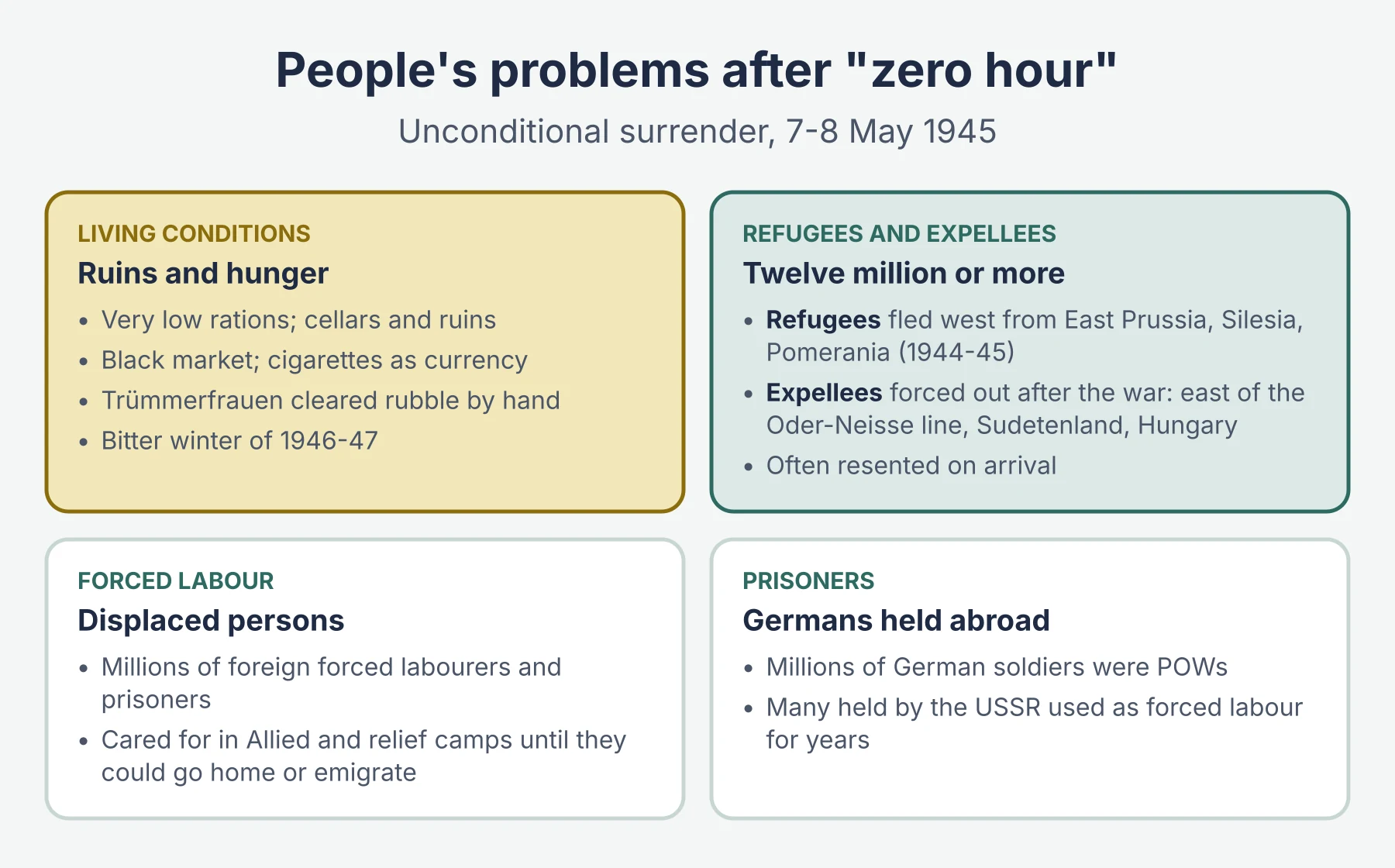
Germany surrendered unconditionally on 7-8 May 1945. Many Germans later called the moment Stunde Null, “zero hour”. Cities such as Berlin, Hamburg, Cologne and Dresden had been devastated by bombing and fighting; millions of homes were destroyed or damaged; transport, gas, water and electricity supplies had broken down. There was no German government: the Allies took supreme authority.
People’s problems
Living conditions. Food was rationed at very low levels, and many city dwellers lived in cellars and ruins. People travelled to the countryside to swap possessions for food, and a black market flourished, with cigarettes often used as currency because the Reichsmark had little value. Women, who greatly outnumbered men because so many men had been killed or were prisoners of war, cleared rubble by hand; they became known as Trümmerfrauen, “rubble women”. The bitterly cold winter of 1946-47 brought hunger and deaths from cold.
Refugees and expulsions. As the Red Army advanced in 1944-45, millions of Germans fled west from East Prussia, Silesia and Pomerania. After the war, Germans were expelled from the lands given to Poland east of the Oder-Neisse line, and from Czechoslovakia (the Sudetenland), Hungary and other countries. The Potsdam Conference (July-August 1945) approved the transfers, calling for them to be “orderly and humane”, but many expulsions were violent, and many died. Estimates of those who fled or were expelled commonly run to twelve million or more. Expellees arrived with nothing in a country short of housing and food, and were often resented by local people.
Forced labour. In 1945 Germany held millions of foreign forced labourers and prisoners brought from occupied Europe. They became displaced persons, cared for in camps by the Allies and international relief organisations until they could return home or emigrate. At the same time, millions of German soldiers were prisoners of war; many held by the USSR were used as forced labour for years, and some ethnic Germans were deported to the USSR to work.
Allied control and the division of Germany
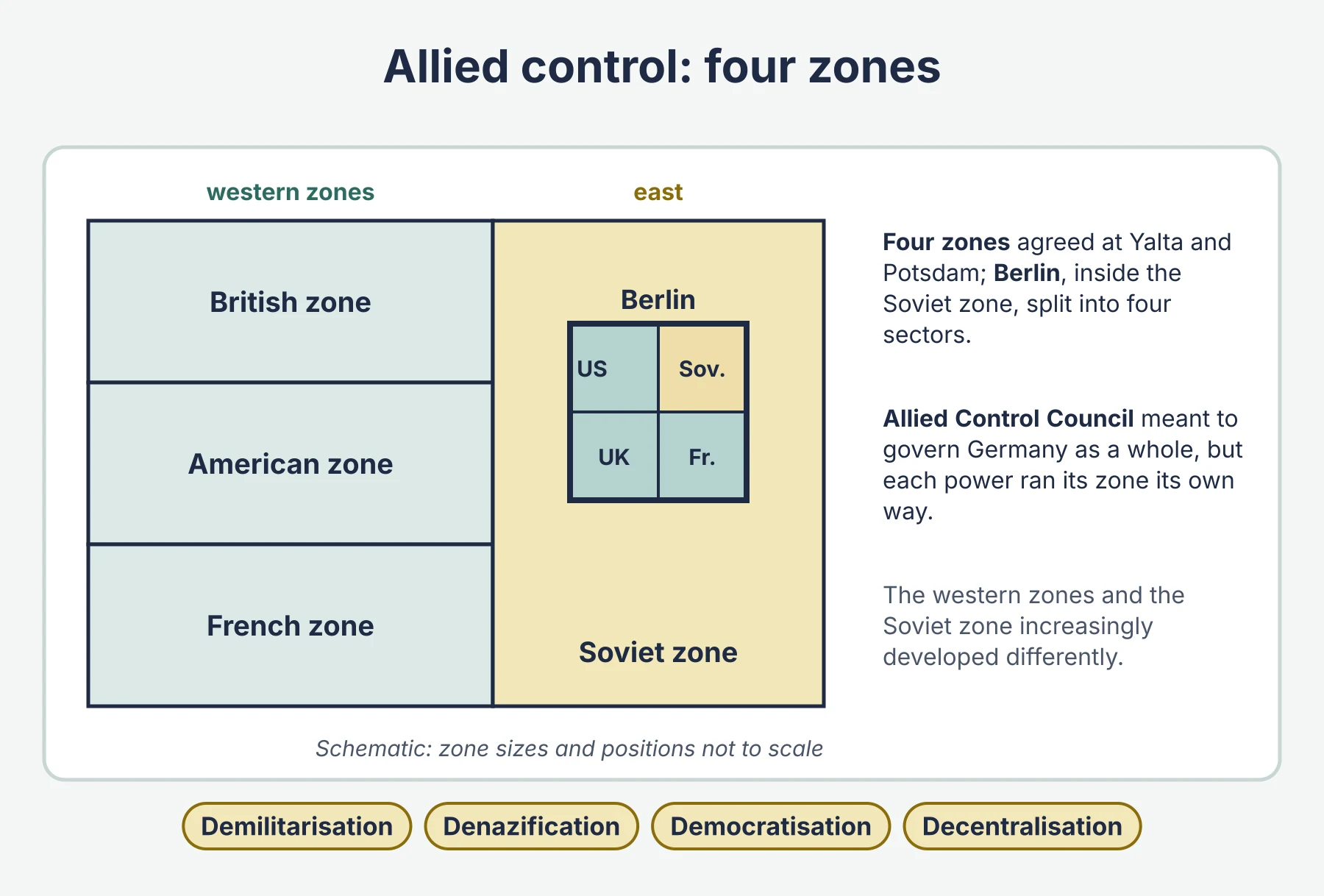
At Yalta and Potsdam the Allies agreed to divide Germany into four zones, American, British, French and Soviet, and Berlin, inside the Soviet zone, into four sectors. An Allied Control Council was meant to govern Germany as a whole, but each power ran its zone in its own way. The aims agreed at Potsdam included demilitarisation, denazification, democratisation and decentralisation. Increasingly, the western zones and the Soviet zone developed differently.
Denazification and the Nuremberg Trials
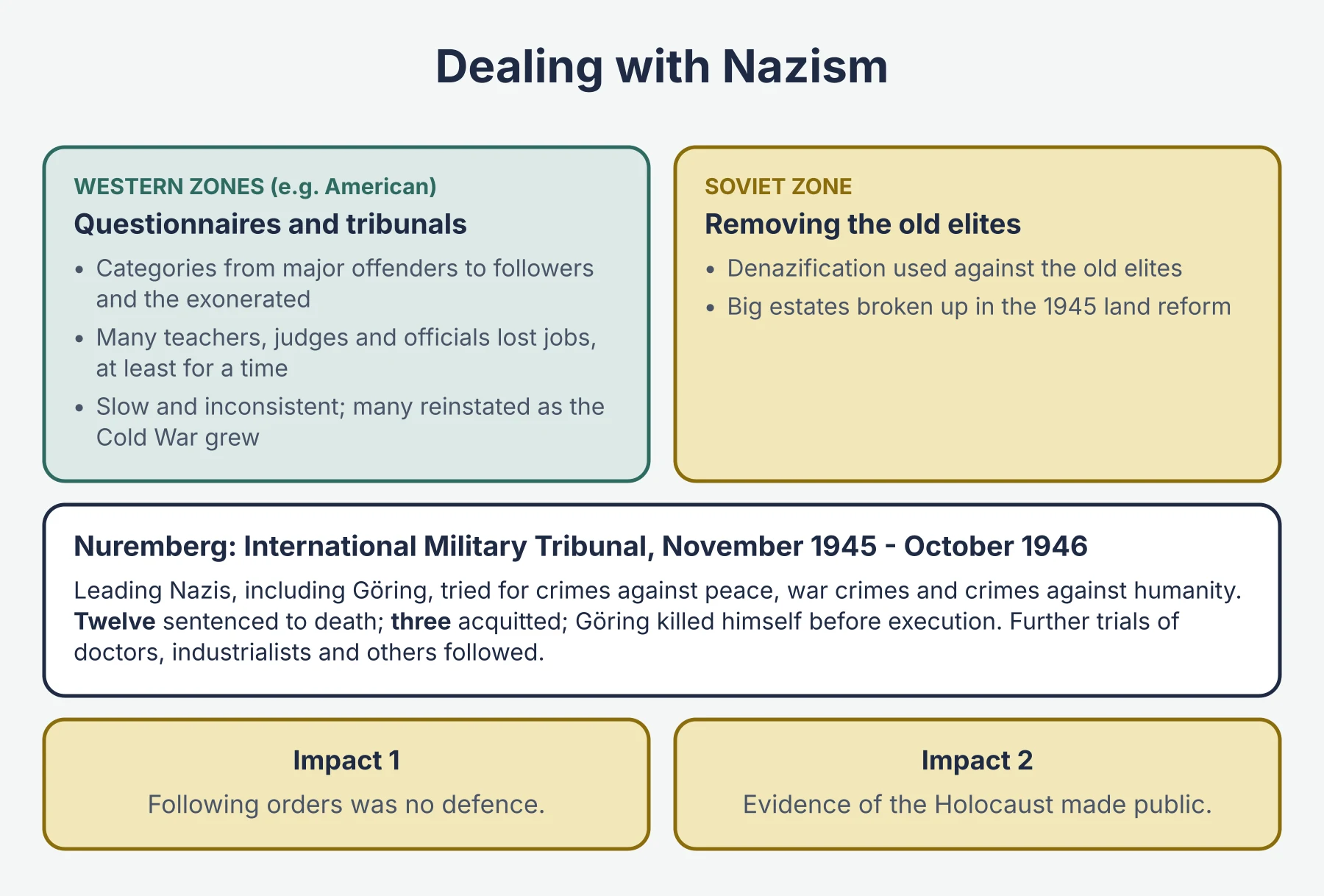
Denazification aimed to remove Nazis from public life. In the American zone, adults completed long questionnaires about their past; tribunals placed people in categories ranging from major offenders to followers and the exonerated. Many teachers, judges and officials lost their jobs, at least for a time. The process was slow and inconsistent; as the Cold War grew, the western Allies needed experienced administrators, and many former Nazis returned to work. In the Soviet zone denazification was used to remove the old elites, and big estates were broken up in a land reform of 1945.
At Nuremberg, the International Military Tribunal (November 1945 to October 1946) tried leading Nazis, including Hermann Göring, for crimes against peace, war crimes and crimes against humanity. Twelve were sentenced to death, and three were acquitted; Göring killed himself before his execution. Further trials of doctors, industrialists and others followed. The trials established the principle that following orders was no defence, and made public evidence of the Holocaust.
Penalties on the Soviet zone
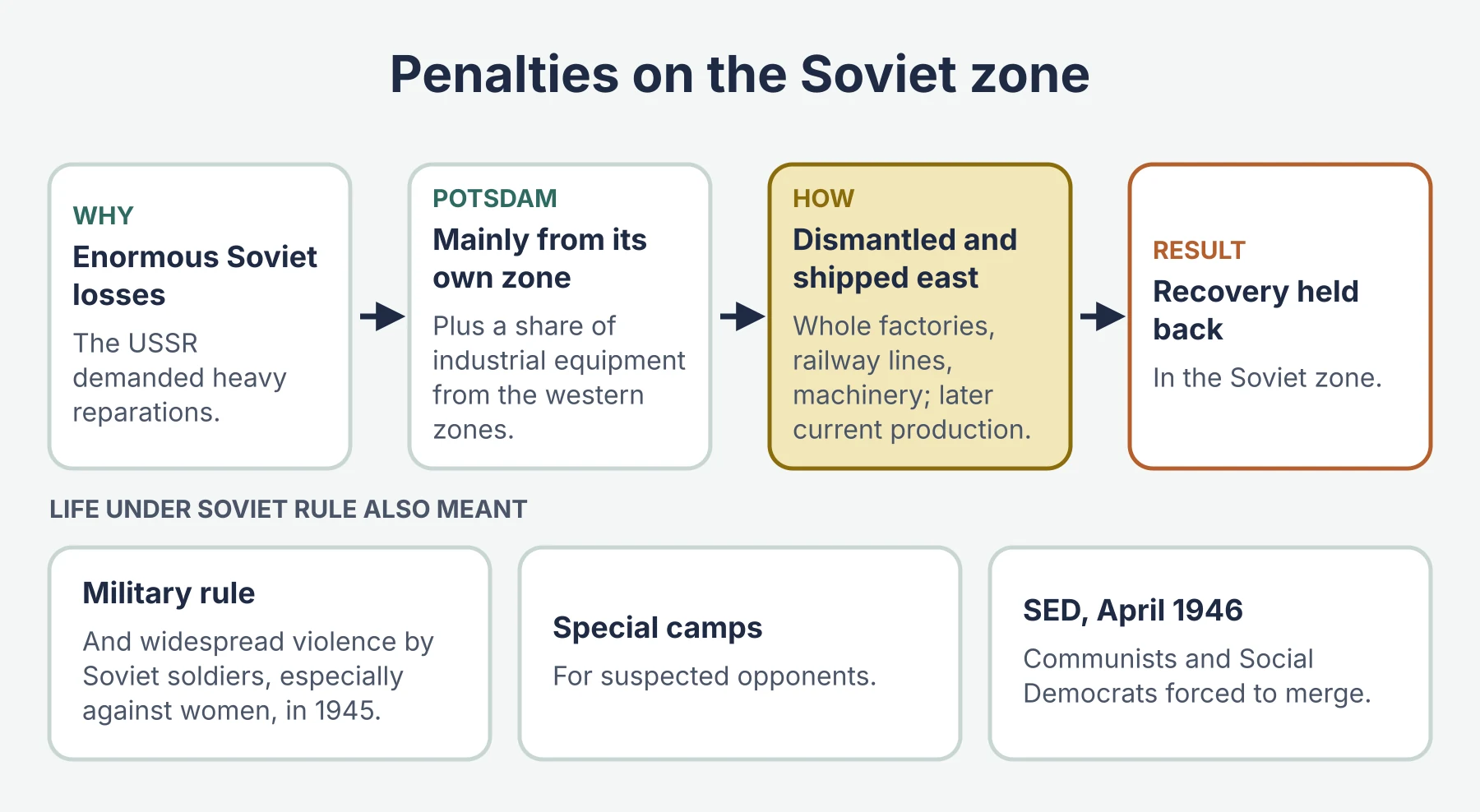
The USSR had suffered enormous destruction and demanded heavy reparations. At Potsdam it was allowed to take reparations mainly from its own zone, plus a share of industrial equipment from the western zones. Whole factories, railway lines and machinery were dismantled and shipped east; later, reparations were also taken from current production. This held back recovery in the Soviet zone. People there also faced Soviet military rule, widespread violence by Soviet soldiers, especially against women, in 1945, special camps for suspected opponents, and the forced merger of the Communist and Social Democratic parties into the SED in April 1946.
The impact of the Cold War
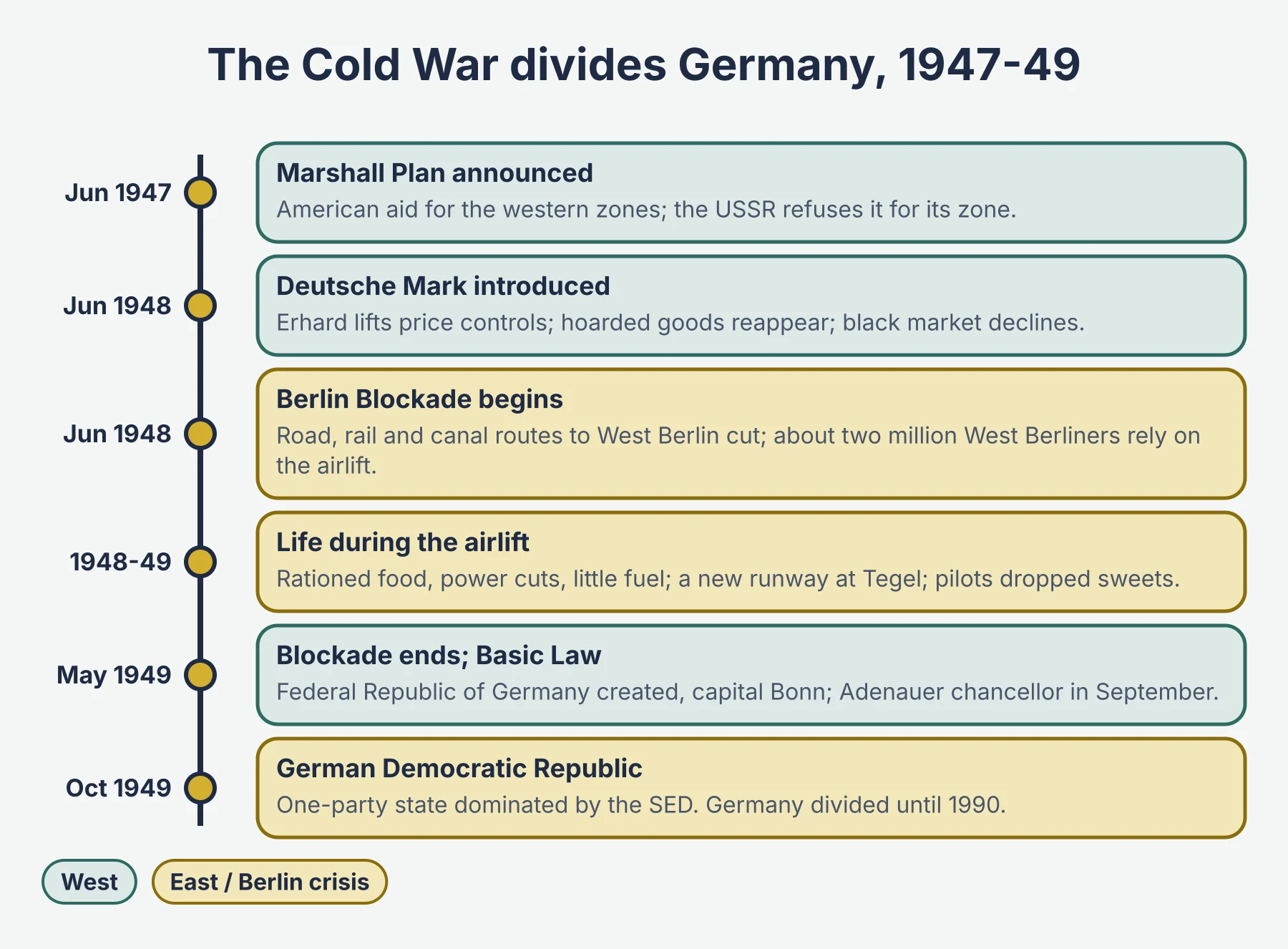
The Marshall Plan. Announced in June 1947, Marshall Aid offered American money to rebuild Europe. The western zones of Germany were included, while the USSR refused it for its zone. In June 1948 the western zones introduced a new currency, the Deutsche Mark, and the economist Ludwig Erhard lifted many price controls. Goods that had been hoarded reappeared in shops almost overnight, the black market declined and recovery began, laying the foundations of West Germany’s later “economic miracle”.
Life for Berliners during the Blockade. In response to the new currency, Stalin cut road, rail and canal routes to West Berlin from June 1948. About two million West Berliners depended on the airlift by American and British aircraft, which landed supplies around the clock for almost a year. Berliners lived with rationed food, power cuts and little fuel through the winter of 1948-49; many helped build a new runway at Tegel; and children watched for pilots who dropped sweets. The Blockade ended in May 1949. It made West Berliners see the Western powers as protectors rather than occupiers.
Two German states. In May 1949 the western zones adopted the Basic Law, creating the Federal Republic of Germany, with its capital at Bonn; Konrad Adenauer became its first chancellor in September. In October 1949 the Soviet zone became the German Democratic Republic (GDR), a one-party state dominated by the SED. Germany would remain divided until 1990.
How lives changed: east and west compared
| Aspect | Western zones / Federal Republic | Soviet zone / GDR |
|---|---|---|
| Economy | Marshall Aid; Deutsche Mark; recovery from 1948 | Dismantling and reparations; slower recovery |
| Politics | Multi-party democracy; Basic Law | SED dominance; one-party state |
| Denazification | Questionnaires and tribunals; many later reinstated | Used to remove old elites; land reform |
| Berlin | West Berliners supplied by the airlift | East Berlin under Soviet control |
Worked example: a 9-mark answer
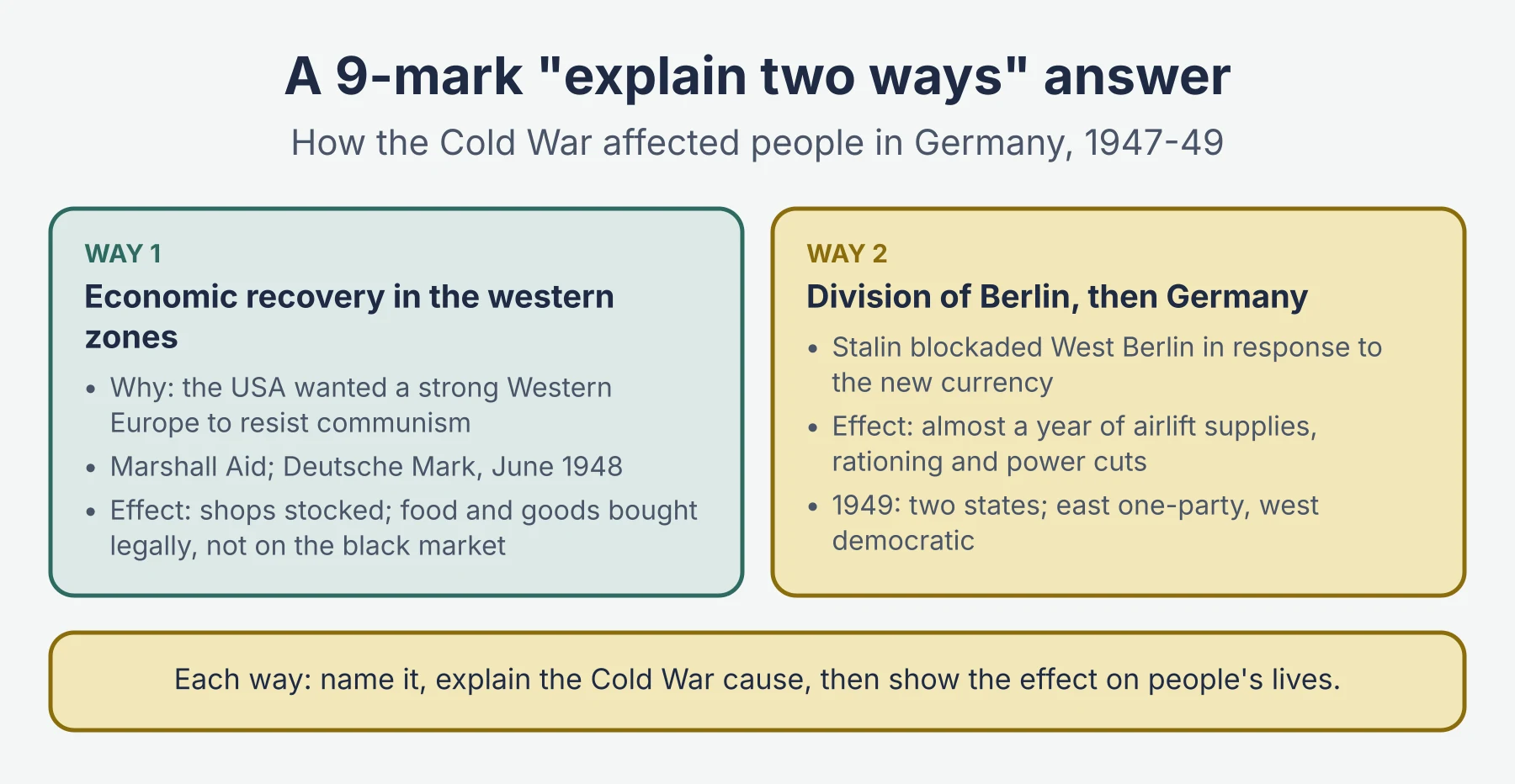
Explain two ways in which the Cold War affected the lives of people in Germany in the years 1947-49. [9]
First, it brought economic recovery to the western zones. Because the USA wanted a strong Western Europe to resist communism, the western zones received Marshall Aid, and in June 1948 the Deutsche Mark replaced the almost worthless Reichsmark. Shops that had been empty were suddenly stocked, so people could buy food and goods legally instead of relying on the black market.
Second, it divided Berliners and then Germany. Stalin answered the new currency by blockading West Berlin, so for almost a year West Berliners lived on food and coal brought in by air, with rationing and power cuts. The crisis made the division permanent: in 1949 two states were created, so Germans in the east lived under a communist one-party state while those in the west lived in a democracy.
Common mistakes
- Treating 1945-49 as an afterthought: it is a full part of the option.
- Confusing refugees (who fled) with expellees (forced out after the war).
- Saying Germany was divided into two zones in 1945; there were four.
- Describing the Nuremberg Trials without explaining their impact.
- Forgetting the Soviet zone’s reparations, which the specification names.
Further practice
Specification
OxfordAQA International GCSE History (9245) specification, Version 1.1, section 3.2.1.1 – oxfordaqa.com.
Related resources
-
Practice questions
OxfordAQA International GCSE History (9245): Post-war Germany, 1945-49 – Practice Questions
Twelve original 9245 Paper 2 questions on Germany 1945-49, from 3-mark recall to 12-mark judgements on expulsions, denazification, the Blockade and division.
World History · OxfordAQA · IGCSE
Try questions -
Revision notes
OxfordAQA International GCSE History (9245): Post-war Germany, 1945-49 – Revision Notes
Revision notes for 9245 Life in Germany, 1945-49: zero hour, expulsions, zones, denazification, Nuremberg, reparations, the Blockade and two states.
World History · OxfordAQA · IGCSE
Revise topic -
Study guides
OxfordAQA International GCSE History (9245): The Printing Revolution, c1440-c1800
The Printing Revolution for 9245 Technology and change: Asian printing, Gutenberg, the book trade, vernaculars, copyright, Reformation, literacy and science.
World History · OxfordAQA · IGCSE
Read guide
Get free revision emails (optional)
Occasional emails with practice questions, worked explanations and links to free resources for the qualification and subjects you choose. No spam, and you can unsubscribe from any email. The free tools on this site never need an email.